ECU AUDI A5 CABRIOLET 2011 Owner's Manual
[x] Cancel search | Manufacturer: AUDI, Model Year: 2011, Model line: A5 CABRIOLET, Model: AUDI A5 CABRIOLET 2011Pages: 364, PDF Size: 86.48 MB
Page 194 of 364
___ s_a_ f_ e_ t_ y _ b_e _l_t _s ___________________________________________ _
Safety be lts attach passe ngers to t he car an d give th em the benef it of
b ei ng s lo we d d own mor e gentl y or "so ftly" throu gh th e "give" in the
sa fety bel ts, crush z ones a nd oth er safety feat ures engin eered in to
today 's vehicles . By "absor bing" the kinetic e ner gy over a lo ng er
p eriod of time, th e saf ety belts make the forces o n th e body mor e
"to lerable" and less likely to ca use inju ry .
Alt hou gh the se ex amp les a re based on a fr ontal col lis ion, safety bel ts
can a lso s ubstantially red uce the risk of in jur y in other ki nds of
cras hes. So , whe ther you 're o n a long tri p o r ju st go in g to th e co rner
sto re, a lways b uckle up a nd make sure others do, too. Accident statis
t ics s how t hat vehi cle occupan ts properly wea rin g safety belts have a
lower risk of bei ng in jured and a muc h better cha nce of s urvivi ng an
acc ident. Properly usi ng safety belts also greatly increases the ability
of the supp lemental a irbags to do t heir job in a co llisio n. For this
reason, wea ring a safety belt is lega lly re quir ed in most countries
including muc h of th e Uni ted Stat es and Canad a.
Altho ugh your Audi is equipped with a irbags, yo u still have to wear
t he s afety bel ts provi ded. Fr ont airba gs, for ex ample, are activ ated
only in some fro nta l collisions . T he front a irbags are not activated in
all fr ont al collis ions, in side and re ar co llisions, in ro ll overs or in cases
w her e th er e is no t enough d ecelerat io n t hroug h im pac t to th e fron t
o f th e ve hicle. T he same goes for the ot he r air bag sys tems in yo ur
Audi. So, always wear your saf ety be lt and make sure eve rybody in
your vehicle is properly restrai ned! •
Important safety instructions about safety
belts
S afety bel ts m ust alw ays b e co rre ctly po sitio ned a cross
t he str ongest bones o f your bo dy.
- Al ways we ar saf ety be lts as illustra te d an d descri bed i n
this c hapter.
- M ake sure that your s afet y be lts are alw ays re a dy f or use
a nd a re n ot d amaged .
& WARNING
Not wearing safety belts or wearing them improperly increases
the risk of serious personal injury and death. Safety belts can work only when used correctly.
• Always fasten your safety belts correctly before driving off and
make sure all passengers are correctly restrained.
• For maximum protection , safety belts must always be posi
tioned properly on the body.
• Never strap more than one person, including small children,
into any belt.
• Never place a safety belt over a child sitting on your lap.
• Always keep feet in the footwell in front of the seat while the
vehicle is being driven.
• Never let any person ride with their feet on the instrument
panel or sticking out the window or on the seat.
• Never remove a safety belt while the vehicle is moving. Doing
so will increase your risk of being injured or killed.
• Never wear belt s twisted .
• Never wear belts over rigid or breakable objects in or on your
clothing, such as eye glasses, pens, keys, etc., as these may cause
injury .
• Never allow safety belts to become damaged by being caught
in door or seat hardware.
• Do not wear the shoulder part of the belt under your arm or
otherwise out of position.
• Several layers of heavy clothing may interfere with correct
positioning of belts and reduce the overall effectiveness of the
system .
• Always keep belt buckles free of anything that may prevent the
buckle from latching securely . .._
Page 196 of 364
-Safety belts ----------------
Fastening safety
belts
Seat first -everybody buc kle up!
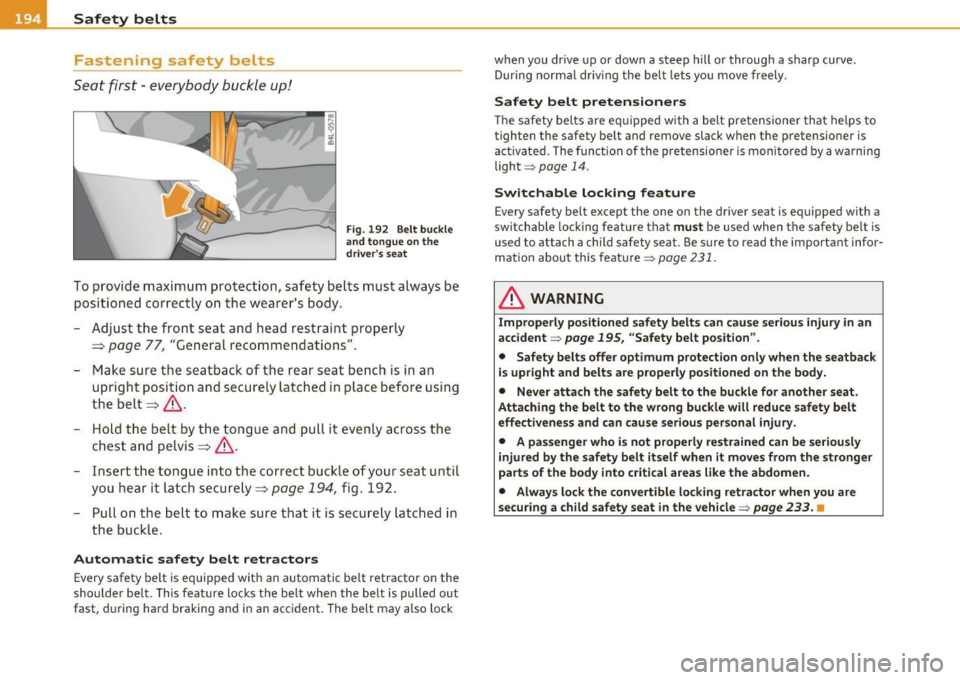
Fig. 192 Bel t buckl e
a n d ton gue on the
d riv er's se at
To provide maximum protection, safety belts must always be
posit ioned cor rectly on the wearer's body.
- Adjust the front seat and head restraint properly
=>
page 77, "General recommendat ions" .
- Make sure the seatbac k of the rear seat bench is in a n
upright posit ion and securely latched in place before using
the belt=> &.
- Hold the belt by the to ng ue and pu ll it evenly across t he
chest a nd pe lvis=> &.
- Insert the tongue into the corre ct buckle of your seat until
you hea r it latch secu re ly =>
page 194, fig. 192.
- Pull on the be lt to make sure t hat it is secure ly latched i n
the buckle.
Automatic safety belt retractor s
Every safety belt is equipped with an automatic be lt retractor on the
shoulder be lt . This feat ure locks the be lt when the belt is pulled out
fast, d uring hard braking and in an acc ident. The belt may also lock when you dr
ive up or down a steep hill or throug h a sharp curve .
Dur ing no rma l driv ing the be lt lets you move freely.
Safety belt pretensioners
The safety bel ts are eq uipped with a belt pretensioner tha t he lps to
tighten the safety be lt and remove slack when the pretensioner is
a cti vated. The fun ct ion of the pretensioner is mon itored by a w arning
light=>
page 14 .
Switchable locking feature
Every safety belt except the one on the driver seat is equ ipped with a
switchab le locking feature that
mu st be used when t he safety be lt i s
used to attach a chi ld safety seat. Be sure to read the important infor
mat ion abou t th is feat ure=>
page 231 .
& WARNING
Improperly po sitioned safety belts can cau se seriou s injury in an
accident
=> page 195 , "Safety belt position".
• Safety belts offer optimum protection only when the seatba ck
is upright and belts a re prope rly po sitioned on the body.
• Never attach the safety belt to the buckle f or another seat .
Attach ing the belt to the wrong buckle will reduce safet y belt
effectivenes s and can cau se seriou s personal injury.
• A passenger who i s not p rope rly restrained can be ser iousl y
injured by the safety belt it self wh en it move s from the stronger
parts of the body into critical areas like the abdomen.
• Always lock the convertible locking retractor when you are
s ecuring a child safety seat in the vehicle =>
page 233. •
Page 197 of 364
Safety belt position
Correct belt position is the key to getting maximum
protection from safety belts.
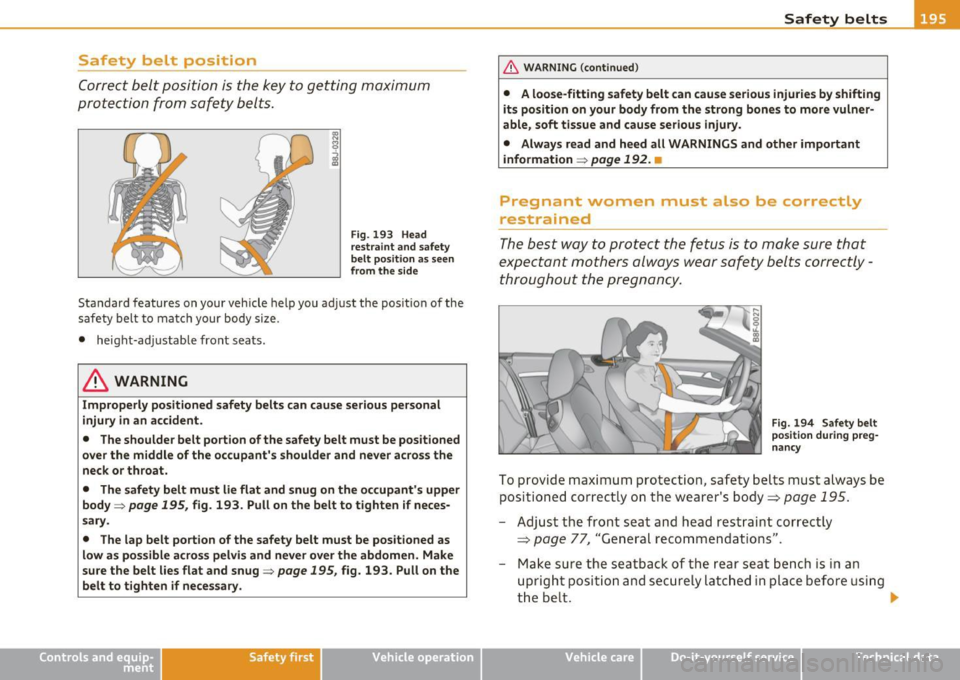
Fig. 193 Head
restraint and safety
belt pos ition as seen
from the side
Standard features on your vehicle help you adjust the position of the
safety belt to match your body size.
• height-adjustable front seats.
& WARNING
Improperly positioned safety belts can cause serious personal
injury in an accident.
• The shoulder belt portion of the safety belt must be positioned
over the middle of the occupant's shoulder and never across the
neck or throat.
• The safety belt must lie flat and snug on the occupant's upper
body =>
page 195, fig. 193. Pull on the belt to tighten if neces
sary.
• The lap belt portion of the safety belt must be positioned as
low as possible across pelvis and never over the abdomen. Make
sure the belt lies flat and snug=>
page 195, fig. 193. Pull on the
belt to tighten if necessary.
Safety first Vehicle OP-eration
Safety belts
& WARNING (continued)
• A loose-fitting safety belt can cause serious injuries by shifting
its position on your body from the strong bones to more vulner
able, soft tissue and cause serious injury.
• Always read and heed all WARNINGS and other important
information =>
page 192. •
Pregnant women must also be correctly
restrained
The best way to protect the fetus is to make sure that
expectant mothers always wear safety belts correctly -
throughout the pregnancy.
Fig. 194 Safety belt
position during preg·
nancy
To provide maximum protection, safety belts must always be positioned correctly on the wearer's body ===>
page 195.
- Adjust the front seat and head restraint correctly
===> page 77, "General recommendations".
- Make sure the seatback of the rear seat bench is in an
upright position and securely latched in place before using
the belt. •
I .
Vehicle care Do-it-yourselt service iTechnical data
Page 198 of 364
.. Safety belts PJWI _______________ _
-Hold the belt by the tongue and pull it evenly across the
chest and pelvis=> fig. 194, => & .
- Insert the tongue into the correct buckle of your seat until
you hear it latch securely=>
page 194, fig. 192.
- Pull on the belt to make sure that it is securely latched in
the buckle.
& WARNING
Improperly positioned safety belts can cause serious personal
injury in an accident.
• Expectant mothers must always wear the lap portion of the
safety belt as low as possible across the pelvis and below the
rounding of the abdomen.
• Always read and heed all WARNINGS and other important
information =:-
& in "Fastening safety belts" on page 194. •
Unfastening safety belts
Unbuckle the safety belt with the red release button only
after the vehicle has stopped.
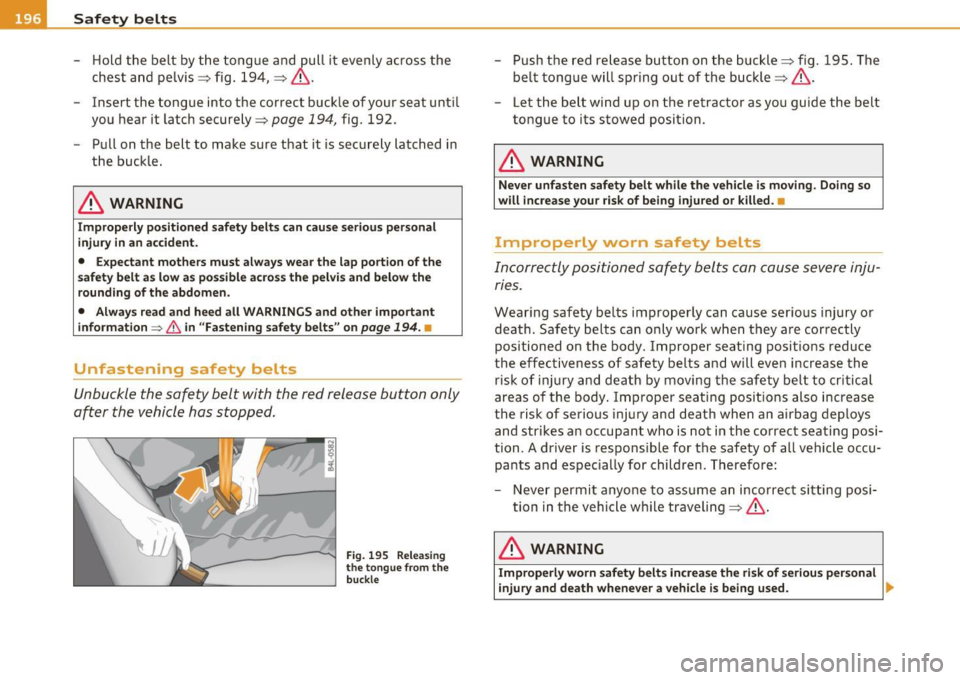
Fig. 195 Releasing
the tongue from the
buckle
-Push the red release button on the buckle=> fig. 195. The
belt tongue will spring out of the buckle=>& .
- Let the belt wind up on the retractor as you guide the belt
tongue to its stowed position .
& WARNING
Never unfasten safety belt while the vehicle is moving. Doing so
will increase your risk of being injured or killed.•
Improperly worn safety belts .
Incorrectly positioned safety belts can cause severe inju
ries.
Wearing safety belts improperly can cause serious injury or
death. Safety belts can only work when they are correctly
positioned on the body. Improper seating positions reduce
the effectiveness of safety belts and w ill even increase the
risk of injury and death by moving the safety belt to critical
areas of the body. Improper seating positions also increase
the risk of serious injury and death when an airbag deploys
and strikes an occupant who is not in the correct seating posi
tion. A driver is responsible for the safety of all vehicle occu
pants and especially for children . Therefore:
- Never permit anyone to assume an incorrect sitting posi
tion in the vehicle while traveling=>,& .
& WARNING
Improperly worn safety belts increase the risk of serious personal
injury and death whenever a vehicle is being used.
IJI,
Page 233 of 364
_______________________________________________ C_ h_ il_d _ S_a _ f_ e _ t..,. Y :...._ __
& WA RNING (c on tinued )
• Always make sure the lap belt portion of the three-point belt is
worn snug and pa sses as low a s pos sible across the ch ild 's pelvis .
Never let the belt pass over the soft abdomen.
• Failure to properly route safety belts over a child's body will
c ause severe injurie s in an accident or other emergen cy situation
:::> page 189.
• Children on the front seat of any car, even with Advanced
Airbags, can be seriously injured or even killed when an airbag
inflates .
• Never let a child stand or kneel on any seat, for e xample the
front seat.
• Ne ver let a child ride in the cargo area of your vehicle .
• Alway s remember that a child leaning forward, sitting side
ways or out of position in any way during an accident can be struck
by a deploying airbag . This will result in seriou s personal injury or
death.
• If you must install a booster seat on the front pas senger seat
because of exceptional circumstances the PASSENGER AIR BAG
OFF light must come on and stay on, whenever the ignition is
switched on.
• If the PASSENGER AIR BAG OFF light does not come on and
stay on, perform the checks described=>
page 210, "Monitoring
the Advanced Airbag System ".
• Take the child restraint off the front passenger seat and install
it properly at one of the rear seat positions if the PASSENGER AIR BAG OFF light does not stay on wheneve r the ignition is sw itched
on.
• Always read and heed all WARNINGS whenever using a child
restrained in a vehicle i s being used =>
page 189, "Safety belts ",
=>
page 199 , "Airbag system " and => page 221, "Important
things to know ".•
Controls and equip ment Safety first Vehicle operation
lnstalli ng a child safety seat
Securing a child safety seat using a safety
belt
S
afety belts for the rear se ats an d the fro nt passen ger 's
seat can be l ock ed with th e conv ertible loc kin g ret ractor
to pro perly secur e ch ild safety seats.
T he safety belts emergency locking retractors for the rear seats
safety belts an d for the front passenge r's se at safety b elt hav e a
convertib le locking retractor for child restrai nts. The safety belt must
be locked so that belt webbing canno t unreel. The retra ctor can be
act ivated to lock the safety belt and prevent the safety belt webb ing
fr om loosen ing up du ring normal dr iv ing. A child sa fe ty sea t can on ly
be properly installed when the safety belt is locked so that the child
and child s afety sea t will s tay in place .
A lways r emembe r: Even tho ugh yo ur vehicle is equipped w ith a n
Advanced Air bag system, all ch ild ren, espec ia lly those 12 yea rs and
younge r, should always ride in t he back seat properly res tra ined for
their age and size.
& WARNING
Improperly installed child safety seats increase the risk of serious
personal injury and death in a collision.
• Always make sure that the safety belt retractor is locked when
installing a chi ld safety seat . An unlocked safety belt retractor
cannot hold the child safety seat in place during normal driving or
in a crash .
• Always buckle the child safety seat firmly in place even if a
child is not sitting in it. A loose child safety seat can fly around
during a sudden stop or in a collision.
• If the backrest is not securely latched, the child and the child
restraint will be thrown forward together with the backre st and
~
Vehicle care Do-it-yourself service Technical data
Page 235 of 364
Child Safety Ill
-------------------"'---
& WARNING (continued)
• A child in a rearward-facing child safety seat installed on the
front passenger seat will be seriously injured and can be killed if
the front airbag inflates -even with an Advanced Airbag System.
• The inflating airbag will hit the child safety seat or infant
carrier with great force and will smash the child safety seat and
child against the backrest, center arm rest, door or roof.
• Always be especially careful if you must install a rearward
facing child safety seat on the front passenger seat in exceptional
circumstances.
• A tight tether strap on a rearward-facing child restraint
attached to the front passenger seat can put too much pressure on
the weight-mat in the seat and register a heavier weight in the
Advanced Airbag System. The heavier weight registered can make
the system work as though an adult were on the seat and deploy
the Advanced Airbag when it must be suppressed causing serious
or even fatal injury to the child.
• Make sure that the PASSENGER AIR BAG OFF light comes on
and stays on all the time whenever the ignition is switched on.
• If the PASSENGER AIR BAG OFF light does not come on and
stay on, immediately install the rearward-facing child safety seat
in a rear seating position and have the airbag system inspected by
your authorized Audi dealer. •
Activating the convertible locking retractor
Use the convertible locking retractor to secure a child
restraint.
Always heed the child safety seat manufacturer 's instruc
tions when installing a child restraint in your vehicle. To acti
vate the convertible locking retractor:
- Place the child restraint on a seat, preferably on the rear
seat .
Controls and equip
ment Safety first Vehicle operation
-
Slowly pull the belt all the way out.
-Route it around or through the child restraint belt path
=>& .
- Push the child safety seat down w ith your full weight to
get the safety belt really tight .
- Insert the belt tongue into the buckle for that seating
position.
- Guide the safety belt back into the retractor until the belt
lies flat and snug on the child safety seat.
- You should hear a "clicking" noise as the belt winds back
into the inertia reel. Test the convertible locking retractor
by pulling on the belt. You should no longer be able to pull
the belt out of the retractor. The convertible locking
retractor is now activated.
- Make sure that the red release button is facing away from
the child restraint so that it can be unbuckled quickly.
- Pull on the belt to make sure the safety belt is properly
tight and fastened so that the seat cannot move forward
or sideways more than one inch (2.5 cm).
& WARNING
Using the wrong child restraint or an improperly installed child
restraint can cause serious personal injury or death in a crash.
• Always make sure that the safety belt retractor is locked when
installing a child safety seat. An unlocked safety belt retractor
cannot hold the child safety seat in place during normal driving or
in a crash.
• Always buckle the child safety seat firmly in place even if a
child is not sitting in it. A loose child safety seat can fly around
during a sudden stop or in a crash.
Vehicle care Do-it-yourself service Technical data
Page 236 of 364
-L~C:!:h ~i~ ld ~ S~a ~f ~e ~ty l.._ ________________________________________ _
& WARNING (conti nued)
• Alway s make sure the se a t backre st to which the child restraint
i s installed is in an upright position and securely latched into place
and cannot fold forward. Otherwise, the se atback with the child
s afety seat attached to it could fly forward in the event of an acci
dent or other eme rgency situation .
• Always read and heed all WARNINGS whenever using a child
restrained in a vehicle is being used~
page 221. Special precau
tions apply when installing a child safety seat on the front
passenger seat~
page 201, "Child restraints on the front seat -
some important thing s to know ".•
Deactivating the convertible locking
retractor
The convertible lockin g retractor for child restraints will
be deac tiva ted a utoma tic ally when the bel t is wou nd all
the way back in to the retr actor.
- Press th e re d but ton on the safety belt buckle. T he belt
t o ngu e will po p out of t he buckle .
- G uide the safe ty belt all the way back i nto its sto wed posi-
t ion.
Always le t the safety be lt retract comple tely into i ts s towed position .
Th e safety bel t can now be used as a n or dinary sa fe ty belt withou t the
convertible locking ret ractor fo r chi ld rest raints .
If the convertible locking retractor should be activated inadvertently,
t he s afety be lt must be unfa stened and guide d comp le tely b ack into
its stowed position to deactivate this feature. If t he convert ible
loc king ret ra ctor is no t deactiva te d , the sa fety belt w ill grad ually
become tighter and uncomfo rtable to wea r.
& WARNING
Improperly installed child safety seats increase the r isk of serious
per sonal injury and death in a collision.
• Never unfasten the safety belt to deactivate the convert ible
lo cking retractor for child re straint s while the vehicle is moving .
You would not be restrained and could be seriously injured in an
accident.
• Always read and heed all WARNINGS whenever using a child
restrained in a vehicle i s being u sed
~ page 221. Special precau
tions apply when installing a child safety seat on the front
pa ssenger seat~
page 201, "Child re straints on the front seat -
some important things to know ".•
LATCH Lower anchorages and
tethers for children
Child Restraint System anchors and how
are they related to child safety
To prov ide a simpler and more practicable way to attach the child
restrain t on the vehicle seat, Federal regulat ions req uire special
lower anc ho rages in ve hicles and devices o n new ch ild restraints to
attac h to the ve hicle anchorages .
Th e combin ation of the tether anchorages and the l ower anchor ages
is now generally called the
LATCH system for " Lower Anc horages and
T ethe rs fo r Chil dre n."
Forward-fac ing c hild restraints manufactured afte r September 1,
1 999, a re requi red by U.S. federa l reg ulat ions to comp ly with new
child head moveme nt performance requirements . These new per for
mance req uirements make a tether necessary on most new ch ild
sea ts.
Page 237 of 364
Child Safety --------------------"'---l'ff'II
Installing a child restraint that requires a top tether without one can
seriously impair the performance of the child restraint and its ability
to protect the child in a collision. Installing a child restraint that
requires a top tether without the top tether may be a violation of
state law.
Child restraint manufacturers offer LATCH lower anchorages on their
child seats with hook-on or push-on connectors attached to adjust
able straps.
In addition to the LATCH lower anchorages, these child restraint
systems usually require the use of tether straps to help keep the child
restraint firm ly in place.
Tether anchorages
Your Audi Cabriolet is not equipped w ith a LATCH system. It is not
equipped with top tether anchorages. It is equipped with lower
anchorages only .
Your Cabriolet is equipped with the Active Rollover Protection
System, which is integrated into the backrest of the rear seat. The
Active Rollover Protection System deploys upwards to help provide
additional protection in certain collisions and crash situations. For
this reason, your vehicle is
not equipped with top tether anchorages
for use with forward-facing child restraints.
In Canada, provincial law requires that forward-facing child
restra ints use both top tether anchorages and lower anchorages;
therefore, it is
not possible to install a forward-facing child restraint
in this vehicle.
In the United States, child restraint installation must conform with
the child restraint manufacturer's instructions. Check the instruc
tions that come with the child restraint or contact the manufacturer
to determine if the child restraint may be installed facing forward
without securing the top tether strap.
Controls and equip
ment Safety first Vehicle operation
& WARNING
Improper installation of
child restraints will increase the risk of
injury and death in a crash.
• Always follow the instructions provided by the manufacturer
of the child restraint you intend to install in your vehicle.
• Improper use of child restraint LATCH lower anchorage points
c an lead to injury in a collision . The LATCH lower anchorage points
are designed to withstand only those loads imposed by correctly
fitted child restraints.
• Never mount two child restraint systems on one LATCH lower
anchorage point.
• Never secure or attach any luggage or other item to the LATCH
lower anchorages.
(I) Tips
In other countr ies, the term "ISOFIX " is used to descr ibe the lower
anchorages. •
Location
Fig. 208 Schematic
overview: LATCH
anchorage point loca
tions
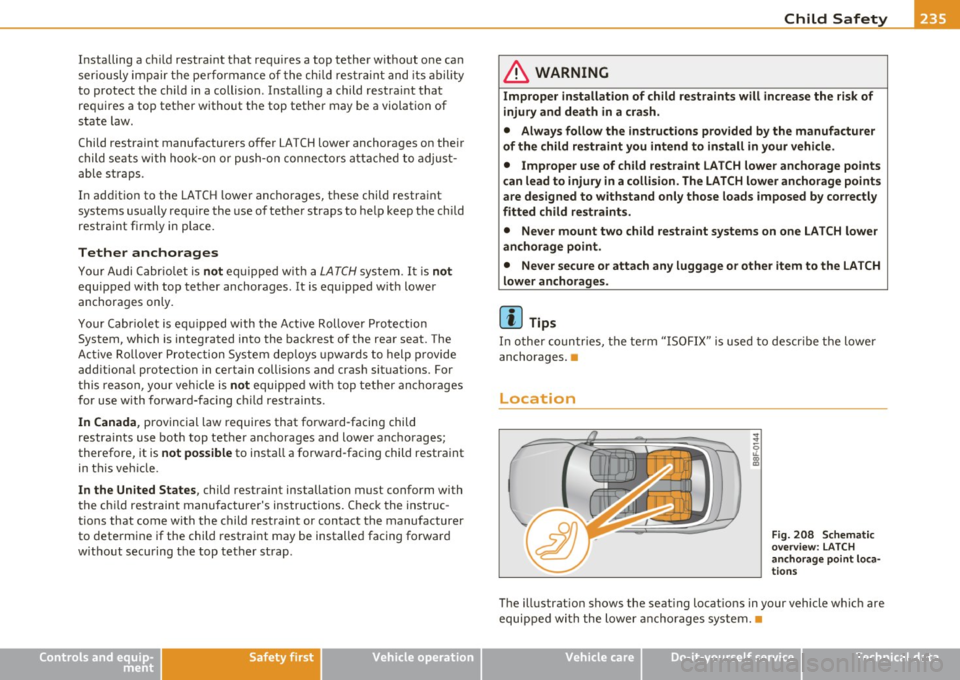
The illustrat ion shows the seat ing locations in your vehicle which are
equipped wi th the lower anchorages system. •
Vehicle care Do-it-yourself service Technical data
Page 238 of 364
Ill Child Safety __ .,.___ ____________ _
Description
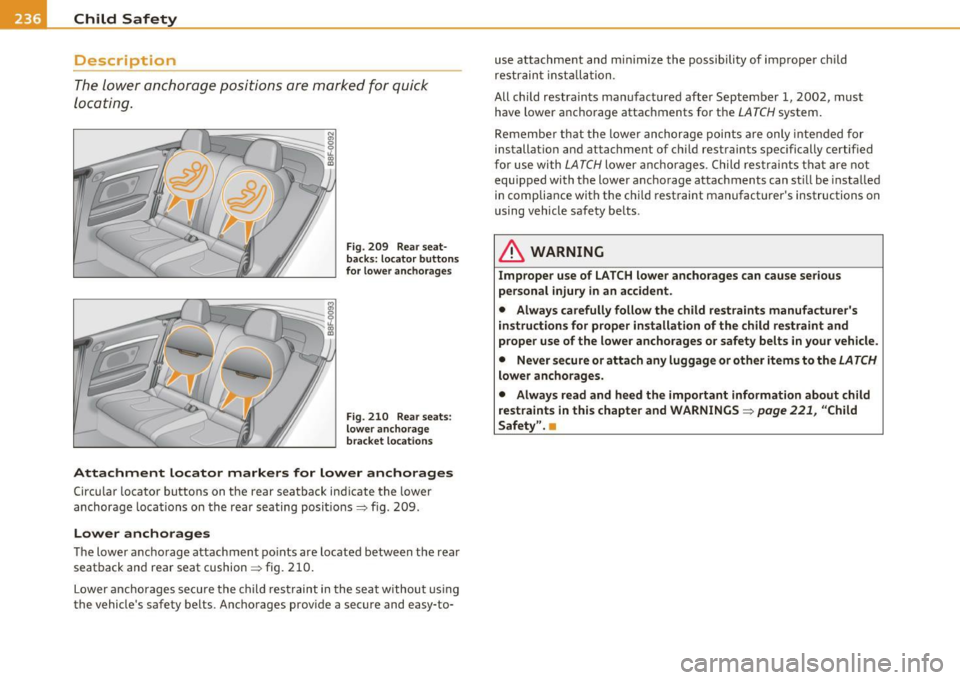
The lower anchorage positions are marked for quick
locating.
Fig. 209 Rear seat
backs: locator buttons
fo r lower anchorages
Fig . 210 Rear seats:
lower anchorage
bracket locations
Attachment locator markers for lower anchorages
Circu lar locator buttons on the rear seatback indicate the lower
anchorage locations on the rear seating positions:::;, fig. 209.
Lower anchorages
The lower anchorage attachment points are located between the rear
seatback and rear seat cushion:::;, fig . 210.
Lower anchorages secure the child restraint in the seat without us ing
the vehicle's safety belts. Anchorages prov ide a secure and easy-to- use attachme
nt and minimize the possibility of improper child
restrain t installat ion.
All ch ild restraints manufactured after September 1, 2002, must
have lower anchorage attachments for the
LATCH system.
Remember that the lower anchorage points are only intended for
installat ion and attachment of ch ild restraints specifically certif ied
for use with
LATCH lower anchorages . Child restraints that are not
equ ipped with the lower anchorage attachments can st ill be installed
in compliance with the ch ild restraint manufact urer's instructions on
using vehicle safety belts .
& WARNING
Improper use of LATCH lower anchorages can cause serious
per sonal injury in an accident.
• Always carefully follow the child restraints manufacturer 's
instructions for proper installation of the child restraint and
proper use of the lower anchorages or safety belts in your vehicle.
• Never secure or attach any luggage or other items to the
LATCH
lower anchorages.
• Always read and heed the important information about child
restraints in this chapter and WARNINGS :::;,
page 221, "Child
Safety". •
Page 239 of 364
___________________________________________ C_ h_il _d _ S_a _f _e _t =c,. y __ lft'II
Installing a child restraint with LATCH
lower anchorages
Whenever you install a child restraint always follow the
child restraint manufacturer's instructions.
Mounting
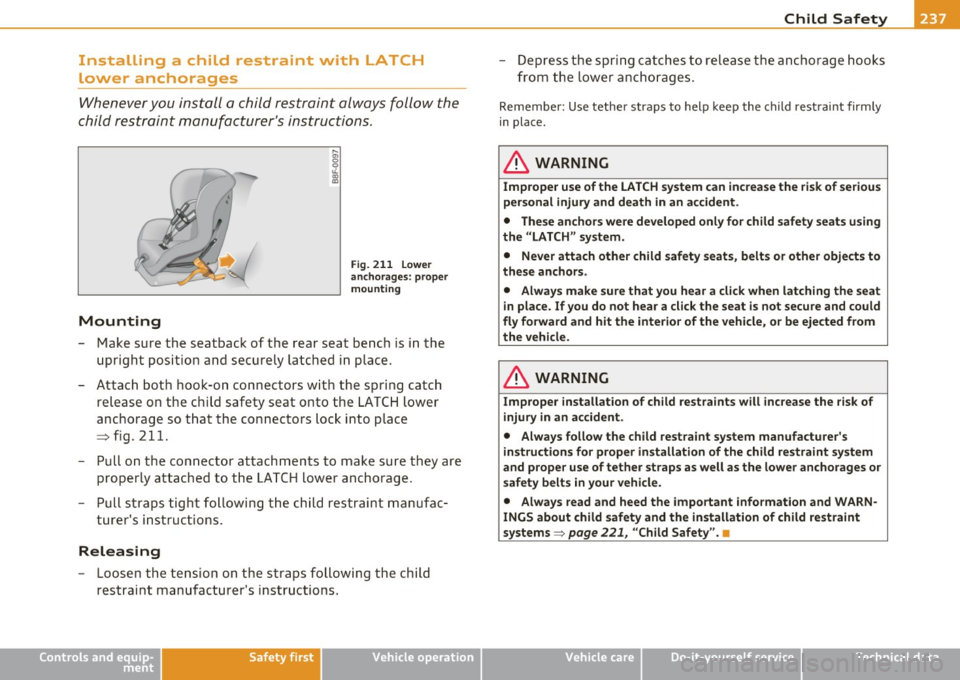
Fig. 211 Lower
anchorages: proper
mounting
- Make sure the seatback of the rear seat bench is in the
upright position and securely latched in place .
- Attach both hook-on connectors with the spring catch
release on the child safety seat onto the LATCH lower
anchorage so that the connectors lock into place
=> fig. 211.
-Pull on the connector attachments to make sure they are
properly attached to the LATCH lower anchorage.
- Pull straps tight following the child restraint manufac
turer's instructions.
Releasing
- Loosen the tension on the straps following the child
restraint manufacturer's instructions.
Controls and equip·
ment Safety first Vehicle operation
-
Depress the spring catches to release the anchorage hooks
from the lower anchorages.
Remember: Use tether straps to help keep the child restraint firmly
in place.
& WARNING
Improper use of the LATCH system can increase the risk of serious
personal injury and death in an accident.
• These anchors were developed only for child safety seats using
the "LATCH" system.
• Never attach other child safety seats, belts or other objects to
these anchors.
• Always make sure that you hear a click when latching the seat
in place. If you do not hear a click the seat is not secure and could
fly forward and hit the interior of the vehicle, or be ejected from
the vehicle.
& WARNING
Improper installation of child restraints will increase the risk of
injury in an accident.
• Always follow the child restraint system manufacturer's
instructions for proper installation of the child restraint system
and proper use of tether straps as well as the lower anchorages or
safety belts in your vehicle.
• Always read and heed the important information and WARN·
INGS about child safety and the installation of child restraint
systems ::::;,
page 221, "Child Safety". •
Vehicle care Do-it-yourself service Technical data