airbag AUDI A5 CABRIOLET 2011 Workshop Manual
[x] Cancel search | Manufacturer: AUDI, Model Year: 2011, Model line: A5 CABRIOLET, Model: AUDI A5 CABRIOLET 2011Pages: 364, PDF Size: 86.48 MB
Page 235 of 364
Child Safety Ill
-------------------"'---
& WARNING (continued)
• A child in a rearward-facing child safety seat installed on the
front passenger seat will be seriously injured and can be killed if
the front airbag inflates -even with an Advanced Airbag System.
• The inflating airbag will hit the child safety seat or infant
carrier with great force and will smash the child safety seat and
child against the backrest, center arm rest, door or roof.
• Always be especially careful if you must install a rearward
facing child safety seat on the front passenger seat in exceptional
circumstances.
• A tight tether strap on a rearward-facing child restraint
attached to the front passenger seat can put too much pressure on
the weight-mat in the seat and register a heavier weight in the
Advanced Airbag System. The heavier weight registered can make
the system work as though an adult were on the seat and deploy
the Advanced Airbag when it must be suppressed causing serious
or even fatal injury to the child.
• Make sure that the PASSENGER AIR BAG OFF light comes on
and stays on all the time whenever the ignition is switched on.
• If the PASSENGER AIR BAG OFF light does not come on and
stay on, immediately install the rearward-facing child safety seat
in a rear seating position and have the airbag system inspected by
your authorized Audi dealer. •
Activating the convertible locking retractor
Use the convertible locking retractor to secure a child
restraint.
Always heed the child safety seat manufacturer 's instruc
tions when installing a child restraint in your vehicle. To acti
vate the convertible locking retractor:
- Place the child restraint on a seat, preferably on the rear
seat .
Controls and equip
ment Safety first Vehicle operation
-
Slowly pull the belt all the way out.
-Route it around or through the child restraint belt path
=>& .
- Push the child safety seat down w ith your full weight to
get the safety belt really tight .
- Insert the belt tongue into the buckle for that seating
position.
- Guide the safety belt back into the retractor until the belt
lies flat and snug on the child safety seat.
- You should hear a "clicking" noise as the belt winds back
into the inertia reel. Test the convertible locking retractor
by pulling on the belt. You should no longer be able to pull
the belt out of the retractor. The convertible locking
retractor is now activated.
- Make sure that the red release button is facing away from
the child restraint so that it can be unbuckled quickly.
- Pull on the belt to make sure the safety belt is properly
tight and fastened so that the seat cannot move forward
or sideways more than one inch (2.5 cm).
& WARNING
Using the wrong child restraint or an improperly installed child
restraint can cause serious personal injury or death in a crash.
• Always make sure that the safety belt retractor is locked when
installing a child safety seat. An unlocked safety belt retractor
cannot hold the child safety seat in place during normal driving or
in a crash.
• Always buckle the child safety seat firmly in place even if a
child is not sitting in it. A loose child safety seat can fly around
during a sudden stop or in a crash.
Vehicle care Do-it-yourself service Technical data
Page 240 of 364
•L_---=C:..:h..:.. i:..: l .=d ~S=-= a..:..f .= e ~ty ~ --------------------------------------------
Using tether straps on rearward-facing
child restraints
Currently , few rearward-facing child restraint systems come with a
tether. Please read and heed the child rest raint system manufac
t u rer's instructions carefully to determine how to properly insta ll the
t e ther.
& WARNING
A child in a rearward-facing child safety s eat install ed on the front
passenger seat will be se riously injured and can be killed if the
front airbag inflat es · even with an Advanced Airb ag System .
• The inflating airbag will hit the child safety seat or infant
carrier with great force and will smash the child safety seat and
ch ild against the backrest, center armrest , or door.
• A tight tether or other strap on a rearward-facing child
restraint attached to the front passenger seat can put too much
pressure on the weight-mat in the seat and r egister a heavier
weight in the Ad vanced Airbag System. The heavier weight regi s
t e red can make the system work as though an adult were on the
seat and deploy the Advanced Airbag when it must be suppressed
c ausing serious or even fatal injury to the child.
• If you must install a rearward facing child safety seat on the
front passenger seat because of exceptional cir cum stan ce s and
the PASSENGER AIR BAG OFF light does not come on and stay on ,
immediately install the r earward-facing chi ld safety seat in a rear
seating position and have the airbag system inspected by your
authorized Audi dealer .•
Additional Information
Sources of information about child
restraints and their use
There are a number of sources of additional information about child
restrain t se lec tion, inst allat ion and use:
NHTSA advises t hat the best chi ld safety seat is the one t hat fits your
child and fits in your vehicle, and that yo u will use correctly an d
c onsistent ly.
Try before you buy!
U .S National Highway Traffic Safety Administration
T e l. : 1-888 -327 -4236 (T TY: 1-800-424 -9 153)
www.n htsa .gov
National SAFE KIDS Campaign
Te l.: (202) 662-0600
www.s afe kid s.o rg
Safety BeltSafe U .S .A
T e l. : (800) 7 45-SAF E (E nglish)
Te l.: (800) 747-SANO (Spa nish)
www .carseat .org
Transport Canada Inform ation Centre
Te l.: 1 (800) 333-0371 or call 1 (613) 998-8616 if yo u are in the
O ttawa area
www .t c.gc .ca/roadsafety
Audi Cu stomer CARE
Te l.: (800) 822-2834 •
Page 242 of 364
Intelligent technology
~----------------------------------------------
Intelligent technology
Notice about data recorded by
vehicle control modu Les
Your vehicle is not equipped with an Event Data Recorder (EDR),
installed by some manufacturers for the express purpose of
capturing data for retrieval after an accident or crash event. EDR's are
sometimes called "crash recorders".
Some state laws restrict the retrieval or downloading of data stored
by ED R's that were installed in a vehicle for the express purpose of
retrieving data after an accident or crash event without the owner's
consent.
Although your vehicle is not equipped with an EDR, it is equipped with
a number of e lectronic control modules for various vehicle systems
such as, for example, eng ine function, emission control, as well as for
the airbags and safety belts.
These electronic control modules also record vehicle-related data
during normal vehicle operation for diagnostic and repair purposes .
The recording capacity of the electronic control modu les is limited to
data (no sound is recorded) and only a sma ll amount of data is actu
ally recorded over a very limited period of time and stored when a
system fault or other condition is sensed by a control unit. Some of
the data then stored may relate to vehicle speed, direction, braking
as well as restraint system use and performance in the event of a
crash or other condition. Stored data can only be read and down
loaded with special equipment .•
Electronic Stabilization Program
(ESP}
Ce-ieral lnforrrc:t~on
The ESP improves the vehicle stability.
Fig. 212 ESP button
Fig. 213 Center
console with ESP
switch
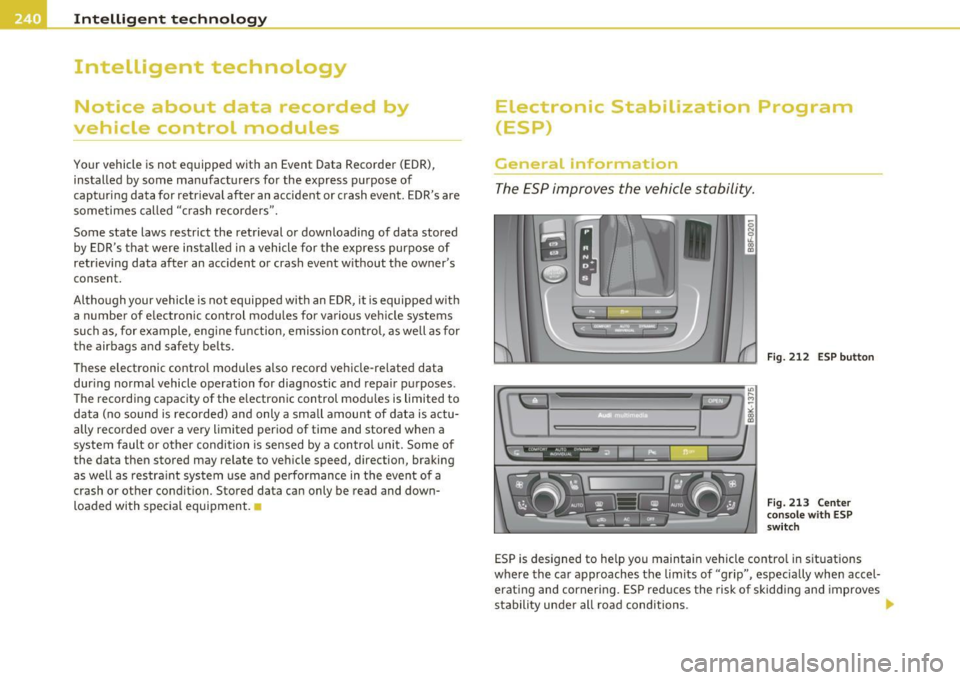
ESP is designed to he lp you maintain vehicle control in situations
where the car approaches the limits of "grip", especially when accel
erating and cornering. ESP reduces the risk of skidding and improves
stability under all road conditions.
Page 271 of 364
____________________________________________ C_l_e _a_ n_ i n--= g=--- a_n_ d----' p,__ r_o _t_ e_ c_ t_ i _o_ n __ _
Cleaning stains
Stains caused by beverages (e.g. cof fee, fruit juice, etc .) can be
tr eat ed wi th a mild detergen t sol ution. Apply the d etergent solut ion
wit h a sponge. In the case of stubbo rn sta ins, a detergent paste can
be applied dire ct ly to th e stai n an d wo rked into the fabric. Afte r
wards, use copious amounts o f clean water to remove the remaining
dete rgent . App ly the water w ith a damp cloth o r sponge and pat the
fabric d ry with an absorbent, dry cloth.
St ains from choco late or makeup shoul d have dete rge nt p ast e
rubbed in to them. Afterwards, remove the soap w ith wate r (damp
sponge).
Alco hol can be used to tre at st ains from grease, o il, lipst ic k or a ba ll
point pen . M elted g rease o r dye must be patted o ff using absorbent
m ateri al. It ma y be nece ssary to ret re at th e ar eas with dete rgen t
paste and water.
I n t he case of general soiling of the upholstery and cover m ater ial, we
recommend hiring a specialist t hat has the eq uipment to clean the
seat covers and other fa bric surfaces by shampooing and spray
extract ion .
& WARNING
Always read and heed all WARNINGS and the information
~page 260 .
[I) Tips
Open Velcro fastene rs on yo ur clothing can dama ge the seat cover .
Please make sure t hat Velc ro fasteners are closed. •
Plastic parts and instrument panel
Always use a clean cloth moistened in clear wate r to clean t hese
areas . For persistent dirt use an Au di app roved
solvent-free plastic
cleaner /protectant .
Safety first
& WARNING
Solvents can change the properties of some plastics and make it
harder for the airbag to deploy.
• Never clean the instrument panel or the surface of airbag
modules with cleaning products that contain solvent s.
• Products containing solvents will make the surface of this part
porous .
• Serious injuries can result if plastic parts come loose when the
airbag is deployed.
• Always read and heed all WARNINGS and other information
~page 260 .
0 Note
Cleaning age nts co nta ini ng solvents w ill a ttack t he m ate rial a nd can
change the way it behaves .•
App lies to vehicles : w ith natural leathe r
Natural Leather
Audi m akes grea t e fforts to maintain the prop erties,
na tur al look and f eel of in terior leath er.
General
We offe r many different types of leathe r on our ve hicles. Most are
differe nt types of n appa lea ther, which ha s a smoo th s urface an d
comes in various colo rs.
Th e intensity o f the colo r de termines t he visual cha ra cte ris tics and
appearance . If the su rface of t he leather has a typ ica l natura l look,
then t he leathe r is a nap pa leather that has bee n left in a relat ive ly
na tura l co ndit ion . This leathe r offers part icu larly good comfort an d
breat hes wel l. Fine veins, closed gra ins, insect b ites, sk in fo lds, and
sub tle variat ions in co lor remai n visible. Th ese cha ract eristics d emon-
st rate t hat the mater ial is nat ural. ..,
Vehicle care Technical data
Page 293 of 364

___________________________________________ C_ h_e _c _k_ i_n ~g_ a_n_ d_ f_ i_ll _i_n _g __ _
Have the battery checked when you take your vehicle in for service .
You are well advised to replace a battery that is older than 5 years.
With certain types of a irbag deployment, the battery is disconnected
from the vehicle electrica l system for safety reasons~
& in "Repair,
care and disposal of the airbags" on
page 213.
Disconnecting the battery terminals
Some vehicle funct ions (power window regulators, for example) are
lost if the battery terminals are disconnected. These functions have
to be relearned after the battery termina ls are connected aga in . To
prevent this, the battery should only be disconnected from the
vehicle electr ica l system when absolute ly necessary for repairs.
Vehicles not driven for long periods
If you do not drive your veh icle over a period of several days or weeks,
electrical components are gradually cut back or switched off. This
reduces energy consumption and maintains starting capability ove r a
longer period
~ page 247.
Take into consideration that when you unlock your vehicle, some
convenience functions, such as the master key remote function or
powe r seat adjustment, may not be available. The convenience func
tions will be available again when you turn on the ignition and start
the engine.
Winter operation
During the winter months, battery capacity tends to decrease as
temperatures drop. This is because more power is also consumed
while starting, and the headlights, rear window defogger, etc., are
used more often .
Avoid unnecessary power consumption, particu larly in city traffic or
when travel ing only short distances. Let your authorized Audi dealer
check the capacity of the vehicle battery before winter sets in
~ page 293. A well charged battery will not only p revent start ing
problems when the weather is cold, but will also last longer.
Safety first
(I] Tips
If your vehicle is left standing for several weeks at extremely low
temperatures, the vehicle battery shou ld be removed and stored
where it will not freeze. This will prevent it from being damaged and
having to be replaced. •
Working on the battery
Be especially careful when working on or near the
battery.
The battery is located in the luggage compartment under the
floor. Before you check anything in the lu~gage compart
ment,
read and heed all WARNINGS =:,& .
Always heed the safety warnings, when working on the vehicle
battery or the vehicle electrical system to prevent injury .
The following WARNINGS are very important when
working on the battery:
Always heed the following WARNING SYMBOLS and safety pre
cautions when working on the battery.
Always wear eye protection.
Battery acid contains sulfuric acid. Always wear
gloves and eye protection. .,_
Vehicle care Technical data
Page 331 of 364
__________________________________________ __!F~U!_.:!S~e:.:s~ a~n~d:!_..!:b~u:!!l~b~s~ _J
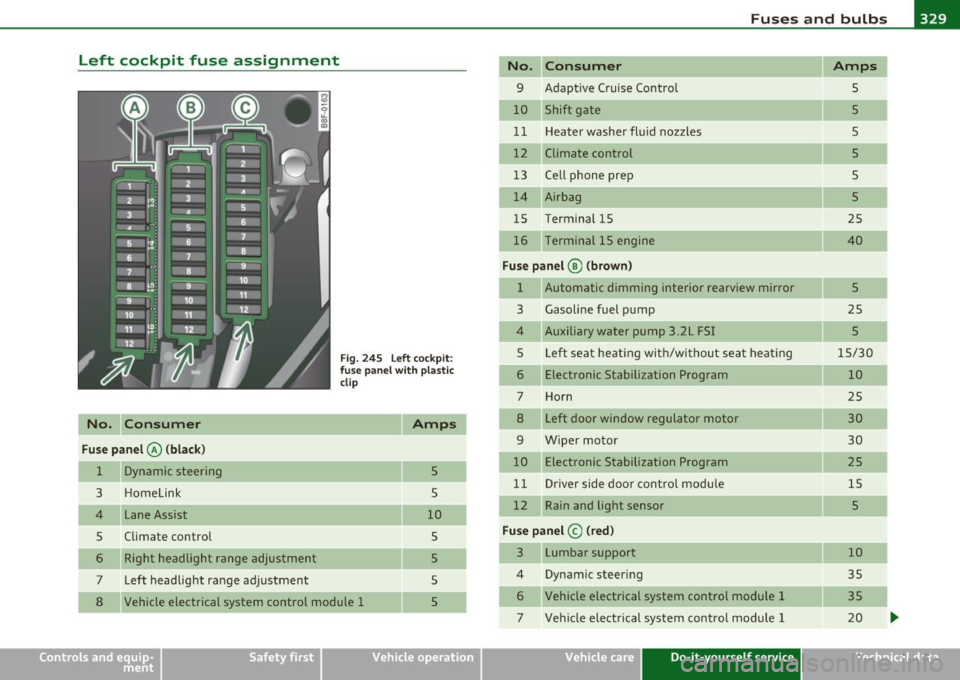
Left cockpit fuse assignment
No. C onsumer
Fus e pa nel @ (black )
1 Dynamic steering
3 Homelink
4 Lane Assist
5 Climate control Right headlight range adjustment
7 Left headlight range adjustment
Fig. 2 4 5 Left cock pit :
fuse pan el with plastic
cl ip
5
5
10 5
5
5
8 Vehicle electrical system control module 1 5
Vehicle OP-eration
No. Consumer Amps
9 Adaptive Cruise Control
5
10 Shift gate 5
1 1 Heater washer fluid nozzles
5
12 Climate control 5
13 Ce lt phone prep
s
14 Airbag
5
15 Term
inal 15
25
16 Terminal 15 engine 40
Fus e pa nel ® (brow n)
1 Automatic dimming interior rearview mirror 5
3 Gasoline fuel p ump 25
4 Auxiliary water pump 3 .2L FSI 5
5 Left seat heating with/wi tho ut seat heat ing 15/30
6 Electronic Stabilization Program
10
7 Horn 25
8 Left door window regulator motor 30
9 Wiper motor 30
10 Electronic Stabilization Program
25
11 Driver side door control modu le 15
12 Rain and light sensor 5
Fuse panel © (red)
3 Lumbar support 10
4 Dynamic steer
ing
35
6 Vehicle electrical system control module 1 35
7 Veh icle elect rical system control module 1 20
Vehicle care Do-it-yourself service iTechnical data
Page 347 of 364

______________________________________________ C _o_ n _ s_u_ m_ e_r_ I_n _f_ o_ r_m _ a_t_ i_ o _ n __ _
& WARNING (co ntinued )
• Always remove the ign ition key before anyone gets under the
vehicle.
• Alway s support your vehicle with safety stands if it is nece ssary
to work underneath the vehicle . The jack supplied with the veh icle
is not adequate fo r thi s purpose and could collap se causing
serious personal injury.
• If you must work underneath the vehicle with the wheels on
the ground, always make sure the vehicle is on level ground, that
the wheels are always securely blocked and that the engine cannot
be started.
• Always make sure the transmi ssion selector lever (automatic
transmi ssion) is in "P " (Park po sition ) and the park brake is firmly
applied.
<£> For the sake of the environment
• Changing the engine settings will adverse ly affect emission levels .
Thi s is det rimenta l to the environme nt and increases fue l co nsump
tion.
• Always obse rve environmen tal regulat ions when d ispos ing of o ld
engine oil, used b rake fl uid, di rty e ngine coo lant, spent batter ies or
worn out t ires .
• Undeployed a irbag modules and pretensioners m igh t be classifie d
as Perchlorate Mater ia l -spec ial hand ling may apply, see
www.dtsc.ca.gov/hazardouswaste/pe rchlorate . When the vehicle or
parts of t he rest raint system includi ng ai rbag modu les safety belts
with pretens ioners are sc rapped, all applicable laws and regulat ions
m ust be ob served. Yo ur author ized Au di dealer is f amiliar wi th these
requirements and we recommend that you have your dealer perform
t his servi ce for yo u. •
Safety first
Additional accessories,
modifications and parts
replacement
Additional accessories and parts
replacement
Always co nsult an autho riz ed Audi d ealer bef ore
purchasing acces sories.
Yo ur vehicle incorporates the latest safety design feat ures ens uring a
high standard of active and pass ive safety .
Th is safety could be compromised by non-approved changes to the
veh icle . F o r th is reaso n, if p arts have to be rep la ce d , ple ase obse rve
the following points when installing addit ional accessories:
Approved Audi accessories and genuine Au di parts are available from
au thori zed Aud i dea le rs .
These dea lers a lso have the necessary facilities, tools and tra ined
specialists to i nstall t he pa rts and ac cesso ries p roperly.
& WARNING
Using the wrong spare parts or u sing non-approv ed accessories
c an cause damage to the vehicle and serious personal injury.
• Use only accessories expressly approved by Audi and genuine
Audi spare parts
• These parts and accessories have been specially designed to be
used on your vehicle.
• Never install accessories such as telephone cradles or beverage
holder s on airbag covers or within the airbag deployment zones .
Doing so will increase the risk of injury if airbags are triggered in
an a ccident!
• Before you check anything
in the engine compartment, always
read and heed all WARNINGS~
page 272. .,
Do-it,yourself service Technical data
Page 350 of 364

___ A_ l_. p_ h _ a_b_ e_ t_ic _a_ l_ in_ d_e _ x ____________________________________________ _
A
A/C mode ...................... 93, 100
Accessories ..... .................. . 345
Active rollover protection system ... ... 186
Retracting rollover protection . ..... 187
Adaptive cruise control ............ .. 116
Chang ing speed .................. 119
Dr iver information ............... 122
Driver intervention prompt ........ 126
Driving in traffic ................. 117
Driving program .. .. ............. 127
Error messages . .. ...... .... ..... 125
Open road ...................... 117
Override ................ ...... .. 117
Request for driver to assume control 117
Save speed . . . . . . . . . . . . . . . . . . . . . . 119
Setting distance ................. 121
Setting time interval . ............. 121
Sett ings ... ..................... 127
Special driving situations ........ .. 127
Status messages ........ ......... 125
Switching on and off .............. 118
System limits ................ ... 127
T emporarily turning off ........... 120
warning/indicator lights ........... 123
Adaptive light ... ...... .............. 66
defect ive . . . . . . . . . . . . . . . . . . . . . . . . 3 7
Adding Engine coolant .................. 288
Engine oil .. ...... ....... ..... ... 284
Windshield washer flu id ........ ... 295 Additional accessories
............... 345 Side airbags .. .. .. .. .. .. ......... 218
Additives We
ight-sensing mat .............. 222
Engine oil ........ .... .. .. .. .. ... 284 When must
the system be inspected? 210
Adjusting All wheel drive
.. .. .. .. .. ...... ... .. 246
Steering column .......... .. .. .. . 105 Winter tires
.. .. ................. 311
Adjusting front seats .......... ...... . 77 Alloy wheels
........... .. .... .... .. 266
Airbag Warning/indicator lights ... .. .. .. .. 14
Airbag system .................. 199, 219
Advanced Airbag System .......... 203
Advanced Airbag System components 206 Care .................... .. .... . 213
Child restraints .................. 223
Children ........................ 222
Components (front airbags) ... .. .. . 206
Danger of fitting a child safety seat on the
front passenger seat ............ 201
Disposal ........ .... ..... .. .... . 213
Front airbags .............. .. 203, 204
How do the front airbags work? ..... 208
How many airbags does my vehicle have? .
206
How the Advanced Airbag System compo- nents work together ........... . 207
Important safety instructions on the knee airbag system ............ ... .. . 217
Important things to know .. .. .. .. . 199
Indicator light ........ .. .. .. .... . 210
Knee airbags .................... 215
Monitoring . .. ............... ... 210
PASSENGER AIR BAG OFF light ..... 211
Repairs .. ........ ... ... .. .. .. .. . 213
Safety instructions ............. .. 212 Alternator
Malfunct ion .... .. .. .............. 29
Anti-freeze
See Eng ine cooling system ......... 286
Anti-glare inside day-night mirror ..... .. 72
Anti -lock brake system
How the ABS system works . . . . . . . . 245
Wa rning/indicator lights . .......... 15
Anti-Slip Regulation System (ASR) How the system works ..... ... .. .. 242
Anti-theft systems Electronic immobilizer ............. 41
Ashtray ............................ 85
Asterisk What does it mean when something is
marked with an asterisk? . . . . . . . . . . . 5
Audi brak ing guard .................. 129
Error messages . . . . . . . . . . . . . . . . . . 131
Settings ........................ 131
Status messages ................. 131
Switching on and off ....... ... .. .. 131
Audi drive select Description ..................... 145
Setting the driving mode .......... 146
Audi Service Repair Manuals and Literature ..
343
Page 355 of 364
Alphabetical index -________________ fWI
For the sake of the environment
Gasol ine fumes and the env ironment 276
Refueling ..... .. .. .. ............ 276
Saving fuel by early upshifting ..... .. . 9
F ront ai rbags
Description ....... ... . .. .. .. ..... 203
How they work ................ .. . 208
Front armrest Adjusting ........................ 83
Storage compartment ............ .. 83
Front ashtray . .. .. .. ...... ....... ... . 85
Front seats .. .. .. .. ............. .... 77
Adjus ting . .. ... .... ... .. .. ..... . 179
Child restraints in the front seat .... 201
Conven ience side view . .. ...... ..... 82
Symmetrical seat posit ions .......... 82
Upper cabin heati ng ........... .. . 104
Frontal collisions and the laws of physics 190
Fuel Add itives ....................... 274
Blended gasoline ................ . 274
Consumpt ion ....... ...... .. .. .. .. 21
Filler neck ..... .. .. .... .......... 275
Fuel gauge ......... ...... .. .... .. 10
Gasoline .................... .... 274
Gasoline additives .. .... ... ... ... . 275
Octane rating ............... .. .. . 274
Recommendation ... .... .... .. .. . 274
Refuell ing ... ... . ...... ......... . 276
Reserve ...... ...... .. .. .. .. .... .. 10
Tank capacity ............. .. .... . 342
Unlocking the fuel filler flap by hand . 278
Controls and equip
ment Safety first
Fuel economy messages (efficiency
program)
25
Fuel filler flap Unlocking the fuel filler flap by hand . 278
Fuel supply too low ..... .. .. .. .. ...... 36
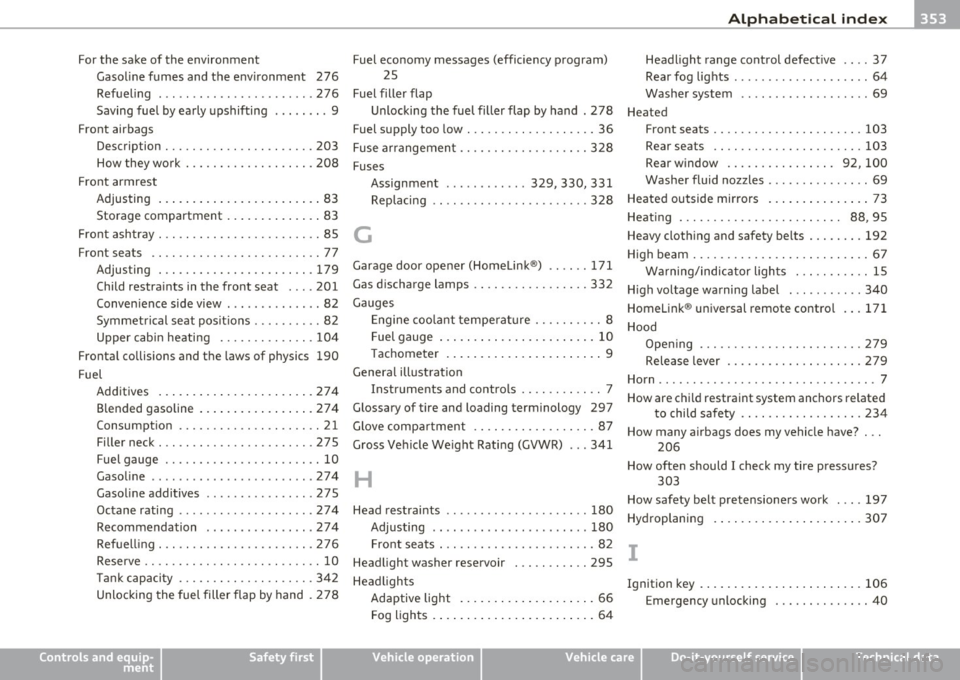
Fuse arrangement ........... ...... .. 328
Fuses Assignment ............ 329,330,331
Replacing . ... .. .... .. .. .. .. .. .. . 328
G
Garage door opener (Homelink ®) .. .. .. 171
Gas d ischarge lamps ...... ........... 332
Gauges Engine coolant tern perature .......... 8
Fuel gauge .. ..... .. .............. 10
Ta chometer ............. .. .. .. .... 9
General illustration
Instruments and controls ........ .. .. 7
Glossary of tire and loading terminology 297
Glove compartment ............... ... 87
Gross Vehicle Weight Rating (GVWR) ... 341
H
Head restraints .................. ... 180
Adjusting .. .. ... ... .. ... ...... .. 180
Front seats . .. .. .................. 82
Headlight washer reservoir ..... .. .. .. 295
Headlights Adaptive light ........... .. ....... 66
Fog lights . ... ................ .... 64 Headlight range control defective
.. .. 37
Rear fog lights .............. .. ... . 64
Washer system ................... 69
Heated Front seats ............... ...... . 103
Rear seats .. .. .. .. ............. . 103
Rear window . . . . . . . . . . . . . . . . 92, 100
Washer fluid nozzles ...... ... . ... .. 69
Heated outside mirrors ............... 73
Heating . . . . . . . . . . . . . . . . . . . . . . . . 88 , 95
Heavy clothing and safety belts ....... . 192
High beam ............ ...... .... .. .. 67
Warning/indicator lights ....... .. .. 15
High voltage warning label .... ..... .. 340
Homelink ® universal remote control ... 171
Hood Opening ........... .. .. .. .. .. .. . 279
Release lever ............. .... .. . 279
Horn ........ ........ .. . ... ... .. ... .. 7
How are child restraint system anchors related to child safety .. .. .... .......... 234
How many airbags does my vehicle have? ...
206
How often should I check my tire pressures? 303
How safety belt pretensioners work .... 197
Hydroplaning . ..................... 307
I
Ignition key ........... ...... .... ... 106
Emergency unlocking ............ .. 40
Vehicle operation Vehicle care Do-it-yourself service Technical data
Page 356 of 364
-Alphabetical inde x _ ___,_ ______ .::..:....=.:..:..__ __________________________ _
Ignition lock .. .. .. .. .. .. ... ........ 106
Malfunction .............. ... .. 32, 37
Immobilizer ... ................. . 11, 38
Important things to do before driving .. 177
Improperly worn safety belts ....... .. 196
Indicator lights ............. ...... ... 12
Airbag system ...... ..... .... 210,211
Dynamic steering .............. 13, 34
PASSENGER AIR BAG OFF .......... 211
Infant seats .... .... ...... ......... 227
Inside rear view mirror ................ 72
Insta lling child safety seats
Safety belts .................. ... 231
Instrument lighting .. .. .......... .... 66
Instruments and controls .............. 8 General illustration ............. .. .. 7
Interior lights ... .. .. .. ... ..... ...... 68
Rear .... .. .. .................... 69
Interval wip ing .. ............ ........ 69
Rain sensor ..... ....... ..... .. .. . 69
J
Jumper cables ...................... 334
Jump-starting .... .. .... .. .. .. .. .. .. 333
K
Key . ..................... .. .... .. . 38
Battery replacement ............... 39
Key replacement .... .. .. .. .. .. .. .. 38
Master key with remote control ...... 38
Mechanical key ..... ... ........... 40 Kick-down
multitronic ® ................ ... . 1S8
t.
t . ® rp ronic ................ ... .. . 151
Knee airbags ................ .. .... . 215
Description . .. ................. . 215
How they work ......... .. .. .. .. . 216
Important safety instructions ...... 217
L
Lane assist
Activating and deactivating ........ 132
Description . .................. .. 132
Indicator in the instrument cluster display
133
Instrument cluster indicator light ... 132
Notes on instrumen t cluster display . 132
steering wheel vibration . .......... 135
warning time .. ... ... ... .. .. .. ... 135
LATCH ............ .... ..... .. .... . 234
Description ... ................. . 236
Installing a child restraint .. .. .... . 237
Location ....... ...... .... .. ..... 235
Mounting and releasing the anchorage hook .............. .... ....... 237
Leather . .. .. .. .. ..... ...... .. ... .. 269
Cleaning . .......... ... .. ... ... . 270
Lifting jack ......... .... .... ....... 323
Lifting vehicle .... ........... .. .. .. . 338
Light sensor ............ .... .. ...... 63
Light senso r defective ............. ... 35
Lighting .. .. .. .... ....... .... .... .. 63 Lights
Com ing home .......... .... ...... 65
Daytime running lights ............. 65
Dr iving light control . .......... ... . 63
Emergency flashers .. .. .. .. .. .. .. . 67
Exterior lighting .. .. .... ......... . 65
H igh beam ... .. .. .. .............. 67
High beam warning/indicator light ... 15
Leaving home ........ ... .. .... ... 65
Switching on and off .............. . 63
Turn signals .. .. .... ............. . 67
Xenon headlights . .. ............. . 66
Loading the luggage compartment 183
Locking Power locking switch . . . . . . . . . . . . . . 46
Rear lid/trunk lid ................. 4 7
Remote control key . . . . . . . . . . . . . . . . 43
Us ing the mechanical key . .......... 45
Low beams . . . . . . . . . . . . . . . . . . . . . . . . . 63
Lower unive rsal ancho rage bars (Canada) ...
234
Lower universal anchorages (Canada) . .. 234
Luggage Stowing ............ .. .. .. .... .. 183
Luggage compartment ............... 83
Increasing the s ize .. .......... .... 84
Loading ........... .. . ... ... .. ... 83
Tie-downs . . . . . . . . . . . . . . . . . . . . . . . 84
See also Loading the luggage
compartment . .. .. ......... .... 183
See also Luggage compartment .... . 83
Luggage compartment lid
Emergency unlocking ....... .. .. .. . 48