service AUDI A5 CABRIOLET 2011 Workshop Manual
[x] Cancel search | Manufacturer: AUDI, Model Year: 2011, Model line: A5 CABRIOLET, Model: AUDI A5 CABRIOLET 2011Pages: 364, PDF Size: 86.48 MB
Page 163 of 364
____________________________________________________ T _r_a _n_ s_m _ i_s _s_ i_ o _ n_---J_
Applies to vehicles : with mult itron ic® Continuous ly Variab le Transm ission (CVT)
Emergency release for selector lever
If the vehicle 's power supply fails, the selector lever can
be released in an emergency.
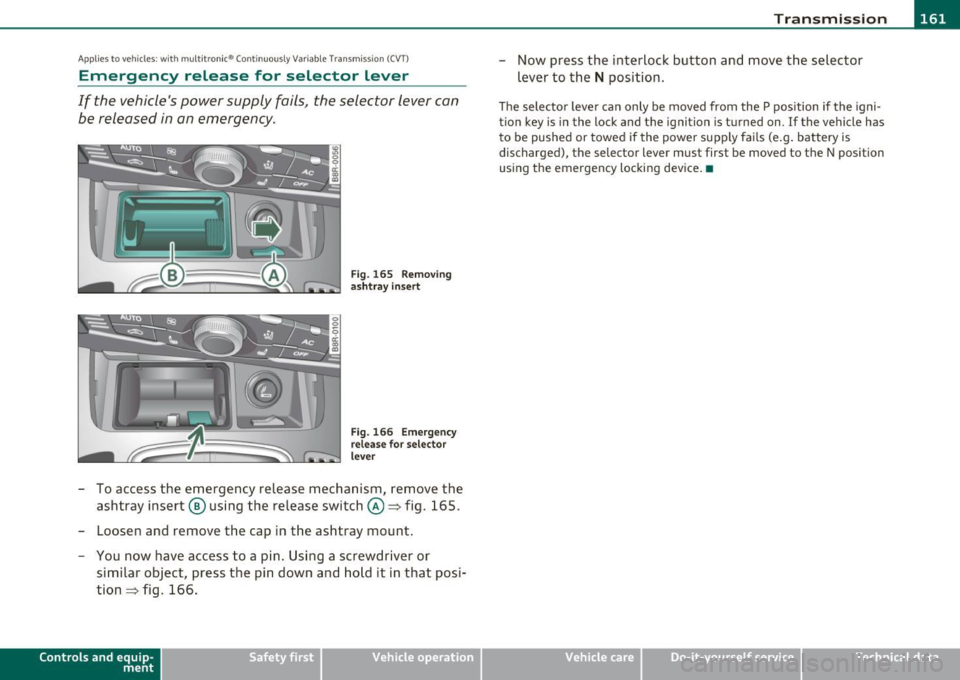
Fig . 165 Removing
ashtray insert
Fig. 166 Emergency
release for selector
lever
- To access the emergency release mechanism, remove the
ashtray insert @ using the release switch@~ fig. 165.
- Loosen and remove the cap in the ashtray mount.
- You now have access to a pin. Using a screwdriver or
similar object, press the pin down and hold it in that posi
tion~ fig. 166.
Contro ls a nd e quip
m en t Vehicle
OP-eration
-Now press the interlock button and move the selector
lever to the
N position.
The selector lever can only be moved from the P position if the igni
tion key is in the lock and the ignition is turned on. If the vehicle has
to be pushed or towed if the power supply fails (e.g. battery is
discharged) , the selector lever must first be moved to the N position
using the emergency locking device. •
Vehicle care Do-it-yourselt service iTechnical data
Page 167 of 364

______________________________________________________ P_a _ r_ k_ a_ s _ s_is _ t _ __.fflll
A ppli es to veh icl es: wi th park ing s yst em (r ear ) and re ar-view camera
General Information
®
Sensors in the bumper
Fig . 169 Covered area
(!) and uncovered area
@ of the rear-view
camera
Fig. 170 Trunk lid:
location of the rear
view camera
Sensors are located in the front and rear bumpers. If these detect an
obstacle, audible and visual signals warn you. The range at which the
sensors begin to measure is approximately:
To the side
Center rear
2 ft (0.60 m)
5.2 ft (1.60 m)
The closer you get to the obstacle, the shorter the interval between
the audible signals. A continuous tone sounds when the obstacle is
Con tro ls a nd e quip ·
m en t Vehicle
OP-eration
less than approximately 1 foot (0.30 meters) away . Do not continue
driving farther.
If the distance to an obstacle stays the same, the volume of the
distance signal chime is gradually reduced after about
4 seconds
(does not affect the continuous signal tone). Approaching another
obstacle will cause the distance signal to sound again at the normal
volume.
Rearview camera coverage area
The MMI display shows the area covered by the rearview
camera ::> fig.
169 (D. Objects that are not in the area covered@ are
not shown on the MMI display.
We recommend that you practice parking with the rear-view camera
in a traffic-free location or parking lot to become familiar with the
system, the orientation lines, and their function. When doing this,
there should be good light and weather conditions.
In the MMI display, objects or vehicles appear closer or further away
if:
• you are driving in reverse gear from a level surface onto an incline,
or a downward slope,
• you are driving in reverse gear toward protruding objects ,
• the vehicle is carrying too much load in the rear.
The accuracy of the orientation lines and blue surfaces diminishes if:
• the rear-view camera does not provide a reliable image, for
example, in poor visibility conditions or if the lens is dirty,
• the image on the screen is not visible due to sun glare and reflec
tion.
Caring for the rear-view camera lens
The rear-view camera is located above the rear license plate bracket.
For the parking assist to operate, the lens=> fig . 170 must be kept
clean:
• Dampen the lens with a household alcohol-based glass cleaner,
and clean the lens with a dry cloth=>
0. .,
Vehicle care Do-it-yourselt service iTechnical data
Page 169 of 364

___________________________________________________ P_ a_ r_k _ a _ s_s _ i_s _t _ __.fflll
If the warning message appears in the display but not the rear-view
camera picture, read and confi rm the warn ing message . The aco ustic
distance signal is always act ive.
If you press a function button on the MMI control console, the rear
view camera picture disappears. The rear-view camera picture reap
pears the next time you park .
Further information on the wa rning message and the MMI contro l
console can be found in the MMI instruct io n booklet.
(I] Tips
• The rear-view camera picture is ava ilable as soon as the MMI
Display or the MMI is .switched on, or the start-up phase is completed.
• Keep the sensors in the rear bumper and the rear-view camera lens
clean and free of snow and ice, so that the parking system can work
properly . Please follow the additional notes on=>
page 170. •
App lies to veh icles : w ith parking system (r ear) and rear-view camera
Reverse Parking
Parking mode 1 can be used when parking in a garage or
parking space.
Con tro ls a nd e quip
m en t
Fig. 17 1 MMI D ispla y:
Aim ing at a par king
sp ot
Vehicle OP-eration
Fig.172 MMI D ispl ay:
A lig ning the vehicl e
-Switch th e MMI on and select the reverse gea r.
- Turn the steering wheel until the orange orientation lines
(D appear in the parking spot=> fig. 171. Use the mark
ings @to help you es timate the distance from an
obstacle. Each marking co rres ponds to 3 ft (1 m). The
blue area repr esen ts an ext ension of the vehicle 's outline
by approximately 16 ft (S m) to the rear .
- While driving in reverse gear, adjust the steering wheel
angle to fit the parking space wi th the aid of the orange
orienta tion lines=>
0. ® marks th e re ar bumper . You
should sto p driving in reverse as soon as and no later than
when the red orientation line © abuts an object=> &!
& WARNING
• The re ar- vie w came ra doe s not sh ow th e entire are a behind the
veh icl e=>
pag e 165, fig. 169. Watch out espe ciall y for small chil
dr en and anim als. Th e rear-view cam era cannot alwa ys dete ct
th em, posing ri sk of an a ccident!
• Plea se note that objec ts not tou ching th e ground can appear to
be furthe r awa y than the y reall y are ( for e xample , th e bump er of
a p arked vehi cle, a trailer hitch , or the rear of a truck ). In thi s ca se, .,_
Vehicle care Do-it-yourselt service iTechnical data
Page 175 of 364

HomeLink® -_______________ __.
10. Press and hold the trained Homelink ® button and
observe the indicator light©~
page 172, fig. 175 .
- If the indicator light is solid/continuous, programming is
complete and your device should activate when you press
and release the trained Homelink ® button.
- If the indicator light blinks rapidly for 2 seconds and is
then a solid/continuous light, proceed with phase 3 to program a rolling code device .
Phase 3: rollin g code progr amm ing
- A second person on a ladder who can safely reach the
garage door opener motor is recommended.
11. Locate the "learn" button on the garage door opener
motor (refer to the operating instructions for the opener,
as the location of this button may vary by manufacturer) .
12. Press and release the learn button on the garage door opener motor.
- Note: once the button is pressed, there are 30 sec ond s in
which to initiate the next step.
13. On the Homelink ® keypad inside the vehicle, firmly press
and hold the Homelink ® button previously programmed
in phases 1 and 2 for two seconds and release. Repeat this
sequence
twice .
-Some vehicles may require the press/hold/release
sequence up to three times to complete the training
process.
-HomeLink ® should now activate your rolling code
equipped device.
Con tro ls a nd e quip
m en t Vehicle
OP-eration
If the 5 minute time limit is exceeded, the em erge ncy fla shers w ill
fla sh on e t ime
to indicate that the process has been terminated. In
this case, repeat steps 4 through 9 .
If the emergency flashers do not flash
three times (after about 15-
60 seconds), programming was not successful. In this case, repeat
steps 4 through 9.
Remote control un its for garage door openers in Canada are set to
stop transmitt ing radio frequency signals after two seconds. This
time may not be sufficient for the Home link ® system to learn the
rad io frequency signal. Perform all other steps as described above .•
Applies to veh icles: with Homelin k® universal re mote cont rol
Operating the Homelink ® transmitter
The HomeLink ® transmitter works in the some manner as
the original hand held remote control that come with the
system.
Fig. 177 Overhead
conso le: Homeli nk®
k ey pad
- Press the appropriate programmed button G),@ or @
to activate the desired remote control function
~ & in
"General information" on
page 171. •
Vehicle care Do-it-yourselt service iTechnical data
Page 179 of 364
Driving Safely ---------------------"~'----
Important things to do before driving
Safety is everybody's job! Vehicle and occupant safety
always depends on the informed and careful driver.
For your safety and the safety of your passengers, before
driving always:
- Make sure that all lights and signals are operating
correctly.
- Make sure that the tire pressure is correct.
- Make sure that all windows are clean and afford good visi-
bility to the outside.
- Secure all luggage and other items carefully::::>
page 87.
-Make sure that nothing can interfere with the pedals.
- Adjust front seat, head restraint and mirrors correctly for your height .
- Instruct passengers to adjust the head restraints according to their height.
- Make sure to use the right child restraint correctly to
protect children ::::,
page 221, "Child Safety".
- Sit properly in your seat and make sure that your passen gers do the same::::,
page 77, "General recommenda
tions".
- Fasten your safety belt and wear it properly. Also instruct
your passengers to fasten their safety belts properly
=:> page 189. •
Controls and equip
ment Safety first Vehicle operation
What impairs driving safety?
Safe driving is directly related to the condition of the
vehicle, the driver as well as the driver's ability to concen
trate on the road without being distracted .
The driver is responsible for the safety of the vehicle and all
of its occupants. If your ability to drive is impaired, safety
risks for everybody in the vehicle increase and you also
become a hazard to everyone else on the road::::,,& . There
fore:
Do not let yourself be distracted by passengers or by using
a cellular telephone.
NEVER drive when your driving ability is impaired (by
medications, alcohol, drugs, etc.).
- Observe all traffic laws, rules of the road and speed limits
and plain common sense .
- ALWAYS adjust your speed to road, traffic and weather
conditions.
- Take frequent breaks on long trips. Do not drive for more than two hours at a stretch.
- Do NOT drive when you are tired, under pressure or when
you are stressed .
& WARNING
Impaired driving safety increases the risk of serious personal
injury and death whenever a vehicle is being used.•
Vehicle care Do-it-yourself service Technical data
Page 181 of 364
______________________________________________ D_ ri_v _ i_n _,,g ,c.._ S_a_ f_ e_ l..:: y __ _
& WARNING (continued)
• Always sit in an upright position and never lean against or
place any part of your body too close to the area where the airbags
are located.
• Before driving, always adjust the front seats and head
restraints properly and make sure that all passengers are properly
restrained.
• Never adjust the seats while the vehicle is moving. Your seat
may move unexpectedly and you could lose control of the vehicle.
• Never drive with the backrest reclined or tilted far back! The
farther the backrests are tilted back, the greater the risk of injury
due to incorrect positioning of the safety belt and improper
seating position. • Children must always ride in child safety seats~
page 221.
Special precautions apply when installing a child safety seat on
the front passenger seat~
page 199. •
Proper seating position for the front
passenger
The proper front passenger seating position is important
for safe, relaxed driving .
For your own safety and to reduce the risk of injury in the
event of an accident, we recommend that you adjust the seat
for the front passenger to the following position:
- Move the front passenger seat back as far as possible.
There must be a minimum of 10 inches (25 cm) between
the breastbone and the instrument panel=>&.
- Adjust the angle of the seatback so that it is in an upright
position and your back comes in full contact with it when
ever the vehicle is moving.
Controls and equip
ment Safety first Vehicle operation
-
Adjust the head restraint so the upper edge is as even as
possible with the top of your head. If that is not possible,
try to adjust the head restraint so that it is as close to this
position as possible.
- Keep both feet flat on the floor in front of the front
passenger seat .
- Fasten and wear safety belts correctly ::::>
page 193.
For detailed information on how to adjust the front passenger's seat,
see~ page 77.
& WARNING
Front seat passengers who are unbelted, out of position or too
close to the airbag can be seriously injured or killed by the airbag
as it unfolds. To help reduce the risk of serious personal injury:
• Passengers must always sit in an upright position and never
lean against or place any part of their body too close to the area
where the airbags are located.
• Passengers who are unbelted, out of position or too close to
the airbag can be seriously injured by an airbag as it unfolds with
great force in the blink of an eye.
• Always make sure that there are at least 10 inches (25 cm)
between the front passenger's breastbone and the instrument
panel.
• Each passenger must always sit on a seat of their own and
properly fasten and wear the safety belt belonging to that seat.
• Before driving, always adjust the front passenger seat and
head restraint properly.
• Always keep your feet on the floor in front of the seat. Never
rest them on the seat, instrument panel, out of the window, etc.
The airbag system and safety belt will not be able to protect you properly and can even increase the risk of injury in a crash.
II>
Vehicle care Do-it-yourself service Technical data
Page 183 of 364
________________________________________________ D_ r_ i_ v _i_n ""'g "-- S_a_ f_ e_ l _,,y'-- __
Adjusting head restraints=> page 82.
& WARNING
Driving without head rest raints or with head restraint s that are
not properl y adju sted increa se s the risk of seriou s or fatal neck
injuriy dram atically. To help reduce the risk of injury :
• Always drive w ith the h ead restraints in place and properly
adjusted.
• Every person in the vehicle must have a prope rly adju sted head
restraint.
• Always make sure each person in the vehicle properly ad justs
their head restraint. Adju st the head restraints so the upper edge
i s as even a s pos sible with th e top of your head . If that i s not
possible, try to adjust the head re straint so that it is as close to
this position as po ssible.
• Never attempt to adjust head restraint while driving. If you
have driven off and must adjust the driver headrest for any reason ,
first stop the vehicle safely before attempting to adju st the head
restraint.
• Children must alwa ys be properly restrained in a child re straint
that is appropriate for their age and size
=> page 221 . •
Examples of improper seating positions
The occupant res traint sy stem can o nly redu ce the risk of
injury i f veh icle occup ants are properly sea ted .
Im proper seati ng positio ns can caus e ser ious inju ry o r death .
Safety belts can on ly work w hen t hey are pro perly posi tio ned
on t he body. Impro per sea tin g posit io ns re duce the effect ive
ness of safety belts and w ill even increase the risk of i njury
and deat h by moving the s afety belt to crit ic a l areas of the
body. Imp roper seati ng positions also increase the r is k of
serious injury and death when an airbag deploys and str ikes
Controls and equip
ment Safety first Vehicle operation
an occ
upan t who is not in th e proper s eati ng pos ition . A
d river is respons ib le f or t he safe ty o f all vehic le occu pants
a nd especial ly for children . Therefore:
- Never allow anyone to a ssum e an in correc t sea ting pos i-
t ion whe n the v ehic le is bei ng us ed::::;, &.
The follow ing b ulletins list only some sample positions that will
increase the risk of serious in ju ry and death. O ur hope is that these
examples will ma ke you mo re awa re of seat ing posi tions t hat are
dangero us.
Therefore, whenever the vehicle is moving :
• never stand up in the vehicle
• never stand on the seats
• never knee l on t he se ats
• never ride with the seatback reclined
• never lie down on the rear seat
• never le an up agains t th e ins tru ment panel
• never sit on the edge of the seat
• neve r sit s ideways
• never lean o ut the win dow
• never put your feet out the window
• never p ut yo ur feet on the ins trumen t panel
• never rest your feet on the seat c ush ion or back of the seat
• never ride in the footwell
• never ride in the cargo area
& WARNING
Improper seating position s in crease the ri sk of seriou s personal
injury and death whenever a vehicle is being used. _,.
Vehicle care Do-it-yourself service Technical data
Page 185 of 364
________________________________________________ D_ r_ i_ v _i_n ""'g "-- S_a_ f_ e_ l _,,y'-- __
Use only floor mats that leave the pedal area unobstructed and that
are firmly secured so that they cannot slip out of position . You can
obtain suitable floor mats from your authorized Audi dealer.
Floor mat fasteners are installed in your Audi.
Floor mats used in your vehicle must be attached to these fasteners.
Properly securing the floor mats will prevent them from sliding into
positions that could interfere with the pedals or impair safe opera
tion of your vehicle in other ways .
& WARNING
Pedals that cannot move freely can result in a loss of vehicle
control and increase the risk of serious personal injury.
• Always make sure that floor mats are properly secured.
• Never place or install floor mats or other floor coverings in the
vehicle that cannot be properly secured in place to prevent them
from slipping and interfering with the pedals or the ability to
control the vehicle.
• Never place or install floor mats or other floor coverings on top
of already installed floor mats. Additional floor mats and other
coverings will reduce the size of the pedal area and interfere with
the pedals.
• Always properly reinstall and secure floor mats that have been
taken out for cleaning.
• Always make sure that objects cannot fall into the driver foot
well while the vehicle is moving. Objects can become trapped under the brake pedal and accelerator pedal causing a loss of
vehicle control. •
Controls and equip ment Safety first Vehicle operation
Stowing luggage
Loading the luggage compartment
All
luggage and other objects must be properly stowed
and secured in the luggage compartment.
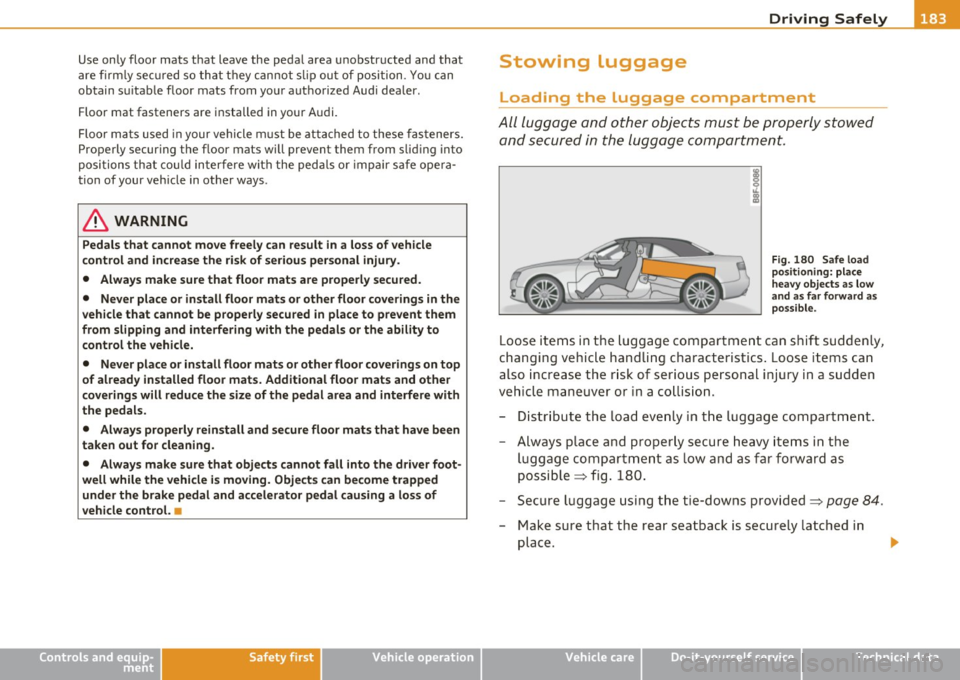
Fig . 180 Safe load
positioning: place
heavy objects as low
and as far forward as
possible.
Loose items in the luggage compartment can shift suddenly,
changing vehicle handling characteristics. Loose items can
also increase the risk of serious personal injury in a sudden
vehicle maneuver or in a collision.
- Distribute the load evenly in the luggage compartment.
- Always place and properly secure heavy items in the
luggage compartment as low and as far forward as
possible => fig. 180.
- Secure luggage using the tie-downs provided=>
page 84.
-Make sure that the rear seatback is securely latched in
place .
Vehicle care Do-it-yourself service Technical data
Page 187 of 364
________________________________________________ D_ r_ i_ v _i_n ""'g "-- S_a_ f_ e_ l _,,y'-- __
the driver's s ide B-pillar. The tire pressure label lists the recom
mended co ld tire in flatio n press ures fo r th e ve hicle at its max imum
capacity weight and the tires that were on your vehicle at the time it
was manufactured . For recommended tire press ures for normal loa d
conditions, p lease see chapte r=>
page 300. •
Tie-downs
The luggage compartment is equippe d with four tie
do wns to sec ure lu gga ge a nd oth er items.
Use the t ie-downs to sec ure yo ur cargo properly=> page 183,
"Lo ad ing t he lugg age comp artmen t".
In a co llision, the laws of physics mean that even sma ller it ems that
are loose in the vehicle will become heavy missiles that can cause
ser iou s injury. Ite ms i n t he vehi cle pos se ss e ne rgy w hich va ry w it h
vehicle speed and the we ight of the item. Vehicle speed is t he most
s ig nifi ca nt f acto r.
For examp le, in a frontal coll is io n at a speed of 30 mph (48 km/h),
the forces acting on a 1 0-lb (4. 5 kg) object are a bout 20 times t he
normal weig ht o f the item. T his means that t he weight o f the ite m
wou ld s uddenly be a bo ut 200 lbs. (90 kg) . You can imagine the inju
r ies tha t a 200 lbs . (9 0 kg) item fly ing free ly throug h the p ass enge r
compartment cou ld cause i n a collision lik e this .
& WARNING
Weak , damaged or improper straps used to secure item s to tie
downs can fail during hard braking or in a collision and cause
serious personal injury.
• Always use suitable mounting straps and properly secure items
to the tie-downs in the luggage compartment to help prevent
items from shifting or flying forward as dangerous missiles.
• When the rear seat backre st is folded down, always use suit
able mounting straps and properly secure items to the tie-downs
Controls and equip ment Safety first Vehicle operation
& WARNING
(co ntinued )
in the luggage compartment to help prevent items from flying
forward as dangerous missiles into the passenger compartment.
• Never attach a child safety seat tether strap to a tie -down. •
Reporting Safety Defects
Applicable to U.S.A.
If you believe that your vehi cle has a defect
which could cause a crash or could cause injury
or death , you should immediately inform the
National Highway Traffic Safety Administration
(NHTSA) in addition to notifying Audi of
America, Inc.
If NHTSA receives similar complaints, it may
open an investigation, and if it find s that a
safety defe cts exist s in a group of vehicles, it
may o rder a recall and remedy campaign.
However , NHTSA cannot become involved in
individual problems between you, your dealer,
or Audi of America, Inc.
To contact NHTSA, you may call the Vehicle
Safety Hotline toll-free at:
Tel.: 1-888-327-4236 (TTY: 1-800-424-9153)
or write to:
Administrator
Vehicle care Do-it-yourself service Technical data
Page 189 of 364
• two rollbars
• the safety belts with belt tensioners
• the windshield frame
• the rollover sensors
The active rollover protection system provides additional safety in the
event of a ro llover. Within milliseconds, sensors deploy two rollbars
located behind the headrests in the rear seats => fig. 182.
The rollbars, reinforced windshie ld frame and belt tensioners help
protect front and rear passengers in the event of a rollover .
The rollover protection system functions when the power top is both
open and closed.
& WARNING
Do not use the area behind the rear seat headrests=> fig. 181 as a
storage area. This is the area where the rollbars deploy. If the roll
over protection system is triggered, objects placed there can be
propelled through the vehicle and make it more difficult for the
rollbars to deploy . This increases the risk for serious or life-threat
ening injuries . •
When Is rollover protection deployed?
Rollover protection deploys in a collision or rollover.
Depending on the collision, sensors throughout the vehicle and the
control module trigger the rollover system to deploy.
For safety reasons, rollover protection also deploys during front, side
and rea r collisions above a certain level of severity .•
Safety first Vehicle OP-eration
Driving Safely
Retracting rollover protection
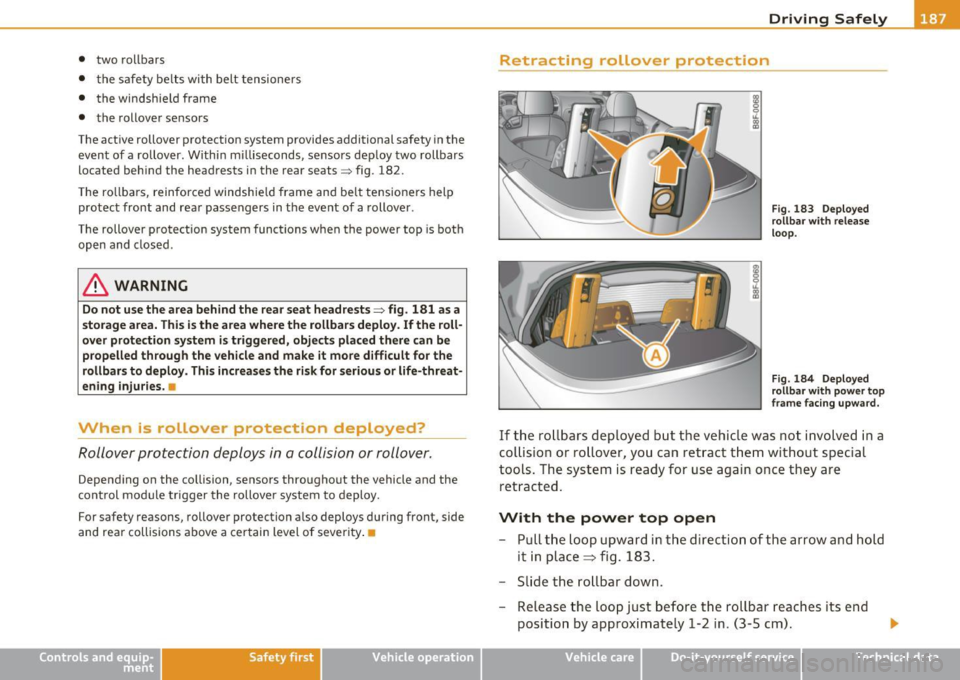
Fig. 183 Deployed
rollbar with release
loop.
Fig. 184 Deployed
rollbar w ith power top
frame facing upward.
If the rollbars deployed but the vehicle was not involved in a
collision or rollover, you can retract them without special
tools . The system is ready for use again once they are
retracted.
With the power top open
- Pull the loop upward in the direction of the arrow and hold
it in place=> fig. 183.
- Slide the rollbar down.
- Release the loop just before the rollbar reaches its end
position by approximately 1-2 in. (3-5 cm). •
Vehicle care Do-it-yourselt service Technical data