warning light AUDI A5 CABRIOLET 2011 Repair Manual
[x] Cancel search | Manufacturer: AUDI, Model Year: 2011, Model line: A5 CABRIOLET, Model: AUDI A5 CABRIOLET 2011Pages: 364, PDF Size: 86.48 MB
Page 180 of 364
• ....__D_ r_iv _i_ n_, g=-- S_ a _ f_e _,Ly _ ______________________________________________ _
Proper occupant seating positions
Proper seating position for the driver
The proper driver seating position is important for safe,
relaxed driving.
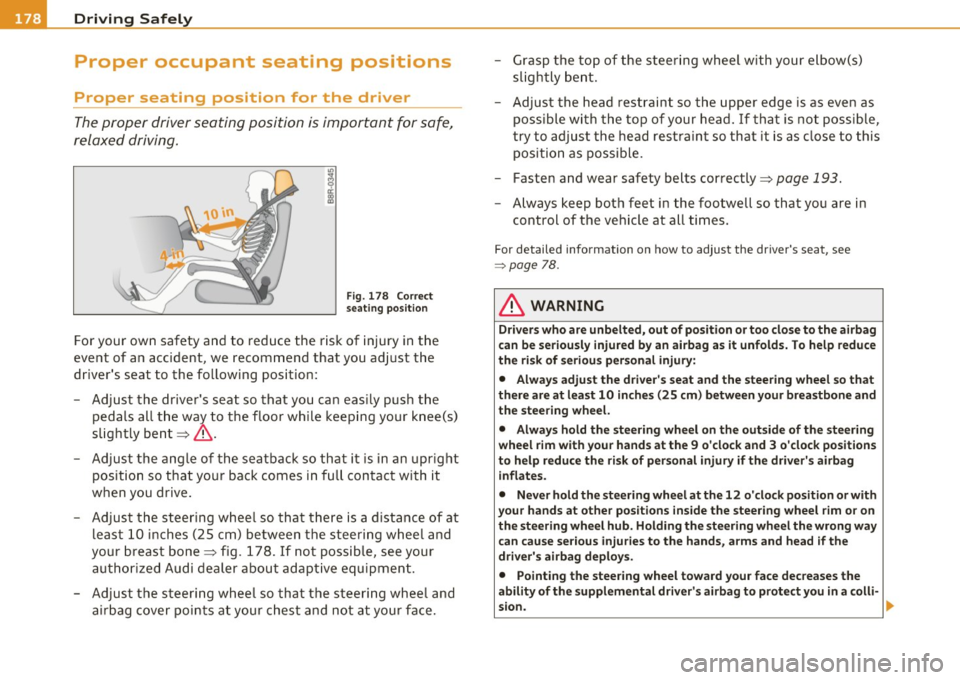
Fig. 178 Correct
seating position
For your own safety and to reduce the risk of injury in the
event of an accident, we recommend that you adjust the
driver's seat to the following position:
- Adjust the driver's seat so that you can easily push the
pedals all the way to the floor while keeping your knee(s)
slightly bent~& .
- Adjust the angle of the seatback so that it is in an upright
pos ition so that your back comes in full contact with it
when you drive.
- Adjust the steering wheel so that there is a distance of at least 10 inches (25 cm) between the steering wheel and
your breast bone~ fig . 178. If not possible, see your
authorized Audi dealer about adaptive equipment.
- Adjust the steering wheel so that the steering wheel and airbag cover points at your chest and not at your face. -
Grasp the top of the steering wheel with your elbow(s)
slightly bent.
- Adjust the head restraint so the upper edge is as even as
possible with the top of your head. If that is not possible,
try to adjust the head restraint so that it is as close to this
position as possible.
- Fasten and wear safety belts correctly~
page 193.
-Always keep both feet in the footwell so that you are in
control of the vehicle at all t imes.
F o r deta iled informat ion on how to adjust the d river 's seat, see
=:> page 78.
& WARNING
Drivers who are unbelted, out of position or too close to the airbag
can be seriously injured by an airbag as it unfolds. To help reduce
the risk of serious personal injury:
• Always adjust the driver's seat and the steering wheel so that
there are at least 10 inches (25 cm) between your breastbone and
the steering wheel.
• Always hold the steering wheel on the outside of the steering
wheel rim with your hands at the 9 o'clock and 3 o'clock positions
to help reduce the risk of personal injury if the driver's airbag
inflates.
• Never hold the steering wheel at the 12 o'clock position or with
your hands at other positions inside the steering wheel rim or on
the steering wheel hub. Holding the steering wheel the wrong way
can cause serious injuries to the hands, arms and head if the
driver's airbag deploys.
• Pointing the steering wheel toward your face decreases the
ability of the supplemental driver's airbag to protect you in a colli-
sion.
~
Page 191 of 364
_____________________________________________ S_a _f _e _t _y _b_ e_lt _ s __ _
Safety belts
General notes
Always wear safety belts!
Wearing safety belts correctly saves lives!
This chapter explains why safety belts are necessary, how
they work and how to adjust and wear them correctly.
- Read all the information that follows and heed all of the
instructions and WARNINGS.
& WARNING
Not wearing safety belts or wearing them improperly increases
the risk of serious personal injury and death.
• Safety belts are the single most effective means available to
reduce the risk of serious injury and death in automobile acci
dents. For your protection and that of your passengers, always
correctly wear safety belts when the vehicle is moving.
• Pregnant women, injured, or physically impaired persons must
also use safety belts. Like all vehicle occupants, they are more
likely to be seriously injured if they do not wear safety belts. The
best way to protect a fetus is to protect the mother -throughout
the entire pregnancy. •
Number of seats
Your Audi has a total of four seating positions: two in the front and
two in the rear . Each seating position has a safety belt .
Controls and equip
ment Safety first Vehicle operation
& WARNING
Not wearing
safety belts or wearing them improperly increases
the risk of serious personal injury and death.
• Never strap more than one person, including small children,
into any belt. It is especially dangerous to place a safety belt over
a child sitting on your lap.
• Never let more people ride
in the vehicle than there are safety
belts available.
• Be sure everyone riding in the vehicle is properly restrained
with a separate safety belt or child restraint. •
Safety belt warning light t
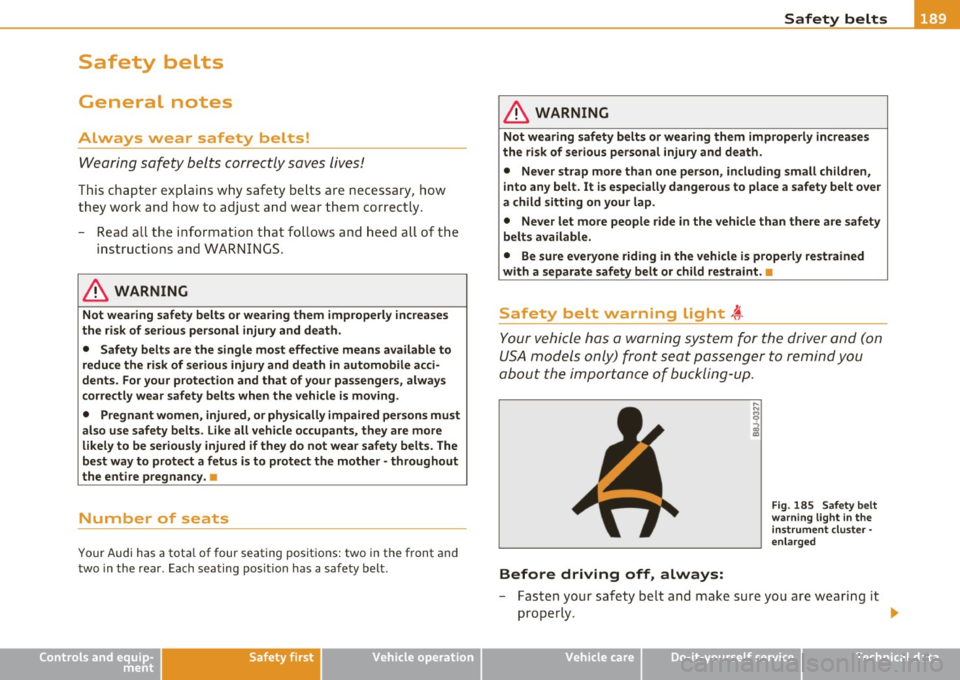
Your vehicle has a warning system for the driver and (on
USA models only) front seat passenger to remind you
about the importance of buckling-up.
Before driving off, always:
Fig. 185 Safety belt
warning light in the
instrument cluster -
enlarged
- Fasten your safety belt and make sure you are wearing it
properly .
IJ,,
Vehicle care Do-it-yourself service Technical data
Page 192 of 364
___ S_a_ f_ e_ t-= y'-- b_e_ l_ t _s _____________________________________________ _
- Make sure that your passengers also buckle up a nd prop
erly wear their safety belts .
- Protect your children wi th a child restraint system appro-
p ria te for the siz e and age of th e ch ild ren.
The warn ing light ~ in the instrument cluster lights up when the igni
tion is sw itched on as a reminder to fasten the safety belts. In addi
tion, you w ill hear a warning tone for a certa in period of t ime ..
Fasten your safety belt now and m ake sure that your passengers
also properly put on their safety belt s.•
Why safety belts?
Frontal collisions and the Law of physics
Frontal crashes c reate very s trong f orces for people
riding in vehicles.
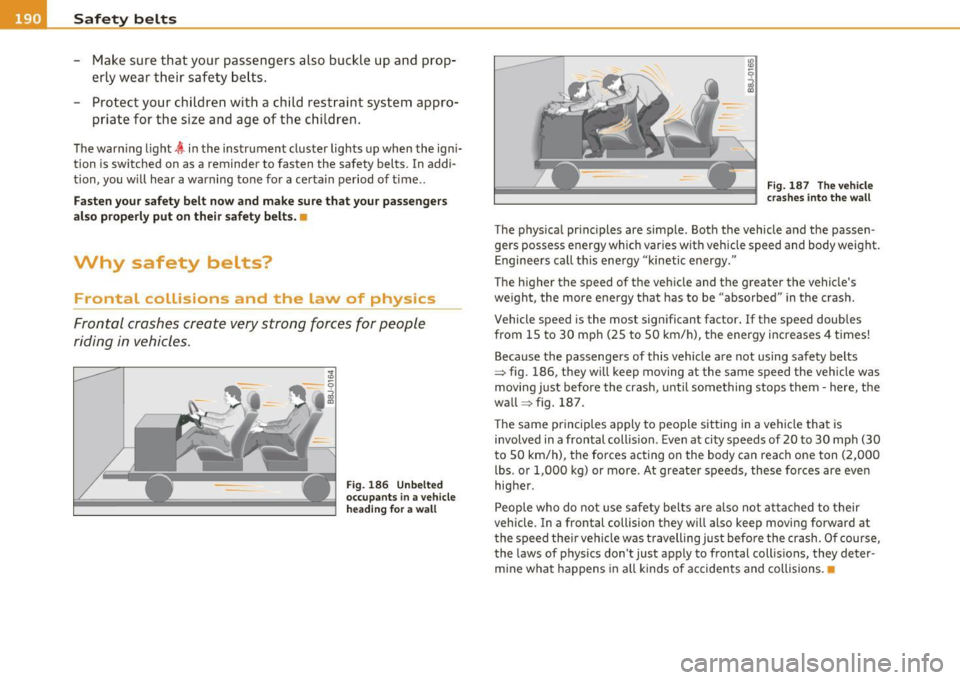
Fig . 18 6 Unbelted
occu pa nt s in a v ehi cle
h ea ding f or a w all Fig. 18
7 The veh icl e
c ra she s into the wall
The p hys ica l pr inc iples are simple. Both the vehicle and the passen
gers possess energy wh ich var ies wit h veh icle speed and body weight.
Enginee rs call th is ene rgy "kinetic energy."
The higher the speed of the veh icle and the greater the vehicle's
we igh t, the more e ne rgy tha t has to be "abso rbed" in t he crash.
Vehicle speed is the most sign ificant factor.
If the speed doubles
from 15 to 30 mph (25 to 50 km/h), the energy increases 4 t imes!
Because the passenge rs of this vehicle a re not using safety belts
=> fig. 186, they w ill keep moving at the same speed the vehicle was
moving j ust before the crash, unt il some thing stops them· here, the
wall => fig . 187 .
Th e same principles apply to people sitting in a vehi cle that is
involved in a frontal collision . Even at city speeds of 20 to 30 mph (30
to 50 km/h), the forces acting on the body ca n reach one ton (2,000
lbs . or 1,000 kg) or mo re . At greate r speeds, these forces are eve n
higher.
People who do not use safety bel ts are also not at ta ched to their
vehicle . In a frontal collision they will also keep moving forward at
t he speed the ir veh icle w as t ravelling just befo re the crash. O f course,
the laws of p hys ics don 't just apply to frontal collis ions, they deter
mine wha t happens in a ll kinds of accidents and collisions .•
Page 196 of 364
-Safety belts ----------------
Fastening safety
belts
Seat first -everybody buc kle up!
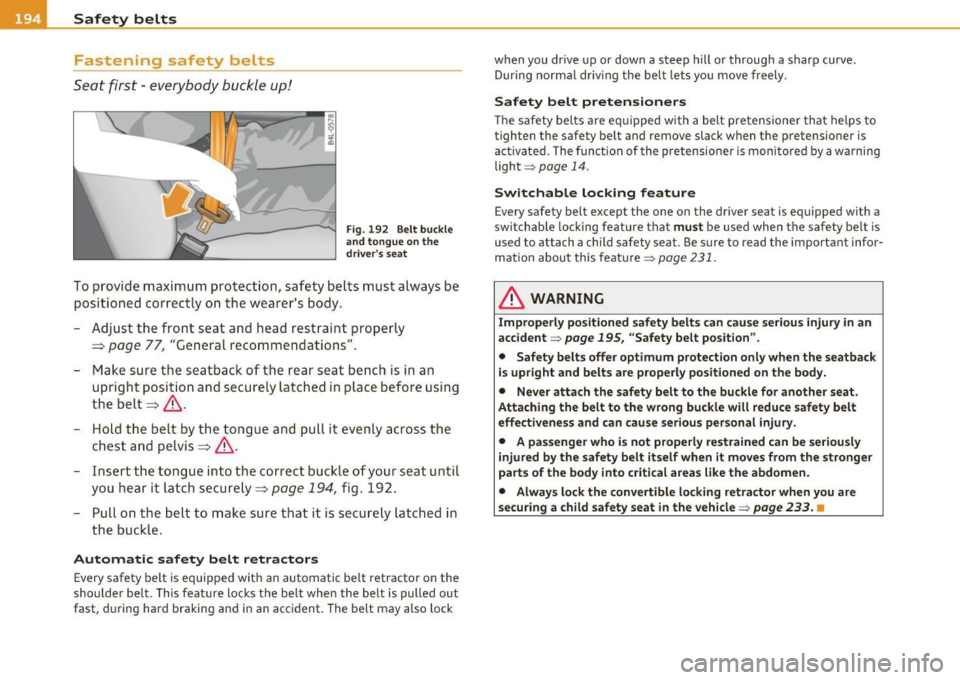
Fig. 192 Bel t buckl e
a n d ton gue on the
d riv er's se at
To provide maximum protection, safety belts must always be
posit ioned cor rectly on the wearer's body.
- Adjust the front seat and head restraint properly
=>
page 77, "General recommendat ions" .
- Make sure the seatbac k of the rear seat bench is in a n
upright posit ion and securely latched in place before using
the belt=> &.
- Hold the belt by the to ng ue and pu ll it evenly across t he
chest a nd pe lvis=> &.
- Insert the tongue into the corre ct buckle of your seat until
you hea r it latch secu re ly =>
page 194, fig. 192.
- Pull on the be lt to make sure t hat it is secure ly latched i n
the buckle.
Automatic safety belt retractor s
Every safety belt is equipped with an automatic be lt retractor on the
shoulder be lt . This feat ure locks the be lt when the belt is pulled out
fast, d uring hard braking and in an acc ident. The belt may also lock when you dr
ive up or down a steep hill or throug h a sharp curve .
Dur ing no rma l driv ing the be lt lets you move freely.
Safety belt pretensioners
The safety bel ts are eq uipped with a belt pretensioner tha t he lps to
tighten the safety be lt and remove slack when the pretensioner is
a cti vated. The fun ct ion of the pretensioner is mon itored by a w arning
light=>
page 14 .
Switchable locking feature
Every safety belt except the one on the driver seat is equ ipped with a
switchab le locking feature that
mu st be used when t he safety be lt i s
used to attach a chi ld safety seat. Be sure to read the important infor
mat ion abou t th is feat ure=>
page 231 .
& WARNING
Improperly po sitioned safety belts can cau se seriou s injury in an
accident
=> page 195 , "Safety belt position".
• Safety belts offer optimum protection only when the seatba ck
is upright and belts a re prope rly po sitioned on the body.
• Never attach the safety belt to the buckle f or another seat .
Attach ing the belt to the wrong buckle will reduce safet y belt
effectivenes s and can cau se seriou s personal injury.
• A passenger who i s not p rope rly restrained can be ser iousl y
injured by the safety belt it self wh en it move s from the stronger
parts of the body into critical areas like the abdomen.
• Always lock the convertible locking retractor when you are
s ecuring a child safety seat in the vehicle =>
page 233. •
Page 204 of 364
___ A_ i_r _b _a _, g,:;._ s_, y._ s _ t_e _m ________________________________________________ _
defined in the elect ronic contro l unit~ page 211, "PASSE NGER AIR
BA G OFF l ight ".
Always r emembe r, a c hild safety seat o r infa nt ca rr ie r i nsta lled on th e
fro nt seat may be struc k and k noc ke d out of position by t he ra pidly
i nflat ing pass enge r's air ba g in a fr ontal c oll ision. Th e airba g could
g reat ly re duce the effectiveness o f th e ch ild restraint an d even seri
ousl y injur e th e child d uring inf lation .
For this r easo n, and b eca use the back seat is th e sa fest plac e for chil
dre n -whe n pro per ly restra ined acc ordin g to their age and size -we
s tr ong ly r ecommen d that childr en a lways sit in the back s eat
~ pa ge 22 1, "Child S afety".
& WARNING
A child in a rearward -facing child safety seat installed on the front
passenger seat will be seriously injured and can be killed if the
front airbag inflates - even with an Advanced Airbag System.
• The inflating airbag will hit the child safety seat or infant
carrier with great force and will smash the child safety seat and
child against the backrest, center armrest, door or roof .
• Always install rear-facing child safety seats on the rear seat.
• If you must install a rearward facing child safety seat on the
front passenger seat because of exceptional circumstances and
the PASSENGER AIR BAG OFF light does not come on and stay on,
immediately install the rear-facing child safety seat in a rear
seating position and have the airbag system inspected by your
authorized Audi dealer.
• Forward-facing child safety seats installed on the front
passenger's seat may interfere with the deployment of the airbag
and cause serious personal injury to the child.
& WARNING
If , in exceptional circumstances , you must install a forward-facing
child restraint on the front passenger's seat:
& WARNING (continued)
• Always make sure the forward-facing seat has been designed
and certified by its manufacturer for use on a front seat with a
passenger front and side airbag.
• Never put the forward-facing child restraint up against or very
near the instrument panel.
• Always move the passenger seat into its rearmost position in
the seat's fore and aft adjustment range, as far away from the
airbag as possible before installing the forward-facing child
restraint. The backrest must be adjusted to an upright position.
• Make sure that the PASSENGER AIR BAG OFF light comes on
and stays on all the time whenever the ignition is switched on.
& WARNING
To reduce the risk of serious injury, make sure that the PASSENGER AIR BAG OFF light will be displayed whenever a child
restraint is installed on the front passenger seat and the ignition
is switched on .
• If the PASSENGER AIR BAG OFF light does not stay on, perform
the checks described~
page 210, "Monitoring the Advanced
Airbag System ".
• Take the child restraint off the front passenger seat and install
it properly at one of the rear seat positions if the PASSENGER AIR
BAG OFF light does not stay on .
• Have the airbag system inspected by your authorized Audi
dealer immediately.
• Always carefully follow instructions from child restraint manu
facturers when installing child restraints.
& WARNING
If , in exceptional circumstances , you must install a forward or
rearward-facing child restraint on the front passenger 's seat:
Page 207 of 364
_________________________________________________ A_ ir_ b_ a_,,g :;..__ s-=y '"- s_ t_ e_ m __ _
listing of the child restraints that were used to certify your vehicle's
compliance with the US Safety Standard ~
page 22 3,
• weight less than a threshold level sto red in the contro l unit is
de tected o n the front p assenge r seat.
When a person is detected on t he front passenger seat, weigh ing
more tha n the tota l we ight of a child that is about 1 year old
restra ined in one of the rear-facing or forward-fac ing infant
restraints (listed in Federal Motor Ve hicle Safety Standard
208 with
w hich t he Advan ced Ai rbag System in your veh icle was cert ified), the
front airbag on the passenger s ide may or may not dep loy.
T he
PASSENGER AIR BAG OFF ligh t comes on when the elect ronic
control u nit detects a tota l weig ht on the front passenger seat that
req uires the front airbag to be turned off . If the
PASSENGER AIR
BAG OF F
light does not come on, the front airbag on the passenger
side has not been turned off by the control unit and can deploy if the
cont rol un it senses an impact that meets the conditions stored in its
memory.
If the tota l we ight on the fro nt passenger sea t is more than th at of a
typical
1 year-o ld, but less than the weight of a small adult, the front
airbag on the passenger side may dep loy (the
PASSENGER AIR BAG
OFF
light does not come on) .
For example, the airb ag may deploy if:
• a small child that is heav ie r than a typical 1 year-old child is on the
front passenger seat (regard less of whether the ch ild is in one of the
child safety seats listed ~
page 223),
• a child who has outgrown child restra ints is on the front passenger
sea t.
If the front passenger a irbag is turned off, the
PASSENGER AIR BAG
OFF
light in the center of the instr ument panel will come on and stay
on .
The front airbag on the passenger side may
not dep loy (the
PASSENGER AIR BAG OFF li ght does not i llumi nate and s tay lit) if:
• a small adult or teenager is on the front passenger seat
Controls and equip
ment Safety first Vehicle operation
•
a passenger w ho is not sitt ing uprig ht with their back against a
non-recline d backrest wi th t he ir feet on the veh icle floor in fro nt o f
the seat is o n the fro nt passenger seat.
If the front passenger airbag dep loys, the Federa l Standard requires
t he a irbag to mee t the " low ris k" deployment c riter ia to help reduce
the risk of injury through interaction with the a irbag. "Low risk"
dep loyment oc curs in those c rashes that ta ke p lace at lowe r de cele r
ations as defined in the electronic contro l unit.~
page 210
Alw ays remember: Even tho ugh your vehicle is eq uipped with
Advanced A irbags, the safest place for children is properly restrained
on the back seat. Please be sure to read the important information in
the sections t hat follow and be su re to heed all of the WAR NINGS.
& WARNING
To reduc e the ri sk of injury w hen an airbag inflate s, alwa ys w ear
safet y belt s properly .
• If you are unrestrained, leaning forward , sitting sidewa ys or
out of po sition in any way , your ri sk of injury i s much high er.
• You will also recei ve serious injurie s and could even be killed if
you are up again st the airbag or too close to it wh en it inflates -
e ven with an Ad vanced Airbag ~
page 199.
& WARNING
A child in a rearward-facing child safety seat installed on the front
pa ssenger seat will be seriou sly injured and can be killed if the
front a irbag inflates · even with an Advanced Airbag System .
• Although the Ad vanced Airb ag System in your v ehicle is
designed to turn off the front airbag when a rearward-facing child
re straint has been installed on the front pas senger seat , nobody
c an absolut ely guarantee th at deployment is impo ssible in all
c onceivable situation s that may happen during the u seful life of
your vehicle. _,.
Vehicle care Do-it-yourself service Technical data
Page 208 of 364
ffl..,___A_ i_rb _ a_,g,:;._ s_, y'- s_ t_e _m ________________________________________________ _
& WARNING (conti nued)
• The inflating ai rbag will hit the child safety seat or infant
carrier with gr eat force and will sma sh the child safety seat and
c hild again st the backrest , center armrest , door , or roof.
• Alway s install rearward-facing child restraints in the back seat.
• If you must install a rearward facing child safety seat on the
front passenger seat because of e xceptional circumstances and
the PASSENGER AIR BAG OFF light does not come on and stay on ,
immediately install the rear-facing child safety seat in a rear
s eating po sition and have the airbag system inspected by your
authorized Audi dealer .
& WARNING
If, in except ional circumstances, you must install a forward-facing
child restraint on the front pas senger' s seat:
• Always make sure the forward-fac ing se at has been designed
and certified by its manufacturer for u se on a front seat with a
passenger front and side airbag.
• Never put the forward -facing child restraint up against or very
near the instrument panel.
• Alway s move the passenger seat into it s rearmost position
in
the seat 's fore and aft adjustment range, as far away from the
airbag a s possible, before in stalling the forward -facing child
restraint. The back rest must be adjusted to an upright position.
• Make sure that the PASSENGER AIR BAG OFF light comes on
and stays on all the t ime whenever the ignition is switched on .•
Advanced Airbag System components
Th e front passenger seat in your veh icle has a lot of very important
parts of t he A dvanced A irbag System in it. These parts incl ude t he
we ight-sens ing mat, sensors, wiring, brackets, and more. The func- tion of the system
in the front passenger seat is checked by the elec
t ronic c ontro l unit w hen the ignitio n is o n. The contr ol unit mon itors
t he Advanced Airbag System and tu rns the airbag indicato r light o n
w hen a malfunction in t he system components is detected. The func
t ion of the a irbag indicator light is descr ibed in greater deta il below .
Because the front passenge r seat co nta ins impo rtant parts of t he
Adva nced Ai rbag System, you must ta ke care to p reve nt i t from be ing
damaged. Damage to the seat may p revent the A dvanced A irbag for
t he fro nt passenge r se at from do ing its job in a crash.
The front Advanced Airbag System consists of the
following:
• Cras h sensors in the front of t he vehicle that measu re vehicle
a cc ele ration/de ce le ra tion to provi de i nfo rm ation to the Advanced
Airbag System about the severity of the crash .
• An e lec tron ic contro l unit, w it h i ntegrated crash sensors fo r front
and side impacts. The contro l unit "dec ides" w het her to fire the front
a irbag s based o n the inform ation receive d fro m t he c rash se nso rs.
The contro l unit also "decides" whether the safety be lt pretens ioners
shoul d be activ at ed .
• An Advanced Air bag with gas generator and control va lve for the
dr ive r in side t he steering wheel hub.
• An Advanced Air bag with gas generator and control va lve inside
t he inst rument pa ne l for the fron t passenge r.
• A weight-sensi ng mat unde r th e up ho ls tery pad ding of the front
passenger s eat cushion that measures the tota l we igh t on the seat .
Th e informat io n registered is sent continuous ly to the elect ronic
con trol unit to regulate deployment of t he front Advanced A irbag o n
the passenger side.
• An airbag mon itoring system a nd ind icator light in the ins trument
cl uster => page
210 .
• A senso r in each front seat reg isters the distance between the
res pective sea t and t he steeri ng whee l o r i nst rument p ane l. T he
info rmation reg iste red is sent co ntin uously to the e lectronic con trol
uni t to reg ulate dep loyment of the front Advanced Air bags . ..,
Page 209 of 364
_______________________________________________ A_ ir_ b_ a_,,,g ~ s,,._y _s _t_ e _ m ___ lJ'II
• The PASSENGER AIR BAG OFF light comes on and stays on in the
c en ter o f the inst ru me nt pane l=>
page 211, fig. 199 a nd t ells you
when the front Advanced A irbag on t he passe nger side has been
t u rne d off.
• A sensor below the safety belt latch for the front seat passenger
t o meas ure t he tension on t he s afety be lt. T he tension on the s afety
belt and the we ight registe red by the weight-sensing mat help t he
cont rol unit " deci de" whether the front a irbag for the front
passenge r seat should be tur ned off o r not=>
page 201, "C hild
restraints on the front seat -some important things to know".
• A se nso r in the safety bel t latch for the driver a nd fo r the front
seat passenge r that senses whether that safety belt is latched or not
and transmits this information to t he e lec tron ic control un it .
& WARNING
Damage to the front passenger seat can prevent the front airbag
from working properl y.
• Improper repair or disassembly of the front passenger and
driver seat will prevent the Advanced Airbag System from func
tioning properly.
• Repairs to the front pa ssenger seat must be performed by qual
ified and properly trained workshop personnel.
• Never remove the front passenger or driver seat from the
vehicle.
• Never remove the upholstery from the front passenger seat .
• Never disassemble or remove parts from the seat or disconnect
wires from it .
• Never carry sharp objects in your pockets or place them on the
seat . If the weight-sensing mat in the passenger seat is punctured
it cannot work properly.
• Never carry th ings on your lap or carry objects on the passenger
seat. Such items can in crease the weight registered by the weight
sensing mat and send the wrong information to the airbag control
unit.
Controls and equip ment Safety first Vehicle operation
& WARNING
(co ntinued )
• Never store item s under the front passenger seat . Parts of the
Advanced Airbag Sy stem under the passenger seat could be
damaged , preventing them and the airb ag system from working
properly .
• Never place seat covers or replacement upholstery that have
not been specifically approved by Audi on the front seats .
• Seat cover s can prevent the Advanced Airbag System from
recognizing child re straints or occupants on the front passenger
seat and prevent the side airbag in the seat backrest from
deploying properly .
• Never u se cushions, pillow s, blankets or similar items on the
front passenger seat. The additional padding will prevent the
weight-sensing mat in the seat from ac curately registering the
child restraint or person on the seat and prevent the Advanced
Ai rbag System from functioning properly .
• If you must use a child restraint on the front passenger seat
and the child restraint manufacturer's instructions require the use
of a towel, foam cushion or something else to properly position
the child restraint, make certain that the PASSENGER AIR BAG
OFF light comes on and stays on whenever the ch ild restraint is
installed on the front passenger seat.
• If the PASSENGER AIR BAG OFF light does not come on and
stay on, immediately install child restraint in a rear seating posi
tion and have the airbag system inspected by your authorized Audi dealer. •
How the Advanced Airbag System
components work together
Th e fron t Adva nced A irbag System and t he side air bags supp lemen t
t he p ro tec tion offered by the front three- po int safety belts with
pretens ioners and load limiters and t he adjusta ble head restra ints to
help reduce the risk of injury in a w ide rang e of acc iden t and crash ..,.
Vehicle care Do-it-yourself service Technical data
Page 211 of 364
Airbag system --------------------------------------------- -=---=----
lowe r pa rts of the body . Front a irbags only supp lemen t th e t hree
po int saf ety b elt s in som e frontal col lisions in which t he vehicl e decel
erat io n is high en ough to d ep loy the a irbags.
Front airbags will not deploy:
• if the ignition is switched off w hen a cras h occ urs ,
• in side co llisions,
• in re ar- end collisions,
• in rollove rs,
• when t he cra sh d ecelera tion m easur ed by the airbag sys te m is le ss
than the min imum threshold needed fo r airbag deployme nt as reg is
t ere d by t he e lectr onic c ontrol u nit.
The front passenger airbag will also not deploy:
• when t he fro nt p ass eng er s eat i s not o ccupi ed,
• when the weight on the front passenge r seat as sense d by the
A dvanc ed Airba g Sy stem indicat es that t he front a irbag o n the
passenge r s id e has to be turned off by the e lectro nic con trol unit (the
PASSENGER AIR BAG OFF lig ht c om es on an d sta ys on).
& WARNING
Sitting in the wrong position can increase the risk of serious injury
in crashes.
• To reduce the risk of injury when the airbags inflate, the driver
and passengers must always sit in an upright position , must not
lean against or place any part of their body too close to the area
where the airbags are located.
• Occupants who are unbelted, out of position or too close to the
airbag can be seriously injured by an airbag as it unfolds with
great force in the blink of an eye=>
page 201.
Controls and equip
ment Safety first Vehicle operation
& WARNING
A child in a rearward-facing child safety seat installed on the front
passenger seat will be seriously injured and can be killed if the
front airbag inflates - even with an Advanced Airbag System.
• The inflating airbag will hit the child safety seat or infant
carrier with great force and will smash the child safety seat and
child against the backrest, center armrest, door or roof.
• Always install rear-facing child safety seats on the rear seat.
• If you must install a rearward facing child safety seat on the
front passenger seat because of exceptional circumstances and
the PASSENGER AIR BAG OFF light does not come on and stay on,
immediately install the rear-facing child safety seat in a rear
seating position and have the airbag system inspected by your
authorized Audi dealer.
& WARNING
Objects between you and the airbag will increase the risk of injury
in a cra sh by interfering with the way the airbag unfolds or by
being pushed into you as the airbag inflates.
• Never hold things in your hands or on your lap when the vehicle
is in use.
• Never transport items on or in the area of the front passenger
seat. Objects could move into the area of the front airbags during
braking or other sudden maneuver and become dangerous projec
tiles that can cause serious personal injury if the airbags inflate .
• Never place or attach accessories or other objects (such as
cupholders, telephone brackets, large , heavy or bulky objects) on
the doors, over or near the area marked "AIRBAG " on the steering
wheel , instrument panel, seat backrests or between those areas
and yourself. These objects could cause injury in a crash, especially
when the airbags inflate .
• Never recline the front passenger's seat to transport objects .
Items can also move into the area of the side airbag or the front
IIJ,,
Vehicle care Do-it-yourself service Technical data
Page 212 of 364
........ _A_ i_rb _ a_,g,:;._ s_, y'- s_ t_e _m ________________________________________________ _
& WARNING (conti nued)
airbag during braking or in a sudden maneu ver. Objects ne ar the
airbag s can b ecome proje ctiles and cause injury, particularly when
the seat is reclined .
& WARNING
The fine dust created when airbag s deploy can cau se breathing
problem s for people with a history of asthma or other breathing
cond itions.
• To reduce the r isk of br eathing problem s, those with asthma or
other respiratory conditions should get fresh air right away by
getting out of the vehicle or opening window s
or doors.
• If you are
in a collision in which airbags deploy, wash your
hands and face with mild soap and water before eating.
• Be careful not to get the dust into your eyes, or into any cuts or
scratches.
• If the residue should get into your eyes, flush them with
water. •
Monitoring the Advanced Airbag
System
Airbag monitoring indicator light tfG
Two separa te indi cat ors m onit or the funct io n of the
Adv ance d Airb ag Sys te m : th e airb ag mo nit ori ng i nd icato r
lig ht a nd th e
PASSENGER AIR BAG OFF ligh t.
The Advanced Airbag System (including the e lectronic control unit,
sensor circui ts and system wi ring) is mo nit o red co ntinu ous ly to make
sure that it is f unction ing p roperly whenever the ignition is on. Each
t ime y ou tur n on the ignit ion, t he air bag mo nito ring in dicat or lig ht
W,
w ill come on for a few s econds (self diagnos tics) .
The system must be inspected when the indicator
light ~:
• does not come on when the ign ition is switched on,
• does not go o ut a few seconds a fter you have switched on the igni
tion, or
• co mes on while driving.
If an airbag system malfunction is detected, the indicator light w ill
fi rst start flashing to catch t he d river's attention and then stay on
cont inuous ly to serve as a co nstant rem inder to have the system
inspected immediately .
If a m alfu n ct io n occur s that tur ns th e fron t airbag on the passenger
side off, the
PASSENGER AIR BAG OFF light will come on and stay on
whe never the ignition is on.
& WARNING
An airbag system that is not functioning properly cannot provide
supplemental protect ion in a frontal crash.
• If the airbag indicator light comes on, it means that there may
be something wrong with the Advanced Airbag System .
It is
possible that the airbag will inflate when it is not supposed to, or
will not inflate when it should.
• Have the airbag system inspected immediately by your autho
rized Audi dealer .•