top AUDI A5 CABRIOLET 2011 Manual PDF
[x] Cancel search | Manufacturer: AUDI, Model Year: 2011, Model line: A5 CABRIOLET, Model: AUDI A5 CABRIOLET 2011Pages: 364, PDF Size: 86.48 MB
Page 192 of 364
___ S_a_ f_ e_ t-= y'-- b_e_ l_ t _s _____________________________________________ _
- Make sure that your passengers also buckle up a nd prop
erly wear their safety belts .
- Protect your children wi th a child restraint system appro-
p ria te for the siz e and age of th e ch ild ren.
The warn ing light ~ in the instrument cluster lights up when the igni
tion is sw itched on as a reminder to fasten the safety belts. In addi
tion, you w ill hear a warning tone for a certa in period of t ime ..
Fasten your safety belt now and m ake sure that your passengers
also properly put on their safety belt s.•
Why safety belts?
Frontal collisions and the Law of physics
Frontal crashes c reate very s trong f orces for people
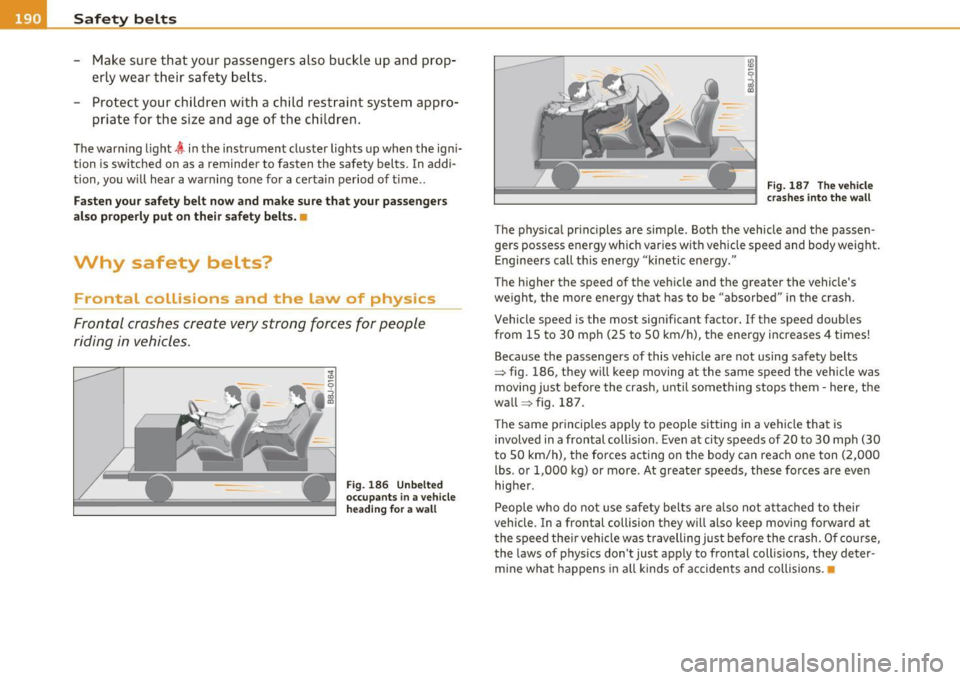
riding in vehicles.
Fig . 18 6 Unbelted
occu pa nt s in a v ehi cle
h ea ding f or a w all Fig. 18
7 The veh icl e
c ra she s into the wall
The p hys ica l pr inc iples are simple. Both the vehicle and the passen
gers possess energy wh ich var ies wit h veh icle speed and body weight.
Enginee rs call th is ene rgy "kinetic energy."
The higher the speed of the veh icle and the greater the vehicle's
we igh t, the more e ne rgy tha t has to be "abso rbed" in t he crash.
Vehicle speed is the most sign ificant factor.
If the speed doubles
from 15 to 30 mph (25 to 50 km/h), the energy increases 4 t imes!
Because the passenge rs of this vehicle a re not using safety belts
=> fig. 186, they w ill keep moving at the same speed the vehicle was
moving j ust before the crash, unt il some thing stops them· here, the
wall => fig . 187 .
Th e same principles apply to people sitting in a vehi cle that is
involved in a frontal collision . Even at city speeds of 20 to 30 mph (30
to 50 km/h), the forces acting on the body ca n reach one ton (2,000
lbs . or 1,000 kg) or mo re . At greate r speeds, these forces are eve n
higher.
People who do not use safety bel ts are also not at ta ched to their
vehicle . In a frontal collision they will also keep moving forward at
t he speed the ir veh icle w as t ravelling just befo re the crash. O f course,
the laws of p hys ics don 't just apply to frontal collis ions, they deter
mine wha t happens in a ll kinds of accidents and collisions .•
Page 193 of 364
What happens to occupants not wearing
safety belts?
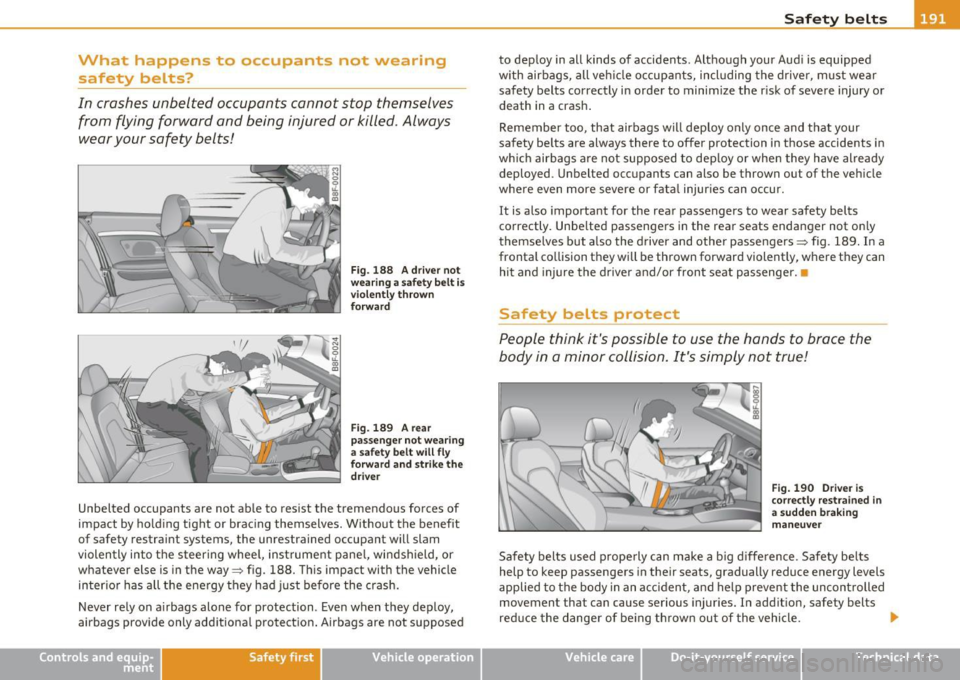
In crashes unbelted occupants cannot stop themselves from flying forward and being injured or killed. Always
wear your safety belts!
Fig. 188 A driver not
wearing a safety belt is
violently thrown
forward
Fig. 189 A rear
passenger not wearing
a safety belt will fly
forward and strike the
driver
Unbelted occupants are not able to resist the tremendous forces of
impact by holding tight or bracing themselves. Without the benefit
of safety restraint systems, the unrestrained occupant will slam
violently into the steering wheel, instrument panel, windshield, or
whatever else is in the way=:> fig. 188. This impact with the vehicle
interio r has all the energy they had just before the crash.
Never rely on airbags alone for protection . Even when they deploy,
airbags provide only additional protection. Airbags are not supposed
Safety first Vehicle OP-eration
Safety belts
to deploy in all kinds of accidents. Although your Audi is equipped
with airbags, all vehicle occupants, including the driver, must wear
safety belts correctly in order to minimize the risk of severe injury or
death in a crash.
Remember too, that airbags will deploy only once and that your
safety belts are always there to offer protection in those accidents in
which airbags are not supposed to deploy or when they have already
deployed . Unbelted occupants can also be thrown out of the vehicle
where even more severe or fatal injuries can occur.
It is also important for the rear passengers to wear safety belts
correctly. Unbelted passengers in the rear seats endanger not only
themselves but also the driver and other passengers=:> fig . 189. In a
frontal collision they will be thrown forward violently, where they can
hit and injure the driver and/or front seat passenger. •
Safety belts protect
People think it's possible to use the hands to brace the
body in a minor collision. It's simply not true!
Fig. 190 Driver is
correctly restrained in
a sudden braking
maneuver
Safety belts used properly can make a big difference. Safety belts
help to keep passengers in their seats, gradually reduce energy levels
applied to the body in an accident, and help prevent the uncontrolled
movement that can cause serious injuries. In addition, safety belts
reduce the danger of being thrown out of the vehicle. .,.
•
Vehicle care Do-it-yourselt service iTechnical data
Page 198 of 364
.. Safety belts PJWI _______________ _
-Hold the belt by the tongue and pull it evenly across the
chest and pelvis=> fig. 194, => & .
- Insert the tongue into the correct buckle of your seat until
you hear it latch securely=>
page 194, fig. 192.
- Pull on the belt to make sure that it is securely latched in
the buckle.
& WARNING
Improperly positioned safety belts can cause serious personal
injury in an accident.
• Expectant mothers must always wear the lap portion of the
safety belt as low as possible across the pelvis and below the
rounding of the abdomen.
• Always read and heed all WARNINGS and other important
information =:-
& in "Fastening safety belts" on page 194. •
Unfastening safety belts
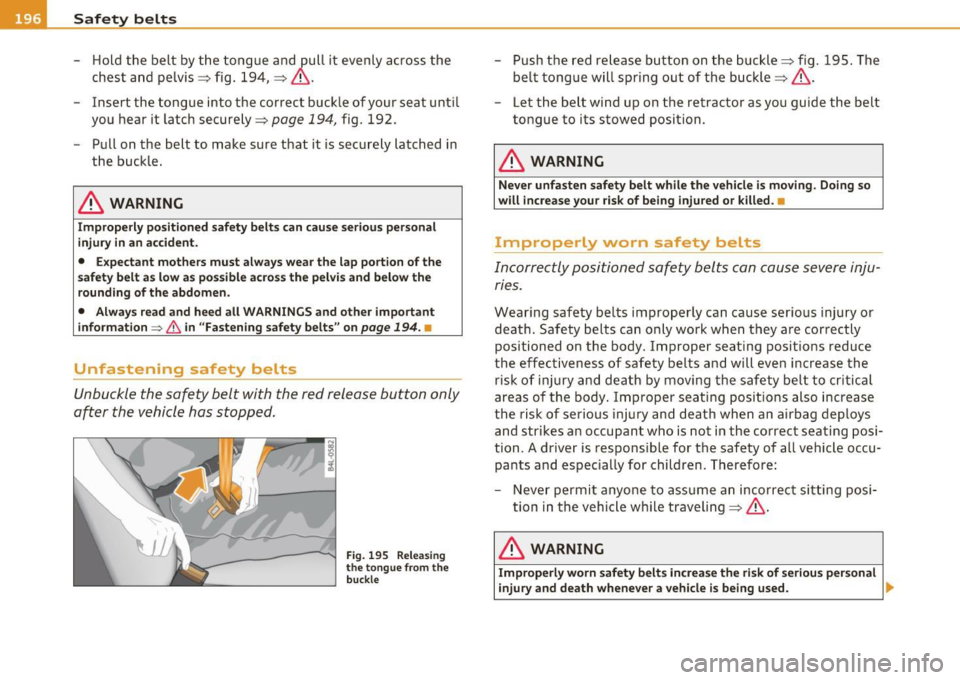
Unbuckle the safety belt with the red release button only
after the vehicle has stopped.
Fig. 195 Releasing
the tongue from the
buckle
-Push the red release button on the buckle=> fig. 195. The
belt tongue will spring out of the buckle=>& .
- Let the belt wind up on the retractor as you guide the belt
tongue to its stowed position .
& WARNING
Never unfasten safety belt while the vehicle is moving. Doing so
will increase your risk of being injured or killed.•
Improperly worn safety belts .
Incorrectly positioned safety belts can cause severe inju
ries.
Wearing safety belts improperly can cause serious injury or
death. Safety belts can only work when they are correctly
positioned on the body. Improper seating positions reduce
the effectiveness of safety belts and w ill even increase the
risk of injury and death by moving the safety belt to critical
areas of the body. Improper seating positions also increase
the risk of serious injury and death when an airbag deploys
and strikes an occupant who is not in the correct seating posi
tion. A driver is responsible for the safety of all vehicle occu
pants and especially for children . Therefore:
- Never permit anyone to assume an incorrect sitting posi
tion in the vehicle while traveling=>,& .
& WARNING
Improperly worn safety belts increase the risk of serious personal
injury and death whenever a vehicle is being used.
IJI,
Page 213 of 364
_______________________________________________ A_ ir_ b_ a_,,,g ~ s,,._y _s _t_ e _ m ___ _
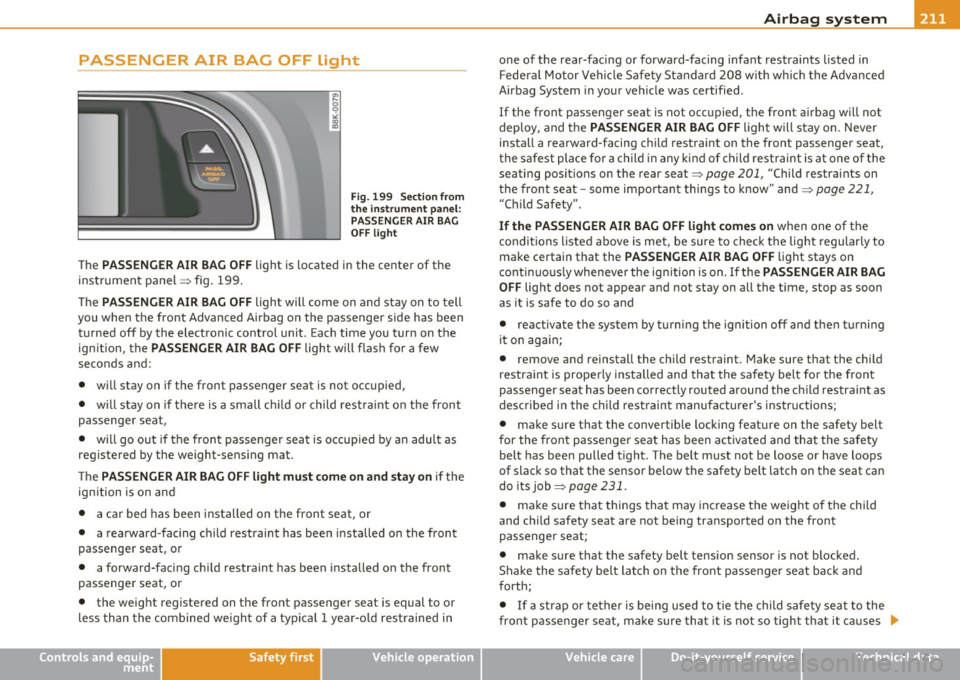
PASSENGER AIR BAG OFF light
Fig. 199 Section from
the in strument pa nel:
PASSENGER AIR BAG
OFF light
T he PASSENGER AIR BAG OFF light is located in the center of the
ins trume nt panel ~ fig. 199 .
Th e
PASSENGER AIR BAG OFF ligh t will come on and stay on to tell
you when the front Advanced Airbag on the passenger side has been
t ur ne d off by the ele ct ronic control unit. Each t ime you t urn on t he
ign ition, the
PASSENGER AIR BAG OFF light will flash fo r a few
se conds a nd:
• will stay on if t he front passenger seat is not occupied,
• will stay on if th ere is a small c hild or child re strain t on the front
passenger seat,
• will go ou t if th e fron t passe nger sea t is o ccup ied by an adul t as
registe red by t he weight-sens ing mat.
Th e
PASSENGER AIR BAG OFF light must come on and stay on if the
ign ition is on and
• a car bed has been insta lled on t he front seat, o r
• a rearward-facing c hild rest raint has been installed on the front
passenger seat, or
• a forward-faci ng chi ld restraint has bee n in stalled on the front
passenge rseat,or
• the weight reg istered on the front passenger seat is equal to or
less th an the co m bined we ig ht of a ty pical 1 year-o ld re strained in
Controls and equip
ment Safety first
Vehicle operation
one of the rear-facing or forward- facing infa nt restraints listed in
F ede ral Mo tor Ve hicl e Sa fe ty S tan dard 20 8 wit h w hich th e Adv anced
Airbag System in your vehicle was certified .
If the front passenger seat is not occ upied, the front a irbag w ill not
dep loy, and the
PASSENGER AIR BAG OFF l igh t will s tay o n. N ever
install a rearward -facing chi ld restraint on the front passenge r seat,
t he s afest pla ce f or a ch ild in any kind o f ch ild re st ra int is at one of the
seating positions on t he rear seat~
page 201, "Child restra ints on
t he fr ont sea t- som e impo rtant t hings to know" and ~
page 2 21,
"Ch ild Safety" .
If the PASSENGER AIR BAG OFF light comes on when one of t he
co ndi tion s list ed above is m et, be sur e to che ck the light re gu la rly to
ma ke certain that the
PASSENGER AIR BAG OFF lig ht stays on
con tinu ously wheneve r the ignition is o n.
If the PASSENGER AIR BAG
OFF
lig ht does not appear and not stay on all the t ime, stop as soon
as it is safe to do so and
• reactivate the system by turni ng the ignition off and then t urning
it on agai n;
• remove and reinstall the ch ild restraint. Make sure that the ch ild
restra in t is prope rly installed and tha t the sa fety belt fo r the fron t
passenger seat has bee n correctly routed around the c hild restra int as
desc rib ed in the c hild restraint manufacturer's i nstr uctions;
• make s ure that the convertib le loc kin g feature o n the safety belt
for the front passenge r seat has been a ct ivated and t hat t he safety
belt has bee n pulled t ight. The be lt must not be loose or have loops
of slac k so that the senso r be low t he safety belt latch on the seat ca n
do its job~
page 23 1.
• make s ure tha t thi ngs tha t may inc rease the wei ght o f th e chi ld
and c hild safety seat are not bei ng transported on the front
passenge r seat;
• make s ure that the safety belt tension sensor is not blocked.
S hake the sa fety belt la tch on the front passen ger seat back an d
fort h;
• If a strap or teth er i s be ing used to tie the chi ld sa fe ty se at to the
front passe nger seat, make sure that it is not so tight that it causes .,
Vehicle care Do-it-yourself service Technical data
Page 228 of 364
____ C_ h_ i _l_d _S_ a_f _e _ty ~ --------------------------------------------
& WARNING (cont inued)
• If exceptional circumstances require the use of a forward
facing child restraint on the front passenger's seat, the child's safety and well-being require that the following special precau
tions be taken:
-Make sure the forward-facing seat has been designed and
certified by its manufacturer for use on a front seat with a passenger front and side airbag.
- Always carefully follow the manufacturer's instructions
provided with the child safety seat or carrier.
- Always move the front passenger seat into the rearmost
position of the passenger seat's fore and aft adjustment range ,
and as far away from the airbag as possible before installing
the child restraint.
- Always make sure that nothing prevents the front
passenger's seat from being moved to the rearmost position in
its fore and aft adjustment range .
-Always make sure that the backrest is in the upright posi
tion .
• Always buckle the child safety seat firmly in place even if a
child is not sitting in it. A loose child safety seat can fly around
during a sudden stop or in a collision.
• Always read and heed all WARNINGS whenever using a child
restrained in a vehicle is being used~
page 189, "Safety belts ",
~ page 199 , "Airbag system " and ~ page 221, "Child Safety".
& WARNING
To reduce the risk of serious injury, make sure that the
PASSENGER AIR BAG OFF light comes on and stays on whenever a
child restraint is installed on the front passenger seat and the
ignition is switched on.
& WARNING (co ntinued )
• Take the child restraint off the front passenger seat and install
it properly at one of the rear seat positions if the PASSENGER AIR
BAG OFF light does not stay on .
• Have the airbag system inspected by your authorized Audi
dealer immediately.
& WARNING
A child in a child restraint installed with the LATCH lower anchor ages or with the standard safety belt on the rear seat may play
with unused rear seat safety belts and become entangled resulting in serious personal injury and even death.
• Always buckle unused rear seat safety belts out of reach of chil
dren in child seats and properly activate the convertible locking
retractor so that the child cannot unreel the safety belt from the
retractor. •
Page 233 of 364
_______________________________________________ C_ h_ il_d _ S_a _ f_ e _ t..,. Y :...._ __
& WA RNING (c on tinued )
• Always make sure the lap belt portion of the three-point belt is
worn snug and pa sses as low a s pos sible across the ch ild 's pelvis .
Never let the belt pass over the soft abdomen.
• Failure to properly route safety belts over a child's body will
c ause severe injurie s in an accident or other emergen cy situation
:::> page 189.
• Children on the front seat of any car, even with Advanced
Airbags, can be seriously injured or even killed when an airbag
inflates .
• Never let a child stand or kneel on any seat, for e xample the
front seat.
• Ne ver let a child ride in the cargo area of your vehicle .
• Alway s remember that a child leaning forward, sitting side
ways or out of position in any way during an accident can be struck
by a deploying airbag . This will result in seriou s personal injury or
death.
• If you must install a booster seat on the front pas senger seat
because of exceptional circumstances the PASSENGER AIR BAG
OFF light must come on and stay on, whenever the ignition is
switched on.
• If the PASSENGER AIR BAG OFF light does not come on and
stay on, perform the checks described=>
page 210, "Monitoring
the Advanced Airbag System ".
• Take the child restraint off the front passenger seat and install
it properly at one of the rear seat positions if the PASSENGER AIR BAG OFF light does not stay on wheneve r the ignition is sw itched
on.
• Always read and heed all WARNINGS whenever using a child
restrained in a vehicle i s being used =>
page 189, "Safety belts ",
=>
page 199 , "Airbag system " and => page 221, "Important
things to know ".•
Controls and equip ment Safety first Vehicle operation
lnstalli ng a child safety seat
Securing a child safety seat using a safety
belt
S
afety belts for the rear se ats an d the fro nt passen ger 's
seat can be l ock ed with th e conv ertible loc kin g ret ractor
to pro perly secur e ch ild safety seats.
T he safety belts emergency locking retractors for the rear seats
safety belts an d for the front passenge r's se at safety b elt hav e a
convertib le locking retractor for child restrai nts. The safety belt must
be locked so that belt webbing canno t unreel. The retra ctor can be
act ivated to lock the safety belt and prevent the safety belt webb ing
fr om loosen ing up du ring normal dr iv ing. A child sa fe ty sea t can on ly
be properly installed when the safety belt is locked so that the child
and child s afety sea t will s tay in place .
A lways r emembe r: Even tho ugh yo ur vehicle is equipped w ith a n
Advanced Air bag system, all ch ild ren, espec ia lly those 12 yea rs and
younge r, should always ride in t he back seat properly res tra ined for
their age and size.
& WARNING
Improperly installed child safety seats increase the risk of serious
personal injury and death in a collision.
• Always make sure that the safety belt retractor is locked when
installing a chi ld safety seat . An unlocked safety belt retractor
cannot hold the child safety seat in place during normal driving or
in a crash .
• Always buckle the child safety seat firmly in place even if a
child is not sitting in it. A loose child safety seat can fly around
during a sudden stop or in a collision.
• If the backrest is not securely latched, the child and the child
restraint will be thrown forward together with the backre st and
~
Vehicle care Do-it-yourself service Technical data
Page 235 of 364
Child Safety Ill
-------------------"'---
& WARNING (continued)
• A child in a rearward-facing child safety seat installed on the
front passenger seat will be seriously injured and can be killed if
the front airbag inflates -even with an Advanced Airbag System.
• The inflating airbag will hit the child safety seat or infant
carrier with great force and will smash the child safety seat and
child against the backrest, center arm rest, door or roof.
• Always be especially careful if you must install a rearward
facing child safety seat on the front passenger seat in exceptional
circumstances.
• A tight tether strap on a rearward-facing child restraint
attached to the front passenger seat can put too much pressure on
the weight-mat in the seat and register a heavier weight in the
Advanced Airbag System. The heavier weight registered can make
the system work as though an adult were on the seat and deploy
the Advanced Airbag when it must be suppressed causing serious
or even fatal injury to the child.
• Make sure that the PASSENGER AIR BAG OFF light comes on
and stays on all the time whenever the ignition is switched on.
• If the PASSENGER AIR BAG OFF light does not come on and
stay on, immediately install the rearward-facing child safety seat
in a rear seating position and have the airbag system inspected by
your authorized Audi dealer. •
Activating the convertible locking retractor
Use the convertible locking retractor to secure a child
restraint.
Always heed the child safety seat manufacturer 's instruc
tions when installing a child restraint in your vehicle. To acti
vate the convertible locking retractor:
- Place the child restraint on a seat, preferably on the rear
seat .
Controls and equip
ment Safety first Vehicle operation
-
Slowly pull the belt all the way out.
-Route it around or through the child restraint belt path
=>& .
- Push the child safety seat down w ith your full weight to
get the safety belt really tight .
- Insert the belt tongue into the buckle for that seating
position.
- Guide the safety belt back into the retractor until the belt
lies flat and snug on the child safety seat.
- You should hear a "clicking" noise as the belt winds back
into the inertia reel. Test the convertible locking retractor
by pulling on the belt. You should no longer be able to pull
the belt out of the retractor. The convertible locking
retractor is now activated.
- Make sure that the red release button is facing away from
the child restraint so that it can be unbuckled quickly.
- Pull on the belt to make sure the safety belt is properly
tight and fastened so that the seat cannot move forward
or sideways more than one inch (2.5 cm).
& WARNING
Using the wrong child restraint or an improperly installed child
restraint can cause serious personal injury or death in a crash.
• Always make sure that the safety belt retractor is locked when
installing a child safety seat. An unlocked safety belt retractor
cannot hold the child safety seat in place during normal driving or
in a crash.
• Always buckle the child safety seat firmly in place even if a
child is not sitting in it. A loose child safety seat can fly around
during a sudden stop or in a crash.
Vehicle care Do-it-yourself service Technical data
Page 237 of 364
Child Safety --------------------"'---l'ff'II
Installing a child restraint that requires a top tether without one can
seriously impair the performance of the child restraint and its ability
to protect the child in a collision. Installing a child restraint that
requires a top tether without the top tether may be a violation of
state law.
Child restraint manufacturers offer LATCH lower anchorages on their
child seats with hook-on or push-on connectors attached to adjust
able straps.
In addition to the LATCH lower anchorages, these child restraint
systems usually require the use of tether straps to help keep the child
restraint firm ly in place.
Tether anchorages
Your Audi Cabriolet is not equipped w ith a LATCH system. It is not
equipped with top tether anchorages. It is equipped with lower
anchorages only .
Your Cabriolet is equipped with the Active Rollover Protection
System, which is integrated into the backrest of the rear seat. The
Active Rollover Protection System deploys upwards to help provide
additional protection in certain collisions and crash situations. For
this reason, your vehicle is
not equipped with top tether anchorages
for use with forward-facing child restraints.
In Canada, provincial law requires that forward-facing child
restra ints use both top tether anchorages and lower anchorages;
therefore, it is
not possible to install a forward-facing child restraint
in this vehicle.
In the United States, child restraint installation must conform with
the child restraint manufacturer's instructions. Check the instruc
tions that come with the child restraint or contact the manufacturer
to determine if the child restraint may be installed facing forward
without securing the top tether strap.
Controls and equip
ment Safety first Vehicle operation
& WARNING
Improper installation of
child restraints will increase the risk of
injury and death in a crash.
• Always follow the instructions provided by the manufacturer
of the child restraint you intend to install in your vehicle.
• Improper use of child restraint LATCH lower anchorage points
c an lead to injury in a collision . The LATCH lower anchorage points
are designed to withstand only those loads imposed by correctly
fitted child restraints.
• Never mount two child restraint systems on one LATCH lower
anchorage point.
• Never secure or attach any luggage or other item to the LATCH
lower anchorages.
(I) Tips
In other countr ies, the term "ISOFIX " is used to descr ibe the lower
anchorages. •
Location
Fig. 208 Schematic
overview: LATCH
anchorage point loca
tions
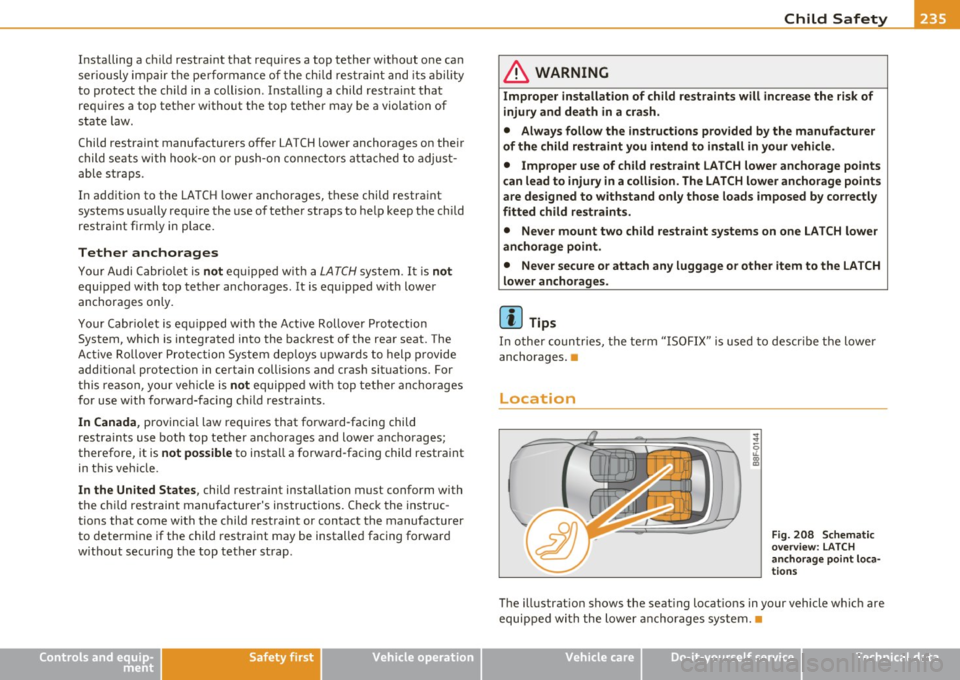
The illustrat ion shows the seat ing locations in your vehicle which are
equipped wi th the lower anchorages system. •
Vehicle care Do-it-yourself service Technical data
Page 245 of 364

Intelligent technology
--------------------------------------------------' "---.L==--
The ASR works in conjunction with the ABS. If a malfunction should
occur in the ABS, the ASR w ill also be out of action.
Activating
The ESP is automatically activated when the engine is started and it
performs a self-test. You can activate a deactivated ASR if required by
pressing the=>
page 240, fig. 213 button. When it is activated, the
message
ESP/ASR on appears briefly in the display .
Deactivating
You can deactivate the ASR if required by pressing the button (for less
than 3 seconds) =>
page 240, fig. 213. With the ASR deactivated , the
ESP check light comes on, see=>
page 14 . The message ASR off
appears in the display as well. The ASR can be deactivated at any
speed .
The ASR should normally be activated a ll the time. Only in certain
exceptional situations when some slip is desirable does it make sense
to deactivate the ASR. Examples:
• when driving with tire chains
• when driving in deep snow or on loose ground and
• when rocking the vehicle loose after it has become stuck .
When the abnormal situation is over, you should activate the ASR again.
& WARNING
The increased safety afforded by ASR does not mean that you can
take safety risks. Always adapt your driving style to the road
conditions and traffic situation.
[I] Tips
To ensu re that the ASR works properly, all four whee ls must be fitted
with ident ical t ires. Any differences in rolling radius of the t ires can
cause the system to reduce eng ine power when this is not desired.
See also=>
page 307, "New tires and replacing tires and wheels". •
Safety first
Braking
General information
What affects braking efficiency?
Operating conditions and driving habits
The brakes on today's automobiles are still subject to wear,
depending la rgely on ope rating conditions and driving habits=>& .
On vehicles that are either driven mostly in stop-and-go city traffic or
are driven hard, the brake pads should be checked by your authorized
Audi dealer more often than specified in the
Warranty & Mainte
nance booklet.
Failure to have your brake pads inspected can result
in reduced brake performance .
On steep slopes, you should use the braking effect of the engine. This
way, you prevent unnecessary wear on the brake system. If you must
use your brakes, do not hold the brakes down continuously. Pump the
brakes at intervals.
Noises may occur when brak ing depending on the speed, braking
force and outside cond itions such as temperatu re and humid ity.
Moisture or road salt
If you are driving faster than 31 mph (50 km/h) and the windshield
wipers are on, the brake pads will briefly touch the brake discs in
regula r interva ls so as to improve reaction time when braking on wet
surfaces. You, the driver, will not not ice anything.
Under certain condit ions, for example, when driving through water or
very heavy rai n, or even after washing your vehicle, the braking effect
can be reduced due to moisture (or in free zing conditions ice) on the
bra ke pads. A few careful brake applications should dry off the brake
pads or remove any ice coatings.
Th e effectiveness of the brakes can be reduced when the vehicle is
dr iven on a salt-covered road and the brakes are not used. H ere too,
you should clean off accumu lated salt coating from brake discs and
pads with a few careful applications of the brake=>&,.
Vehicle care Technical data
Page 246 of 364

Intelligent technology
'-------------------------------------------------
Corrosion
T he re may be a te ndency fo r d irt to build u p on the bra ke pads and
co rrosion to form on the d iscs if the car is not dr iven reg ularly o r only
for short trips with litt le use of the bra kes .
If the brakes a re not used freq uen tly, or if co rrosion has formed o n
the discs, it is advisable to clean off the pads and discs by braking
fir mly a few times from a mode rat ely h igh spee d~ & .
Faults in the brake system
If yo u sh ou ld noti ce a sudden increase in b rake peda l trave l, then one
of the two brake circu its may have failed~& .
Low brake fluid level
Ma lfunctions can occ ur in t he brake system if the brake fluid level is
t oo low. The bra ke f lu id level is moni tore d elec tron ically.
Brake lin ing wear status
Brake lin ing wear may be checked by v isua l inspect ion of the condi
tion of the brake pads throu gh the open ings in the whee l.
If neces
sary, the whe el may be removed fo r thi s insp ection~
page 320,
"Changing a w hee l".
& WARNING
• You should perform braking maneuvers for the purpose of
cleaning the brake system only if road conditions permit. Other
road users must not be put at risk - you may cau se an accident!
• Before descending a steep grade, reduce speed and shift trans
mission into a lower gear or lower driving range. Do not ride the
brakes or hold the pedal down too long or too often . This could
cause the brakes to get hot and diminish braking efficiency.
• Do not "ride the brakes " by resting your foot on the pedal when
you do not intend to brake . This may cause the brakes to overheat ,
premature wear and increased stopping distance.
• Under certain climatic and operating condition s such as
passing through water , driving in heavy rain or after washing the
& WARNING (co ntinued )
vehicle, the effectiveness of the brakes can be reduced . In winter,
ice can ac cumulate on the brake pads, linings, dis cs and drums.
Carefully apply brakes for a test. Brakes will dry and ice coatings
will be cleaned off after a few careful brake appli cations.
• Driving for an extended period of time on salt-covered roads
without u sing your brakes can also affect braking efficiency . Clean
off accumulated salt coating from b rake discs and pads with a few
careful brake applic ations.
• If you damage the front spoiler, or if you install a different
spoiler, be sure the air flow to the front brakes i s not obstructed .
Otherwise the brake system could overheat reducing the effective
ness of the entire brake system.
• Failure of one brake circuit will impair the braking capability
resulting in an increased stopping di stance. Avoid driving the
vehicle and have it towed to the nearest authorized Audi dealer or
qualified workshop.
n
Brake booster
The b roke boost er odds extra broking po wer.
The bra ke boos ter wor ks wi th v acuum pressure whi ch is crea ted o nly
when the eng ine is ru nning~ &.
& WARNING
• Never let the vehicle roll to a stop with the engine shut off.
• If the brake booster is not working, for example when towing
your vehicle , or because the brake booster has somehow been
damaged, the brake pedal mu st be pressed considerably harder to
make up for the lack of booster assistance. •