fuel AUDI A5 CABRIOLET 2013 User Guide
[x] Cancel search | Manufacturer: AUDI, Model Year: 2013, Model line: A5 CABRIOLET, Model: AUDI A5 CABRIOLET 2013Pages: 290, PDF Size: 72.35 MB
Page 30 of 290
28 Driver in formation d isplay
Fue l economy messages are disp layed when
fuel consumption is increased by certain con
d itions. If you follow these fuel economy mes
sages, you can reduce your vehicle's consump
tion of fuel. The messages appear automati
cally and are on ly displayed in the eff ic iency
program. The fuel economy messages turn off
automatically after a certain pe riod of time .
.,. To turn a fuel economy message off imme-
diately after it appears, press the
I RES ET I
button r:::;, fig . 11 @ , or
.,. Press the function selection switch
r:::;, fig . 11
® ·
(D Tips
- Once you have t urned a fuel economy
message off, it will only appear again af
te r you tu rn the ignition on aga in.
- The fuel economy messages are not dis
played in eve ry instance, but rat her in in
terv als over a period of time.
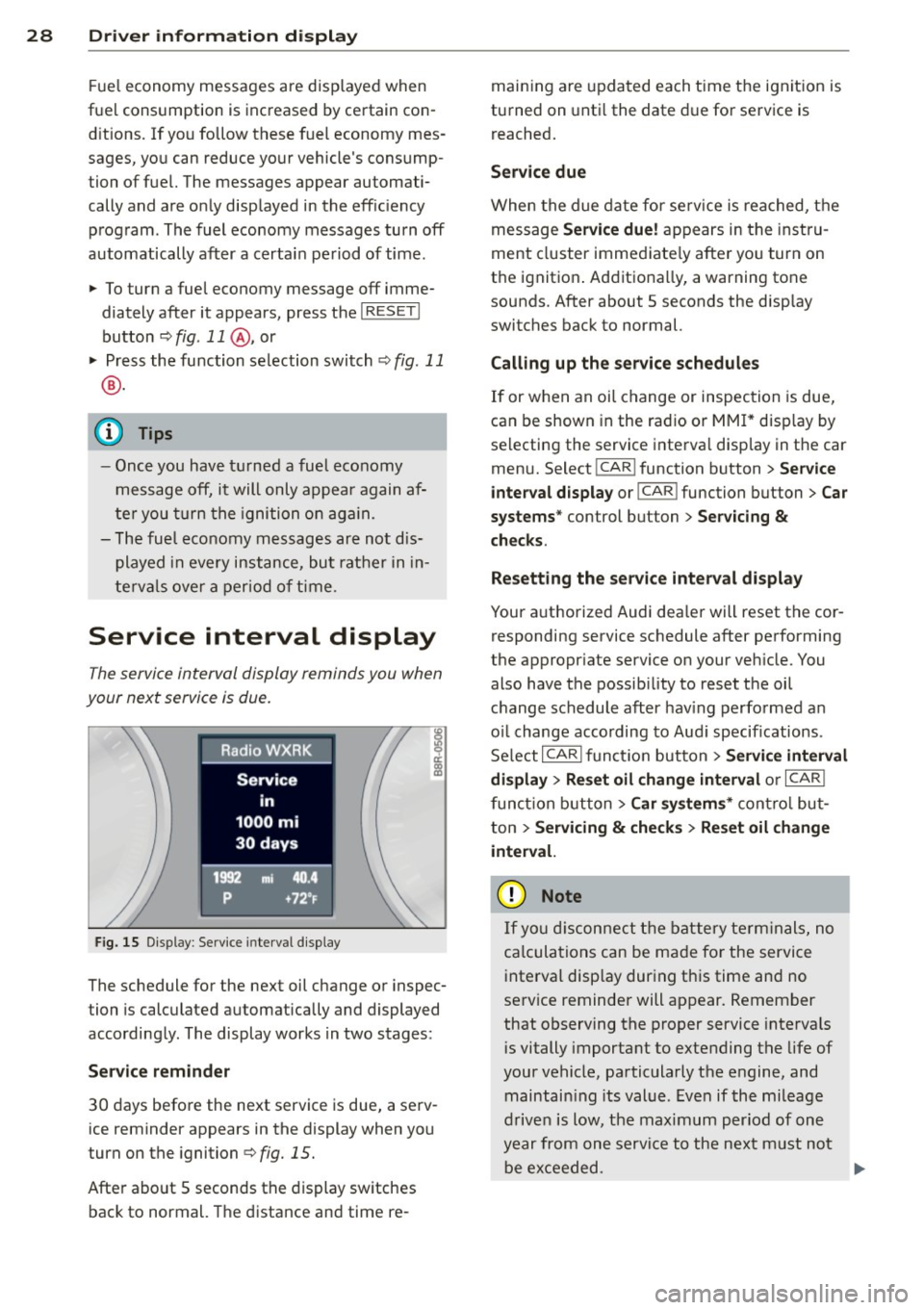
Service interval display
The service interval display reminds you when
your next service is due.
F ig. 15 D is p lay : Serv ice interval d isplay
The schedule for the next oil change or inspec
tion is calculated automatically and displayed
accordingly . The display works in two stages :
Service reminder
30 days before the next service is due, a serv
ice reminder appears in the display when you
turn on the ignition
c:> fig. 15.
Afte r abo ut 5 seconds the display sw itches
back to normal. The distance and time re- main
ing are upda ted each t ime the ignit ion is
turned on unt il the date d ue for service is
reached.
Service due
When the d ue date fo r se rv ice is reached, t he
message
Service due ! appears in the instru
ment cluster immediate ly after yo u turn on
the ignition . Additiona lly, a warning tone
sounds. After about 5 seconds the disp lay
switches back to normal.
Calling up the service schedule s
If or when an oi l change or inspec tion is due,
can be shown in the rad io or
MM I* disp lay by
selecting the service interva l display in the car
menu. Select
! CAR ! function button > Service
inte rval d isplay
or !CAR ! function button> Car
s ystems *
control button > Servicing &
checks .
Resett ing the se rv ice interval display
Your authorized Audi dea ler will reset the cor
responding service schedule after performing
the appropr iate service on your veh icle. You
also have the possib ility to reset the oil
change schedule after hav ing perfo rmed a n
o il change acco rding to Aud i specif ications .
Select
I CAR ! functio n button > Se rvi ce interval
di splay
> Re set oil change int erval or I CAR I
funct ion b utt on > Car sy stem s* cont ro l bu t
ton
> Servicing & check s > Reset oil ch ange
inte rval.
(D Note
If you di sconnect the battery term inals, no
ca lcula tions can be made for the service
i nterva l disp lay dur ing this time an d no
se rvice reminder will appear. Remember
that observing the proper service intervals
i s vitally important to extending the life of
your vehicle, particularly the engine, and maintain ing its value . Even if the mileage
d rive n is low, the maximum period of one
year from one servi ce to the next m ust not
be ex ceeded. .,..
Page 31 of 290

@ Tips
-Do not reset the display between oil
changes, otherwise the display will be in
correct.
- The information in the Service Reminder
remains stored even when the vehicle
battery is disconnected.
On-Board Diagnostic
system (OBD)
Malfunction Indicator Lamp (MIL)
The Malfunction Indicator Lamp (MIL)¢• in
the instrument cluster is part of the On-Board
Diagnostic (OBD II) system .
The warning/indicator light illuminates when
the ignition is switched on and goes out after
the engine starts and the idle has stabilized.
This indicates that the MIL is work ing proper
ly.
If the light does not go out after the engine
is started, or illuminates while you are driv
ing, a ma lfunction may ex ist in the engine sys
tem. If the light illuminates, the catalytic con
verter could be damaged.
Continue driving
with reduced power (avoid
ing sustained high speeds and/or rapid acce l
erat ions) and have the condition corrected.
Contact your author ized Audi dealer .
If the lig ht illuminates, the electronic speed
limiter may also be malfunctioning. For more
information
~ page 29, Electronic speed
limiter .
An improperly closed fuel filler cap may also
cause the MIL light to illuminate
~page 210.
Driver information display 29
On-Board Diagnostics
Fig. 1 6 Locat io n of Data Li nk Co nnector (DLC)
On-Board D iagnostics monitors the compo
nents of your em ission contro l system. Each
monitored component in your engine system
has been ass igned a code. In case of a mal
funct ion, the component will be identified
and the fault stored as a code in the control
module memo ry.
The MIL light may also illuminate if there is a
l eak in the on-board fuel vapor recovery sys
tem. If the light illuminates after a refueling,
stop the vehicle and make sure the fuel filler
cap is properly closed ~page 210.
In order to make an accurate diagnosis, the
stored data can only be disp layed using spe
cial diagnostic equipment (generic scan tool
for OBD).
In order to connect the specia l diagnostic
equipment, p ush the plug into the Data Link
Connector (DL C). The DLC is located to the
rig ht of the hood release
~ fig. 16.
Your authorized Audi dealer or qualified work
shop can interpret the code and perform the
necessary repair.
A WARNING
Do not use the diagnostic connector for
personal use . Incorrect usage can cause
malfunctions , whic h can increase the risk
of a collision!
Electronic speed limiter
Your vehicle may be factory equ ipped with
-
tires that are rated for a maximum speed of .,..
Page 72 of 290
70 Warm and cold
Warm and cold Climate controls
Description
The climate control system warms, cools and
adds humidity to the air in the vehicle interior.
It is the most effect ive when the windows and
sunroof are closed . If there is a build-up of
heat inside the vehicle, ventilation can help to
speed up the cooling process.
I n all heating mode functions except
defrost,
the blower on ly switches to a higher speed
once the engine coolant has reached a certain
temperature.
Condensat ion from the cooling system can
drip and form a puddle of water under the ve
hicle. This is normal and does not mean there
is a leak.
Pollutant filter
The pollutant filter removes pollutants s uch
as dust and pollen from the air.
The air pollutants filter must be changed at
the intervals spec ified in you r Warranty
&
Maintenance booklet, so that the air condi
tioner can properly work.
If you drive your vehicle in an area with h igh
a ir po llution, the fi lter may need to be
changed more frequently than specified in
your Aud i Wa rranty
& Ma intenance booklet. If
in doubt, ask your authorized Audi Service Ad
visor for advice .
Key coded settings
The climate control settings are automat ically
stored and assigned to the remote control key
that is in use. These settings are different
when the power top is open or closed .
A WARNING
Reduced visibility is dangerous and can
cause accidents. -
- For safe driving it is very important that
all windows be free of ice, snow and con
densation.
- Comp letely familiarize yourself with the
proper use and function of the heating
and ventilation system and especially how to defog and defrost the windows.
- Never use the windshield wiper/washer
system in freez ing weather unt il you
have warmed the windshield first, using
the heating and ventilation system. The
washer solution may freeze on the wind shie ld and reduce visib ility.
(D Note
- If you suspect that the air conditioner has been damaged, switch the system
off to avoid further damage and have it
inspected by a qualified dealership.
- Repairs to the Audi air conditioner re
quire special technical know ledge and
special tools. Contact an authorized Aud i
dea ler fo r assistance.
@ For the sake of the environment
By reducing the amount of fuel you use,
you also reduce the amount of pollutants
emitted into the air.
(D Tips
- Keep the air intake s lots (in fro nt of the
w indshield) free from ice, snow and de
bris in order to maintain the proper func
tion of the climate control system.
- The energy management system may
switch the seat heating* or rear window
defroster off temporarily . These systems
are available again as soon as the energy
balance has been restored.
- Air escapes through vents under the rear
window. When placing items of clothing
on the luggage compartment cover, en
sure that the openings are not covered.
Page 88 of 290
86 Transmi ssion
Transmission
multitronic ®, S tronic ®,
tiptronic
Introduction
Appl ies to vehicles: with multitronic/5 tronic/tiptronic
The automatic transmission is controlled elec
tronically. The transmission ups hifts or down
shifts automatically depending on which drive program is se lected.
When a
moderate driving style is used, the
transmission se lects the most economical
driving mode. It wi ll then change up early and
de lay the downshifts to g ive better f uel econ
omy.
The transmission switches to a sporty mode after a k ick-down or when the dr iver uses a
sporty driv ing style characterized by qu ick ac
celerator peda l movements, heavy accelera
tion, frequent changes in speed and traveling
at the maximum speed .
If desired, the driver can a lso sel ect the gears
manually (tiptronic mode ) q page 86.
Various a utomatic transmissions may be in
stalled, depend ing on the mode l:
multitronic ® transmission
The mult it ron ic® transm ission is a co nti nuous
l y var iable transmission. Power is transferred
using a m ultidisk clutch. In contrast to con
ventiona l automatic transmissions using sh ift
ing operat ions, the transmission ratio in the
continuously variable transm ission is changed
continuously. This optimizes the comfort level
and conserves fuel.
S tronic ® transmission
The 5 tronic ® is a d ual-clutch transmission .
Power is transferred using two clutches that
work independently from one another. They
replace the to rque conve rter used in conven
tional automa tic transm iss ions and allow the
ve hicle to acc elerate without a noticeable in
ter ruption in traction.
tiptronic transmission
In the t ipt ro ni c transm iss ion, powe r is trans
f erred by a torque converter .
Selector lever positions
Applies to vehicles: with multitronic/5 tronic/tiptronic
i--...~~-----------..,.-~ -... N
N
N
" :ll
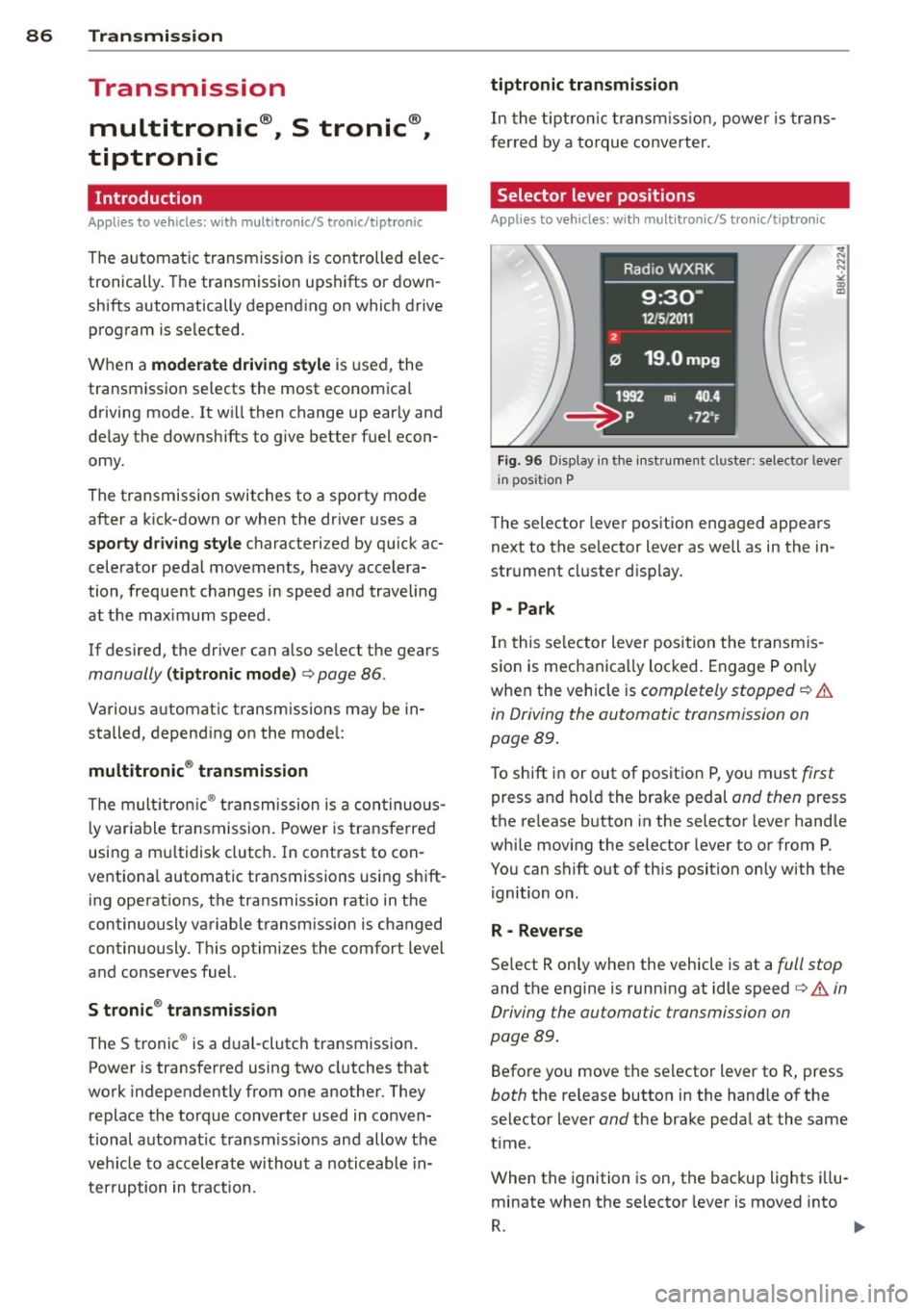
Fig. 96 Display in t he inst ru m ent cluster: selecto r lever
in pos ition P
The selector leve r pos ition engaged appea rs
next to the se lector lever as well as in the in
strument cluster d isp lay.
P -Park
In this se lector lever posi tion the transmis
sio n is mechanica lly loc ked. Engage P o nly
whe n the vehicle is
completely stopped q .&.
in Driving the automatic transmission on
page
89.
To shift i n or out of posit ion P, yo u must first
press and ho ld the bra ke pedal and then press
the re lease b utton in the selector lever hand le
whi le movi ng the selector lever to or from P.
You can shift out of th is position only with the
ignition o n.
R - Reverse
Se lect R on ly when the vehicle is at a full stop
and the engine is running at idle speed q .&. in
Driving the automatic transmission on
page
89.
Befo re you move the se lector lever to R, press
both the release button in the hand le of the
select or lever
and the brake peda l at the same
t ime .
When the ignition is on, the bac kup lights illu
minate when t he selector lever is moved into
R. 1111-
Page 190 of 290
188 Driving and en vironm ent
8_ WARNING
After driving through water, mud, slush,
etc ., the brakes may be slow to take effect
because of wet brake rotors and pads. Dry
the brakes first by braking carefully to re
store the full braking effect.
CD Note
Vehicle components such as the engine,
transmiss ion, suspension or electrical sys
tem can be severely damaged by driving
through wate r.
@ Tips
- Check the depth of the water before dr iv
i ng through it.
- Do not stop the veh icle, dr ive in reverse
or switc h the engine off when driving
t hr ough water.
- Keep in mind that oncoming vehicles
may c reate waves that raise the water
l evel and make it too deep fo r you r vehi
cle to dr ive through safely.
-
- Avoid dr iving thro ugh salt water because
i t can ca use corrosion.
Catalytic converter
It is very important that your emission con
trol system (catalytic converter) is function
ing properly to ensure that your vehicle is run
ning in on environmentally sound manner.
,,. Always use lead-free gasoli ne¢ page 207,
Fuel supply .
,,. Never run the tank down a ll the way to
empty.
,,. Never put too much motor oil in your en-
gine ¢
page 217, "t':::r. Adding engine oil.
,,. Never t ry to push- o r tow-start your veh icle.
The catalytic converter is an effic ient "clean
up" device built into the exhaust system of
the vehicle. The catalytic converter burns
many of the polluta nts in the exhaust gas be
fore they are released into the atmosphe re. The exclusive
use of unleaded f uel is critica lly
important for the life of the catalytic convert
er and proper funct ion ing of the eng ine .
A WARNING
= -
-Do not park or operate the vehicle in
areas where the hot exhaust system may
come in co ntact with dry grass, brush,
fuel spill or other material wh ich can
cause a fire .
- Do not app ly additional undercoating or
r u stp roofing on or nea r the exhaust
manifold, exhaust pipes, cataly tic con
ver ter or heat shields. Dur ing driv ing, the
substance used for under coa ting co uld
overhea t and cause a fire.
CD Note
- Be aware that just o ne tank filling with
leaded fu el w ill already ser io usly de
gr ad e the per form ance o f the catalytic
c onverte r.
- Do not ex ceed t he corre ct engine oil level
r:;!) page 217.
- Do not drive until the fuel tank be co m es
completely emp ty. The engine co uld mis
fire . Unburned fuel could also get in to
the exhaust system and this co uld cause
the cata lytic converter to overheat .
- Do not turn off the igni tion whi le the ve
hicle is mov ing.
- Do not contin ue to ope rate your veh icle
unde r these conditions, as otherwise fuel
can reach the catalyt ic converte r. T his
co uld resu lt in overheating of the con
verter, requir ing its replacement.
- To assure efficient operation of the Emis
sion Control System:
- H ave you r vehicle maintained p rope rly
and in accordance w ith the se rvi ce rec
ommen dat ions in yo ur Warranty &
M ain tenance boo klet.
- L ack of prope r maintenan ce as we ll as
i mprope r use of t he ve hicl e wi ll impair
the func tion of the em ission cont ro l
system and could lea d to damage .
Ill>
Page 191 of 290
@ For the sake of the environment
Even when the Emission Control System is
operating properly, the exhaust gas can
have a sulfur-like exhaust gas smell under
some operating states. This depends on
the sulfur content of the fuel being used.
Using a different brand of fuel may help,
or filling the tank w ith lead-free super
grade gasoline.
Operate your vehicle
economically and minimize pollution
General
Your personal style of driving will determine
the economy of your vehicle, as well as ex
haust and noise levels.
Fuel economy, environmental impact, and
wear on you r engine, bra kes and t ires largely
depend on th ree factors:
= your persona l dr iving style
- operating conditions
- technica l lim itations
I f you anticipate what yo u need to do next and
drive economically, you can easi ly cut your
fuel consumption by 10-15 percent. This sec
tion will give you some t ips on how you can
he lp the environment and your pocketbook.
@ Tips
The consumpt ion estimates as published
by ENVIRONMENTAL PROTECTION AGENCY
(EPA) and Transport Canada may not corre
spond to your actual consumption on the
road, wh ich will vary depending upon vehi
cle load and speed, road and weather con
ditions, tr ip length, etc.
Drive smoothly and keep a lookout
ahead
Vehicles use the most fuel when they are ac
celerating.
" Avoid unnecessary accele rat ing and braking.
Dri vin g and en vironm ent 18 9
Vehicles use the most fue l when they a re ac
ce lerating. If you anticipate what is going to
happen next, you will need to brake less and,
th us, acce lerate less. Let the vehicle coast
whenever possible -for example when you see
that the next traff ic light is red.
Avoid full throttle
Driving at moderate speeds saves fuel and
improves your mileage.
" Try and keep well below your car's maxi-
mum speed.
Acce lerating gently red uces fue l cons ump
tion, engine wear, and does not disturb the environment.
Fuel consumpt ion, exhaust emiss ions and en
gine noise increase disproportionately at high
speeds . If you drive at approximately th ree
quarters of top speed, fuel consumption w ill
be reduced by one half. Never drive faster
than the posted speed limit and weather con
ditions perm it.
Reducing unnecessary idling
Even when your car is just idling it burns up
fuel .
" Shut the eng ine off when you are not driv
ing the vehicle.
" Do not warm up the ve hicle by letting the
eng ine run at idle .
It makes sense to shut off the engine in traffic
jams, when wa it ing for tra ins to pass at rail
road crossings, or at traffic lig hts t hat have
long waits on red . T ur ning the eng ine off for
just 30-40 seconds saves mo re fuel than is
bur ned star ting the e ngine again.
It takes a long t ime for the engine to warm up
fully when it is run ning at idle . However, wea r
and noxious emissions are espec ia lly high
whe n the eng ine is wa rm ing up. So yo u shou ld
drive away as soon a s you start the e ngine and
avo id r unning at high rpms whi le the engine is
still warming up.
Ill-
•
•
Page 192 of 290
190 Driving and en vironm ent
(0 Note
Do not leave engine idling unattended af
ter starting . If warning lights should come
on to indicate improper operation, they
would go unheeded. Extended idling also
produces heat, which could result in
over
heating or other damage to the vehicle or
other property.
Regular maintenance
A badly tuned engine unnecessarily wastes a lot of fuel .
.,. Have your vehicle serv iced at regular inter-
vals.
By having your vehicle regularly serviced by an
author ized Audi dealer he lps to ensure that it
runs properly and economically. The condition
of your vehicle not only affects its safety and
ab il ity to hold its value, it also affects
fu el
con sump tion .
C heck your oil each time you fill your tank.
The amount of oil used is related to engine
l oad and speed.
I t is normal for the oil consumption o f a new
engine to reach its lowest val ue after a certain
mileage has been driven.
You mus t drive yo ur vehicle abo ut 3,000 miles
(5,000 kilometers) be fo re yo u can properly
assess oi l consumption.
This a lso applies to fuel consumption and en
g ine output.
(]) Note
-Have yo ur vehicle maintai ned properly
and in accordance with the service re c
ommendations in your War ran ty
& Mai n
tenance bookle t. Lack of proper mainte
nance as well as imp roper use of the
ve
hicle will impair the function of the
emission control system and could lead
to damage. -
Do not alter or
remove any component of
the Emission Control System unless ap
proved by the manufacturer .
- Do not alter or
remove any device, such
as heat shie lds, switches, ignition w ires,
valves, which are designed to protect
your vehicle's Emission Control System and other important vehicle compo
nents.
Fewer short trips
Fuel consumption will always be relatively
high on short trips .
.,. Try to avoid driv ing short distances w ith a
cold engine.
The engine and cata lytic converter have to
reach their opt imal
oper ating temperature to
reduce fuel consumpt ion and nox ious em is
s ions effectively.
Just after starting, a co ld engine in a mid-size
car on ly achieves a fuel economy of 6-8 m iles
per gallon (30-40 l/100 km). After about a
half a mile, fuel economy climbs to 12 mpg
(20 l/100 km) . After about
2 .5 miles (4 km),
the engine is at its prope r operating tempera
tu re and fuel economy has reached a normal
level. So you can see that yo u should avo id
short trips whenever poss ible.
T he
outside temperatur e is also cr it ical in t his
regard. Your car consumes more fue l in the
winter tha n in the s umme r.
Page 196 of 290
194 Cleaning and protection
Cleaning and
protect ion
General information
Regular core preserves vehicle value .
Any automobile is exposed to industrial
fumes, corrosive road salt, etc. A well cared
for Audi can look like new many years after
purchase . Regular and correct care w ill con
tr ibute to maintaining the beauty and value of
your Aud i.
Furth erm ore, goo d car e m ay be a c onditi on
for substantiat ing a warrant y claim shou ld
c orrosion dam age or paint d efe ct s occ ur.
Your author ized Audi dealer has a variety of
d ed ica ted vehicl e-ca re product s and can ad
vise which ones to use for cleaning the exter i
or and inte rior of your vehicle .
Whether you use products recommended by
Aud i or other commercially ava ilable clean ing
agents, please make sure you apply them cor
rectly .
A WARNING
-Cleaning agents may be poisonous. Keep
them out of the reach of children.
- Heed all caut ion labels.
- Always read directions on the container
before using any product . Follow the di
rect ions carefu lly.
- Most chemical cleaners are concentrated
and have to be diluted.
- Use spot removing fluids only in well
ventilated areas.
- Do not use gasoline, kerosene, d iesel
fuel, nail pol ish remover or other volati le
fluids. They may be toxic, flammab le or
haza rdous in other ways. Do not wash,
wax or dry the vehicle with the ignit ion
on or the engine running.
- Do not clean the undersides of chassis,
fenders, wheel covers, etc. without pro
tecting your hands and arms. You may
c u t yourself on sharp-edged metal parts . -
Moisture and ice on brakes may impair
brak ing eff ic iency
c::> page 181. Test the
brakes carefully each time you wash the
veh icle.
@ For the sake of the environment
Select on ly environ mentally friendly clean
i ng products. Leftover cleaning products
should not d isposed of in the househo ld
waste .
Care of exterior
Washing
Frequent washing protects the vehicle .
The best protection against environmental in
fluences is
frequent washing and waxing . How
often this is required depends on:
- How much the veh icle is used
- Where the veh icle is parked (garage, in the
open under trees, etc.)
- The seasona l and weather conditions
- Environmental infl uences
T he longer b ird droppings, insects, tree resin,
road and indus tria l gr ime, ta r, soot, road salt
and other materials remain on the vehicle body, the more lasting their destr uctive ef
fects wi ll be . High temperatures caused by ex
pos ure to intense sun light intens ify the corro
s ive effect, particularly when humid ity is high
as well.
Under certain circumstances,
weekl y washing
may be necessary. Under other cond itions, a
monthly washing and waxing may be ade
quate .
After the winter, the underside of the vehicle
should be thoroughly washed, preferably in a professional car wash.
Vehicles with matte finish paint
c::> poge 197.
A WARNING
-Always read and heed all WARNINGS and
other information
c::> page 194.
Page 198 of 290
196 Cleaning and protection
-Never use sponges designed to remove
insects, or any kitchen scouring sponges
or similar products. They can damage
your paint finish .
- Never use a dry cloth or sponge to clean
the headlights. Only use wet cloths or
sponges to prevent scratches .
It is best
to use soapy water.
- You should remove debris (such as in
sects) from the headlight lenses on a
regular basis, for example when refuel
ing your vehicle. Never use a dry cloth or
sponge to clean the headlights . Only use
wet cloths or sponges to prevent
scratches.
It is best to use soapy water.
@ For the sake of the environment
Only wash the vehicle in facilities specially
designed for that purpose. This will reduce
the risk of dirty water contaminated with
oil from entering the sewer system. In
some areas, washing vehicles outside of
these facilities is prohibited.
Washing your vehicle with a power
washer
Cleaning the exterior of your car with a high
pressure power washer is safe as long as you
observe a few simple rules.
.. Before using the power washer, make sure
you have read and understood the WARN
INGS¢
A in General information on
page 194 .
• Always follow the operating instructions for
the power washer .
• Make sure that the jet on the spray hose
produces a "fan shaped spray".
• Do
not hold the spray nozzle too close to
soft materials.
Never use a power washer to clean the power
top itself.
Keep a distance from soft materials such as
rubber hoses or insulating material as well as
sensors and camera lenses. When cleaning the vehicle with a power wash
er
always follow the operating instructions.
This applies particularly to the operating pres
sure and the spraying distance. Do not point
the spr ay directly at the seals around the side
windows, around the doors, on the rear lid or on the power top . Likewise, do not point it di
rectly at tires, rubber hoses, insulation mate
rial or sensors
¢page 198. Hold the spray
nozzle at least 1.3 ft (0 .4 m) away from the
vehicle.
Do not use a high-pressure power washer to
remove snow and ice .
Do not use a jet which sprays water in a direct
stream or one that has a rotating jet.
Water temperature should not exceed 140 °F
(60 °().
A WARNING "'--
Never wash tires with a jet that sprays wa -
ter in a direct stream . This could cause in
visible damage to the tires and weaken
them, even if the spray is from a relatively
long distance and for a short time. Dam
aged and weakened tires can fail and cause
accidents and personal injury.
(D Note
- Never use a power washer to clean the
power top itself.
- To avoid damaging your vehicle, always
make sure that there is sufficient dis
tance between the spray head and soft
materials like rubber hoses, plastic parts
and sound-deadening materials as well
as sensors and camera lenses. Never aim
the spray head at the same point for a
long time . This also applies to cleaning
headlights and painted bumpers. Re
member: the closer the nozzle is to the
surface of the material , the greater the
stress on the material.
Page 199 of 290
Caring for vehicles with matte finish
paint
Applies to vehicles: with matte finish paint
Vehicles with matte finish paint require spe
cial care due to the characteristics of the
paint.
Washing b y hand
To avo id damag ing the pa int when wash ing ,
first remove dust and large particles from
your veh icle. Insects , g rease spots and finge r
p rints a re best removed with a
s pecial cleaner
for matt e fini sh paint .
Apply the product using a microfiber cloth . To
avoid damaging the paint su rface, do not use
too muc h press ure.
R inse the vehicle thoroughly w ith water . Clean
the vehicle starting at the top and working to
ward the bottom using a
neu tral shampoo
and a soft mi cro fiber cloth . Stop freque ntly to
rinse the clot h thorough ly.
Clean the wheels and sill panels last . Use a
clea n
sp o nge on these areas.
Rinse the vehicle thoroughly aga in and let it
air dry . If there are any water spots, they can
be removed us ing a
l e ath er cloth .
Clean again with the special cleaner for matte
finish paint
i f nece ssary.
Rem oving stubb orn dirt
B ird d ropping s or tree sap
are best removed
with p lenty of water and a m icrof ib er cloth.
You sho uld r inse off
ga soline r esidue immedi
ately with plenty of water.
A WARNING
- Wash your vehicle only when the ignition
is switched off to reduce the risk of a
crash .
- Always read and heed all WARNINGS and
other information ¢page 194.
(D Note
-Do no t treat vehicle parts painted w ith
matte finish paint using polish ing mate -
Cleaning and protec tion 197
ria ls or hard wax. These p rod ucts could
cause damage to the appearance or sur
face that cannot be repaired .
- Never use protective wax . It can destroy
the matte finish effect.
- Do not place any s tickers or magnetic
signs on vehicle pa rts painted with
matte finish paint. The paint could be
damaged when the stickers or magnets
are removed.
- To prevent paint damage, do not wash
the vehicle i n direct sunlight .
- To prevent damage to the paint surface,
do not use insect remova l sponges,
rough kitchen sponges or sim ilar items.
- Yo u should
remove debris (such as in
sects) from t he headlight lenses on a
regu lar bas is, for example when refuel
ing your veh icle. Only clea n the head
lights us ing a wet cloth or sponge,
neve r
a dry one. Cleaning with soapy wate r is
recommended.
(D Tips
Fo r more informat ion on special clean ing
products desig ned fo r matte f inish paint ,
see your Aud i dea le r.
Power top care
The power top requires special care .
Keep ing your top looking great and mak ing
certain that it lasts a long time depend to a
great extent on prope r use a nd care. Remove
bird dropp ings as soon as poss ible , since the
cor ros ive chemicals in them wi ll cause the
rubber imp regna tion in you r top to swell and
poss ibly allow the fabr ic to leak.
With normal soiling, all you need to do is
cl ea r th e top wi th a soft br ush and clea r wa
te r. A lways b ru sh in the di rection of the fabric
from front to rear.
If the top is very dirty and has spotted areas
cl ean it with a brush using a conve rtible top
cl eaner . Always brush in the d irect ion of t he
f abric from front to rea r. R inse wi th p lenty of
clear water, and allow the top to air-dry .
IJI,-
•
•