window AUDI A5 CABRIOLET 2013 Owner's Manual
[x] Cancel search | Manufacturer: AUDI, Model Year: 2013, Model line: A5 CABRIOLET, Model: AUDI A5 CABRIOLET 2013Pages: 290, PDF Size: 72.35 MB
Page 130 of 290
128 Driving Safely
area because the rear lid cannot be fully
closed.
- If you absolutely must drive with the rear
lid open, observe the following notes to
reduce the risk of poisoning:
- Close all windows,
- Close the power top,
- Open all air outlets in the instrument
panel,
- Switch off the air recirculation,
- Set the fresh air fan to the highest
speed.
A WARNING
Always make sure that the doors, all win
dows, the power top and the rear lid are
securely closed and locked to reduce the
risk of injury when the vehicle is not being
used .
-After closing the rear lid, always make
sure that it is properly closed and locked .
- Never leave your vehicle unattended es
pecially with the rear lid left open. A
child could crawl into the vehicle through
the luggage compartment and close the
rear lid becoming trapped and unable to
get out. Being trapped in a vehicle can
lead to serious personal injury.
- Never let children play in or around the
vehicle.
- Never let passengers ride in the luggage
compartment. Vehicle occupants must
always be properly restrained in one of
the vehicle's seating positions.
(D Tips
- Air circulation helps to reduce window
fogging. Stale air escapes to the outside
through vents in the trim panel. Be sure
to keep these slots free and open.
- The tire pressure must correspond to the
load. The tire pressure is shown on the
tire pressure label. The tire pressure la
bel is located on the driver's side B-pillar.
The tire pressure label lists the recom
mended cold tire inflation pressures for
the vehicle at its maximum capacity
-
'
weight and the tires that were on your
vehicle at the time it was manufactured.
For recommended tire pressures for nor
mal load conditions, please see chapter
r::::>page 231.
Tie-downs
Applies to vehicles: with tie-downs
The luggage compartment is equipped with
four tie-downs to secure luggage and o ther
items.
Use the tie-downs to secure your cargo prop
erly
r::::> page 12 7, Loading the luggage com
par tmen t.
In a collision, the laws of physics mean that
even smaller items that are loose in the vehi
cle will become heavy missiles that can cause
serious injury. Items in the vehicle possess en
ergy which vary with vehicle speed and the
weight of the item . Vehicle speed is the most
significant factor.
For example, in a frontal collision at a speed
of 30 mph (48 km/h), the forces acting on a 10-lb (4 .S kg) object are about 20 times the
normal weight of the item . This means that
the weight of the item would suddenly be about 200 lbs. (90 kg). You can imagine the
injuries that a 200 lbs. (90 kg) item flying
freely through the passenger compartment could cause in a collision like this.
A WARNING
Weak, damaged or improper straps used
to secure items to tie-downs can fail dur ing hard braking or in a collision and cause
serious personal injury.
- Always use suitable mounting straps and
properly secure items to the tie-downs in
the luggage compartment to help pre
vent items from shifting or flying for
ward as dangerous missiles.
- When the rear seat backrest is folded
down, always use suitable mounting
straps and properly secure items to the
tie-downs in the luggage compartment
to help prevent items from flying
Page 137 of 290
Important safety instructions about
safety belts
Safety belts must always be correctly posi
tioned across the strongest bones of your
body.
~ Always wear safety belts as illustrated and
described in this chapter.
~ Make sure that your safety belts are always
ready for use and are not damaged.
A WARNING
Not wearing safety belts or wearing them
improperly increases the risk of serious
personal injury and death. Safety belts can
work only when used correctly.
- Always fasten your safety be lts correctly
before driving off and make sure all pas
sengers are correctly restrained.
- For maximum protection, safety belts must always be positioned properly on
the body .
- Never strap more than one person, in
cluding small children, into any belt.
- Never place a safety belt over a child sit ting on your lap.
- Always keep feet in the footwell in front
of the seat while the vehicle is being d riv
en .
- Never let any person ride with their feet
on the instrument panel or sticking out
the window or on the seat.
- Never remove a safety belt while the ve
hicle is moving. Doing so will increase
your risk of be ing injured or killed.
- Never wear belts twisted.
- Never wear belts over rigid or breakable
objects in or on your clothing, such as
eye glasses, pens, keys, etc., as these may cause injury.
- Never allow safety belts to become dam
aged by being caught in door or seat
hardware .
- Do not wear the shoulder part of the belt
under your arm or otherwise out of posi
tion . Safety belts
135
- Several layers of heavy clothing may in
terfere with correct positioning of belts and reduce the overall effectiveness of
the system .
- Always keep belt buckles free of anything
that may prevent the buckle from latch
ing securely .
- Never use comfort clips or devices that
create slack in the shoulder belt . Howev
er, special clips may be requ ired for the
proper use of some child restraint sys
tems .
- Torn or frayed safety belts can tear, and
damaged belt hardware can break in an
accident. Inspect belts regularly.
If web
bing , bindings, buckles, or retractors are
damaged, have belts replaced by an au
thorized Audi dealer or qualified work
shop.
- Safety belts that have been worn and
loaded in an accident must be replaced
with the correct replacement safety belt
by an authorized Audi dealer. Replace
ment may be necessary even if damage
cannot be clearly seen . Anchorages that
were loaded must also be inspected.
- Never remove, modify, disassemble, or
try to repair the safety belts yourself.
- Always keep the belts clean. Dirty belts
may not work properly and can impair
the function of the inertia reel
c::> page 205, Safety belts .
Safety belts
Belt positioner
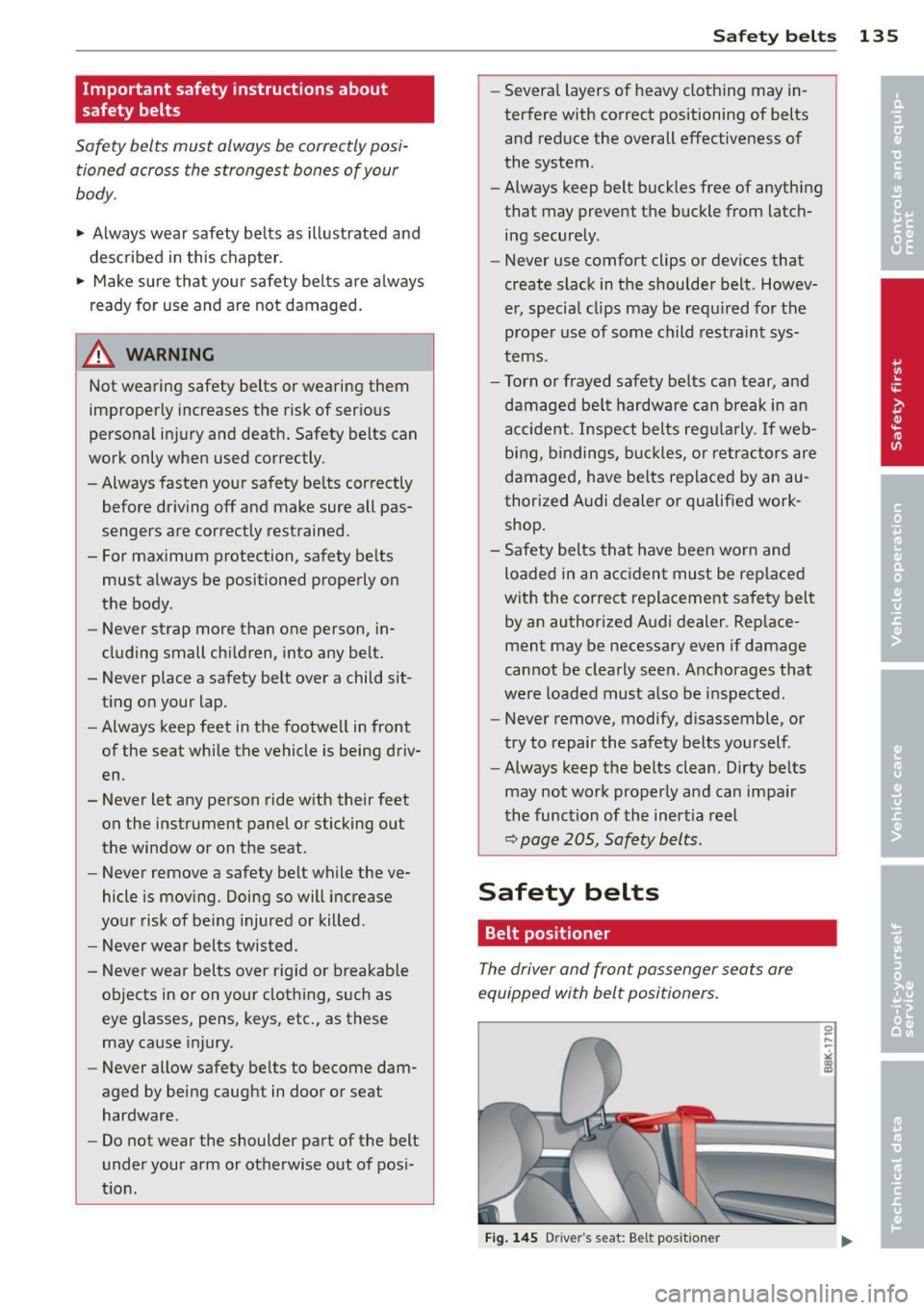
The driver and front passenger seats are
equipped with belt positioners.
Fig. 145 Driv er's se at: Be lt pos itio ner
Page 152 of 290
150 Airbag system
must always sit in an upright position,
must not lean against or place any part
of their body too close to the area where
the airbags are located .
- Occupants who are unbelted, out of posi
tion or too close to the airbag can be se riously injured by an airbag as it unfolds
with great force in the blink of an eye
~page 141.
A WARNING
A child in a rearward-facing child safety
seat installed on the front passenger seat
will be seriously injured and can be killed if
the front airbag inflates -even with an Ad
vanced Airbag System.
- The inflating airbag will hit the child
safety seat or infant carrier with great
force and will smash the child safety seat
and child against the backrest, center
armrest, door or roof.
- Always install rear-facing child safety
seats on the rear seat.
- If you must install a rearward facing
child safety seat on the front passenger
seat because of exceptional circumstan
ces and the
PASSENGER AIR BAG OFF
light does not come on and stay on, im
mediately install the rear-facing child
safety seat in a rear seating position and
have the airbag system inspected by your
authorized Audi dealer.
A WARNING
Objects between you and the airbag will
increase the risk of injury in a crash by in
terfering with the way the airbag unfolds
or by being pushed into you as the airbag
inflates.
- Never hold things in your hands or on
your lap when the vehicle is in use.
- Never transport items on or in the area of the front passenger seat. Objects
could move into the area of the front air
bags during braking or other sudden ma
neuver and become dangerous projec- tiles that can cause serious personal in
jury if the airbags inflate.
- Never place or attach accessories or oth
er objects (such as cupholders, tele phone brackets, large, heavy or bulky ob
jects) on the doors, over or near the area marked "AIRBAG" on the steering wheel,
instrument panel, seat backrests or be
tween those areas and yourself. These
objects could cause injury in a crash, es
pecially when the airbags inflate.
- Never recline the front passenger's seat
to transport objects. Items can also
move into the area of the side airbag or
the front airbag during braking or in a
sudden maneuver. Objects near the air
bags can become projectiles and cause
injury, particularly when the seat is re
clined.
A WARNING
'-
The fine dust created when airbags deploy
can cause breathing problems for people
with a history of asthma or other breath
ing conditions.
- To reduce the risk of breathing problems, those with asthma or other respiratory
conditions should get fresh air right
away by getting out of the vehicle or
opening windows or doors.
- If you are in a collision in which airbags
deploy, wash your hands and face with
mild soap and water before eating.
- Be careful not to get the dust into your
eyes, or into any cuts or scratches.
- If the residue should get into your eyes,
flush them with water.
Page 161 of 290
- in rollovers.
I n some types of acc idents the front airbags
and side ai rbags may be t rigge red togethe r.
A WARNING
- Safety belts and t he a irbag sys tem will
only provide protection when occupan ts
are in the p roper seating posit ion
¢ page 159.
-If the airbag indicato r light c::> page 20
comes when the vehicle is be ing used,
have the system inspected immediately
by your authori zed Aud i dea ler. It is pos
sible that the airbag will inflate when it
is not supposed to, or w ill not inflate
when it sho uld .
How supplemental side airbags work
.
Side airbags deploy ins tan tly and can help re
duce the risk of upper torso injuries for occu
pants who are properly restrained .
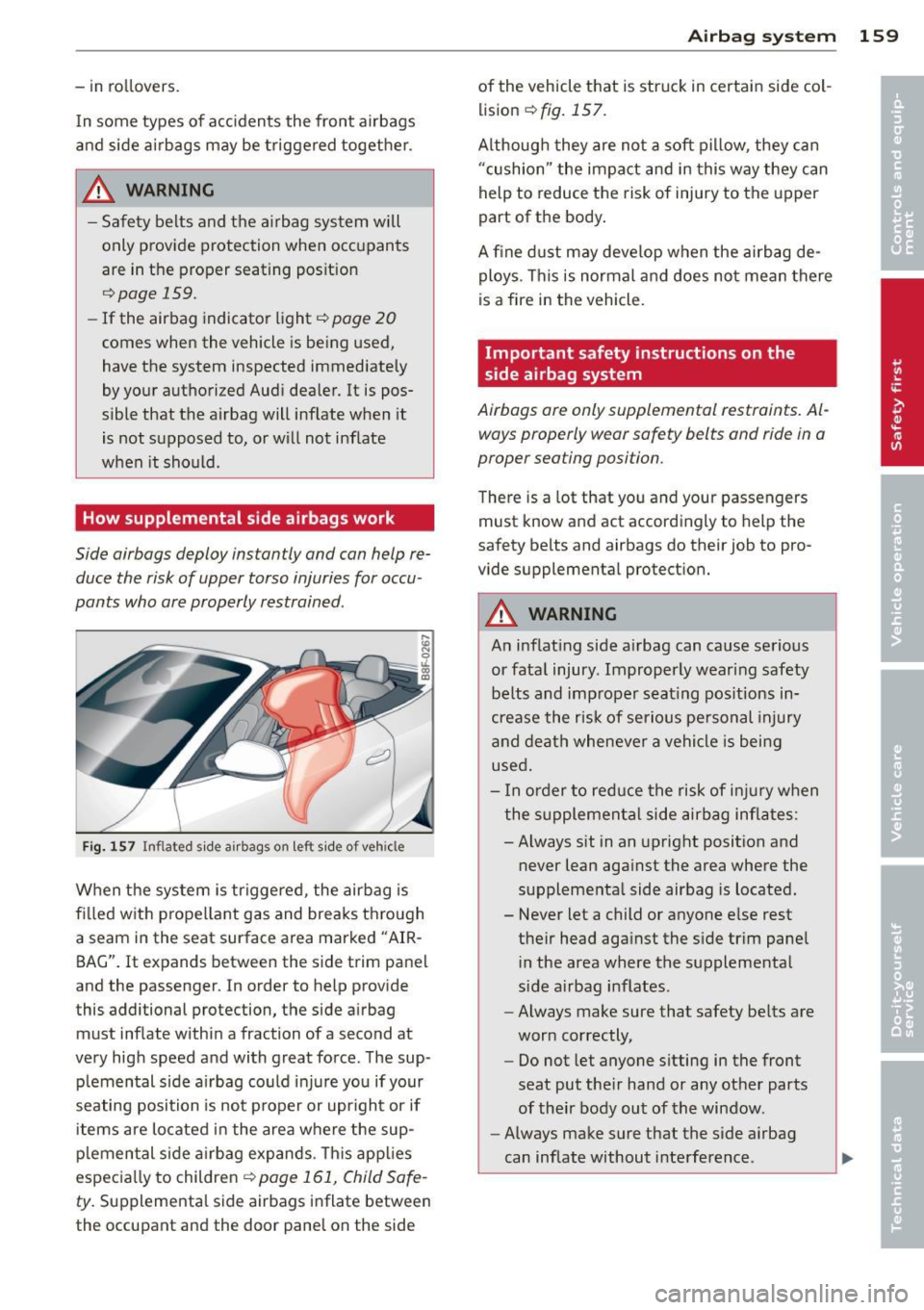
Fig. 15 7 Infla ted s ide a irbag s on left s ide of ve hicle
When the system is trigge red , the airbag is
fi lled w ith p ropel lant gas and breaks thro ugh
a seam in the seat surface area marked "AIR
BAG" . It expands between the side trim panel
and the passenger. In orde r to help provide
t his additional protection, the side a irbag
must inf late within a fraction of a second at
very high speed a nd with great force . The sup
p lemental side a irbag could injure you if your
seating position is not p roper or upr ight or if
items are located in the area where the sup
p lemental side a irbag expands . T his app lies
especia lly to children
c::> page 161, Child Safe
ty.
Supplemental side airbags inflate between
the occupant and the door pane l on the side
A irba g sy stem 159
of the vehicle that is struck in certain side col
lision
c::> fig . 157 .
Although they are no t a soft pillow , they can
"cushion" the impa ct and in this way they can
help to reduce the risk of injury to the upper
part of the body .
A fine dust may develop when the airbag de
ploys . T his is normal and does no t mean there
is a fire in the vehicle.
Important safety instructions on the
side airbag system
Airbags are only supplemental restraints . Al
ways properly wear safety belts and r ide in a
proper sea ting position.
T here is a lot that you and your passengers
must know and act accord ingly to help the
safety belts and airbags do the ir job to pro
vide supplemental protect ion.
A WARNING ,-
An inflat ing s ide a irbag can cause se rious
or fata l injury . Improperly wearing safety
belts and imp roper seat ing pos itions in
crease the risk of serious pe rsonal injury
and death whenever a vehicle is being
used.
- I n o rder to red uce the risk of i nju ry when
the s upplemental side airbag inflates:
- Always sit in an upright position and never lean against the area where the
suppleme nta l side airbag is located.
- Never let a child or anyone e lse rest
their head aga inst the s ide trim pane l
i n the area where the supplementa l
s ide a irbag inflates .
- Always make sure that safety belts are
worn correctly,
- Do not let anyone s itting in the front
seat put t he ir hand or any ot her parts
of their body out of the window .
- Always make su re t hat the side a irbag
can inflate without interfe rence .
Page 188 of 290
186 Intelligent technology
Plea se start the engine soon or the system
will be tu rned off.
The warning ind icates that the system will be
turned off automa tic ally after 3 m inu tes. If
you wish to cont inue using the functions , you
have to start the engine .
With the engine running
Although ele ct ric al e nergy is generated when
the vehicle i s be ing driven , the battery can be
come d ischarged. This happens most ly w hen
little energy is being generated and a great
deal consumed and the battery 's state of
charge is not optima l.
To br ing the energy balance back into equili
brium, cons umers which require especia lly
l arge amounts of energy are temporarily c ut
back or switched off. Heating systems in par·
ticular requ ire a great deal of energy. If you
notice, for example, that the heated seats* or
the heated rear window are not heating, they have been temporar ily cut back o r switched
off. These systems will be ava ilable again as
soon as the ene rgy ba lance h as been restored.
You will a lso notice that engine idle speed has
been inc reased slightly . This is norma l and not
a cause fo r conce rn . By increas ing engine idle
speed the add itiona l ene rgy required is gener
ated and the ba tte ry is charged.
Page 197 of 290
Automatic car wash
The vehicle can be washed in almost any
modern automatic car wash .
The vehicle paint is so durable that the vehicle
can normally be washed without problems in
an automatic car wash. However, the effect on
the paint depends to a large extent on the de
sig n of the fac ility, the filtering of the wash
water, the type of wash and care mater ial , etc.
If the paint has a dull appearance afte r go ing
through the car wash or is scratched, bring
this to the attention of the operator immedi
ately. If necessary, use a different car wash.
The power top does not require special pre
cautions be fore passing through a car wash.
Howe ver, the c ar mu st not be tre ated with
hot w ax after th e was h cy cle !
The wax could
adversely affect the power top and
even dam
age the fabric
over a period of time.
The power top does not have to be washed
ev
ery time you use a car wash. The power top
can be spared if the car wash facility is equip
ped with manually adjustable roof brushes or
rollers .
Before going through a car wash, be sure to
take the usual precaut ions such as clos ing the
windows . Remove antenna if applicable .
If yo u have installed additional accessories on
the vehicle -such as spoilers, etc. -it is best to
ask the car wash operator if these should be
removed .
A WARNING
Always read and heed all WARNINGS and
other information
Q page 194.
(D Note
- Before washing the vehicle in an auto
matic car wash, please make sure to re
tract t he exterior m irrors to prevent
them from being damaged.
- Compare the width of your vehicle with
the width of the tunnel at the fac ility.
Cleaning and protec tion 195
Washing the vehicle by hand
A lot of water is needed when washing a vehi
cle by hand .
.,. Before you start washing, make sure you
have read and understood the WARNINGS
Q & ,
.,. First soak all dried d irt unt il it is soft, then
r inse it off.
.,. As you clean your vehicle , start w it h the
roof and work your way down to the bottom,
using a sponge, a sponge g love or a clean
brush.
.,. Rinse the sponge or the sponge g love often,
flushing it clean each time.
.,. Use specia l car shampoo only for
very per
sistent d irt .
.,. Rinse the car thoroughly w ith water .
.,. Use a chamo is leather to gently w ipe the ex-
ter ior d ry.
Use a separate sponge for cleaning the
wheels, door sills and other regions exposed
to road dirt . In this way, you will not scratch
the pa int with coarse particles imbedded in
the sponge the next time you wash the ca r.
A WARNING ~ -
- Wash your vehicle only when the ignition
is switched off to red uce the risk of a
crash.
-A lways read and heed a ll WARNINGS and
other information
Q page 194.
{(D Note
-Never try to remove dirt, mud or dust if
the surface of the veh icle is dry. Never
use a dry cloth or sponge, since this
cou ld scratch your vehicle's paint or win
dows.
- Never wash your car in bright s unlight .
Drops of water act as magnifying lenses
and may damage yo ur paint .
- When you wash your car in the winter: if
you rinse yo ur vehicle with a hose, be
careful not to aim the stream of water
directly at locks, or at door or hatch
openings -they can freeze shut . •
•
Page 198 of 290
196 Cleaning and protection
-Never use sponges designed to remove
insects, or any kitchen scouring sponges
or similar products. They can damage
your paint finish .
- Never use a dry cloth or sponge to clean
the headlights. Only use wet cloths or
sponges to prevent scratches .
It is best
to use soapy water.
- You should remove debris (such as in
sects) from the headlight lenses on a
regular basis, for example when refuel
ing your vehicle. Never use a dry cloth or
sponge to clean the headlights . Only use
wet cloths or sponges to prevent
scratches.
It is best to use soapy water.
@ For the sake of the environment
Only wash the vehicle in facilities specially
designed for that purpose. This will reduce
the risk of dirty water contaminated with
oil from entering the sewer system. In
some areas, washing vehicles outside of
these facilities is prohibited.
Washing your vehicle with a power
washer
Cleaning the exterior of your car with a high
pressure power washer is safe as long as you
observe a few simple rules.
.. Before using the power washer, make sure
you have read and understood the WARN
INGS¢
A in General information on
page 194 .
• Always follow the operating instructions for
the power washer .
• Make sure that the jet on the spray hose
produces a "fan shaped spray".
• Do
not hold the spray nozzle too close to
soft materials.
Never use a power washer to clean the power
top itself.
Keep a distance from soft materials such as
rubber hoses or insulating material as well as
sensors and camera lenses. When cleaning the vehicle with a power wash
er
always follow the operating instructions.
This applies particularly to the operating pres
sure and the spraying distance. Do not point
the spr ay directly at the seals around the side
windows, around the doors, on the rear lid or on the power top . Likewise, do not point it di
rectly at tires, rubber hoses, insulation mate
rial or sensors
¢page 198. Hold the spray
nozzle at least 1.3 ft (0 .4 m) away from the
vehicle.
Do not use a high-pressure power washer to
remove snow and ice .
Do not use a jet which sprays water in a direct
stream or one that has a rotating jet.
Water temperature should not exceed 140 °F
(60 °().
A WARNING "'--
Never wash tires with a jet that sprays wa -
ter in a direct stream . This could cause in
visible damage to the tires and weaken
them, even if the spray is from a relatively
long distance and for a short time. Dam
aged and weakened tires can fail and cause
accidents and personal injury.
(D Note
- Never use a power washer to clean the
power top itself.
- To avoid damaging your vehicle, always
make sure that there is sufficient dis
tance between the spray head and soft
materials like rubber hoses, plastic parts
and sound-deadening materials as well
as sensors and camera lenses. Never aim
the spray head at the same point for a
long time . This also applies to cleaning
headlights and painted bumpers. Re
member: the closer the nozzle is to the
surface of the material , the greater the
stress on the material.
Page 201 of 290
Trim strips
Metal trim needs special care.
For environmenta l reasons, Audi fabricates
the br ight trim strips and trim pieces from
pure chromium-free aluminum.
Dirt and marks on the trim strips should be
removed with a
pH -b ala nced cleaning agent
(do not use a chrome cleaner). Authorized
Aud i dealers carry clean ing products w hich
have been tested for use on your veh icle and
are not harmful to the env ironment .
To avoid corros ion on the exterior trim str ips,
only a pH-balanced solution should be used
for the w indshield washer .
A WARNING
Always read and heed all WARNINGS and
other information ¢
page 194.
Plastic and vinyl
Plastic needs special care .
Use a clean, damp cloth or sponge to remove
dust and light surface dirt. For other soil, use
a lukewarm all-purpose clean ing solution or a
m ild saddle soap for vinyl trim. Remove water
spots and traces of soap w ith a clean, damp
clot h or sponge. Use a clean, soft clot h to rub
d ry.
Grease, tar or oil stains can be removed with a
clean cloth or sponge soaked w ith all-purpose
cleane r or with a solvent des igned especially
to clean viny l.
Occasionally apply a colorless vinyl or leather preservat ive to reta in the material's luste r
and pliability.
A WARNING
Alw ays read a nd heed all WARNINGS an d
other information
¢page 194.
Aluminum trim
.
Use only neutral-pH products to remove spots
and deposits from alumin um s urfaces.
Cleaning and protec tion 199
Chrome care products and a lkaline cleaners
will attack a luminum surfaces and can dam
age them over t ime.
A WARNING
A lways read and heed all WARNINGS and
other information
¢page 194.
Touch-up paint
Minor paint damages should be touched up
immediately.
.. Use either a touch-up paint stick or spray
paint to cover minor scratches and nicks .
You r authorized Audi dea ler has touch -up
paint for minor scratches and stone chips.
Scratches sho uld be touched up soon after
they occur to prevent corrosion.
If a spot starts to rus t, however, a s imple
touch -up job will not be eno ugh. The affected
s u rface m ust be sanded smooth and coated
with an anti-rust primer before the painted
finish can be restored.
T he number for the origina l veh icle paint can
be fo und o n the vehicle identification label
¢ page 265.
A WARNING
Always read and heed all WARNINGS and
other information¢
page 194.
Windows
Clear vision to all sides.
Clean a ll w indows regularly to remove road
f ilm and car wash wax buildup.
.. Remove snow from w indows using a brush.
.. Use a plastic ice s craper to remove ice from
w indows and mi rrors .
.. Remove other residue on the windows with
a spray-on g lass cleaner .
.. Wipe the windows dry with a clean piece of
cloth or kitchen paper towel.
•
•
Page 202 of 290
200 Cleaning and protec tio n
The best way to remove snow from windows
and mirrors is to use a brush. Use a non-abra
sive
plas tic ice scraper -better still, a spray
de icer -to remove
ic e from windows and mir
rors.
The windows must not be cleaned with insect remover or wax s ince these can interfere with
the function of the windshield wiper blades (chatter).
Oi l, grease, or silicone residue can be removed
with
gl ass clea ner or silic on e remo ver. How
ever, wax residue requires the use of a special ly formulated solvent. Please contact your au
thor ized Audi dealer for adv ice on safe prod
ucts for wax removal.
W indows shou ld also be cleaned on the inside
at regular intervals.
Never dry windows with the same chamois
that you use to dry painted surfaces. Wax resi
due on the chamois can impair vision through
the w indows.
.&_ WARNING
- Always read and heed all WARNINGS and
other information ~
page 194.
-The windshie ld must not be treated with
water-repellent materials . They can in
crease glare under poor visib ility condi
tions such as wetness, darkness, or when
the sun is low on the hori zon. In addi
t ion, they can cause the win dshield wip
ers to chatter.
(D Note
- Never use warm or hot water to remove
snow and ice from windows and mirrors.
This cou ld cause the g lass to cra ck.
- To preven t damage to the wi res of the
rear defogger, do not place any adhe sive
stickers on the inside of the rear window
ove r the wires .
- To he lp prevent d irt from sc ratch ing the
window, always scrape in a forward di
rection -pushing the scraper away from
you -never back and fo rth. -
Water leaking from the ins ide of the rear
windows may damage sensitive electrical components located either under the
rear parcel shelf or in the rear trunk area.
Always ensure that water never leaks
through the body section of the vehicle.
You can do th is by us ing waterproof pro
tection over the vehicle's electrical com
ponents (e.g. when install ing window
tinting) .
- Damage or malfunction of elect rical
c ompone nts due to water damage or any
other o uts ide infl uence is not covered by
the A udi New Veh icle Limited Warranty.
See your Warranty
& Ma intenance book
let for additional detai ls about your war
ranty.
Cast (light) alloy wheels
Cast (light) alloy wheels require special care.
.,. Wash the w heels with a sponge or hose
brush every other week .
.,. For deep clean ing afterwards, use only a
dedicated
a ci d-free cast alloy wheel cleaner.
.,. Rub a coat of
liqu id w ax onto the rims every
three month. Be sure to reach and treat all
parts of the rim.
To preserve the decorative appearance of the cast alloy wheels, some special care is neces
sary. In addition to road dirt and salt, brake dust is also corrosive . If left on for too long,
brake dust can cause pitting .
U se only spec ial
acid-free cleaners formulated
for alloy r ims. Safe products are availab le at
your authorized Aud i dealer . Never leave the
cleaner on the rims longer than spec ified on
the label. If not rinsed off promptly, the acid
contained in some cleane rs can attac k the
threads on the wheel bolts .
Never use abrasive o r metal po lish ing clean
ing agents.
If the protective coating has been
c h ipped, e .g. by kicked up road dirt, touc h it
u p as soon as possible . .,..
Page 225 of 290
Have the battery checked when you take your
vehicle in for service. Yo u are well advised to
replace a battery that is older than 5 years.
W ith certa in types o f airbag deployment, the
battery is disconnec ted from the vehicle elec
trica l system for safety reasons
c::> &. in Re
pair, care and disposal of the airbags on
page 154.
Di sconn ecting the battery t erminal s
Some vehicle functions (power w indow regu
l ators, for example) are lost if the battery ter
minals are disconnected . These functions have
to be re learned after the battery terminals are
connec ted again. To prevent this, the battery
should only be disconnected from the vehicle
e lectrical system when absolutely necessary
for repairs .
Vehicl es not driven for long p eriod s
If you do not drive your vehicle over a period
of several days or weeks, electrical compo
nents are gradually cu t back or switched off .
This reduces energy consumption and main
tains starting capability over a longer per iod
c::> page 185.
Some of the conven ience functions may not
operate, such as the inter ior lights or the
power seat adjustment. The conven ience
functions will be ava ilable again whe n you
turn on the ignition and sta rt the eng ine.
Winter operation
During the winter months, battery capacity
tends to decrease as temperatures drop . This
i s because more powe r is also consumed while
start ing , and the head lights, rea r window de
fogger, etc., are used more often .
Avo id unnecessary power consumption, par
ticularly in c ity t raffic or when t rave ling on ly
short d istances. Let you r authorized Audi
dea le r che ck t he capacity of the vehicle bat
t ery before w inte r sets in
c::> page 225. A well
cha rged batte ry w ill no t only p revent sta rting
p rob lems when the weathe r is cold, b ut will
a lso last longer.
Checkin g and fillin g 223
(D Tips
If your vehicle is left standing for seve ral
weeks at extremely low temperatures, the
vehicle battery shou ld be removed and
stored where it w ill not freeze. This will
prevent it from be ing damaged and having
to be replaced .
Working on the battery
Be especially careful when working on or near
the battery.
The battery is located in the l uggage compart
ment under the floor. Before you check any
th ing in the luggage compartment,
read and
h eed all WARNINGS
c::> &_ .
Always heed the safety warnings , when work
ing on the vehicle battery or the vehicle e lec
trical system to prevent injury.
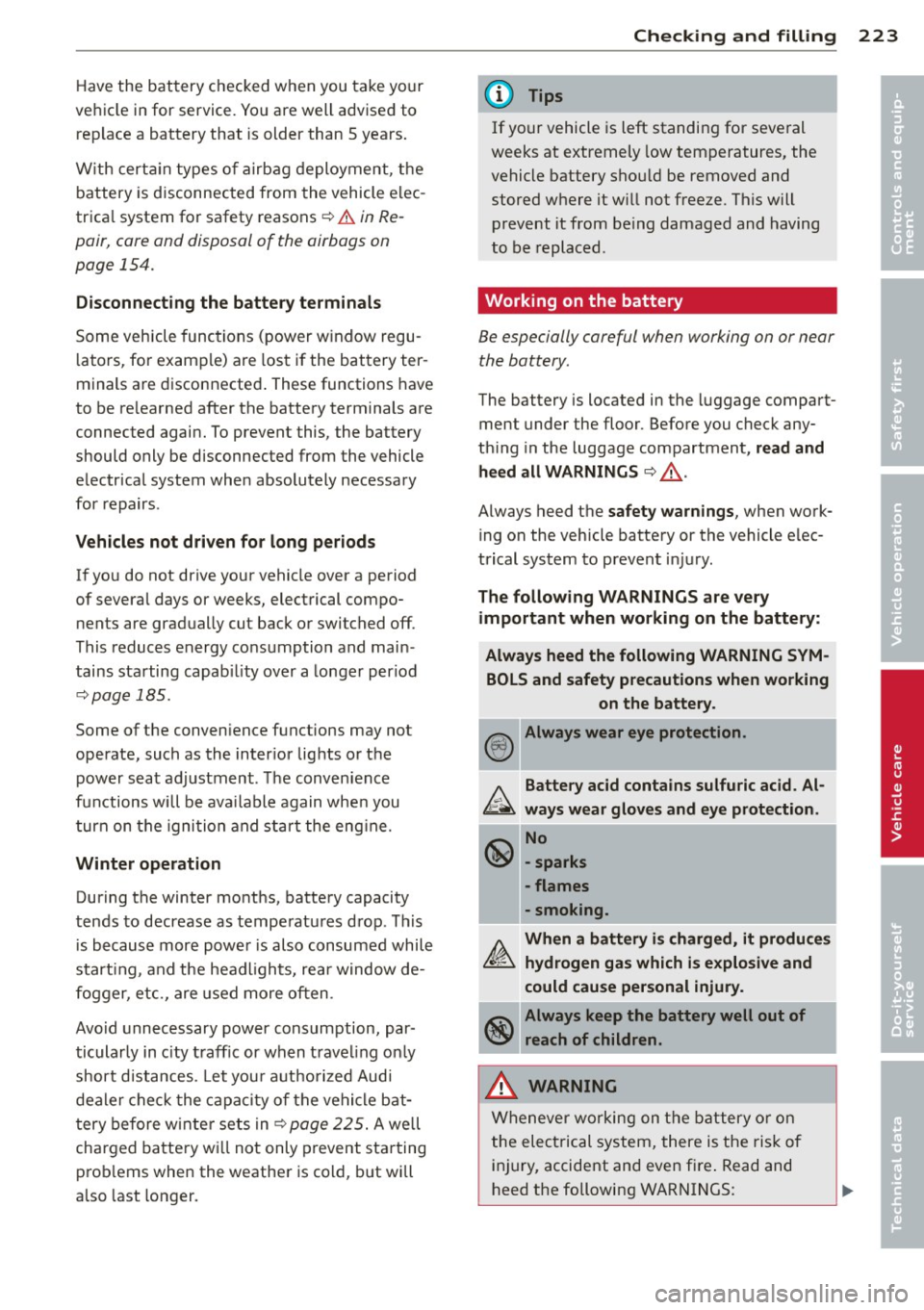
The following WARNINGS are very
important when working on the battery:
Al ways heed the follo wing WARNING SYM
BOLS and safety precautions when working on the battery.
® Always wear eye protection .
/).. Batte ry acid contains sulfuric acid . Al
~ ways w ear glov es and ey e protection .
IC No
\!!51 -sparks
-flames
- smoking.
A Wh en a battery i s charged , it produces
~ hydrogen g as which i s explosive and
could cau se per sonal injur y.
~ Always keep the battery well out of
'if!:11 reach of children .
_&. WARNING
Whenever working on t he battery o r on
the electrical system, there is the risk of
injury, accident and even fire . Read and
heed the following WARNINGS:
-
•
•