belt AUDI A5 CABRIOLET 2014 Workshop Manual
[x] Cancel search | Manufacturer: AUDI, Model Year: 2014, Model line: A5 CABRIOLET, Model: AUDI A5 CABRIOLET 2014Pages: 286, PDF Size: 70.4 MB
Page 175 of 286
Activating the convertible locking retractor
Use the convertible locking retractor to se
cure a child restraint .
Always heed the child safety seat manufactur
er's instructions when installing a child re
straint in your vehicle. To activate the conver
tible locking retractor :
"" Place the child restraint on a seat, prefera
bly on the rear seat.
.. Slowly pull the belt
all the way out.
.. Route it around or through the child re
straint belt path¢.&_ .
.. Push the child safety seat down with your
full weight to get the safety belt really tight.
.. Insert the belt tongue into the buckle for
that seating position .
.. Guide the sa fety belt back into the retractor
until the belt lies flat and snug on the child
safety seat .
.. You should hear a "clicking " noise as the
belt winds back into the inertia reel. Test the
convertible locking retractor by pulling on
the belt. You should no longer be able to
pull the belt out of the retractor. The con
v ertible locking retractor is now activated.
.. Make sure that the red release button is fac
ing away from the child restraint so that it
can be unbuckled quickly .
""Pull on the belt to make sure the safety belt
is properly tight and fastened so that the
seat cannot move forward or sideways more
than one inch (2.5 cm).
A WARNING
Using the wrong child restraint or an im
properly installed child restraint can cause
serious personal injury or death in a crash.
- Always make sure that the safety belt re-
tractor is locked when installing a child safety seat. An unlocked safety belt re
tractor cannot hold the child safety seat in place during normal driving or in a
crash .
- Always buckle the child safety seat firmly
in place even if a child is not sitting in it.
-
Child Safety 173
A loose child safety seat can fly around
during a sudden stop or in a crash.
- Always make sure the seat backrest to
which the child restraint is installed is in
an upright position and securely latched
into place and cannot fold forward . Oth
erwise, the seatback with the child safety
seat attached to it could fly forward in
the event of an accident or other emer
gency situation.
- Always read and heed all WARNINGS
whenever using a child restrained in ave
hicle is being used¢
page 161. Special
precautions apply when installing a child
safety seat on the front passenger seat
¢ page 141, Child restraints on the front
seat -some important things to know .
Deactivating the convertible locking
retractor
T he convertible locking retractor for child re
straints will be deactivated automatically
when the bel t is wound oil the way bock in to
the retractor .
.. Press the red button on the safety belt buck
le . The belt tongue will pop out of the buck
le.
.,. Guide the safety belt all the way back into
its stowed position .
Always let the sa fety belt retract completely
into its stowed position . The safety belt can
now be used as an ordinary safety belt with
out the convertible locking retractor for child
restraints.
If the convertible locking retractor should be
activated inadvertently, the safety belt must be unfastened and guided completely back in
to its stowed position to deactivate this fea
ture. If the convertible locking retractor is not
deactivated , the safety belt will gradually be-
come tighter and uncomfortable to wear.
11>
•
•
Page 176 of 286
174 Child Saf ety
A WARNING
Improperly installed child safety seats in
crease the risk of ser ious personal injury
and death in a collision .
- Never unfasten the safety belt to deacti
vate the convert ible lock ing retractor for
child rest raints while the veh icle is mov
ing. You would not be rest rained and
c ou ld be ser iously injured in an ac cident.
- Always read and heed all WARNI NGS
whenever using a child rest rained in ave
hicle is being use d
¢page 161. Spe cial
precautions apply when installing a ch ild
sa fety seat on the front passenger seat
¢ page 141, Child restraints on the front
seat -some important things to know.
Page 178 of 286
1 76 Child Safety
location
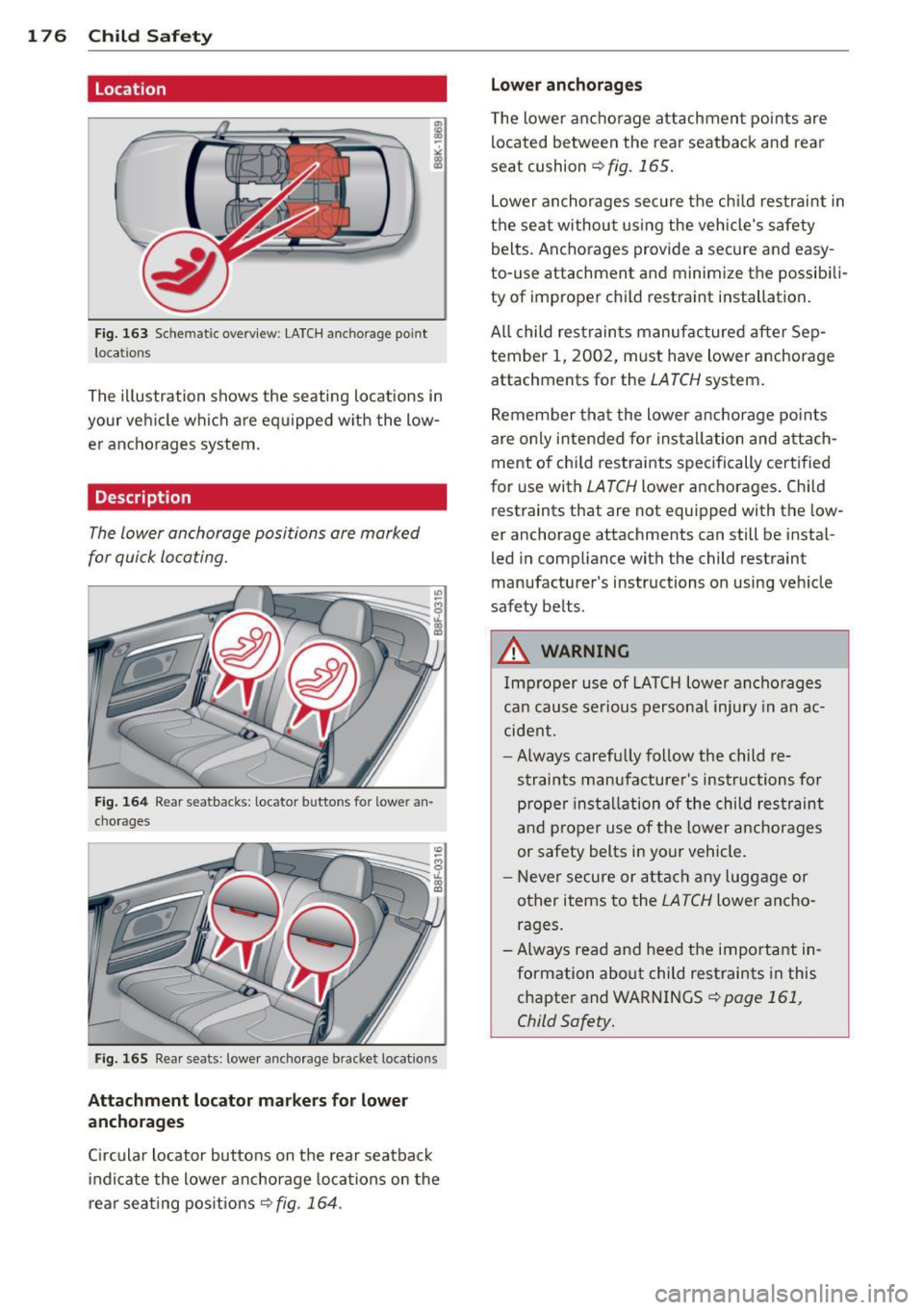
Fig. 163 Schematic overview: LATCH anchorage point
locations
The illustration shows the seating locations in
your vehicle which are equipp ed with the low
er anchorages system.
Description
The lower anchorage positions are marked
for quick locating.
Fig. 164 Rear seatbacks: locator buttons for lower an
chorages
Fig. 165 Rear seats: lower anchorage bracket locations
Attachment locator markers for lower
anchorages
Circular locator buttons on the rear seatback
indicat e the lower anchorage locations on the
rear seating positions
¢ fig . 164.
lower anchorages
Th e lower anchorage attachment points are
located between the rear seatback and rear
seat cushion
¢fig. 165.
Lower anchorages secure the child restraint in
the seat without using the vehicle's safety belts. Anchorages provide a secure and easy
to-use attachment and minimize the possibili
ty of improper child restraint installation .
All child restraints manufactured after Sep
tember 1, 2002, must have lower anchorage
attachments for the
LATCH system.
Remember that the lower anchorage points
are only intended for installation and attach
ment of child restraints specifically certified
for use with
LATCH lower anchorages. Child
restraints that are not equipped with the low
er anchorage attachments can still be instal
led in compliance with the child restraint
manufacturer's instructions on using vehicle
safety belts .
.&_ WARNING
-Improper use of LATCH lower anchorages
can cause serious personal injury in an ac
cident.
-Always carefully follow the child re
straints manufacturer's instructions for proper installation of the child restraint
and proper use of the lower anchorages
or safety belts in your vehicle.
- Never secure or attach any luggage or
other items to the
LATCH lower ancho
rages.
- Always read and heed the important in
formation about child restraints in this
chapter and WARNINGS
¢page 161,
Child Safety.
Page 179 of 286
Installing a child restraint with LATCH
lower anchorages
Whenever you install a child restraint always
follow the child restraint manufacturer's in
structions.
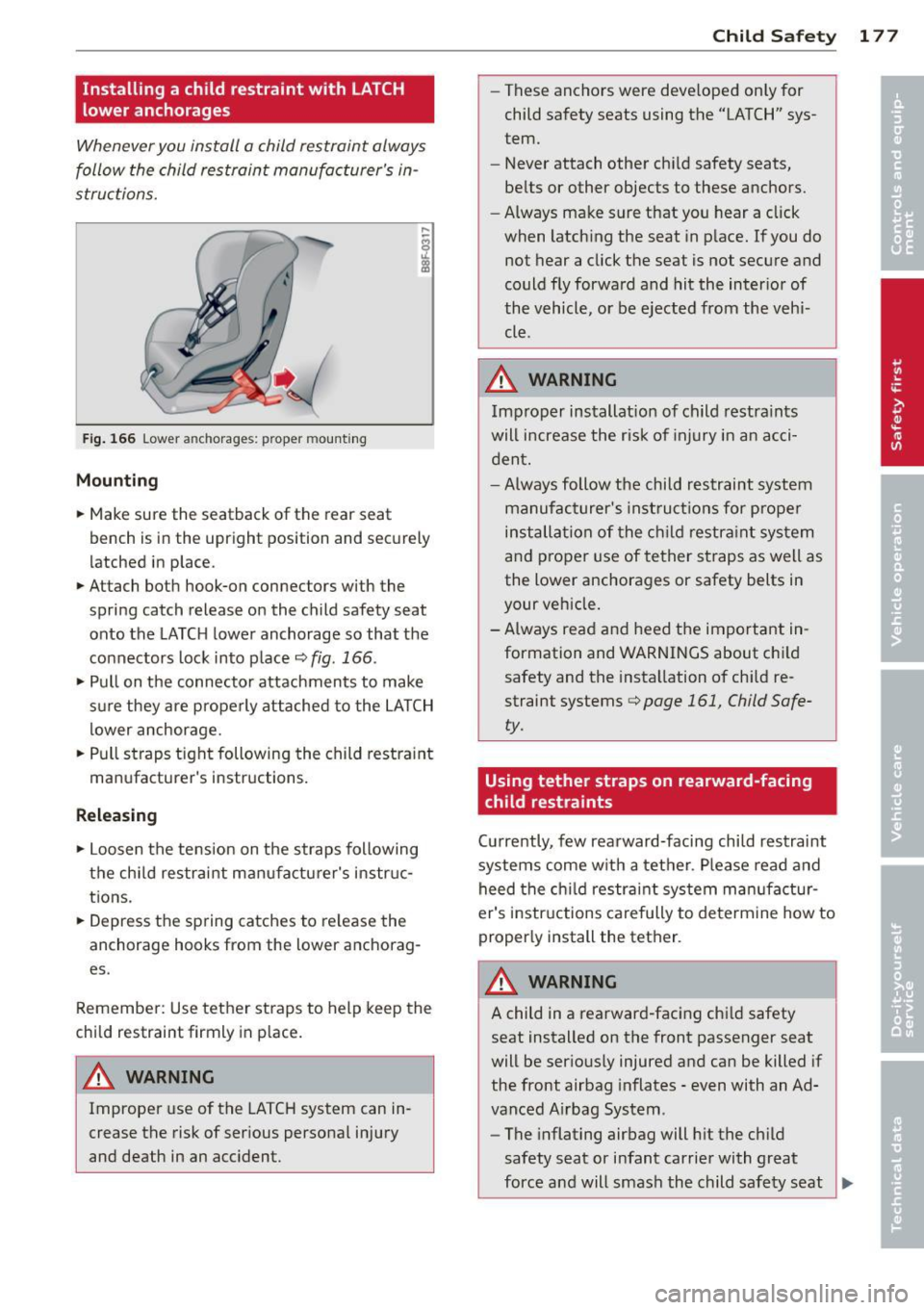
F ig . 166 Lower anchorages: proper mounting
Mou nting
~ Make sure the seatback of the rear seat
bench is in the upright position and securely
latched in place.
~ Attach both hook-on connectors with the
spring catch release on the child safety seat
onto the LATC H lower anchorage so that the
connectors lock into p lace
c::> fig. 166 .
~Pullon the connector attachments to make
s u re they are properly attached to the LATCH
lower anchorage.
~ Pull straps tight following the child restraint
manufacturer's instructions.
Releasing
~ Loosen the te nsion on the straps following
the chi ld restraint manufacturer's instr uc
tions.
~ Depress the spring catches to re lease the
anchorage hooks from the lower anchorag
es.
Remember: Use tether straps to help keep the
child restraint firmly in p lace.
A WARNING
Improper use of the LATCH system can in
crease the risk of ser ious personal injury
and death in an acc ident.
Child S afety 177
- These anchors were deve loped only for
child safety seats using the "LATCH" sys
tem.
- Never attach other chi ld safety seats,
belts or other objects to these anchors.
- Always make sure that you hear a click
when latch ing the seat in p lace. If you do
not hear a click the seat is not secure and
could fly forward and hit the interior of
the vehicle, or be ejected from the veh i
cle .
A WARNING
Improper installat ion of ch ild rest ra ints
will increase the risk of injury in an acci
dent.
- Always follow the child restraint system
manufacturer's inst ruct io ns for prope r
installation of the ch ild restra int system
and proper use of te ther s traps as well as
the lower anchorages or safety belts in
your vehicle.
- Always read and heed the im portant in
formation and WARNINGS about chi ld
safety and the insta llation of chi ld re
straint systems
c::> page 161, Child Safe
ty.
Using tether straps on rearward-facing
child restraints
-
Currently, few rearward-facing chi ld res traint
systems come w ith a tether . Please read and
heed the ch ild restraint system ma nufactur
er's instr uctions carefully to dete rmine how to
proper ly install the tether.
A WARNING
-
A child in a rearward-fac ing chi ld safety
seat installed on the front passenger seat
will be ser iously injured and can be killed if
the front airbag inflates - even with an Ad
vanced Airbag System .
- The inflating airbag will h it the ch ild
safety seat or i nfant carrier with great
force and will smash the child safety seat
11>-
Page 180 of 286
178 Child Saf ety
and child against the backrest, center
armrest, or door .
- A tight tether or other strap on a rear
ward -facing child restra int attached to
the front passenger seat can put too much pressure on the weight-mat in the
seat and register a heavier weight in the
Advanced Airbag System. The heav ier
we ight registered can make the system
wor k as though an adu lt were on the seat
and dep loy the Advan ced Airbag when i t
must be suppressed ca using serious or
even fatal injury to the child.
- If you must install a rearward facing
child safety seat on the front passenger
seat because of exceptional circ umstan
ces and the
PASSENG ER AIR BAG OFF
light does not come on and stay on, im
med iately install the rearward-facing
child safety seat in a rear seat ing pos i
t io n and have the airbag system inspect
ed by your authorized Audi dea le r.
Additional Information
Sources of information about child
restraints and their use
There are a number of sources of additional
information about ch ild restraint select ion, in
stallat io n and use:
NHTSA advises that the best child safety seat
is the one that fits your child and fits in your
vehicle, and that you w ill use correctly and
consistently.
Try before you buy!
U.S N ation al H ighw ay Traffic S afety Admin
i s tr ation
Te l.: 1-888-327-4236 (TTY : 1-800-424-9153)
www .nhtsa.gov
N ation al SA FE KIDS Campaign
Te l.: (202) 662-0600
www .safekids.org
Safet y Belt Safe U.S.A
Tel.: (800) 74S-SAFE (English)
Tel.: (800) 747 -SANO (Span ish)
www.carseat .org
T ransport Can ada Information Centre
Tel.: 1-800-333-0371 or ca ll
1-6 13-998-86 16 if yo u are in the Ottawa area
http://www .tc.gc.ca/eng/roadsafety/
menu. htm
Audi Cu stome r Rel ation s
Tel.: (800) 822-2834
Page 181 of 286

Intelligent technology Notice about data
recorded by vehicle
control modules
Your vehicle is not equipped with an Event Da
ta Recorder (EDR), installed by some manu
facturers for the express purpose of capturing
data for retrieval after an accident or crash
event. EDR's are sometimes called "crash re
corders".
Some state laws restrict the retr ieval or down
loading of data stored by EDR's that were in
stalled in a vehicle for the express purpose of
retrieving data after an accident or crash
event without the owner's consent.
Although your vehicle is not equipped with an
EDR, it is equipped with a number of electron
ic control modules for various vehicle systems
such as, for examp le, engine function, emis
sion control, as well as for the airbags and
safety belts.
These electronic control modules also record
vehicle-related data during norma l vehicle op
eration for diagnostic and repair purposes.
The recording capacity of the electronic con
trol modules is limited to data (no sound is re
corded) and only a small amount of data is ac
tually recorded over a very limited period of
time and stored when a system fault or other
condition is sensed by a control unit. Some of
the data then stored may relate to vehicle
speed, direction, braking as we ll as restraint
system use and performance in the event of a
crash or other condition. Stored data can only be read and downloaded with special equip
ment.
Electronic Stabilization
Control (ESC)
Description
ESC helps to improve road holding and vehicle
dynamics to help reduce the probability of
skidding and loss of veh icle control. It works
only when the engine is running. ESC detects
Intelligent technology 179
certain difficult driving situations, including
when the vehicle is beginning to spin (yaw)
out of control and helps you to get the veh icle
back under control by se lectively braking the
wheels, and/or reducing engine power and
providing steering ass istance to help hold the
vehicle on the driver's intended course. The in
dicator light
B.J in the instrument cluster
blinks when ESC is taking action to help you
control the vehicle.
ESC has limitations .
It is important to remem
ber that ESC cannot overcome the laws of
physics.
It will not always be able to help out
under all conditions you may come up against.
For example, ESC may not always be able to
help you master situations where there is a
sudden change in the coefficient of friction of
the road surface. When there is a section of dry road that is suddenly covered with water,
slush or snow, ESC cannot perform the same
way it would on the dry surface . If the vehicle
hydroplanes (rides on a cushion of water in
stead of the road surface), ESC will not be
able to help you steer the vehicle because con
tact with the pavement has been interrupted
and the vehicle cannot be braked or steered .
During fast cornering, particularly on winding
roads, ESC cannot always deal as effectively
with difficu lt driving situations than at lower
speeds. When towing a trailer, ESC is not able
to help you regain control as it would if you
were not tow ing a trailer.
Always adjust your speed and driving style to road, traffic and weather conditions. ESC can
not override the vehicle's physical limits, in
crease the available traction, or keep a vehicle
on the road if road departure is a result of
driver inattention. Instead, ESC improves the
possibility of keeping the vehicle under con
trol and on the road dur ing extreme maneu
vers by using the driver's steering inputs to
help keep the vehicle going in the intended di
rection. If you are traveling at a speed that
causes you to run off the road before ESC can
provide any assistance, you may not experi
ence the benefits of ESC.
•
•
Page 201 of 286
-Never use abrasive cleaning materials
or alcohol to clean the camera lens.
Th is could cause scratches and cracks .
-Po we r top
-Remove bird dropp ings immediately.
- Never use gasoline, stain remover, ben-
zene, paint thinner or other solvents to
remove stains .
-W ind ows
-Remove snow and ice on w indows and
exterior mirrors with a plastic scraper.
To avoid scratches, move the sc raper
only in one direction and not back and
forth .
- Never remove snow or ice from win
dows and mirrors using warm or hot
water because this cou ld cause cracks
to form.
- To avoid damage to the rear window
defogger, do not apply any stickers on
the heating wires on the inside of the
w indow.
- Decor ati ve pa rts /tri m
- Never use chrome care or cleaning
products.
-Pa int
- To reduce the risk of sc ratches, the ve-
hicle must be free of dirt and dust be
fore polishing or waxing.
- To prevent paint damage, do not polish
or wax the vehicle in direct sunlight .
- To reduce the risk of paint damage, do
not polish away rust film.
- Di spla ys
- To avoid scratches, do not use dry
cleaning methods on displays.
- Cont rols
- Make sure that no flu ids enter the con-
trols, because this cou ld cause dam
age.
- Safe ty belt s
-Do not remove the safety belts to clean
them .
- Never clean safety belts or their com
ponents chemically or with corrosive
fluids or solvents and never allow sharp objects to come into contact
V ehicl e ca re a nd cl eanin g 199
with the safety belts . This could cause
damage to the belt webbing.
- If there is damage to the webbing, the
connections, the retractors or the buck
les , have them replaced by an author
ized Audi dealer or qualified workshop.
- Te xtile s/Vin y l/ Alcant ara
- Never treat V inyl/Alcantara w ith leath-
er care products , solvents, floor polish,
shoe polish, stain remover or s imilar
p roducts.
- To avoid damage, have stubborn stains
removed by an autho rized Audi dea le r
or qua lified wor kshop.
- Neve r use steam cleaners, brushes,
hard sponges, etc. when cleaning.
- Do not turn on the seat heating* to dry
the seat.
- Objects w ith sharp edges such as zip
pers, rivets on clothing or be lts can
cause damage to the surface.
- Open hook and loop fastene rs, for ex
ample on cloth ing, can damage seat
covers. Make sure hook and loop fas
teners are closed .
-Natural leath er
- Never treat leather with solvents, floor
polish, shoe polish, stain remover or
similar products.
- Objects with sharp edges such as zip
pers, rivets on clothing or be lts can
cause damage to the surface.
- Never use steam cleaners, brushes,
hard sponges, etc. when cleaning.
- Do not turn on the seat heating* to dry
the seat.
- To help prevent the leather from fad
ing, do not leave the vehicle in d irect
sunlight for long periods of time . If
leaving the vehicle parked for long pe
riods of time, you should cover the
leather to protect it from d irect sun
light .
(D Tips
-Insects are easier to remove from paint
that has been freshly waxed .
•
•
Page 217 of 286

Do not fill coolant above the "MAX" mark. Ex
cess coolant will be forced out through the pressure relief valve in the cap when the en
gine becomes hot .
_& WARNING
-The cooling system is under pressure and
can get very hot. Reduce the risk of
scalding from hot coolant by following
these steps .
- Turn
off the engine and allow itto cool
down.
- Protect your face, hands and arms from escaping fluid and steam by covering
the cap with a large, thick rag.
- Turn the cap slowly and very carefully in a counter-clockwise direction while
applying light, downward pressure on
the top of the cap .
- To avoid being burned, do not spill an
tifreeze or coolant on the exhaust sys
tem or hot engine parts . Under certain
conditions, the ethylene glycol in en
gine coolant can catch fire.
- Antifreeze is poisonous. Always store an
tifreeze in its original container and well
out of the reach of children.
- If you drain the coolant, it must be
caught and safely stored in a proper con
tainer clearly marked "poison".
(D Note
- Do not add coolant if the expansion tank
is empty. Air could enter the cooling sys
tem and damage the engine. If this is
the case, do not continue driving . Seek
professional assistance.
- Coolant pollutes the environment and
could cause an engine fire . Excess cool
ant will be forced out through the pres
sure relief valve in the cap when the en
gine becomes hot.
- If, in an emergency, only water can be
added, the correct ratio between water
and antifreeze
¢ page 213 must be re
stored as soon as possible.
Checking and filling 215
'
@) For the sake of the environment
Drained coolant should not be reused. Al
ways dispose of used coolant while observ
ing all environmental regulations.
Radiator fan
The radiator fan switches on automatically by
itself .
The radiator fan is driven by the engine via the
V-belt. The viscous clutch regulates the speed
of the fan according to the temperature of the coolant.
An auxiliary electric radiator fan* switches on
and
off depending on coolant temperature
and other vehicle operating conditions.
After you switch the engine
off, the auxiliary
fan can continue running for up to 10 minutes
- even with the ignition
off. It can even switch
on again later by itself ¢.&. , if
- the temperature of the engine coolant rises
du e to the h eat build-up from th e engin e in
the engine compartment, or
- the engine compartment heats up because
the vehicle is parked in intense sunlight.
_& WARNING ~
-To reduce the risk of personal injury nev-
er touch the radiator fan .
- The auxiliary electric fan is temperature
controlled and can switch on suddenly
even when the engine is not running.
- The auxiliary radiator fan switches on au
tomatically when the engine coolant reaches a certain temperature and will
continue to run until the coolant temper
ature drops. •
•
Page 232 of 286
230 Tire s and wheel s
the function of the tire pressure monitor
ing system*.
- Always inflate tires to the recommended
and correct tire pressure before driving
off.
- Driv ing with under inflated tires bend
more, letting them get too hot resu lting
in tread separation, sudden t ire fail ure
and loss of control.
- Excess ive speed and/overloading can
cause heat bui ld-up, sudden t ire failure
and loss of control.
- If the t ire pressure is too low or too high,
the tires w ill wear prematurely and the
vehicle will not hand le we ll.
- If the t i re is not flat and you do not have
to change a wheel immed iate ly, dr ive at
reduced speed to the nearest service sta
t ion to check the tire pressure a nd add
air as required.
0 Note
Dr iving without va lve stem caps can cause
damage to the t ire va lves . To prevent this,
always ma ke sure that facto ry installed
valve stem caps on all wheels a re secu re ly
mou nte d on the valve.
@) For the sake of the environment
Unde rinflated tires will a lso inc reas e the
fue l cons umption .
Tires and vehicle load limits
There are limits to the amo unt of load or
weight that any vehicle and any t ire can carry .
A vehicle that is overloaded w ill not handle
well and is more difficult to stop. Overloading
can not only lead to loss of vehicle contro l,
but c an also damage import ant parts of the
vehicle and can lead to sudde n tire failure, in
cluding a blowout and sudden deflation that
can cause t he veh icle to crash .
Your safety and that of your passengers a lso
depends on making sure that load limits are
not exceeded . Vehicle load includes everybody
and everyth ing in and on the vehicle. These load lim
its are technically referred to as the
vehicle's
Gro ss Vehicle Weight R ating
("GVWR").
T he "GVWR" includes t he weight of the basic
vehicle , a ll f actory installed accessories, a f ull
tank of fuel, oi l, coo lant and other f luids plus
maximum load. The max imum load incl udes
the number of passengers that the vehicle is
intended to carry ("seat ing capac ity ") wi th an
assumed we ight of 150 lbs . (68 kg) for each
passenger at a designated seating posit ion
and the total weight of a ny luggage in the ve
hicle. If you tow a trai le r, the we ight of the
t ra ile r hi tc h and the tongue we ight of the
l oaded tra iler mus t be include d as part of the
vehicle load .
T he
Gro ss Ax le Weight Rating ("GAWR ") is
the max imum load that can be applied a t each
of the veh icle's two axles .
T he Gross Vehicle Weight Rat ing and the
G ross Ax le Weig ht Ra ting are listed on the
sa fety comp lian ce s ticke r label loca ted on the
driver's side B-pillar. Yo ur Audi has 4 seat ing
pos itions , 2 in the front and 2 in the rea r fo r
total seati ng capacity of 4. Each seating posi
t ion has a seat belt c:>
page 132, Safety belts.
T he fact that there is an upper limit to yo ur
vehicle's Gross Vehicle Weight Rating means
t h at the total weight of whatever is being car
ried in the vehicle ( includ ing the weight of a
trailer hitch and the tongue weight of the
loaded tra iler) is lim ited. The more passen
gers in the vehicle or passengers who are
heavier tha n the sta ndard we igh ts assumed
mean that less we ight can be carried as lug
gage.
The tire pressure label o n your Aud i also lists
the max imum combi ned weig ht of all of the
occupants and luggage or other cargo that
t h e vehi cle can carry . Fo r th e lo ca tion of the
l a bel c:>page 226,
fig.182.
8_ WARNING
<=
Over loading a vehicle can cause loss o f ve -
hicl e co ntro l, a c rash or other accident, se-
rious personal injury, and even death. .,.
Page 268 of 286

26 6 Con sum er Inf ormation
-Always make sure the transmission se
lector lever (automatic transmiss ion) is
in "P" (Park position) and the park brake
is f irmly app lied .
@) For the sake of the environment
-Changing the engine settings wi ll ad
versely affect em iss ion levels. This is det
rimental to the environment and increas
es fuel consumption .
- Always observe env ironmental regula
tions when dispos ing of old engine oil,
used brake fluid, dirty engine coolant,
spent batteries or worn out tires.
- Undeployed airbag modules and preten
s ioners might be classified as Perchlo
rate Material -spec ial handling may ap
ply, see www.dtsc.ca .gov/hazardous
waste/perch lorate . When the veh icle or
parts of the restraint system including
airbag modules safety belts wit h preten
sioners are scrapped, all applicable laws
and regulations must be observed. Your
authori zed Aud i dea ler is familiar with
these requirements and we recommend
that you have your dealer perform this
serv ice for you .
Additional accessories,
modifications and
parts replacement
Additional accessories and parts
replacement
Always consult an authorized Audi dealer be
fore purchasing accessories.
Your veh icle incorporates the latest safety de
sig n featu res ensu ring a high standard of ac
tive and passive safety .
This safety could be compromised by non-ap proved changes to the veh icle. For this reason ,
if pa rts have to be replaced , please observe
the following points when install ing addition
a l accessories: Approved Audi accessories and genuine Aud
i
parts are available from authorized A udi deal
er.
T hese dea le rs a lso have the necessary facili
ties, tools and trained specialists to install the parts and acc essories proper ly .
A WARNING
-Using the wrong spare parts or using non-
approved accessories can cause damage to
the veh icle and ser ious persona l injury.
- Use on ly accessories express ly approved
by Audi and gen uine Audi spare parts
- These parts and accessories have been
specia lly designed to be used on yo ur ve
h icle .
- Never install accessor ies such as tele
phone crad les or beverage ho lders on a ir
bag covers or within the airbag deploy
ment zones . Do ing so will increase the
risk of injury if a irbags are triggered in an
accident!
- Before you check anything in the engine
compa rtment, always read and heed a ll
WARNI NGS
9 page 206 .
(D Note
-If items other than genu ine Audi spare
parts, add-on equipment and accessory
items are used or if repair work is not
performed accord ing to specified meth
ods, this c an resu lt in seve re damage to
your vehicle's eng ine and body (such as
corrosion) and adversely affect yo ur vehi
cle's warranty .
- If emergency repairs must be performed
elsewhere, have the vehicle examined by
an authorized A udi dealer as soon as
possible .
- The manufacturer cannot be held liable
for damage wh ich occ urs due to failure
to comply with these stipu lations.