seats AUDI A5 CABRIOLET 2015 User Guide
[x] Cancel search | Manufacturer: AUDI, Model Year: 2015, Model line: A5 CABRIOLET, Model: AUDI A5 CABRIOLET 2015Pages: 268, PDF Size: 66.88 MB
Page 69 of 268
M N
ci LL co
rl I.O
"' N
"' rl
Securing the ski sack
Applies to vehicles: with sk i sack
Long objects such as skis or snowboards can be
transported in the ski sack.
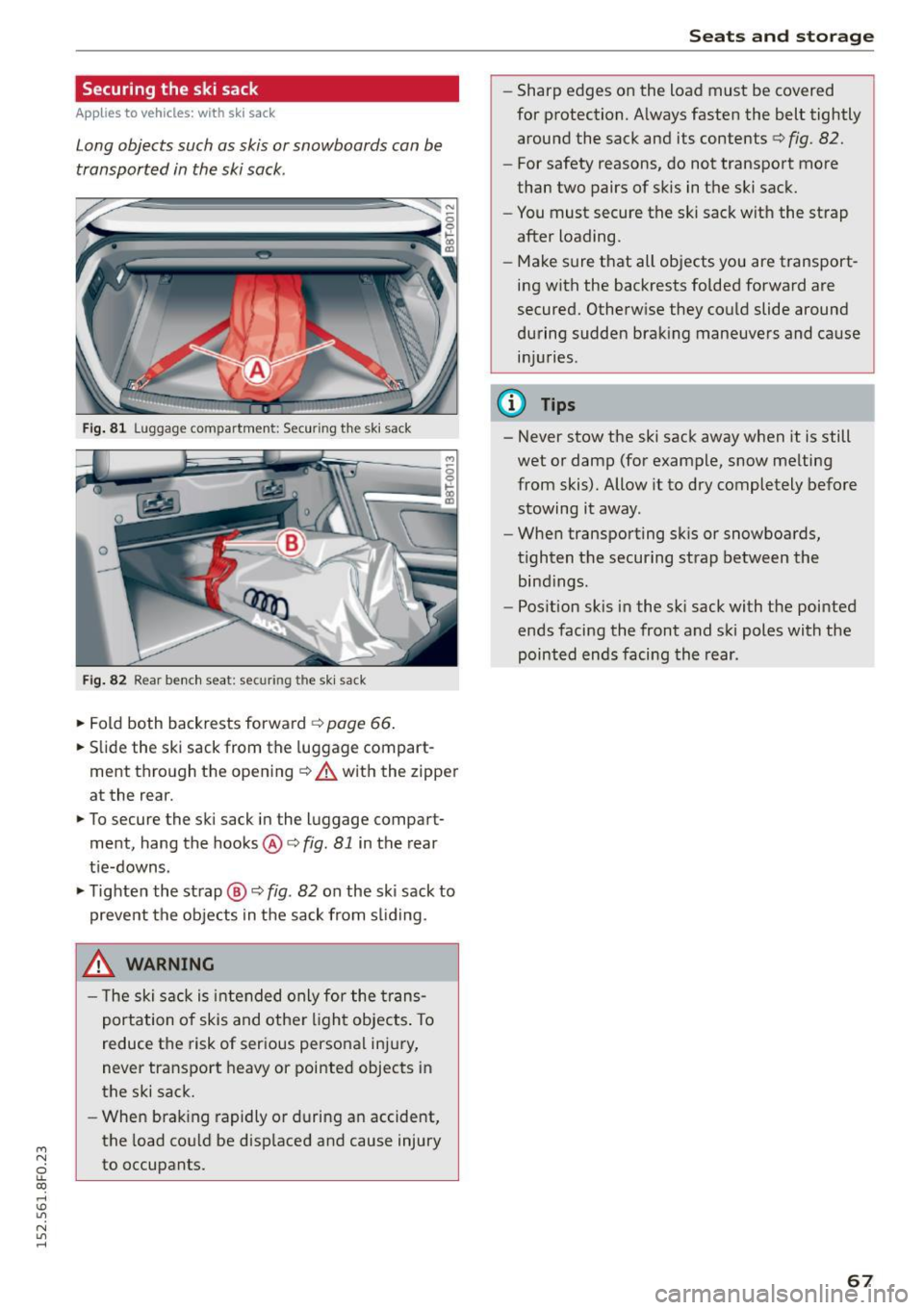
Fig. 81 L uggage compartment: Securing th e sk i sack
Fig. 82 Rear bench seat: securi ng the ski sac k
~ Fold both backrests forward c> page 66.
~ Slide the ski sack from the luggage compart
ment through the opening
¢ A with the zipper
at the rear.
~ To secure the ski sack in the l uggage compart
ment, hang the hooks@c>
fig. 81 in the rear
tie-downs.
~ Tighten the strap @ c> fig. 82 on the ski sack to
prevent the objects in the sack from sliding .
_& WARNING
- The ski sack is intended only for the trans
portation of skis and other light objects. To
reduce the risk of serious personal injury,
never transport heavy or pointed objects in
the ski sack.
- When braking rapidly or during an accident,
the load could be displaced and cause injury
to occupants.
Seats and storage
- Sharp edges on the load must be covered
for protection. Always fasten the belt tightly
around the sack and its contents c>
fig. 82.
-For safety reasons, do not transport more
than two pairs of skis in the ski sack.
- You must secure the ski sack with the strap
after loading.
- Make sure that all objects you are transport
ing with the backrests folded forward are
secured. Otherwise they could slide around
during sudden braking maneuvers and cause injuries .
@ Tips
-Never stow the ski sack away when it is still
wet or damp (for example, snow melting
from skis). Allow it to dry completely before
stowing it away.
- When transporting sk is or snowboards,
tighten the securing strap between the bindings.
- Position skis in the ski sack with the pointed
ends facing the front and ski poles with the
pointed ends facing the rear .
67
Page 73 of 268
M N
ci LL co
rl I.O
"' N
"' rl
the risk of injury, these individua ls should
not use seat heating.
(D Note
To avo id damage to the heating elements in
the seats, do not kneel on the seats or place heavy loads on a small area of the seat .
Setup
The basic climate control settings can be adjust
ed in the radio or MMI*.
.. Se lect: I CAR I fu nct ion button > A /C control but
ton . Or
.. Se lect:
ICARI function button> Car system s*
control button > AC.
Automatic recircul ation *
When switched o n, automatic recirculation con
trols the recircu lation mode au toma tically . If the
windows fog up, press the
I '"" F RONT I button.
Synchronization *
When synchronization is sw itched on, the same
settings are applied to both the driver and front
p a ssenger, except fo r the seat hea ting/vent ila
tion* . Synchronization switches off when you ad
just the settings on the front passenger 's side .
You can a lso switch synchroniza tion on by press
i ng a nd ho ld ing the knob on the driver's side.
Supplementary he ater
The supplementary heater warms the inter ior of
veh icles w ith flexible fuel engines more quickly.
The supplementa ry heater is cont rolled automat
ically in the
Auto se tting.
Warm and cold
Upper cabin heating
Applies to vehicles: with upper cabin heating
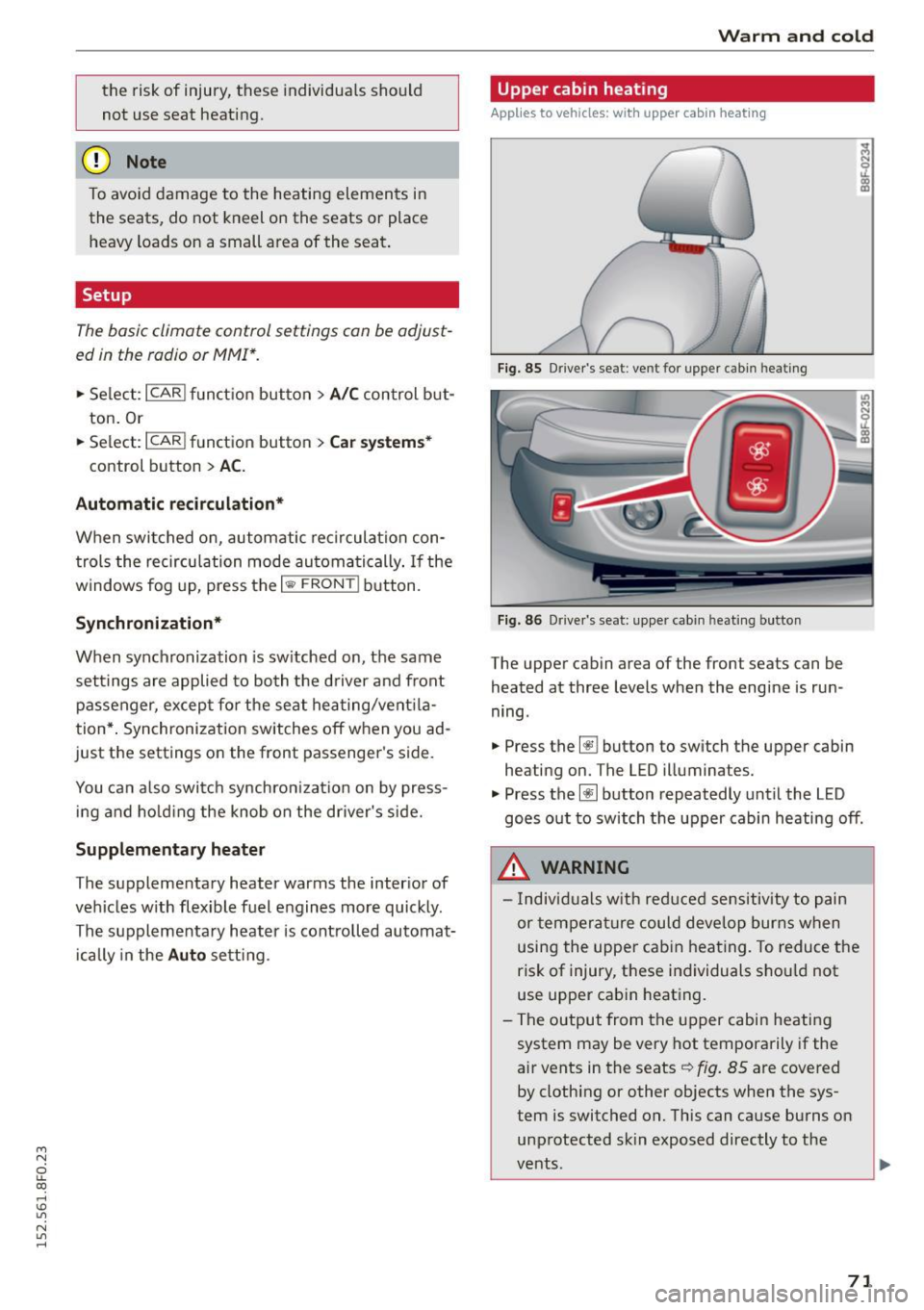
F ig. 85 Driver's seat: ven t fo r upper cabin heating
Fig . 86 Driver's sea t: uppe r cab in hea tin g button
The upper cabin area of the front seats can be
heated at three levels when the engine is run
ning.
.. Press the~ button to switch the upper cabin
heating on. The LED illuminates.
.,. Press the~ button repeatedly until the LED
goes out to switch the upper cabin heating off .
A WARNING
-Individuals w ith reduced sensitivity to pain
or tempera ture could deve lop burns when
using the upper cabin heat ing. To reduce the
risk of injury, these ind ividuals shou ld not
use upper cabin heat ing.
- The output from the upper cabin heati ng
system may be very hot temporarily if the
air vents in the seats<=>
fig. 85 are covered
by clothing or other objects when the sys
tem is switched on. This can cause burns on
unprotected sk in exposed directly to the
vents.
71
Page 115 of 268
Driving safety
Basics
Safe driving habits
Please remember -safety first!
This chapter contains important information,
tips, instructions and warnings that you need to
read and observe for your own safety, the safety
of your passengers and others . We have summar
ized here what you need to know about safety
belts, airbags , chi ld restraints as well as child
safety. Your safety is for us
priority number 1. Al
ways observe the informat ion and warn ings in
this section - for your own safety as well as that
of your passengers .
The information in this section app lies to all
model ve rsions of your vehicle . Some of the fea
tures described in this sections may be standard
equipment on some models, or may be optional
eq uipment on others .
If you are not sure, ask
your authorized Audi dealer.
A WARNING
- Always make sure that you follow the in
struct ions and heed the WARNINGS in this
Manual. It is in your interest and in the in
terest of your passengers.
- Always keep the complete Owne r's Litera
ture in your Aud i when you lend or sell your
vehicle so that this important info rmation
will always be ava ilable to the driver and
passenge rs.
-
- Always keep the Owner's literature handy so
that you can find it easily if you have ques
tions.
Safety equipment
The safety features are part of the occupant re
straint system and work together to help reduce
the risk of injury in a wide variety of accident sit
uations.
M
6 Your safety and the safety of your passenge rs
~ should not be left to chance. Advances in tec h-,...., \!) 1.1'1
N 1.1'1 ,....,
nology have made a var iety of fea tures available
to help reduce the r isk o f injury in an accident.
Dr ivin g s afet y
The following is a list of just a few of the sa fety
features in your A udi:
- sophisticated s afety be lts fo r drive r and a ll pas-
senger seat ing pos itions,
- be lt fo rce limi ters for the front seats,
- belt pretensioners for the seats,
- head restra ints for each seating posit ion,
- front airbags,
- side airbags in the front seats,
- special LATCH anchorages for child rest raints,
- ad justab le steer ing column.
These ind iv idual safety features, can wo rk to
gether as a system to he lp p rotect you and you r
passengers in a w ide range of accidents . T hese
f ea tures cannot work as a system if they are not
always cor rect ly adjusted and correctly used .
Safet y is eve rybod y's res pon sibilit y!
Important things to do before driving
Safety is everybody 's job! Vehicle and occupant
safety always depends on the informed and care
f1,1l driver .
For you r safety and the safety of your passen
gers,
b efore driv ing alway s:
.,. Make sure that all lights and signals are operat
ing correctly .
.,. Make sure that the tire pressure is co rrect .
.,. Make s ure that all w indows are clean and afford
good vis ibility to the outs ide.
.,. Sec ure all luggage and other items caref ully
qpage 64.
.,. Make s ure that nothing can interfere with the
pedals.
.,. Adjust front seat, head restraint and mirrors
correctly for your height .
.,. Instruct passengers to adjust the head re
straints according to the ir height .
.,. Make su re to use the r ight child restraint cor
rectly to protect ch ildren
q page 152, Child
safety.
.,. Si t properly in your seat and ma ke s ure that
your passengers do the same
q page 59, Seats
and storage. .,.
113
Page 117 of 268
M N
ci u.. co ,...., \!) ..,.,
N ..,., ,....,
For detailed information on how to adjust the
driver's seat, see
¢ page 60.
A WARNING
Drivers who are unbelted, out of position or
too close to the airbag can be seriously in
jured by an airbag as it unfolds. To help re
duce the risk of serious personal injury:
- Always adjust the driver's seat and the
steering wheel so that there are at least
10 inches (25 cm) between your breastbone
and the steering wheel.
- Always hold the steering wheel on the out
side of the steering wheel rim with your
hands at the 9 o'clock and 3 o'clock posi
tions to help reduce the risk of personal in
jury if the driver's airbag inflates.
- Never hold the steering wheel at the
12 o'clock position or with your hands at
other positions inside the steering wheel
rim or on the steering wheel hub. Holding
the steering wheel the wrong way can cause
serious injuries to the hands, arms and head
if the driver's airbag deploys.
- Pointing the steering wheel toward your
face decreases the ability of the supplemen
tal driver's airbag to protect you in a colli
sion.
- Always sit in an upright position and never lean against or place any part of your body
too close to the area where the airbags are located .
- Before driving, always adjust the front seats
and head restraints properly and make sure
that all passengers are properly restrained.
- Never adjust the seats while the vehicle is
moving . Your seat may move unexpectedly
and you could lose control of the vehicle.
- Never drive with the backrest reclined or
tilted far back! The farther the backrests are
tilted back, the greater the risk of injury due
to incorrect positioning of the safety belt
and improper seating position.
- Children must always ride in child safety
seats
¢page 152. Special precautions ap
ply when installing a child safety seat on the
front passenger seat¢
page 132.
Driving safety
Proper seating position for the front
passenger
The proper front passenger seating position is
important for safe, relaxed driving.
For your own safety and to reduce the risk of in
jury in the event of an accident, we recommend
that you adjust the seat for the front passenger
to the following position:
.,. Move the front passenger seat back as far as
possible . There must be a minimum of 10 in
ches (25 cm) between the breastbone and the
instrument panel¢.&, .
.,. Adjust the angle of the seatback so that it is in
an upright position and your back comes in full
contact with it whenever the vehicle is moving.
.,. Applies to vehicles with adjustable head re
straints: Adjust the head restraint so the upper
edge is as even as possible with the top of your
head . If that is not possible, try to adjust the
head restraint so that it is as close to this posi
tion as possible .
.,. Keep both feet flat on the floor in front of the
front passenger seat.
.,. Fasten and wear safety belts correctly
c:> page 127.
For detailed information on how to adjust the
front passenger's seat, see ¢
page 59.
A WARNING ~
Front seat passengers who are unbelted, out
of position or too close to the airbag can be
seriously injured or killed by the airbag as it unfolds. To help reduce the risk of serious per
sonal injury:
- Passengers must always sit in an upright po
sition and never lean against or place any
part of their body too close to the area
where the airbags are located.
- Passengers who are unbelted, out of posi
tion or too close to the airbag can be seri
ously injured by an airbag as it unfolds with
great force in the blink of an eye.
- Always make sure that there are at least 10 inches (25 cm) between the front passen
ger's breastbone and the instrument panel.
115
Page 118 of 268
Driving safet y
-Each passenger must always sit on a seat of
their own and properly fasten and wear the
safety belt belonging to that seat.
- Before driving, a lways adjust the front pas
senger seat and head restraint properly.
- Always keep your feet on the floor in front
of the seat. Never rest them on the seat, in
strument pane l, out of the window, etc . The
airbag system and safety belt will not be
able to protect you properly and can even in
c reas e the risk of injury in a crash.
- Never dr ive with the backrest recl ined or
t ilted far back! The farther the backrests are
t il te d back, the greater the r isk of injury due
to incorrect pos itioni ng of the safety bel t
and improper se ating posi tion.
- Children m ust always ride i n child safety
seats ¢
page 152. Special preca utions ap
ply when installing a ch ild safety sea t on the
front passenger seat ¢
page 132.
Proper seating positions for passengers in
rear seats
Rear seat passengers must sit upright with both
feet on the floor consistent with their physical
size and b e properly r estrained wh enever the ve
hicle i s in use.
To reduce the risk of injury caused by an incorrect
seating position in the event of a sudden braking maneuver or an accident, your passengers on the
rear bench seat must always observe the follow
ing:
"' Make sure that the seatback is securely latched
in the upright pos ition
¢ page 66 .
"' Keep both feet flat in the footwell in front of
the rear seat.
"' Faste n and wear safety belts prope rly
¢ page 127.
"' Make sure that ch ildren are always properly re
stra ined in a chi ld restraint that is appropria te
f o r their size and age ¢
page 15 2.
A WARNING
Passengers who a re improperly seated on the
rear se-at can be se riously i njured in a crash .
116
-Each passenger must always sit on a seat o f
their own and proper ly fasten and wea r the
safety belt belong ing to that seat.
- Safety belts only offer maximum protection
when the seatback is securely latched in the
upright pos ition and the safety belts are
properly positioned on the body. By not sit
ting upr ight , a rear seat passenger increases
the risk of pe rsonal injury from imprope rly
posi tioned safety belts!
Proper adjustment of head restraints
Applies to vehicles: with adjustable head restraints
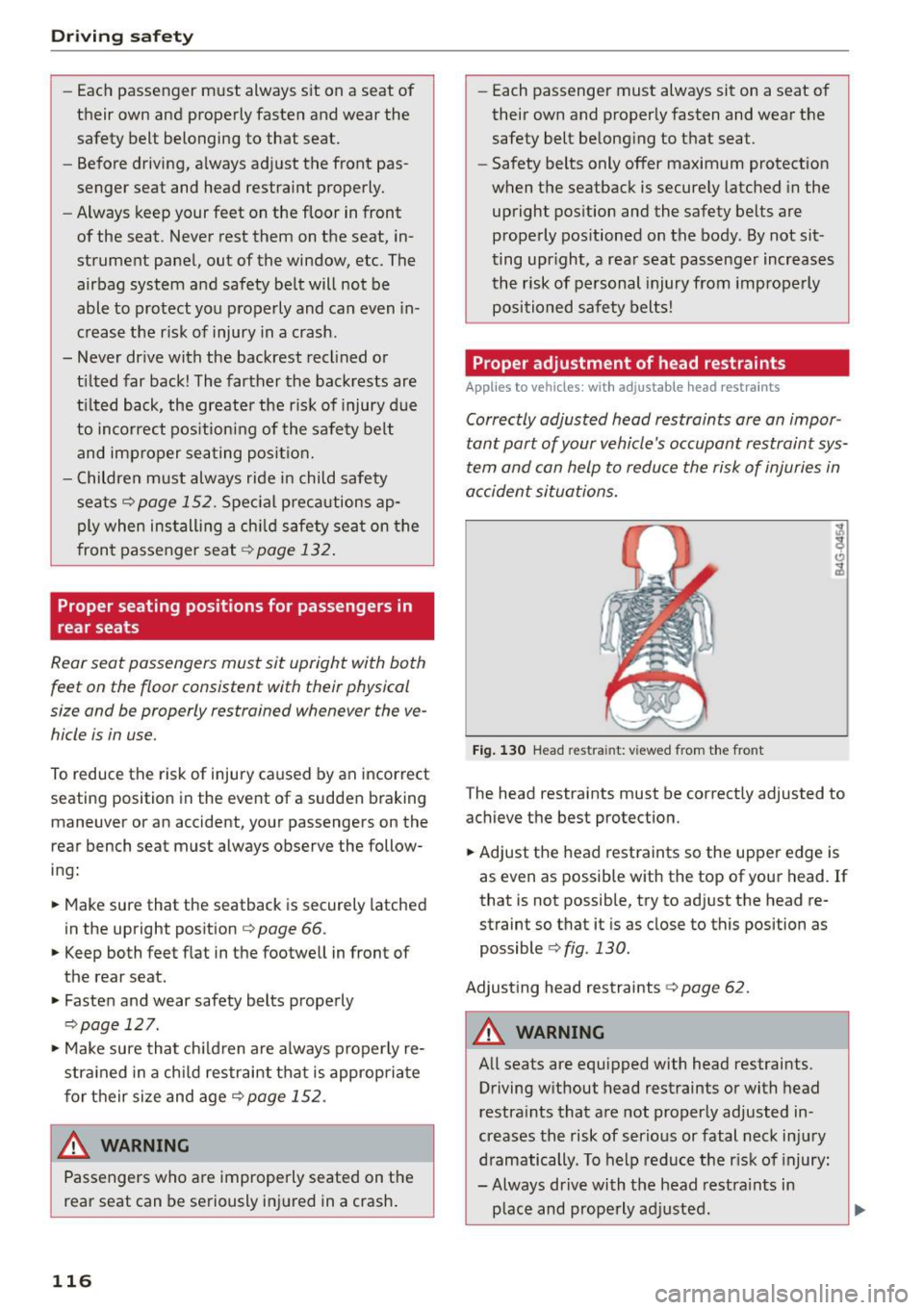
Correctly adjusted head restraints are an impor
tant part of your vehicle's occupant restraint sys
tem and can help to redu ce the risk of injuries in
accident si tua tions.
F ig . 1 30 Head res tra in t: v iewed from th e fro nt
T he head restraints must be correctly adjusted to
achieve t he best protection.
"' Adjust the head restraints so the upper edge is
as even as possib le with the top of your head. If
that is not poss ible, try to ad just the head re
straint so that i t is as close to this position as
possible
c> fig . 130.
Adjust ing head restraints c> page 62.
A WARNING
All seats are equipped with head restraints.
Driving w ithout head rest raints or with head
restra ints that a re not properly adjusted in
creases the risk of serio us or fatal nec k inju ry
d ramatically. To help reduce the r isk of injury:
- Always drive with the head restra ints in
place and properly a djusted.
-
Page 119 of 268
M N
ci u.. co ,...., \!) ..,.,
N ..,., ,....,
-Every person in the vehicle must have a
properly adj usted head restra int.
- Always make sure each person in the vehicle
properly ad justs their head restraint. Adjust
the head restraints so the upper edge is as
even as possib le w ith the top of your head.
If that is not possib le, try to adjust the head
restraint so that it is as close to this position
as possib le.
- Never attempt to adjust head rest raint
wh ile driving. If you have driven off and
must adjust the dr iver head rest for any rea
son, first stop the veh icle safely before at
tempting to ad just the head rest raint.
- Children must always be properly restrained
in a ch ild restraint that is appropriate fo r
their age and size
q poge 152.
Examples of improper seating positions
The occupant restraint system con only reduce
the risk of injury if vehicle occupants ore properly
seated.
Improper seating posit ions can cause serious in
jury o r death . Safety be lts can only work when
they are prope rly positioned on the body. Im
p roper seating posit ions reduce the effectiveness
of safety belts and wi ll even increase the risk of
in ju ry and death by moving the safety belt to cr it
ical areas of the body. Improper seating positions
also increase the risk of serious injury and death
when an airbag deploys a nd strikes an occupant
who is not in the proper seating position . A driver
i s responsible for the safety of all vehicle occu
pants and especia lly for children. Therefore:
.. Never allow anyone to assume an incorrect
seat ing pos it ion when the veh icle is being used
~ & -
The follow ing bulletins list only some sample po
sitions that will increase the risk of ser ious injury
and death . Our hope is that these examples w ill
make you mor e aware of seat ing pos itions that
are dangerous.
The refore, whene ver the vehicle is moving:
- never stand up in the vehicle
- never stand on the seats
Dr ivin g s afet y
-neve r kneel on the seats
- neve r ride w it h the seatback reclined
- never lie down on the rear seat
- never lean up against the instrument panel
- never s it on the edge of the seat
- never s it sideways
- never lean out the window
- never put your feet out the window
- neve r put your feet on the instr ument pane l
- neve r rest your feet on the seat cush ion or back
of the seat
- never ride in the footwell
- never ride in the cargo area
A WARNING
Imp roper seating posit ions increase the risk
of ser ious personal in ju ry and death whenever
a veh icle is being used.
- Always make sure that all vehicle occupants
stay in a prope r seating position and are
properly rest rained whenever the vehicle is
be ing used.
Driver's and front
passenger's footwell
Important safety instructions
App lies to vehicles : wit h knee airbags
A WARNING ,-.=-
Always make sure that the knee airbag can in-
flate w ithout interference. Objects between
yourself and the airbag can increase the risk
of injury in an accident by interfering with the
way the airbag deploys or by be ing pushed in
to you as the ai rbag deploys .
- No persons (children) or animals shou ld ride
in the footwell in front of the passenger
seat. If the airbag deploys, th is can result in
serious or fatal injur ies.
- No objects of any kind should be ca rried in
the footwell area in front of the driver's or passenger's seat. Bu lky objects (shopping
bags, for example) can hamper or prevent
p roper deployment o f the a irbag . Small ob
jects can be thrown through the vehicle if
117
Page 123 of 268
M N
NHTSA
U.S. Department of Transporta
tion 1200 New Jer sey Av e., S.E.
West Building
Washington , DC 20590
You can also obtain other infor mation about motor veh icle safe
ty from:
http: / /www.safercar .gov
Applicable to Canada
If you live in Canada and you be
liev e th at your vehi cle ha s a de
fect that could cau se a cra sh, in
jury or death , you should imm edi
ately inform Transport Canada ,
Defect Investigation s and Recalls.
You should also notify Audi C ana
da .
Canadian customers who wish to
report a safety-related defect to
Transport Canada, Defect Invest i
gations and Recalls, may either
call Transport Canada toll-free at:
Tel.: 1 -800-333-0510 or
Tel.: 1-819-994-3328 (Ottawa re
gion and from other countries)
TTY for hearing impaired: Tel.:
1-888-6 7 5-6863
~ or contact Transport Canada by
rl
:5: mail at:
N l/1 rl
Driving safety
Tran sport Canada
Motor Vehicle Safety Investiga
tions Laboratory 80 Noel Street
Gatineau , QC
J8Z 0Al
For additional road safety infor
mation , please visit the Road
Safety website at:
http://www.tc .gc .ca/eng/
road safety/menu.htm
Active rollover
protection system
Function
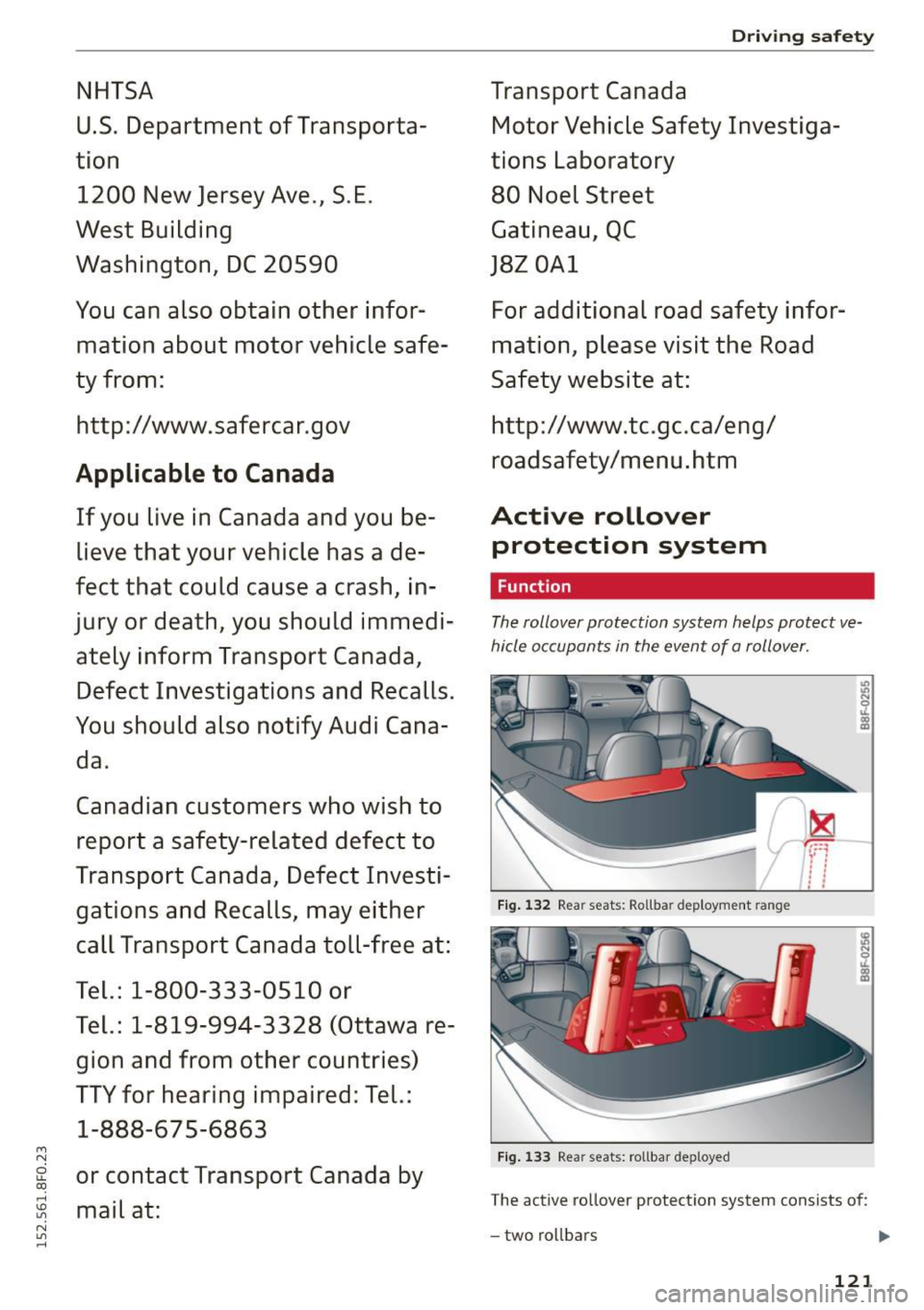
Th e rollover protection system helps pro tect ve
hicle o ccupan ts in the event of a rollover.
Fig. 132 Rea r seats: Ro llba r dep loyment range
Fig. 13 3 Rear seats : roll bar deployed
~ ,,-.... . ...,
I ,.
' ' ' ' ' . ' ' . • • '
The active ro llover protection system consists o f:
- t wo ro llbars
121
Page 124 of 268

Driving safet y
-the safety belts wit h be lt te nsioners
- the wind shie ld frame
- the rollover sensors
The active rollover protection system provides
addit ional safety in the event of a rollover. W ith in
m ill iseconds, sensors deploy two rollbars located
behind the headrests in the rear seats ¢
fig. 133.
The rollbars, reinforced windshield frame and
belt tens ioners help protect front and rear pas
sengers in the event of a rollover .
The rollover protection system functions when
the power top is both open and closed.
A WARNING
-
Do not use the area beh ind the rear seat
headrests
9fig . 132 as a storage a rea . Th is is
t he a rea whe re the rollbars dep loy. If the ro ll
over pro tect ion system is triggered, objects
placed there can be pro pelled th roug h the
ve
hicle and make it more difficult for the roll
bars to deploy . This increases the risk for seri
ous or life-threaten ing injur ies.
When is rollover protection deployed?
Rollover protection deploys in a collision or roll
over.
Depending on the coll is ion, sensors throughou t
the vehicle and the control mod ule tr igger the
rollover system to deploy.
For safety reasons, ro llover protect ion a lso de
p loys during front, side and rear coll is ions above
a certa in leve l of severi ty .
Retracting rollover protection
F ig . 13 4 Dep loyed roltba r wit h re lease loop .
122
Fig . 13 5 Deployed rollbar w it h power top frame facing up
ward.
If the rollover p rotection has tr iggered but the
vehicle was not involved in an accident, you can
retract the rollover protection yourself in an
emergency. Drive to your authorized Audi dealer
or qualified repair facility immed iate ly to have
the malfunct ion corrected.
With the power top open
.. Pull the loop upward in the direction of the ar
row and hold it in place
9 fig. 134.
.. Slide the rollbar down .
.,.. Release the loop just before the ro llbar reaches
its end position by approximately 1-2 in . (3-5
cm).
.,.. Press t he rollbar down unt il i t stops.
.. Ma ke s ure the rollbar is secure be fore releasing
it .
.. Close the cover @¢
fig. 135.
.. Repeat t he proced ure on the other ro llbar.
With the power top closed
.,.. Sw itch the ignit io n on.
.. Press the conver tible switch to adjus t the co n
ver tible frame until it is vertical ¢
fig. 135 .
.. Pull the loop upward in the direction of the ar
row and hold it in place
9 fig. 134.
.,. Slide the rollbar down .
.. Release the loop ju st before the rollbar reaches
its end position (3-5 cm) .
.,.. Press the rollbar down unt il it stops .
.. Ma ke su re the rollbar is secu re before releasing
i t .
.,.. Clo se the cover @¢
fig. 135 .
.. Repeat the procedure on the other ro llba r .
.. Yo u can now close the power top again .
Page 126 of 268
Safety belt s
Safety belts
General information
Always wear safety belts!
Wearing safety belts correctly saves lives!
This chapter explain s why safety be lts are neces
sary, how they work and how to adjust and wear
them correctly.
.. Read all the information that fo llows and heed
all of the instructions and WARNINGS.
&_ WARNING
Not wearing safety belts or wearing them im
properly increases the risk of serious personal
injury and death.
- Safety belts are the single most effective
means available to reduce the risk of serious
injury and death in automobile accidents.
For your protection and that of your passen
gers, always correct ly wear safety belts
when the vehicle is moving.
- Pregnant women, injured, or physically im
paired persons must also use safety belts.
L ik e all veh icle occupants, they are more
likely to be seriously injured if they do not
wear safety be lts . The best way to protect a
fetus is to protect the mother - throughout
the ent ire pregnancy.
Number of seats
Your Audi has a total of four seating positions:
two in the front and two in the rear. Each seating
position has a safety belt .
&_ WARNING
Not wearing safety belts or wearing them im
properly increases the risk of serious personal
injury and death.
- Never strap more than one person, includ
ing small ch ildren, into any belt. It is espe
cially dangerous to place a safety belt over a
child sitting on your lap.
- Never let more people ride in the vehicle
than there are safety belts available.
124
-Be sure everyone riding in the vehicle is
properly restrained with a separate safety
belt or child restraint.
Safety belt warning light
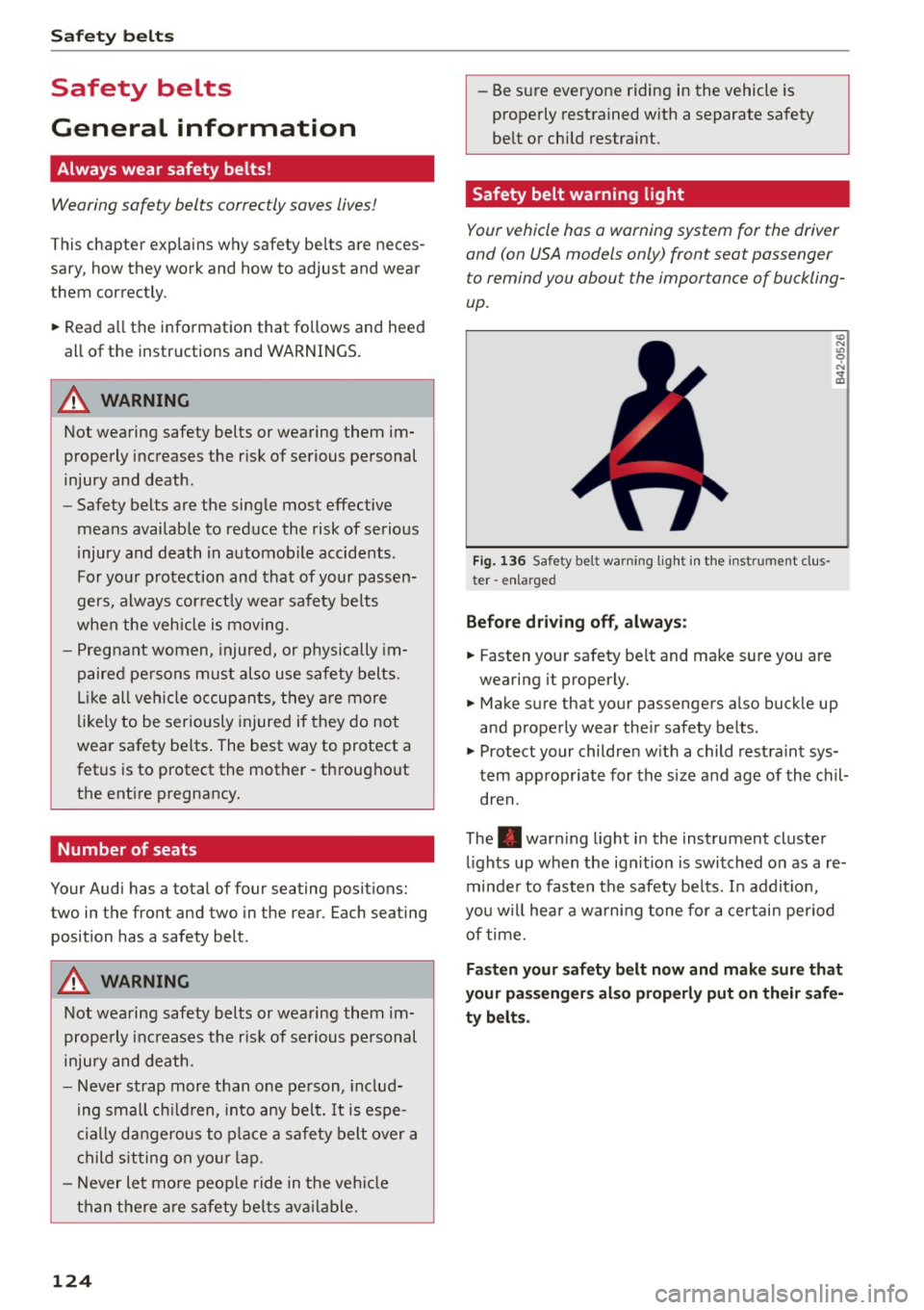
Your vehicle has a warning system for the driver
and (on USA models only) front seat passenger
to remind you about the importance of buckling
up .
Fig. 136 Safety belt warning light in the instrument cl us
ter -enlarged
Before driving off, always:
.. Fas ten your safety belt and make sure you are
wearing it properly.
(0
"'
"' 0 N
and properly wear the ir safety belts .
.. Protect your children w ith a child restraint sys
tem appropriate for the siz e and age of the chil
dren.
The . warn ing light in the instrument cluster
lights up when the ign it ion is switched on as a re
minder to fasten the safety be lts. In addit io n,
you w ill hear a warning tone for a certain period
of time.
Fasten your safety belt now and make sure that
your passengers also properly put on their safe
ty belts.
Page 128 of 268
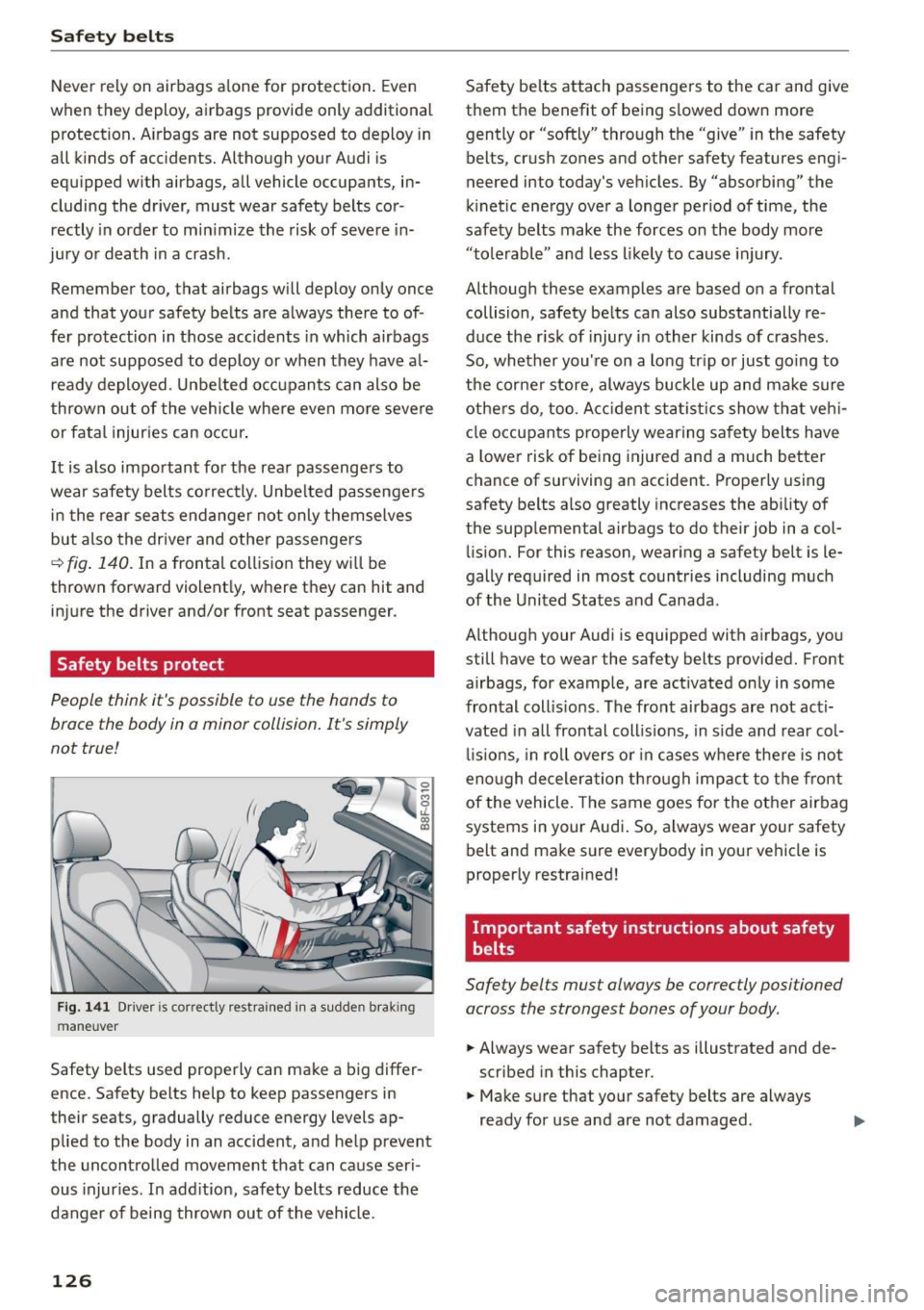
Safety belts
Never rely on airbags a lone for protection . Even
when they deploy, airbags provide only additional
protection . A irbags are not supposed to deploy in
all kinds of accidents. Although your Audi is
equipped w ith airbags, all vehicle occupants, in
cluding the driver, must wear safety belts cor
rectly in orde r to min imize the risk of seve re in
jury o r death in a crash .
Remember too, that airbags will deploy only once
and that your safety be lts are a lways there to of
fer protection in t hose accidents in which airbags
are not supposed to deploy or when they have a l
ready deployed . Unbelted o ccupan ts can also be
thrown ou t of the vehicle where even mo re severe
or fata l injur ies can occur .
It is also important fo r the rea r passenge rs to
wear safety belts co rrectly. Unbe lted passenge rs
i n t he rear se ats endanger not only themselves
but also the driver and other passengers
~ fig . 140. In a frontal coll ision they wi ll be
thrown forward violent ly, where they can hit and
in ju re the driver and/or front seat passenger.
Safety belts protect
People think it's possible to use the hands to
brace the body in a minor collision . It 's simply
not true!
F ig . 141 D river is correct ly rest ra ined i n a sudden b rak ing
m aneuver
Safety belts used properly can make a big differ
ence. Safety belts help to keep passengers in
their seats , gradually reduce energy levels ap
plied to the body in an accident, and he lp prevent
the uncont ro lled movement that can cause seri
ous injur ies. In add it ion, safety belts reduce the
danger of being throw n ou t of the vehicle.
126
Safety be lts attach passengers to the car and give
them the benefit of being s lowed down more
gently or "softly" through t he "give" in the safety
belts, crush zones and other safety features eng i
neered into today's veh icles. By "absorbing" the
ki net ic ene rgy over a longer period of time, the
safety be lts make the forces on the body more
"tole rable" and less li kely to cause injury .
Although these examples are based o n a frontal
collision, safety be lts can also substantially re
duce the r isk o f injury in other kinds o f crashes.
So, whether you're on a long tr ip or just go ing to
t he cor ne r store, always bu ckle up and ma ke sure
o thers do, too. Ac ciden t sta tis tics show that ve hi
cle occupants properly wearing sa fe ty belts have
a lowe r risk of be ing injured and a much better
chance of surviving an accident. Pro perly using
safety belts a lso greatly increases the ab ility of
the supp lemental airbags to do their job in a col
li sion. For this reason, wear ing a safety be lt is le
gally required in most countries including much
of the United States and Canada .
Although your Audi is equipped with a irbags, you
still have to wear the safety belts provided. Front airbags, for example, are act ivated only in some
fron tal coll is io ns . The front airbags are not act i
vated in a ll frontal col lisions, in s ide and rear co l
li sio ns, in ro ll overs o r in cases whe re the re is not
eno ugh deceler ation th rough imp act to the front
of the vehicle . T he same goes for the other airbag
systems in your Audi. So, always wear your safety
belt and make sure everybody in your vehicle is
proper ly restrained!
Important safety instructions about safety
belts
Safety belts must always be correctly positioned
across the strongest bones of your body .
.,. Always wear safety belts as illustrated and de
scribed in this chapter .
.,. Make s ure that your safety belts are always
ready fo r use and are not damaged .