instrument cluster AUDI A5 CABRIOLET 2015 Owner's Manual
[x] Cancel search | Manufacturer: AUDI, Model Year: 2015, Model line: A5 CABRIOLET, Model: AUDI A5 CABRIOLET 2015Pages: 268, PDF Size: 66.88 MB
Page 104 of 268

Audi side assist
(D Tips
-Side assist is not active while you are mak
ing the adjustment.
- Your settings are automatically stored and
assigned to the remote control key being
used.
Driver messages
Applies to veh icles: w ith Aud i side ass ist
If side assist switches off by itself, the LED in the
button turns
off and a message will appear in the
instrument cluster display:
Audi side assist unavailable: Sensors blocked
The radar sensors' vision is affected. Do not cover
the area in front of the sensors with bike wheels,
stickers, dirt or other objects. Clean the area in
front of the sensors, if necessary ¢
page 100,
fig. 117.
Audi side assist: Currently unavailable
Side assist cannot be switched on temporarily be
cause there is a malfunction (for example, the
battery charge level may be too low).
Audi side assist: System fault!
The system cannot guarantee that it will detect
vehicles correctly and it is switched off . The sen
sors have been displaced or are faulty. Have the
system checked by an authorized Audi dealer or
authorized Audi Service Facility soon.
Audi side assist: Unavailable when towing
Side assist switches off automatically when a fac
tory-installed trailer hitch is connected to the
electrical connector on the trailer. There is no
guarantee the system will switch off when using
a retrofitted trailer hitch. Do not use side assist
when towing a trailer.
102
Page 106 of 268

Audi drive select
sporty shifting characteristics . The S gear
position engages automatically.
- In vehicles that have dynamic steering*, op
erating noise is heard when starting or stop
ping the engine. This does not indicate a
problem.
Selecting the driving mode
Applies to veh icles: with Audi drive select
You con choose between Comfo rt, Auto , Dynam·
ic
and Individual * modes.
N N 0
0
'I::======:..,. gJ
drive I sel,.c,ct _ J -~-
F ig. 119 Cente r conso le: Control fo r Aud i drive se lect
Fig . 120 MMI*: A udi drive select
Adjusting the Individual mode
Applies to vehicles: w ith MMI and Audi drive select
.,. To set the mode, press the~:/:'.~ button
r::!) fig. 119 multiple times until the desired
mode is displayed in the instrument cluster . Or
.,. In the MMI*, select: ICARlfunction button>
Comfort, Auto, Dynamic or Individual*.
In vehicles without the MMI*, the r:::~ button is
found underneath the shift/selector lever.
You can change the driving mode when the vehi
cle is stationary or while driving . If traffic per
mits, after changing modes, briefly take your
foot off the accelerator pedal so that the recently
selected mode is also activated for the engine
and transmission .
Comfort -provides a comfort-oriented vehicle
setup and is suited for long drives on highways.
Auto -provides an overall comfortable yet dy
namic driving feel and is suited for every day use.
Dynamic -gives the driver a sporty driving feel
and is suited to a sporty driving style .
Individual* -c>page 104 .
&_ WARNING
Pay attention to traffic when operating drive
select to prevent potential risk o f an acciden t.
You can personally specify the vehicle setup in the MMI* .
.,. Select the ICAR I function button > Set individu·
al
control button. Once you select the menu,
you w ill automatically drive in the
individual
mode.
Systems Comfort
Eng i ne/Tra nsm ission ba
lanced
Steering comfortable
Dynamic steering* comfortable/indirect
104
The equipment in your vehicle will determine
which settings you can adjust. The following ta
ble prov ides an overview of the characteristics of
each driving mode.
Auto Dynamic
balanced sporty
balanced sporty
balanced/direct sporty/direct
Page 126 of 268
Safety belt s
Safety belts
General information
Always wear safety belts!
Wearing safety belts correctly saves lives!
This chapter explain s why safety be lts are neces
sary, how they work and how to adjust and wear
them correctly.
.. Read all the information that fo llows and heed
all of the instructions and WARNINGS.
&_ WARNING
Not wearing safety belts or wearing them im
properly increases the risk of serious personal
injury and death.
- Safety belts are the single most effective
means available to reduce the risk of serious
injury and death in automobile accidents.
For your protection and that of your passen
gers, always correct ly wear safety belts
when the vehicle is moving.
- Pregnant women, injured, or physically im
paired persons must also use safety belts.
L ik e all veh icle occupants, they are more
likely to be seriously injured if they do not
wear safety be lts . The best way to protect a
fetus is to protect the mother - throughout
the ent ire pregnancy.
Number of seats
Your Audi has a total of four seating positions:
two in the front and two in the rear. Each seating
position has a safety belt .
&_ WARNING
Not wearing safety belts or wearing them im
properly increases the risk of serious personal
injury and death.
- Never strap more than one person, includ
ing small ch ildren, into any belt. It is espe
cially dangerous to place a safety belt over a
child sitting on your lap.
- Never let more people ride in the vehicle
than there are safety belts available.
124
-Be sure everyone riding in the vehicle is
properly restrained with a separate safety
belt or child restraint.
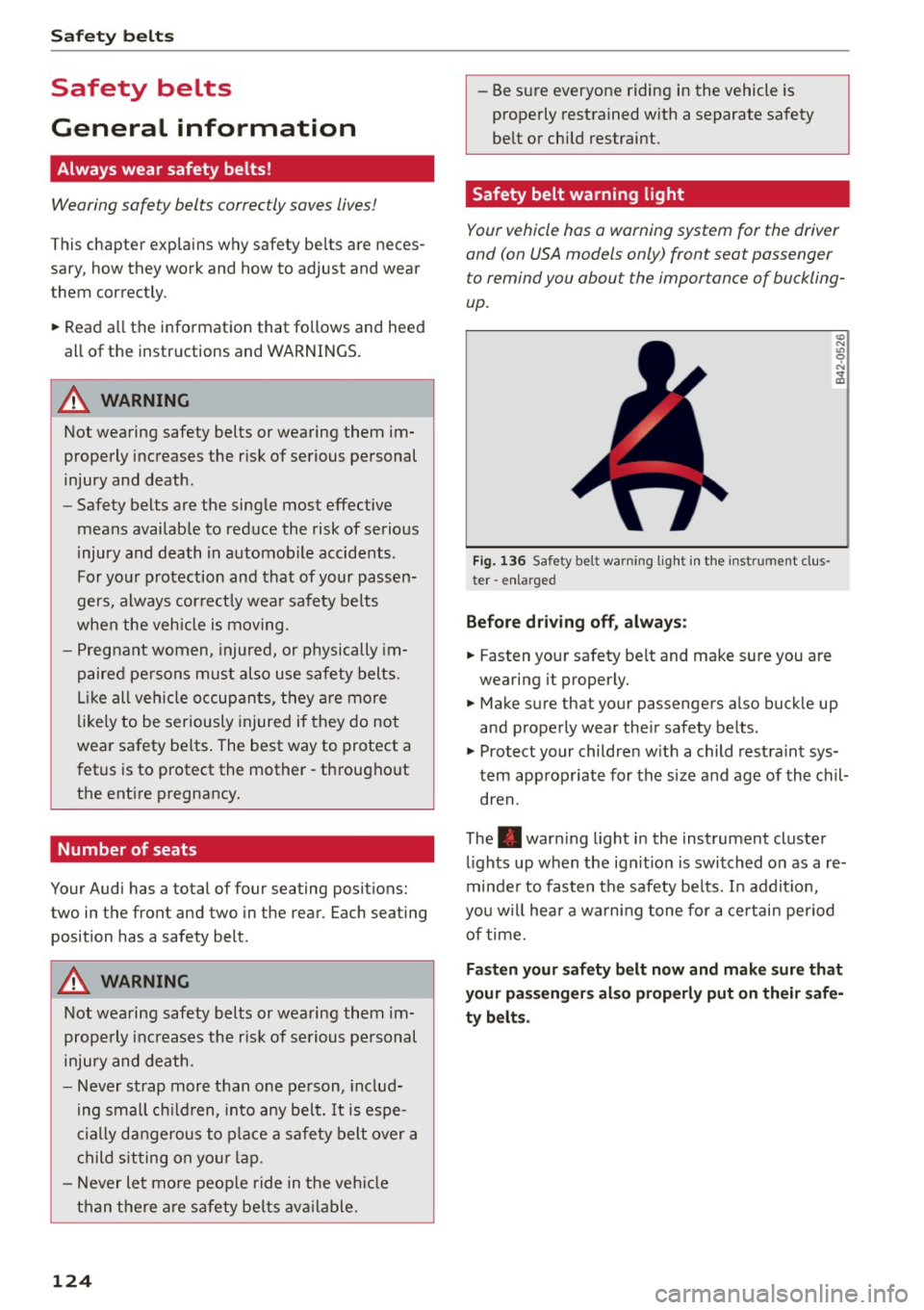
Safety belt warning light
Your vehicle has a warning system for the driver
and (on USA models only) front seat passenger
to remind you about the importance of buckling
up .
Fig. 136 Safety belt warning light in the instrument cl us
ter -enlarged
Before driving off, always:
.. Fas ten your safety belt and make sure you are
wearing it properly.
(0
"'
"' 0 N
and properly wear the ir safety belts .
.. Protect your children w ith a child restraint sys
tem appropriate for the siz e and age of the chil
dren.
The . warn ing light in the instrument cluster
lights up when the ign it ion is switched on as a re
minder to fasten the safety be lts. In addit io n,
you w ill hear a warning tone for a certain period
of time.
Fasten your safety belt now and make sure that
your passengers also properly put on their safe
ty belts.
Page 141 of 268

M N
ci u.. co ,...., \!) 1.1'1
N 1.1'1 ,....,
detail below . Because the front passenger seat
contains important parts of the Advanced Airbag
System, yo u must take care to prevent it from be
ing damaged. Damage to the seat may prevent
the Advanced Airbag for the front passenger seat
from do ing its job in a crash .
The front Ad vanced Airb ag S ystem con sis ts
of the following :
-Crash sensors in the front of the veh icle that
measure veh icle acceleration/deceleration to
provide information to the Advanced Airbag
System about the severity of the crash .
- An electronic control unit, with integrated
crash sensors for front and side impacts . The
control unit "decides" whether to fire the front
airbags based on the information received from
the crash sensors . T he control un it also "de
cides" whether the safety be lt pretensioners
sho uld be activated.
- An Advanced Airbag with gas generator and
control valve for the driver inside the steering
whee l hub.
- An Advanced Airbag with gas generator and
control valve inside the instrument panel for
t h e front passenger.
- A weig ht-sensing mat under the upholstery
padding of the front passenger seat cushion
that meas ures the tota l weight on the seat. The
information registered is sent cont in uous ly to
the e lectronic control unit to regulate dep loy
ment of the front Advanced Airbag on the pas
senger side.
- An airbag monitoring system and indicator
light in the instrument cluster
¢ page 142.
-A sensor in each front seat registers the dis
tance between the respect ive seat and the
steering wheel or instrument panel. The infor
mation registered is sent cont inuously to the
elect ron ic cont ro l unit to regulate deployment
of the front Advanced Airbags.
- T he
PASSENGER AIR BAG OFF light comes on
and stays on in the center of the i nstrument
pane l¢
page 142, fig . 150 and tells you when
the front Advanced Ai rbag on the passenger
side has been turned
off .
-A sensor below the safety belt la tch fo r the
front seat passenge r to measure the tension on
Airbag syste m
the sa fe ty belt. The tens ion on the safety be lt
and the weight registe red by the weight -sens
ing mat help the control unit "decide" whether
the front a irbag for the front passenger seat
should be turned
off or not¢ page 133, Child
restraints on the front seat- some important things to know.
- A sensor in the safety belt latch for the driver
and for the front seat passenger that senses
whether that safety belt is latched or not and
transm its this informat ion to the elect ro nic
cont ro l unit.
A WARNING
D amage to the fron t passenger seat can pre
vent the fron t air bag from working prope rly.
- Imp roper repai r or d isassembly of the front
passenger and driver sea t will prevent the
Advanced Airbag System from functioning properly .
- Repairs to the front passenge r seat must be
performed by qualified and p roperly trained
workshop personne l.
- Never remove the front passenger or driver seat from the vehicle .
- Never remove the upho lstery from the front
passenger seat.
- Never d isassemble o r remove par ts from the
seat or disconnect w ires from it.
- Never carry sh arp objects in yo ur po ckets or
p la ce them on t he seat.
If the weight-sens
ing mat in the passenger seat is punctu red
it cannot work properly .
- Never carry things on yo ur lap or carry ob
jects on the passenger seat. S uch items can
increase the we ight registe red by the
weight-sensing mat and send the wrong in
formation to the a irbag control unit.
- Never store items under the front passenger
seat . Parts of the Advanced Airbag System
under the passenger seat could be dam
aged, p reventing them and the airbag sys
tem from wo rking prope rly.
- Never p lace seat covers or rep lacement up
holstery that have not been specifically ap
p roved by Aud i on the front seats.
- Seat cove rs can prevent the Advanced Air
bag Sys tem from recogniz ing child
1 39
Page 146 of 268

Airbag syste m
his or her back up against the backrest and the
backrest is not reclined ¢
page 114, Correct
passenger seating positions,
- the adu lt is not taking weight off the seat by
holding on to the passenger assist handle
above the front passenger door or supporting
their weight on the armrest,
- the safety belt is being properly worn and that
there is not a lot of slack in the safety belt web
bing,
- accessory seat covers or cushions or other
things that may cause an incorrect reading or impression on the weight-sens ing mat under
the upholstery of the seat have been removed
from the front passenger seat,
- a safety be lt extender has not been left in the
safety belt latch for the front passenger seat .
In addition to the
P ASS ENGER AIR BA G OF F
light in the center of the instrument panel, the
message
PASSE NGER A IR BAG OFF or PASSEN
GER AIR BAG ON
will briefly appear in the instru
ment cluster display . Thi s is to inform the driver
of the current front passenger airbag status.
Important safety instructions on
monitoring the Advanced Airbag System
A WARNING
An airbag system that is not funct ion ing prop
erly cannot prov ide supplementa l protect ion
in a frontal crash.
- If the airbag indicator light ¢
page 19
comes when the vehicle is being used, have
the system inspected immediate ly by your
authorized Aud i dealer.
It is possible that
the a irbag will inflate when it is not s up
posed to, or wi ll not inflate when it should.
A WARNING
If the front airbag in flates, a chi ld without a
child restraint, in a rearward-facing child safe
ty seat or in a forward-facing child restraint
that has not been proper ly installed will be
ser iously injured and can be killed.
- Even though your veh icle is equipped with
an Advanced Airbag System, make certa in
that all ch ildren, especially 12 yea rs and
144
younger, a lways ride on the back seat prop
erly restrained for their age and size.
- Always install forward or rear-facing child
safety seats on the rear seat -even with an
Advanced A irbag System.
- If you must install a rearward-facing child
safety seat on the front passenger seat be
cause of exceptional circumstances and the
PASSENG ER AIR BAG OFF light does not
appear and stay on, immediately insta ll the
rea r-facing chi ld safety seat in a rear seating
position and have the airbag system inspect
ed by your authori zed Audi dealer .
- A t ight tether or other s trap on a rea rward
facing chi ld restraint attached to the front
p assenger sea t can put too much pressure
on the weight-sens ing mat in the seat and
reg ister more weight than is actually on the
seat. The heavier weight registered can make the system work as though an adult
were on the seat and deploy the Advanced Airbag when it must be suppressed caus ing
serious or even fatal injury to the child .
- If, in exceptiona l circumstances, you must
install a forward-facing child restraint on
the front passenger seat, always move the seat into i ts rearmost pos ition in the seat's
fore and aft ad justmen t range, as fa r away
from the airbag as possib le. The backrest
m ust be adjusted to an upr ight position.
Make sure that the
PASSENGER AIR BAG
OFF
li ght comes on and stays on all the time
whenever the ignit ion is switched on.
A WARNING
- If the PASS ENGER AIR BAG OF F light does
not go out when an adult is s itting on the
front passenger seat after tak ing the steps
described above, make sure the adult is
prope rly seated and restra ined at one of the
rea r seat ing pos itions.
- Have the airbag system inspected by your
author ized Audi dealer befo re transpo rting
anyone on the fro nt passenger seat.
Page 172 of 268

Smart Technolog y
shared, ple ase see your contract with the
wireless telecommunications provider and the "About Aud i connect" tab in your vehicle's
MMI*:
I MENU ! button > Audi connect > About
Audi conne ct .
Electronic Stabilization
Control (ESC)
Description
ESC helps to improve road holding and vehicle
dynamics to help reduce the probability of sk id
d ing and loss of veh icle control.
It works only
when the engine is runn ing . ESC detects certain
d ifficult driving situations, including when the ve
h icle is beginn ing to sp in (yaw) out of control and
he lps you to ge t the vehicle back u nder cont rol by
selectively braking the wheels, and/or reducing
engine power and providing steering assistance
to help hold the vehicle on the driver's intended
course. The indicator light
liJ in the instrument
cluster blinks when ESC is taking action to help
you control the veh icle.
ESC has limitations. It is important to remember
that ESC cannot overcome the laws of physics. It
will not always be able to help out under all con
d itions you may come up against. For example,
ESC may not always be able to help you master
situations where there is a sudden change in the
coefficient of friction of the road surface. Whe n
there is a section of d ry road that is s uddenly cov
ered wi th wa ter, s lush or snow, ESC cannot per
form the same way it wou ld on the d ry surface . If
the vehicle hydroplanes (rides on a cushion of wa
ter instead of the road surface), ESC wi ll not be
ab le to he lp you steer the veh icle because contact
with the pavement has been i nterrupted and the
ve hicle cannot be braked or steered. Dur ing fast
cornering, particula rly on w inding roads, ESC
cannot a lways deal as effect ively with d iff icu lt
d riving situat ions than at lower speeds. When
towing a trailer, ESC is not able to he lp yo u regain
con trol as it wou ld if yo u were not towing a trail
er .
A lways adjust you r speed and dr iving style to
road, traffic and weather conditions. ESC cannot
override the vehicle's physical limi ts, increase the
170
available traction, or keep a vehicle on the road if
road departure is a result of driver inattention .
Instead, ESC improves the possibility of keeping
the ve hicle under control and on the road dur ing
extreme maneuvers by using the dr iver's steering
i nputs to help keep the vehicle going in the in
tended direction. If you are traveling at a speed
that causes you to run off the road before ESC
can p rov ide any assistance, you may not expe ri
ence the benefi ts of ESC.
ESC is switched o n all the time. In ce rtain s itua
tions when you need less traction, you can switch
off ASR by p ress ing the button [!]¢
page 171,
fig. 164 or ¢page 171, fig. 165. Be s ure to
swi tch ASR on again when you no longe r need
l ess traction .
The following system s are integrated in the ESC:
Anti- lock braking s ystem (ABS )
ABS prevents the wheels from locki ng up when
braking. The vehicle ca n still be steered even dur
i ng hard braki ng . Apply steady pressure to the
brake pedal. Do not pump t he pedal. A pu lsing in
t h e b ra ke peda l ind icates that the system is he lp
i ng yo u to b ra ke the vehicle.
Brake assist system
The brake ass ist system can decrease brak ing dis
ta nce. It increases braking power when the d river
presses the bra ke peda l quickly in emergency sit
u at ions. You must press and hold t he b ra ke peda l
u nt il t he s ituation is ove r. In vehicles with adap
tive cru ise contro l*, the bra ke assist system is
more sensitive if the distance detected to the ve
hicle ahead is too sma ll.
Anti-slip regulation (ASR )
ASR reduces eng ine power when the d rive wheels
begin to spi n and adap ts the force to the ro ad
cond it ions . This makes it eas ie r to start, acce le r
ate and drive up hills.
Electronic differential lock (EDL)
The EDL bra kes whee ls that a re spinn ing and
t ransfers the dr ive power to the othe r drive wheel
o r whee ls if the ve hicle is equippe d wi th a ll-wheel
drive*. T his function is not available at higher
speeds .
Page 184 of 268
Trailer mode
Tire pressure
When tow ing a trailer, inflate the tires of your ve
hicle to the cold tire pressure listed under " Full
load" on the label located on the driver's side B
pillar (visible when the door is open). Inflate
trailer tires to trailer and tire manufacturers'
specifications.
Lights
The headlight settings should be checked with
the trailer attached before driving off . Check to
make sure both vehicle and trailer lights are
working properly.
Safety chains
Be su re trailer safety chains are properly connect
ed from the trailer to the hitch on the vehicle.
Leave enough slack in the chains to permit turn
ing corners. When you install safety chains, make
sure they will not drag on the road when you are
driving.
The chains shou ld cross under the trai ler tongue
to prevent it from dropping in case of separation
from the hitch.
Driving instructions
Driving with a trailer always requires extra care
and consideration.
To obtain the best possible handling of vehicle
and trai ler, please note the following:
.. Do not tow a loaded trailer when your car itself
is not loaded .
.. Be especia lly careful when passing other
vehicles.
.. Observe speed limits.
.. Do not drive at the maximum permissible
speed .
.. Always apply brakes early.
.. Monitor the temperature gauge.
Weight distribution
Towing a loaded trai ler with an empty car results
in a highly unstable distribution of weight. If this
cannot be avoided, drive at very low speeds only
to avoid the risk of losing steering control.
182
A "balanced" rig is easier to operate and contro l.
This means that the tow vehicle shou ld be loaded
to the extent possible and permissib le, wh ile
keep ing the trailer as light as possible under the
c ir cumstances. Whenever poss ible, transfer
some cargo to the luggage compartment of the
tow veh icle while observing tongue load require
ments and vehicle load ing considerat ions .
Speed
The higher the speed, the more difficult it be
comes for the driver to control the rig. Do not
drive at the maximum permissible speed. Reduce
your speed even more if load, weather or w ind
cond it ions are unfavorab le - particularly when
go ing downh ill.
Reduce veh icle speed
immediately if the trailer
shows the slightest sign of swaying.
Do not try
to stop the swaying by accelerating.
Observe speed limits. In some areas, speeds for
vehicles towing tra ilers are lower than for regular
vehicles.
Always apply brakes early. When dr iving down
hill, shift into a lower gear to use the engine
braking effect to slow the vehicle. Use of the
brakes alone can cause them to overheat and fail.
Coolant temperature
The coolant temperature gauge¢ page 10 must
be observed carefully. If the needle moves close
to the upper end of the scale, reduce speed im
med iately and/or turn off the air conditioner .
If the coolant temperature warning light . in
the instrument cluster starts flashing, pull off
the road, stop and let the engine
idle for about
two m inutes to prevent heat build-up .
&_ WARNING
Anyone not properly restrained in a moving
vehicle is at a much greater risk in an acci
dent. Never let anyone ride in your car who is
not properly wearing the restraints provided
by Audi.
-
Page 193 of 268
M N
ci u.. co ,...., \!) 1.1'1
N 1.1'1 ,....,
fill up at busy gas stations where the seasonal
adjustment is more likely to be made in time.
(D Note
- Fuels containing a high pe rcentage of etha
no l such as ESQ and E85 may only be used in
vehicles with f lexible fuel engines. Using
high ethanol fuel in veh icles not equ ipped
with flexible fuel engines can cause severe
engine damage.
- Methanol fuels which do not meet these re quirements may cause corrosion and dam
age to plastic and rubber components in the
fuel system.
- Do not use fuels that fail to meet the spec i
fied criter ia in this chapter .
- If you are unable to determine whether or
not a particular fuel blend meets the speci
fications, ask your service station or its fuel
supplier .
- Do not use fuel for wh ich the contents can
not be identified.
- Fuel system damage and performance prob
lems resulting from the use of fuels differ
ent from those spec ified are not the respon
s ibility of Audi and are not covered under
the New Vehicle o r the Emission Cont ro l
System Warranties.
- If you experience a loss of fue l economy o r
driveability and pe rformance problems due
to the use of one of these f uel b lends, we
r ecommend that yo u switch to unb lended
fuel.
Ethanol fuel (Bio-ethanol)
Applies to vehicles: with flexible fuel engine
You can recognize vehicles with a flexible fuel
engine by looking at the label on the inside of the fuel filler flap.
Vehicles w ith f lexible fuel engines may be operat
ed with bio-ethanol fuels such as E85 (85% e tha
nol and 15% gasoline) or with unleaded gasoline
(91 AKI/ROZ 95) . The vehicle may also be operat
ed with a m ixt ure of these fuels.
Fu el and R efu elin g
Your f uel consumption wi ll increase when using
bio-ethano l fue ls due to the lower amount of en
ergy contained per unit vo lume in ethano l.
Warming up the fle xible fuel engine in low
t e mperatu res
Due to the chemical composition of b io-ethanol,
a certain amount of fue l ends up in the engine oil
when driving short distances in
very low temper
atures. This fuel evaporates again when the en
gine is warmed up .
II Please w arm up eng ine .
If the driver message appears in the instrument
cluster disp lay, drive with a warm engine to re
duce the oil leve l.
(D Note
-Never fill with methano l or with a h igher
percentage of b io-ethanol than 85% (E85).
A highe r percentage of bio-ethanol in the
fue l can cause damage to the engine or to
the fuel system.
- If you use on ly E85, it is recommended to
fill the fue l tank complete ly w ith unleaded
premium grade gasoline every 5,000 miles.
- If you experience starting, rough id le or hes
itat ion driveab ility problems, fill the fuel
tank complete ly w ith unleaded premium
grade gasoline and drive it normally unt il
the gaso line is used. See your author ized
Audi dea ler if the problem pe rsists.
- Inform your author ized Audi dealer that you
are operating or have operated the vehicle
w ith E85.
- Read and follow the information and t ips
about gasoline<=:>
page 190 .
(D Tips
It may take longer to start the engine when
the outs ide temperature is
very cold. If possi
ble, use winte rized fue l if tempe ratu res are
below free zin g.
191
Page 199 of 268

M N
ci LL co
rl I.O
"' N
"' rl
Checking and Filling
Engine compartment
Engine compartment
These are the most important items that you can check.
Fig. 172 Typical layout for containers and eng ine oil filler cap
(D Eng ine o il filler cap (
@ Brake fluid reservoir((();) .... .. .
@ Coolant expansion tank (- L) .. .. .
® Jump start point(-) with hex head
199
206,241
203
202
screw . . . . . . . . . . . . . . . . . . . . . . . 206, 241
@ Windshield/headlight* washer con-
tainer
(Q) . . . . . . . . . . . . . . . . . . . 208
The position of the engine oil filling hole
c:> fig. 172 (item@) can differ depending on the
engine design .
A WARNING
Before you check anything in the engine com
partment, always read and heed all WARN
INGS
c:> &. in Working in the engine compart
ment on page 195.
Engine oil
Engine oil specifications
The engine oil used must conform to exact speci
fications.
T he service interval disp lay in the instrument
cluster of your vehicle will inform you when it is
time for an oi l change . W e recommend that you
have your oil changed by an authorized A udi Serv
ice Advisor .
If you have to top off the oil between oil changes,
use the Audi oil qua lity standard specified in the
table .
Audi oil quality standard
Ga soline
VW 502 00 or
engine vw 504 00
197
Page 201 of 268

M N
ci LL co
rl I.O
"' N
"' rl
dealer to have the cause of your concern
properly diagnosed. Keep in mind that the
accurate meas urement of oil cons umption
requires great care and may take some time.
An authorized Audi dealer has instructions
about how to measure oil consumption ac
curately.
Checking the engine oil level
Fig. 173 MMI Disp lay: Oil level indicator
Read oil level
• Park your vehicle so that it is horizonta lly level.
• Shut the engine off when it is at operating tem-
perature.
• Switch only the ignition back on.
• Wait approx. two minutes.
• Select: Function button
~IC ~A ~R~I > Oil level. Or
• Se lect: Funct ion button
ICARI > Car systems*
control button > Servicing & checks > Oil level.
• Read the oil level in the MMI* Display
r:::> fig. 173. Add engine o il if the bar of the oil
level indicator is near "min"
r:::>page 199
Depending on the way the vehicle is driven and
the operating conditions, oil consumpt ion can be
up to a 1/2 quart per 600 miles (O.S liter per
1,000 km) . Consumption may be higher within
the first 3,000 miles (S,000 km).
@ Tips
The oil level indicator in the MMI* Display is
only an information disp lay. If the oil level is
too low, a minimum oil warn ing appears in
the instrument cluster. Add oi l
¢ page 199.
If the hood has been opened, the current oil
level is shown in the instrument cluster the
next time the ignition is switched on.
Checking and Filling
~ Adding engine oil
Fig. 174 Engine compartment: Cover on the oil filler neck
• Before you check anything in the engine com
partment,
always read and heed all WARN
INGS
¢ .&. in Working in the engine compart
ment on page 195.
• Shut the eng ine off.
• Unscrew the cap~ to the eng ine oil filling
hole
¢ fig. 174, ¢page 197, fig. 172.
• Carefully top off with 0 . S quarts (0.5 liters) of
the appropriate oi l
¢page 197.
• Check the oil level again after two minutes
¢ page 199, Checking the engine oil level.
• Top off the o il aga in, if necessary.
• Screw the cap back on the filling hole.
A WARNING
-
- Wh ile topping off, the o il must not come in
contact w ith hot engine parts -fire hazard!
- The oil filler cap must be properly secured to
p revent oil from being sprayed on the hot
engine and exhaust system when the engine
is running -fire hazard!
- If you r skin has come in contac t with the en
g in e oi l, you must subsequently cleanse it
thoroughly.
CJ) Note
- Check the oil level using the radio or MMI*.
If the message
Please reduce oil level ap
pears, contact your authorized Audi dealer
or qualified workshop to have excess oil ex
tracted if necessary.
-Audi does not recommend the use of oil
additives. They may damage the engine
and adversely affect your New Vehicle War-
ranty. ..,.
199