ECU AUDI A5 CABRIOLET 2015 Owner's Guide
[x] Cancel search | Manufacturer: AUDI, Model Year: 2015, Model line: A5 CABRIOLET, Model: AUDI A5 CABRIOLET 2015Pages: 268, PDF Size: 66.88 MB
Page 167 of 268
M N
ci u.. co ,...., \!) 1.1'1
N 1.1'1 ,....,
LATCH system (Lower
anchorages and tethers
for children)
Child Restraint System anchors and how
are they related to child safety
To provide a s impler and more pract icable way to
attach the child restraint o n the vehicle seat, Fed
eral reg ulations requi re specia l lower ancho rages
i n veh icles and devices on new child restraints to
attach to the ve hicle anchorages.
The combination of the tether anchorages and
the lower a nchorages is now gene rally called the
LATCH system for " Lower Anchorages and
T ethers for Children ."
F orward -facing child res train ts manufactured af
ter September 1, 1999, are requ ired by U.S. fed
e ra l reg ulations to comply with new child head
movement per formance requirements . These
new performance requirements make a tether
necessary on most new chi ld seats.
I nstal ling a chi ld restraint that requ ires a top
tether witho ut one can serio usly impair the per
formance of t he chi ld restraint and its ability to
protect the child in a coll is ion. Insta lling a child
restra int that requires a top tether without the
top tether may be a v iolation of state law.
C hild restraint manufact urers offe r LATCH lower
anchorages on their chi ld seats with hook-on or
push-on connectors attached to adjustable
straps.
In addition to the LATCH lowe r anchorages, these
chi ld restraint systems usually require the use of
tether straps to help keep the child restraint
f irm ly in place.
Tether anchorage s
Your Audi Cabriolet is not equipped with a LATCH
system. It is not equipped with top tethe r ancho
rages. It is equipped with lower anchorages on ly.
Your Cabriolet is equipped wi th the Act ive Roll
over Protection System, wh ic h is integrated into
the backrest of the rear seat. The Active Rollover
Protection System dep loys upwards to he lp pro
vide addit ional protection in certa in collisions
Child sa fety
and c rash s ituations . For this reason, you r vehicle
is
not equipped wit h top tether anchorages fo r
u se with forward -facing child restraints .
In Canada, prov inc ia l law req uires that forward
f acing child rest raints use both top tethe r ancho
rages and lower anchorages; therefore, it is
not
possible to insta ll a forward -facing child restraint
in th is vehicle.
In the United State s, child restraint installat ion
must conform with the chi ld restrai nt ma nufac
turer's instructions . Check the instruct ions that
come with the child restraint or contact the man
ufacturer to determine if the child restra int may
be insta lled facing forward without securing the
top tether strap .
A WARNING ,..__ -Improper installat ion of child restra ints w ill
in crease the r is k of injury and death in a crash.
- Always follow the instr uctions provided by
the ma nufactu rer of the child restraint you
i n te nd to insta ll in you r vehicle.
- I mp roper use of child rest raint LATC H lower
anc horage po ints can lead to injury in a colli
sion. The LA T C H l ower anchor age point s are
des igned to w ithstand only t hose loads im
posed by co rrec tly fitted child rest rain ts.
- Never mo unt two child restra in t sys tems o n
one LA TC H lower anchorage po int .
- Never secure or a ttac h any lugg age or o ther
item to the LA TC H lower anchorages .
(D Tips
In other countries, the term "ISO FIX" is used
t o des cribe the lower anchorages.
165
Page 168 of 268
Child safety
Location
F ig. 160 Sc hem atic overv iew: LATCH anc ho rage po int loca
tio ns
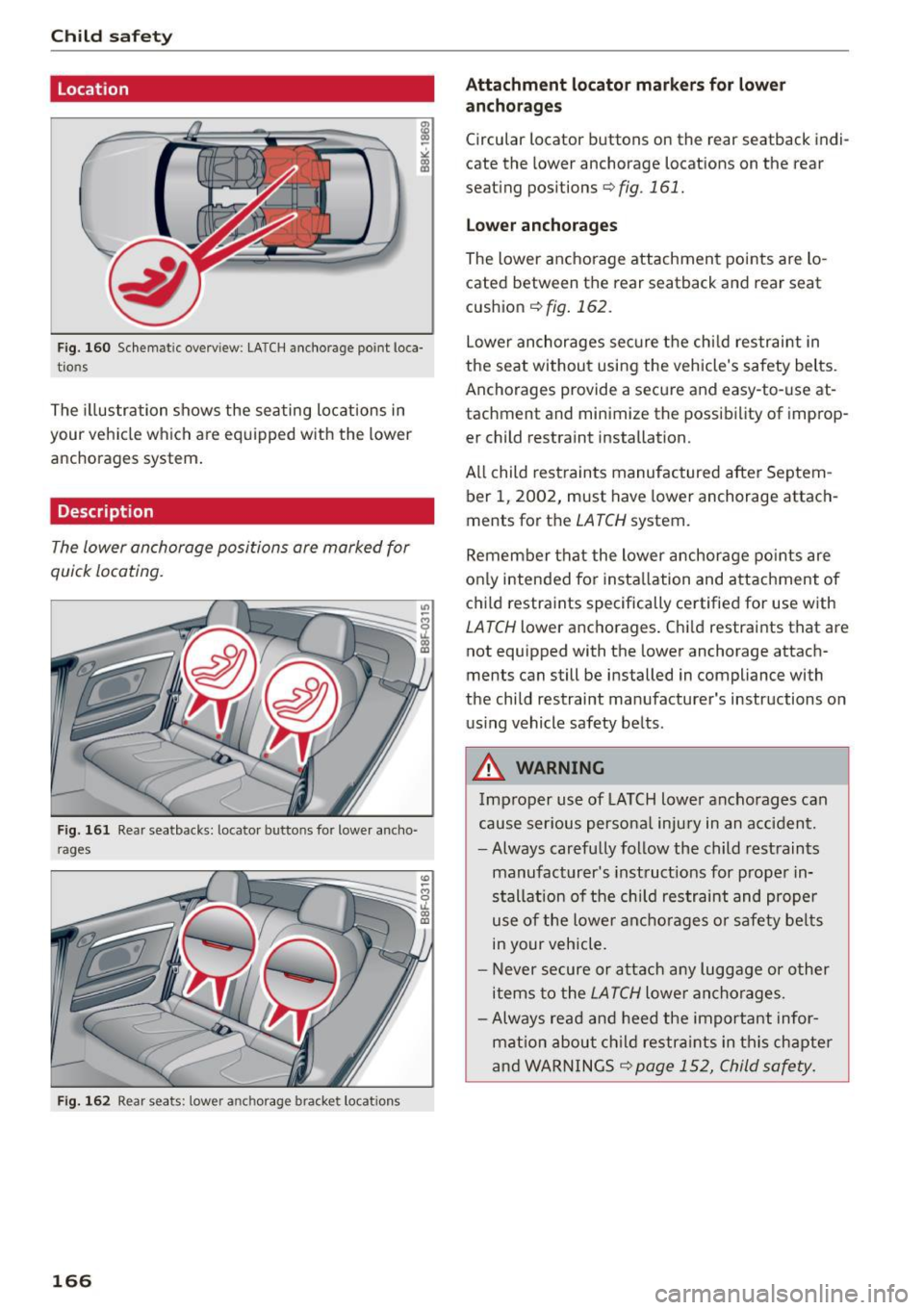
The illustra tion shows the seating locations in
your veh icle wh ich a re eq uipped w it h t he lower
anchorages system .
Description
The lower anchorage positions are marked for
quick locating.
F ig . 161 Rea r seatbacks: locato r bu tto ns fo r lowe r ancho
r ages
F ig. 16 2 Rear s eats : lower a nch ora ge brack et locat io ns
166
Attachment locato r markers for lower
anchorage s
Circular locator buttons on the rear seatback indi
cate the lower an chorage loc ations on the rear
sea ting pos itions
¢ fig . 161.
Lower anchorages
The lower anchorage attachmen t points are lo
cated between the rear seatback and rear seat
cushion
Q fig . 162 .
Lower anchorages sec ure t he chi ld restraint in
the seat without using the vehicle's safety belts .
Anchorages provide a secure and easy-to -u se at
tachment and minimize the possibility of improp
er child restr aint installation.
A ll child rest rain ts manufactured afte r Septem
ber 1 , 2002, must have lowe r anchorage attach
ments for the
LATCH system.
Remem ber that the lower anchorage po ints are
o nl y intended fo r insta llation and attachment of
ch ild restraints specifically ce rtified for use w ith
LATCH lower anchorages . Chi ld restraints that are
not equipped w ith the lower anchorage attach
ments can still be installed in compliance with
the chi ld restraint manufacturer 's instructions o n
us ing vehicle safety belts .
_&. WARNING
Imp ro per use of LA TCH lowe r ancho rages can
cause ser ious perso na l inju ry in an accident.
- Always carefully follow the child rest raints
manufactur er's instruct ions for prope r in
stallat ion of the child restraint and proper
use o f the lower an chorages or s afety be lts
in your vehicle.
- Never secure or a ttach any luggage or other
items to the
LATCH lower ancho rages.
- Always read and heed the impo rtant infor
mat io n about ch ild restra ints in th is chapte r
a nd WAR NINGS
Q page 152, Child safety.
Page 169 of 268
M N
ci u.. co ...... \!) ..,.,
N ..,., ......
Installing a child restraint with LATCH
lower anchorages
Whenever you install a child restraint always fol
low the child restraint manufacturer's instruc tions.
Fig. 163 Lowe r anch orages : proper mounting
Mounting
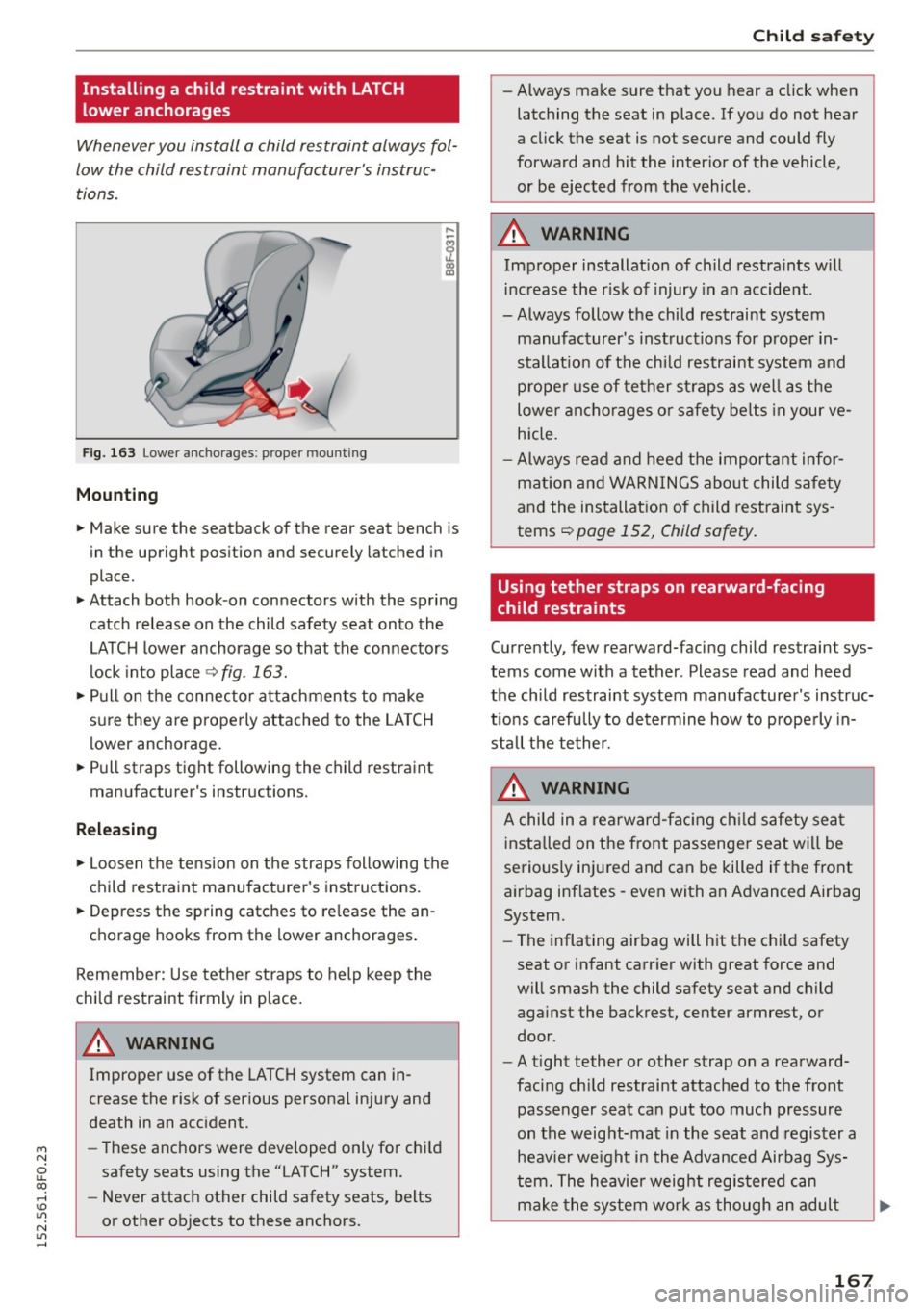
~ Make sure the seatback of the rear seat bench is
in the upright position and securely latched in
place.
~ Attach both hook-on connectors with the spring catch release on the child safety seat onto the
LATCH lower anchorage so that the connectors
lock into place
Qfig . 163.
~Pullon the connector attachments to make
sure they are properly attached to the LATCH
lower anchorage.
~ Pull straps tight following the child restraint
manufacturer's instructions.
Releasing
~ Loosen the tension on the straps following the
child restraint manufacturer's instructions.
~ Depress the spring catches to release the an
chorage hooks from the lower anchorages.
Remember: Use tether straps to help keep the
child restraint firmly in place.
A WARNING
Improper use of the LATCH system can in
crease the risk of serious personal injury and
death in an accident.
-
- These anchors were developed only for child
safety seats using the "LATCH" system.
- Never attach other child safety seats, belts
or other objects to these anchors.
Child safety
-Always make sure that you hear a click when
latching the seat in place. If you do not hear
a click the seat is not secure and could fly
forward and hit the interior of the vehicle,
or be ejected from the vehicle .
A WARNING '"---
Improper installation of child restraints will
increase the risk of injury in an accident.
- Always follow the child restraint system manufacturer's instructions for proper in
stallation of the child restraint system and proper use of tether straps as well as the
lower anchorages or safety belts in your ve
hicle.
- Always read and heed the important infor
mation and WARNINGS about child safety
and the installation of child restraint sys
tems
Q page 152, Child safety.
Using tether straps on rearward-facing
child restraints
Currently, few rearward-facing child restraint sys
tems come with a tether . Please read and heed
the child restraint system manufacturer's instruc
tions carefully to determine how to properly in
stall the tether.
A WARNING
A child in a rearward-facing child safety seat
installed on the front passenger seat will be
seriously injured and can be killed if the front
airbag inflates - even with an Advanced Airbag
System.
- The inflating airbag will hit the child safety
seat or infant carrier with great force and
will smash the child safety seat and child against the backrest, center armrest, or
door .
- A tight tether or other strap on a rearward
facing child restraint attached to the front
passenger seat can put too much pressure
on the weight-mat in the seat and register a
heavier weight in the Advanced Airbag Sys
tem. The heavier weight registered can
make the system work as though an adult
167
Page 183 of 268

M N
ci u.. co ,...., \!) ..,.,
N ..,., ,....,
Trailer mode Driving with a trailer
General information
Your Audi was designed primarily for passenger
transportation.
If you plan to tow a tra iler, p lease remember that
the additiona l load will affect durability, econo
my and performance .
T railer towing not on ly places more stress on the
vehicle, it also calls for more concentrat ion from
the driver .
F or this reason, a lways fo llow the operating and
d riving instructions provided and use common
sense.
Technical requirements
Traile r hitch
Use a weight-carrying hitch conforming to the
gross trailer weight. The hitch must be suitable
for your vehicle and trailer and must be mounted
securely on the veh icle 's chassis at a technically
sound
location . Use on ly a tra iler hitc h with a re
movable ba ll mou nt. Always chec k w ith the t ra il
e r hitch m anu fac tur er to make sure that you a re
using the co rrec t hitch.
Do not use a bumper hitch .
The hitch must be installed in such a way that it
does not in terfere with the impact-absorbi ng
bumper system. No mod ificat ions should b e
mad e to the vehicle exhaust and brake systems .
Fr om time to t ime, c hec k t hat a ll h itch mou nti ng
bo lts remain sec urely fastened .
When you are no t tow ing a trailer,
remove the
trai ler hitch ball mount . Th is prevents the hitc h
fr om caus ing damage should you r vehicle be
s truck from behind¢,&. .
Trailer brakes
If yo ur tra iler is equipped w it h a braking system,
check to be s ure that it conforms to all regu la
tions.
Trailer mode
T he trailer hyd raulic brake system must not be di
rect ly connected to the ve hicle's hydraulic b rake
system ¢.&. .
Safety chains
Alw ays use s afety ch ains be tween your ve hicle
and t he tra ile r.
Trailer lights
Tra ile r li ghts must meet all regulations. Be sure
to check w it h your author ized Audi deal er for cor
r e ct w iring, sw itches, and relays.
Mirrors
If you are unable to see the traffic behind you us
i ng the regular o uts ide mirrors, then you
must in
sta ll extended mirrors .
It is importa nt that you
always have clea r vision to the rea r.
_&. WARNING
- I f a trai ler has elec trical brake s please note
th at these b ra kes are not acti va ted by the
factory -fitted contro l unit -ris k of acci dent!
- After removing the t railer hi tch, do n ot store
it in your vehicle . In case o f su dden braking,
the hi tch could fly forward and injure you or
your passe ngers.
Operating instructions
Maximum traile r weight
A trai ler for you r vehicle is limited to a typical
class 1 or class 2 trailer.
Trailer load distribution
B e sure the load in the t ra iler i s held secure ly in
pla ce to prevent it from sh ifting forw ard , back
war d or sideways .
Never allow a passenger to ride in a trailer¢.&.
in Driving in struc tion s on page 182.
Engine cooling system
Towing a trailer makes the engine work harder . It
is important that the cooling system's pe rform
ance is up to the additional load . Ma ke s ure that
t h e coo ling system has enoug h fluid.
IIJJ,
181
Page 197 of 268

M N
ci LL co
rl I.O
"' N
"' rl
Checking and Filling Hood
Releasing and opening the engine hood
The engine hood is released from inside the vehi
cle.
Fig. 170 Driver's side footwell: e ng in e hood release lever
Fig. 171 Releas e lev er un der t he e ngin e hood
Before opening the engine hood, make sure that
the windshield wipers are flat against the wind
shield . Otherwise, they could damage the paint
on the hood.
.. With the driver's door open, pu ll the lever un
der the instrument panel in the direction of the
arrow
c::> fig . 170.
.. Ra ise the hood slightly c::> &.
.. Press the rocker switch under the hood upward
c::> fig . 171. This releases the catch .
.. Open the hood.
A WARNING
Hot engine coolant can burn you.
- To reduce the r isk of being burned, never
open the hood if you see or hear steam or
coolant escaping from the engine compa rt
ment. Wait until no steam or coolant can be
Checking and Filling
seen or heard before carefully opening the
hood .
Closing the engine hood
.. Pull the hood down until the pressure from the
struts is reduced.
"' Let the hood
drop down and latch in place. Do
not try to push it shut;
it may fa il to engage
c::> &. -
A WARNING
A hood that is not comp letely latched could
fly up and block your view while driving.
- When you close the engine hood, check it to
make sure the safety catch has properly en
gaged . The hood should be flush with the
surrounding vehicle body parts.
- If you notice while driv ing that the hood is
not secured properly, stop at once and close
it.
Working in the engine compartment
Be especially careful whenever you work in the
engine compartment.
-
Whenever you must perform any work in the
engine compartment, for example checking and
filling different fluids , there i s a risk of injury ,
burns and accidents. To prevent personal injury
always observe the following WARNINGS . The
engine compartment of any vehicle is a hazard
ous area
c:> .&. .
A WARNING
-
To help avoid injury, before you check any-
thing under the hood:
- Turn off the engine.
- Remove the ignition key .
- Apply the parking brake.
- Move selector lever of automatic transmis-
sion to "P" (Park) .
-Always let the engine cool down. Hot com
ponents wi ll burn skin on contact .
- To reduce the risk of being burned, never
open the hood if you see or hear steam o r
coo lant escaping from the engine
195
Page 201 of 268

M N
ci LL co
rl I.O
"' N
"' rl
dealer to have the cause of your concern
properly diagnosed. Keep in mind that the
accurate meas urement of oil cons umption
requires great care and may take some time.
An authorized Audi dealer has instructions
about how to measure oil consumption ac
curately.
Checking the engine oil level
Fig. 173 MMI Disp lay: Oil level indicator
Read oil level
• Park your vehicle so that it is horizonta lly level.
• Shut the engine off when it is at operating tem-
perature.
• Switch only the ignition back on.
• Wait approx. two minutes.
• Select: Function button
~IC ~A ~R~I > Oil level. Or
• Se lect: Funct ion button
ICARI > Car systems*
control button > Servicing & checks > Oil level.
• Read the oil level in the MMI* Display
r:::> fig. 173. Add engine o il if the bar of the oil
level indicator is near "min"
r:::>page 199
Depending on the way the vehicle is driven and
the operating conditions, oil consumpt ion can be
up to a 1/2 quart per 600 miles (O.S liter per
1,000 km) . Consumption may be higher within
the first 3,000 miles (S,000 km).
@ Tips
The oil level indicator in the MMI* Display is
only an information disp lay. If the oil level is
too low, a minimum oil warn ing appears in
the instrument cluster. Add oi l
¢ page 199.
If the hood has been opened, the current oil
level is shown in the instrument cluster the
next time the ignition is switched on.
Checking and Filling
~ Adding engine oil
Fig. 174 Engine compartment: Cover on the oil filler neck
• Before you check anything in the engine com
partment,
always read and heed all WARN
INGS
¢ .&. in Working in the engine compart
ment on page 195.
• Shut the eng ine off.
• Unscrew the cap~ to the eng ine oil filling
hole
¢ fig. 174, ¢page 197, fig. 172.
• Carefully top off with 0 . S quarts (0.5 liters) of
the appropriate oi l
¢page 197.
• Check the oil level again after two minutes
¢ page 199, Checking the engine oil level.
• Top off the o il aga in, if necessary.
• Screw the cap back on the filling hole.
A WARNING
-
- Wh ile topping off, the o il must not come in
contact w ith hot engine parts -fire hazard!
- The oil filler cap must be properly secured to
p revent oil from being sprayed on the hot
engine and exhaust system when the engine
is running -fire hazard!
- If you r skin has come in contac t with the en
g in e oi l, you must subsequently cleanse it
thoroughly.
CJ) Note
- Check the oil level using the radio or MMI*.
If the message
Please reduce oil level ap
pears, contact your authorized Audi dealer
or qualified workshop to have excess oil ex
tracted if necessary.
-Audi does not recommend the use of oil
additives. They may damage the engine
and adversely affect your New Vehicle War-
ranty. ..,.
199
Page 231 of 268
M N
ci LL co
rl I.O
"' N
"' rl
Emergency assistance
Vehicle tool kit
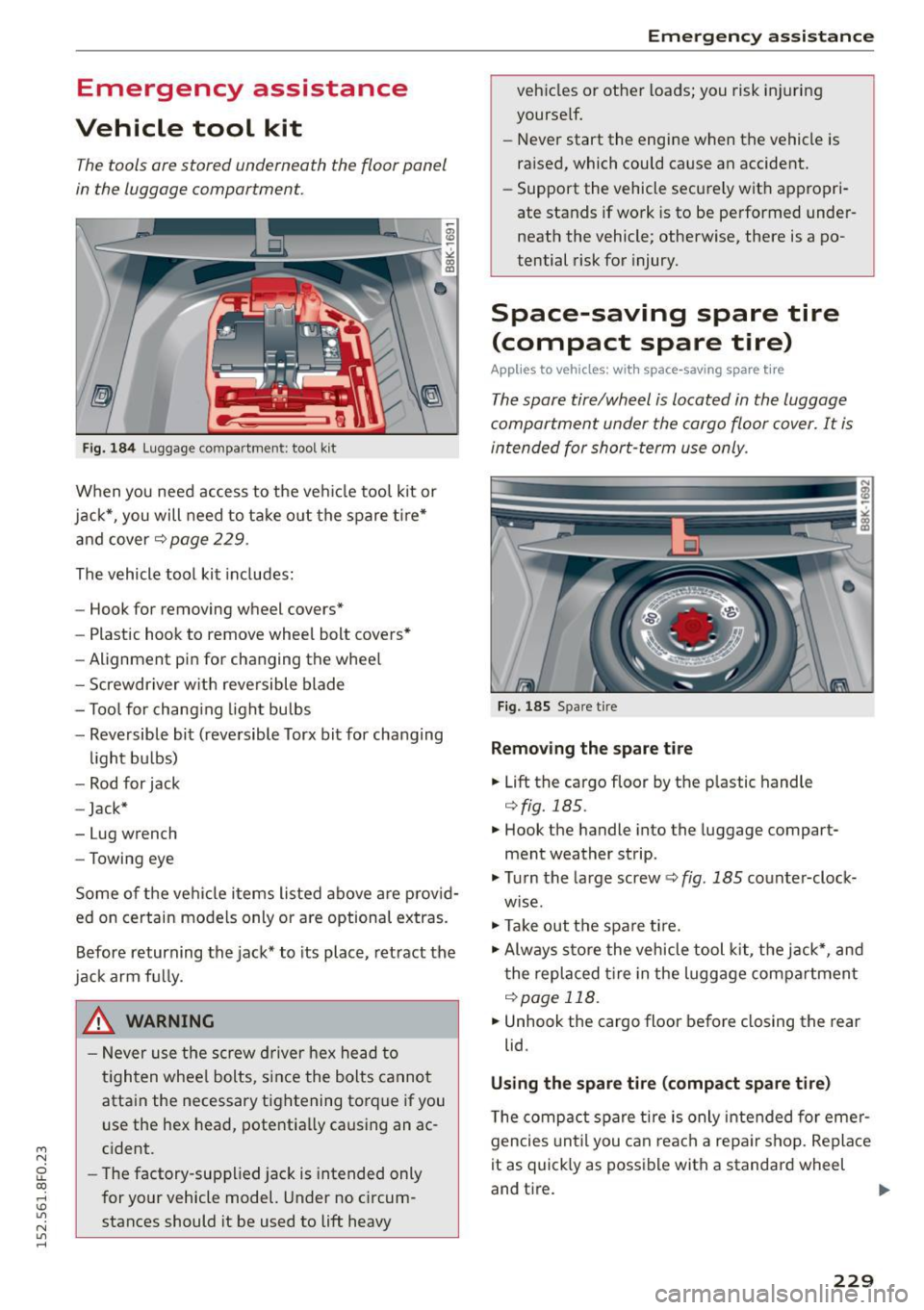
The tools ore stored underneath the floor panel
in the luggage comportment.
Fig. 184 Luggage compartme nt: tool kit
When you need access to the veh icle tool kit or
jack*, you will need to take out the spare t ire*
and cover¢
page 229.
The vehicle tool kit includes:
- Hook for removing wheel covers*
- Plastic hook to remove wheel bolt covers*
- Alignment pin for changing the whee l
- Screwdriver w ith reversible blade
- Tool for chang ing light bulbs
- Reversible bit (reversible Torx bit for changing
light bulbs)
- Rod for jack
- Jack*
- Lug wrench
- Towing eye
Some of the vehicle items listed above are prov id
ed on certain models only or are optional extras.
Before returning the jack* to its place, retract the
jack arm fu lly.
_& WARNING
- Never use the screw driver hex head to
t ighten whee l bolts, since the bolts cannot
attain the necessary tightening torque if you
use the hex head, potentially causing an ac
cident.
- The factory-suppl ied jack is intended only
for your vehicle model. Under no c ircum
stances should it be used to lift heavy
Emergen cy assistance
vehicles or other loads; you risk injuring
yourself.
- Never start the engine when the vehicle is
raised, which could cause an accident.
- Support the vehicle securely with appropri
ate stands if work is to be performed under
neath the vehicle; otherwise, there is a po
tential risk for injury.
Space-saving spare tire
(compact spare tire)
Applies to vehicles: with space-saving spare tire
The spore tire/wheel is located in the luggage
comportment under the cargo floor cover. It is
intended for short-term use only.
Fig. 185 Spare tire
Removing the spare tire
.,. Lift the cargo floor by the p lastic handle
¢ fig. 185.
.,. Hook the handle into the lugg age compart
ment weather strip.
.,. Turn the large screw ¢
fig. 185 counter-clock
wise.
.,. Take out the spare ti re .
.,. Always store the vehicle tool kit, the jack*, and
the replaced tire in the luggage compartment
¢page 118.
.,. Unhook the cargo floor before closing the rear
lid.
Using the spare tire (compact spare tire)
The compact spare tire is only intended for emer
gencies until you can reach a repa ir shop. Replace
it as quickly as possible with a standard wheel
and tire. ..,
229
Page 235 of 268
M N
ci LL co
rl I.O
"' N
"' rl
Raising the vehicle
The vehicle must be li~ed with the jack first be
fore the wheel can be removed .
Fig. 189 Sill panels: markings
Fig . 190 Sill: posit ion ing the vehicl e jack
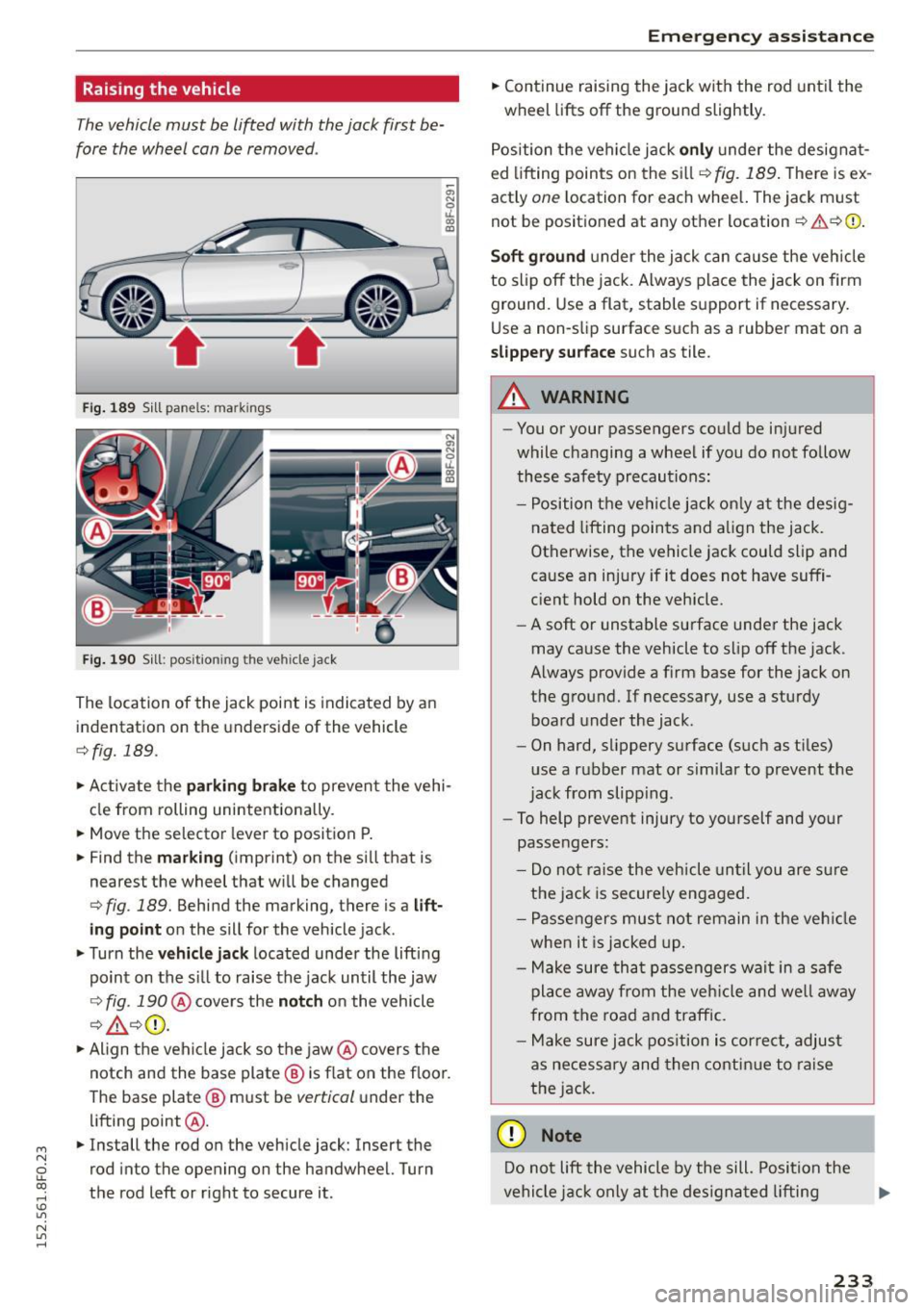
The location of the jack point is indicated by an
indentation on the underside of the vehicle
c::> fig. 189.
;:;; N 0 u. a, ID
.,.. Activate the pa rkin g brake to prevent the vehi
cle from rolling unintentionally.
.,.. Move the se lector lever to position P .
.,.. Find the
m ar king (imprint) on the si ll that is
nearest the wheel that wi ll be changed
<=> fig . 189. Behind the marking, there is a lift
ing point on the sill for the vehicle jack .
.,.. Turn the
vehicl e jack located under the lifting
point on the si ll to raise the jack until the jaw
<=> fig. 19O @cove rs the n o tch on the vehicle
Q ,& c::>0.
.,.. Align the vehi cle jack so the jaw @covers the
notch and the base plate @ is f lat on the floor.
The base plate @ must be
vertical under the
lifting point @.
.,.. Install the rod on the veh icle jack: Insert the
rod into the opening on the handwheel. Turn
the rod left or right to secure it.
Em erg en cy ass is tan ce
.,.. Continue raising the jack wit h the rod unt il the
wheel lifts off the ground slightly.
Position t he vehicle jack
only under the designat
ed lifting points on the si ll
r:1>fig. 189. The re is ex
actly
one l ocation fo r each wheel. The jack must
not be posit ioned at any other location
c::> .& c::>0 .
Soft ground under the jack can cause the veh icle
to s lip off the jack. A lways place the jack on firm
ground. Use a flat, stable support if necessary.
Use a non-slip surface suc h as a rubber mat on a
slipper y surface such as tile.
_& WARNING
--You or your passengers could be injured
while changing a wheel if you do not follow
these safety precautions:
- Position the vehi cle jack on ly at the desig
nated lifting points and a lign the jack.
Otherwise, the vehicle jack could slip and
cause an injury if it does not have suffi
cient hold on the vehicle.
- A soft or unstable surface under the jack
may cause the vehicle to slip off the jack .
Always provide a firm base for the jack on
the g round. If necessary, use a sturdy
board under the jack.
- On hard, slippery surface (such as tiles)
use a rubber mat or similar to prevent the
jack from slipp ing .
- To help prevent injury to yourself and your
passengers:
- Do no t ra ise the vehicle until you are s ure
the jack is secure ly engaged.
- Passengers must not remain in the veh icle
when it is jacked up .
- Make sure tha t passengers wait in a safe
pla ce away from the veh icle and we ll away
from the road and traffic.
- Make sure jack pos ition is cor rect, adjus t
as necessary and then contin ue to raise
the jack .
(D Note
Do not lift the vehicle by the sill. Posi tion the
vehicle j ack only at the des igna ted lifting
233
Page 237 of 268

M N
ci u.. co ,...., \!) ..,.,
N ..,., ,....,
Tires with unidirectional tread design
Tires with unidirectional tread design must be
mounted with their tread pattern pointed in the
right dir ection .
Using a spare tire with a tread pattern
intended for use in a specific direction
When us ing a spa re tire w ith a t read pa tte rn in
t e nded fo r use in a specific d ir e ct ion, p lease no te
the following:
- The direction of rotation is marked by an
arrow
on the side of the tire .
-If the spare t ire has to be installed in the incor
rect direction, use the spare tire only tempora
rily since the tire will not be able to achieve i ts
o ptimum performanc e character istics wit h re
gard to aquaplaning, noise and wea r.
- We recommend that you pay pa rticular atten
t io n t o this fact du ring wet weat he r and t hat
yo u adju st yo ur sp eed to match road condi
t ions.
- Re place the fla t tire w ith a new one and have i t
i nsta lled on yo ur vehicle as s oon as po ssible to
re store the han dling a dvan tages o f a un idirec
t io na l tire.
Notes on wheel changing
P lease read the information ¢ page 216, New
tires or wheels
i f you are going to use a spare tire
which is different from the tires on your ve hicle.
Afte r you change a tire:
- Check the tire pressure on the spare immedi
ately after installation.
- Have the wheel bolt tightening torque
checked with a torque wrench as soon as po s
sible by your authorized Audi dealer or quali
fied workshop .
- With steel and alloy wheel rims , the wheel
bolts are correctly tightened at a torque of 90
ft lbs. (120 Nm ).
- If you notice th at the wheel bolt s are corroded
and difficult to turn while changing a tire ,
they should be replaced before you check the
tightening torque .
Emergency assistance
-Replace the flat tire with a new one and have
it installed on your vehicle as soon as possi
ble. Remount the wheel cover .
Until then , drive with extra care and at reduced
speed s.
_& WARNING
- If you are going to e quip your ve hicl e wit h
tires o r rims which differ from those which
were factory installed, then be sure to read
the information
¢ page 216, New tires or
wheels.
- Always make sure the damaged wheel o r
even a flat tire a nd the jack a nd too l kit a re
p roperly secu red in the luggage compart
men t and are not loos e in t he passeng er
compa rt m ent.
- In an acci dent or sudde n man euver they
could fly forwa rd, inj uring a nyone in t he ve
h icle.
- Always s to re damag ed wh eel , jack and tools
s ecure ly in the luggage co mpart ment. Ot h
e rwi se, in an accident o r sud den man euver
they co uld fly forward, causing injury to pas
sen gers in t he ve hicle.
(D Note
D o not use co mmercially ava ilab le tire seal
a nts. O therwise, the e le ct ric al c ompone nts of
the tire pre ssure monit oring sys tem * w ill no
l on ger wor k properly and t he sensor for the
tire pressu re monito ring system * wi ll have to
b e replaced by qu alified workshop.
-
235
Page 244 of 268
Emergency situation s
-The ba ttery ce ll lockin g screws must be
t ightened securely .
- Before you check anyt hing in the engine
compartment, always read and heed all
WARNINGS
c> page 195.
(D Note
Improper hook -u p of jumper cables can r uin
the generator .
- A lways connect POS ITIV E(+ ) to POS ITIV E
( + ), and NEGATIVE( -) to NEGATIVE( -)
gro und post of the battery manager control
unit .
- Check that a ll screw plugs o n the batte ry
ce lls are screwed in firmly . If not, tighten
pl ugs prior to connect ing clamp on negat ive
battery te rminal.
- Please note that the procedure for connect
i ng a jumper cable as desc ribed above ap
plies specifica lly to the case of yo ur vehicle
being jump started . W hen you a re g iving a
j u mp sta rt to another vehicl e, do
not co n
ne ct the negative ( -) cab le to the negative
( -) t erminal o n the di scharged battery @
c> fig. 19 8 . In stea d, secure ly co nn ect the
nega tive ( -) cab le to either a solid me tal
com ponent that is f irm ly bolted to the en
gine block o r to t he engine bloc k itself. I f
the battery that is being charged does not
vent to the outside , escap ing battery gas
could ignite and exp lode!
Towing with a tow truck
General hints
Y o ur Audi requires special handling for towing.
The fo llow ing information is to be used by com
mercia l tow truck operato rs who know how to op
erate their eq uipment safe ly .
- Never tow your Audi, towing will cause dam
age to the engine and transmiss ion.
- Never wrap the safety chains or winch cables
around the brake lines .
- To pre vent unnecessary damage, your Audi
must be transported with a flat bed truck.
242
- To load the vehicle on to the flat bed , use the
towing loop found in the vehicle tools and at·
tach to the front or rear anchorage
c> page 242 and c:>page 243.
A WARNING
A veh icle being towed is not safe f or passe n
gers . Never a llow anyone to ride in a ve hicle
be ing towed, fo r any reason .
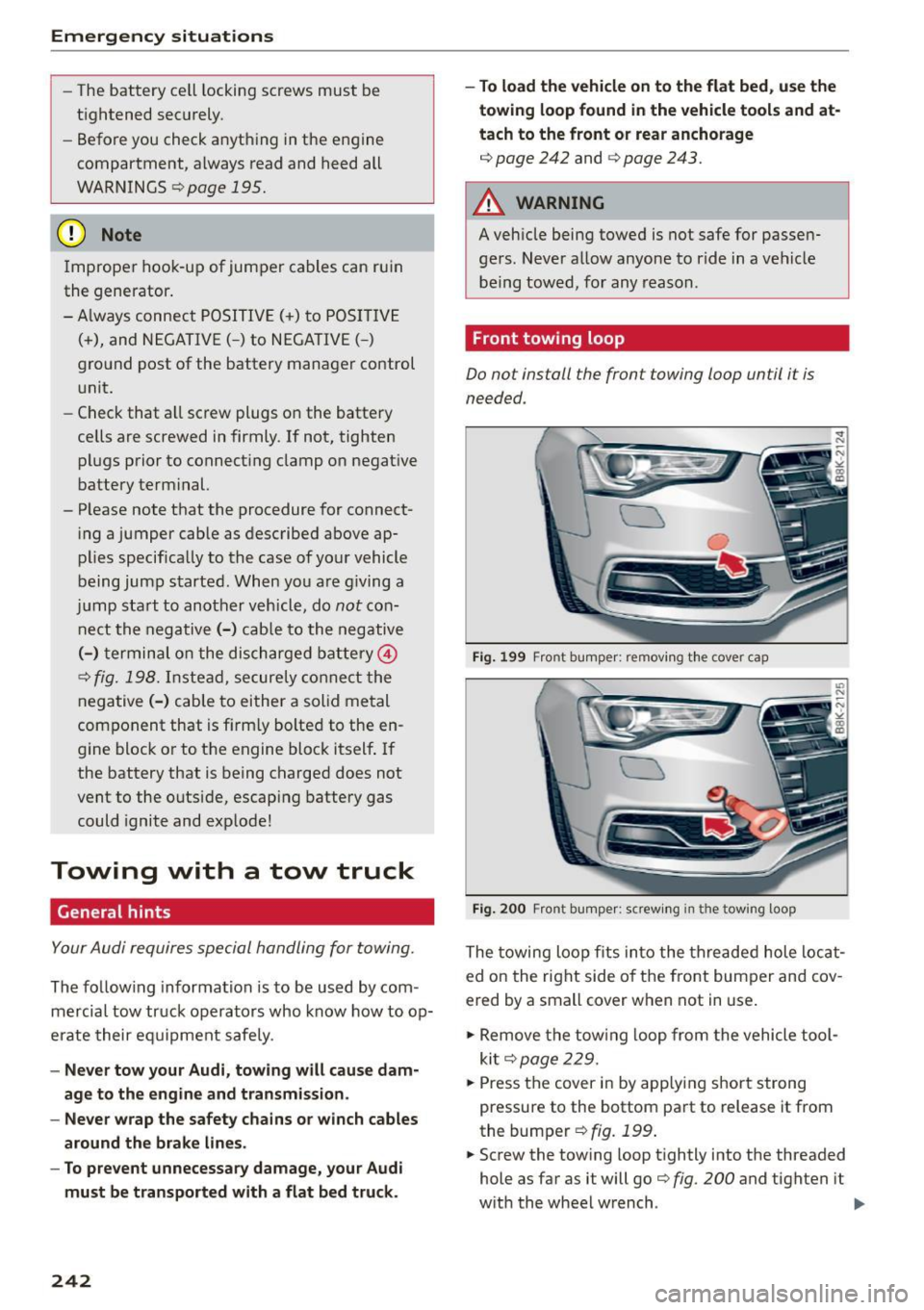
Front towing loop
Do not install the front towing loop until it is
needed .
Fig. 19 9 Fro nt b um per: remov ing t he cove r cap
Fig. 200 Front b umper: sc rew ing in t he tow ing loop
The towing loo p fits in to the threade d hole locat
ed on the right side o f the front bum per and cov
e red by a small cover when not in use .
.,. Remove the tow ing loop fr om the vehicle tool
ki t
c> page 229.
... Press the cover i n by app lyi ng shor t strong
pressure to the bottom part to release it from
the bumper
¢ fig. 199.
... Sc rew the tow ing loop tightly into the th readed
hole as far as it will go
c> fig. 200 and tighten it
w it h the wheel w rench . ..,.