warning light AUDI A5 CABRIOLET 2015 Workshop Manual
[x] Cancel search | Manufacturer: AUDI, Model Year: 2015, Model line: A5 CABRIOLET, Model: AUDI A5 CABRIOLET 2015Pages: 268, PDF Size: 66.88 MB
Page 142 of 268

Airbag system
restraints or occupants on the front passen
ger seat and prevent the side airbag in the
seat backrest from deploying properly.
- Never use cushions, pillows, blankets or
similar items on the front passenger seat.
The additional padding will prevent the
weight-sensing mat in the seat from accu rately registering the child restraint or per
son on the seat and prevent the Advanced
Airbag System from functioning properly.
- If you must use a child restraint on the front
passenger seat and the child restraint man
ufacturer's instructions require the use of a
towel, foam cushion or something else to
properly position the child restraint, make
certain that the
PASSENGER AIR BAG OFF
light comes on and stays on whenever the
child restraint is installed on the front pas
senger seat.
- If the
PASSENGER AIR BAG OFF light does
not come on and stay on, immediately in
stall child restraint in a rear seating position
and have the airbag system inspected by
your authorized Audi dealer.
How the Advanced Airbag System
components work together
The front Advanced Airbag System and the side
airbags supplement the protection offered by the
front three-point safety belts with pretensioners and load limiters and the adjustable head re
straints to help reduce the risk of injury in a wide
range of accident and crash situations. Be sure to
read the important information about safety and
heed the WARNINGS in this chapter.
Deployment of the Advanced Airbag System and
the activation of the safety belt pretensioners de
pend on the deceleration measured by the crash
sensors and registered by the electronic control
unit . Crash severity depends on speed and decel
eration as well as the mass and stiffness of the
vehicle or object involved in the crash.
On the passenger side, regardless of safety belt
use, the airbag will be turned off if the weight on
the passenger seat is less than the amount pro
grammed in the electronic control unit . The front
140
airbag on the passenger side will also be turned
off if one of the child safety seats that has been
certified under Federal Motor Vehicle Safety
Standard 208 has been recognized on the seat.
The
PASSENGER AIR BAG OFF light comes on
and stays on to tell you when the front Advanced
Airbag on the passenger side has been turned off
¢ page 133, Child restraints on the front seat
some important things to know .
.&_ WARNING
To reduce the risk of injury when an airbag in
flates, always wear safety belts properly.
- If you are unrestrained, leaning forward, sit
ting sideways or out of position in any way,
your risk of injury is much higher.
- You
will also receive serious injuries and
could even be killed if you are up against the
airbag or too close to it when it inflates -
even with an Advanced Airbag
r::!;> page 132.
More important things to know about front
airbags
Fig. 149 Inflated front airbags
-,... N 0 :i: ;;i;
Safety belts are important to help keep front seat
occupants in the proper seated position so that
airbags can unfold properly and provide supple
mental protection in a frontal collision.
The front airbags are designed to provide addi
tiona l protection for the chest and face of the
driver and the front seat passenger when:
- safety belts are worn properly,
- the seats have been positioned so that the oc-
cupant is properly seated as far as possible
from the airbag, .,._
Page 143 of 268
M N
ci u.. co ,...., \!) ..,.,
N ..,., ,....,
-and the head restraints have been p roperly ad -
justed.
Because airbags inflate in the blink of an eye w ith
great force, things you have on yo ur lap o r have
p laced on the seat cou ld become dangerous p ro
jectiles, and be pushed into yo u if the airbag in
flates.
When an a irbag deploys, fine dust is released.
This is normal and is not caused by a fire in the
vehicle. This dust is made up mostly of a powder
used to lubricate the airbags as they dep loy. It
could irr itate skin.
It is important to remember that whi le the sup
p lemental airbag system is designed to reduce
the likelihood of serious in juries, other injur ies,
for example swell ing, bruising and minor abra
sions, can also happen when a irbags inf late. Air
bags do not protect the arms or the lower parts
of the body. Front airbags o nly supplement the
three point safety belts in some frontal col lisions
i n which the veh icle deceleration is high enough
to deploy the airbags.
F ront airbags will not deploy:
- if the ign it io n is switched off when a crash oc -
curs,
- in s ide collisions,
- in rear-end collisions,
- in ro llovers,
- when the crash deceleration measured by the airbag system is less than the minimum thresh
o ld needed for airbag deployment as registered
by the electronic control un it.
Th e front pa ssenger airbag will al so not
depl oy:
-when the front passenger seat is not occupied,
- when the weight on the front passenger seat as
sensed by the Advanced Airbag System indi
cates that the front airbag on the passenger
s ide has to be turned off by the electronic con
trol unit (the
PA SSENGER AIR BAG OFF light
comes on and stays on) .
A WARNING
Sitting in the wrong position can increase the
risk of se rious injury in crashes .
Airbag syste m
- To reduce the risk of injury when the airbags
inflate, the driver and passengers must al
ways sit in an upright pos ition, must not
lean aga inst or place any part of the ir body
too close to the area where the a irbags are
located.
- Occupants who are unbelted, out of position
or too close to the airbag can be seriously
in ju red by an a irbag as it unfo lds with great
for ce in the blink ofan eye
Qpage 133.
A WARNING
A child in a rearward-fac ing ch ild safety sea t
i nsta lled on the front passenger seat w ill be
se riously inju red and can be killed if the front
a irbag inflates - even with an Advanced Airbag
System .
- The inflating airbag will hit the child safety
seat o r infant carrier with great force and
will smash the child safety seat and child
aga inst the backrest, center armrest, door
or roof.
- Always install rear-fac ing ch ild safety seats
on the rear seat.
- If you must install a rearwa rd fac ing child
safety seat on the front passenger seat be
cause of except ional circumstances and the
PASS ENG ER AIR BAG OFF light does not
come on and stay on, immediately install
the rear-facing child safety seat in a rear
seating posi tion and have the airbag system
inspected by your authori zed Audi dealer .
A WARNING
Objects between you and the airbag will in
crease the risk of injury in a crash by interfe r
ing with the way the airbag unfolds or by be
ing p ushed into you as the airbag inflates .
- Never hold things in yo ur hands or on your
lap when the vehicle is in use .
- Never transpo rt items on or in the a rea of
the front passenger seat. Objects could move into the area of the front airbags dur
ing brak ing or other sudden maneuver and
become dangerous project iles that can
cause serious persona l injury if the a irbags
inflate.
141
Page 144 of 268

Airb ag syst em
-Never place or attach accessories or other
objects (such as cupholders, telephone
brackets, large, heavy or bulky objects) on
the doors, over or near the area marked "AIRBAG" on the steer ing wheel, instru
ment pane l, seat backrests or between
those areas and yourself. These obje cts
could cause injury in a crash, e specially
when the airbags inflate.
- Never recline the front passenger's seat to
transport objec ts . Items can also move into
t h e area of the side airbag or the front air
bag dur ing braking or in a sudden maneu·
ver. Objects near the airbags can become
projectiles and cause injury, part icularly
when the seat is reclined.
A WARNING
The f ine dust created when a irbags dep loy can
cause breathing problems for people with a
history of asthma or other breathing condi
tions .
- To reduce the r isk of breathing problems,
those w ith asthma or other resp iratory con
ditions should g et fr esh air r ight away by
get ting out of the vehicle o r opening w in
dows or door s.
- If you are in a col lision in w hich a irbags de
p loy, wash your hand s and fa ce wi th mild
soap and water before eating.
- Be caref ul not to get the dus t into you r eyes,
or into any cuts or s cratches.
- If the residue should get into you r eyes,
flush them with water.
Monitoring the
Advanced Airbag System
Airbag monitoring indicator light
Two separa te indicators monitor the function of
the Advanced Airbag System: the airbag moni
toring indicator light and the
PASSENGER AIR
BAG OFF
light.
The Advanced Airbag System (including the elec· tronic control unit, sensor circuits and system
w iri ng) is monitored cont inuous ly to make sure
that it is funct ion ing properly whenever the ign i·
142
tion is on . Each time you t urn on the ignit ion, the
fl airbag monitoring indicator light wi ll come on
for a few seconds (self diagnostics).
The sy stem must be inspected when th e II
indicator light :
-does not come on when the ignition is sw itched
on,
- does not go out a few seconds after you have
switched on t he ignit ion, or
- comes on wh ile driving.
If an airbag system malfunction is detected, t he
i ndic ator light will fi rst s tart flashing to catch the
dr ive r's at ten tion and the n stay on con tinuou sly
to serve as a constant reminder to have the sys
tem inspected immediately .
If a malfu nction occurs that turns the front air
bag on the passenge r side off, the
PASSENGER
AIR BAG OFF
light will come on and stay on
whenever the ignit ion is on .
A WARNING
An airbag system that is not functioning prop
erly cannot provide supp lemental protection
in a frontal crash.
- If the airbag ind icator light
c> page 19
comes when the vehicle is being used, have
the system inspected immediately by your
author ized Audi dealer .
It is possible that
the airbag will inflate when it is not sup·
posed to, or will not inflate when it should.
PASSENGER AIR BAG OFF light
Fig. 15 0 Section fro m t he in strument panel: PASSENGER
AIR BAG O FF ligh t
The PASSENGER AIR BAG OFF light is loca ted in
the center of the inst rument panel
c> fig . 150. ..,.
Page 146 of 268

Airbag syste m
his or her back up against the backrest and the
backrest is not reclined ¢
page 114, Correct
passenger seating positions,
- the adu lt is not taking weight off the seat by
holding on to the passenger assist handle
above the front passenger door or supporting
their weight on the armrest,
- the safety belt is being properly worn and that
there is not a lot of slack in the safety belt web
bing,
- accessory seat covers or cushions or other
things that may cause an incorrect reading or impression on the weight-sens ing mat under
the upholstery of the seat have been removed
from the front passenger seat,
- a safety be lt extender has not been left in the
safety belt latch for the front passenger seat .
In addition to the
P ASS ENGER AIR BA G OF F
light in the center of the instrument panel, the
message
PASSE NGER A IR BAG OFF or PASSEN
GER AIR BAG ON
will briefly appear in the instru
ment cluster display . Thi s is to inform the driver
of the current front passenger airbag status.
Important safety instructions on
monitoring the Advanced Airbag System
A WARNING
An airbag system that is not funct ion ing prop
erly cannot prov ide supplementa l protect ion
in a frontal crash.
- If the airbag indicator light ¢
page 19
comes when the vehicle is being used, have
the system inspected immediate ly by your
authorized Aud i dealer.
It is possible that
the a irbag will inflate when it is not s up
posed to, or wi ll not inflate when it should.
A WARNING
If the front airbag in flates, a chi ld without a
child restraint, in a rearward-facing child safe
ty seat or in a forward-facing child restraint
that has not been proper ly installed will be
ser iously injured and can be killed.
- Even though your veh icle is equipped with
an Advanced Airbag System, make certa in
that all ch ildren, especially 12 yea rs and
144
younger, a lways ride on the back seat prop
erly restrained for their age and size.
- Always install forward or rear-facing child
safety seats on the rear seat -even with an
Advanced A irbag System.
- If you must install a rearward-facing child
safety seat on the front passenger seat be
cause of exceptional circumstances and the
PASSENG ER AIR BAG OFF light does not
appear and stay on, immediately insta ll the
rea r-facing chi ld safety seat in a rear seating
position and have the airbag system inspect
ed by your authori zed Audi dealer .
- A t ight tether or other s trap on a rea rward
facing chi ld restraint attached to the front
p assenger sea t can put too much pressure
on the weight-sens ing mat in the seat and
reg ister more weight than is actually on the
seat. The heavier weight registered can make the system work as though an adult
were on the seat and deploy the Advanced Airbag when it must be suppressed caus ing
serious or even fatal injury to the child .
- If, in exceptiona l circumstances, you must
install a forward-facing child restraint on
the front passenger seat, always move the seat into i ts rearmost pos ition in the seat's
fore and aft ad justmen t range, as fa r away
from the airbag as possib le. The backrest
m ust be adjusted to an upr ight position.
Make sure that the
PASSENGER AIR BAG
OFF
li ght comes on and stays on all the time
whenever the ignit ion is switched on.
A WARNING
- If the PASS ENGER AIR BAG OF F light does
not go out when an adult is s itting on the
front passenger seat after tak ing the steps
described above, make sure the adult is
prope rly seated and restra ined at one of the
rea r seat ing pos itions.
- Have the airbag system inspected by your
author ized Audi dealer befo re transpo rting
anyone on the fro nt passenger seat.
Page 149 of 268
M
position in a frontal co llision so that the airbags
can provide supp lemental protection.
The airbag system is not a s ubst itute for yo ur
safety belt. Rathe r, it is part of the overall occu
pant restraint system in your vehicle . Always re
member that the airbag system can only help to
protect you if you are wear ing your safety belt
and wearing it properly. Th is is why you should al
ways wear your safety belt, not just because the law requ ires you to do soc::>
page 124, General in
formation .
Remember too, airbags will deploy only once and
only in certain kinds of accidents -you r safety
be lts are a lways there to offer protection in those
accidents in which airbags are not supposed to
deploy or when they have already deployed, for
examp le when yo ur vehicle str ikes or is struck by
anothe r after the first collision .
This is just one of the reasons why an a irbag is
not a substitute for the safety belt . The airbag
sys tem works most effective ly when used with
the safety belts. Therefore, always wear your
safety bel ts correctly .
It is important to remember that whi le the sup
p lemental knee a irbag sys tem is designed to re
d uce the likelihood of serious i njur ies , o ther inj u
ries, for examp le, swe lling, bruising, and mino r
abrasions and friction b urns can a lso occur when
an airbag inf lates.
The knee airbag system basically consist s of:
- T he elec tronic control mod ule
- Two inflatab le airbags (airbag and gas genera-
tor), one for the dr ive r and one fo r the front
passenge r
- T he airbag ind icator light in the instrument
pane l
The knee airb ag system will not deploy:
- when the ign it ion is turned o ff
- in frontal collis ions when the dece lerat ion
measured by the control unit is too low
- in side collisions
6 -in rear -end collisions LL 00
-in rollovers rl I.O
"' N
"' rl
Ai rb ag system
- in the event of a system malfunction (warning/
indicator light is on)
c::> page 19.
A WARNING
-
-Safety belts and the airbag system can only
provide protection when occupants are in
the proper seating position
c::> page 140.
- If the airbag indicator light c::>page 19
comes w hen the veh icle is being used, have
the system inspected immediately by your
author ized Audi dealer. It is possib le that
the airbag will inflate when it is not sup
posed to, or will not inflate when it should.
How knee airbags work
Applies to veh icles: w it h knee airbags
The risk of injury to the leg area can be reduced
by fully deployed knee airbags.
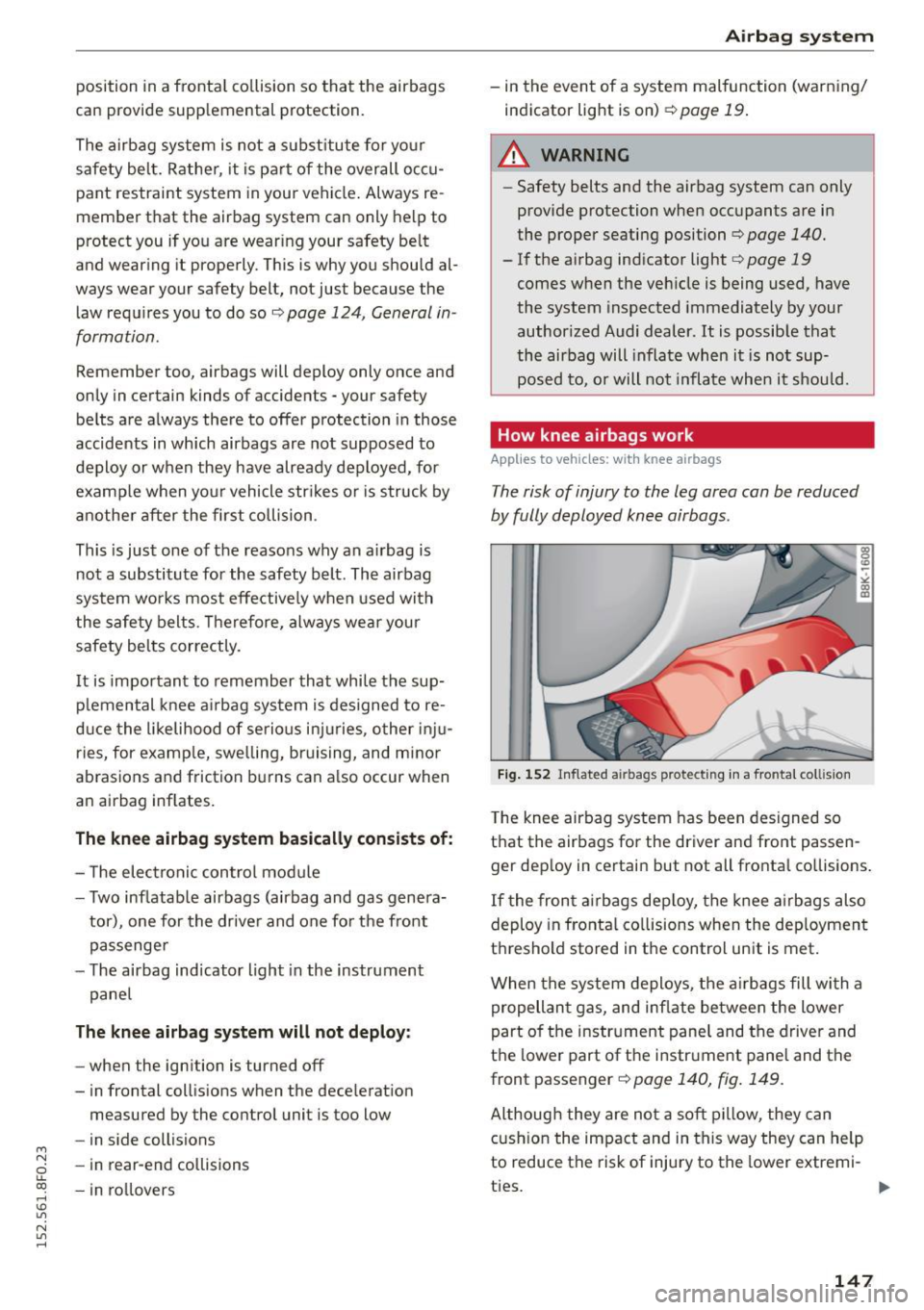
F ig . 1 52 Inflated a irbags p rotect ing in a fro ntal co llis ion
T he knee airbag system has been designed so
that the airbags for the driver and front passen
ger dep loy in certain but not all fronta l co llisions .
If the front a irbags dep loy, the knee a irbags also
deploy in fronta l co llisions when the dep loyment
threshold stored in the control unit is met.
When the system deploys, the a irbags fill with a
propellan t gas, and inf late be tween the lower
part o f the instr ument pane l and the driver and
the lowe r part of the instr ument pane l and the
front passenger
c::> page 140, fig. 149 .
Although they are not a soft p illow , they can
cus hion the impact and in this way they can help
to reduce the risk of injury to the lower extremi-
ties.
1111>
147
Page 151 of 268
M N
ci u.. co ,...., \!) 1.1'1
N 1.1'1 ,....,
-the e lectronic control module and external side
impact sensors
- the two side airbags located in the sides o f the
front backrests
- the a irb ag warning light in the inst rument cl us-
ter.
The airbag system is monitored elect ron ica lly to
make certa in th at it is func tioning properly at all
times. Each time you t urn on the ign ition, the a ir
bag system ind icator light will come on for a few
seconds (self diagnostics) .
The s ide a irbag system supp lements the safety
be lts and c an he lp to reduce the r is k of i njury to
the dr iver's and front passenger's upper torso on
the side of the vehicle that is struck in a s ide col
lision. The airbag dep loys only in side impacts
and only when the veh icle acce leration registered
by the control unit is high enoug h. If th is rate is
below the refe rence value programmed into the
control un it, the side a irbags will not be t rig
gered, even though the car may be bad ly dam
aged as a result of t he coll is ion. It is not poss ible
to define an airbag trigge ring range that will cov
e r every possib le ang le o f impact , since the c ir
cumstances wi ll vary considerably between one
collision and another . Important factors include,
for example, the nature (hard or soft) of the im
pacting object, the ang le of impact, vehicle
speed, etc.¢
page 150, Important safety in
structions on the side airbag system .
Aside from their norma l safety function, safety
be lts work to help keep the dr iver or front pas
senger in posit ion in the event of a side collision
so that the s ide a irbags can provide protect ion.
T he airbag system is
not a substitute for your
safety belt. Rather, it is part of the overall occu pant restraint system in your veh icle. Always re
membe r th at the s ide a irbag system can only
h elp to p rotect you if yo u are wear ing your safety
be lt and wea ring it p roperly . T his is ano th er rea
son why you s hou ld always wea r yo ur safety
b e lts, no t just because the law req uires you to do
so ¢
page 1 24, General information.
It is important to remember that whi le the sup
p lemental s ide a irbag sys tem is designed to re
d uce the likelihood of serious i njuries, other inju-
Airbag syste m
ries, for example, swell ing, bruising, and minor
abrasions can a lso be associated with dep loyed
s ide airbags. Remember too, s ide a irbags w ill de
ploy only once and only in certain kinds of acci
dents -your safety belts are always there to offer
protection .
Vehicle damage, repair costs o r even the lack of
vehicle damage are not necessari ly an indication
of over-sensitive or failed airbag activation . In
some collisions , both front and side airbags may
infla te. Remembe r too, that a irbags w ill dep loy
o n ly onc e and on ly in certa in ki nds of co llisions -
yo ur safety belts a re a lways the re to offer p rotec
t io n in those accidents in wh ich airbags are not
s u pposed to deploy or when they have a lready
deployed.
The side airbag system will not deploy:
- when the ignit ion is tu rned off
- in side co llisions whe n the acceleration meas -
ured by the senso r is too low
- in front -end collisions
- in rear-end collisions
- in rollove rs.
In some types of ac cidents the front airbags and
s ide airbags may be tr iggered together.
A WARNING ~
- Safety belts and the airbag system will only
provide p rotection when occupants are in
the proper seating position¢
page 150 .
-If the ai rbag ind icator light ¢ page 19
comes when the ve hicle is being used, have
the system inspected immediately by your
author ized Audi dealer. It is possib le that
the airbag will inflate when it is not sup
posed to, or will not infla te when i t should.
149
Page 155 of 268

M N
ci u.. co ,...., \!) er,
N er, ,....,
exceptional circumstances and the PASSEN
GER AIR BAG OFF
light does not come on
and stay on, immediately install the rear
ward-facing child safety seat in a rear seat
ing position and have the airbag system in
spected immediately by your authorized
Audi dealer.
A WARNING
If, in exceptional circumstances, you must in
stall a forward-facing child restraint on the
front passenger's seat:
- Always make sure the forward-facing seat
has been designed and certified by its man
ufacturer for use on a front seat with a pas
senger front and side airbag.
- Always follow the manufacturer's instruc
tions provided with the child safety seat or carrier.
- Always
move the passenger seat into its
rearmost position in the seat's fore and aft
adjustment range, as far away from the air
bag as possible before installing the child
restraint. The backrest must be adjusted to
an upright position.
- Always make sure that the
PASSENGER AIR
BAG OFF
light comes on and stays on all the
time whenever the ignition is switched on.
Always replace child restraints that were in
stalled in a vehicle during a crash. Damage to
a child restraint that is not visible could cause
it to fail in another collision situation.
Advanced front airbag system and children
Your vehicle is equipped with a front "Advanced
Airbag System" in compliance with United States
Federal Motor Vehicle Safety Standard (FMVSS)
208 as applicable at the time your vehicle was
manufactured.
The Advanced Airbag system in your vehicle has
been certified to meet the "low-risk" require
ments for 3- and 6-year old children on the pas
senger side and small adults on the driver side.
The low risk deployment criteria are intended to
Child safety
reduce the risk of injury through interaction with
the airbag that can occur, for example, by being
too close to the steering wheel and instrument
panel when the ai rbag inflates. In addition, the
system has been certified to comply with the "suppression" requirements of the Safety Stand
ard, to turn off the front airbag for infants up to
12 months who are restrained on the front pas
senger seat in child restraints that are listed in
the Standard.
Even though your vehicle is equipped with an Ad
vanced Airbag system, all children, especially
those 12 years and younger, should always ride in
the back seat properly restrained for their age
and size. The airbag on the passenger side makes
the front seat a potentially dangerous place for a
child to ride. The front seat is not the safest place
for a child in a forward-facing child safety seat. It
can be a
very dangerous place for an infant or a
larger child in a rearward-facing seat.
Advanced Airbags and the weight-sensing
mat in the front seat
The Advanced Airbag System in your vehicle de
tects the presence of an infant or child in a child
restraint on the front passenger seat using the
weight-sensing mat in the seat cushion and the sensor below the safety belt latch on the front
passenger seat that measures the tension on the
safety belt .
The weight-sensing mat measures total weight of
the child and the child safety seat and a child blanket on the front passenger seat. The weight
on the front passenger seat is related to the de
sign of the child restraint and its "footprint", the
size and shape of the bottom of the child re
straint as it sits on the seat. The weight of a child
restraint and its "footprint" vary for different
kinds of child restraints and for the different
models of the same kind of child restraint offered
by child restraint manufacturers.
The weight ranges for the individual types, makes
and models of child restraints that the NHTSA
has specified in the Safety Standard together
with the weight ranges of typical infants and typ-
ical 1 year-old child have been stored in the ...,
153
Page 157 of 268
M N
ci u.. co ,...., \!) 1.1'1
N 1.1'1 ,....,
Model Manufactured on or
a fter
Cosco Summit Deluxe September 25, 2007
High Back Booster
22-262
Cosco High Back Boos -September 25, 2007
ter 22-209
Evenflo Tribute V September 25, 2007
379xxxx
Evenflo Medallion 254 December 1, 1999
Evenflo Generations September 25, 2007
3S2xxxx
Graco ComfortSport September 25, 2007
Graco Toddler Safety September 25, 2007
Seat Step 2
Graco Platinum Cargo September 25, 2007
.&, WARNING
To reduce the risk of serious injury, make sure
that the
PASS ENGER AIR BAG OFF light
comes on and stays on whenever a child re
straint is installed on the front passenger seat
and the ignition is switched on.
- Take the child restraint off the front passen ger seat and install it properly at one of the
rear seat positions if the
PASSENGER AIR
BA G OFF
light does not stay on.
- Have the airbag system inspected by your
authorized Audi dealer immediately.
(D Tips
The ch ild seats listed in categories A to C have
been statically tested by Audi on ly for the Ad
vanced Airbag function.
Important safety instructions for using
child safety seats
Correct use of child safety seats substantially re
duces the risk of injury in an accident!
As the driver, you are responsible for the safety of
everybody in the vehicle, especially children:
.,. Always use the right child safe ty seat for each
child and a lways use it properly
¢ page 157 .
Child sa fety
.,. Always carefully follow the child safety seat
manufacturer's instructio ns on how to route
the safety belt properly through the child safe
ty seat.
.,. When using the vehicle safety belt to install a
child safety seat, you must first activate the
convert ible lock ing retractor on the safety belt
to prevent the child safety seat from mov ing
r::) page 161 .
.,. Push the ch ild safety sea t down with yo ur full
weight to get the safety belt rea lly tight so that
the seat cannot move forward or sideways more
than one inch (2.5 cm).
.,. If a strap or tether is being used to tie the child
safety seat to the front passenger seat, make
sure that it is not so tight that it causes the
weight -sensing mat to measure more we ight
than is actually on the seat .
.,. Secure unused safety belts on the rear seat
r::)page 157 .
Always remember : Even though your vehicle is
equipped with an Advanced Airbag system, all
c hi ld ren, especially those 12 years and younge r,
shou ld a lways r ide in the back seat prope rly re
stra ined for their age and size.
A WARNING
=
Not using a child sa fety seat, us ing the wrong
chi ld safety seat or improperly installing a
chi ld restraint increases the risk of serious
personal injury and death.
- All vehicle occ upants and especially children
must always be restrained properly whenev
er riding in a vehicle .
- An unrest rained or improperly restrained
ch ild can be injured or killed by being
thrown against the ins ide of the vehicle o r
b y being ejected from it du ring a s udden
maneuver or impact.
- An unrestrained or improperly res trained
child is at much greater risk of injury or
death by being struck by an inflating air
bag.
- Commercia lly available child safety seats
are req uired to comply with U.S. Federa l Mo
tor Vehicle Safety Standard (FMVSS) 213 (in
Canada CMVSS 213). .,_
155
Page 159 of 268
M N
ci LL co
rl I.O
"' N
"' rl
-Take the child restraint off the front passen
ger seat and install it properly at one of the
rear seat pos itions if the
PASSENGER AIR
BA G OFF
light does not stay on .
- Have the airbag system inspected by your
authorized Audi dealer immediately .
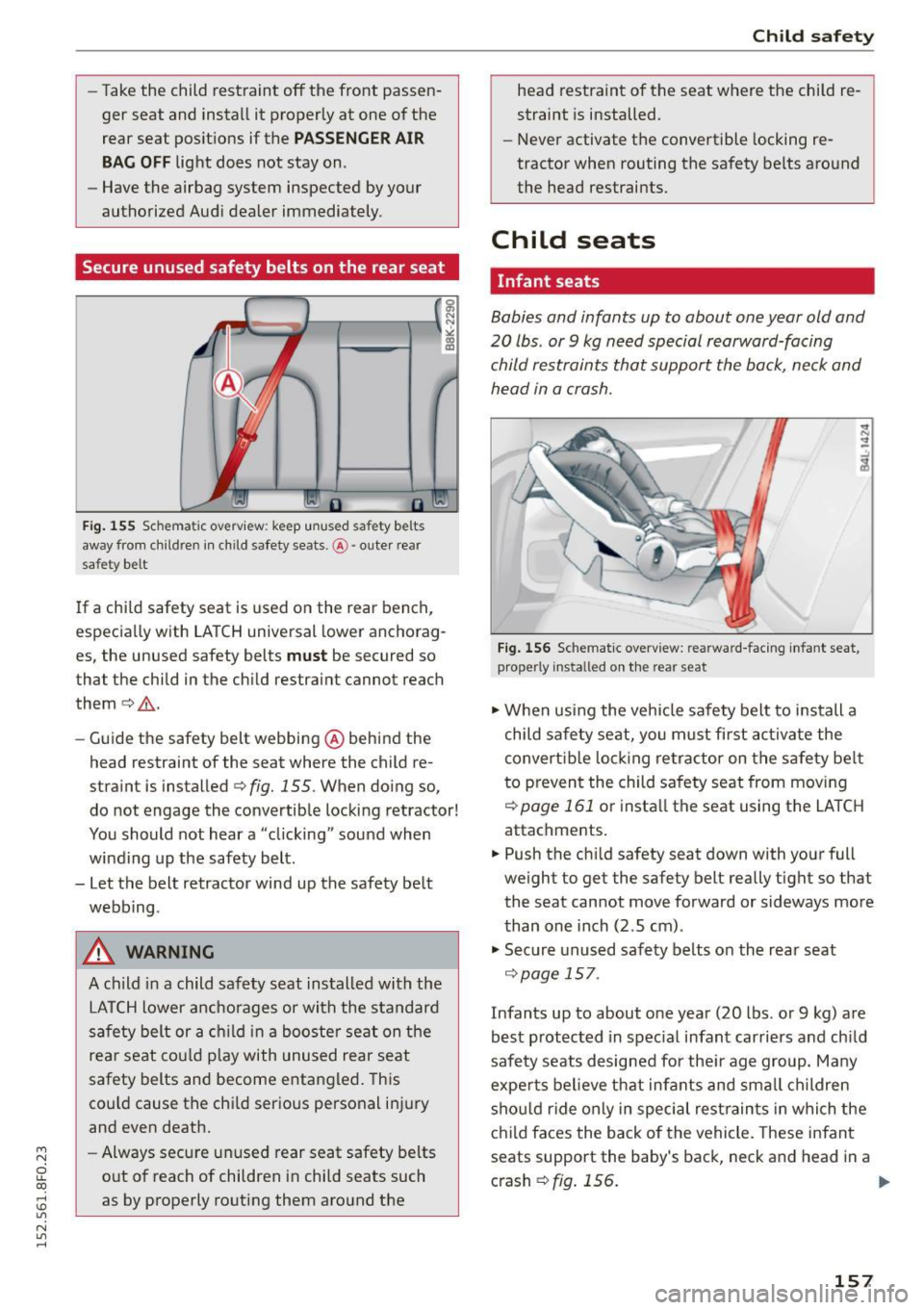
Secure unused safety belts on the rear seat
Fig . lSS Sche mati c ov erview : keep un use d safet y b elts
away from child re n in ch ild safety seats. @-o ute r rear
s a fe ty b elt
If a chi ld safety seat is used on the rear bench ,
especia lly with LATCH universal lower anchorag
es, the unused safety belts
mus t be secured so
t ha t the child in the child restraint cannot re ach
them
c::> ,& .
-Guide the safety belt webbing @ behind the
head restraint of the seat where the child re
straint is installed
c:> fig. 155. When do ing so,
do not engage the convertible locking retractor!
You should not hear a "clicking " sound when
winding up the safety belt .
- Let the belt retractor wind up the safety belt webbing .
A WARNING
A child in a child safety seat installed with the
LA TCH lower anchorages or with the standard
safety belt or a ch ild i n a booste r seat on the
rea r seat co uld play with unused rear seat
safety belts and become entangled. This
co uld cause the chi ld serious personal inj ury
and even death.
- Always secu re un used rear seat safety belts
o ut of reach of children in child seats such
as by properly routing them around the
Chil d sa fe ty
head restra int of the seat where the child re
straint is installed.
- Never activate the convertible locking re
tractor when routing the safety be lts around
the head restraints.
Child seats
Infant seats
Babies and infants up to about one year old and
20 lbs . or
9 kg need special rearward-facing
child restraints that support the back , neck and
head in a crash.
F ig . 1 56 Sc hematic ove rv iew: re ar ward -fac in g in fa nt seat ,
pro perl y in st all ed on th e r ear s eat
... When using the vehicle safety belt to install a
child safety seat, you must first activate the
convert ible lock ing re tractor on the safety belt
to prevent the child sa fety seat from mov ing
c:> page 161 or insta ll the seat using the LATCH
attachments.
... Push the ch ild safety seat down with your full
weight to get the safety belt really tight so tha t
the seat cannot move forward or sideways more
than one inch (2 .5 cm) .
... Secure unused safety belts on the rear seat
c::> page 157.
Infants up to about one year (20 lbs . or 9 kg) are
best p rotected in spec ial infant carriers and ch ild
safety seats designed for the ir age group. Many
experts bel ieve that infants and sma ll children
sho uld ride only in special restrain ts in which the
child faces the back of the vehicle. These infant
seats support the baby 's back, neck and head in a
crash
c:> fig . 156. ll>
157
Page 160 of 268
Child safety
The airbag on the passenger side makes the front
seat a potentially dangerous place for a child to
ride. The front seat is not the safest place for a
child in a forward-facing child seat. It is a very
dangerous place for an infant or a larger child in
a rearward -facing seat .
A WARNING
Not using a child safety seat, using the wrong
child safety seat or improperly installing a
child restraint increases the risk of serious
personal inju ry and death in a crash.
- Never install rearward-facing child safety
seats or infant carriers on the front passen
ger seat -even w ith an Advanced Airbag Sys
tem . A child will be seriously injured and can
be killed when the inflating airbag hits the
child safety seat or infant carrier with great
force and smashes the child safety seat and
child against the backrest, center armrest,
door or roof¢
page 133, Child restraints on
the front seat -some important things to
know .
-Always install rearward -facing child safety
seats or infant carriers on the rear seat.
- Never install a rearward-facing child re
straint in the forward-facing direction. Such
restraints are designed for the special needs
of infants and very small children and can
not protect them properly if the seat is for
ward-facing .
- If you must install a rearward facing child
safety seat on the front passenger seat be
cause of exceptional circumstances and the
PASSENGER AIR BAG OFF light does not
come on and stay on, immediately install
the rearward-facing child safety seat in a rear seating position and have the airbag
system inspected by your authorized Audi
dealer.
- Always read and heed all WARNINGS when
ever using a child restrained in a vehicle is
being used
~ page 124, Safety belts,
~ page 132, Airbag system and
¢ page 152, Important information.
158
Convertible child safety seats
Properly used convertible child safety seats can
help protect toddlers and children over age one who weigh between 20 and 40 lbs. (9 and 18 kg)
in a crash .
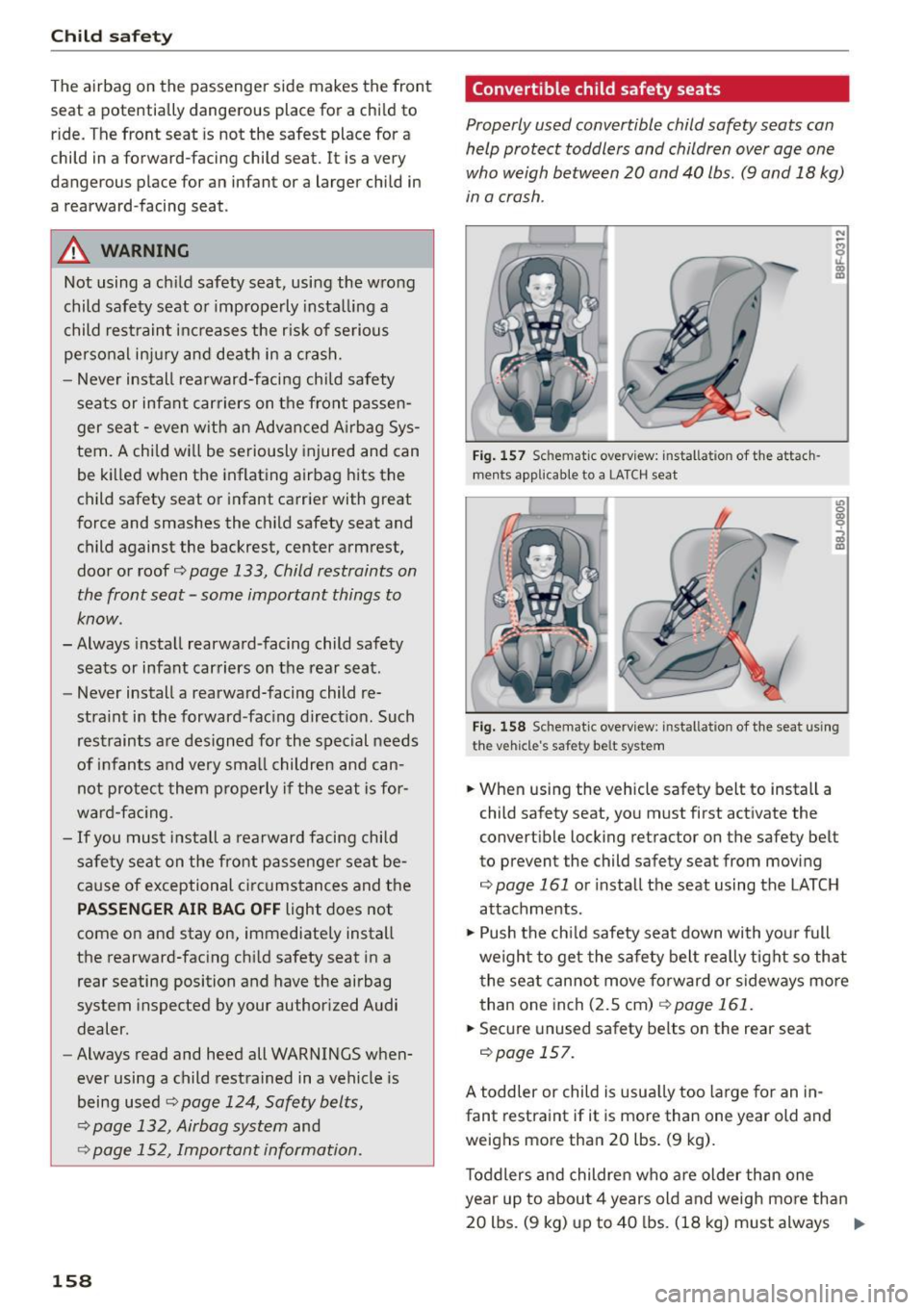
Fig. 157 Schem atic ove rview: instal la ti on of the attach
ments applicable to a LATCH seat
Fig. 158 Sc hematic ove rview : instal lat ion of the seat using
t he vehicl e's sa fet y bel t system
.. When using the vehicle safety belt to install a
child safety seat, you must first activate the
convertible locking retractor on the safety belt
to prevent the child safety seat from moving
¢page 161 or install the seat using the LATC H
attachments.
.,. Push the chi ld safety seat down with your full
weight to get the safety belt really tight so that
the seat cannot move forward or sideways more
than one inch (2.5 cm)
~ page 161.
.. Secure unused safety belts on the rear seat
¢page 157.
A toddler or child is usually too large for an in
fant restraint if it is more than one year old and
weighs more than 20 lbs. (9 kg).
T oddlers and children who are older than one
year up to about 4 years old and weigh more than
20 lbs. (9 kg) up to 40 lbs. (18 kg) must always
Ill>