engine AUDI A5 CABRIOLET 2015 Manual PDF
[x] Cancel search | Manufacturer: AUDI, Model Year: 2015, Model line: A5 CABRIOLET, Model: AUDI A5 CABRIOLET 2015Pages: 268, PDF Size: 66.88 MB
Page 208 of 268

Checking and Filling
-If you get battery acid in your eyes or on
your skin, immediately rinse with cold wa
ter for several minutes and get medical at
tention .
- If you should ingest any battery acid, seek
medical attention immediately .
- Do not expose the battery to an open flame, electric sparks or an open light .
- Do not smoke .
- Do not interchange the positive and nega-
tive cables.
- When working on the battery , be sure not to
short-circuit the terminals with tools or oth
er metal objects . This would cause the bat
tery to heat up very quickly, which could lead to damage or explosion and personal
injury .
- When a battery is charged, it produces hy
drogen gas which is explosive and could
cause personal injury.
- Always keep the battery well out of the
reach of children .
- Before work is done on the electrical sys
tem, disconnect the negative ground cable .
- Before performing any work on the electri cal system, switch off the engine and igni
tion as well as any electrical equipment. The negative cable on the battery must be dis
connected. If you are just going to replace a
light bulb, then it is enough to switch off
the lights.
- Before disconnecting the battery, switch off
the anti-theft alarm system! Otherwise you
will set off the alarm.
- When disconnecting the battery, first dis
connect the negative cable and then the
positive cable.
- Before reconnecting the battery, make sure
all electrical consumers are switched off. Re
connect the positive cable first and then the
negative cable. Never interchange the ca
bles -this could start a fire!
- Never charge a frozen or a thawed-out bat
tery. It could explode! If a battery has fro ·
zen, then it must be replaced. A discharged
battery can freeze over at 32°F (0°C).
- Make sure the vent hose is always attached
to the opening on the side of the battery .
206
-Never use batteries which are damaged.
There is the danger of an explosion! Always
replace a damaged battery.
A WARNING
California Proposition 65 Warning:
- Battery posts, terminals and related acces
sories contain lead and lead compounds,
chemicals known to the State of California
to cause cancer and reproductive problems .
Wash hands after handling .
(D Note
- Do not disconnect the vehicle battery when
the ignition is switched on or when the en
gine is running, otherwise, you will damage
electronic components in the electrical sys
tem .
-If your vehicle is going to stand for a long
period of time without being driven, protect
the battery from "freezing", otherwise it
will be damaged and will then have to be re
placed .
Battery charging
Starting the engine requires a well charged bat
tery.
Fig. 177 E n g in e compar tmen t: C on nectors fo r charger and
jump er cables
Always read and heed all WARNINGS below
9 A and ¢ A in Working on the battery on
page 205.
.,. Turn off the ignition and all electrical consum
ers.
.,. Make sure the area is well ventilated when you
charge the battery.
Iii>-
Page 209 of 268

M N
ci u.. co ,...., \!) 1.1'1
N 1.1'1 ,....,
~ Open the engine hood ¢page 195 .
~ Open the cover on the positive pole ~ fig. 177.
~ Connect the charger connectors accord ing to
the instructions to the
j ump sta rt bolts . (Bolts
under the cover= "positive", Bo lts with hex
head = "negat ive") .
~ Only now plug the mains lead for the charg ing
equipment into the wall outlet and turn it on
~ & -
~ Ma ke s ure th e char gin g rate is not ov er
3 0 amp s/14 .8 Volt .
~ When the battery is fully charged: Turn the
charging equipment
off and remove the mains
l ead from the wall outlet.
~ Now remove the clamps for the charging equip-
ment.
~ Close the cover on the positive pole .
~ Close the hood 9 page 195.
A discharged battery can freeze at temperatures
of only 32 °F (0 °C). Allow a frozen battery to
thaw completely before attempting to charge it
9 & . However, we recommend not using a
thawed battery again because the batte ry casing
can be cracked due to ice formation and can leak
battery ac id.
Battery charg ing (Ma ximum charging rate of
30 amps /14.8 Volt )
When charging at low voltages (e.g. w ith a tri ckl e
c h arge r),
the battery cables do not have to be
disconnected first. The battery caps shou ld
not
be opened when charging a battery.
It is not necessary to remove the batte ry from
the luggage compartment.
F a st charging th e battery (charg ing r ate
above 14.8 Vo lts )
For technical reasons do no t use a battery charg
e r that uses voltage greater than 14.8 Volts to
charge your vehicle's battery .
A WARNING
Charging a battery can be dangerous.
- Always follow the operating instructions
provided by the battery charger manufactur
er when charging your battery.
Checking and Fillin g
-Never charge a frozen battery. It may ex
plode because of gas trapped in the ice. Al
low a frozen battery to thaw out first.
- Do not reuse batteries wh ich were frozen.
The battery housing may have cracked and
weakened when the battery froze.
- Charge the battery in a well ventilated area. Keep away from open flame or electrical
spark. Do not smoke. Hydrogen gas generat
ed by the batte ry is explosive.
- To reduce the danger of explosion, never
connect or d isconnect charger cables wh ile
the charger is operating.
- Fast charging a battery is dangerous and
should only be attempted by a competent
technician w ith the proper equipment.
- Battery acid that may sp ill dur ing charging
should be washed
off with a solut ion of
warm water and baking soda to neutralize the acid .
@ Note
Never use a fast charger as a booster to start
the engine . This w ill ser iously damage sensi
tive electronic components, suc h as control
units, relays, radio, etc., as we ll as the battery
charger.
Battery replacement
The new battery must have the same specifica
tions and dimensions as the original equipment
battery.
Intelligent energy management in your vehicle is
responsible for distributing the elect rical energy
throughout your vehicle
9 page 175. T he intelli
gent energy management system w ill keep the
engine battery charged better then vehicles with
out this system. To make sure the additional elec
trical energy is avai lab le once again after you
have changed the battery, we recommend that
you install batteries of the same type and manu
facture only (the same as those installed at the
t ime your vehicle was delivered) . Specifications
are listed on the battery housing . Your autho r
ized Audi dealer must code the battery in the en-
ergy management system to enab le you to use .,,.
207
Page 210 of 268

Checking and Fill in g
th e e nergy management functions correctly after
replacing the battery.
If i t is not poss ible to use a battery of this type,
the new battery must have the same capacity,
voltage (12-vo lts), amperage, construct ion and
p lug sealing.
When insta lling the battery, make sure the igni
tion and all elec trical consumers are t urned off.
CD Note
Make sure the ventilation hose on the s ide of
t he batte ry is connected, otherwise fumes or
bat tery ac id can leak out.
@ For the sake of the environment
Because of the problem of proper d isposa l of
a battery, we recommend your author ized
Audi dea le r change the battery for yo u. Ba t
teries contain su lfuric acid and lead and must
always be disposed of properly in compliance
w ith all environmenta l reg ulations. D isposing
of vehicle batteries improperly is very danger
ous to the environment.
Windshield/headlight* washer container
Fig. 178 Engine co mpa rtment : Cove r on th e w in d shiel d
an d h ead ligh t• was her fl uid container
The washer fluid containe r is marked with the
symbol
O on its cap ¢ fig . 178 , ¢page 197,
fig . 172 .
.,. Before you check anyth ing in the eng ine com
partment , alw ays re ad and he ed all WARN·
I NGS
¢ ,& in Working in the engine comport
ment on page 195 .
208
.,. Lift the filler cap tongue to add washer fluid.
Yo u can fill the container to the top.
.,. Press the cap back onto the filler neck after fill-
ing the container .
You can find the reservoir ca p acit y in the table in
~ page 246.
Clean water should be used when filling up. If
possible, use soft water to prevent scaling on the
washer jets . Always add a g lass cleaner solution
(with frost protection in the winter) .
CD Note
Do not mix engine coolant antifreeze or any
other additives to fill up the windsh ield wash
er reservoir.
Page 223 of 268
M N
ci u.. co ,...., \!) 1.1'1
N 1.1'1 ,....,
Wheels
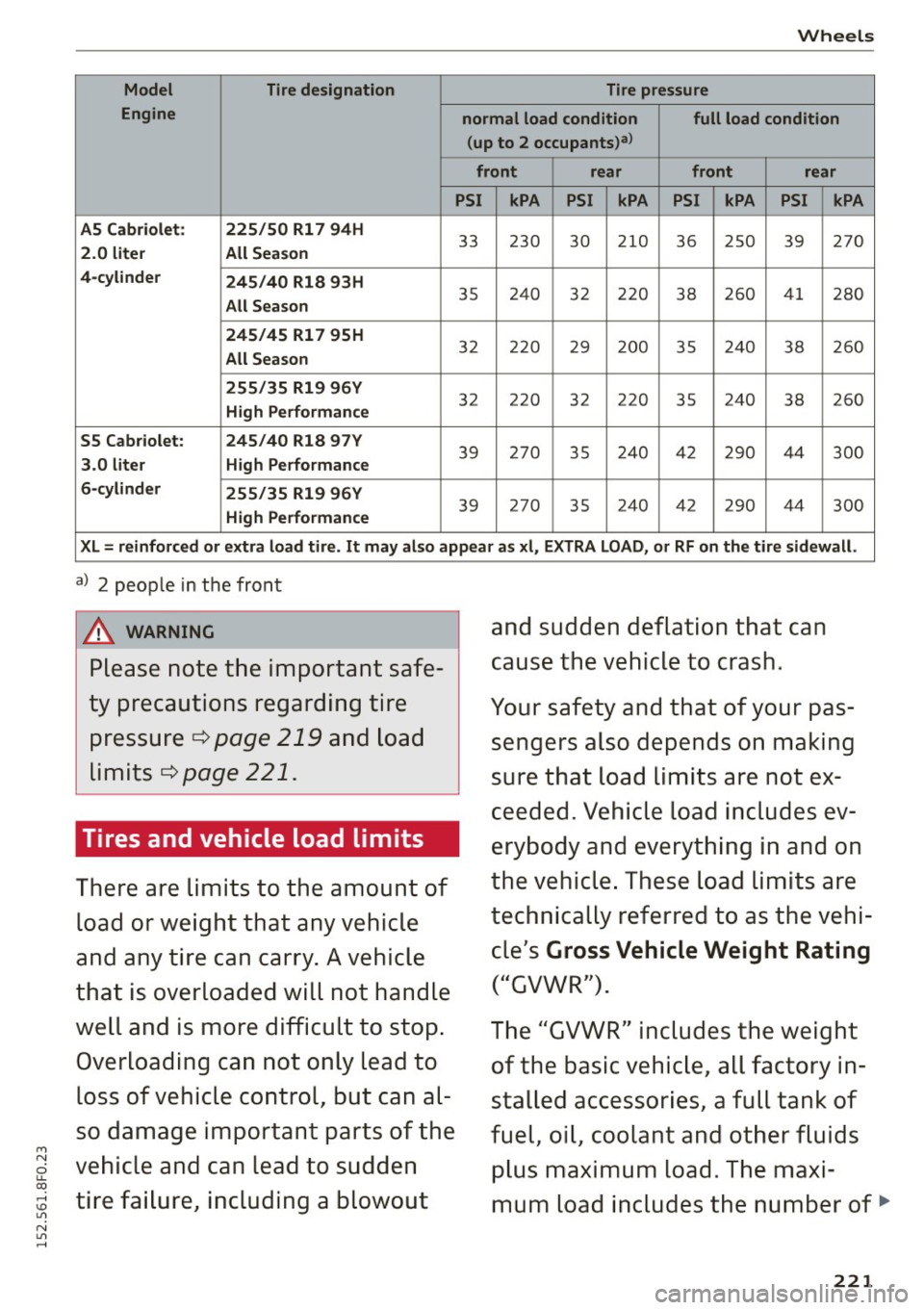
Model Tire designation Tire pressure
Engine normal load condition full load condition
(up to 2 occupants)a)
front rear front rear
PSI kPA PSI kPA PSI kPA PSI kPA
AS Cabriolet: 225/50 Rl 7 94H
33 230 30 210 36 250 39 270 2.0 liter All Season
4-cylinder 245/40 Rl8 93H
All Season
35 240 32 220 38 260 41 280
245/45 Rl7 95H 32 220 29 200
35 240
38 260
All Season
255/35 Rl9 96Y
32 220 32 220 35 240
38 260 High Performance
SS Cabriolet: 245/40 Rl8 97V
39 270 35 240 42 290 44 300 3.0 liter High Performance
6-cylinder
255/35 Rl9 96V
High Performance
39 270
35 240 42 290 44 300
XL= reinforced or extra load tire. It may also appear as xl, EXTRA LOAD, or RF on the tire sidewall.
a) 2 people
in the front
A WARNING
Please note the important safe
ty precautions regarding tire pressure ¢
page 219 and load
limits
¢ page 221.
Tires and vehicle load limits
There are limits to the amount of
load or weight that any vehicle
and any tire can carry. A vehicle
that is overloaded will not handle
well and is more difficult to stop. Overloading can not only lead to
loss of vehicle control, but can al
so damage important parts of the
vehicle and can lead to sudden
tire failure, including a blowout and
sudden deflation that can
cause the vehicle to crash.
Your safety and that of your pas sengers also depends on making
sure that load limits are not ex
ceeded. Vehicle load includes ev
erybody and everything in and on
the vehicle. These load limits are
technically referred to as the vehi cle's
Gross Vehicle Weight Rating
("GVWR").
The "GVWR" includes the weight of the basic vehicle, all factory in
stalled accessories, a full tank of
fuel, oil, coolant and other fluids plus maximum load. The maxi
mum load includes the number of
1111-
221
Page 231 of 268
M N
ci LL co
rl I.O
"' N
"' rl
Emergency assistance
Vehicle tool kit
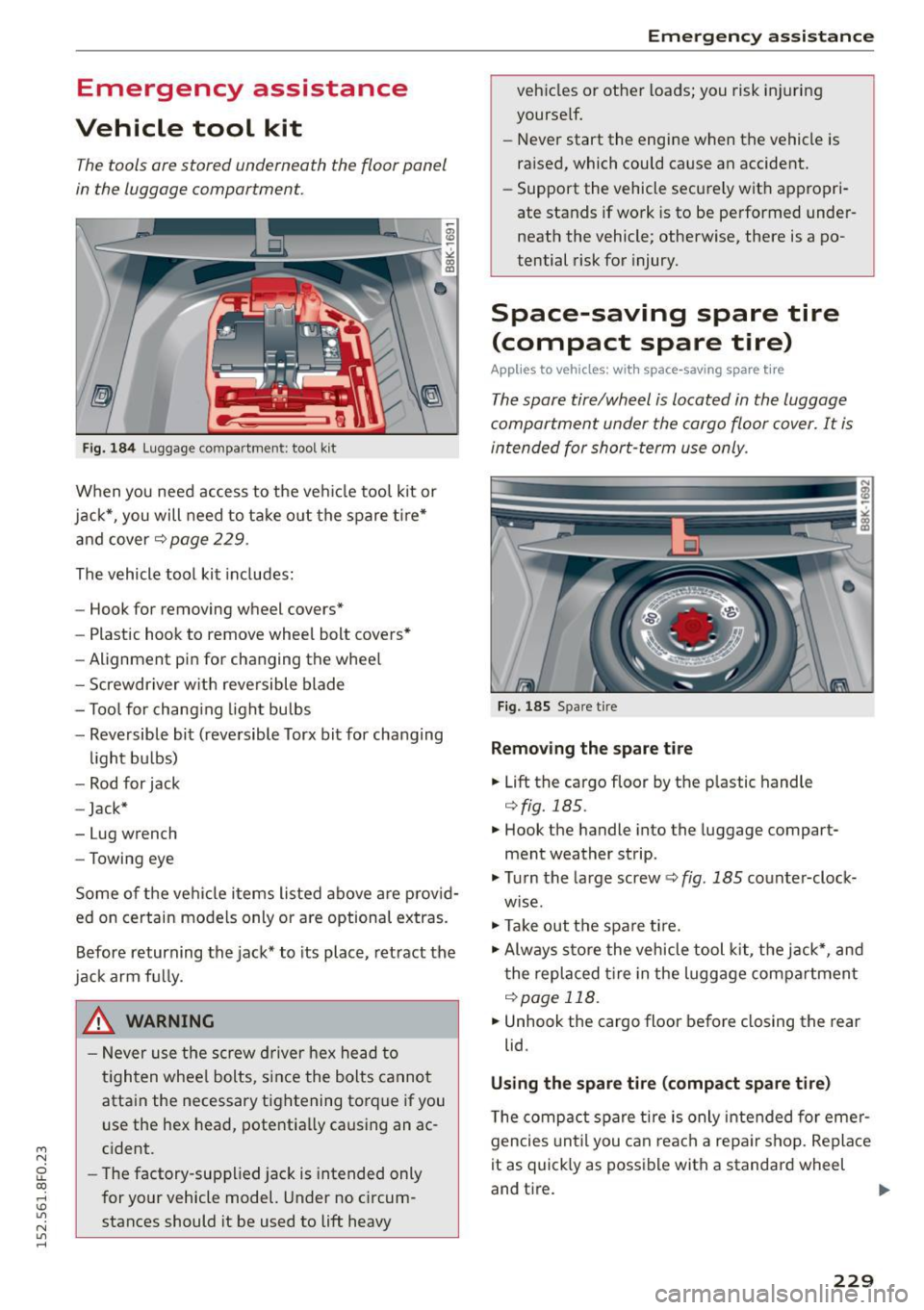
The tools ore stored underneath the floor panel
in the luggage comportment.
Fig. 184 Luggage compartme nt: tool kit
When you need access to the veh icle tool kit or
jack*, you will need to take out the spare t ire*
and cover¢
page 229.
The vehicle tool kit includes:
- Hook for removing wheel covers*
- Plastic hook to remove wheel bolt covers*
- Alignment pin for changing the whee l
- Screwdriver w ith reversible blade
- Tool for chang ing light bulbs
- Reversible bit (reversible Torx bit for changing
light bulbs)
- Rod for jack
- Jack*
- Lug wrench
- Towing eye
Some of the vehicle items listed above are prov id
ed on certain models only or are optional extras.
Before returning the jack* to its place, retract the
jack arm fu lly.
_& WARNING
- Never use the screw driver hex head to
t ighten whee l bolts, since the bolts cannot
attain the necessary tightening torque if you
use the hex head, potentially causing an ac
cident.
- The factory-suppl ied jack is intended only
for your vehicle model. Under no c ircum
stances should it be used to lift heavy
Emergen cy assistance
vehicles or other loads; you risk injuring
yourself.
- Never start the engine when the vehicle is
raised, which could cause an accident.
- Support the vehicle securely with appropri
ate stands if work is to be performed under
neath the vehicle; otherwise, there is a po
tential risk for injury.
Space-saving spare tire
(compact spare tire)
Applies to vehicles: with space-saving spare tire
The spore tire/wheel is located in the luggage
comportment under the cargo floor cover. It is
intended for short-term use only.
Fig. 185 Spare tire
Removing the spare tire
.,. Lift the cargo floor by the p lastic handle
¢ fig. 185.
.,. Hook the handle into the lugg age compart
ment weather strip.
.,. Turn the large screw ¢
fig. 185 counter-clock
wise.
.,. Take out the spare ti re .
.,. Always store the vehicle tool kit, the jack*, and
the replaced tire in the luggage compartment
¢page 118.
.,. Unhook the cargo floor before closing the rear
lid.
Using the spare tire (compact spare tire)
The compact spare tire is only intended for emer
gencies until you can reach a repa ir shop. Replace
it as quickly as possible with a standard wheel
and tire. ..,
229
Page 239 of 268

M N
ci LL co
rl I.O
"' N
"' rl
Fu se pa nel @ (black )
No. Consumer
1 Dynamic steering
2 Electron ic Stabilization Control (module)
A/C system pressure sensor, electrome-
chanical parking brake, HomeLink, auto-
3 mat
ic dimming interior rear view mirror,
air quality/outside air sensor, Electron ic
Stabilization Control (button)
s Sound actuator
6 Headlight range control/headl
ight (corner-
ing light)
7 Headlight (cornering light)
Control modu les (electromechanical park-
8 ing brake, shock absorber, q uattro sport),
DCDC converte r
9 Adaptive
cruise control
10 Shift gate/clutch sensor
11 Side assist
1 2 Headlight range cont ro l, parking system
13 Airbag
14 Rear
wiper (a llroad)
15 Auxiliary fuse (instrument panel)
16 Auxiliary
fuse termina l 15 (engine area)
Fuse p anel @ (brown )
No. C onsumer
2 Brake light sensor
3 Fuel pump
4 Clutch sensor
5
Left seat heating with/without seat venti-
lation
6 Electronic Stabilization Control (electric)
7 Ho rn
8
Front left door (window regulator, central
locking, mirror, switch, lighting)
9 Windshield wiper motor
10 Electronic Stabilization Control (valves) Fu
ses a nd bulb s
No. Consumer
Two-door mode ls: rear left window regula-
11 tor; Four-door
models: rear left door (win-
dow regulator, central locking, switch,
light ing)
12 Rain and l
ight sensor
Fuse panel © (r e d )
No . Con sumer
3 Lumbar support
4 Dynamic steering
5 Inter
ior l ight ing (Cabriolet)
6 Windshie
ld washer system, headlight
washer system
7 Vehicle electrica l system control module 1
8 Vehicle electr ica l system control module 1
9 Left rear
window regulator motor (Ca brio-
let)/su nroof
10 Vehicle electr ica l system co ntrol module 1
11 Right rear
window regulator (Cabriolet)/
sun shade motor
12 Anti-theft
alarm warning system
Right cockpit fuse assignment
Fig. 195 Right cockpit: fu se panel with plastic cl ip
237
Page 241 of 268
M N
ci u.. co ,...., \!) 1.1'1
N 1.1'1 ,....,
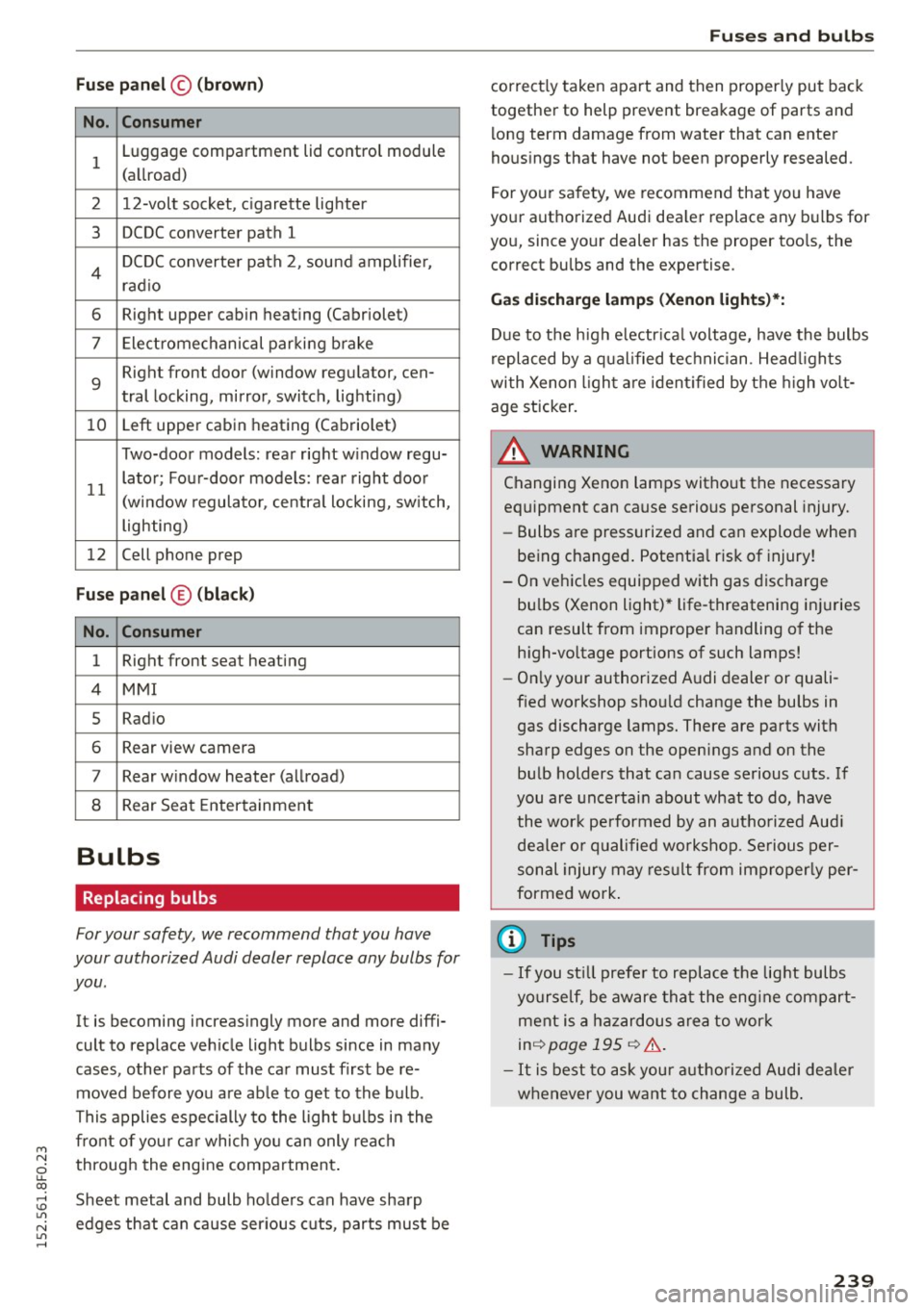
Fuse panel© (brown)
No. Consumer
1 Luggage compartment lid control module
(allroad)
2 12-volt socket, cigarette lighter
3 DCDC converter path 1
4 DCDC converter path 2, sound amplifie r,
rad io
6 Right upper cabin heating (Cabriolet)
7 Electromechanical parking brake
9
Right front door (window regulator, cen-
tral locking, mirror, switch, lighting)
10 Left upper cabin
heating (Cabriolet)
Two-door models: rear right w indow regu-
11 lator; Four-door models: rear
right door
(window regulator, central locking, switch,
lighting)
12 Cell phone prep
Fuse
panel © (black)
No. Consumer
1 Right front seat heating
4 MMI
5 Radio
6 Rear view camera
7 Rear window heater (allroad)
8 Rear
Seat Entertainment
Bulbs
Replacing bulbs
For your safety, we recommend that you have
your authorized Audi dealer replace any bulbs for
you .
It is becoming increasingly more and more diffi
cult to replace vehicle light bulbs since in many
cases , other parts of the car must first be re
moved before you are ab le to get to the bulb .
This applies especially to the light bulbs in the
front of you r ca r which you can only reach
through the engine compartment .
Sheet metal and bulb holders can have sharp
edges that can cause ser ious cuts, parts must be
Fuses and bulbs
correct ly taken apart and then properly put back
together to help prevent breakage of parts and
long term damage from water that can enter
housings that have not been properly resealed.
For your safety, we recommend that you have
your authorized Audi dea ler replace any bulbs for
you, since your dealer has the proper tools, the
correct bulbs and the expertise.
Gas discharge lamp s (Xenon lights)*:
Due to the high electr ical voltage, have the bulbs
replaced by a qualified technician . Head lights
with Xenon light are identified by the high volt
age sticker.
A WARNING
Changing Xenon lamps without the necessary
equipment can cause serious personal injury.
- Bulbs are pressurized and can explode when
being changed . Potential risk of injury!
- On vehicles equipped with gas discharge
bu lbs (Xenon light) * life -threatening injuries
can result from improper handling of the
high -vo ltage portions of such lamps!
-On ly your authorized Audi dealer or quali
fied workshop shou ld change the bulbs in
gas discharge lamps. There are parts with
sharp edges on the openings and on the
bulb holders that can cause serious cuts . If
you are uncertain about what to do, have
the wor k performed by an autho rized Audi
dealer or qualified workshop. Serious per
sonal injury may result from improperly per
formed work .
(D Tips
-If you st ill prefer to replace the light bulbs
yourself, be aware that the eng ine compart
ment is a hazardous area to work
inq page 195 q &..
-It is best to ask your authorized Audi dealer
whenever you want to change a bulb.
239
Page 242 of 268

Emerg enc y s it uat ion s
Emergency situations
General
T his c hapt er is inte nded fo r tra ined e merg ency
c rews a nd worki ng p ers onn el w ho h ave the nec
e ssa ry tool s and equipm ent t o perf orm the se
op era tion s.
Starting by pushing or
towing
CD Note
Vehicl es with an automa tic tra nsmission
c annot be st arted by pushing or towing .
Starting with jumper
cables
If necessary, the engine con be started by con
necting it to the battery of another vehicle .
If the engine should fail to start because of a d is
charged or weak battery, the battery can be con
nected to the battery of
another vehicle, us ing a
p air of j umpe r cables to start the engine.
Jump er c abl es
Use only jumper cab les of sufficiently largec ross
sec tion
to carry the starter current safely. Refer
to the manufacturer's specifications.
Use on ly jumper cables with
insulated term inal
clamps which are d istinctly mar ked:
plus (+ ) cabl e in most cases co lored re d
minu s(-) cable
in most cases colored black .
A WARNING
Batteries contain electricity, ac id, and gas.
Any of these can cause very ser ious or fatal in
jury . Fo llow the inst ruct ions be low for safe
hand Ling of your veh icle's battery.
- Always shield your eyes and avoid leaning
over the battery whenever possible.
- A discharged battery can freeze at tempera
tures just below 32 °F (0 °C). Before con
nect ing a jumper cab le, you must thaw the
240
frozen battery completely, otherwise it
could explode.
- Do not allow battery acid to contact eyes or
skin. Flush any contacted area with water immed iately.
- Improper use of a booster battery to start a
veh icle may cause an explosion.
- Vehicle batteries generate explosive gases .
Keep sparks, flame and lighted cigarettes
away from batteries.
- Do not try to jump start any vehicle with a
low acid level in the battery.
- The voltage of the booster battery must al
so have a 12-Volt rat ing . The capacity (Ah)
of the booster battery should not be lower
than that of the discharged battery. Use of batter ies of different voltage or substantial
ly different "Ah" rating may cause an explo
sion and personal injury .
- Never charge a frozen battery . Gas trapped
in the ice may cause an explosion .
- Never charge or use a battery that has been
frozen . The battery case may have be weak
ened .
- Use of batter ies of different voltage or sub
stantially d ifferent capacity (Ah) rating may
cause an explosion and injury. The capacity
(Ah) of the booster battery sho uld not be
lowe r than that of the discharged battery.
- Before you check anything in the engine
compartment, always read and heed a ll
WARNINGS
qpoge 195.
CD Note
-App lying a higher voltage booster battery
wi ll cause expensive damage to sensitive
elec tronic components, such as control
units, re lays, radio, etc.
- T here must be no electrical contact between
the vehicles as otherwise cu rrent cou ld al
ready start to flow as soon as the positive
(+) termina ls are connected.
@ Tips
The discharged battery must be properly con-
nected to the vehicle's electrical system. .,.
Page 243 of 268
M N
ci LL co
rl I.O
"' N
"' rl
When jump starting or charging the battery,
never connect the negative ground cable to
the battery negat ive post because the battery
manager system must be able to detect the
battery's state of charge. Always connect the
negative g round cab le to the negative ground
post of the battery manager control unit.
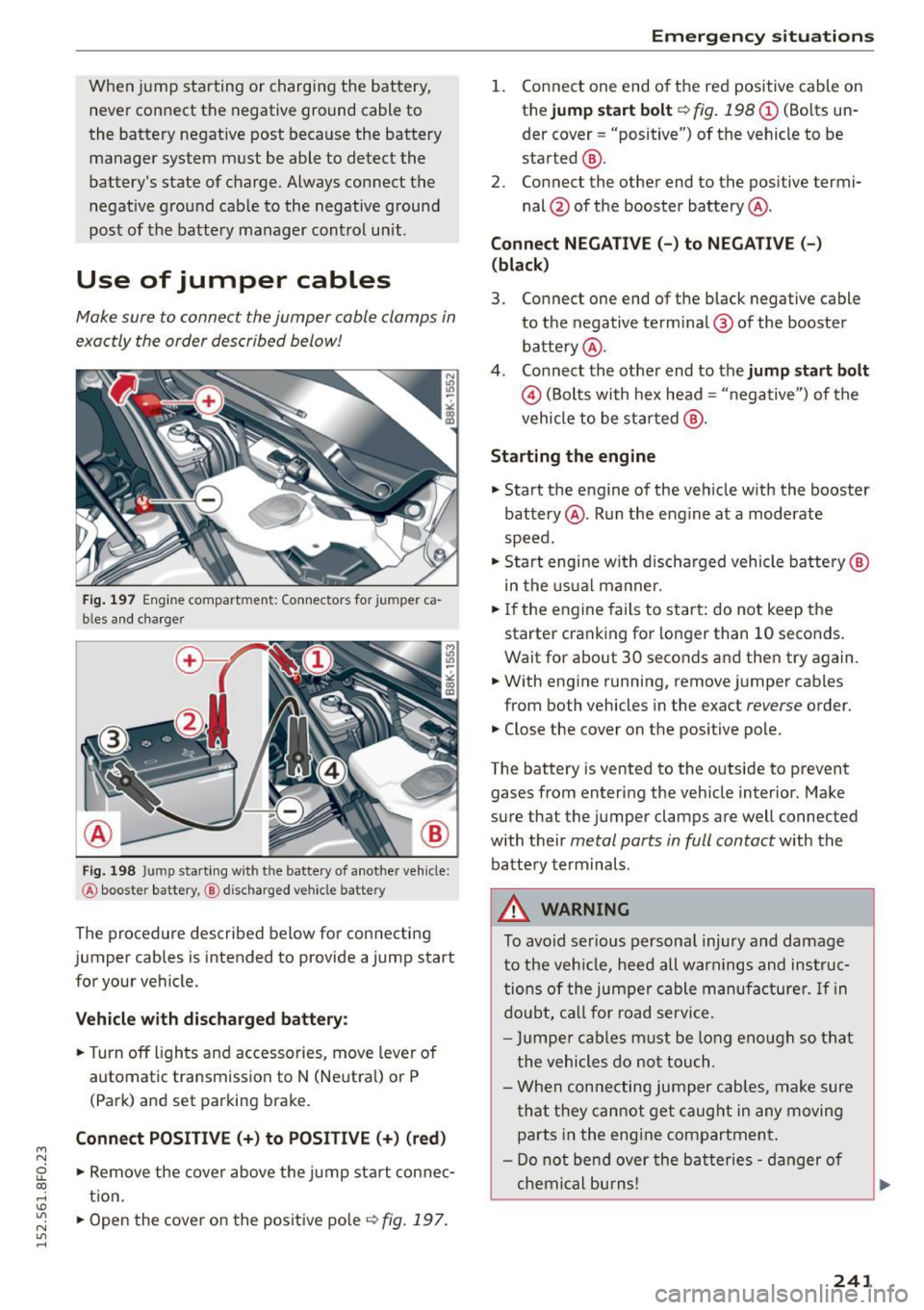
Use of jumper cables
Make sure to connect the jumper cable clamps in
exactly the order described below!
Fig. 197 Engine compa rtment: Connectors for jumper ca
b les and c harger
Fig. 198 Jum p sta rting with the battery of anot her veh icle :
@ boos te r ba ttery, @ discharged veh icle battery
The procedure described below for connecting
jumper cables is intended to provide a jump start
for your vehicle.
Vehicle with discharged battery :
.. Turn
off lights and accessories, move lever of
automatic transmission to N (Ne utra l) or P
(Park) and set parking brake.
Connect POSITIVE(+) to POSITIVE(+) (red)
.. Remove the cover above the jump start connec
t ion.
.. Open the cover on the posit ive pole ¢
fig. 197.
Emergency situations
1. Connect one end of the red positive cable on
the jump start bolt~
fig. 198 (D (Bolts un
der cover= "positive") of the vehicle to be
started @.
2. Connect the other end to the positive termi- nal@of the booster battery @.
Connect NEGATIVE (-) to NEGATIVE(-)
(black)
3. Connect one end of the black negative cable
to the negative terminal ® of the booster
battery @.
4 . Connect the other end to the jump start bolt
@ (Bolts with hex head= "negative") of the
vehicle to be started @.
Starting the engine .. Start the engine of the veh icle with the booster
battery @. Run the eng ine at a moderate
speed .
.. Start engine with discharged vehicle battery @
in the usual manner.
.. If the engine fails to start: do not keep the
starter cranking for longer than 10 seconds.
Wait for about 30 seconds and then try again .
.. With engine running, remove jumper cables
from both vehicles in the exact
reverse order .
.. Close the cover on the positive pole.
The battery is vented to the outside to prevent
gases from entering the vehicle inter ior. Make
sure that the jumper clamps are well connected
with their
metal parts in full contact with the
batte ry terminals.
A WARNING
To avoid serious personal injury and damage
to the vehicle, heed all warnings and instruc
tions of the jumper cable manufacturer. If in
doubt, call for road service.
- Jumper cables must be long enough so that
the vehicles do not touch .
- When connecting jumper cables, make sure
that they cannot get caug ht in any moving
parts in the eng ine compartment.
- Do not bend over the batteries -danger of
chemi cal burns!
241
Page 244 of 268
Emergency situation s
-The ba ttery ce ll lockin g screws must be
t ightened securely .
- Before you check anyt hing in the engine
compartment, always read and heed all
WARNINGS
c> page 195.
(D Note
Improper hook -u p of jumper cables can r uin
the generator .
- A lways connect POS ITIV E(+ ) to POS ITIV E
( + ), and NEGATIVE( -) to NEGATIVE( -)
gro und post of the battery manager control
unit .
- Check that a ll screw plugs o n the batte ry
ce lls are screwed in firmly . If not, tighten
pl ugs prior to connect ing clamp on negat ive
battery te rminal.
- Please note that the procedure for connect
i ng a jumper cable as desc ribed above ap
plies specifica lly to the case of yo ur vehicle
being jump started . W hen you a re g iving a
j u mp sta rt to another vehicl e, do
not co n
ne ct the negative ( -) cab le to the negative
( -) t erminal o n the di scharged battery @
c> fig. 19 8 . In stea d, secure ly co nn ect the
nega tive ( -) cab le to either a solid me tal
com ponent that is f irm ly bolted to the en
gine block o r to t he engine bloc k itself. I f
the battery that is being charged does not
vent to the outside , escap ing battery gas
could ignite and exp lode!
Towing with a tow truck
General hints
Y o ur Audi requires special handling for towing.
The fo llow ing information is to be used by com
mercia l tow truck operato rs who know how to op
erate their eq uipment safe ly .
- Never tow your Audi, towing will cause dam
age to the engine and transmiss ion.
- Never wrap the safety chains or winch cables
around the brake lines .
- To pre vent unnecessary damage, your Audi
must be transported with a flat bed truck.
242
- To load the vehicle on to the flat bed , use the
towing loop found in the vehicle tools and at·
tach to the front or rear anchorage
c> page 242 and c:>page 243.
A WARNING
A veh icle being towed is not safe f or passe n
gers . Never a llow anyone to ride in a ve hicle
be ing towed, fo r any reason .
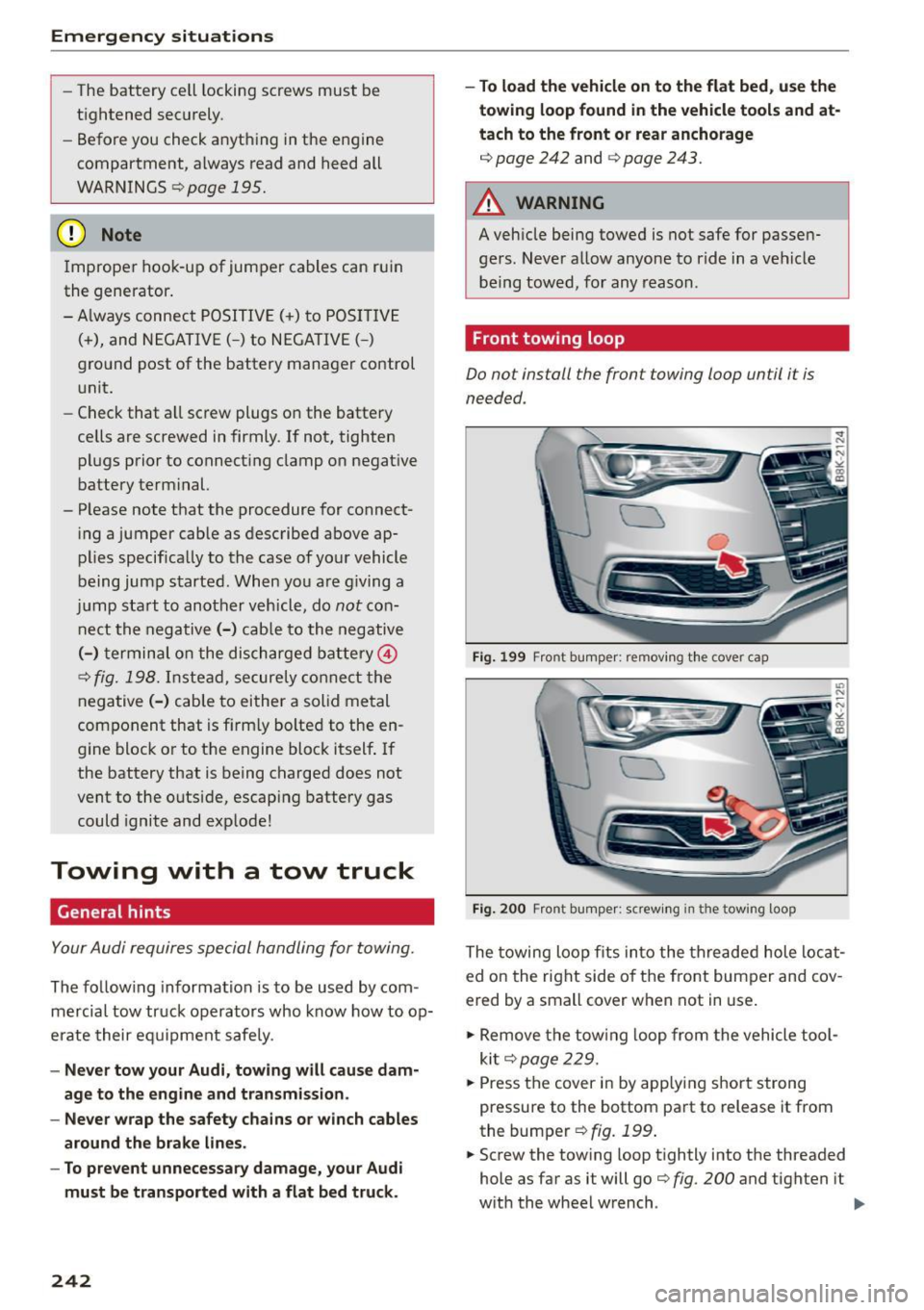
Front towing loop
Do not install the front towing loop until it is
needed .
Fig. 19 9 Fro nt b um per: remov ing t he cove r cap
Fig. 200 Front b umper: sc rew ing in t he tow ing loop
The towing loo p fits in to the threade d hole locat
ed on the right side o f the front bum per and cov
e red by a small cover when not in use .
.,. Remove the tow ing loop fr om the vehicle tool
ki t
c> page 229.
... Press the cover i n by app lyi ng shor t strong
pressure to the bottom part to release it from
the bumper
¢ fig. 199.
... Sc rew the tow ing loop tightly into the th readed
hole as far as it will go
c> fig. 200 and tighten it
w it h the wheel w rench . ..,.