weight AUDI A5 CABRIOLET 2017 Owner's Manual
[x] Cancel search | Manufacturer: AUDI, Model Year: 2017, Model line: A5 CABRIOLET, Model: AUDI A5 CABRIOLET 2017Pages: 266, PDF Size: 66.64 MB
Page 160 of 266
Child safety
Booster seats and safety belts
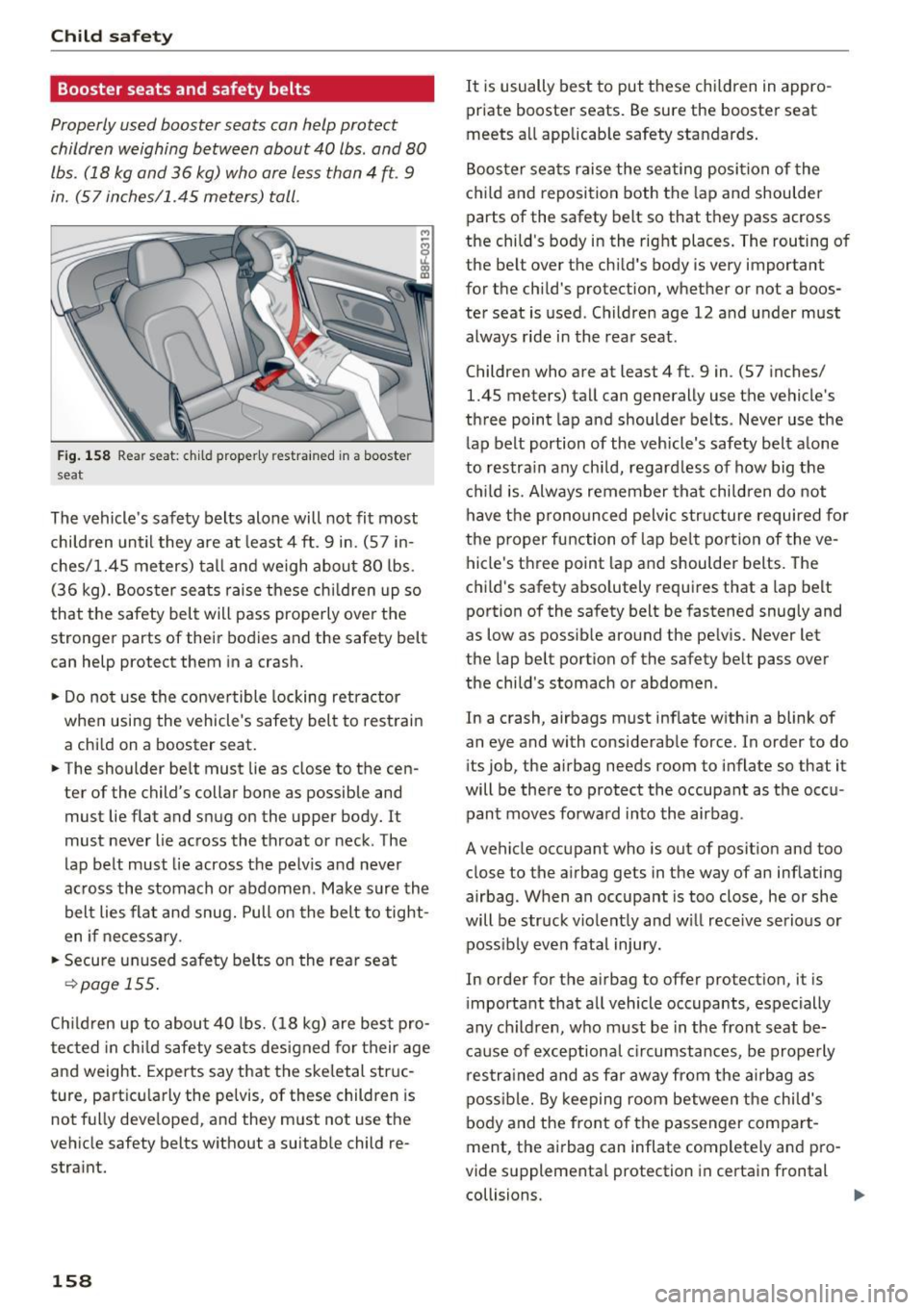
Properly used booster seats can help protect
children weighing between about 40 lbs . and 80
lbs. (18 kg and 36 kg) who are less than 4
ft. 9
in. (57 inches/1.45 meters) tall .
Fig. 158 Rear seat: ch ild proper ly restrained in a booster
seat
The vehicle's safety belts alone will not fit most
children until they are at least 4 ft. 9 in. (57 in
ches/1.45 meters) tall and weigh about 80 lbs .
(36 kg). Booster seats raise these chi ld ren up so
that the safety belt will pass properly
over the
stronger parts of their bodies and the safety belt
can help protect them in a crash.
• Do not use the convertible locking retractor
when using the vehicle's safety belt to restrain
a chi ld on a booster seat.
• The shoulder be lt must lie as close to the cen
ter of the child's collar bone as possible and
must lie flat and snug on the upper body. It
must
never lie across the throat or neck. The
lap belt must lie across the pelv is and
never
across the stomach or abdomen . Make sure the
belt lies flat and snug. Pull on the belt to tight
en if necessary .
• Secure unused safety belts on the rear seat
¢page 155.
Child ren up to about 40 lbs. (18 kg) are best pro
tected in chi ld safety seats des igned for their age
and weight . Experts say that the skeletal str uc
ture, part icu larly the pelvis, of these children is
not fully deve loped , and they must not use the
vehicle safety belts without a suitable child re
stra int.
158
It is usually best to put these children in appro
priate booster seats. Be sure the booster seat
meets all applicab le safety standards .
Booster seats raise the seating posi tion of the
child and reposition both the lap and shoulder
parts of the safety belt so that they pass across
the child 's body in the right places. The routing of
the belt over the ch ild's body is
very important
for the child's protection, whether or not a boos
ter seat is used. Child ren age 12 and under must
always ride in the rear seat.
Children who are at least 4 ft. 9 in . (57 inches/
1.45 meters) tall can generally use the vehicle's
three point lap and shoulder belts. Never use the
l ap belt portion of the veh icle's safety belt a lone
to restrain any child, regard less of how big the
child is. Always remember that children do not
have the pronounced pelvic structure required for
the proper function of lap belt portion of the ve
hicle's three point lap and shoulder belts. The
child's safety abso lutely requires that a lap belt
portion of the safety belt be fastened snugly and
as low as possible around the pe lvis. Never let
the lap belt portion of the safety belt pass over
the child 's stomach or abdomen .
In a crash, airbags must inflate with in a blink of
an eye and with considerab le force. In order to do
its job, the a irbag needs room to inflate so that it
will be there to protect the occupant as the occu
pant moves forward into the airbag.
A vehicle occupant who is out of position and too
close to the airbag gets in the way of an inf lating
airbag . When an occupant is too close, he or she
will be struck vio lent ly and w ill rece ive serio us or
possibly even fatal injury.
In order for the a irbag to offer protection, it is
important that all vehicle occupants, especially
any ch ildren, w ho must be in the front seat be
cause of exceptional circumstances, be properly
restrained and as far away from the airbag as
possible. By keeping room between the child's
body and the front of the passenger compart
ment, the airbag can inflate completely and pro
vide supplementa l protection in certain frontal
collisions.
Page 161 of 266
a:,
a:,
...... N r--. N ...... 0
0
LL 00
& WARNING
Not using a booster seat, using the booster
seat improperly, incorrectly installing a boos
ter seat or using the vehicle safety belt im
properly increases the risk of serious personal
injury and death in a collision or other emer
gency situation. To help reduce the risk of se
r ious personal injury and/or death:
- The shoulder belt must lie as close to the
center of the child's collar bone as possible
and must lie flat and snug on the upper
body.
It must neve r lie across the th roat or
neck. The lap belt must lie across the pelv is
and never across the stomach or abdomen.
Make sure the belt lies flat and snug. Pull on
the belt to tighten if necessary .
- Failure to proper ly route safety belts over a
child's body will cause severe injuries in an
accident or other emergency situation
¢ page 122.
-The rear side of the child safety seat should
be positioned as close as possible to the
backrest on the vehicle seat.
- Children on the front seat of any car, even
with Advanced Airbags, can be seriously in
jured or even killed when an a irbag inflates.
- Never let a child stand or kneel on any seat.
- Never let a child ride in the cargo area of
your vehicle.
- Always remember that a child leaning for
ward, sitting sideways or out of position in
any way during an accident can be struck by
a deploying airbag. This will result in serious
personal injury or death.
- If you must install a booster seat on the
front passenger seat because of exceptional
c ircumstances the
PA SSENGER AIR B AG
OFF
light must come on and stay on, when
ever the ignition is switched on.
- If the
PASSEN GER AIR BAG OFF light does
not come on and stay on, perform the
checks described ¢
page 140, Monitoring
the Advanced Airbag System.
- Take the ch ild restraint off the front passen
ger seat and install it properly at one of the
rea r seat positions if the
PASSENGER AIR
-
Ch ild safety
BAG O FF light does not stay on whenever
the ignition is switched on.
- Always read and heed all WARNINGS when
ever us ing a child restrained in a vehicle is
be ing used
c> page 122, Safety belts,
c> page 130, Airbag system and
c> page 150, Important information.
Securing child seats
Securing a child safety seat using a safety
belt
Safety belts for the rear seats and the front pas
senger's seat can be locked with the convertible
locking retractor to properly secure child safety
seats.
The safety belts emergency locking retractors for
the rear seats safety be lts and for the front pas
senger's seat safety be lt have a convertible lock
ing retractor for child restraints. The safety be lt
must be locked so that belt webb ing cannot un
reel. The retractor ca n be activated to lock the
safety belt and prevent the safety belt webbing
from loosening up dur ing norma l driving. A ch ild
safety seat can on ly be prope rly insta lled when
the safety belt is locked so that the c hild and
c h ild safety seat will stay in place .
Always remembe r: Even though your veh icle is
equipped with an Advanced Airbag system, all
children, especia lly those 12 yea rs and younger,
shou ld a lways ride in the back seat p roperly re
strained for their age and weight.
& WARNING
=
Improperly installed child safety seats in-
crease the risk of serious personal injury and
death in a co llision.
- Always make sure that the safety be lt re
tractor is locked when installing a child
safety seat. An un locked safety be lt retrac
tor cannot hold the ch ild safety seat in place
during normal driving or in a crash.
- Always buckle the child safety seat firmly in
place even if a ch ild is not sitt ing in it. A
loose child safety seat can fly a round dur ing
a sudden stop or in a co llision.
~
159
Page 162 of 266
Child safety
-If the backrest is not securely latched, the
child and the child restraint will be thrown
forward together with the backrest and will
strike parts of the vehicle interior. The child
can be seriously injured or killed .
- Never install rearward-facing child safety
seats or infant carriers on the front passen
ger seat . A child will be seriously injured and
can be killed when the passenger airbag in
flates.
- The inflating airbag will hit the child safety
seat or infant carrier with great force and
will smash the child safety seat and child
against the backrest, center armrest, door
or roof.
- Always install rearward-facing child safety
seats or infant carriers on the rear seat.
- Forward-facing child safety seats or infant
carriers installed on the front passenger's
seat may interfere with the deployment of
the airbag and cause serious injury to the
child.
- It is safer to install a forward-facing child
safety seat on the rear seat.
- Always read and heed all WARNINGS when ever using a child restrained in a vehicle is
being used
9 page 150. Special precautions
apply when installing a child safety seat on
the front passenger seat
9 page 131, Child
restraints on the front seat -some impor
tant things to know .
A WARNING
Always take special precautions if you must
install a forward or rearward-facing child re
straint on the front passenger's seat in excep
tional situations:
- Whenever a forward or rearward-facing
child restraint is installed on the front pas
senger seat, the
PASSENGER AIR BAG OFF
light must come on and stay on whenever
the ignition is switched on.
- If the PASSENGER AIR BAG OFF light does
not come on and stay on, perform the
checks described
9 page 140, Monitoring
the Advanced Airbag System.
160
-
- Take the child restraint off the front passen
ger seat and install it properly at one of the
rear seat positions if the
PASSENGER AIR
BAG OFF
light does not stay on whenever
the ignition is switched on .
- Improper installation of child restraints can
reduce their effectiveness or even prevent
them from providing any protection.
- An improperly installed child restraint can
interfere with the airbag as it deploys and
seriously injure or even kill the child .
-Always carefully follow the manufacturer's instructions provided with the child safety
seat or carrier .
- Never place additional items on the seat that can increase the total weight registered
by the weight-sensing mat and can cause in
jury in a crash.
A WARNING
Forward-facing child restraints:
- Always make sure the forward-facing seat
has been designed and certified by its man
ufacturer for use on a front seat with a pas
senger front and side airbag.
- Never put the forward-facing child restraint
up, against or very near the instrument pan
el.
-Always move the passenger seat into its
rearmost position in the seat's fore and aft
adjustment range, as far away from the air
bag as possible before installing the for
ward-facing child restraint. The backrest
must be adjusted to an upright position.
- Make sure that the
PASSENGER AIR BAG
OFF
light comes on and stays on all the time
whenever the ignition is switched on.
A WARNING
Rearward-facing child restraints:
- A child in a rearward-facing child safety seat
installed on the front passenger seat will be
seriously injured and can be killed if the
front airbag inflates - even with an Ad -
vanced Airbag System .
~
Page 163 of 266
-The inflating airbag will hit the child safety
seat or infant carrier with great force and
will smash the child safety seat and child
against the backrest, center armrest, door
or roof .
- Always be especially careful if you must in
stall a rearward facing child safety seat on
the front passenger seat in exceptional c ir
cumstances.
-A tight tether strap on a rearward-facing child restraint attached to the front passen
ger seat can put too much pressu re on the
we ight-mat in the seat and register a heavi
er weight in the Advanced Ai rbag System.
T he heavier we ight registered can make the
system work as though an adult were on the
seat and deploy the Advanced Airbag when
it must be suppressed causing serious or
even fatal injury to the child.
- Make sure that the
PASS ENG ER AIR B AG
OFF
light comes on and stays on all the time
whenever the ignition is switched on.
- If the
PA SSENGER AIR BAG OFF light does
not come on and stay on, immediately in
stall the rearward-facing child safety seat in a rear seating position and have the a irbag
system inspected by your author ized Audi
dealer.
Activating the convertible locking retractor
Use the convertible locking retractor to secure a
child restraint.
Always heed the child safety seat manufacturer's
instructions when installing a child restraint in
your veh icle . T o act ivate the convertible locking
retractor:
.. Place the child restraint on a seat, preferab ly
on the rear seat.
.. Slowly pull the belt all the way out .
.. Route it around or through the ch ild rest raint
belt path
Q .&, .
.. Push the child safety seat down with your fu ll
weight to get the safety be lt rea lly t ight .
a:,
~ .. Insert the belt tongue into the buckle for that
N ~ seating position .
... 0
0
LL 00
Ch ild safety
.. Guide the safety belt back into the retractor un
til the belt lies flat and snug on the child safety
seat.
.. You shou ld hear a "cl icking" noise as the belt
w inds back into the inertia reel. Test the con
vert ible lock ing retractor by pulling on the belt.
You should no longer be able to pull the belt out of the retractor . The convertib le locking re
tracto r is now activated.
.. Ma ke sure that t he red release bu tton is facing
away from the child restraint so that it can be
unbuckled quickly .
.. Pull on the belt to make sure the safety belt is
properly t ight and fastened so that the seat
cannot move forward or sideways more than
one inch (2.5 cm).
A WARNING
Using the wrong ch ild restraint or an improp
e rly installed child restra int can cause serious
personal injury or death in a crash .
- Always make sure that the safety belt re
tractor is locked when installing a child
safety seat. An unlocked safety belt retrac
tor cannot hold the ch ild safety sea t in place
during normal driving or in a crash.
- Always buckle the child safety seat fi rm ly in
p lace even if a ch ild is not si tting in it. A
loose child safety seat can fly around dur ing
a sudden stop or in a crash.
- Always make sure the seat backrest to which
the child restraint is installed is in an up right position and securely latched into
p lace and cannot fo ld forward. Otherw ise,
the seatback with the child safety seat at
tached to it could fly forward in the event of
an accident or other emergency s ituation .
- Always read and heed all WARNINGS when
ever using a child restrained in a vehicle is
be ing used
Q page 150 . Special precautions
apply when install ing a child safety seat on
the front passenge r seat
Q page 131, Child
restraint s on the front seat -some impor
tant things to know .
161
Page 167 of 266
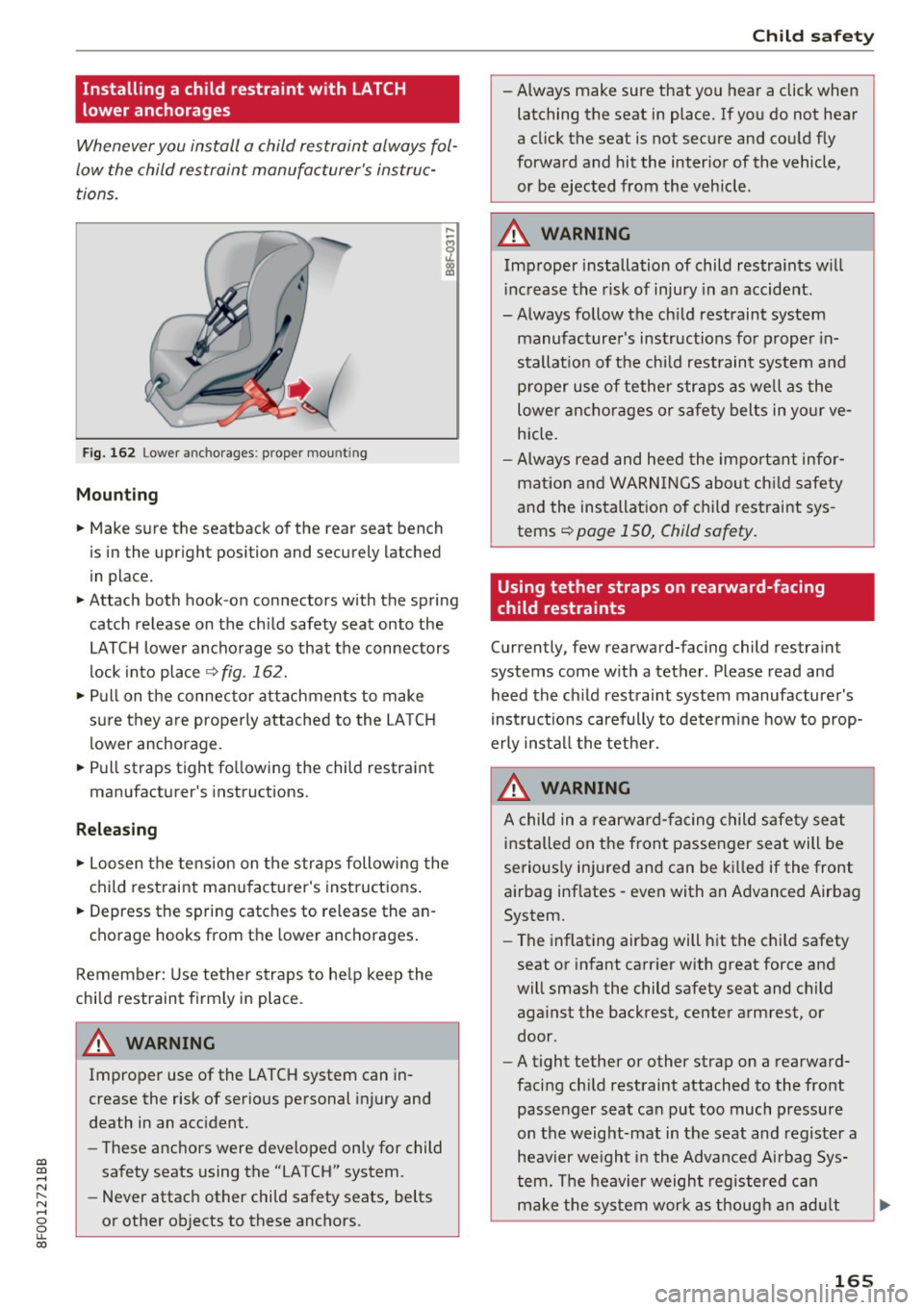
Installing a child restraint with LATCH
lower anchorages
Whenever you install a child restraint always fol
low the child restraint manufacturer's instruc tions.
Fig. 162 Lowe r anch orages : proper mo untin g
M ounting
~ Make sure the seatback of the rear seat bench
is in the upright position and securely latched
in place.
~ Attach both hook-on connectors with the spring
catch release on the ch ild safety seat onto the
LATCH lower anchorage so that the connectors
lock into place
¢ fig . 162.
~ Pullon the connector attachments to make
sure they are properly attached to the LA TCH
l ower anchorage.
~ Pull straps tight following the child restraint
manufacturer's instructions.
R el ea sing
~ Loosen the tension on the straps following the
child restraint manufactu rer's instruct ions.
~ Depress the spring catches to release the an
chorage hooks from the lower anchorages .
Remember: Use tether straps to he lp keep the
chi ld restraint firm ly in place.
A WARNING
Improper use of the LATCH system can in
crease the risk of serious personal injury and
death in an acc ident.
-
- These anchors were deve loped only for child a:,
~ safety seats using the "LATCH" system.
N
~ - Never attach other child safety seats, belts ..... g or other objects to these anchors .
LL 00
Child safety
-Always make sure that you hear a click when
latching the seat in place. If you do not hear
a cl ick the seat is not secure and cou ld fly
forward and hit the inter ior of the vehicle,
or be ejected from the vehicle .
A WARNING
'"----
Improper installation of child restra ints w ill
i ncrease the risk of injury in an accident.
-Always follow the ch ild restraint system
manufacturer's instructions for proper in
stallat io n of the chi ld restraint system a nd
proper use of tether straps as well as the
lowe r anchorages or safety belts in yo ur ve
h icle.
- Always read and heed the importan t info r
mat ion and WARNINGS abou t ch ild safety
and the installation of child restraint sys
tems
¢ page 150, Child safety.
Using tether straps on rearward-facing
child restraints
Currently, few rearward-facing child restraint
systems come w ith a tether . Please read and
heed the ch ild restraint system manufacturer's
instruct ions carefully to determ ine how to prop
erly install the tethe r.
A WARNING
A child in a rearward-facing child safety seat
installed on the front passenger seat will be
seriously injured and can be ki lled if the front
airbag inflates - even with an Advanced Airbag
System.
- The inflating airbag will hit the child safety
seat or infant carrier with great force and
will smash the child safety seat and child against the backrest, center armrest, or
door .
- A tight tether or other strap on a rearward
facing ch ild restraint attached to the front
passenger seat can put too much pressure
on the weight-mat in the seat and register a
heavier we ight in the Advanced Ai rbag Sys
tem. The heavier weight registered can
make the system wor k as thoug h an ad ul t
Ill>
165
Page 181 of 266

Trailer towing Driving with a trailer
General information
Your Audi was designed primarily for passenger
transportation .
If you plan to tow a trailer, please remember that
the additional load will affect durability, econo
my and performance.
Trailer towing not only places more stress on the
vehicle, it also calls for more concentration from
the driver.
For this reason, always follow the operating and
driving instructions provided and use common
sense.
Technical requirements
Trailer hitch
Use a weight-carrying hitch conforming to the
gross trailer weight. The hitch must be suitable
for your vehicle and trailer and must be mounted
securely on the vehicle's chassis at a technically
sound
location . Use only a trailer hitch with a re
movable ball mount . Always check with the trail
er hitch manufacturer to make sure that you are
using the correct hitch.
Do not use a bumper hitch.
The hitch must be installed in such a way that it
does not interfere with the impact -absorbing
bumper system . No modifications should be
made to the vehicle exhaust and brake systems .
From time to time, check that all hitch mounting
bo lts remain securely fastened.
When you are not towing a trailer,
remove the
tra iler hitch ball mount . This prevents the hitch
from causing damage shou ld your vehicle be
struck from beh ind ¢
,&. .
Trailer brakes
If your trailer is equipped with a braking system,
gi check to be sure that it conforms to all regula-......
~ tions . N ...... 0
0
LL 00
Trailer towing
The trailer hydraulic brake system must not be
directly connected to the vehicle's hydraulic
brake system ¢.&. .
Safety chains
Always use safety chains between your vehicle
and the trailer.
Trailer lights
T ra iler lights must meet all regulations . Be sure
to check w ith your author ized Audi dealer for cor
rect wiring, switches, and relays.
Mirrors
If you are unable to see the traffic behind you us
ing the regular outside mirrors, then you
must in
stall extended mirrors. It is important that you
always have clear vision to the rear.
,8. WARNING
-If a tra iler has electr ical brakes please note
that these bra kes are not activated by the
factory-fitted control unit -risk of accident!
- After removing the trailer hitch, do not
store it in your vehicle. In case of sudden
braking, the hitch could fly forward and in
jure you or your passengers.
Operating instructions
Maximum trailer weight
A trailer for your vehicle is limited to a typical
class 1 or class 2 trailer.
Trailer load distribution
Be sure the load in the trailer is held sec ure ly in
place to prevent it from shifting forward, back
ward or sideways.
Never allow a passenger to ride in a trailer¢.&.
in Driving instructions on page 180.
Engine cooling system
Towing a trailer makes the engine work harder . It
is important that the cooling system's perform
ance is up to the additional load . Make sure that
the cool ing system has enough fluid. .,..
179
Page 182 of 266
Trailer towing
Tire pr essure
When tow ing a tra iler, inflate the tires of yo ur
veh icle to the tire pressure listed under " Fu ll
load" on the label ¢
page 217. Inflate trai ler
tires to trai ler and tire manufacturers' specifica
tions.
Lights
The headlight settings should be chec ked with
the trailer attached before driving off . Check to
make sure both vehicle and trailer lights are
working properly.
Safety chains
Be s ure t railer safety chains are properly connect
ed from the trailer to the hitch on the vehicle .
L eave enough slack in the chains to permit turn
ing corners. When you install safety chains, make
sure they wi ll not drag on the road when you are
driving.
The chains shou ld cross under the trailer tongue
to prevent it from dropping in case of separation
from the hitch.
Driving instructions
Driving with a trailer always requires extra care
and consideration .
Weight distribution
Towing a loaded trailer with an empty car res ults
in a high ly unstable distribution of weight . If this
cannot be avo ided, drive at very low speeds on ly
to avoid the risk of losing steering control.
A "balanced" rig is easie r to operate and cont rol.
This means that the tow vehicle should be loaded
to the extent possible and permissible, while keeping the trai ler as light as possib le under the
circumstances . Whenever possible, transfer
some cargo to the luggage compartment of the
tow vehicle while observ ing tongue load requ ire
ments and vehicle loading considerat ions .
Spe ed
The higher the speed, the more difficult it be
comes for the driver to contro l the rig. Do not
drive at the maximum permiss ible speed. Reduce
your speed even more if load, weather or w ind
180
conditions are unfavorab le -particularly when
going downhi ll.
Reduce vehicle speed
immediate ly if the trailer
shows the slightest sign of sway ing.
Do not try
to st op the swaying by accele rating.
Observe speed limits. In some a reas, speeds fo r
vehicles towing tra ilers are lower tha n for regular
vehicles.
A lways apply brakes ear ly . When driving down
hill, shift into a lower gea r to use the engine
braki ng effect to slow the vehicle. Use of the
brakes alone ca n cause them to overheat and fa il.
Coolant temperature
The coolant temperature gauge¢ page 8 must
be observed carefully. If the needle moves close
to the upper end of the scale, reduce speed im
med iate ly and/or tu rn off the a ir cond itioner .
If the coolant temperatu re warning light . in
the instrument cluster starts flashing, p ull off
the road, stop and let the engine
idle for about
two minu tes to p revent heat build-up .
.&, WARNING
Anyone not properly res trained in a moving
vehicle is at a much greater risk in an acci
dent . Never let anyone ride in your car who is
not properly wear ing the restraints provided
by Aud i.
Trailer towing
information
Important to know
-
Your vehicle handles differently when towing a
trailer because of the addit iona l weight and dif
ferent weight distribution. Safety, performance
and economy will greatly depend on how careful
ly you load your tra iler and operate your rig.
Before you actually tow your trailer, pract ice
turning, stopping and backing up in an area away
from traffic. Keep pract icing u nti l you have be
come completely fam iliar w ith the way your vehi-
cle-tra ile r combination behaves and respo nds . .,.
Page 211 of 266
"' "' .... N ,.._ N .... 0
0
u. a:,
® Mud and snow capability
"M/5" or "M+S" indicates the tire
is suitable for driving on mud and
snow. £ indicates a winter tire.
@Composition of the tire cord
and materials
The number of plies indicates the
number of rubberized fabric lay
ers in the tire . In general: the
more layers, the more weight a
tire can carry. Tire manufacturers
must also specify the materials
used in the ti re . These inc lude
stee l, nylon, polyester and other
materials.
@ Maximum permitted load
This number indicates the maxi
mum load in kilograms and
pounds that the tire can carry.
@ Un iform tire quality grade
standards for treadwear,
traction and temperature resistance
Treadwear, traction and tempera
ture ranges
c:::> page 224.
@ Running direction
T he arrows indicate the running
direction of unidirectional tires.
You must always follow the speci
fied running direction
c:::>page 233 .
~ Maximum permitted
inflation pressure
Wheels
T his number indicates the maxi
mum pressure to which a tire can
be inflated under normal operat
ing condit ions .
Glossary of tire and loading
terminology
Accessory weight
means the combined weight (in
excess of those standard items
which may be replaced) of auto matic t ransmission, power steer
ing, power brakes, power win
dows , powe r seats, radio, and
heater, to the extent tha t these
items are avai lab le as factory- in
stalled equipment (whether in
s t alled or not).
Aspect ratio
means the ratio of the height to
the w idth of the tire in percent.
Numbers of 55 or lower indicate a
low sidewall for improved steer
ing response and better overall
handling on dry pavement .
Bead
means the part of the tire that is
made of steel wires, wrapped or
reinfo rced by ply cords and that is
shaped to fit the rim. ...
20 9
Page 212 of 266
Wheel s
Bead separation
means a breakdown of the bond
between components in the bead .
Cord
means the strands forming the
plies in the tire.
Cold tire inflation pressure
means the tire pressure recom
mended by the vehicle manufac
turer for a tire of a designated
size that has not been driven for more than a couple of miles (kilo
meters) at low speeds in the
three hour period before the tire
pressure is measured or adjusted.
Curb weight
means the weight of a motor ve
hicle with standard equipment in
cluding the maximum capacity of
fuel, oil, and coolant, air condi
tioning and additional weight of
optional equipment.
E x tra load tire
means a tire designed to operate
at higher loads and at higher in
flation pressures than the corre sponding standard tire . Extra load
tires may be identified as "XL",
"xl", "EXTRA LOAD", or "RF" on
the sidewal l.
210
Gross Axle Weight Rating
("GAWR ")
means the load-carrying capacity
of a single axle system, measured
at the tire -ground interfaces .
Gross Vehicle Weight Rating
(" GVWR ")
means the maximum total loaded
weight of the vehicle .
Groove
means the space between two ad
jacent tread ribs .
Load rating (code )
means the maximum load that a
tire is rated to carry for a given in
flation pressure. You may not find
this information on all tires be
cause it is not required by law.
Ma ximum load rating
means the load rating for a tire at
the maximum permissible infla tion pressure for that tire.
Ma ximum loaded vehicle
weight
means the sum of :
(a) Curb weight
(b) Accessory weight
(c) Vehicle capacity weight, and
(d) Production options we ight
Page 213 of 266

"' "' .... N ,.._ N .... 0
0
u. a:,
Maximum (permissible )
inflat ion pressure
means the maximum cold infla
tion pressure to wh ich a t ire may
be inflated . Also called "maxi
mum inflation pressure ."
Normal occupant weight
means 150 lbs . (68 kilograms)
times the numbe r of occupants
seated in the veh icle up to the to
tal seating capacity of your vehi
c le .
Occupant distribution
means distribution of occupants
in a vehicle .
Outer diameter
means the overall diameter of an
inflated new tire .
Overall width
means the linear dis ta n ce be
tween the exteriors of the side
walls of an inflated tire, inc luding
e levations due to labeling, deco
rations, or protect ive bands or
ribs.
Ply
means a layer of rubber-coated
parallel cords .
Wheels
Production options weight
means the combined weight of
those installed regular production
options weighing over 5 lbs. (2.3 kg) in excess of those standard
items which they replace, not pre
viously considered in curb weight
or accessory weight , including
heavy duty brakes, ride levelers,
heavy duty battery, and special
trim .
Radial ply tire
means a pneumatic tire in which
the ply cords that extend to the
beads are laid at substantia lly 90
degrees to the centerline of the
tread .
Recommended inflation
pressure
see c:::> page 210, Cold tire infla
tion pressure .
Reinforced tire
means a tire designed to operate
at higher loads and at higher in
fl ation pressures than the corre
sponding standard tire. Rein
forced tires may be iden tified as
"X L" "x l" "EXTRA LOA D" or "RF"
, , ,
on the sidewa ll. ..,
211