lock AUDI A5 CABRIOLET 2017 Repair Manual
[x] Cancel search | Manufacturer: AUDI, Model Year: 2017, Model line: A5 CABRIOLET, Model: AUDI A5 CABRIOLET 2017Pages: 266, PDF Size: 66.64 MB
Page 186 of 266

Care and cleaning
Component Situation Solution
Power top
Deposits Clean water, power top cleaning product , if necessary .
C lean with the grain of the fabric using a soft brush and al-
low to air dry.
Wind deflector Deposits Water, mild soap solution,
if necessaryal
Decorative parts/ Deposits Mild soap solution a>, a cleaning solution suitable for stain-
Trim less stee l, if necessary
Carbon parts Deposits clean the same way as
painted parts~ page 182, Car
washes
Paint Paint damage Refer to the paint number on the vehicle data label, repair
with touch up paint~
page 243
Spilled fuel Rinse with water immediately
Surface rust Rust remover, then protect with hard wax; for questions,
consult an authorized Audi dealer or authorized Audi Se rv-
ice Facility .
Corros ion Have it removed by an authorized Aud i dealer or author -
ized Audi Service Fac ility .
Water no longer Protect with hard wax (at least twice per year)
beads on the surface
of clean paint
No shine even though Treat wit h suitable polish; then apply paint protectant if
paint has been pro- the polish that was used does not contain any protectant
tected/paint looks
poor
Deposits such as in- Dampen with water immediately and remove with a micro-
sects, bird droppings, fiber cloth
t ree sap and road salt
Grease-based con- Remove immediately with a mild soap solution a) and a
taminants such as soft cloth
cosmetics or sunb lock
a) M ild soap so lution: maxim um two ta bles poo ns o f neu tral soap in 1 quar t (l liter) of wat er
Interior cleaning
Component Situation Solution
Windows
Deposits Glass cleaner, then wipe dry
Decorative parts/ Deposits Mild soap solutiona >
trim
Plastic parts
Deposits Damp cloth
Heavier deposits Mild soap solution a>, detergent-free plastic clean ing solu-
tion, if necessary
Displays Deposits
Soft cloth with LCD cleaner
Controls Deposits Soft brush, then a soft cloth with a mild soap solutiona >
Safety belts Deposits Mild soap so lution a>, allow to dry before letting them re-
tract
184
Page 192 of 266
Fuel and R efue li ng
Gasoline additives
A major concern among many auto manufactur
ers is carbon deposit build-up ca used by the type
of gasoline you use .
Although gasoline grades d iffer from one manu
facturer to another, they have certain things in
common. All gasoline grades contain substances
that can cause deposits to collect on v ita l engine
parts, such as fue l injectors and intake valves . Al
though most gasoline brands include addit ives to
keep engine and fuel systems clean, they are not
equally effective.
Audi recommends using TOP TIER Detergent Gas
oline. For more information on TOP TIER Deter
gent Gasoline, please go to the official website (www.toptiergas.com).
After an extended period of using inadequate
fue ls, built-up carbon deposits can rob your en
g ine of peak performance.
CD Note
- Damage or ma lfunction due to poor fuel
quality is not covered by the Audi New Vehi
cle Limited War ranty.
- Do not add afterma rket fuel add it ive prod
ucts to yo ur fuel tank.
Refueling
Fuel filler neck
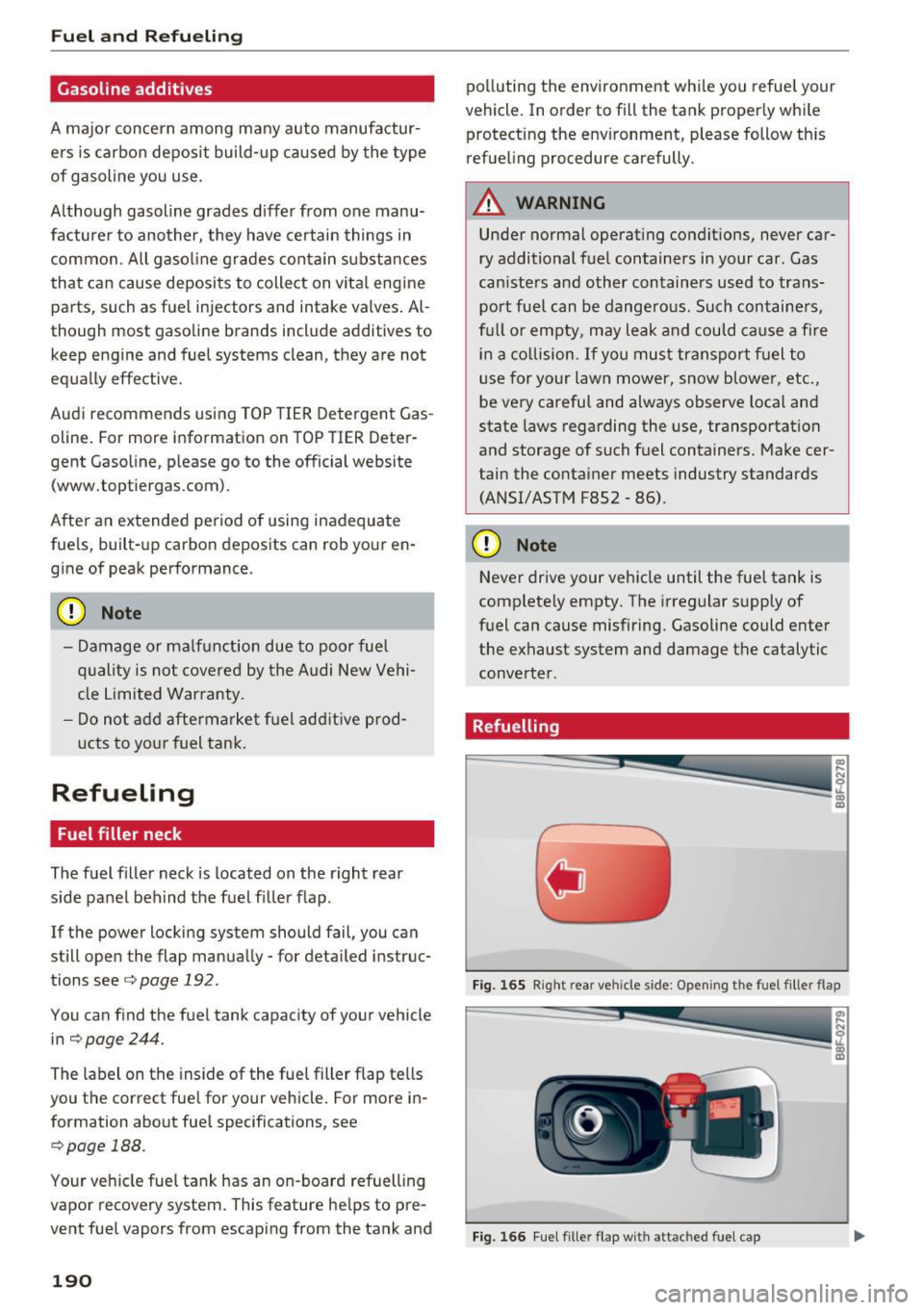
The fuel filler neck is located on the r ight rear
side panel behind the fuel f iller flap .
If the power locking system should fail, you can
still open the flap manually -for detailed instruc
tions see
c:> page 192 .
You can find the fuel tank capacity of your vehicle
in
c:>page 244 .
The label on the inside of the fuel filler flap tells
you the correct fue l for your vehicle. For more in
formation about fuel specifications , see
c:>page 188 .
Your veh icle fuel tank has an on-board refuelling
vapor recovery system . This feature he lps to pre
vent fuel vapors from escaping from the tank and
190
po lluting the environment whi le you refuel your
veh icle. In order to fill the tank proper ly while
protecting the env ironment, please follow th is
refueling procedure carefully.
A WARNING
Under normal operating conditions, never car
ry additional fuel containers in your car. Gas
can isters and other containers used to trans
port fue l can be dangerous. Such containers,
f ull or empty, may leak and could cause a fi re
in a co llision.
If you mus t transport fuel to
use for your lawn mower , snow blower, etc.,
be very careful and always observe local and
state laws regarding the use, transportation
and storage of such fuel containers. Make cer
tain the container meets industry standards
(ANSI/ASTM F852 -86) .
CD Note
Never drive your vehicle until the fuel tank is
complete ly empty. The irregular supply of
fuel can cause misfiring. Gasoline could enter the exhaust system and damage the catalytic
converte r.
Refuelling
Fig. 165 R ig ht rea r ve hicle side : Ope ning the fuel fil ler fl ap
Fig. 166 Fuel fille r flap w ith att ach ed fuel c ap
Page 193 of 266
a:,
a:,
...... N r--. N ...... 0
0
LL 00
When activating the central locking, the fuel fill
er flap is automatically unlocked or locked. Re
fue l the vehicle with the ignit ion turned
off.
T a king the fuel cap off
.,. Turn off the ignition.
.,. Press the left side of the fue l filler flap to open
it
r=;, fig . 165 -arrow -.
.,. Unscrew fue l cap counter -clockwise and hang it
on the fue l filler flap
c:> fig. 166.
Refuelling proc edure
.,. Inse rt the fue l nozzle from the gasoline pump
into the fuel filler neck as far as it will go .
.,. Se lect a medium refuelling rate so that the
nozzle switches off automatically when the
tank is full.
Putting the fuel cap back on
.,. After filling your tank, tw ist the f uel cap clock-
wise as far as it wi ll go .
.,. Close the fuel filler flap.
To avoid fuel spill ing o r evaporating from the f uel
tank always close fuel cap proper ly and com
pletely.
A WARNING
Improper refueling or handling of fuel can
cause fire, explosion and severe b urns.
-
- Fuel is highly flammable and can cause se
vere burns and other injur ies .
- Failure to shut the engine off wh ile refuel
ing and/or to insert the pump nozz le fully
into the fuel filler neck could ca use fue l to
spray out of filler neck or to ove rflow. Fuel
spray and overflowing fue l can cause a fire.
- Never use a cellular telephone wh ile refuel
ing. The electromagnetic radiation can
cause spa rks that can ignite f uel vapors and
cause a fire .
- Never get back into your vehicle while refu
eling. If in except ional circumstances you
must get back in your vehicle while refuel
ing, make certain that you close the door
and touch meta l to discha rge static ele ctric
ity befo re touching the filler noz zle ag ain.
Fuel and R efueling
Stat ic electricity can cause sparks that can
ignite fue l vapors released during refueling.
- Never smo ke or have an open flame any
where in or near your vehicle when ref ueling
or filling a portable fuel container .
- For your safety, we strongly recommend
that you do not trave l with a po rtable fuel
container in your veh icle. The container, fu ll
or empty may leak and co uld cause a fire,
especially in a crash .
- If, under except ional circumstances, you
m ust transport a portable fuel container,
p lease observe the following:
- Never fill a portab le fue l conta iner while it
is anywhere in or on the vehicle (for exam
ple, in the l uggage compa rtment, o r on
the trunk). Static electricity can build up
while filling and can ignite fuel vapors caus ing a f ire .
-Always place a portab le fue l conta iner on
the ground before fi lling .
-A lways keep the f iller nozzle comp lete ly
inside the portable container before and
during f il li ng.
- If filling a portable conta iner made of
metal, the filler nozz le must always be in
contact with the container . This will he lp
prevent stat ic elec trici ty from discharging
and ca use a fire .
- Never spill fue l inside the vehicle o r lug
gage compartment. F uel vapors a re highly
flammable .
- Always observe loca l and state/prov incial
laws rega rding the use, storage a nd trans
po rtation of fuel contai ners.
- Make ce rtain the f uel con tainer mee ts i n
dust ry standards (A NSI/ AS TM F852 -86) .
(D Note
If any fuel has sp illed onto the car, it should
be removed immed iately to p revent damage
to the pa int.
@) For the sake of the environment
As soon as the correctly operated nozzle
switches off automatically for the first time,
191
Page 194 of 266
Fuel and Refueling
the tank is full . Do not try to add more fuel
because fuel may spill out. In addition, the
expansion space in the fuel tank will be filled -
causing the fuel to overflow when it becomes
warm and pollute the environment.
(D Tips
- Running your engine while refuelling may
cause vapors to escape or even cause fuel to
sp ill out of the tank. This would then shut
off the fuel nozzle before the tank is full.
- Do not refuel your vehicle with the ignition
turned on. The fuel gauge may otherwise
not indicate the correct fuel level after refu
elling.
- The fuel filler flap of your vehicle is not
l ocked when you lock the veh icle from the
inside .
Unlocking the fuel filler flap by hand
You con open the fuel filler flop by hand if the
power locking system should fail.
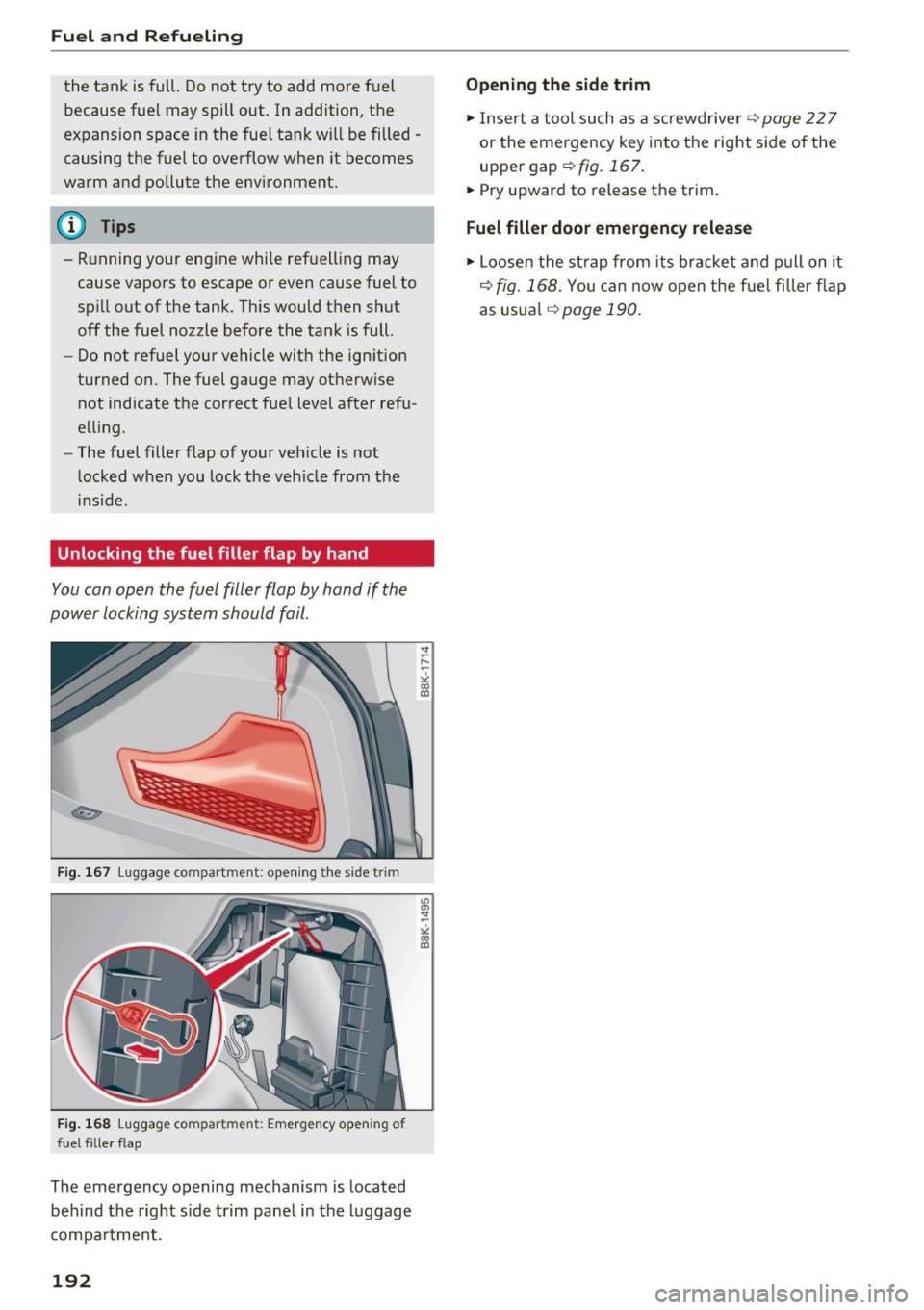
F ig. 167 luggage compartment: opening the side trim
F ig. 168 luggag e compartment: Emergency opening of
fuel filler flap
The emergency opening mechanism is located
behind the right side trim panel in the luggage
compa rtment.
192
"' a, st
-
" co
"'
Opening the side trim
.,. Insert a tool such as a screwdriver¢ page 22 7
or the eme rgency key into the right side of the
upper gap¢
fig. 167 .
.,. Pry upward to release the trim.
Fuel filler door emergency release
.,. Loosen the st rap from its bracket and pull on it
¢fig. 168. You can now open the fue l filler f lap
as usual
¢page 190.
Page 195 of 266

a:,
a:,
...... N
" N ...... 0
0
LL co
Checking and Filling Hood
Releasing and opening the engine hood
The engine hood is released from inside the vehi
cle.
Fig. 169 Driver's side footwell: engine hood re lea se lever
Fig. 170 Release lever under the engine hood
Before opening the engine hood, make sure that
the windshield wipers are flat against the wind
shield. Otherwise, they could damage the paint
on the hood.
.. With the driver's door open, pull the lever un
der the instrument panel in the direction of the
arrow
¢ fig. 169.
.. Raise the hood slightly¢&.
.. Press the rocker switch under the hood upward
¢
fig . 170. This releases the catch.
.. Open the hood.
A WARNING
Hot engine coolant can burn you.
- To reduce the risk of being burned, never
open the hood if you see or hear steam or
coolant escaping from the engine compart
ment. Wait until no steam or coolant can be
Checking and Filling
seen or heard before carefully opening the
hood.
Closing the engine hood
.. Pull the hood down until the pressure from the
struts is reduced.
"' Le t the hood
drop down and latch in place. Do
not try to push it shut;
it may fail to engage
¢&, .
A WARNING
A hood that is not completely latched could
fly up and block your view while driving.
- When you close the engine hood, check it to
make sure the safety catch has properly en
gaged. The hood should be flush with the
surrounding vehicle body parts.
- If you notice while driving that the hood is
not secured properly, stop at once and close
it.
Working in the engine compartment
Be especially careful whenever you work in the
engine compartment.
-
Whenever you must perform any work in the
engine compartment, for example checking and
filling different fluids, there is a risk of injury, burns and accidents. To prevent personal injury
always observe the following WARNINGS. The
engine compartment of any vehicle is a hazard
ous area
¢ .&. .
A WARNING
-~
To help avoid injury, before you check any
thing under the hood:
- Turn off the engine.
- Remove the ignition key .
- Apply the parking brake.
- Move selector lever of automatic transmis-
sion to "P" (Park).
-Always let the engine cool down. Hot com
ponents will burn skin on contact.
- To reduce the risk of being burned, never
open the hood if you see or hear steam or
coolant escaping from the engine
193
Page 202 of 266

Check ing and F illing
The location of the coolant expansion tank can be
seen in the engine compartment illustration
¢ page 195.
To obtain an accura te reading, the eng ine must
be switched off .
The expans io n tank in your vehicle is equipped
with a n elec tric coolant level sensor.
When the coolant level is too low, the war ning
lig ht in the Auto-Check System¢
page 15 will
blin k until you add coo la nt and the level has bee n
restored to normal. Even t hou gh the re is an e lec
tr ic coolant level sensor, we still re commend you
check the coo lant level from time to time .
Coolant loss
Coolant loss may indicate a leak in the cooling
system. I n the event of coolant loss, the cooling
system should be inspected immediately by your
author ized Audi dealer. It is not enough me rely
to add coolant.
I n a
se aled system, losses can occur only if the
boi ling point of the coo lant is ex ceeded as a re
sul t of over heat ing.
A WARNING
T he cooling system is unde r pressure and can
get very hot . Red uce the risk of scalding from
hot coolant by following these steps.
- Turn off the eng ine and a llow it to cool
down .
- Protect your face, hands and arms from es
caping fluid and steam by cove ring the ca p
with a la rge, thick rag.
- Turn the cap s lowly and very ca refu lly in a
counter-clockwise direction w hile ap ply ing
light, downwa rd pressure o n the top of the
cap.
- To avo id being burned, do not sp ill anti
freeze or coolant on the exha ust system or
hot eng ine parts. Under certain conditions,
the ethy lene g lycol in e ngine coolant can
catch fire.
(D Note
Do not add any type of radiato r leak sealant
to your veh icle's engine coolant. Adding radia-
200
tor repair fluid may a dverse ly affect the func
tion and performance of your coo ling system
and could result in damage not covered by
your New Vehicle Limited Warranty.
Adding coolant
Be very careful when adding engine coolant.
Befo re yo u check any thing in the engine compart
ment,
always read and heed all WARNINGS
¢ A in Working in the engine compartment on
page 193.
Requireme nt: The re mus t be a res idual amo unt
of coolant in the expans ion tank ¢(!) .
""Tur n off t he engine .
"" Let the eng ine cool down.
"" Pla ce a thick rag over the coolan t ex pan sio n
tank ¢
page 199, fig. 174 and carefull y turn
the cap counter-clockwise ¢,&. .
"" Add coolant m ixed in the cor rect rat io
¢page 199, Coolant up to the MAX ma rking.
"" Make sure that the fluid level remains stab le.
Add more coolant if necessa ry .
"" Twis t the cap o n aga in
tightly.
Replacement eng ine coolant must conform to ex
act specifications ¢
page 199, Coolant.
We recommend using only coo lant ad ditive G 12+
+ , G13 or in an emergency G12+. Do
not use a
different additive. In an emergency use plain wa
te r unt il you can get the cor rect addit ive and ca n
r esto re the cor rect rat io. Thi s should be done as
soon as possib le.
If you have lost a considerable amount of coo l
an t, then you s hou ld add co ld a ntifreeze and cold
water only whe n the engine is co ld.
A lways use
new engine coo lant when ref illing.
Do no t fill c oolant above the "MAX" mark . Excess
coolant will be forced out th rough the pressure
r elief valve in the cap when the engine becomes
hot.
~
Page 203 of 266
a:,
a:,
...... N r--. N ...... 0
0
LL 00
A WARNING ,~
- The cooling system is under pressure and
can get very hot. Reduce the risk of scald ing
from hot coolant by following these steps.
- Turn
off the engine and allow it to coo l
down.
- Protect you r face, hands and arms from
escaping fluid and steam by cover ing the
cap with a large, thick rag.
- Turn the cap slowly and very carefully in a
counter-clockwise d irection while applying
light, downward p ressure on the top of
the cap.
- To avoid being burned, do not spill anti
freeze or coolant on the exhaust system or
hot engine parts. Under certa in cond i
tions, the ethylene glycol in eng ine cool
ant can catch fire.
- Antifreeze is poisonous. Always store anti
freeze in its orig inal container and well out
of the reach of children.
- If you dra in the coolant, it must be caught
and safely stored in a proper conta iner
clearly marked "poison".
- Do not add coolant if the expansion tank is
empty. Air cou ld enter the cooling system
and damage the eng ine. If this is the case,
do not continue driving . Seek professional
ass istance.
- Coolant pollutes the env ironment and could
cause an eng ine fire. Excess coolant will be
fo rced o ut through the pressure relief valve
i n the cap when the e ng ine be comes hot.
- If, in an emergency, only wate r can be add
ed, the co rrect r atio betwee n wate r and an
tifree ze
Q page 199 must be res to red as
soon as possib le.
{® For the sake of the environment
Dra ined coolant sho uld not be reused. Always
disp ose of used coolant while obse rving all
env ironment al regulat ions.
-
Ch eck ing and Filling
Rad iator fan
The radiator fan switches on automatically by it
self .
The radiator fan is driven by the engine via the V
belt. The viscous clutch regulates th e speed of
the fan accord ing to the temperature of the cool
ant .
An auxiliary e lectr ic radiator fan* switches on and
off depending on coo lant temperature and other
vehicle operating conditions.
After you switch the engine
off, the auxiliary fan
can continue running for up to 10 m inutes -even
with the ignition
off. It can even switch on aga in
later by itself
Q .& , if
- the temperature of the engine coolant rises due
to the heat build-up from the engine in the en
gine compartment, or
- the engine compartment heats up beca use the
veh icle is parked in intense sunlight.
A WARNING
- To reduce the r isk of persona l injury neve r
touch the radia to r fan .
- The auxiliary e lectr ic fan is temperature
controlled and can switch on s uddenly even
when the engine is not ru nning .
- The a uxiliary radiator fan sw itches on auto
mat ically when the eng ine coolant reaches a
certa in temperature a nd will continue to run
until the coolant temperature d rops.
201
Page 204 of 266
Checking and Filling
Brake fluid
Checking brake fluid level
The brake fluid level can be checked with a quick
glance.
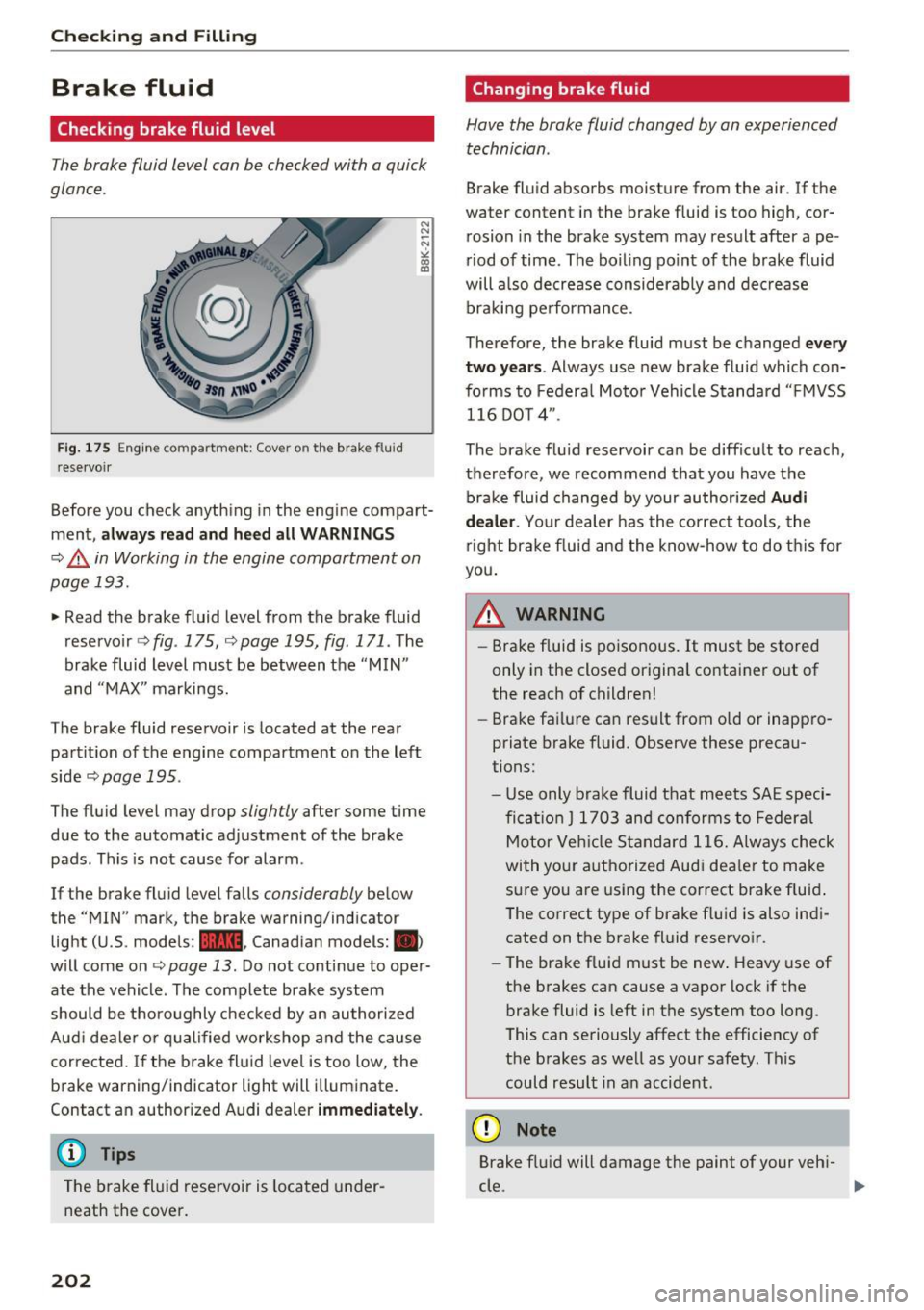
Fig. 175 Engine compartment: Cover on the brake fluid
r eservoir
Before you check anything in the engine compart
ment,
always read and heed all WARNINGS
¢ A in Working in the engine compartment on
page 193.
., Read the brake fluid level from the brake fluid
reservoir
<=> fig . 175, ¢page 195, fig . 171 . The
brake fluid level must be between the
" MIN"
and "MAX " markings.
The brake fluid reservoir is located at the rear
partition of the engine compartment on the left
side
¢ page 195.
The fluid level may drop slightly after some time
due to the automatic adjustment of the brake
pads . This is not cause for alarm .
If the brake fluid level falls
considerably below
the ' 'MIN" mark, the brake warning/indicator
light (U .S. models:
1111 , Canadian models: 1111)
will come on¢ page 13 . Do not continue to oper
ate the vehicle . The complete brake system
should be thoroughly checked by an authorized
Aud i dealer or qualified workshop and the cause
corrected . If the brake fluid level is too low, the
brake warning/indicator light w ill illuminate.
Contact an author ized Audi dealer
immediately.
(D} Tips
The brake fluid reservoir is located under
neath the cover.
202
Changing brake fluid
Have the brake fluid changed by an experienced
technician .
Brake fluid absorbs moisture from the air. If the
water content in the brake fluid is too high, cor
rosion in the brake system may result after ape
riod of time . The boiling po int of the brake fluid
will a lso decrease considerably and decrease
braking performance.
Therefore , the brake fluid must be changed
every
two years .
Always use new brake fluid which con
forms to Feder-al Motor Vehicle Standard "FMVSS
116 DOT 4 ".
The brake fluid reservoir can be difficult to reach ,
therefore, we recommend that you have the
brake fluid changed by your author ized
Audi
dealer .
Your dealer has the correct tools, the
right brake fluid and the know-how to do this for
you.
A WARNING
- Brake fluid is poisonous. It must be stored
only in the closed original container out of
the reach of children!
- Brake fai lure can result from o ld or inappro
priate brake fluid. Observe these precau
tions:
- Use only brake fluid that meets SAE speci
fi cation
J 1703 and conforms to Federal
Motor Veh icle Standard 116. Always check
with your authorized Audi dealer to make
sure you are using the correct brake f luid .
The correct type of brake f luid is also indi
cated on the brake fluid reservoir.
- The brake fluid must be new . Heavy use of
the brakes can cause a vapor lock if the
brake fluid is left in the system too long .
This can seriously affect the efficiency of
the brakes as well as your safety. This
could result in an accident.
(D Note
Brake fluid will damage the paint of your vehi-
cle .
lilJJ,
Page 224 of 266

Wheels
and a special procedure. You must not repair or
disassemble them¢&. .
A WARNING
Wheel bolts that are tightened or repaired in
correctly can become loose and result in loss
of vehicle control, which increases the risk of
an accident. For the correct t ightening specifi
cation, see ¢
page 229, After changing a
wheel .
-Always keep the wheel bolts and the
threads in the wheel hub clean and free of
grease.
- Only use wheel bolts that fit the rim .
- Always have damaged rims repaired by an
authorized Audi dealer or authorized Aud i
Service Facility . Never repair or disassemble
rims yourself, because this inc reases the risk
of an accident.
Winter tires
Winter tires s ignificantly improve the vehicle's
handling when driving in winter conditions . Be
cause of their construction (width, compound,
tread pattern), summer tires provide l ess trac
tion on ice and snow.
.,. Use winter tires on all four wheels.
.,. Only use winter tires that are approved for your
vehicle.
.,. Please note that the maximum permitted
speed may be lower with winter tires
q .&,. . An
authori zed Audi dealer or authori zed Audi Serv
ice Facility can inform you about the maximum
permitted speed for your tires .
.,. Check the tire pressure after install ing wheels
q page 217.
The effectiveness of winter tires is reduced great
ly when the tread is worn down to a depth of
0 .157 inch (4 mm). The character istics of winter
tires also decrease greatly as the tire ages, re
gardless of the remaining tread.
A WARNING
- Never drive faster than the maximum per
mitted speed for your tires. This could cause
the tires to heat up too much. This increases
222
-
the risk of an accident because it can cause
the tire to burst.
- Always adapt your driving to the road and
traffic conditions . Drive carefully and reduce
your speed on icy or slippery roads . Even
winter tires can lose traction on black ice .
@ For the sake of the environment
Reinstall summer tires at the appropriate
time, because they prov ide better handling
when roads are free of snow and ice. Summer
tires cause less road noise, tire wear and fuel
consumpt ion .
(D Tips
You can also use all season tires instead of
winter tires. Please note that in some coun
tries where winter tires are required, only
winter tires w ith the ~ symbol may be per
mitted.
Snow chains
Snow chains improve traction in the snow .
.,. Only install snow chains on the front wheels.
This applies also to vehicles with all wheel
drive* .
.,. Check and correct the seating of the snow
chains if necessary after driving a few feet. Fol
low the instructions from the manufacturer.
.,. Note the maximum permitted speed when dr iv
ing with snow chains. Do not exceed 30 mph (SO km/h).
Snow cha ins not only improve the
driving in win
ter road conditions, but also the
braking .
Use of snow chains is only permitted with certain
rim/tire combinat ions due to technical reasons .
Check with an author ized Audi dealer or author
ized Audi Service Facility to see if you may use
snow chains.
Use
fine-mesh snow chains. They must not add
more than 0.53 inch (13.5 mm) in height, includ
ing the chain lock.
You must remove the chains when driving on
roads that are
free of snow . When roads are free ..,.
Page 229 of 266
a:,
a:,
...... N
" N ...... 0
0
LL co
Emergency assistance
Vehicle tool kit
The tools ore stored underneath the floor panel
in the luggage comportment.
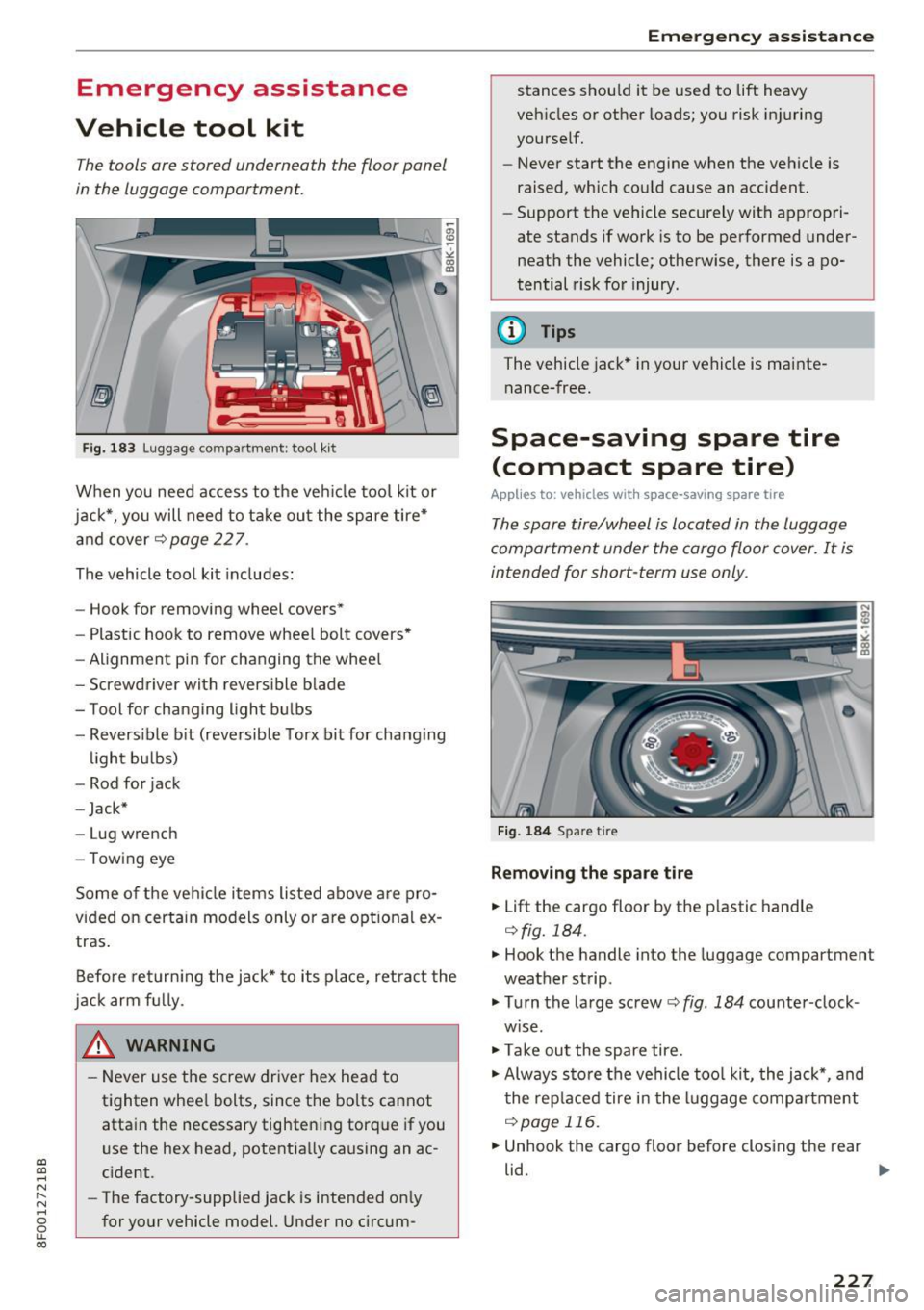
Fig. 183 Luggage compartment: tool ki t
When you need access to the veh icle tool kit or
jack*, you will need to take out the spare tire*
and cover
q page 22 7.
The vehicle tool kit includes:
- Hook for removing wheel covers*
- Plastic hook to remove wheel bolt covers*
- Alignment pin for changing the wheel
- Screwdriver with reversible blade
- T ool for changing l ight bulbs
- Revers ible b it (reversible Torx bit for changing
li ght bulbs)
- Rod for jack
- Jack*
- Lug wrench
- Towing eye
Some of the vehicle items listed above are pro
vided on certa in models only or are optional ex
tras.
Before return ing the jack* to its place, retract the
jack arm f ully.
_& WARNING
-Never use the screw driver hex head to
tighten wheel bolts, since the bo lts cannot
attain the necessary tightening torque if you
use the hex head, potentially causing an ac
c ident.
- The factory-supplied jack is intended on ly
for your vehicle model. Under no circum-
Emergency assistance
stances should it be used to lift heavy
vehicles or other loads; you risk injuring
yourself.
- Never start the engine when the vehicle is
raised, which could cause an accident.
- Support the vehicle securely with appropri
ate stands if work is to be performed under
neath the vehicle; otherwise, there is a po
tential risk for injury .
(D Tips
The vehicle jack* in your vehicle is mainte
nance-free.
Space-saving spare tire (compact spare tire)
App lies to : vehicles wi th space-saving spare tire
The spore tire/wheel is located in the luggage
comportment under the cargo floor cover . It is
intended for short-term use only .
Fig. 184 Spare tire
Removing the spare tire
.. Lift the cargo floor by the p lastic handl e
Q fig. 184 .
.. Hook the handle into the lugg age compartment
weather strip .
.,. Turn the large screw
qfig. 184 counter-clock
w ise.
.,. Take out the spare tire .
.,. Always store the vehicle tool kit, the jack *, and
the replaced tire in the luggage compartment
qpoge 116.
.. Unhook the cargo floor before closing the rear
lid . ...
227