lock AUDI A5 CABRIOLET 2017 Workshop Manual
[x] Cancel search | Manufacturer: AUDI, Model Year: 2017, Model line: A5 CABRIOLET, Model: AUDI A5 CABRIOLET 2017Pages: 266, PDF Size: 66.64 MB
Page 155 of 266
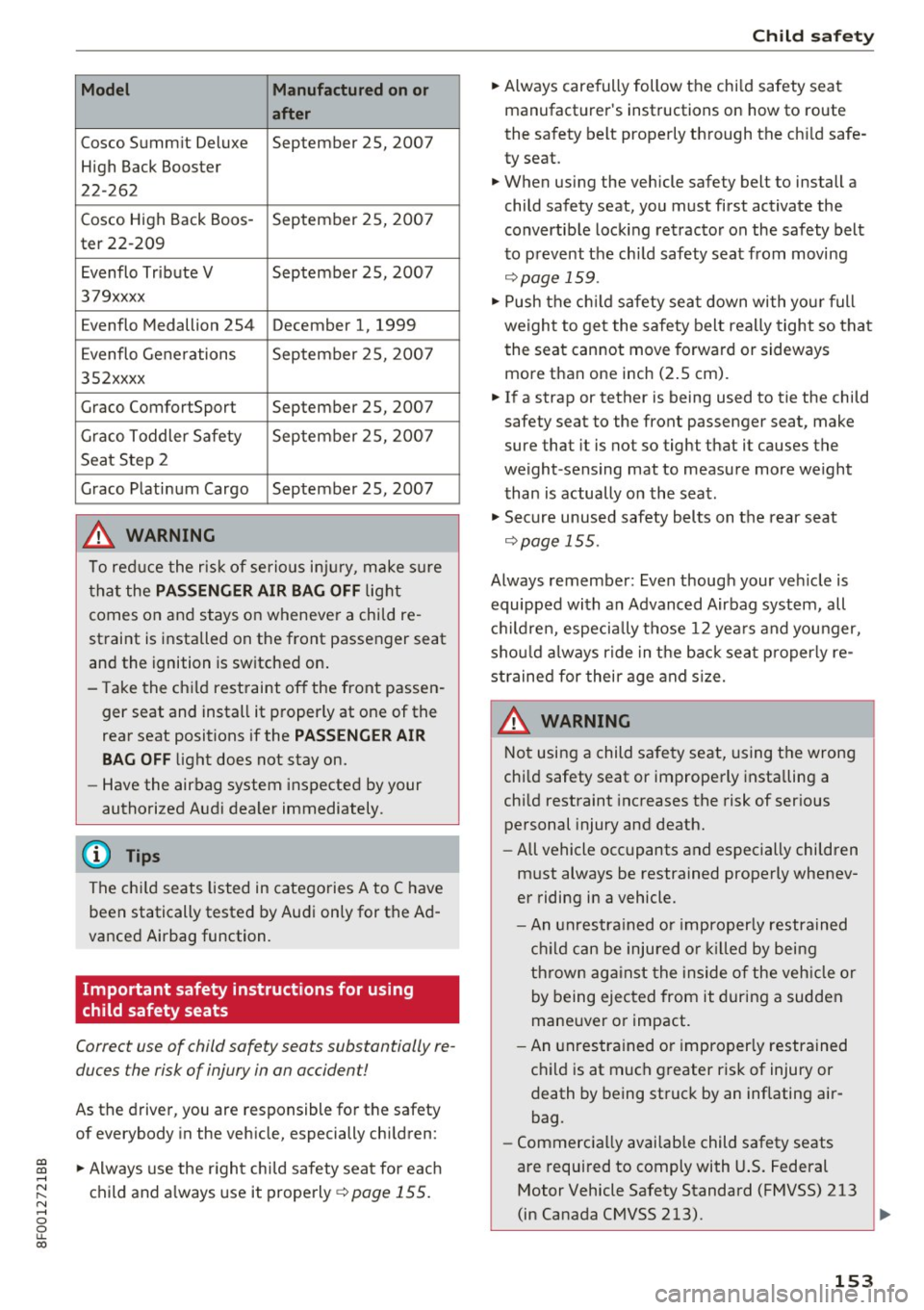
Model Manufactured on or
after
Cosco Summit Deluxe September 25, 2007
High Back Booster
22-262
Cosco High Back Boos -
September 25, 200 7
ter 22-209
Evenflo Tr ibute V September 25, 2007
379xxxx
Evenflo Medallion 254 December 1, 1999
Evenflo Generations September 25, 2007
352xxxx
Graco ComfortSport September 25, 2007
Graco Toddler Safety September 25, 2007
Seat Step 2
Graco Platinum Cargo September 25, 2007
.&, WARNING
To reduce the risk of serious inju ry, make sure
that the
PA SSEN GER AIR BAG OFF light
comes on and stays on whenever a child re
straint is installed on the front passenger seat
and the ignition is switched on.
- Take the child restraint off the front passen
ger seat and install it properly at one of the
rear seat positions if the
P A SSEN GER AIR
BAG OFF
light does not stay on.
- Have the airbag system inspected by your
authorized Audi dealer immediately.
(D Tips
The chi ld seats listed in categories A to C have
been statically tested by Audi only for the Ad
vanced Airbag function.
Important safety instructions for using
child safety seats
Correct use of child safety seats substantially re
duces the risk of injury in an accident!
As the driver, you are responsible for the safety
of everybody in the veh icle, especially children:
gi .,. Always use the right chi ld safety seat for each ......
~ child and a lways use it properly qpage 155. N ...... 0
0
LL 00
Child safety
.,. Always carefully follow the chi ld safety seat
manufacturer's instructions on how to route
the safety belt properly through the ch ild safe
ty seat.
.,. When using the vehicle safety belt to install a
child safety seat, you must first activate the
convertible locking retractor on the safety belt
to prevent the chi ld safety seat from moving
q page 159.
.,. Push the ch ild safety sea t down with yo ur full
weight to get the safety belt really tight so that the seat cannot move forward or sideways
more than one inch (2.5 cm).
.,. If a strap or tether is being used to tie the child
safety seat to the front passenger seat, make
sure that it is not so tight that it causes the
weight -sensing mat to measure more weight
than is actually on the seat .
.,. Secure unused safety belts on the rear seat
q page 155.
Always remember: Even though your veh icle is
equipped with an Advanced Airbag system, all
c hi ldren, especia lly t hose 12 yea rs and younger,
sho uld a lways ride in th e back seat p roper ly re·
strained for their age and s ize.
A WARNING
=
Not using a child safety seat, using the wrong
chi ld safety seat or improperly insta lling a
chi ld restraint increases the risk of serious
personal injury and death.
- All vehicle occupants and especially children
must always be restrained properly whenev
er riding in a vehicle.
- An unrestra ined o r improperly restrained
c hi ld can be injured o r killed by being
thrown aga inst the inside of the veh icle or
by being ejected from it during a sudden
maneuver or impact.
- An unrestra ined or improperly restrained
child is at much greater risk of injury or
death by being struck by an inflating air bag.
- Commercially availab le child safety seats
are requi red to comply with U .S. Federal
Motor Vehicle Safety Standard (FMVSS) 213
(in Canada CMVSS 213). ..,_
153
Page 157 of 266
a:,
a:,
...... N
" N ...... 0
0
LL co
-Take the child restraint off the front passen
ger seat and install it properly at one of the
rear seat positions if the
PASSENGER AIR
BAG OFF
light does not stay on.
- Have the airbag system inspected by your
authorized Audi dealer immediately.
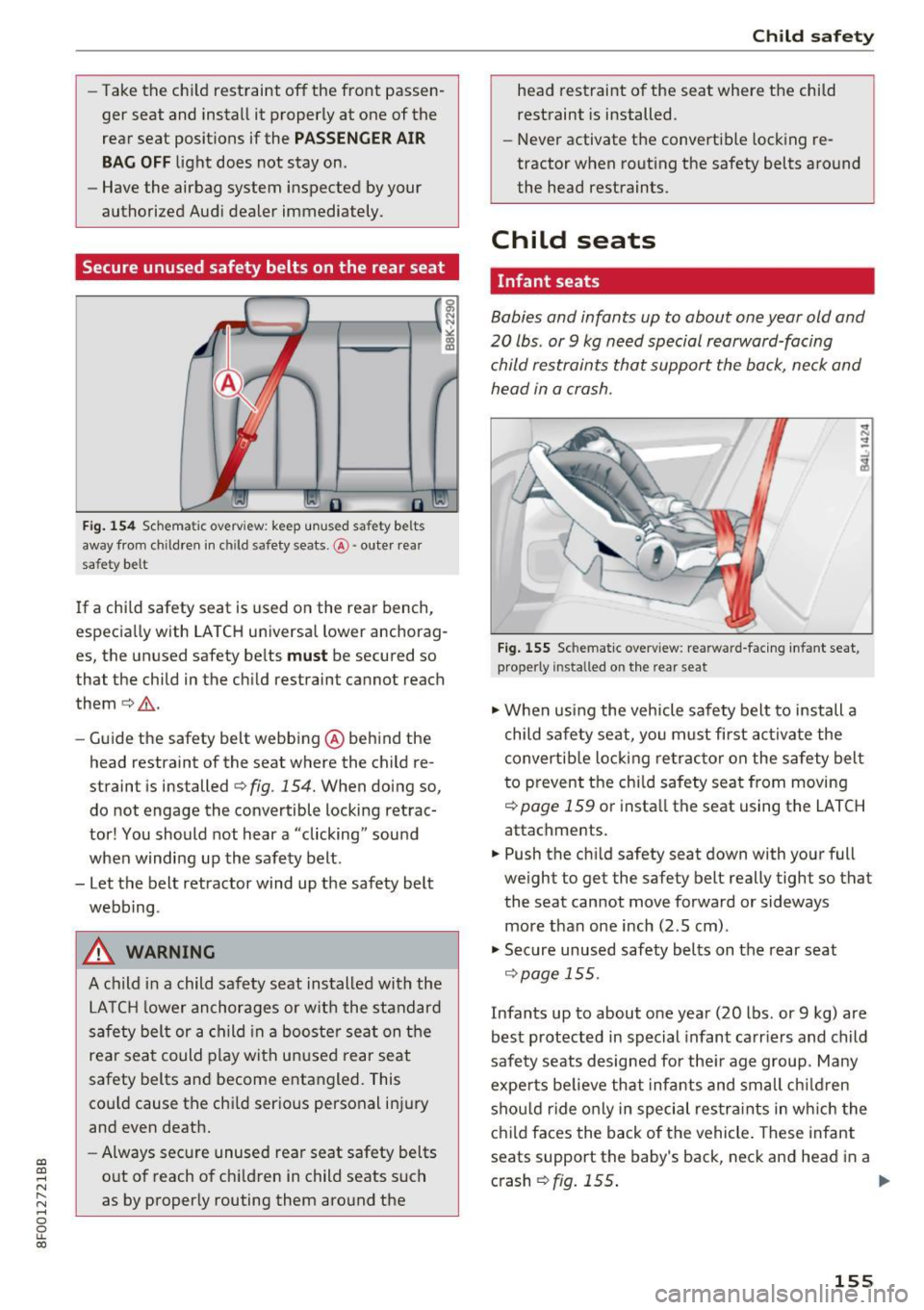
Secure unused safety belts on the rear seat
Fig. 154 Schemat ic overv iew: keep unused s-afety belts
away from children in chil d safety seats. @-oute r rear
sa fety belt
If a chi ld safety seat is used on the rear bench,
especially with LA TCH universal lower anchorag
es, the unused safety belts
must be secured so
that the child in the child restraint cannot reach
them
c::> ,& .
-Guide the safety belt webbing @behind the
head restraint of the seat where the child re
straint is installed
c::> fig . 154. When doing so,
do not engage the convertible locking retrac
tor! You should not hear a "clicking" sound
when winding up the safety belt .
- Let the belt retractor wind up the safety belt
webbing .
A WARNING
A child in a child safety seat installed with the
LATCH lower anchorages or with the standard
safety belt or a child in a booste r seat on the
rear seat could play with unused rear seat
safety belts and become entangled. This
cou ld cause the chi ld serious personal injury
and even death.
- Always secure unused rear seat safety belts
out of reach of children in child seats such
as by proper ly routing them aro und the
Child safety
head restraint of the seat where the child
restraint is installed .
- Never activate the convertible locking re
tractor when routing the safety belts around
the head restraints.
Child seats
Infant seats
Babies and infants up to about one year old and
20 lbs. or
9 kg need special rearward-facing
child restraints that support the back , neck and
head in a crash.
Fig. 155 Schematic overview: rearward -facing infant seat,
p roper ly insta lled o n the rear seat
... When using the vehicle safety belt to install a
child safety seat, you must first activate the
convertib le locking retractor on the safety belt
to prevent the child safety seat from moving
c::>poge 159 or install the seat using the LATCH
attachments.
... Push the ch ild safety seat down with your full
weight to get the safety belt really tight so that
the seat cannot move forward or sideways more than one inch (2 .5 cm) .
... Secure unused safety belts on the rear seat
c::>page 155.
Infants up to about one year (20 lbs. or 9 kg) are
best protected in special infant carriers and child
safety seats designed for their age group . Many
experts believe that infants and small children
shou ld ride only in special restraints in which the
child faces the back of the vehicle. These infant
seats support the baby's back, neck and head in a
crash
r=;, fig. 155 . .,..
155
Page 158 of 266
Child safety
The airbag on the passenger side makes the front
seat a potentially dangerous p lace for a child to
ride. The front seat is not the safest place for a
child in a forward-facing child seat. It is a very
dangerous place for an infant or a larger child in
a rearward-fac ing seat.
A WARNING
Not using a ch ild safety seat, using the wrong
child safety seat or improperly installing a
child restra int increases the r isk of serious
personal inju ry and death in a crash.
- Never install rearward-fac ing ch ild safety
seats or infant carriers on the front passen ger seat -even w ith an Advanced A irbag Sys
tem. A child will be seriously injured and can
be ki lled when the inflating airbag hits the
child safety seat or infant carrier with great
force and smashes the child safety seat and
child against the backrest, center armrest,
door or roof
c::, page 131, Child restraints on
the front seat -some important things to
know.
-Always install rearward-fac ing ch ild safety
seats or infant carriers on the rear seat.
- Never install a rearward-facing child re
straint in the forward-facing direction. Such restra ints are des igned for the special needs
of infants and very small ch ild ren and can
not protect them properly if the seat is for
ward- facing.
- If you mus t install a rearward fac ing ch ild
safe ty seat on the front passenger seat be
ca use of exceptiona l circumstances and the
PASSENGER AIR BAG OFF light does not
come on and stay on, immediate ly install
the rearward-facing child safety seat in a
rear seat ing position and have the airbag
system inspected by your author ized Audi
dealer.
- Always read and heed all WARNINGS when
ever using a child restrained in a veh icle is
being used
c:> page 122, Safety belts,
c:> page 130, Airbag system and
9 page 150, Important information.
156
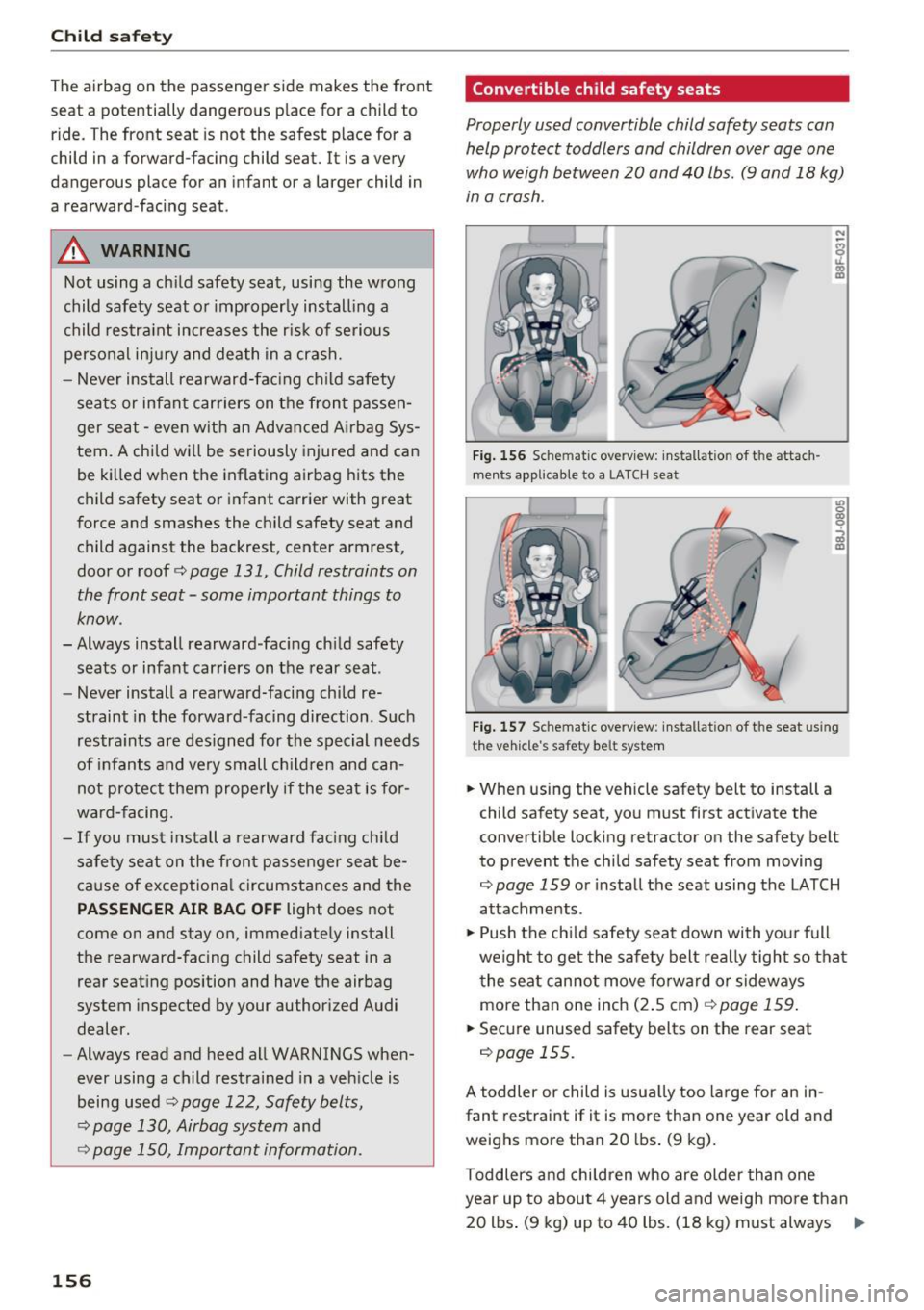
Convertible child safety seats
Properly used convertible child safety seats can
help protect toddlers and children over age one
who weigh between 20 and 40 lbs. (9 and 18 kg)
in a crash.
Fig . 156 Schemat ic overv iew : installat ion of the attach
ments applicable to a LA TCH seat
Fig. 157 Schemat ic overv iew: installat ion of the seat using
the vehicle's safety belt system
.. When using the vehicle safety belt to install a
child safety seat, you must first activate the
convertib le locking retractor on the safety belt
to prevent the child safety seat from moving
c:> page 159 or install the seat using the LATCH
attachments .
.. Push the chi ld safety seat down wi th your full
we igh t to get the safe ty belt really tight so that
the seat cannot move forward or sideways
more than one inch (2 .5 cm)
c:>page 159.
.. Secure unused safety belts on the rear seat
c:> page 155.
A toddler or child is usua lly too la rge for an in
fant restraint if it is more than one year old and
weighs more than 20 lbs . (9 kg).
Toddlers a nd chi ldren who are older than one
year up to about 4 years old and weigh more than 20 lbs . (9 kg) up to 40 lbs. (18 kg) must always ..,.
Page 160 of 266
Child safety
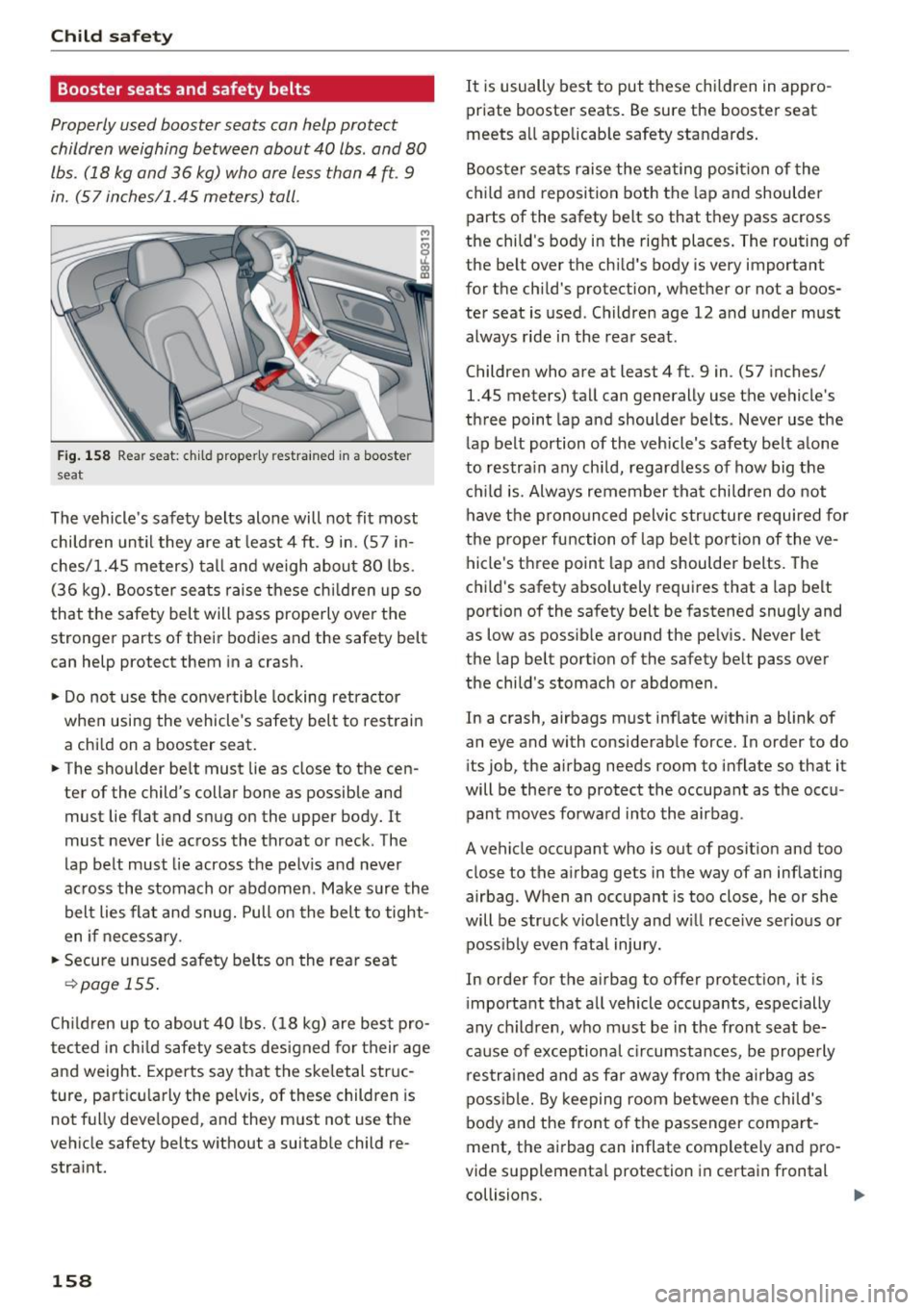
Booster seats and safety belts
Properly used booster seats can help protect
children weighing between about 40 lbs . and 80
lbs. (18 kg and 36 kg) who are less than 4
ft. 9
in. (57 inches/1.45 meters) tall .
Fig. 158 Rear seat: ch ild proper ly restrained in a booster
seat
The vehicle's safety belts alone will not fit most
children until they are at least 4 ft. 9 in. (57 in
ches/1.45 meters) tall and weigh about 80 lbs .
(36 kg). Booster seats raise these chi ld ren up so
that the safety belt will pass properly
over the
stronger parts of their bodies and the safety belt
can help protect them in a crash.
• Do not use the convertible locking retractor
when using the vehicle's safety belt to restrain
a chi ld on a booster seat.
• The shoulder be lt must lie as close to the cen
ter of the child's collar bone as possible and
must lie flat and snug on the upper body. It
must
never lie across the throat or neck. The
lap belt must lie across the pelv is and
never
across the stomach or abdomen . Make sure the
belt lies flat and snug. Pull on the belt to tight
en if necessary .
• Secure unused safety belts on the rear seat
¢page 155.
Child ren up to about 40 lbs. (18 kg) are best pro
tected in chi ld safety seats des igned for their age
and weight . Experts say that the skeletal str uc
ture, part icu larly the pelvis, of these children is
not fully deve loped , and they must not use the
vehicle safety belts without a suitable child re
stra int.
158
It is usually best to put these children in appro
priate booster seats. Be sure the booster seat
meets all applicab le safety standards .
Booster seats raise the seating posi tion of the
child and reposition both the lap and shoulder
parts of the safety belt so that they pass across
the child 's body in the right places. The routing of
the belt over the ch ild's body is
very important
for the child's protection, whether or not a boos
ter seat is used. Child ren age 12 and under must
always ride in the rear seat.
Children who are at least 4 ft. 9 in . (57 inches/
1.45 meters) tall can generally use the vehicle's
three point lap and shoulder belts. Never use the
l ap belt portion of the veh icle's safety belt a lone
to restrain any child, regard less of how big the
child is. Always remember that children do not
have the pronounced pelvic structure required for
the proper function of lap belt portion of the ve
hicle's three point lap and shoulder belts. The
child's safety abso lutely requires that a lap belt
portion of the safety belt be fastened snugly and
as low as possible around the pe lvis. Never let
the lap belt portion of the safety belt pass over
the child 's stomach or abdomen .
In a crash, airbags must inflate with in a blink of
an eye and with considerab le force. In order to do
its job, the a irbag needs room to inflate so that it
will be there to protect the occupant as the occu
pant moves forward into the airbag.
A vehicle occupant who is out of position and too
close to the airbag gets in the way of an inf lating
airbag . When an occupant is too close, he or she
will be struck vio lent ly and w ill rece ive serio us or
possibly even fatal injury.
In order for the a irbag to offer protection, it is
important that all vehicle occupants, especially
any ch ildren, w ho must be in the front seat be
cause of exceptional circumstances, be properly
restrained and as far away from the airbag as
possible. By keeping room between the child's
body and the front of the passenger compart
ment, the airbag can inflate completely and pro
vide supplementa l protection in certain frontal
collisions.
Page 161 of 266
a:,
a:,
...... N r--. N ...... 0
0
LL 00
& WARNING
Not using a booster seat, using the booster
seat improperly, incorrectly installing a boos
ter seat or using the vehicle safety belt im
properly increases the risk of serious personal
injury and death in a collision or other emer
gency situation. To help reduce the risk of se
r ious personal injury and/or death:
- The shoulder belt must lie as close to the
center of the child's collar bone as possible
and must lie flat and snug on the upper
body.
It must neve r lie across the th roat or
neck. The lap belt must lie across the pelv is
and never across the stomach or abdomen.
Make sure the belt lies flat and snug. Pull on
the belt to tighten if necessary .
- Failure to proper ly route safety belts over a
child's body will cause severe injuries in an
accident or other emergency situation
¢ page 122.
-The rear side of the child safety seat should
be positioned as close as possible to the
backrest on the vehicle seat.
- Children on the front seat of any car, even
with Advanced Airbags, can be seriously in
jured or even killed when an a irbag inflates.
- Never let a child stand or kneel on any seat.
- Never let a child ride in the cargo area of
your vehicle.
- Always remember that a child leaning for
ward, sitting sideways or out of position in
any way during an accident can be struck by
a deploying airbag. This will result in serious
personal injury or death.
- If you must install a booster seat on the
front passenger seat because of exceptional
c ircumstances the
PA SSENGER AIR B AG
OFF
light must come on and stay on, when
ever the ignition is switched on.
- If the
PASSEN GER AIR BAG OFF light does
not come on and stay on, perform the
checks described ¢
page 140, Monitoring
the Advanced Airbag System.
- Take the ch ild restraint off the front passen
ger seat and install it properly at one of the
rea r seat positions if the
PASSENGER AIR
-
Ch ild safety
BAG O FF light does not stay on whenever
the ignition is switched on.
- Always read and heed all WARNINGS when
ever us ing a child restrained in a vehicle is
be ing used
c> page 122, Safety belts,
c> page 130, Airbag system and
c> page 150, Important information.
Securing child seats
Securing a child safety seat using a safety
belt
Safety belts for the rear seats and the front pas
senger's seat can be locked with the convertible
locking retractor to properly secure child safety
seats.
The safety belts emergency locking retractors for
the rear seats safety be lts and for the front pas
senger's seat safety be lt have a convertible lock
ing retractor for child restraints. The safety be lt
must be locked so that belt webb ing cannot un
reel. The retractor ca n be activated to lock the
safety belt and prevent the safety belt webbing
from loosening up dur ing norma l driving. A ch ild
safety seat can on ly be prope rly insta lled when
the safety belt is locked so that the c hild and
c h ild safety seat will stay in place .
Always remembe r: Even though your veh icle is
equipped with an Advanced Airbag system, all
children, especia lly those 12 yea rs and younger,
shou ld a lways ride in the back seat p roperly re
strained for their age and weight.
& WARNING
=
Improperly installed child safety seats in-
crease the risk of serious personal injury and
death in a co llision.
- Always make sure that the safety be lt re
tractor is locked when installing a child
safety seat. An un locked safety be lt retrac
tor cannot hold the ch ild safety seat in place
during normal driving or in a crash.
- Always buckle the child safety seat firmly in
place even if a ch ild is not sitt ing in it. A
loose child safety seat can fly a round dur ing
a sudden stop or in a co llision.
~
159
Page 163 of 266
-The inflating airbag will hit the child safety
seat or infant carrier with great force and
will smash the child safety seat and child
against the backrest, center armrest, door
or roof .
- Always be especially careful if you must in
stall a rearward facing child safety seat on
the front passenger seat in exceptional c ir
cumstances.
-A tight tether strap on a rearward-facing child restraint attached to the front passen
ger seat can put too much pressu re on the
we ight-mat in the seat and register a heavi
er weight in the Advanced Ai rbag System.
T he heavier we ight registered can make the
system work as though an adult were on the
seat and deploy the Advanced Airbag when
it must be suppressed causing serious or
even fatal injury to the child.
- Make sure that the
PASS ENG ER AIR B AG
OFF
light comes on and stays on all the time
whenever the ignition is switched on.
- If the
PA SSENGER AIR BAG OFF light does
not come on and stay on, immediately in
stall the rearward-facing child safety seat in a rear seating position and have the a irbag
system inspected by your author ized Audi
dealer.
Activating the convertible locking retractor
Use the convertible locking retractor to secure a
child restraint.
Always heed the child safety seat manufacturer's
instructions when installing a child restraint in
your veh icle . T o act ivate the convertible locking
retractor:
.. Place the child restraint on a seat, preferab ly
on the rear seat.
.. Slowly pull the belt all the way out .
.. Route it around or through the ch ild rest raint
belt path
Q .&, .
.. Push the child safety seat down with your fu ll
weight to get the safety be lt rea lly t ight .
a:,
~ .. Insert the belt tongue into the buckle for that
N ~ seating position .
... 0
0
LL 00
Ch ild safety
.. Guide the safety belt back into the retractor un
til the belt lies flat and snug on the child safety
seat.
.. You shou ld hear a "cl icking" noise as the belt
w inds back into the inertia reel. Test the con
vert ible lock ing retractor by pulling on the belt.
You should no longer be able to pull the belt out of the retractor . The convertib le locking re
tracto r is now activated.
.. Ma ke sure that t he red release bu tton is facing
away from the child restraint so that it can be
unbuckled quickly .
.. Pull on the belt to make sure the safety belt is
properly t ight and fastened so that the seat
cannot move forward or sideways more than
one inch (2.5 cm).
A WARNING
Using the wrong ch ild restraint or an improp
e rly installed child restra int can cause serious
personal injury or death in a crash .
- Always make sure that the safety belt re
tractor is locked when installing a child
safety seat. An unlocked safety belt retrac
tor cannot hold the ch ild safety sea t in place
during normal driving or in a crash.
- Always buckle the child safety seat fi rm ly in
p lace even if a ch ild is not si tting in it. A
loose child safety seat can fly around dur ing
a sudden stop or in a crash.
- Always make sure the seat backrest to which
the child restraint is installed is in an up right position and securely latched into
p lace and cannot fo ld forward. Otherw ise,
the seatback with the child safety seat at
tached to it could fly forward in the event of
an accident or other emergency s ituation .
- Always read and heed all WARNINGS when
ever using a child restrained in a vehicle is
be ing used
Q page 150 . Special precautions
apply when install ing a child safety seat on
the front passenge r seat
Q page 131, Child
restraint s on the front seat -some impor
tant things to know .
161
Page 164 of 266
Child safety
Deactivating the convertible locking
retractor
The convertible locking retractor for child re
straints will be deactivated automatically when the belt is wound all the way back into the re
tractor .
.. Press the red button on the safety belt buckle.
The belt tongue will pop out of the buckle .
.. Guide the safety belt all the way back into its
stowed position.
Always let the safety belt retract completely into
its stowed position . The safety belt can now be
used as an ordinary safety belt without the con
vertible locking retractor for child restraints.
If the convertible locking retractor should be ac
tivated inadvertently, the safety belt must be un
fastened and guided completely back into its
stowed position to deactivate this feature. If the
convertible locking retractor is not deactivated,
the safety belt will gradually become tighter and
uncomfortable to wear.
A WARNING
-
Improperly installed child safety seats in
crease the risk of serious personal injury and
death in a collision.
- Never unfasten the safety belt to deactivate the convertible locking retractor for child re
straints while the vehicle is moving. You
would not be restrained and could be seri
ously injured in an accident.
- Always read and heed all WARNINGS when
ever using a child restrained in a vehicle is
being used~
page 150. Special precautions
apply when installing a child safety seat on
the front passenger seat~
page 131, Child
restraints on the front seat -some impor
tant things to know.
162
Page 167 of 266
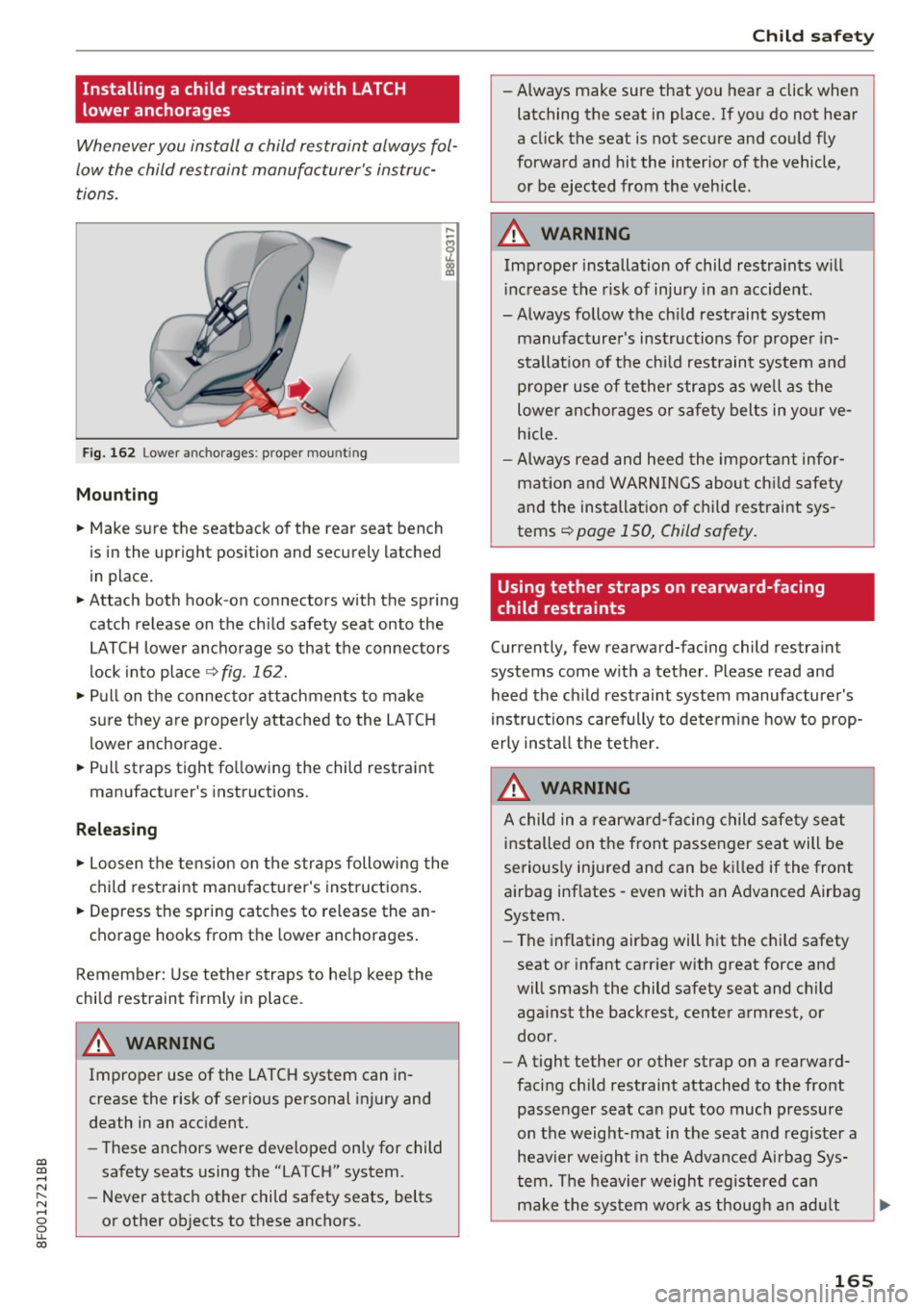
Installing a child restraint with LATCH
lower anchorages
Whenever you install a child restraint always fol
low the child restraint manufacturer's instruc tions.
Fig. 162 Lowe r anch orages : proper mo untin g
M ounting
~ Make sure the seatback of the rear seat bench
is in the upright position and securely latched
in place.
~ Attach both hook-on connectors with the spring
catch release on the ch ild safety seat onto the
LATCH lower anchorage so that the connectors
lock into place
¢ fig . 162.
~ Pullon the connector attachments to make
sure they are properly attached to the LA TCH
l ower anchorage.
~ Pull straps tight following the child restraint
manufacturer's instructions.
R el ea sing
~ Loosen the tension on the straps following the
child restraint manufactu rer's instruct ions.
~ Depress the spring catches to release the an
chorage hooks from the lower anchorages .
Remember: Use tether straps to he lp keep the
chi ld restraint firm ly in place.
A WARNING
Improper use of the LATCH system can in
crease the risk of serious personal injury and
death in an acc ident.
-
- These anchors were deve loped only for child a:,
~ safety seats using the "LATCH" system.
N
~ - Never attach other child safety seats, belts ..... g or other objects to these anchors .
LL 00
Child safety
-Always make sure that you hear a click when
latching the seat in place. If you do not hear
a cl ick the seat is not secure and cou ld fly
forward and hit the inter ior of the vehicle,
or be ejected from the vehicle .
A WARNING
'"----
Improper installation of child restra ints w ill
i ncrease the risk of injury in an accident.
-Always follow the ch ild restraint system
manufacturer's instructions for proper in
stallat io n of the chi ld restraint system a nd
proper use of tether straps as well as the
lowe r anchorages or safety belts in yo ur ve
h icle.
- Always read and heed the importan t info r
mat ion and WARNINGS abou t ch ild safety
and the installation of child restraint sys
tems
¢ page 150, Child safety.
Using tether straps on rearward-facing
child restraints
Currently, few rearward-facing child restraint
systems come w ith a tether . Please read and
heed the ch ild restraint system manufacturer's
instruct ions carefully to determ ine how to prop
erly install the tethe r.
A WARNING
A child in a rearward-facing child safety seat
installed on the front passenger seat will be
seriously injured and can be ki lled if the front
airbag inflates - even with an Advanced Airbag
System.
- The inflating airbag will hit the child safety
seat or infant carrier with great force and
will smash the child safety seat and child against the backrest, center armrest, or
door .
- A tight tether or other strap on a rearward
facing ch ild restraint attached to the front
passenger seat can put too much pressure
on the weight-mat in the seat and register a
heavier we ight in the Advanced Ai rbag Sys
tem. The heavier weight registered can
make the system wor k as thoug h an ad ul t
Ill>
165
Page 169 of 266
Intelligent Technology Electronic Stabilization
Control (ESC)
Description
ESC helps to improve road ho lding and vehicle
dynamics to help reduce the probability of skid
ding and loss of vehicle control. It works only
when the engine is runn ing . ESC detects certain
d ifficult driving situat ions, including when the
vehicle is beginn ing to spin (yaw) out of control
and helps you to get the veh icle back under con
tro l by selectively braking the wheels , and/or re
ducing engine powe r and provid ing steering as
sistance to help ho ld the veh icle on the driver 's
intended course. The indicator light
bJ in the in
strument cluster blinks when ESC is taking action
to help you contro l th e vehicl e.
The follow ing systems a re integr ated in the ESC:
Anti -lock braking system (ABS )
ABS preve nts the wheels from lock ing up when
b raking . The ve hicle can still be stee red even dur
in g ha rd brak ing . Apply steady pressure to the
b rake pedal. Do not p ump the pedal. A pu lsing in
the brake pedal indicates tha t the system is help
ing you to brake the vehicle .
Brake assist system
The brake assist sys tem can dec rease braking dis
tance .
It increases brak ing power when the d rive r
pr esses the brake pedal q uickly in eme rge ncy sit
uations . You m ust press and hold the b rake pedal
unti l the situation is over . In vehicles with adap
tive cruise control* , the brake assist system is
mo re sensitive if the distance det ected to the ve
h icle ahead is too small.
Anti -slip regulation (ASR)
ASR red uces eng ine power when the drive wheels
begin to spin and adapts the force to the road
conditions. This makes it easier to start, acceler
ate and dr ive up h ills.
gi Electronic differential lock (EDL ) ...... N
~ The ED L br ak es w heels that a re spi nnin g and
8 trans fers the drive power to the othe r drive LL 00
Intellig ent Technology
whee l or wheels if the vehicle is equ ipped with
all-wheel drive*. This function is not avai lable at
highe r speeds.
In extreme cases , EDL automat ic all y swi tches off
to help keep t he b rake on the braked wheel from
overheating . EDL will switch on again automati
ca lly when cond itions have returned to normal.
Steering recommendation
T he ES C helps to s tabilize the vehicle by changing
the s teering torque.
In veh icles with dynamic steer ing*, ESC a lso
helps to stab ilize the steer ing in crit ica l sit ua
tions.
Electronic interaxle differenti al lock */
selective wheel torque control*
T he elect ronic inte raxle d iffere ntial lo ck (front
whee l dr ive) o r the sele ct ive whee l torque co ntro l
(a ll w heel d rive) operates when driving thro ugh
cu rves. The front wheel on the inside of the curve
o r both wheels on the inside of the curve are
braked selectively as needed. This allows more
precise driving in curves . The applicab le system
may not activate when driving in wet or snowy
condit ions .
A WARNING
--The ESC and i ts integrated systems ca nnot
overcome the laws of physics. This is espe
cially importa nt on slippery or wet roads. If
the systems begin act ing to sta biliz e your
veh icle, you shou ld immedi ate ly change
your speed to match the road and traffic conditions. Do not let the increased safety
provided by these systems tempt yo u to
take risks. Doing so will increase the risk of
a loss of vehicle control, collision and seri
ous personal injur ies .
- Always adapt your speed to road, traffic and
weather conditions . The risk of losing con
trol of the vehicle increases when driv ing
too fast, especially through curves and o n
slippe ry o r wet roads , and whe n driving too
close to ve hicl es up ahea d. The ESC and its
integ ra t ed systems cannot always preven t
collis ions -the re is s till a risk o f accidents!
167
Page 183 of 266
Backing up is difficult and requires practice.
Backing up with a trailer generally requires steer
ing action oppos ite to that when backing up your
vehicle without a trailer.
Maintain a greater distance between your vehicle
and the one in front of you. You wi ll need more
room to stop. To compensate for the tra iler, you
will need a larger than normal turning radius.
When passing, remember that you cannot accel
erate as fast as you normally would because of
the added load. Make sure you have enough room
to pass. After passing, allow plenty of room for
your trailer before changing lanes again.
Avoid jerky starts, sharp turns or rapid lane
changes.
@ Tips
- Do not tow a trailer during the break-in peri
od of your vehicle.
- If you tow a trailer, your Audi may require
more frequent maintenance due to the ex
tra load
~ page 246.
Parking on a slope
Do not pork on o slope with o trailer. If it cannot
be avoided, do so only ofter doing the following:
When parking:
" Apply the foot brake.
"Have someone place chocks under both the ve
hicle and the trailer wheels.
" With chocks in place, slowly release the brakes
until the wheel chocks absorb the load.
" Turn the wheels towards the curb.
" Apply the parking brake.
" Move the selector lever to P .
When restarting after parking:
" Apply the foot brake.
" Start the engine .
" Move the selector lever to D/S.
" Release the parking brake and slowly pull out
and away from the wheel chocks.
a:,
~ " Stop and have someone retrieve the wheel
~ chocks . N .... 0
0
LL 00
Trailer towing
(D Tips
If you move the selector lever of the automat
ic transmission to P before applying the park
ing brake and before blocking the wheels, you
may have to use more force later to move the
lever out of the P posit ion .
181