lock AUDI A5 CABRIOLET 2017 Service Manual
[x] Cancel search | Manufacturer: AUDI, Model Year: 2017, Model line: A5 CABRIOLET, Model: AUDI A5 CABRIOLET 2017Pages: 266, PDF Size: 66.64 MB
Page 84 of 266

Automatic transmission
When the vehicle is stationary or at speeds below 1 mph (2 km/h), you must always app ly the foot
brake before and while moving the lever out of N.
D /S -Normal position for driving forward
In the D/S posi tion, the transmission can be op
erated e ither in the no rma l mode Do r in the
sport mode S. To select the sport mode S, pull
the selector lever back briefly. P ulling the lever
back again w ill select the normal mode D. The in
strument cluster display shows the selected dr iv
ing mode.
In the
normal mode D, the transmission auto
mat ica lly selects the suitab le gear ratio. It de
pends on eng ine load, vehicle speed and driving
style.
Select the
s port mode S for sporty driving. The
veh icle makes fu ll use of the engine 's power.
Shifting may become noticeab le when acce lerat
ing.
When the vehicle is stationary or at sp eeds below
1 mph (2 km/h), you must always app ly the foot
brake before and while moving the lever to D/S
out of N.
A WARNING
Read and follow all WARNINGS cc> .& in Driv
ing the automatic transmission on
pag e 84.
(D Note
Coasting down hill with the transm iss ion in N
and the engi ne not run ning will result in dam
age to the automatic transmission and poss i
bly the catalytic converte r.
@ Tips
- On vehicles wit h drive select*, you can ad
ju st the sporty shift characteristics in the
Dynamic dr iv in g mod e.Swi ll appea r in th e
in st ru ment cl uster display instead of D.
-If you accide nta lly select N while driv ing,
take yo ur foot off the a cceler ator ped al im
med iately an d wait for the e ngine to slow
d own to idle bef ore se lec ting D/S.
82
- If there is a powe r failure, t he se lector lever
wi ll not move out of the P position. The
eme rgency re lease can be used if th is hap
pens
q page 8 7 .
Automatic Shift Lock (ASL)
App lies to : vehicles wi th mult itro nic/S t ro ni c/ tip tronic
The Automatic Shift Lock safeguards you against
accidentally shifting into a forward or the re
verse gear and causing the vehicle to move unin
tentionally.
Fig. 96 Sh ift gate : se lec to r lever lock pos it io ns and re lease
but ton high lig hted
The selector lever lock is re leased as follows:
.,. Tur n the ignition on.
.,. Step on the bra ke pedal.
At the same time
press and hold the release button on the side of
the gear selector knob
cc> fig. 96 with your
thumb until you have moved the selector lever
to the desired position .
Automatic selector leve r lock
The selector lever is locked in the P and N posi
tions when the ign itio n is turned on . You must
press the brake peda l and the release button to
select another posit ion. As a rem inder to the
driver, the following warn ing appears i n the in
str ume nt cluster d isp lay when the se lector is in P
and N:
When stat ionary apply brake pedal while select
ing gear
The Automatic Shift Lock only functions whe n the
vehicle is stat ionary or at speeds be low 1 mph
(2 km/h) .
Page 85 of 266
At speeds above about 1 mph (2 km/h) the Auto
matic Shift Lock is automatically deactivated in
the N position.
A time delay element prevents the selector lever
from locking when it is moved through the N po
sition (going from R to D/S). The locking e lement
will lock the se lector lever if the lever is left in N
(Neutral) for more than approx imately 2 sec
onds, without the brake pedal being pressed.
Release button
The release button on the se lector lever prevents
the lever from being accidentally sh ifted into cer
tain positions. Depending on the d irection of the
shift, the selector lever locks at d ifferent posi
tions . The positions are highlighted in the illus
tration ¢
fig. 96 .
Ignition key safety interlock
The key cannot be removed from the ignition un
less the selector lever is in the P park posit ion.
When the ignit ion key is removed, the selector
lever will be locked in the P pos ition .
Driving the automatic transmission
App lies to: ve hicles with multitro nic/S tronic/tiptronic
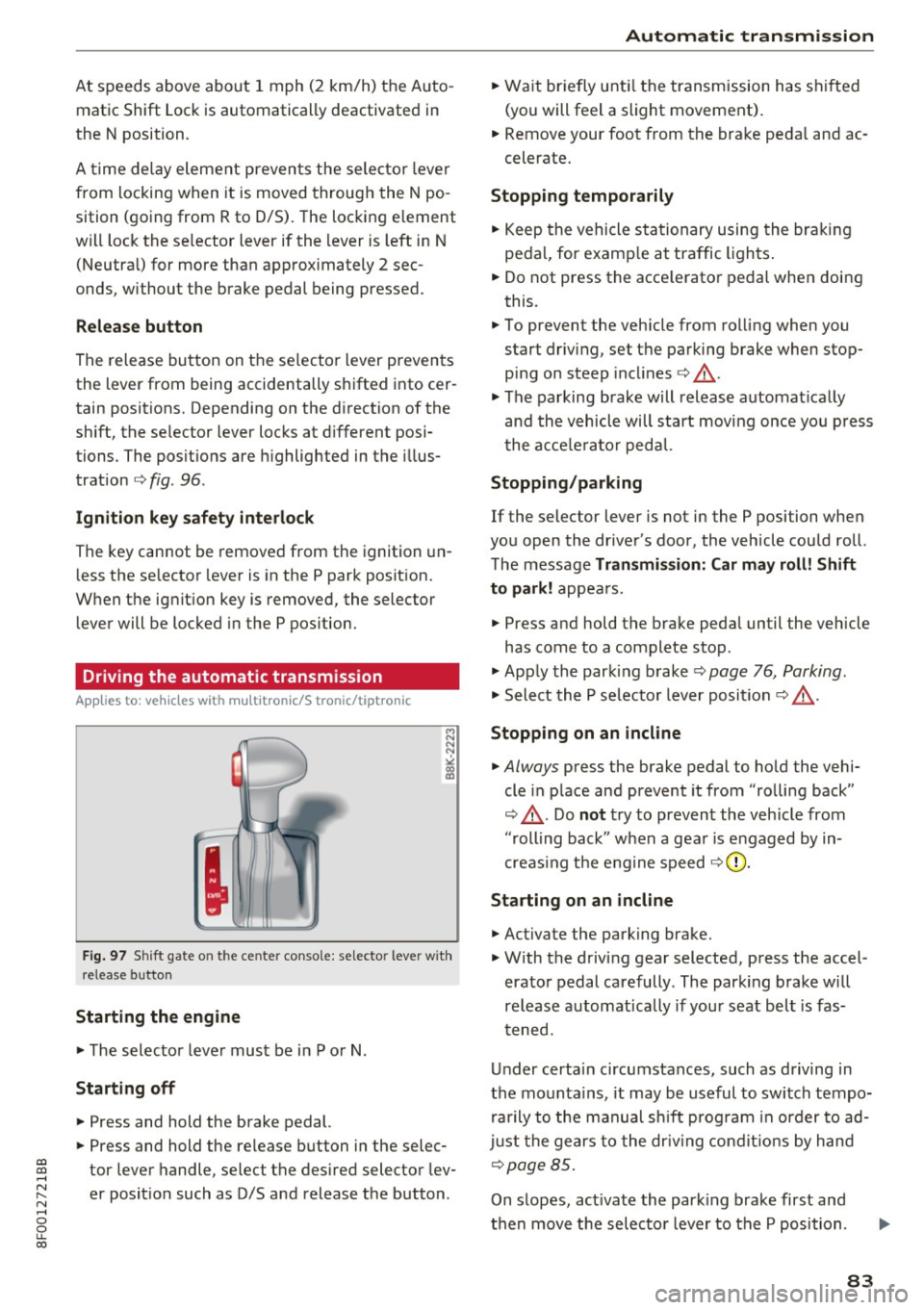
Fig . 97 S hift gate o n the ce nte r conso le: selecto r leve r w ith
release button
Starting the engine
~ The selector lever must be in P or N.
Starting off
~ Press and hold the brake pedal.
~ Press and hold the release button in the selec-
a:,
a:, tor lever handle, select the des ired selector lev-......
~ er position such as D/S and release the button. N ...... 0
0
LL 00
Automatic transm ission
~ Wait briefly unti l the transmission has shi fted
(you will feel a slight movement).
~ Remove your foot from the brake pedal and ac
celerate.
Stopping temporarily
~ Keep the vehicle stationary using the braking
pedal, for examp le at traffic lights.
~ Do not press the acce lerator pedal when doing
this .
~ To prevent the veh icle from rolling when you
start driv ing, set the parking brake when stop
p in g on steep incl ines ¢.&_ .
~ The parking brake will release automat ically
and the vehicle will start moving once you press
the acce le rator pedal.
Stopping/parking
If the selector lever is not in the P position when
you open the driver's door, the vehicle could roll.
The message
Transmission: Car may roll! Shift
to park!
appea rs.
~ Press and hold the brake pedal until the vehicle
has come to a complete stop .
~ Apply the parking brake ¢ page 76, Parking.
~ Select the P selector lever position ¢ .&_ .
Stopping on an incline
~ Always press the brake pedal to hold the vehi
cle in place and prevent it from "rolling back"
¢ .&_ . Do
not try to prevent the vehicle from
"rolling back" when a gear is engaged by in
creas ing the engine speed
¢0.
Starting on an incline
~ Activate the parking brake.
~ With the driving gear selected, press the accel
erator pedal carefully . The park ing brake will
release automatically if your seat belt is fas
t ened.
Under certain circumstances, such as driving in
the mountains , it may be useful to switch tempo
rarily to the manual shift program in order to ad
just the gears to the driv in g conditions by hand
¢page 85.
On slopes, act ivate the park ing brake first and
then move the selecto r lever to the P position.
83
Page 86 of 266
Automatic transmission
This prevents too much stress from being placed
on the locking mechanism.
Vehicles with multitronic transmission: Your ve hicle is equipped with
hill hold assist allowing
you to start while on an incline. The system is ac
tivated when the brake pedal is pressed down
and held
for a few seconds. The brake pressure
will hold for
a moment after the brake pedal
loosens to prevent the vehicle from rolling back
wards while starting up.
A WARNING
- The vehicle can also roll when the engine is
stopped.
- Unintended vehicle movement can cause se rious injury.
- Never leave your vehicle with the engine
running while in gear. If you must leave
your vehicle when the engine is running, ac tivate the parking brake and move the selec
tor lever to P.
- Power is still transmitted to the wheels
when the engine is running at idle. To pre
vent the vehicle from "creeping", you must
keep your foot on the brake when the en
gine is running and the selector lever is in 0/
Sor R or "tiptronic" mode is selected.
- Do not press the accelerator pedal when changing the selector lever position while
the vehicle is stationary and the engine is
running.
- Never shift into R or P while driving.
- Before driving down a steep slope, reduce
your speed and shift into a lower gear with
"tiptronic".
- Do not ride the brakes or press the brake
pedal too often or too long when driving
down a hill. Constant braking causes the
brakes to overheat and substantially re
duces braking performance, increases brak
ing distance or causes complete failure of
the brake system.
- To prevent the vehicle from rolling back
when stopping on inclines, always hold it in
place with the brake pedal or parking brake.
- Never hold the vehicle on an incline with a
slipping clutch. The clutch opens automati-
84
cally when it becomes too hot from the
overload. An indicator lamo
[O ] illuminates
and a driver message appears
c::;, page 86
when the clutch is overloaded.
- If the engine must remain running, never
have any driving position engaged when
checking under the hood. Make sure these
lector lever has securely engaged and is
locked in P with the parking brake set
¢page 193. Otherwise, any increase in en
gine speed may
set the vehicle in motion,
even with the parking brake applied.
(D Note
- S tronic- and tiptronic transmission: When
stopping on an incline, do not try to hold
the vehicle in place by pressing the accelera
tor pedal while a driving gear is selected.
This can cause the transmission to overheat
and can damage it. Activate the parking
brake or press the brake pedal to prevent
the vehicle from rolling.
- S tronic- and tiptronic transmission: Allow
ing th@ vehicle to roll when th@ engine is
stopped and the selector lever is in N will
damage the transmission because it is not
lubricated under those circumstances.
(D Tips
For safety reasons, the parking brake is re
leased automatically only when the driver's
safety belt is engaged in the buckle.
· Hill descent control
App lies to: vehicles with mult itron ic/S tron ic/t iptronic
The hill descent control system assists the driver
when driving down declines .
Hill descent control is activated when the selec
tor lever is in D/S and you press the brake pedal.
The transmission automatically selects a gear
that is suitable for the incline. Hill descent con
trol tries to maintain the speed achieved at the
time of braking, within physical and technical
limitations. It may still be necessary to adjust the
speed with the brakes. ..,..
Page 89 of 266
a:,
a:,
...... N
" N ...... 0
0
LL co
will no longer shift at all. The engine may sta ll.
D rive to yo ur aut horized Audi dea le r or q ualified
repair fac ility immediately to have the malfunc
tion corrected.
rm liJ Transmission malfunction: No reverse
You can continue driving
S t roni c tra nsmissi on: The re is a s ystem m alfu nc
tion in t he tra nsmission. The transmiss io n is
switch ing to emergency mode . This mo de only
shifts into certain gears or will no longer sh ift at
all. The engine may stall. You cannot engage the
reverse gea r. D rive to your authorized A udi dealer
or qua lified repa ir facility immed iate ly to have
the ma lfunction co rrected.
rm Transmission malfunction: Stop vehicle and
sh ift to park.
Do not cont inue driving . Selec t the P se lector lev
e r p osition and see you r authorized Audi dea ler
or qua lified repa ir facility for assistance.
([) Note
If the tr ansmi ssion swi tc h es to emer gency
mo de, you s ho uld take the ve hicle to a n au
t horized A udi dealersh ip as soon as poss ible
to have the condition c orrected.
Selector lever emergency release
Applies to: vehicles with multitronic/S tron ic/tiptronic
If the vehicle 's power supply foils, the selector
lever can be released in an emergency.
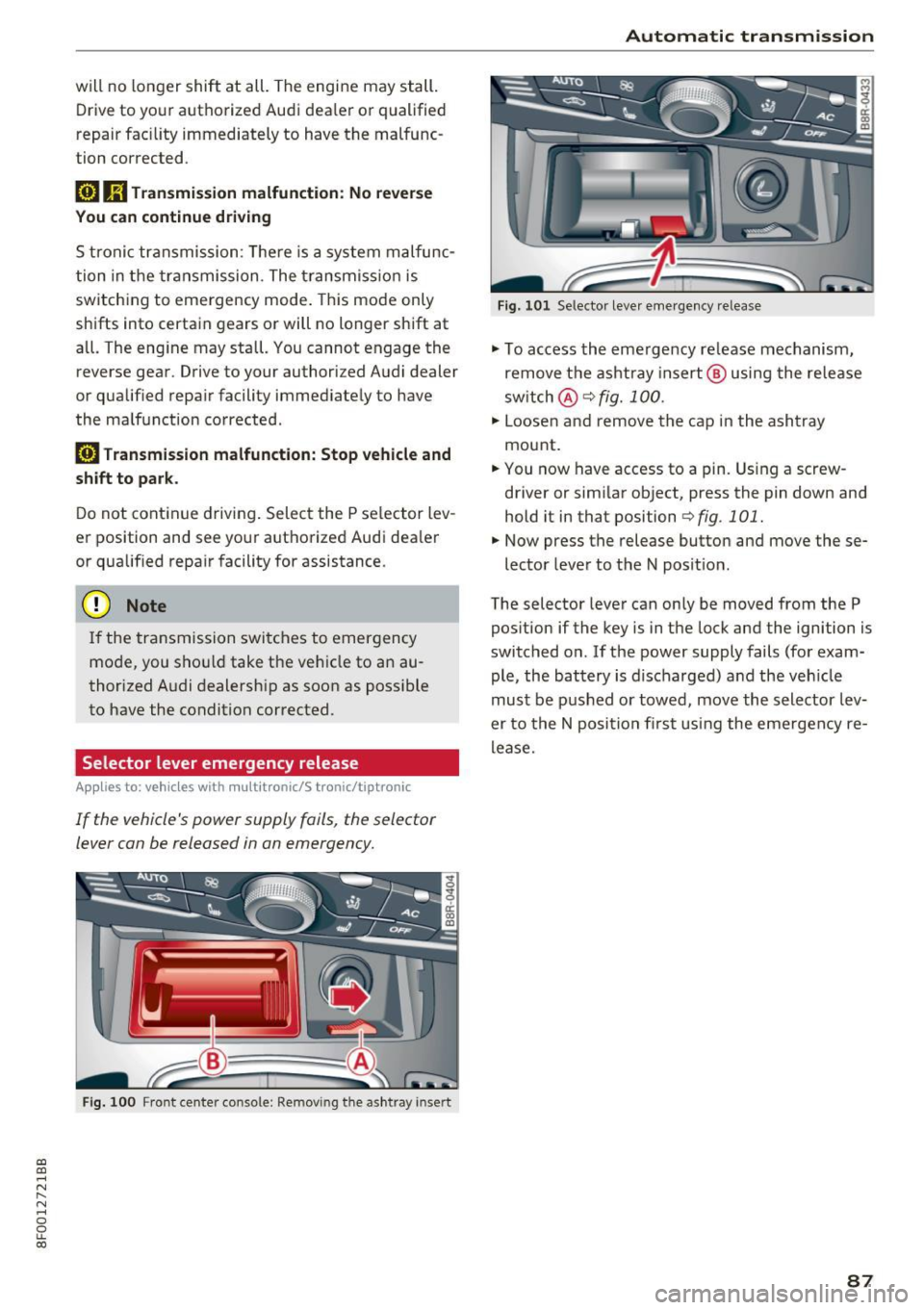
F ig . 100 Front center co nsole: Removing the ashtray insert
Automatic transmission
Fig. 10 1 Selec tor leve r em erge ncy re lease
"' To access the eme rg ency re lease me chanism,
remove t he ash tra y insert @ usin g the re lease
sw itch @
¢fig. 100.
"' Loose n and r emove the c ap in the ash tray
mount .
"' You now have access to a pin. Using a screw
driver or sim ila r ob ject, press the pin down and
hold it in that positi on
¢ fig. 101.
"' Now press the release button and move these-
lector leve r to the N pos it io n.
The selector leve r can on ly be moved from the P
pos ition if the key is in t he lock and the ign ition is
switched on. If the power supply fails (fo r exam
ple, the bat tery is d ischarged) a nd the veh icle
must be p ushed or towed, move th e selector lev
er to th e N posi tion first using the e merge ncy re
lease.
87
Page 102 of 266

Audi side assist
(D Tips
-Si de assist is not active w hile you are mak
i ng t he a dju stment .
- You r settings are automatic ally store d an d
assi gned to t he remote co ntrol key being
u sed.
Driver messages
App lies to: ve hicles w ith Audi side assist
If s ide ass ist switches off by itself, the LED in the
button turns off a nd a message will appear in the
i n str ument cluster d isp lay :
Aud i side assist unavailable: Sensors blocked
T he rada r senso rs ' vision is affe cted . Do not cove r
the area in front of the sensors wit h bike wheels,
sticke rs, dirt o r other objects. Clean the area in
front of the sensors, if necessary
c> page 98,
fig. 116.
Audi side assist : Currently unavailable
S ide assist c an no t be swi tc h ed on tem pora ril y be
c a use there is a mal func tio n (fo r ex am ple, the
bat tery ch arge level may be too low) .
Audi side assist: System fault!
The system cannot guarantee that it wi ll detect
ve hicles co rrectly and it is swi tched off . The sen
sors have bee n disp lace d or are fa ulty . Have the
sys tem chec ked by a n aut hori zed Audi de aler or
a uthor ized Audi Se rvice F acility soon.
Audi side assist: Unavailable when towing
Side assist sw itches off automatica lly when a fac
tory-installed trailer hitch is connected to the
electr ica l co nnector on the trailer. The re is no
gua rantee the system will sw itch off when usi ng
a retrofi tte d t raile r hi tc h. D o not use s ide ass is t
w hen towing a trailer.
100
Page 109 of 266

a:,
a:,
...... N r--. N ...... 0
0
LL 00
-Dampen the lens wi th a house ho ld alcoho l
based glass cl eaner , and clean the l ens with a
dry cloth
¢ (i) .
-Remove snow with a hand brush and ice pref
erab ly with a de-icing spray
¢ (i).
A WARNING
- The parking aid cannot replace the driver's
attent ion. The driver a lone is responsible for
park ing and s imilar driving maneuvers.
-Always keep your eyes on the vehicle's sur round ings, using the rear view m irror as
we ll.
- Do not a llow yourse lf to be d istracted from
traff ic by the rear view camera p ictures.
- If the posit ion and the installat ion ang le of
the camera has changed, for example, after
a rear end collision, do not continue to use
the system for safety reasons. Have it
checked by a qualified dealersh ip .
@ Note
- Low obstacles already s ignaled by a warn ing
ca n disappear from the system's detection
range as they are approached and will not
continue to be signa led. Objects such as
barrier chai ns, t rai ler d raw ba rs, thin pa int
ed verti cal poles o r fences may not be de
tec ted by t he sys tem, posing r isk o f dam
age.
- Neve r use warm or hot water to remove
snow or ice from the rear view camera lens -
danger of crack format ion on t he lens!
- When cleaning the lens, never use p roduc ts
that are abrasive.
Switching on/off
Applies to: veh icles with pa rk ing system (rear, with rear view
camera)
The rear view camera switches on automatically
togeth er with the acoustic park assist when you
put the vehicle in reverse.
Sw itching on
.,. Put the vehicle in reverse gear , th e acoustic
parking system w it h rear view camera is acti
vated a utomat ically . Act ivation of the acoust ic
Parking S ystem
parking system is confirmed by a brief acknow l
edgement sound.
Switching off
.,. Dr ive faste r than 9 mp h (15 km/h), o r
.,. take the ve hicle out of reve rse gear. The acous
t ic parking sys tem is immed iately deactivated,
and the rear view camera pictu re is deactivated
automatically after a period of abo ut 15 sec
onds, or
.,. sw itch off the ignit ion.
The delay in deactivating the camera provides an u ninterrupted view be hind th e vehicle especia lly
when maneuvering in t ight pa rking spaces and
prevents the picture from turning off t he every
t ime you shift o ut of reverse .
If the warning messag e appears in the display
but not the rear view camera picture, read and
confirm the warning message . The acoustic dis
tance sig nal is always active.
If you press a f unction button on the M MI control
console , the rear view camera picture disappears.
The rear view camera picture reappears the next
time you pa rk .
Further in format ion on th e warning message and
the MMI control console can be found in the MMI inst ruct ion booklet.
A WARNING
--
- On ly use the rearv iew camera to ass ist you if
it shows a good, clear pictu re . Fo r example,
the image may be affected by the sun shin i n g into the lens, dirt on the lens o r if t he re
is a defec t.
- Us e th e rearv iew cam era on ly w ith th e rear
lid comple tely closed . Make s ure any obje cts
you m ay h ave moun ted on t he rear lid do
not block the rearv iew camera.
(D Tips
- The rear view camera picture is available as
soo n as the M MI D ispla y or the MM I is
s w itched on, or the s tart- up phase is com
p le ted .
- Th e se nsors m ust be kep t clean and free of
s now and ice fo r th e park ass is t to operate.
107
Page 115 of 266
a:,
a:,
...... N r--. N ...... 0
0
LL 00
For detailed information on how to adjust the
driver's seat, see
¢ page 58.
A WARNING
Drivers who are unbelted, out of position or
too close to the airbag can be seriously in
jured by an airbag as it unfolds. To help re
duce the risk of serious personal injury:
- Always adjust the driver's seat and the
steering wheel so that there are at least 10 inches (25 cm) between your breastbone
and the steering wheel.
- Always hold the steering wheel on the out
side of the steering wheel rim with your
hands at the 9 o'clock and 3 o'clock posi
tions to help reduce the r isk of personal in
jury if the driver's airbag inflates.
- Never hold the steering wheel at the
12 o'clock position or with your hands at
other positions inside the steering wheel
rim or on the steering wheel hub. Holding
the steering wheel the wrong way can cause
serious injuries to the hands, arms and head
if the driver's airbag deploys.
- Pointing the steering wheel toward your
face decreases the ability of the supplemen
tal driver's airbag to protect you in a colli sion.
- Always sit in an upright position and never lean against or place any part of your body
too close to the area where the airbags are located .
- Before driving, always adjust the front seats
and head restraints properly and make sure
that all passengers are properly restrained.
- Never adjust the seats while the vehicle is
moving . Your seat may move unexpectedly
and you could lose control of the vehicle .
- Never drive with the backrest reclined or
tilted far back! The farther the backrests are
tilted back, the greater the risk of injury due
to incorrect positioning of the safety belt
and improper seating position.
- Children must a lways ride in child safety
seats¢
page 150. Special precautions ap
ply when installing a child safety seat on the
front passenger seat ¢
page 130.
Driving safety
Proper seating position for the front
passenger
The proper front passenger seating position is
important for safe, relaxed driving.
For your own safety and to reduce the risk of in
jury in the event of an acc ident, we recommend
that you adjust the seat for the front passenger
to the following position:
" Move the front passenger seat back as far as
possible . There must be a minimum of 10 in
ches (25 cm) between the breastbone and the
instrument panel¢.&, .
"Adjust the angle of the seatback so that it is in
an upright position and your back comes in full
contact with it whenever the vehicle is moving.
" Applies to vehicles with adjustable head re
straints : Adjust the head restraint so the upper
edge is as even as possible with the top of your
head . If that is not possible, try to adjust the
head restraint so that it is as close to this posi
tion as possible .
" Keep both feet flat on the floor in front of the
front passenger seat.
" Fasten and wear safety belts correctly
¢page 125.
For detailed information on how to adjust the
front passenge r's seat, see ¢
page 57.
A WARNING ~
Front seat passengers who are unbelted, out
of position or too close to the airbag can be
seriously injured or killed by the airbag as it unfolds. To help reduce the risk of serious
personal injury:
- Passengers must always sit in an upright po
sition and never lean against or place any
part of their body too close to the area
where the airbags are located .
- Passengers who are unbelted, out of posi
tion or too close to the airbag can be seri
ously injured by an airbag as it unfolds with
great force in the blink of an eye.
-Always make sure that there are at least 10 inches (25 cm) between the front passen
ger's breastbone and the instrument panel.
113
Page 119 of 266
a:,
a:,
...... N r--. N ...... 0
0
LL 00
Loose items in the luggage compartment can
shift suddenly, changing vehicle handling charac
teristics . Loose items can also increase the risk of
serious personal injury in a sudden vehicle ma
neuver or in a collision.
~ Distribute the load evenly in the luggage com
partment.
~ Always place and properly secure heavy items in
the luggage compartment as low and as far for
ward as possible
c> fig . 130 .
~ Secure luggage using the tie-downs provided
i=>page 64 .
~ Make sure that the rear seatback is securely
latched in place.
A WARNING ,~ -
Improperly stored luggage or other items can
fly through the vehicle causing serious per
sonal injury in the event of hard braking or an
accident. To help reduce the risk of serious
personal injury:
- Always put objects, for example, luggage or
other heavy items in the luggage compart
ment.
-Always secure objects in the luggage com
partment using the tie-down eyelets and
suitable straps.
A WARNING
Heavy loads will influence the way your vehi
cle handles . To help reduce the risk of a loss
of contro l leading to serious personal injury:
- Always keep in mind when transporting heavy objects, that a change in the center of
gravity can also cause changes in vehicle
hand ling:
- Always distribute the load as evenly as
possible.
- Place heavy objects as far forward in the
luggage compartment as possible.
- Never exceed the Gross Axle Weight Rating
or the Gross Vehicle Weight Rating specified
on the safety compliance sticker on the left
door jamb. Exceeding permissible weight
standards can cause the vehicle to slide and
handle differently .
Driving safety
-Please observe information on safe driving
i=> page 111.
A WARNING
-To help prevent poisonous exhaust gas from
being drawn into the vehicle, always keep the
rear lid closed while driving.
- Never transport objects larger than those
fitting completely into the luggage area be
cause the rear lid cannot be fully closed.
- If you absolutely must drive with the rear lid
open, observe the following notes to reduce
the risk of poisoning:
- Close all windows,
- Close the power top,
- Open all a ir outlets in the instrument pan-
el,
- Switch off the air recirculation,
- Set the fresh air fan to the highest speed.
A WARNING ~ -
Always make sure that the doors, all win
dows , the power top and the rear lid are se
curely closed and locked to reduce the risk of
in jury when the vehicle is not being used.
- After closing the rear lid, always make sure
that it is properly closed and locked.
- Never leave your vehicle unattended espe
cially with the rear lid left open. A child
could crawl into the vehicle through the lug
gage compartment and close the rear lid be
coming trapped and unable to get out. Be
ing trapped in a vehicle can lead to serious
personal injury.
- Never let children play in or around the vehi
cle.
- Never let passengers ride in the luggage
compartment. Vehicle occupants must a l
ways be properly restrained in one of the
ve
hicle's seating positions.
(D Tips
-Air circulation helps to reduce w indow fog
ging. Stale air escapes to the outside
through vents in the trim panel. Be sure to
keep these slots free and open.
117
Page 128 of 266
Safe ty belts
_& WARNING
-Only your authorized Audi dealer shou ld
work on the system or remove and installing
system components when perform ing other
work.
- The belt pos itioners could cause injury or
damage if they pinch peop le or objects
when extending or ret ract ing.
Fastening safety belts
Safety first -everybody buckle up!
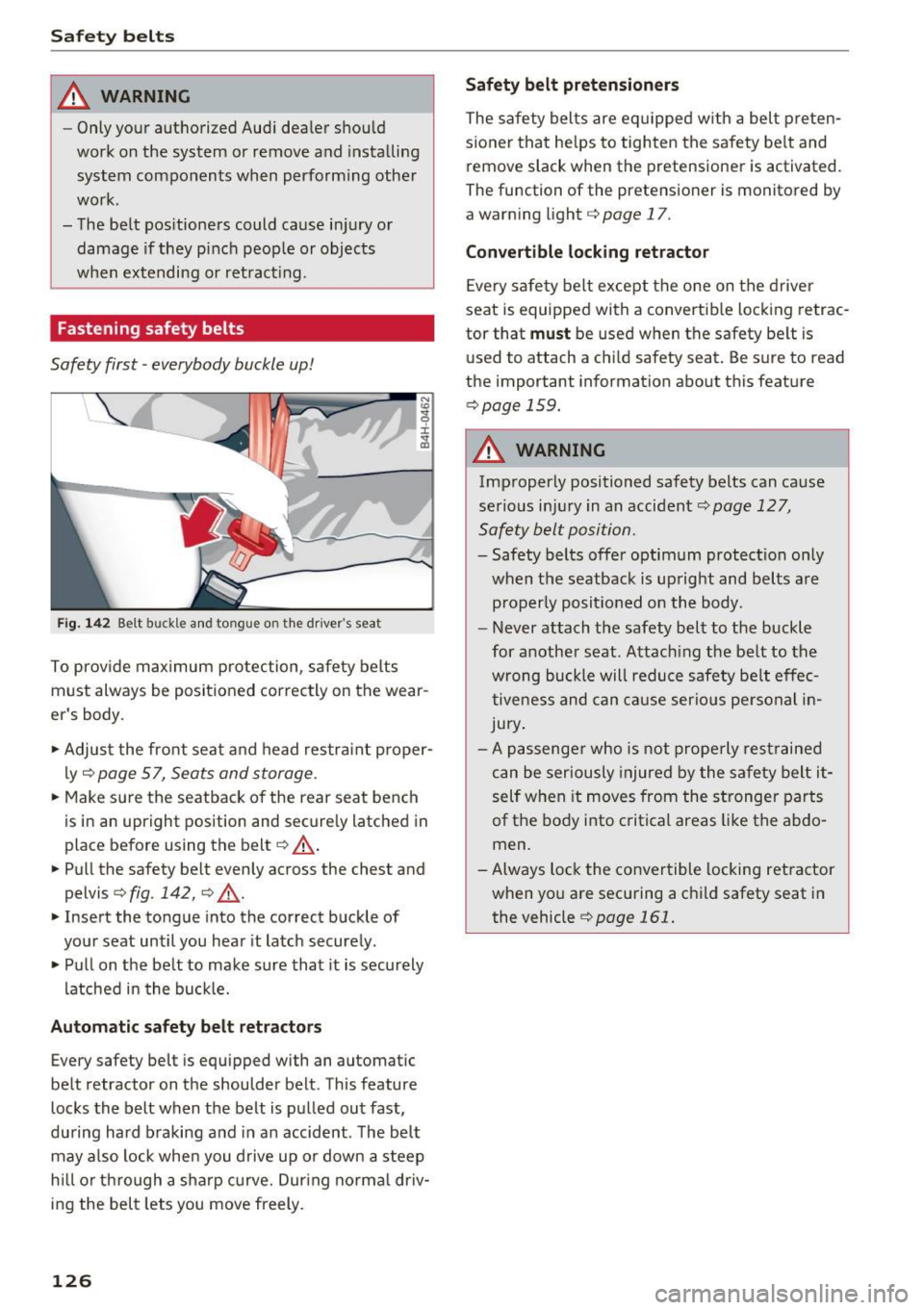
F ig. 1 42 Belt buckle a nd tong ue o n the dr iver's seat
To prov ide max imum protection, safe ty belts
must always be posit ioned correctly on the wear
er's body .
.,. Adjust the fro nt sea t an d head restra int proper
ly ¢
page 57, Seats and storage .
.,. Make s ure the seatback of the rear seat bench
is in an upright position and sec ure ly latched in
place before using the belt¢.&_ .
.,. Pull the safety belt evenly across the chest and
pelvis
¢ fig. 142, ¢ .&_ .
.,. Insert the tongue into the correct buckle of
your seat until you hear it latch securely .
.,. Pull on the be lt to make sure that it is securely
latched in the buck le.
Autom atic safety belt retractors
Every safety belt is equipped with an automatic
belt retractor on the shoulder belt . This feature
locks the belt when the belt is pulled out fast,
du ring hard b raking and in an accident . The belt
may a lso lock when you drive up or down a steep
h ill or th rough a s harp c urve. Dur ing no rmal driv
ing the belt lets you move freely.
126
Safety belt pr etensioners
The safety belts are eq uipped w ith a bel t preten
s ioner that he lps to tighten the safety be lt and
remove slack when the pretensione r is activated.
The function of the pretens ioner is monitored by
a warn ing light ¢
page 17.
Convertible locking retractor
Every safety belt except the o ne on the driver
seat is equipped with a convertib le locking retrac
tor that
mu st be used when the safety be lt is
used to attach a child safety seat . Be sure to read
the important information about this feature
¢ page 159.
_& WARNING
Improperly positioned safety belts can cause
serious i nju ry in an accident
¢page 127,
Safety belt position.
- Safety belts offer optimum protection only
when t he seatback is up right and belts a re
properly positioned on the body .
- Never attach the safety belt to the buckle
for another seat . Attach ing the be lt to the
w rong buckle will reduce safety be lt effec
tiveness and can cau se serio us pe rsonal in
jury .
- A passenge r who is not prope rly rest rained
can be ser iously injured by the safety belt i t
self when it moves from the st ronger parts
of the body into c ritical areas like the abdo
men.
- Always lock the co nver tible locking retractor
when yo u are securing a c hild safety seat in
the vehicle
¢ page 161.
Page 143 of 266

The PASSENGER AIR BAG O FF light is located in
the c enter of the instrument panel¢
fig. 149 .
The PASS ENGER AIR BAG OFF light will come on
and stay on to tell you when the front Advanced
Airbag on the passenger side has been turned off
by the el ectronic control unit . Each time you turn
on the ignition, the
P ASSENGER AIR BAG OFF
light will flash for a few seconds and:
- will stay on if the front passenger seat is not
occupied,
- will stay on if the re is a sma ll child or child re
straint on the front passenger seat,
- wi ll go out if the front passenge r seat is occu
pied by an adult as registered by the weight
sensing mat .
The
PA SSENGER AIR BAG O FF light mu st c ome
on and sta y on
if the igni tion is on and
- a car bed has been insta lled on the front seat,
o r
- a rearward-facing child restrai nt has been in
stalled on the front passenger seat , or
- a forward -facing child restra int has been instal
led on the front passenger seat, or
- the weight reg istered on the front passenger
seat is equal to or less than the comb ined
weight of a typical 1 yea r-o ld restrained in one
of the rear-facing or forward-fac ing infant re
strain ts listed in Federal Motor Vehicle Safety
Standard 208 w ith which the Advanced A irbag
System in your vehicle was certified.
I f the front passenger seat is no t occupied, the
fron t air bag w ill not deploy, and the
PASSENGER
AIR BAG OFF
light will stay on . Never install a
rearward -fac ing child restraint on the front pas
senger s eat, the safest p lace for a child in any
kind of child restraint is at one of the seating po
sitions on the rear seat ¢
page 131, Child re
s train ts on the front sea t-some impor tan t
things to know
and ¢ page 1 SO, Child safety .
If the PASSENGER AIR BAG OFF light comes on
when one of the condit ions listed above is met,
be sure to check the light regularly to make cer-
gi tain that the PASSENGER AIR BA G OFF light ......
~ stays on cont inuously whenever the ign ition is
~ on . If the PASSENGER A IR BAG OFF lig ht does
0 LL 00
Airb ag sys tem
not appear and not stay on all the time, stop as
soon as it is safe to do so and
- react ivate the system by tur ning t he ignit ion
off and then t urn ing it on again ;
- remove and re insta ll th e chi ld restrain t. M ake
sure that the chi ld restraint is properly ins ta l
led and that the safety belt for the front pas
senger seat has bee n correct ly routed around
the child restraint as desc ribed in the c hild re
straint manufacture r's instruct ions;
- make sure that the convertible locking retrac
tor on the safety belt for the front passenge r
seat has been activated and that the safety belt
has been pulled tight. The belt must not be
loose or have loops of slack so that the sensor
below the safety belt latch on the seat can do its job
¢ page 159.
-make sure that th ings that may increase the
weight of the child and ch ild safety seat are not
be ing transported on the front passenger seat ;
- make sure that the safety belt tens ion sensor is
not b locked . Shake the safety belt la tch on the
front passenger seat bac k and forth;
- If a strap or tether is being used to tie the child
safety seat to the front passenger seat, make
sure that it is not so tight t hat i t causes the
weight-sensing mat to me asu re more weight
than is actua lly on the sea t.
If the PASSENGER AIR BAG OFF light still do es
not come on
and does not stay on co nti nuously
(whe n the ignition is switched on),
- take the child restraint off the front passenge r
seat and install it p roper ly at one of the rear
seat pos itions . Have the airbag system inspect
ed by yo ur au thori zed Aud i deale r immedi ately .
- move the child to a rear seat pos ition and ma ke
sure that t he chi ld is proper ly rest rained in a
child restra int that is appropr iate for its s ize
and age .
T he
PASSENGER AIR BAG OFF lig ht should NOT
come on when the ignit io n is on and an adu lt is
s itting in a prope r seat ing pos ition on the front
passenge r seat. If the
PASSENGER AIR BAG OFF
light comes on and stays on or flashes for about
5 seconds whi le dr iv ing, under these c ircumstan-
ces, make sure that :
Ill-
141