oil pressure AUDI A5 CABRIOLET 2017 Owners Manual
[x] Cancel search | Manufacturer: AUDI, Model Year: 2017, Model line: A5 CABRIOLET, Model: AUDI A5 CABRIOLET 2017Pages: 266, PDF Size: 66.64 MB
Page 11 of 266
a:,
a:,
...... N
" N ...... 0
0
LL co
A WARNING
-Always observe the warning in ¢ page 193,
before opening t he hood and checking the
engine coolant level.
- Never open the engine hood if you see or
hear steam, or if you see engine coolant
dr ipping from the engine compartment. You
cou ld burn yourself. Let the engine cool off
firstsothatyoucannothearo rseeany
steam or engine coo lant.
0 Note
- Mounting additional lights or accessories in
front of the air inlets reduces the cooling ef
fect of the radiator. At h igh outside temper
atu res or high engine load, the engine could
overheat.
- The front spoiler has been designed to prop
erly distribute the cooling air when the vehi
cle is moving. If the spoiler is damaged, this
could reduce the cooling effect and the en
gine could then overheat. Ask your author
ized Audi dealer for assistance.
Tachometer (engine rev counter )
The tachometer indicates the engine RPM (revo
lutions per minutes).
If engine RPM drops below 1,500, you should
downshift to the next lower gear. The red area at
the end of the scale indicates maximum permis
sible eng ine RPM after the break-in period. Be
fore reaching this area, move the selector lever
to position D/5 or ease your foot off the accelera
tor pedal.
(D Note
The tachometer needle@¢ page 8, fig . 3
should only briefly be in the red zone: you
could damage your eng ine! The beginning of
the red zone varies depending on the engine.
@ For the sake of the environment
Upshifting early saves fuel and reduces en
gine noise.
Instruments and indicator lights
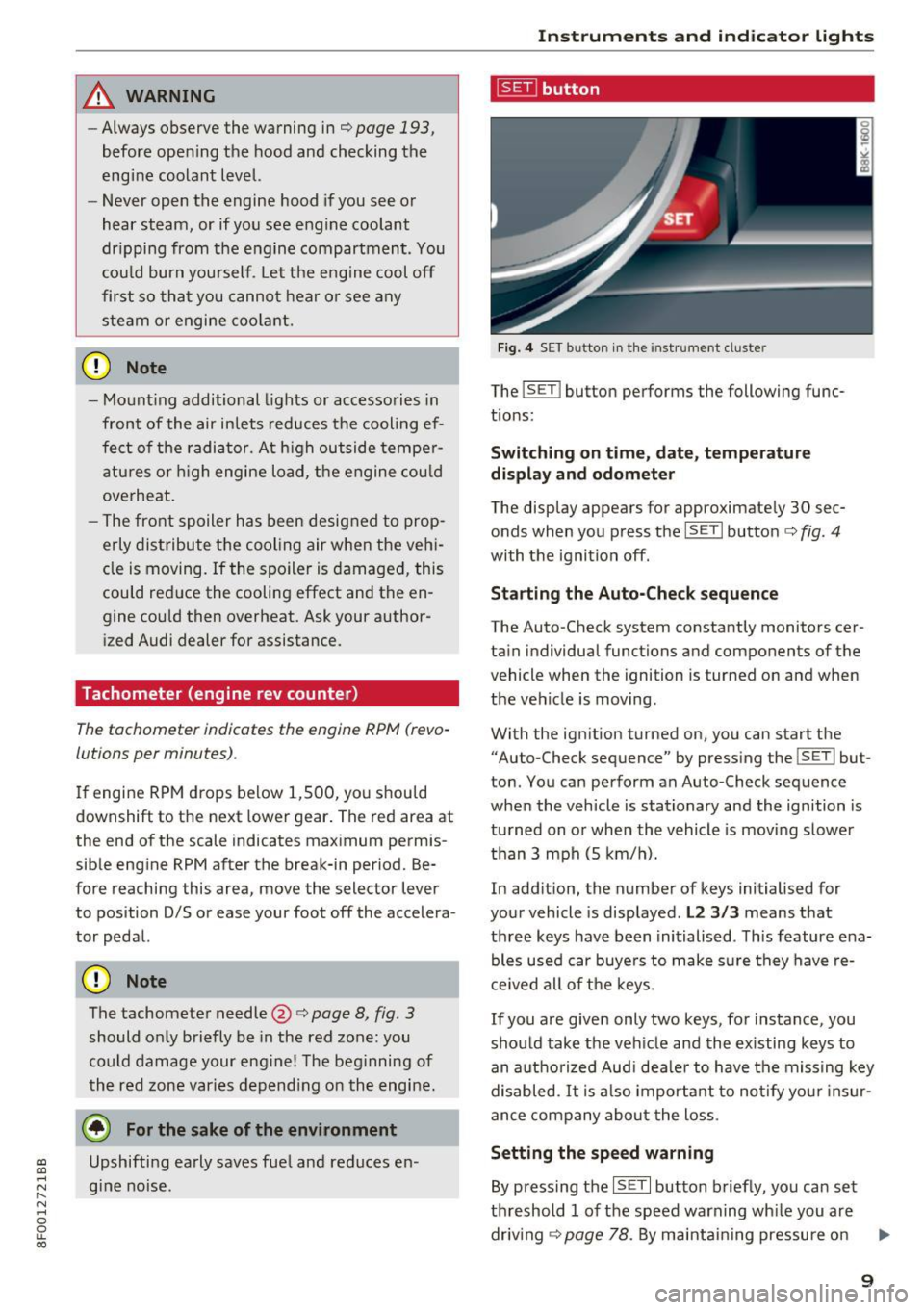
~button
Fig. 4 SET button in the instrument cluste r
The !SET I button performs the following func
tions:
Switching on time, date, temperature
display and odometer
The display appears for approximately 30 sec
onds when you press the
ISETI button¢ fig . 4
with the ignition off.
Starting the Auto-Check sequence
The Auto-Check system constantly monitors cer
tain indiv idual functions and components of the
vehicle when the ignition is turned on and when
the vehicle is moving .
With the ignition turned on, you can start the
"Auto-Check sequence" by pressing the
! SET I but
ton. You can perform an Auto-Check sequence
when the vehicle is stat ionary and the ignition is
turned on or when the vehicle is moving slower
than 3 mph (5 km/h).
In addition, the number of keys initialised for
your vehicle is displayed .
L2 3/3 means that
th ree keys have been initialised . This feature e na
bles used car buye rs to make su re they have re
ceived all of the keys.
If you are given only two keys , for instance , you
should take the veh icle and the existing keys to
an authorized Audi dealer to have the missing key
disabled. It is also important to notify your insur
ance company about the loss.
Setting the speed warning
By pressing the ISETI button briefly, you can set
threshold 1 of the speed warning wh ile you are
driv ing
¢ page 78. By ma intaining pressure on IJ,,
9
Page 13 of 266
a:,
a:,
...... N r--. N ...... 0
0
LL 00
Indicator lights
Description
The indicator lights in the instrument cluster
b link or turn on. They indicate functions or mal
functions ¢& .
Messages may appear with some indicator lights.
A warning signal will sound at the same time.
The messages disappear again after a short t ime.
To disp lay a message again, press the
ISETI but
ton ¢
page 9. If several malfunctions occur, each
of the indicator/warning lamps will be displayed
in succession for about two seconds at a time.
Some ind icators lights in the display can turn on
in several colors.
A WARNING
-
-Failure to heed warning lights and other im
portant vehicle informat ion may result in
serious personal injury or vehicle damage.
- Whenever stalled or stopped for repair,
move the vehicle a safe distance off the
road, stop the engine, and turn on th@
emergency flasher¢ page 50.
-The engine compartment of any motor vehi
cle is a potentially hazardous area . Before
you check anything in the engine compart ment, stop the engine and let it cool down.
Always exercise extreme caution when work ing under the hood¢
page 193.
Overview
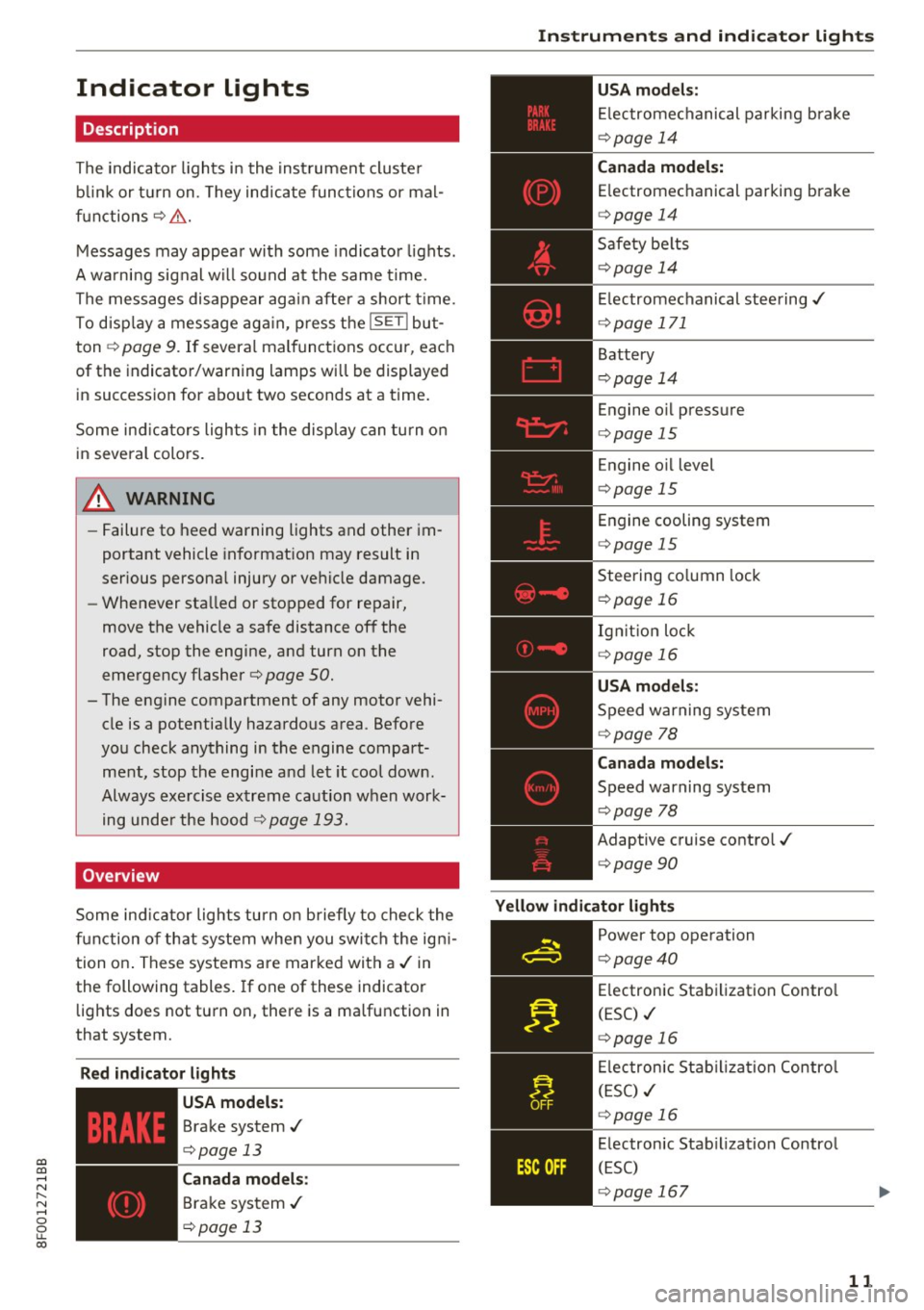
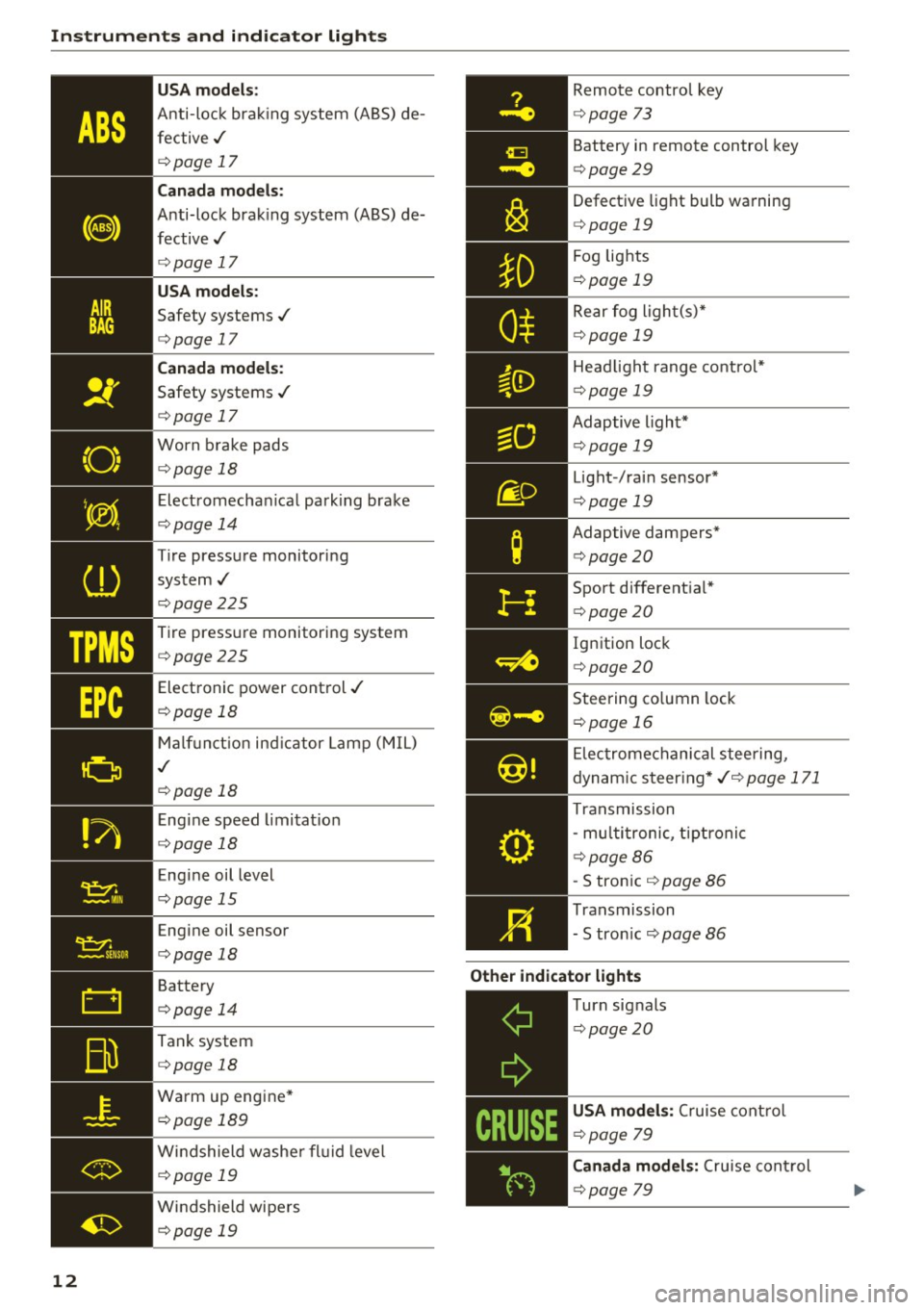
Some ind icator lights turn on briefly to check the
function of that system when you switch the ign i
tion on . These systems are marked with a ,/ in
the following tables. If one of these indicator
lights does not turn on, there is a malfunction in
that system.
Red indicator lights
--------------
US A models:
Brake system./
¢page 13
Canada models:
Brake system ./
¢page 13
Instruments and indicator lights
USA models:
Electromechanical parking brake
¢page 14
Canada models:
Electromechanical parking brake
¢ page 14
Safety belts
¢page 14
Electromechanical steering./
¢page 171
Battery
¢page 14
Engine oil pressure
¢page 15
Engine oil level
¢page 15
Engine cooling system
¢page 15
Steering column lock
¢ page 16
Ignition lock
¢ page 16
USA models :
Speed warning system
¢page 78
Canada models:
Speed warning system
¢page 78
Adaptive cruise control./
¢page 90
Yellow indicator lights
--------------
Power top operation
¢page40
Electronic Stabilization Contro l
(ESC) ./
¢page 16
Electronic Stabilization Contro l
(ESC) ./
¢page 16
Electronic Stab ilization Control
(ESC)
¢ page 167
11
Page 14 of 266
Instruments and indicator lights
TPMS
-~--
12
USA models :
Anti-lock brak ing system (ABS) de
fective,/
¢ page 17
Canada mod els :
Anti-lock brak ing system (A BS) de
fective,/
¢ page 17
USA models :
Safety systems ./
¢page 17
Canada models :
Safety systems ./
¢page 17
Worn brake pads
¢page 18
Electromechan ical park ing brake
¢page 14
Tire pressure monitoring
system ,/
¢page 225
Tire pressure monitor ing system
¢page225
Electronic power control ,/
¢page 18
Malfunct io n ind icator Lamp (MIL)
,I
c::> page 18
Engi ne speed limitat ion
c::> page 18
Engine oil level
c::> page 15
Engine oil sensor
c::>page 18
Battery
c::> page 14
Tank system
c::>page 18
Warm up engine *
¢page 189
Windshield washe r fl uid leve l
¢page 19
Windshield wipers
¢page 19
Remote control key
¢ page 73
Battery in remote control key
¢page 29
Defect ive light bulb wa rning
<=> page 19
Fog lights
¢page 19
Rear fog light(s)*
c> page 19
Headlight range control*
c> page 19
Adaptive light*
c>page 19
Light-/rai n sensor*
c> page 19
Adaptive dampers*
c>page20
Sport different ial*
<=> page20
Ig nition loc k
c>page 20
Steering co lumn lock
¢ page 16
Elec tromechanical stee ring,
dynam ic steer ing *
./c> page 171
Transmission
- mu lti tronic, tiptronic
c> page86
-S tron ic c> page 86
Transmission
- S tron ic
c::> page 86
Other indicator light s
c----=-----------
T urn signals
¢page20
USA mode ls: Cruise cont rol
c> page 79
Canada models : Cruise cont rol
¢ page 79
Page 17 of 266
a:,
a:,
...... N r--. N ...... 0
0
LL 00
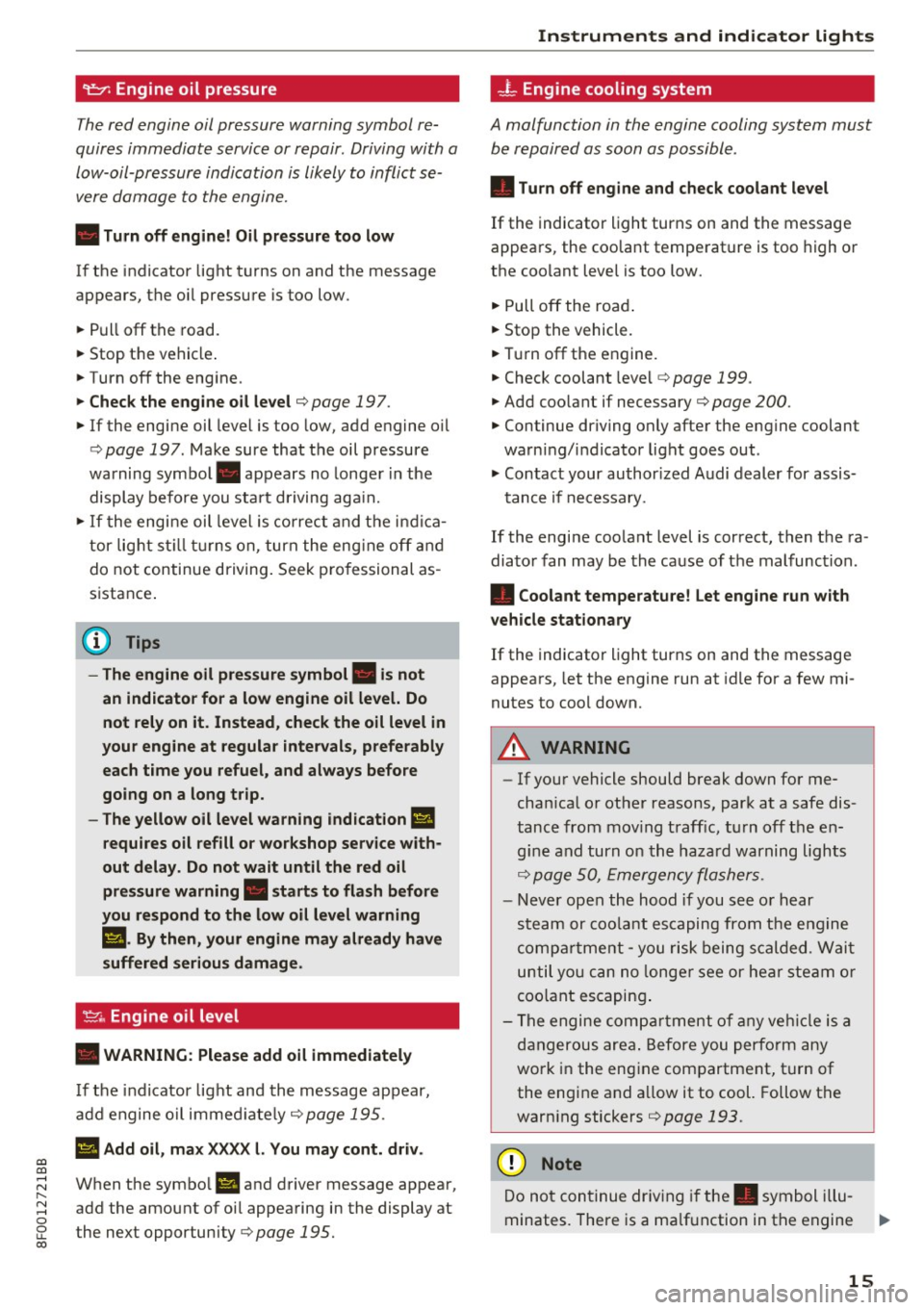
9=:1: Engine oil pressure
The red engine oil pressure warning symbol re
quires immediate service or repair . Driving with a
low-oil-pr essure indication is likely to inflict se
vere damage to the engine.
• Turn off engine! Oil pressure too low
If the indicator lig ht t urns on and the message
appears, the oi l pressu re is too low.
~ P ull off the road.
~ Stop t he vehicle .
~ Turnoff the engine.
~ Check the engine oil level¢ page 197 .
~ If the engine oil leve l is too low, add engine oi l
¢
page 197 . Make sure that t he oil pressure
warning symbol. appears no longe r in the
display before you s ta rt driving ag ain.
~ If the engi ne oil leve l is cor rect and t he i ndic a
t or lig ht still tur ns on, turn t he eng ine
off and
do not continue driving . Seek p ro fessional as
s istance .
(D Tips
- The engine oil pressure symbol. is not
an indicator for a low engine oil level. Do
not rely on it. Instead, check the oil level in
your engine at regular intervals, preferably each time you refuel, and always before
going on a long trip.
- The yellow oil level warning indication
Ill
requires oil refill or workshop service with
out delay . Do not wait until the red oil
pressure warning. starts to flash before
you respond to the low oil level warning
Ill . By then , your engine may already have
suffered serious damage .
~ . Engine oil level
• WARNING: Please add oil immediately
If the indicator lig ht and the message ap pear,
a dd engine o il i mm edi ate ly
¢page 195.
Ill Add oil, max XX XX l. You may cont. driv .
When the symbol II and driver message appea r,
add the amount of oi l appea ring in the display at
the next opportunity ¢
page 195.
Instruments and ind icator lights
- L Engine cooling system
A malfunction in the engine cooling system must
be repaired as soon as possible .
• Turn off engine and check coolant level
If the indicator light turns on and the message
appea rs, the coo lant tempe rat ure is too high o r
t h e coo lant leve l is too low.
~ Pull off the ro ad.
~ Stop the vehicle.
~ Tur noff th e engine.
~ Check coolant leve l¢ page 199 .
~ Add coolant if necessary¢ page 200.
~ Continue dr iv ing only afte r the e ngine coolant
warni ng/ indicator light goes out .
~ Contact your authorized Audi dealer for assis-
t ance if necessa ry.
If the engi ne coo lant level is correct , then t he ra
dia to r f an may be the cause of t he mal func tion.
• Coolant temperature! Let engine run with
vehicle stationary
If the indicator lig ht tur ns on and the messa ge
appea rs, let the engine run a t idle for a few mi
nutes to c ool down.
A WARNING
-- If yo ur vehicle should break down for me
cha nica l o r ot her reasons, park at a safe dis
t ance from mov ing t raff ic, t urn off t he e n
g in e a nd turn on the haz ard warning lights
¢ p age S O, Em ergency fla she rs.
- N ever open t he hood if you see o r hear
s te am or coo lant esca p in g fr om th e engine
co mpartm ent - you ris k being scald ed . W ait
un til yo u can no longe r see or hear steam or
coo lant escapin g.
- T he engi ne compart ment of an y vehicl e is a
d anger ous are a. B efore y ou perfo rm any
wo rk in the eng ine com partment, t urn of
the eng ine a nd a llow it to cool. Follow t he
warn ing stickers
¢page 193.
(D Note
Do not con tinue dr iv in g if the . symbol i llu-
minates. The re is a malf u nction in the engine
IJi,,,
15
Page 76 of 266
Driving
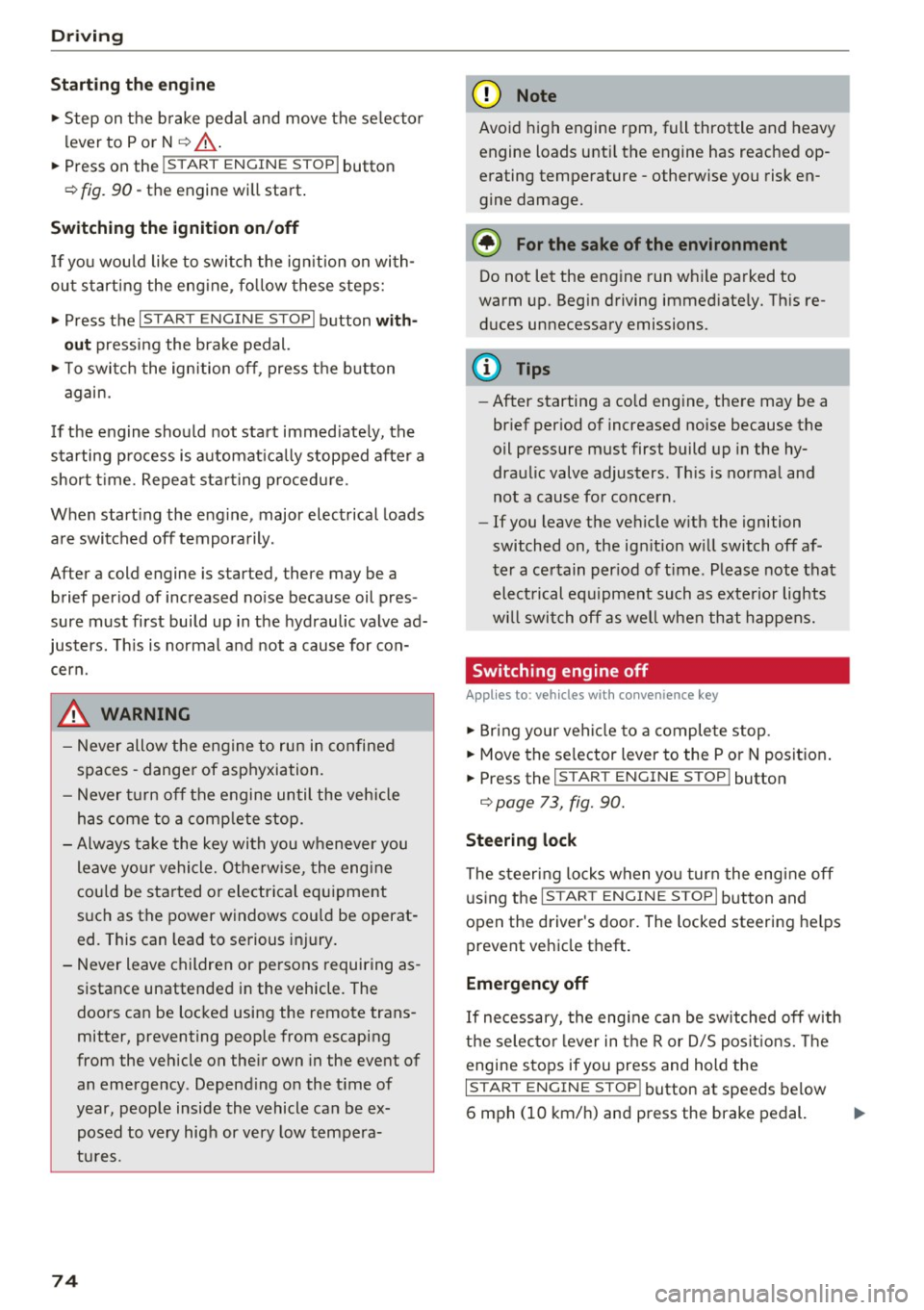
Starting the engine
.,. Step on the b rake pedal and move the se lector
l ever to P o r N
¢ &, .
... Press on the r.l S::-:: T=- A,,., R ""T=-= E~ N":"'. G::- I ;-:N:-:-.:= E-;:Se:;T;=-;: O" P~I button
¢ fig.
90-the engine will start .
Switching the ignition on/off
If yo u wou ld like to switch the ign ition on with
ou t starting the eng ine, fo llow these steps:
.,. Press t he
I STAR T ENGIN E ST OPI button with
out
pressing the brake pedal.
.,. To switc h the ign ition off, press t he bu tton
again.
I f t he engine should not start immed iate ly, the
starting p rocess is a utomat ica lly stopped afte r a
short t ime. Repe at st arting procedu re .
When start ing the e ng ine, major elect rical loads
are switched off temporarily.
After a cold engine is started, there may be a b rief period of increased no ise beca use oil pres
sure must first bui ld up in the hydraulic valve ad
justers. This is no rmal a nd not a cause for con
cern.
.&, WARNING
- Never allow t he eng ine to run in confine d
spa ces -danger of asphyxiation.
- Never t urn off the engine until the vehi cle
has come to a comp lete stop.
- Always take the key wi th you w henever you
leave you r vehicle. Othe rw ise, the eng ine
c ould be sta rted o r ele ctrical eq uipment
s u ch as the power windows co uld be operat
ed. This can lead to se rious injury.
- Never leave children or pe rsons requiring as
sistance unattended i n the vehicle. The
doo rs can be loc ked using the remote trans
mitter, prevent ing people from escaping
from the vehicle on the ir own in the event of
an emergency . Depend ing o n the t ime of
year, peop le inside the vehicle can be ex
posed to very hig h or very low tempe ra-
t u r es.
74
-
(D Note
Avoid high engine rpm, full throttle and heavy
engine loads unti l the engine has reached op
e rating tempe rature -otherwise you risk en
gine damage.
@ For the sake of the environment
Do not let the eng ine run wh ile pa rked to
warm up. Beg in d riving immed iate ly. Th is re
duces unnecessary emissions.
(D Tips
- After starting a co ld eng ine, the re may be a
br ief per iod of increased noise because the
oil pressure must first build up in the hy
dra ulic valve adjusters . Th is is norma l and
not a cause for concern .
- If you leave the ve hicle w ith the ignition
switched on, the ig nition w ill switch off af
ter a ce rtain per iod of t ime . Please note that
elect rical equipment such as exte rior lights
w ill swi tch off as we ll when that happens.
Switching engine off
Applies to: vehicles with convenience key
.,. Br ing your vehi cle to a comple te stop .
.,. Move the se lector lever to the P or N position .
... Press the
I STAR T ENGINE S TOP I button
¢ page 73, fig. 90.
Steering lock
The steer ing locks when yo u turn the eng ine off
u sing t he
I S TART ENGI NE STOPI button and
open the driver's doo r. The locked steering he lps
prevent veh icle theft.
Emergency off
I f necessary, the eng ine can be switched off w ith
t h e se lec to r l ever in t he R or D/S posit ions. The
engine s tops if you press and hold the
I S T AR T EN GINE S TOP ! button at speeds be low
6 mph (10 km/ h) and press the brake pedal. .,,.
Page 173 of 266
a:,
a:,
...... N r--. N ...... 0
0
LL 00
Fa ults in the brake system
If yo u should notice a sudden increase i n brake
pedal travel, then one of the two brake circuits
may have failed
¢ .&. .
Low brake fluid level
Malf unct ions can occur in the bra ke system if the
b rake fl uid leve l is too low. The brake fluid level
i s monitored e lectronica lly .
Bra ke booste r
The brake booster increases the pressure that
you generate with the brake pedal.
It works on ly
when the engine is run ning
.¢ .&.
Bra ke lining we ar status
Brake lining wear may be checked by visual in
spection of the condition of the brake pads
through the open ings in the wheel. If necessary,
the wheel may be removed for this inspection
¢ page 228, Replacing wheels.
A WARNING
- New bra ke pads don't have the best stop
ping power and must be "bro ken- in" dur ing
the init ia l 250 m iles (400 kilometers). Yo u
can compensate for th is by press ing the
brake pedal more firmly. This a lso applies
later when new pads are installed.
- Yo u should perfo rm braking maneuvers for
the p urpose of clean ing the brake system
only if road conditions permit. Other road
users must not be put at risk -you may
cause an accident!
- Before descending a steep grade, reduce
speed and shift t ransm iss ion into a lower
gear or lowe r driving range. Do not ride the
brakes or hold the pedal down too long or
too often. This could ca use the brakes to get
hot and diminish brak ing efficie ncy.
- Do not "r ide t he b rakes" by resting your foot
on the pe dal when yo u do not inten d to
bra ke. This may cause the bra kes to over
heat, premat ure wear and increased stop
ping distance.
- Under certa in climatic and operating condi
tio ns such as passing thro ugh water, driving
in heavy rain or after washing the vehicle,
Intellig ent Technology
the effectiveness o f the brakes can be re
duced. In winter, ice can accum ulate on the
brake pads, lin ings, d iscs and drums . Care
fu lly apply brakes for a test . Brakes will dry
and ice coat ings will be cleaned off after a
few ca refu l brake applications .
- Driving for an extended period of t ime on
salt-covered roads without usi ng your
b rakes can also affect braking eff iciency.
Clea n off acc umul ated salt coat ing from
b rake discs an d pa ds w ith a few careful
b rake appli cat ions .
- I f you d amage the front spoile r, or if you in
s t all a different spoiler, be s ure the a ir flow
to the front brakes is not obstruc ted. Other
wise the brake system could overheat reduc ing the effectiveness of t he ent ire bra ke sys
tem.
- Fai lure of one brake circuit w ill impa ir the
braking capability resulting in an increased
stopping distance . Avoid driving the vehicle
and have it towed to the nearest authorized
Aud i dealer or qualified workshop.
- Never let the vehicle roll to a stop with the
engine shut off.
- If the brake booster is not working, the
brake pedal must be pressed cons iderab ly
ha rder to make up fo r the lack of booste r
assis tance .
Electro-mechanical
power assist, dynamic
steering
The electro-mechanical power assist helps the
driver when steering.
Power steer ing adapts electronically based on
the vehicle speed.
Indicator lights and messages
• Steering defe ctive! Do not drive vehicle!
If this indicato r light turns on and stays on and
t hi s message appears, the powe r steering may
have failed.
171
Page 212 of 266
Wheel s
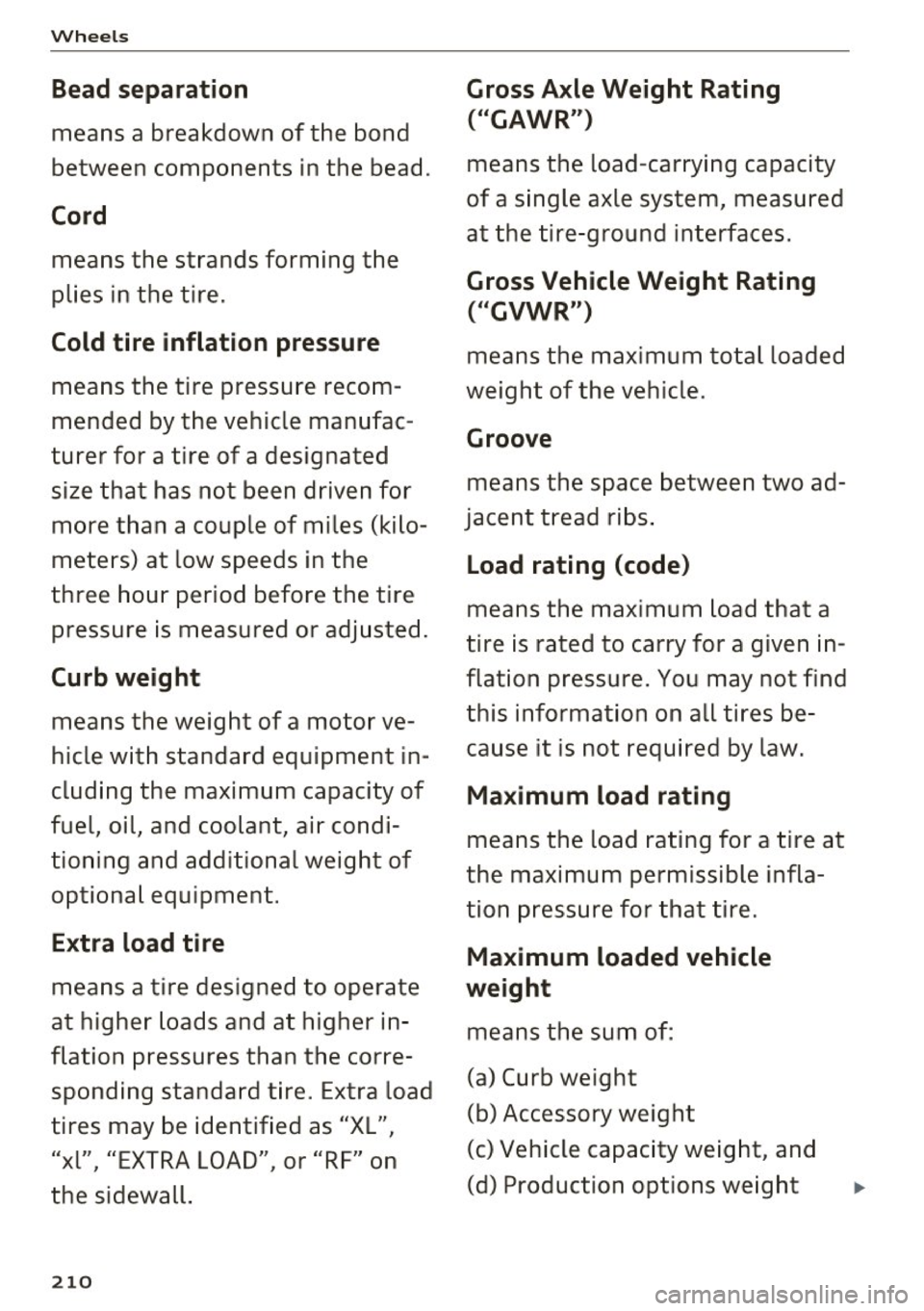
Bead separation
means a breakdown of the bond
between components in the bead .
Cord
means the strands forming the
plies in the tire.
Cold tire inflation pressure
means the tire pressure recom
mended by the vehicle manufac
turer for a tire of a designated
size that has not been driven for more than a couple of miles (kilo
meters) at low speeds in the
three hour period before the tire
pressure is measured or adjusted.
Curb weight
means the weight of a motor ve
hicle with standard equipment in
cluding the maximum capacity of
fuel, oil, and coolant, air condi
tioning and additional weight of
optional equipment.
E x tra load tire
means a tire designed to operate
at higher loads and at higher in
flation pressures than the corre sponding standard tire . Extra load
tires may be identified as "XL",
"xl", "EXTRA LOAD", or "RF" on
the sidewal l.
210
Gross Axle Weight Rating
("GAWR ")
means the load-carrying capacity
of a single axle system, measured
at the tire -ground interfaces .
Gross Vehicle Weight Rating
(" GVWR ")
means the maximum total loaded
weight of the vehicle .
Groove
means the space between two ad
jacent tread ribs .
Load rating (code )
means the maximum load that a
tire is rated to carry for a given in
flation pressure. You may not find
this information on all tires be
cause it is not required by law.
Ma ximum load rating
means the load rating for a tire at
the maximum permissible infla tion pressure for that tire.
Ma ximum loaded vehicle
weight
means the sum of :
(a) Curb weight
(b) Accessory weight
(c) Vehicle capacity weight, and
(d) Production options we ight
Page 221 of 266
Wheels
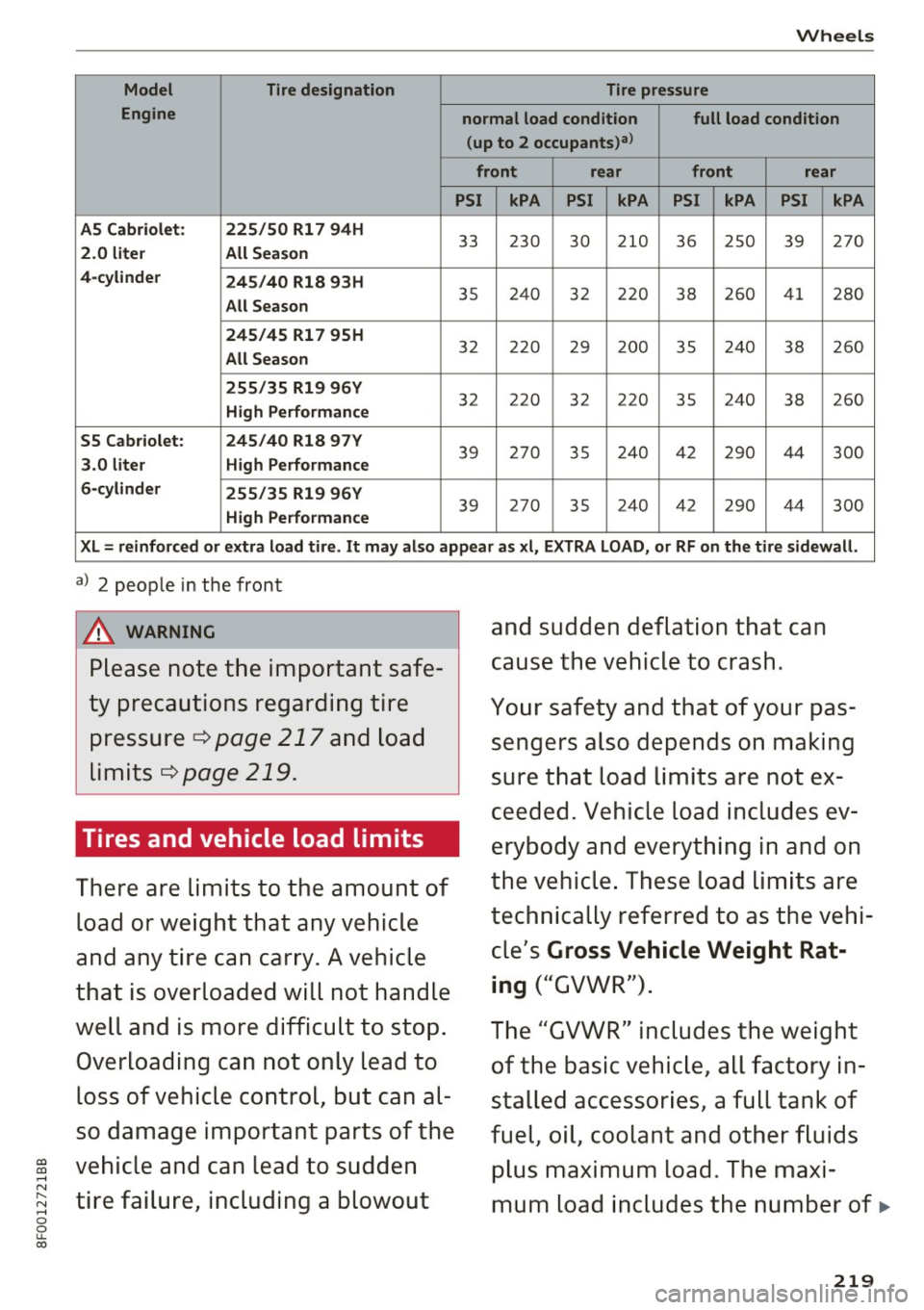
Model Tire designation Tire pressure
Engine normal load condition full load condition
(up to 2 occupants)a)
front rear front rear
PSI kPA PSI kPA PSI kPA PSI kPA
AS Cabriolet: 225/50 Rl 7 94H
33 230 30 210 36 250 39 270 2.0 liter All Season
4-cylinder 245/40 Rl8 93H
All Season
35 240 32 220 38 260 41 280
245/45 Rl7 95H 32 220 29 200 35 240 38 260
All Season
255/35 Rl9 96Y
32 220 32 220 35 240
38 260 High Performance
SS Cabriolet: 245/40 Rl8 97Y
39 270 35 240 42 290 44 300 3.0 liter High Performance
6-cylinder
255/35 Rl9 96Y
High Performance
39 270
35 240 42 290 44 300
XL= reinforced or extra
load tire. It may also appear as xl, EXTRA LOAD, or RF on the tire sidewall.
a) 2 people in the front
A WARNING
Please note the important safe
ty precautions regarding tire pressure
¢ page 217 and load
limits
¢ page 219.
Tires and vehicle load limits
There are limits to the amount of
load or weight that any vehicle
and any tire can carry. A vehicle
that is overloaded will not handle
well and is more difficult to stop. Overloading can not only lead to
loss of vehicle control, but can al
so damage important parts of the
gi vehicle and can lead to sudden ...... N
~ tire failure, including a blowout
0
0
LL 00
and sudden deflation that can
cause the vehicle to crash.
Your safety and that of your pas sengers also depends on making
sure that load limits are not ex
ceeded. Vehicle load includes ev
erybody and everything in and on
the vehicle. These load limits are
technically referred to as the vehi cle's
Gross Vehicle Weight Rat
ing
("GVWR").
The "GVWR" includes the weight of the basic vehicle, all factory in
stalled accessories, a full tank of
fuel, oil, coolant and other fluids plus maximum load. The maxi
mum load includes the number of..,.
219
Page 256 of 266

Index
Engine oil . . . . . . . . . . . . . . . . . . . . . . . . . . . 195
Adding . . . . . . . . . . . . . . . . . . . . . . . . . . . . 197
Addit ives . . . . . . . . . . . . . . . . . . . . . . . . . . . 197
Changing . . . . . . . . . . . . . . . . . . . . . . . . . . 198
Check oil level . . . . . . . . . . . . . . . . . . . . . . 197
Consumption . . . . . . . . . . . . . . . . . . . . . . . 197
Indicator light . . . . . . . . . . . . . . . . . . . . 15, 18
Oi l consumption . . . . . . . . . . . . . . . . . . . . . 196
Pressure malfunction . . . . . . . . . . . . . . . . . 15
Sensor defective . . . . . . . . . . . . . . . . . . . . . . 18
Specification and viscosity . . . . . . . . . . . . . 195
Engine speed limitation . . . . . . . . . . . . . . . . . 18
Environment Catalytic converter . . . . . . . . . . . . . . . . . . . 176
Disposing of your vehicle battery . . . . . . . 206
Driving at high speeds . . . . . . . . . . . . . . . . 177
Fuel ...... .... ........... ........ . . 190
Leaks under your vehicle . . . . . . . . . . . . . . 193
L ett ing the veh icle stand and warm up . . . 177
Proper disposal of drained brake fluid . . . 202
Proper disposal of drained engine coolant 200
Proper disposal of drained engine oil 197, 198
Recycling used engine oil . . . . . . . . . . . . . 197
Unleaded fuel . . . . . . . . . . . . . . . . . . . . . . . 188
What should I do with an old battery? . . . 206
EPC
refer to Electronic power control . . . . . . . . 18
Ethyl alcohol (Fuel) . . . . . . . . . . . . . . . . . . . . 189
E vent Data Recorder (EDR) . . . . . . . . . . . . . 169
Expansion tank . . . . . . . . . . . . . . . . . . . . . . . 199
Exterior lighting . . . . . . . . . . . . . . . . . . . . . . . 48
Exterior mirrors Adjusting . . . . . . . . . . . . . . . . . . . . . . . . . . . 51
Dimming . . . . . . . . . . . . . . . . . . . . . . . . . . . . 52
He ating . . . . . . . . . . . . . . . . . . . . . . . . . . . . . 51
F
Fan
Radiator 201
Fa sten ing
Booster seats . . . . . . . . . . . . . . . . . . . . . . . 158
Convertible child safety seats . . . . . . . . . . 156
Infant seats . . . . . . . . . . . . . . . . . . . . . . . . 155
f lexible fuel . . . . . . . . . . . . . . . . . . . . . . . . . . 189
Floor mats . . . . . . . . . . . . . . . . . . . . . . . . . . . 116
Fog lights/rear fog light(s) . . . . . . . . . . . . . . 48
Folding the rear seats . . . . . . . . . . . . . . . . . . . 64
254
Foot pedals .......................... 116
For the sake of the environment Environmentally-friendly driving . . . . . . . 177
Gasoline fumes and the env ironment . . . . 190
Letting the engine warm up . . . . . . . . . 71 , 73
Refueling . . . . . . . . . . . . . . . . . . . . . . . . . . 190
Saving fuel by early upshifting . . . . . . . . . . . 9
Front airbags Description . . . . . . . . . . . . . . . . . . . . . . . . . 134
How they work . . . . . . . . . . . . . . . . . . . . . . 138
Frontal collisions and the laws of physics . . 123
Front passenger's door emergency locking . . 32
Front seats Adjust ing . . . . . . . . . . . . . . . . . . . . . . . . . . 113
Child restraints in the front seat........ 131
Upper cabin heating . . . . . . . . . . . . . . . . . . . 69
Fuel Additives. . . . . . . . . . . . . . . . . . . . . . . . . . . 188
B lended gasol ine . . . . . . . . . . . . . . . . . . . . 188
Consumption . . . . . . . . . . . . . . . . . . . . . . . . 22
Fuel gauge . . . . . . . . . . . . . . . . . . . . . . . . . . 10
Gasoline additives . . . . . . . . . . . . . . . . . . . 190
Low fuel level symbol . . . . . . . . . . . . . . . . . 18
Octane rating . . . . . . . . . . . . . . . . . . . . . . . 188
Recommendation . . . . . . . . . . . . . . . . . . . . 188
Refuelling . . . . . . . . . . . . . . . . . . . . . . . . . . 190
Reserve . . . . . . . . . . . . . . . . . . . . . . . . . . . . . 10
Saving fuel ......................... 177
T ank capacity . . . . . . . . . . . . . . . . . . . . . . . 244
Tank system . . . . . . . . . . . . . . . . . . . . . . . . . 18
Unlocking the fuel filler flap by hand . . . . 192
Fuel economy messages (efficiency program) .24
F u el filler flap
Unlocking the fuel filler flap by hand . . . . 192
Fuses Assignment ... .. .. .. ....... 234, 235, 236
Replacing . . . . . . . . . . . . . . . . . . . . . . . . . . 234
G
Garage door opene r (Home Link) . . . . . . . . . . 36
Gas discharge lamps ................... 237
Gauges Engine coolant temperature . . . . . . . . . . . . . 8
Fuel gauge . . . . . . . . . . . . . . . . . . . . . . . . . . 10
Tachometer . . . . . . . . . . . . . . . . . . . . . . . . . . 9
General illustration Instruments and controls . . . . . . . . . . . . . . . 6
Page 259 of 266
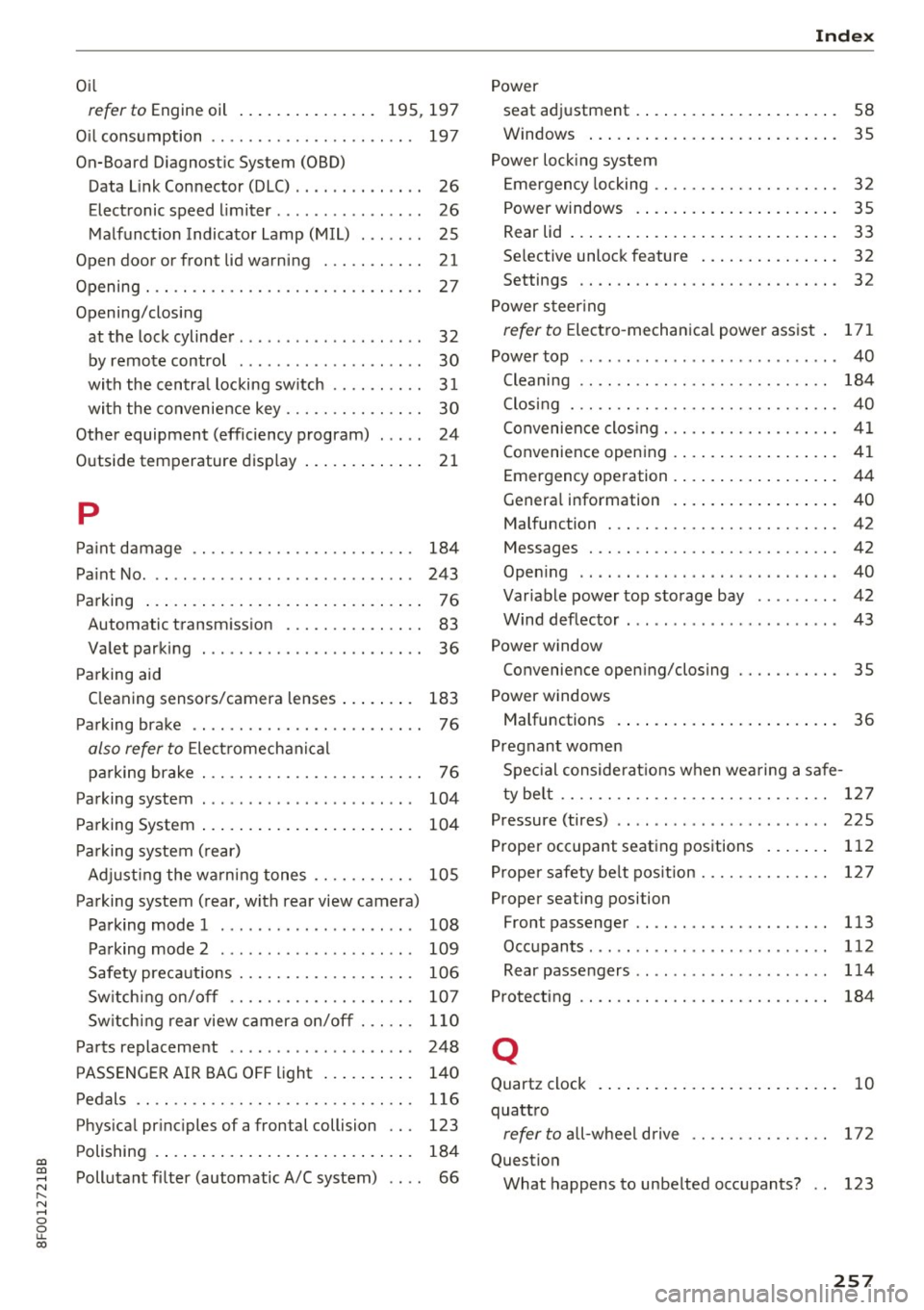
a:,
a:,
...... N r--. N ...... 0
0
LL 00
Oil
refer to Engine oil . . . . . . . . . . . . . . . 195, 197
O il consumption . . . . . . . . . . . . . . . . . . . . . . 197
On-Board Diagnostic System (OBD) Data L ink Connector (DLC) . . . . . . . . . . . . . . 26
Electronic speed limiter . . . . . . . . . . . . . . . . 26
Malfunction Indicator Lamp (MIL) . . . . . . . 25
Open door or front lid warning . . . . . . . . . . . 21
Opening. .. .. .. ............... .. .. .. .. 27
Opening/closing at the lock cylinder. . . . . . . . . . . . . . . . . . . . 32
by remote control . . . . . . . . . . . . . . . . . . . . 30
with the central locking sw itch . . . . . . . . . . 31
with the convenience key . . . . . . . . . . . . . . . 30
Other equipment (efficiency program) . . . . . 24
Outside temperature display . . . . . . . . . . . . . 21
p
Paint damage . . . . . . . . . . . . . . . . . . . . . . . . 184
Paint No. . . . . . . . . . . . . . . . . . . . . . . . . . . . . 243
Parking . . . . . . . . . . . . . . . . . . . . . . . . . . . . . . 76
Automatic transmission . . . . . . . . . . . . . . . 83
Vale t parking . . . . . . . . . . . . . . . . . . . . . . . . 36
Parking aid
C leaning sensors/camera lenses . . . . . . . . 183
Parking brake . . . . . . . . . . . . . . . . . . . . . . . . . 76
also refer to E lectromechanical
parking brake . . . . . . . . . . . . . . . . . . . . . . . . 76
Parking system . . . . . . . . . . . . . . . . . . . . . . . 104
Parking System . . . . . . . . . . . . . . . . . . . . . . . 104
Parking system (rear)
Adjusting the warning tones . . . . . . . . . . . 105
Parking system (rear, with rear view camera) Parking mode 1 . . . . . . . . . . . . . . . . . . . . . 108
Parking mode 2 . . . . . . . . . . . . . . . . . . . . . 109
Safety precautions . . . . . . . . . . . . . . . . . . . 106
Switching on/off . . . . . . . . . . . . . . . . . . . . 107
Sw itching rear view camera on/off . . . . . . 110
Parts replacement . . . . . . . . . . . . . . . . . . . . 248
PASSENGER AIR BAG OFF light . . . . . . . . . . 140
Pedals . . . . . . . . . . . . . . . . . . . . . . . . . . . . . . 116
Physical principles of a frontal collision . . . 123
Polishing . . . . . . . . . . . . . . . . . . . . . . . . . . . . 184
Pollutant filter (automatic A/C system) . . . . 66
Index
Power
seat adjustment . . . . . . . . . . . . . . . . . . . . . . 58
Windows . . . . . . . . . . . . . . . . . . . . . . . . . . . 35
Power locking system
Emergency locking . . . . . . . . . . . . . . . . . . . . 32
Power windows . . . . . . . . . . . . . . . . . . . . . . 35
Rear lid . . . . . . . . . . . . . . . . . . . . . . . . . . . . . 33
Se lective unlock featur e . . . . . . . . . . . . . . . 32
Settings . . . . . . . . . . . . . . . . . . . . . . . . . . . . 32
Power steering
refer to Electro-mechanical power assist . 171
Power top . . . . . . . . . . . . . . . . . . . . . . . . . . . . 40
Cleaning . . . . . . . . . . . . . . . . . . . . . . . . . . . 184
Closing . . . . . . . . . . . . . . . . . . . . . . . . . . . . . 40
Convenience closing . . . . . . . . . . . . . . . . . . . 41
Convenience opening . . . . . . . . . . . . . . . . . . 41
Emergency operation . . . . . . . . . . . . . . . . . . 44
General information . . . . . . . . . . . . . . . . . . 40
Malfunction . . . . . . . . . . . . . . . . . . . . . . . . . 42
Messages . . . . . . . . . . . . . . . . . . . . . . . . . . . 42
Opening . . . . . . . . . . . . . . . . . . . . . . . . . . . . 40
Variable power top storage bay . . . . . . . . . 42
Wind deflector . . . . . . . . . . . . . . . . . . . . . . . 43
Power window Convenience opening/closing . . . . . . . . . . . 35
Power windows
Malfunctions . . . . . . . . . . . . . . . . . . . . . . . . 36
Pregnant women Spec ial considerat ions when wearing a safe-
ty belt . . . . . . . . . . . . . . . . . . . . . . . . . . . . . 127
Pressure (tires) . . . . . . . . . . . . . . . . . . . . . . . 225
Proper occupant seat ing positions . . . . . . . 112
Proper safety be lt pos ition . . . . . . . . . . . . . . 127
Proper seating position Front passenger . . . . . . . . . . . . . . . . . . . . . 113
Occupants ....... .. ................. 112
Rear passengers . . . . . . . . . . . . . . . . . . . . . 114
Protecting . . . . . . . . . . . . . . . . . . . . . . . . . . . 184
Q
Quartz clock . . . . . . . . . . . . . . . . . . . . . . . . . . 10
quattro
refer to all-wheel drive . . . . . . . . . . . . . . . 172
Question What happens to unbelted occupants? . . 123
257