ignition AUDI A5 COUPE 2008 Manual PDF
[x] Cancel search | Manufacturer: AUDI, Model Year: 2008, Model line: A5 COUPE, Model: AUDI A5 COUPE 2008Pages: 313, PDF Size: 13.86 MB
Page 186 of 313
Airbag system
184
– The front passenger's airbag can be reactivated by turning the key to position .Deactivating front passenger 's airbag when a child
safety seat is in use
If you have no alternative but to in stall a rearward-facing child safety
seat on the front passenger's seat you must deactivate the front
passenger's airbag beforehand.
We recommend, however, that child seats should be only fitted on
the rear seat so that the front passenger's airbag can remain func-
tional and provide protection in an accident ⇒page 185 .
Monitoring of airbag system
The airbag warning lamp will light up for a few seconds every time
the ignition is switched on.
If the front passenger's airbag has been deactivated via the key-
operated switch, the indicator lamp “PASSENGER AIRBAG OFF” will
light up constantly as a reminder ⇒fig. 196. Please refer also to the
description of the
warning lamp in the instrument cluster
⇒ page 16 .
When the front passenger's airbag is deactivated using the key-
operated switch, the seat belt warning lamp for the front passenger
⇒ page 17 is also switched off.
WARNING
•
If you have no alternative but to install a rearward-facing child
seat on the front passenger's se at, the front passenger's airbag
must be deactivated beforehand. Potentially fatal injuries to the
child can result if the front pass enger's airbag is not deactvated!
⇒ page 186, “Using a child safety seat on the front passenger's
seat”
•
If you have deactivated the front passenger's airbag, reactivate
it as soon as the child seat is no longer needed so that the airbag
can continue to give the required protection.
•
It is the driver's responsibility to ensure that the key-operated
switch is set to the correct position.Note
All the other airbags in the car will remain functional if the front
passenger's airbag has been deac tivated with the key-operated
switch.
AON
WARNING (continued)
document_0900452a8179700c.book Seite 184 Donnerstag, 22. März 2007 10:19 10
--4 -
-T
[I]
•
-+ +-
Page 204 of 313
Intelligent technology
202Replacing tyres
On vehicles with four-wheel drive, all four tyres must have the same
rolling circumference. Also avoid using tyres with varying tread
depths ⇒page 245, “Replacing wheels and tyres”.
Off-roader?
Your Audi does not have enough ground clearance to be used as an
off-road vehicle. It is therefore best to avoid rough tracks and
uneven terrain as much as possible.
WARNING
•
Even with four-wheel drive, yo u should always adjust your
speed to suit the conditions. Do not let the extra safety provided
tempt you into taking any risks wh en driving – this can cause acci-
dents.
•
The braking ability of your car is limited by the grip of the tyres.
In this respect, your car is no different from a car without four-
wheel drive. So do not be tempted to drive too fast on icy or slip-
pery roads just because the car still has good acceleration in these
conditions (acc ident risk).
•
On wet roads bear in mind that the front wheels may start to
“aquaplane” and lose contact with the road if the car is driven too
fast. If this should happen, ther e will be no sudden increase in
engine speed to warn the driver, as with a front-wheel drive car. So
do not drive too fast in the wet: adjust your speed to suit the
conditions (acc ident risk).
Power managementThis system helps to ensure reliable starting
The power management controls the distribution of elec-
trical energy and thus helps to ensure that there is always
enough power available to start the engine.If a vehicle with a conventional electrical system is left parked for a
long time, the battery will gradually lose its charge because certain
electrical equipment (such as the immobiliser) continues to draw
current even when the ignition is off. In some cases there may not
be enough power available to start the engine.
Your vehicle is equipped with an intelligent power management
system to control the distribution of electrical energy. This signifi-
cantly improves reliability when starting the engine, and also
prolongs the life of the battery.
The main functions incorporated in the power management system
are battery diagnosis , residual current management and dynamic
power management .
Battery diagnosis
The battery diagnosis function constantly registers the condition of
the battery. Sensors dete ct the battery voltage, battery current and
battery temperature. This enables the system to calculate the
current power level and charge condition of the battery.
Residual current management
The residual current management reduces power consumption
while the vehicle is parked. It controls the supply of power to the
various electrical components while the ignition is switched off. The
system takes the battery diagnosis data into consideration.
Depending on the power level of the battery, the individual electrical
components are switched off one after the other to prevent the
battery from losing too much charge and to ensure that the engine
can be started reliably.
document_0900452a8179700c.book Seite 202 Donnerstag, 22. März 2007 10:19 10
--4 -
-T
-+ +-
•
Page 205 of 313
Intelligent technology203
Controls
Safety
Driving tips
General maintenance
Self-help
Technical data
Dynamic power management
While the vehicle is moving, this function distributes the available
power to the various electrical components and systems according
to their requirements. The power management ensures that on-
board systems do not consume more electrical power than the
alternator can supply, and thus
maintains the maximum possible
battery power level.
Note
•
The power management system is not able to overcome the
given physical limits. Please reme mber that the power and life of
the battery are limited.
•
A warning message will appear ⇒page 204, “Driver message in
the instrument cluster display” if the battery power has dropped to
a level where reliable starting is impaired.
Points to remember
Starting ability has first priority.Short trips, city traffic and low te mperatures all place a heavy load
on the battery. In these conditions a large amount of power is
consumed, but only a small amount is supplied. The situation is also
critical if electrical equipment is in use when the engine is not
running. In this case power is consumed when none is being gener-
ated.
In these situations you will be aware that the power management
system is intervening to control the distribution of electrical power.
When the vehicle is parked for long periods
If you do not drive your vehicle for a period of several days or weeks,
the power management will gradually shut off the on-board
systems one by one, or reduce the amount of current they are using.
This limits the amount of power consumed and helps to ensure reli-
able starting even after a long period. Please note that certain convenience features, such as the Audi
advanced key*, the remote control key or the electrical seat adjust-
ment may not be available when yo
u unlock the vehicle. These func-
tions will be restored when you switch on the ignition and start the
engine.
With the engine switched off
If you listen to the radio or us e the other MMI functions when the
engine is not running, this will discharge the battery.
The MMI display will show this wa rning message before the battery
power drops to a level where the starting ability is impaired.
Please start engine, otherwise system will switch off
in 3 minutes.
This message warns you that the system you are using will be
switched off automatically after 3 minutes. You should therefore
start the engine if you wish to continue using the system.
When the engine is running
Although the alternator generates electrical power, the battery can
still become discharged while the vehicle is being driven. This can
occur when a lot of power is being consumed but only a small
amount supplied, especially if the battery is not fully charged
initially.
To restore the necessary energy balance, the system will then
temporarily shut off the electrical components that are using a lot
of power, or reduce the current they are consuming. Heating
systems in particular use a large am ount of electrical power. If you
notice, for instance, that the seat heating* or the rear window
heater is not working, they may have been temporarily switched off
or regulated to a lower heat output. These systems will be available
again as soon as sufficient electrical power is available.
You may also notice that the engine runs at a slightly faster idling
speed. This is quite normal, and no cause for concern. The increased
idling speed allows the alternat or to meet the greater power
requirement and charge the battery at the same time.
document_0900452a8179700c.book Seite 203 Donnerstag, 22. März 2007 10:19 10
--4 -
-T
[I]
•
-+ +-
•
Page 206 of 313

Intelligent technology
204Driver message in the instrument cluster displayIf battery power drops to a level at which you may encounter prob-
lems when starting the engine, the following message will appear
in the instrument cluster display:
Low battery charge: Battery will be charged while driving
This message reminds you that th e starting reliability may be
impaired. The message will disappear as soon as you set off and the
battery is charged.
Message comes on and goes out again
If the message appears in the displ ay after the ignition is switched
on or while driving, and goes out again after a period of time, the
battery has been charged up again sufficiently while the vehicle was
being driven.
Message comes on and does not go out
If the message appears in the displ ay after the ignition is switched
on or while driving, and does not go out again, the battery is not
being maintained at the proper power level. Starting reliability may
be impaired. You should have the battery checked by a qualified
workshop as soon as possible.
document_0900452a8179700c.book Seite 204 Donnerstag, 22. März 2007 10:19 10
--4 -
-T
-+ +-
•
Page 211 of 313
Towing a trailer209
Controls
Safety
Driving tips
General maintenance
Self-help
Technical data
additional mirrors fitted. Both exterior mirrors should be mounted
on hinged extension brackets. Adjust the mirrors to give sufficient
vision to the rear.
Headlights
Before starting a journey, check
the headlight beam settings with
the trailer hitched up. If necessary, alter the height of the headlight
beams by means of the headlight range control ⇒page 56 .
Power supply
When you remove the ignition key the power supply to the trailer is
interrupted.
Removable ball joint coupling
Vehicles with a factory-fitted towing bracket are equipped with a
removable ball joint coupling. It is carried under the floor panel on
the left-hand side of the luggage compartment.
Note
We recommend having the car serviced between the normal inspec-
tion intervals if it used frequently for towing a trailer.Applies to vehicles: with towing bracketTrailer stabilisation system
Trailer stabilisation helps to reduce the risk of the vehicle
skidding when towing a trailer.When is the trailer stab ilisation system activated?
Trailer stabilisation is active when the following requirements are
met:•
The ESP must NOT be switched off ⇒page 196 ,
•
The trailer connector must be properly secured in the vehicle
socket.
•
Vehicle speed must be higher than approx. 60 km/h. How trailer stabilisation works:
In many cases, the driver can stabilise a swaying trailer by manually
braking the vehicle.
However, if the ESP detects that th
e trailer is swaying and this is
affecting the towing vehicle, it will automatically brake the vehicle
to stabilise the trailer by slowing it down. The warning lamp
will
light up in the instrument cluste r. If possible, do not turn the
steering wheel at this stage.
In order to warn traffic behind you, the brake lights will come on
during this automatic braking operation.
A trailer weighing less than 70% of the kerb weight of the towing
vehicle may sway quite considerably without the trailer stabilisation
system intervening. This can happen when the swaying movements
of the light-weight trailer are not or hardly passed on to the towing
vehicle and are therefore not detected by the ESP.
If the system for activating the trai ler brake lights is defective, this
will be indicated in the instrument cluster display ⇒page 36, “Bulb
monitor ”.
Requirements for correct functioning of the trailer
stabilisation system
If these conditions are not met in full, the trailer stabilisation system
will only intervene to a limited extent or not at all ⇒.
•
The electrical connection between the towing vehicle and the
trailer must be functioning correctly, without any defects.
•
The load on the trailer must be properly secured.
•
The tyre pressures on both the vehicle and the trailer must be
adapted to the load that is being carried.
•
Where possible, operate the trai ler with the maximum permitted
draw bar weight.
•
The trailer overrun brake must be set correctly. This is important
to ensure that the trailer can be braked correctly, to avoid the vehicle
and trailer “jack-knifing” and to pr event excess braking of the trailer.
document_0900452a8179700c.book Seite 209 Donnerstag, 22. März 2007 10:19 10
--4 -
-T
•
+-
Page 223 of 313
Care of vehicle and cleaning221
Controls
Safety
Driving tips
General maintenance
Self-help
Technical data
WARNING
•
Do not wash the vehicle with the ignition switched on – risk of
accident.
•
Do not clean the underside of th e car or inside the wheel arches
without protecting your hands and arms. You may cut yourself on
sharp metal parts.
•
Take care when washing the car during the winter: moisture
and ice on the brakes may affect braking efficiency – this could
cause an accident.Caution
•
Do not wash the vehicle in direct sunlight – otherwise the paint
can be damaged.
•
Do not use insect sponges, or abrasive household sponges, etc.
– they can damage the surfaces.
•
The headlights should only be washed with water – do not wipe
them with a dry cloth or sponge . It is best to use soapy water.
•
Never wash tyres with a jet that sprays the water out in a direct
stream. This could damage the tyres – even if the spray is kept at a
distance and only used for a very short time.For the sake of the environment
The car should only be washed in special wash bays. This prevents
oily water from getting into the pu blic drains. In some districts,
washing vehicles anywhere else may be prohibited.Waxing and polishingWaxing
Waxing protects the paintwork. It is time to apply a good coat of wax
when water no longer forms droplets and rolls off the clean paint-
work. Even if a
wax solution is used regularly in the car wash, it is advis-
able to protect the paint with a coat of wax at least twice a year.
In the summer, you will find it is much easier to remove dead insects
(which accumulate on the bumper an d the front of the bonnet) if the
car has been waxed recently.
Polishing
Polishing is only necessary if the paint has lost its shine, and the
gloss cannot be brought back by putting on wax.
The car must be waxed after polishing if the polish used does not
contain wax compounds to seal the paint.
Caution
Matt painted and plastic parts mu st not be treated with wax or
polish.Ornamental trim and mouldingsThe metal brightwork on the body is made of aluminium rather than
chrome (for environmental reasons).
Dirt or marks on the trim mouldings should be removed with an
acid-free cleaning agent (do not use a chrome cleaner). Body polish
is also unsuitable for use on trim mouldings. The intensive cleaning
fluids often used before the car goes into a car wash may contain
alkaline substances, which can cause dull or milky patches when
they dry out.
Audi dealers carry stocks of cleaning products which have been
tested for use on your vehicle and are not harmful to the
environment.
document_0900452a8179700c.book Seite 221 Donnerstag, 22. März 2007 10:19 10
--4 -
-T
CD
CD
-+
•
+-
•
•
Page 229 of 313

Fuel and filling the tank227
Controls
Safety
Driving tips
General maintenance
Self-help
Technical data
Fuel and filling the tankPetrolApplies to vehicles: with petrol enginePetrol grade
The correct grade of petrol is listed inside the fuel tank
flap.The vehicle is equipped with a catalytic converter and must only be
run on unleaded petrol . Unleaded petrol must comply with the
European EN 228 standard. The petrol grades have different octane
ratings (RON). If, in exceptional circumstances, the correct octane
rating is not available, please note the following:•
For engines which require Premium unleaded petrol (95 RON)
according to ⇒page 295, “Performance, weights and dimensions”:
Regular unleaded fuel with 91 RON can also be used. This will,
however, result in a slight loss of power.
•
For engines which require Super Plus unleaded petrol (98 RON)
according to ⇒page 295, “Performance, weights and dimensions”:
Premium unleaded fuel with 95 RON can also be used. This can,
however, result in a slight loss of power under certain driving condi-
tions. – If premium unleaded petrol is not available, the engine can
be run on regular unleaded petrol with 91 RON as an emergency
measure . In this case only use moderate engine speeds and a light
throttle. Avoid using full throttle. Fi ll up with premium or Super Plus
petrol as soon as possible.Caution
•
Petrol complying with the EN 228 standard can contain small
quantities of ethanol. However, “bioethanol fuels”, which are
retailed under various different names such as E50 and E85, and
which contain a large proportion of ethanol, must not be put into
the vehicle, as this would damage the fuel system.
•
Even one tankful of leaded fuel would permanently impair the
efficiency of the catalytic converter.
•
High engine speed and full throttle can damage the engine when
using petrol with an octane rating lower than the correct grade for
the engine.
DieselApplies to vehicles: with diesel engineDiesel fuel
Please note the information on the inside of the fuel tank
flap.Diesel fuel must comply with the European EN 590 standard. It must
have a cetane number (CN) of at least 51. The cetane number indi-
cates the ignition quality of the diesel fuel.
Winter-grade diesel
Diesel fuel can thicken in winter. For this reason petrol stations in
some countries also offer winter diesel.
Caution
•
The vehicle is not designed for the use of biodiesel (FAME fuel).
The fuel system would be damaged if you use biodiesel.
•
Do not mix fuel additives (“thinners”, petrol or similar additives)
with the diesel fuel.
•
If poor-quality diesel fuel is used, it may be necessary to drain
the water separator on the fuel filter more frequently than is speci-
fied in the Service Schedule. We recommend having this done by a
specialist workshop. If water is allowed to collect in the filter, this
can cause engine performance problems.
document_0900452a8179700c.book Seite 227 Donnerstag, 22. März 2007 10:19 10
--4 -
-T
•
-+ +-
CD
CD
•
Page 231 of 313
Fuel and filling the tank229
Controls
Safety
Driving tips
General maintenance
Self-help
Technical data
−
Insert the filler nozzle as far as possible into the spare fuel
canister.
− If the spare fuel canister is made of metal, the filler nozzle
must be in contact with the canister during filling. This helps
prevent an electrostatic charge building up.
− Make sure you never spill fuel in the vehicle or in the luggage
compartment. Fuel vapour is ex plosive. Risk of fatal accident!
Caution
•
If any fuel is spilt onto the vehicle, it should be removed immedi-
ately, as it could otherwise damage the paintwork.
•
Never run the tank completely dry. If there is an irregular fuel
supply, misfiring can occur. As a result unburnt fuel can enter the
exhaust system and cause damage to the catalytic converter(s).
•
When filling the fuel tank after having run it completely dry on a
vehicle with a diesel engine the ignition must be switched on for at
least 30 seconds without starting the engine. When you then start
the engine it may take longer than normal (up to one minute) for the
engine to start firing. This is because air needs to be bled from the
fuel system while starting.For the sake of the environment
Do not try to put in more fuel after the automatic filler nozzle has
switched off; this may cause the fuel to overflow if it becomes warm.
Note
The tank flap is not locked when you lock the vehicle from the
inside.
Releasing the tank flap manually
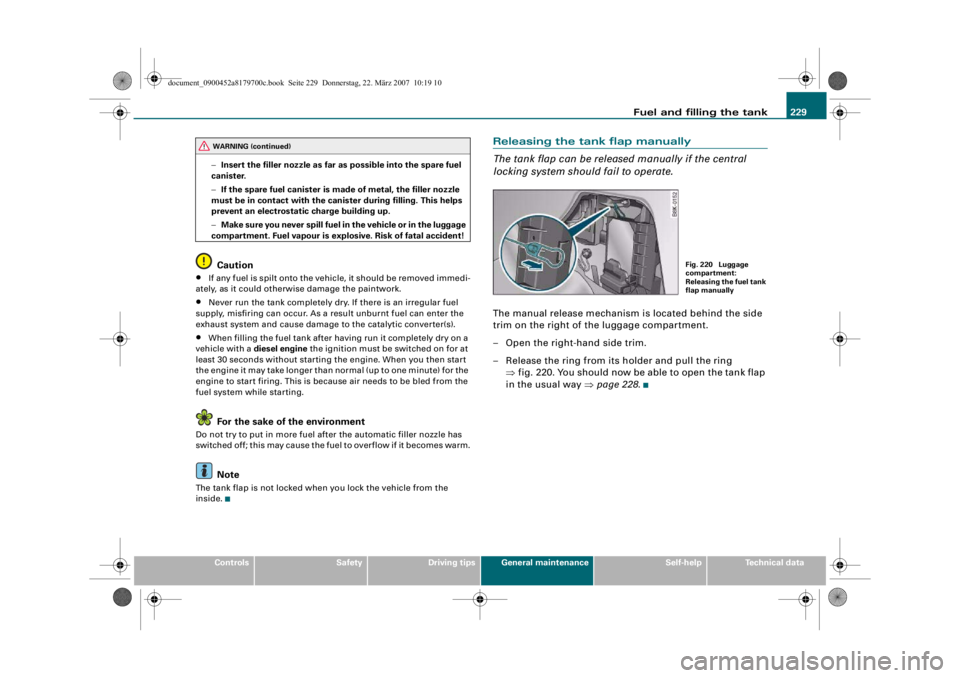
The tank flap can be released manually if the central
locking system should fail to operate.The manual release mechanism is located behind the side
trim on the right of the luggage compartment.
– Open the right-hand side trim.
– Release the ring from its holder and pull the ring
⇒ fig. 220. You should now be able to open the tank flap
in the usual way ⇒page 228 .
WARNING (continued)
Fig. 220 Luggage
compartment:
Releasing the fuel tank
flap manually
document_0900452a8179700c.book Seite 229 Donnerstag, 22. März 2007 10:19 10
--4 -
-T
CD
-+ +-
•
[I]
•
Page 233 of 313
Checking and topping up fluids231
Controls
Safety
Driving tips
General maintenance
Self-help
Technical data
Working on components in the engine compartment
Extra caution is necessary when working on components
in the engine compartment.Always be aware of the danger of injury and scalding as well as the
risk of accident or fire when working in the engine compartment
(e.g. when checking and refilling fluids). Always observe the warn-
ings listed below and follow al l normal safety precautions. The
engine compartment of any motor vehicle is a potentially
hazardous area . ⇒ .
WARNING
•
Switch off the engine.
•
Remove the ignition key.
•
Apply the parking brake.
•
Put the gear lever in neutral or selector in P.
•
Wait for the engine to cool down.
•
Keep children away from engine compartment.
•
Never spill fluids on hot engine components. These fluids can
cause a fire (e.g. radiator anti-freeze).
•
Take care not to cause short circ uits in the electrical system,
especially when working on the battery.
•
Do not touch the radiator fan when the engine is hot. The fan
may start running suddenly.
•
Do not unscrew the cap on the ex pansion tank when the engine
is hot. The cooling system is under pressure.
•
Protect face, hands and arms by covering the cap with a large,
thick rag to protect against escaping coolant and steam.
•
If any tests have to be performed with the engine running,
there is an extra safety risk from the rotating parts, such as the
drive belts, alternator and radiator fan, etc., and from the high-
voltage ignition system.
•
Vehicles with automatic gearbox: Never open the throttle inad-
vertently (for instance by hand from the engine compartment) if a
gear is engaged while the vehicle is stationary with the engine
running. The vehicle could otherwise start moving immediately
and possibly cause an accident.
•
Observe the following a dditional warnings if work on the fuel
system or the electrical system is necessary:
−Always disconnect the battery.
− Do not smoke.
− Never work near naked flames.
− Always keep an approved fire extinguisher immediately
available.Caution
When topping up fluids make sure the correct fluid is put into the
correct filler opening. This can otherwise cause serious malfunc-
tions or engine damage.
For the sake of the environment
Inspect the ground un derneath your vehicle regularly so that any
leaks are detected at an early stag e. If you find oil spots or other
fluids, have your vehicle inspected by a qualified workshop.
Note
On right-hand drive vehicles* some of the containers/ reservoirs
mentioned below are located on the other side of the engine
compartment.
WARNING (continued)
document_0900452a8179700c.book Seite 231 Donnerstag, 22. März 2007 10:19 10
--4 -
-T
-+
CD
+-
[I]
•
Page 236 of 313
Checking and topping up fluids
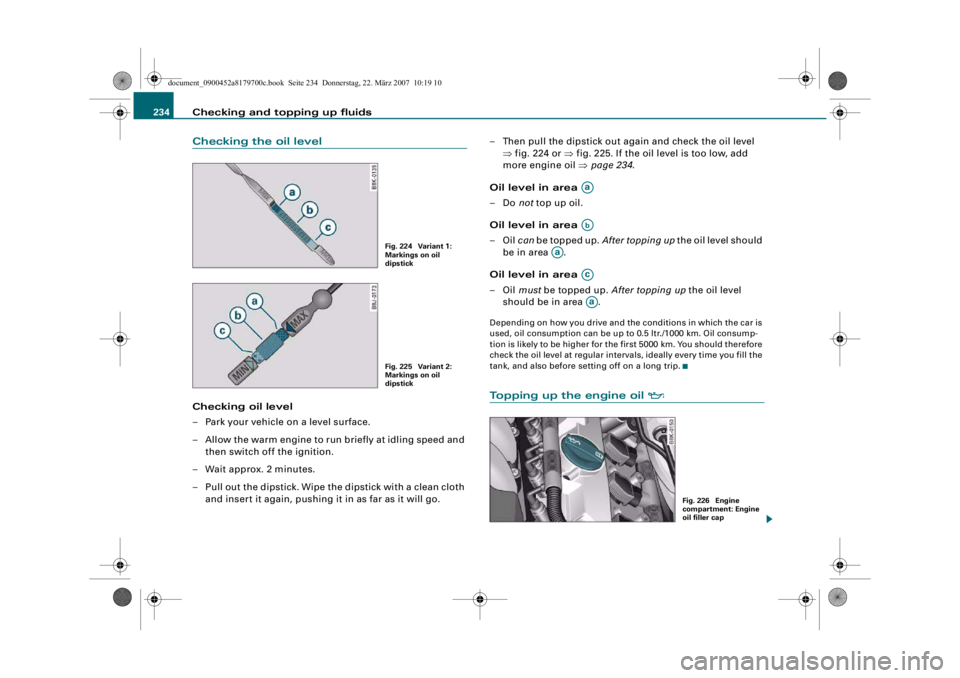
234Checking the oil levelChecking oil level
– Park your vehicle on a level surface.
– Allow the warm engine to run briefly at idling speed and
then switch off the ignition.
– Wait approx. 2 minutes.
– Pull out the dipstick. Wipe the dipstick with a clean cloth and insert it again, pushing it in as far as it will go. – Then pull the dipstick out again and check the oil level
⇒fig. 224 or ⇒fig. 225. If the oil level is too low, add
more engine oil ⇒page 234 .
Oil level in area
–Do not top up oil.
Oil level in area
–Oil can be topped up. After topping up the oil level should
be in area .
Oil level in area
–Oil must be topped up. After topping up the oil level
should be in area .
Depending on how you drive and the conditions in which the car is
used, oil consumption can be up to 0.5 ltr./1000 km. Oil consump-
tion is likely to be higher for the first 5000 km. You should therefore
check the oil level at regular intervals, ideally every time you fill the
tank, and also before setting off on a long trip.Topping up the engine oil
Fig. 224 Variant 1:
Markings on oil
dipstickFig. 225 Variant 2:
Markings on oil
dipstick
AaAb
Aa
AcAa
Fig. 226 Engine
compartment: Engine
oil filler cap
document_0900452a8179700c.book Seite 234 Donnerstag, 22. März 2007 10:19 10
--4 -
-T
-+
•
+-