lock AUDI A5 COUPE 2010 Owners Manual
[x] Cancel search | Manufacturer: AUDI, Model Year: 2010, Model line: A5 COUPE, Model: AUDI A5 COUPE 2010Pages: 360, PDF Size: 84.39 MB
Page 296 of 360

-~_T_ ir_e_ s_ a_ n_d _ w_ h_ e_e _l_s _________________________________________________ _
The tire pressure label on your Audi lists the recommended cold tire
in flation pressures at maximum capacity for the new, origina l equip
ment tires that were on your vehicle at the time it was manufac
tured. For the location of the label
~ page 291, fig. 229 .
Most tires lose air natural ly over time. They can a lso lose some air if
you drive over a pothole or hit a curb while parking. It is usually not
possible to see whether the radial t ires used today are underinflated
just by looking at them.
Therefore, be sure to check tire pressures at least once a month and always before going on a long trip. Make sure to take the number of
people and the amount of luggage into account when adjusting tire
pressure for a trip - even one that you would not consider to be
"long ." See ~
page 295, "Tires and vehicle load limits" for more
important information .
Always use an accurate tire pressure gauge when checking and adjusting inflation pressures. Check a ll of the tires and be sure not
to forget the spare tire . If the pressure in any tire is too high when
the tire is "cold," let air out of the tire s lowly with the edge of the tire
gauge and keep checking the pressure until you reach the pressure
that is correct for the load (passengers and luggage) and kind of
driving you p lan to do.
If the pressure in any tire is too low, note the difference between the
press ure in the cold t ire and the pressure you need and add the air
that you need to reach the correct pressure for the vehicle load
(passengers and luggage) for the tires on your vehicle as listed on
the on your vehicle and in this manual and the kind of driving you p lan to do .
Nev er e xce ed the m aximum i nflation pr essure listed on the tir e
s ide wall for any re aso n .
Reme mber that the veh ic le manufacturer, not the tire manufacturer,
determines the correct tire pressure for the tires on your vehicle .
It is important to check the tire pressure when the tires are cold.
• Read the required tire pressure from the tire pressure label. On
USA vehicles, the tire pressure label is located on the driver's side 8-pillar
. On Canada vehicles , the tire pressure label is located either
on the driver's side B -pi llar or inside the fuel fi ller flap . The ti re pres
sure labe l lists the recommended co ld tire inflation pressures for
the vehicle at its maximum capacity weight and the tires that were
on your vehicle at the time it was manufactured . For recommended
tire p ressu res for normal load conditions, please see chapter
=> page 291.
• Turn the va lve stem cap counte r-clockwise to remove it from the
tire valve.
• Place the air pressure gauge on the valve.
• T he tire pressures should only be checked and adjusted when
the tires are co ld . The s lightly raised pressures of warm tires must
not be reduced .
• Adjust the tire pressure to the load you are carrying.
• Reinstal l the valve stem cap on the valve.
Wh en should I ch ec k th e tir e pr ess ure?
The correct tire pressure is especially important at high speeds. The
pressure should therefore be checked at least once a month and
a lways before starting a journey . Do not forget to check the tire pres
sure for the spare wheel.
When should I adjust the tire p res sure s?
Adjust the tire pressure to the load you are carrying . After changing
a wheel
or replacing whee ls you have to adjust the tire pressu res on
a ll wheels . In addition, you must then initialize the new t ire pres
sures in the tire pressure monitoring system*~
page 307.
& WARNING
Incorrect tire pre ssur es a nd/or und erinflat ion can lead sudden t ire
fa ilure , loss of cont rol , co llision , seri ous person al inj ury or e ven
death.
• When the w arning symbol
f) a ppe ars in the in strument
cluste r, stop and inspe ct th e tires .
Page 304 of 360

___ T_ ir_e_ s _ a_ n_d_ w_ h_ e_e _ l_s _________________________________________________ _
& WARNING
• Using incorrect or unm atched t ires and / or wheels o r improper
tire and wheel combinations can lead to lo ss of control , collision
and se rious per sonal injury .
• Always use tires , rim s and wheel bolts that meet the specifica
t ions of original f actory -installed tire s or other combinations that
have been spe cifically approved by the vehicle manufacturer .
• T ires age even if they are not being used and can fail suddenly ,
especially at high speeds . Tires that are more than 6 years old c an
only be used in an emergen cy and then with spec ial care and at
lower speeds .
• Never mount used tires on your vehi cle if you are not sure of
their "previou s history." Old used tires may have been damaged
e ven though the damage cannot be seen that can lead to sudden
tire failure and loss of vehicle control.
• All four wheels must be fitted w ith radial tires of the same type ,
size (rolling circumference ) and the same tread pattern . Driving
with different tires reduces veh icle handling and can lead to a loss
of control.
• If the spare t ire is not the same as the tires that are mounted
on the vehicle -for example with winter tires -only use the spare
tire for a short period of time and drive with e xtra care . Refit the
normal road wheel as soon as safely possible.
• Never drive faster than the ma ximum speed for which the tires
on your vehicle are rated because tires that are driven faster than
their rated speed can fail suddenly .
• Overloading tires cause heat build -up , sudden tire failure,
in cluding a blowout and sudden deflation and lo ss of control.
• Tempe rature grades apply to tires that are properly inflated and
not over or under inflated .
• For technical reasons it i s not always po ssible to use wheel s
from other veh icles - in some cases not even wheels from the
same vehicle model .
& WARNING (continued )
• If you install wheel trim discs on the vehicle wheels, make sure
that the air flow to the brakes is not blocked . Reduced airflow to
the brakes can them to overheat , increasing stopping distances
and causing a collision .
• Run flat tires may only be used on vehicles that were equipped
with them at the factory . The vehicle must have a cha ssis designed
for run flat tires and a fa ctory-installed tire pressure monitoring
system* that indicates a loss of tire pressure. Incorrect use of run
flat tires can lead to vehicle damage or acc idents . Check with an
authorized Audi dealer or tire specialist to see if your vehicle can
be equ ipped with run f lat tires . If run flat t ires are used , they must
be installed on all four wheels . Mixing tire types is not permitted.
0 Note
• For technical r eas ons, it is not gen erally possible t o us e the
whee l rims from other veh icles . ihis can ho ld true for whee ls of the
same veh ic le type.
• I f the spare tire is different from the tires that you have mounted
o n yo ur vehicl e (f or example wi nter tires or wide p rofile t ires), then
use the spare tire for a short period of time on ly and drive with extra
care . Rep lace the flat tire wi th the ti re m atchi ng t he o thers on you r
vehic le as soon as possib le.
• I f you should put diff ere nt w heels and tires o n your v ehicle (e. g.
winter wheels and tires), you must be certain that the wheels and
t ires are c ompatib le wi th the tire p ressu re monitoring system* .
Otherwise the system will register a malfunction and a fau lt
mes sage will be displayed . For more info rmation, contact your
author ized Aud i dea ler.
0 Note
• When insta lling new t ires, be care fu l not to damage the va lves o r
tire pressure mon itoring system* sensors. .,_
Page 315 of 360

What do I do now? -__________________ __;__:....:....:..:: ___ J?rll
•
& WARNING (continued)
• To help prevent the vehicle from moving suddenly and possibly
slipping off the jack, always fully set the parking brake and block
the wheel diagonally opposite the wheel being changed with the
folding chocks or other objects. When one front wheel is lifted off
the ground, placing the Automatic Transmission in "P" (Park) will
not prevent the vehicle from moving.
• Before you change a wheel, be sure the ground is level and firm.
If necessary, use a sturdy board under the jack.
• After installing the inflatable spare tire, make sure that you
replace the flat tire/wheel in its storage area properly and tighten
the knurled retaining screw securely.
0 Note
If you are changing the wheel on a steep incline, use a rock or
similar object to block the opposite wheel to prevent the vehicle
from moving.
[ i] Tips
Obey all laws.•
Changing a wheel
When you change a wheel, follow the sequence described
below step-by-step and in exactly that order.
1. Remove the decorative wheel cover*. For more details
see also =>
page 314, "Decorative wheel covers".
2. Loosen the
wheel bolts=> page 315.
3. Locate the proper mounting point for the jack and align
the jack below that point=>
page 315.
4. Lift the car with the jack=> page 315.
5. Remove the wheel with the flat tire and then install the
spare tire=> page 317.
6. Tighten all wheel bolts lightly.
7.
Lower the vehicle with the jack.
8. Use the wheel bolt wrench and
firmly tighten all wheel
bolts in a crisscross pattern=>
page 315.
9. Replace the decorative wheel cover*.
_& WARNING
Always read and follow all WARNINGS and information => & in
"Raising the vehicle" on
page 315 and => page 318. •
After changing a wheel
A wheel change is not complete without the doing the
following.
- Store and secure the wheel you replaced in the spare
wheel well.
- Replace the tools and the jack in their proper location.
- Check the
tire pressure of the spare tire as soon as
possible.
- As soon as possible, have the
tightening torques on all
wheel bolts checked with a torque wrench. The correct
tightening torque is 90 ft lbs. (120 Nml.
- Have the flat tire
replaced as soon as possible.
Do-it-yourself service
Page 317 of 360

What do I do now ? 1111
------------------
Loosening and tightening the wheel bolts
The wheel bolts must be loosened before raising the
vehicle .
Loosening
Fig . 242 C han ging a
wh eel: l oose ning th e
whee l bolts
- Install the wheel bolt wren ch over the w heel bol t an d
push it d own as far as i t will go.
Take tight hold of the
end o f the w rench ha ndle and turn
the wheel bolts
c ounter- clockwi se about one single turn
in the di rection of arrow=::, fig . 242.
Tightening
- Install the wheel bolt wren ch over the w heel bolt and
push it down as far as it will go.
- Take tight hold of the
end of the wrench han dle and turn
each wheel bolt
clockwise until it is seated .
& WARNING
• Do not use for ce or hu rry when ch ang ing a whee l - you can
ca use th e vehicle t o slip off th e jack a nd cause ser ious p erso nal
inj urie s.
& W ARNING (continued )
• Do n ot loo sen the wh eel bolt s more than one turn before y ou
rais e the vehicle with the jack . - You ri sk an injur y.
[ i ] Tip s
• Never use the hexagona l socket in the handle of the screwdriver
to loosen or tighten the wheel bolts .
• If a wheel bolt is
very tight, you may find it easier to loosen by
carefully pushing down on the end of the whee l bolt wrench with
one foot only . As you do so , hold on to the car to keep your balance
and take care not to slip. •
Raising the vehicle
The vehicle must be lifted with the jack first before the
wheel can be removed .
Vehicle care
Fig. 243 Cha nging a
w he el: m oun ting
poi nts for the jack ..
Do-it-yourself service irechnical data
Page 319 of 360

_____________________________________________ W_ h_ a_t _d_ o_l _ d_o _ n_o_ w_ ? _ __._
Taking the wheel off /installing the spare tire
Follow these instructions step -by-step for changing the
wheel.
Fig . 245 Changing a
wheel: using the screwdriver handle
!with the blade
removed) to turn the
bolts
Fig . 246 Changing a
wheel: alignment pin
inside the top hole
After you have loosened all wheel bolts and raised the
vehicle off the ground, remove and replace the wheel as
follows:
Removing the wheel
-Remove the topmost wheel bolt completely with the
hexagonal socket in the screwdriver handle (vehicle tool
kit) => fig. 245 and set it aside on a
clean surface. - Screw the threaded end of the
alignment pin from the
tool kit hand-tight into the empty bolt hole=> fig. 246.
- Then remove the other wheel bolts as described above.
- Take off the wheel leaving the alignment pin in the bolt
hole.
Putting on the inflatable spare tire
- Push the spare tire over the alignment pin.
- Screw on t he wheel bolts and tighten them
slightly using
the hexagonal socket.
- Remove the alignment pin and insert and tighten the
remaining wheel bo lt slightly l ike the rest.
- Turn the jack handle counter -clockwise to lower the
vehicle until the jack is fully released .
- Use the wheel bolt wrench to tighten all wheel bolts
firmly =>
page 315. Tighten them Tighten them in a criss
cross pattern ,
from one bolt to the (approximately) oppo
site one, to keep the wheel centered.
- Perform the steps required after changing the wheel
=>
page 313, "After changing a wheel".
The hexagonal socket makes it easier to remove the wheel bolts
from the rim . Care should be taken when removing the reversible
blade.
[ i] Tips
• When mounting tires wi th unidirectional tread design make sure
the tread pattern is pointed the right way~
page 318.
• The wheel bolts should be clean and easy to turn. Check for dirt
and corrosion on the mating surfaces of both the wheel and the .,
Vehicle care Do-it-yourself service irechnical data
Page 324 of 360
-Fuses and bulbs Pffl.,___ ______________ _
No. Consum er Ampere
4 Dynamic steering
35
5 Climatized cupholder 10
6 Vehicle electrical system contro l module 1 35
7 Vehicle electrical system control module
1
20
8 Vehicle electrical system con tro l module 1 30
9 Panorama sunroof
20
10 Vehicle e lectrical system contro l module 1
30
1 1 Panorama sunroof shade 20
12 Convenience electronics 5
Fuse Location, Instrument Panel right
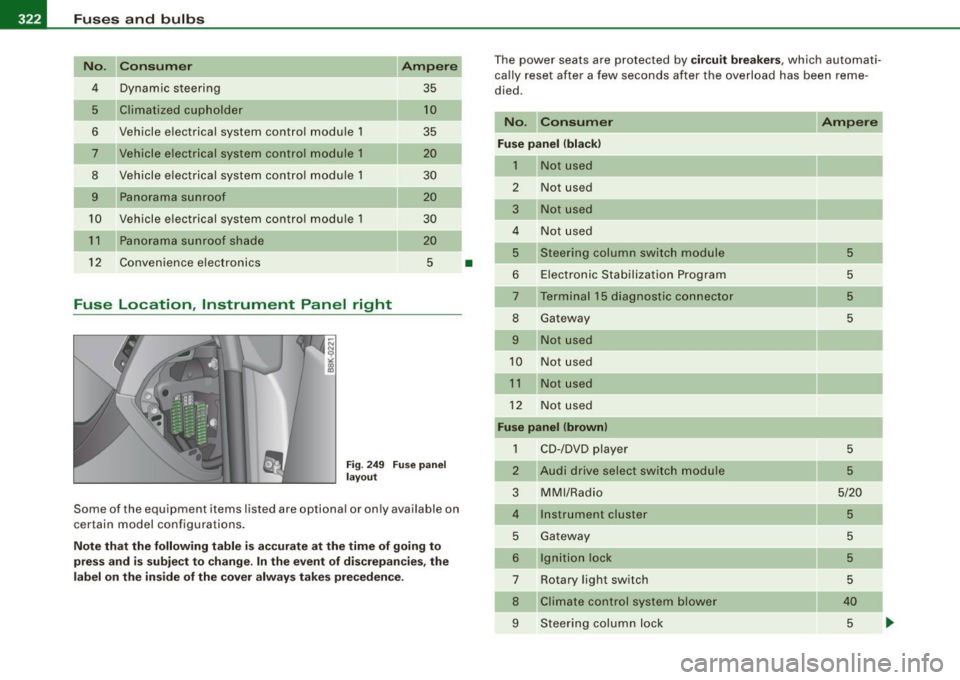
Fig . 2 49 Fuse panel
l ay ou t
Some of the equipment items lis ted are optional or only available on
certain model configurations.
Note th at th e fo llo wi ng t able i s ac cur ate at the time of going to
pr ess an d is s ubje ct to chan ge. In th e eve nt of d iscrep ancies, the
label o n the in side of th e cover alw ays take s pr ece de nce.
•
T he power seats are protected by cir cuit break ers, which automati
cally reset after a few seconds after the overload has been reme
died.
No . Co nsumer
Fu se p anel (blac k)
1 Not used
2 Not used
3 Not used
4 Not used
5 Steering column switch module
6 E
lectronic Stabilization Program
7 Terminal 15 diagnostic connector
8 Gateway
9 Not used
10 Not used
11 Not used
12 Not used
Fu se panel (brown )
1 CD-/DVD player
2 Audi drive select switch mo dule
3 MM I/Radio
4 Instrument cluster
5 Gateway
6 I
gn ition lock
7 Rotary light switch
8 Climate control system blower
9 Steering column lock
Amper e
5
5
5
5
5
5
5/20
5
5
5
5
40
5
Page 330 of 360

lllffl.___E_ m _ e _r-==g :...e_ n_ c...:y _ s_ i_t _u _a _t_ i_o _n_ s _______________________________________________ _
Conn ect POSITIVE
(+) to POSITIVE (+) (red )
- Remove the cover above the jump start connection.
- Open the red cover on the positive pole
~ page 327,
fig. 251.
1. Connect one end of the positive cable (red) on the
jump
start bolt~ page 327, fig. 252 G) (Bolts under red cover
= "positive") of the vehicle to be started @.
2. Connect the other end to the positive terminal @ of the
booster battery @.
Connect NEGATIVE (-) to NEGATIVE (-) (black)
3. Connect one end to the negat ive terminal 0 of the
booster battery ®·
4. Connect the other end of the negative cable (black) to the
jump start bolt@ (Bolts with hex head= "negative") of
the vehicle to be started @.
Starting the engine
- Start the engine of the vehicle with the booster battery.
Run the engine at a moderate speed.
- Start engine with discharged vehicle battery in the usual
manner.
- If the engine fails to start : do not keep the starter
cranking for longer than 10 seconds. Wait for about
30 seconds and then try again.
- With engine running, remove jumper cables from both
vehicles in the exact
reverse order .
- Close the red cover on the positive pole.
T he battery is vented to the outside to prevent gases from entering
th e vehicle interior. Make sure that the jumper clamps are well
connected with their
metal parts in full contact with the battery
terminals.
& WARNING
To avoid serious personal injury and damage to the vehicle , heed
all warnings and instructions of the jumper cable manufacturer.
If
in doubt, call for road service.
• Jumper cables must be long enough so that the vehicles do not
touch .
• When connecting jumper cables, make sure that they cannot
get caught in any moving parts in the engine compartment.
• Do not bend over the batteries -danger of chemical burns!
• The battery cell locking screws must be tightened securely.
• Before you check anything in the engine compartment , always
read and heed all WARNINGS ~ page 263, "Engine compartment".
0 Note
Improper hook-up of jumper cables can ruin the generator .
• Always connect POS ITIVE(+) to POS ITIVE(+), and NEGATIVE(-) to
NEGATIVE( -) ground post of the battery manager control unit .
• Check that all screw plugs on the battery cells are screwed in
firm ly. If not, tighten plugs prior to connecting clamp on negative
battery terminal.
• Please note that the procedure for connecting a jumper cable as
described above applies specifically to the case of your vehicle
being jump started . When you are giving a jump start to another
vehicle, do
not connect the negative(-) cable to the negative{-)
terminal on the discharged battery©~
page 327, fig. 252. Instead,
securely connect the negative(-) cable to either a solid metal
component that is firmly bolted to the engine block or to the engine ..
Page 331 of 360
________________________________________________ E_ m_ e_r ,,::g c..e_ n _ c..::y;._ s_ i_t _u _a_ t_ i_o _n_ s _ ___.ffllll
block itself. If the battery that is being charged does not vent to the
outside, escaping battery gas could ignite and explode! •
Emergency towing with commercial
tow truck
General hints
Your Audi requires special handling for towing.
The following information is to be used by commercial tow truck
operators who know how to operate their equipment safely.
• Never tow your Audi , towing will cause damage to the engine
and transmission.
• Never wrap the safety chains or winch cables around the brake
lines.
• To prevent unnecessary damage, your Audi must be transported
with a flat bed truck.
• To load the vehicle on to the flat bed, use the towing loop found
in the vehicle tools and attach to the front or rear anchorage
~ page 329 and ~ page 330.
& WARNING
A vehicle being towed is not safe for passengers. Never allow
anyone to ride in a vehicle being towed, for any reason. •
Front towing loop
Do not install the front towing loop until it is needed.
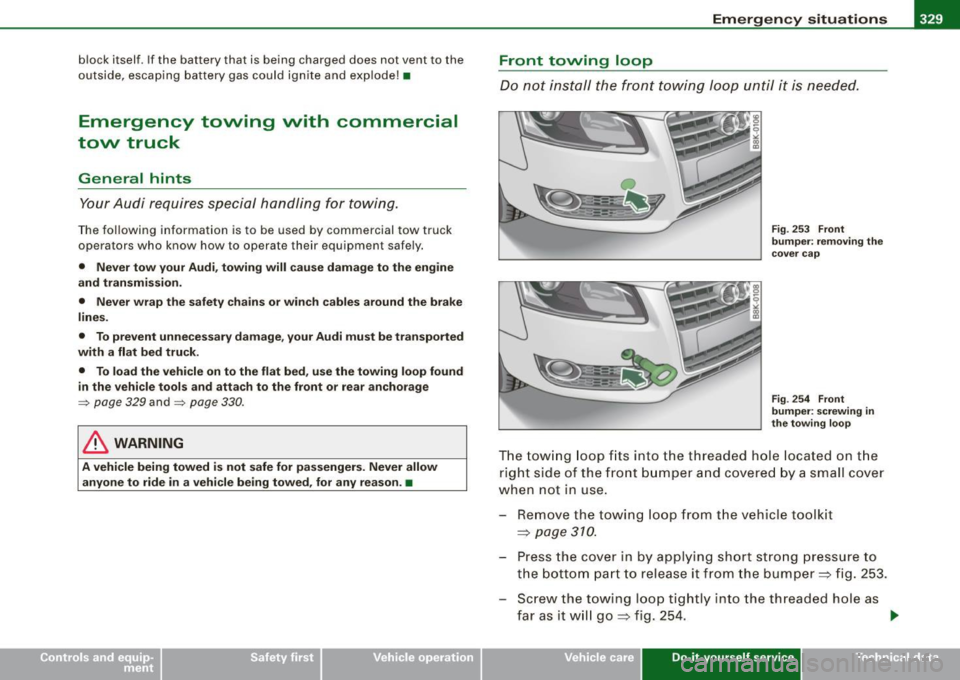
Fig. 253 Front
bumper: removing the
cover cap
Fig . 254 Front
bumper: screwing in
the towing loop
The towing loop fi ts into the thread ed hole located on the
r ight side of the front bumper and covered by a small cover
when not in use.
- Remove the towing loop from the vehicle toolkit
~ page 310.
- Press the cover in by applying short strong pressure to
the bottom part to release it from the bumper~ fig. 253.
- Screw t he towing loop tightly into the threaded hole as
far as it will go
~ fig. 254. ~
Vehicle care Do-it-yourself service irechnical data
Page 334 of 360

-Emergency situations PW:f..._--=---=----------------
& WARNING
• To reduce the risk of serious injury and vehicle damage .
- Always lift the vehicle only at the special workshop hoist and
floor jack lift points illustrated~ page
331, fig. 257 and
~ page 331, fig. 258.
- Failure to lift the vehicle at these points could cause the
vehicle to tilt or fall from a lift if there is a change in vehicle
weight distribution and balance. This might happen, for
example, when heavy components such as the engine block or
transmission are removed.
• When removing heavy components like these, anchor vehicle
to hoist or add corresponding weights to maintain the center of
gravity. Otherwise, the vehicle might tilt or slip off the hoist,
causing serious personal injury.
0 Note
• Be aware of the following points before lifting the vehicle:
- The vehicle should never be lifted or jacked up from under
neath the engine oil pan, the transmission housing, the front or
rear axle or the body side members . This could lead to serious
damage.
- To avoid damage to the underbody or chassis frame, a rubber
pad must be inserted between the floor jack and the lift points.
- Before driving over a workshop hoist, check that the vehicle
weight does not exceed the permissible lifting capacity of the hoist .
- Before driving over a workshop hoist, ensure that there is sufficient clearance between the hoist and low parts of the
vehicle. •
Page 337 of 360
General information -
----------------
left door jamb. It shows the month and year of production and the
vehicle identification number of your vehicle (perforation) as well as
the Gross Vehicle Weight Rating (GVWR) and the Gross Axle Weight
Rating (GAWR).
The high voltage warning label
is located on the lock carrier.
The spark ignition system complies with the Canadian
standard ICES-002. •
Applies to vehicles: with MMI
Identification Number in the MMI
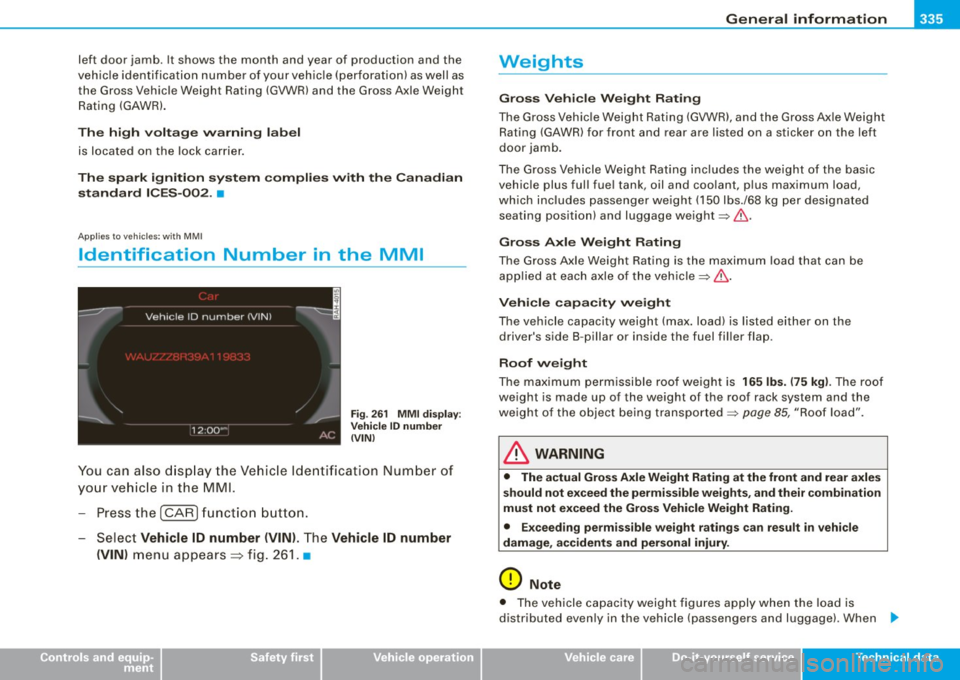
Fig. 261 MMI display:
Vehicle ID number
(VIN)
You can also display the Vehicle Identification Number of
your vehicle in the MMI.
- Press the
I CAR) function button.
- Select
Vehicle ID number (VIN). The Vehicle ID number
(VIN)
menu appears =:> fig. 261. •
Controls and equip
ment Safety first Vehicle operation
Weights
Gross Vehicle Weight Rating
The Gross Vehicle
Weight Rating (GVWR), and the Gross Axle Weight
Rating (GAWR) for front and rear are listed on a sticker on the left
door jamb.
The Gross Vehicle Weight Rating includes the weight of the basic
vehicle plus full fuel tank, oil and coolant, plus maximum load,
which includes passenger weight (150 lbs./68 kg per designated
seating position) and luggage weight:::::,&.
Gross Axle Weight Rating
The Gross Axle Weight Rating is the maximum load that can be
applied at each axle of the vehicle:::::,.&,.
Vehicle capacity weight
The vehicle capacity weight (max. load) is listed either on the
driver's side B -pillar or inside the fuel filler flap.
Roof weight
The maximum permissible roof weight is 165 lbs. (75 kg). The roof
weight is made up of the weight of the roof rack system and the
weight of the object being transported:::::,
page 85, "Roof load".
& WARNING
• The actual Gross Axle Weight Rating at the front and rear axles
should not exceed the permissible weights, and their combination
must not exceed the Gross Vehicle Weight Rating.
• Exceeding permissible weight ratings can result in vehicle
damage, accidents and personal injury.
0 Note
• The vehicle capacity weight figures apply when the load is
distributed evenly in the vehicle (passengers and luggage) . When _,,
Vehicle care Do-it-yourself service Tec hn ica l da ta