headlights AUDI A5 COUPE 2010 User Guide
[x] Cancel search | Manufacturer: AUDI, Model Year: 2010, Model line: A5 COUPE, Model: AUDI A5 COUPE 2010Pages: 360, PDF Size: 84.39 MB
Page 66 of 360
Clear vision
Anti-glar e setting
- Move the small leve r (located on the bottom edge of the
mirror) to the rear. •
Applies to vehi cles: wit h a utom atica lly dimm in g ins id e mirro r
Automatically dimming inside mirror
The aut omatic dimming function can be turned on and off
if required.
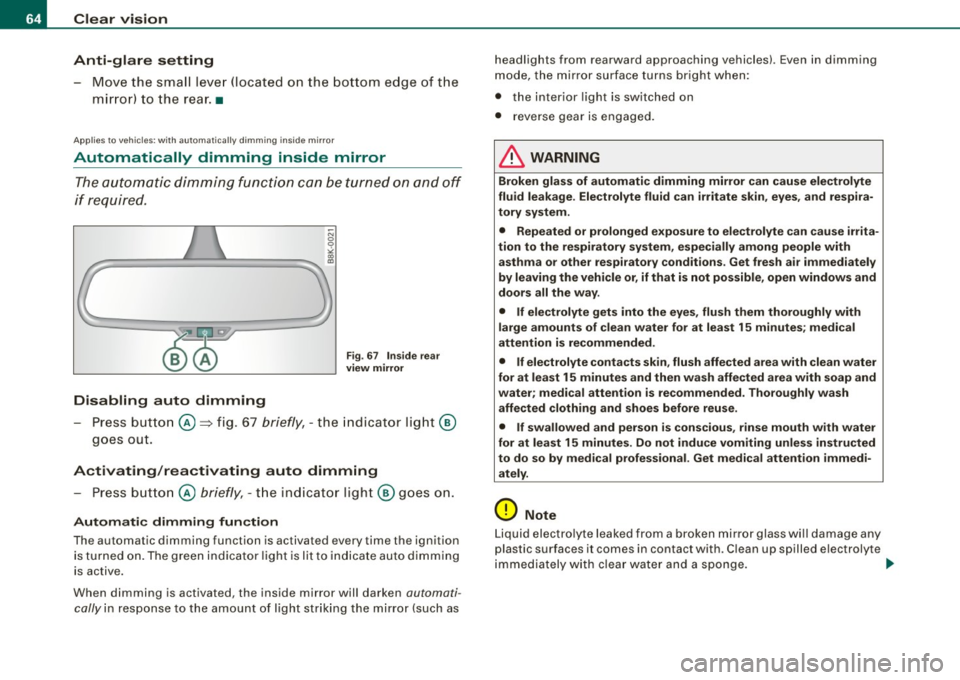
Disabling auto dimming
F ig . 6 7 Ins ide r ear
vi ew mirror
- Press button©=> fig. 67 briefly, -the indicator light @
goes out.
Activating /rea ctivating auto dimming
- Press button© briefly, -th e indicator ligh t@ goes on .
Automatic dimming fun ction
The automatic dimming function is activated eve ry time th e ignition
is turned on . The green indicator light is lit to indicate auto d imming
is active.
When dimming is activated , the inside mirror will darken automati
cally in response to the amount of light striking the mirror (such as headlights from rearward approaching vehicles). Even in dimming
mode,
the mirror surface t urns bright when:
• the inter ior light is switched on
• r everse gear is engaged.
& WARNING
Broken glas s of au tomati c dimming mir ror can cau se elect rol yte
flu id l eaka ge . Ele ctr olyte fluid can irritate s kin , eyes , and re s pir a
t o ry sy stem.
• Repeated or prolonged e xposure to el ectro lyte can cause irrita
ti on to the re spiratory sy stem , espe cially am ong people wi th
a sthm a or other re spirator y conditions . Get fr esh air immediatel y
by leavin g the vehicl e or , if that i s not po ssib le , open window s and
door s all the wa y.
• If electrolyte get s into the eye s, flu sh them thorough ly with
l a rge amou nts of cle a n wa ter for at le ast 15 mi nute s; me dic al
a tt ention is recommended .
• If ele ctrolyte cont acts sk in , flu sh affe cted are a w ith cle an w ater
for a t lea st 15 minute s and then wa sh affe cted ar ea with soap and
wa ter; medi cal attention is re commended . Thoroughl y w ash
affected cloth ing and shoe s before reu se .
• If swallo wed and person is consciou s, rinse mouth w ith w ater
for at lea st 1 5 minute s. Do no t indu ce vomiting unle ss instru cted
to do so by medi cal profess iona l. G et me dica l attenti on immedi
ately.
0 Note
Liquid electro lyte leaked from a broken mir ror glass wi ll damage any
plastic surfaces it comes in contact wi th . C lean up spilled electrolyte
immediately with c lear water and a sponge . ..
Page 67 of 360

[ i J Tips
• If you sw itch off the automatic dimming function on the in side
mirror, autom ati c dimming of the outs ide mirror s will likewise be
di sabled.
• Check to make sure there are no objects preventing light from
reaching the inside mirror.
• Do not attach any sticke rs to the windshield in front of the light
sensor*, as this wou ld interfere with both the automatic operation
of the headlights and the automatic dimming of the inside mirror .
• Be aware that automatic dimming of the inside mirror can on ly
operate proper ly if the rear window sun blind* is retracted .•
Outsid e mirrors
The outside mirrors are electrically adjusted (power
mirrors) .
Adjusting exterior mirrors
Fig. 6 8 Fo rwa rd
se ction of driver's
arm re st : po wer mirr or
c ontrol s
-Rotat e th e kno b to th e© pos ition (driver's exter ior
m ir ror) o r to the ® pos ition (passenger's exterior m irro r)
:::::, fig . 68.
- Rotate the knob a nd t he mi rror so that you have a clear
view to the r ear .
Con tro ls and eq uip
ment
Clear vision
Heated mirrors
- Rotate the knob to pos ition
@ .
Depending on the outside temperature, the mirror surfaces are
heated until the ignition is switched off -even if the knob is no
longer in position
@ .
You are well -advised to fold the outside mirrors in when maneu
vering in tight spaces or when leaving the car parked close to other
vehic les.
Mem ory for e xte rior mirrors *
On vehicles wi th memory for the d river's seat, the cur rent setting for
the ex ter ior mirrors is automatically s tored along wi th the seat posi
tion :::}
page 74.
Tilt function f or the passenge r's mirro r* (only w ith
memory for exterior mirrors )
When the reverse gear is engaged, the mirror surface t ilt s down
ward slight ly if the setting is for the passenger's mirror (knob in
pos it ion @ ~ fig. 68) . This allows you to see the curb during parallel
parking.
The mirror returns to its initia l pos ition as soon as reverse gear is
disengaged and vehic le speed is above about 9 mph (15 km/h) . T he
mirro r also returns to its initia l p osition if the swi tch is moved to the
driver's outside mirror© or the ignition is switched off.
I f the position of the mirror surface is changed on a ti lted mirror, this
new pos it ion will be automa tically assigned to the remote key when
the vehicle is taken out of reverse gear.
0 Note
Curved mirror surfaces (convex or spherical*) increase your field of
v iew . Remember that vehicles or o ther objects wi ll appear sma ller
and farther away than when seen in a flat mirror. If you use this
mirror t o estimate distances of following vehic les when changing
lanes, you cou ld estimate incorrectly and cause an acc ident. .,.
Vehicle care I I irechnical data
Page 256 of 360
___ C_ le_ a _ n_i_n ~g _ a_ n_ d __ p_r _o _t _e _c_ t_ i_o _n ___________________________________________ _
0 Note
• Never try to remove d irt, mud or dust if the surface of the vehicle
is dry . Never use a dry cloth or sponge, since this cou ld scratch your
vehic le's paint or w indows.
• Never wash your car in bright sunlight. Drops of water act as
magnify ing lenses and may damage your paint.
• When you wash your car in the winter : if you rinse your vehicle
with a hose, be careful not to aim the stream of water directly at
locks, or at door or hatch openings -they can freeze shut.
• Never use sponges designed to remove insects, or any kitchen
scouring sponges or similar products. They can damage your paint
finish .
• Never use a dry cloth or sponge to c lean the head ligh ts. Only use
wet cloths or sponges to prevent scratches . It is best to use soapy
water.
For the sake of the environment
In the interest of the environment, the vehicle should on ly be
washed in specia l wash bays. •
Washing your vehicle with a power washer
Cleaning the exterior of your car with a high -p ressure
power washer is safe as l ong as y ou observe a few simple
rules .
-Before using the power washer, make s ure you have read
and understood the WAR NINGS=::;,
& in "General infor
mati on" o n
page 252.
-Always follow the operating instructions for the power
washer. - Make sure that the jet o
n the spray hose pro duces a "fan
sha ped sp ray".
D o
not hold the spray nozzle too close to soft materials.
When cleaning the vehicle with a power washer always follow the
operating instructions. This applies particula rly to the
operating
pre ssure
and the spraying di stance . Maintain a sufficient distance
to soft materia ls such as rubber hoses and sound/vibration dead
ening materia ls (part icularly on the underside of the engine hood).
Do not use a jet which sprays water in a
direct stream or one that
has a
rotating jet.
Water temperature should not exceed 140 °F (60 °Cl.
& WARNING
Never wash tire s with a jet that sp ra ys water in a dir e ct stream .
Thi s could cau se invisible damage to the tire s and we ake n them ,
eve n if th e spra y is from a re lativel y lo ng dis tanc e an d f or a sh o rt
time . Damaged and weakened tire s can f ail and cau se ac cident s
a nd per sona l injur y.
0 Note
To avoid damaging your vehicle, always make sure that there is
suffic ient distance between the spray head and soft materia ls like
rubber hoses, plastic parts and sound -deadening materials . Never
aim the spray head at the same p oint for a long time . This also
applies to cleaning headlights and painted bumpers . Remember :
the c loser the nozzle is to the surface of the material, the greater the
stress on the mater ial. •
Page 284 of 360

-~_C_ h_e _c _ k_ i_n ...:::g::;...._ a_n_ d_ f_ i_ll _in -'g:::;.._ ___________________________________________ _
Have the battery checked when you take your vehicle in for service.
You are well advised to replace a battery that is older than 5 years.
With certain types of airbag deployment, the battery is discon nected from the vehicle electrical system for safety reasons=>
& in
"Repair, care and disposal of the airbags" on
page 202.
Disconnecting the battery terminals
Some vehicle functions (power window regulators, for example) are
lost if the battery terminals are disconnected. These functions have
to be relearned after the battery terminals are connected again . To
prevent this, the battery should only be disconnected from the
vehic le electr ical system when absolute ly necessary for repairs .
Vehicles not driven for long periods
If you do not drive your vehicle over a period of several days or
weeks, electrical components are gradually cut back or switched off.
This reduces energy consumption and maintains starting capability
over a longer period=>
page 241.
Take into consideration that when you unlock your vehicle, some
convenience functions, such as the master key remote function or power seat adjustment, may not be available. The convenience
functions will be available again when you turn on the ignition and start the engine .
Winter operation
During the winter months, battery capacity tends to decrease as
temperatures drop . This is because more power is also consumed
while starting, and the headlights, rear window defogger, etc., are
used more often.
Avoid unnecessary power consumption, particularly in city traffic or
when traveling only short distances . Let your authorized Audi dea ler
check the capacity of the vehicle battery before winter sets in
=>
page 284 . A well charged battery will not only prevent starting
problems when the weather is cold, but will also last longer.
[ i ] Tips
If your vehicle is left standing for several weeks at extremely low
temperatures, the vehicle battery should be removed and stored
where it will not freeze. This will prevent it from being damaged and
having to be replaced. •
Working on the battery
Be especially careful when working on or near the battery.
The battery is located in the luggage compartment under
the floor. Before you check anything in the luggage
compartment,
read and heed all WARNINGS =:>& .
Always heed the safety warnings, when working on the vehicle
battery or the vehicle electrical system to prevent injury.
The following WARNINGS are very important when
working on the battery:
Always heed the following WARNING SYMBOLS and safety pre
cautions when working on the battery.
Always wear eye protection .
Battery acid contains sulfuric acid. Always wear
gloves and eye protection.
Page 326 of 360
11111.___F_ u_ s _ e_s _ a_n _ d_ b_ u_lb _ s _______________________________________________ _
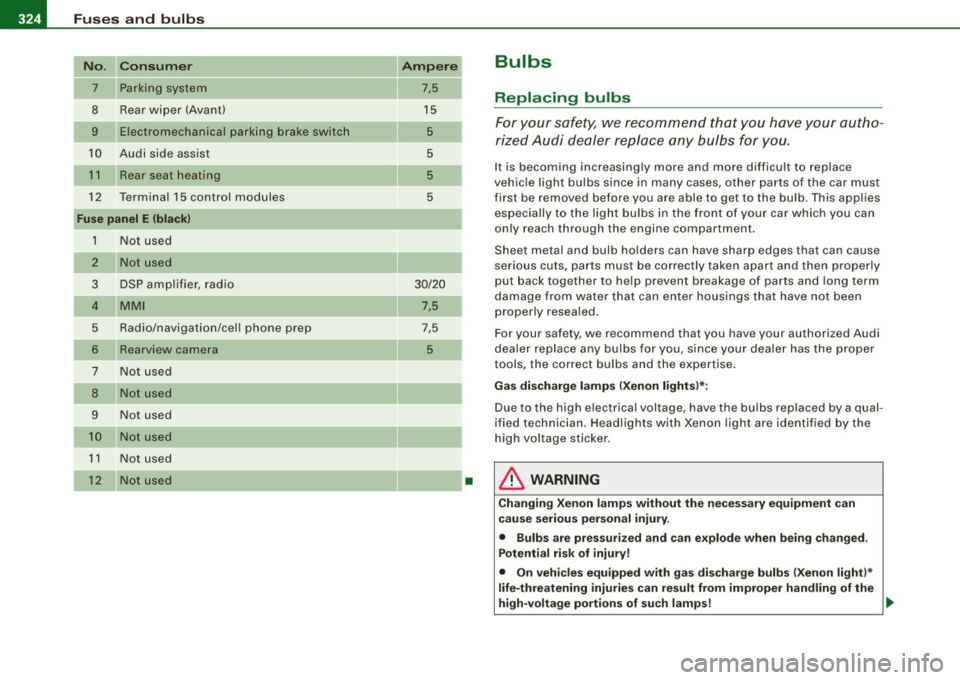
No. Consum er
7 Parking system
8 Rear wiper (Avant)
9 Electromechanical parking brake switch
10 Audi side assist
1 1 Rear seat heating
12 Terminal 15 control modu les
Fu se panel E (bla ck)
1 N ot used
2 Not used
3 DSP amp lifier, radio
4 MMI
5 Radio/navigation/cel l phone prep
6
Rearview camera
7 Not used
8 Not used
9 N ot used
10 Not us ed
1 1 Not used
12 Not used
Ampere
7,5
15 5
5
5
5
30/20
7,5
7,5
5
•
Bulbs
Replacing bulbs
For your s afety, we recommend th at you have your autho
ri zed Audi dealer replace any bulbs for you.
It is becoming increasingly more and more difficult to replace
vehic le light bulbs since in many cases, o ther parts of the car must
first be removed before you are able to get to the bu lb . This applies
especia lly to the light bu lbs in the front of your car which you can
only reach through the engine compartment .
Sheet metal and bulb holders can have sharp edges that can cause
serious cuts, parts must be correctly taken apart and then properly
put back together to help prevent breakage of parts and long term
damage from water that can enter housings that have not been
properly resealed.
Fo r your safety, we recommend that you have your authorized Audi
dea ler replace any bulbs for you, s ince your dealer has the proper
tools, the correct bulbs and the expertise.
Ga s di scharg e lamps (X enon ligh ts)*:
Due to the high electrical voltage, have the bulbs replaced by a qual
ified technician . Headlights with Xenon light are identified by the
high voltage sticker .
& WARNING
Changi ng Xeno n lamp s w ithout th e necess ary e quipm ent can
c a use se riou s pers on al injury .
• Bulb s are p ress urize d and can e xpl ode when being ch ange d.
Po tentia l ri sk of injury!
• On ve hic les equ ippe d with g as disc ha rg e bulb s (Xenon li ght )*
li fe -thre atening injuri es can re sult from impro per h andling of th e
hi gh-v olt age portion s of su ch lam ps! .,_
Page 351 of 360

______________________________________________ A_ l_,_ p _h_ a_ b_e _t_i c_ a _ l _in _ d_e _ x __ lll
Fastening
Booster seats .................... 221
Convertible chi ld safety seats ..... . 219
Infant seats .. ...... ...... ........ 218
Flat tire Changing ....... .... .... ...... .. 312
Floor mats . . . . . . . . . . . . . . . . . . . . . . . . . 175
Fog lights . ....... .... ... .. ... ... .. .. 54
Foot pedals ... ... .. .... .... ...... .. 174
For the sake of the environment Gaso line fumes and the environment 267
Reducing engine noise by early upshifting .. ............ ......... 9
Refueling ..................... .. 267
Saving fuel by early upshifting ....... 9
Front ai rbags
Description ...................... 192
How they work . . . . . . . . . . . . . . . . . . . 197
Front ashtray ... .... .... .... .... .... . 87
Front seats . ... ... .... ... .. .... .... .. 69
Adjusting ... .... .... .... .... ... . 171
Child restraints in the front seat .... 190
Fronta l collisions and the laws of physics
180
Fuel Additives . .............. ......... 265
Blended gasoline ................. 265
Consumption .... ..... ... .... .... . 23
Filler neck ....................... 266
Fuel gauge ...... .... .... ..... .. .. 10
Gasoline ... .. .... .... ... .... .... 265
Gasoline additives .. ...... ...... .. 266
Octane rating ..... .... ... .... .... 265
Controls and equip
ment Safety first
Recommendation
.... ... ... .. .... 265
Refuel ling .... .... .... .... ....... 267
Reserve .......................... 10
Tank capacity .... ...... ....... ... 337
Un locking the fue l filler flap by hand 269
Fuel filler flap
Un locking the fuel filler flap by hand 269
Fuel supply too low ....... .. .... .... .. 35
Fuse arrangement ... .... .... ..... .. . 320
G
Garage door opener (Homelink®) 164
Gas discharge lamps .... ........ .... 324
Gauges Engine coolant temperature . .... ..... 8
Fuel ga uge ... .. .... .... .... .... .. 10
Tachometer ..... .... .... .... .... .. 9
Gearshift indicato r .. ........ .... .... . 20
Gearshift lever 6-speed manual transmission ... ... 147
General illustration
I nstruments and contr ols ... .. .... ... 7
G lossary of tire and loading terminology .. .
288
G love compartment ... .. .... ..... .. .. 89
Gross Vehicle Weight Rating (GVWR) ... 335
H
Head lights
Fog lights ... ....... .............. 54
Rear fog lights ... .... .... .. ....... 54 Head restraints
..... . .. .. ...... ..... 173
Adjusting .. .... .... ... .... .... ... 173
Front seats ... .... .... .... ..... ... 76
Rear seats ........................ 77
Headlight Washer system .... .... ... .... ..... 61
Headlight washer rese rvoir ...... ... .. 286
Headlights Adaptive ligh t .. ... .... .... .... .... 57
Head light range control defective .... 36
Heatable Front seats ... .... .... ... ... .... . 105
Heated Rear window ...... .... .... .... 95, 102
Washer fluid nozzles . ..... .... .... . 61
Hea ted outside m irrors ....... .... .... . 65
Heater Deluxe automatic climate contro l .... 90
Hea ting
Deluxe au tomatic c limate con trol plus 96
Heavy clothing and safety be lts .... .... 182
High beam ... .... ..... .. .... ...... .. 58
Warning/indicator lights .... .... .... 15
High vo ltage warning la b el . ...... ... . 334
Home link® universal remote control .. . 164
Hood Opening .. ........ ....... .... ... 270
Release lever ... .... ..... .. ...... . 270
Horn . ...... .... .... ... .... .... ..... . 7
How are chi ld restraint system anchors relat-
ed to child safety .. ...... .... .... 227
How many airbags does my vehicle have? ..
195
Vehicle operation Vehicle care Do-it-yourself service Technical data
Page 352 of 360

___ A_l.:,. p _h_ a_ b_e _t _ic _ a_l _in _ d_e _x ____________________________________________ _
How often should I check my tire pressures?
294
How safety be lt pretensioners work . . . 186 Interval wiping
Rain sensor .
.. ..... .. ... ... .. .... 61
61
Hydroplaning ..... .. .... .... ..... .. 298
J
I
Ignition key .... ... .. .... .... ...... . 108
Emergency unlocking .............. 40
Ignition lock ...... ...... .... ...... . 108
Malfunction ................... 32, 36
Immobilizer .. ............... ..... 11, 38
Important things to do before driving . . 169
Im proper ly worn safety belts . . . . . . . . . 186
Indicator light
Dynam ic steering ... ... .... .. .. 13, 33
Indicator lights ........... ...... ..... 12
Airbag system . . . . . . . . . . . . . . . 199, 200
PASSENGER AIR BAG OFF . . . . . . . . . 200
Infant seats ..... ................... 218
Inside rear view mirror ......... ....... 64
Installing child safety seats
Safety belts . . . . . . . . . . . . . . . . . . . . . 223
Installing the upper tether strap on the
anchorage ................. .... 231
Instrument lighting .............. .... 56
Instruments and controls .............. 8
General illustration ................. 7
Interior lights
Dimming ................. .... ... 59
Front ................. ........... 59
Rear . ..... ... .... ........ .... ... 59 Jumper cables ........
............ .. 327
Jump -starting 326
K
Key ......... .... ...... ....... ...... 38
Battery replacement . . . . . . . . . . . . . . . 39
Key replacement . . . . . . . . . . . . . . . . . . 38
Master key with remote contro l ..... 38
Mechanica l key ................... 40
Kick -down
tiptronic ...... ............. ..... 151
Knee airbags ................ ....... 204
Description ............ ..... .. ... 204
How they work . . . . . . . . . . . . . . . . . . . 205
Important safety instructions 206
L
LATCH .................. ..... .. ... 227
Description ... ....... ...... ...... 228
Installing a child restraint ......... 229
Location ......... ............... 228
Mounting and releasing the anchorage hook ........ ........ .......... 229
Leather ... .... .... .. ..... ...... .... 260
Cleaning ..... .... ... .... ....... . 261
Lifting jack .. .... ....... ...... ...... 315
Lifting vehicle ...................... 331 Light
Coming home .................... 55
Daytime running lights . .... .... .... 55
Driving light control ....... .... .... 53
Exterior light ing ................... 55
Leaving home ......... ... .... .... 55
Switching on and off ... .... .... .... 53
Light sensor .... .... ... ..... ... .. .... 53
Light sensor defective ........ .... .... 34
Lighting ...... ........... .... .... ... 53
Lights Emergency flashers .... .... .... ... . 57
High beam . ... ... ... .. ..... ...... 58
High beam warning/indicator light ... 15
Turn signals ...................... 58
Xenon headlights .. ........ ... .... 56
Loading the luggage compartment 175
Locking Power locking switch ...... .... .... 46
R ear lid/trunk lid . ...... .... .... ... 47
Remote control key . . . . . . . . . . . . . . . . 43
Using the mechanical key .. .... .... 45
Low beams . ... .. .... .... ...... .... . 53
Low -beam headlight
De fective ......................... 35
Lower anchorage locator button ...... 228
Lower universal anchorage bars (Canada) ...
227
Lower universal anchorages (Canada) 227
Luggage Stowing ........ .. .............. 175
Page 358 of 360
___ A_l.:,. p _h_ a_ b_e _t _ic _ a_l _in _ d_e _x ____________________________________________ _
Glossary of tire and loading terminology
288
New tires and wheels . . . . . . . . . . . . . 299
Tires and vehicle load limits ... .... 295
When must a safety belt be replaced? . . 182
When must the airbag system be inspected? 199
When should I adjust the tire pressures?
294 T
ires ... .. .... ..... .. ... ... .... . 240
Windows .. ... ...... ...... ...... 256
Winter tires ...... ...... .... ... .. ... 304
All -wheel drive ................ ... 304
Wiper blades Installing new wipe r blades ..... .... 63
X
When should I check the tire pressures? 294 Xenon headlights ....... ...... ... 56, 324
Where can I find the tire pressures for my
car? .......................... 293
Why safety belts? . . . . . . . . . . . . . . . 179 , 180
Window regulators Malfunctions ...... .... ........... 50
Power locks ........... .. .... .... . 49
Windows Cleaning ........................ 256
Windshield defogging/defrosting 95, 102
Windshield washer fluid Low level ... .. .... .... ...... ... .. 35
Windshield wiper Insta lling new wiper b lades ......... 63
Windshield wipers .... ....... ....... . 61
Faulty ... ................ .... .... 37
Service position . . . . . . . . . . . . . . . . . . 62
Washer reservoir . . . . . . . . . . . . . . . . . 286
Winter operation Battery . . . . . . . . . . . . . . . . . . . . . . . . . 281
Coolant system ............. .... . 277
Defrosting windows ... ...... .. 95, 102
Front seat heating . . . . . . . . . . . . . . . . 105
y
Yellow symbols .. ....... ....... .. .... 32