automatic transmission AUDI A5 COUPE 2010 Owner's Manual
[x] Cancel search | Manufacturer: AUDI, Model Year: 2010, Model line: A5 COUPE, Model: AUDI A5 COUPE 2010Pages: 360, PDF Size: 84.39 MB
Page 253 of 360

-Place an automatic transmission* in P, respectively a
manual transmission in first or reverse gear.
When restarting after parking :
- Apply the foot brake .
- Start the engine.
- Move t he selector lever to
D, respectively a manual trans-
mission in first gear.
- Release the parking brake and slowly pull out and away
from the wheel chocks.
- Stop and have someone retrieve the wheel chocks .
[ i ] Tips
If you move the selector lever of the automatic transmission * to P
before applying the parking b rake and before blocking the wheels,
you may have to use more force later to move the lever out of the P
position .•
Controls and equip
ment Safety first Vehicle operation
Trailer towing
Vehicle care Do-it-yourself service
Technical data
Page 273 of 360
Checking and filling IJI
--------------~-
•
Closing the engine hood
-Pull the hood down until the pressure from the struts is
reduced .
- Let the hood
drop down and latch in place. Do not try to
push it shut;
it may fail to engage => &.
& WARNING
A hood that is not completely latched could fly up and block your
view while driving.
• When you close the engine hood, check it to make sure the
safety catch has properly engaged. The hood should be flush with
the surrounding vehicle body parts.
• If you notice while driving that the hood is not secured prop
erly, stop at once and close it. •
Working in the engine compartment
Be especially careful whenever you work in the engine
compartment.
Whenever you must perform any work in the engine compartment,
for example checking and filling different fluids, there is a risk of injury, burns and accidents. To prevent personal injury always
observe the following WARNINGS. The engine compartment of any
vehicle is a hazardous area
~ & .
& WARNING
To help avoid injury, before you check anything under the hood :
• Turn off the engine.
• Remove the ignition key.
• Apply the parking brake .
& WARNING (continued)
• Move selector lever of automatic transmission to "P" (Park);
put manual transmission in Neutral .
• Always let the engine cool down. Hot components will burn
skin on contact.
• To reduce the risk of being burned, never open the hood if you
see or hear steam or coolant escaping from the engine compart
ment. Wait until no steam or coolant can be seen or heard before
carefully opening the hood .
• Keep children away from the engine compartment.
• Never spill fluids on hot engine components . They can cause a
fire.
• Never touch the radiator fan. The auxiliary electric fan is
temperature controlled and can switch on suddenly.
• Never open the coolant reservoir cap when the engine is still
warm. The coolant system is pressurized and hot coolant could
spray out.
• Protect your face, hands and arm from steam or hot engine
coolant by placing a thick rag over the cap when you open the
coolant reservoir.
• If work on the fuel system or the electrical system is necessary:
- Always disconnect the battery.
- Never smoke or work near heaters or open flames. Fluids in
the engine compartment could start a fire .
- Keep an approved fire extinguisher immediately available.
• To avoid electrical shock and personal injury while the engine
is running or being started, never touch :
- Ignition cables
- Other components of the high voltage electronic ignition
system.
• If you must perform a check or repair with the engine running: ..,
Vehicle care
I t •
Page 274 of 360
-Checking and filling
---=---------------
& W
ARNING (continued )
-First, fully apply the park ing brake, move selector lever of
automatic transmission to "P " (Park ); put manual transmission
in Neutral.
- Alway s use extreme c aution to prevent clothing , jewel ry , or
long hair from gettin g caught in the radiator fan , V-belts or
other moving parts , or from contacting hot parts. Tie back hair
before starting , and do not wear clothing that will hang or
droop into the engine .
• Minimize exposure to emission and chemi cal hazard s
=> &.
& WARNING
Californ ia Proposition 65 Warning :
• Engine exhaust , some of its constituents , and certa in vehicle
component s contain or emit chemicals known to the State of Cali
fornia to cause cancer and birth defe cts and reproductive h arm . In
addition, certain fluid s contained in vehicles and certain products
of component wear contain or emit chem icals known to the State
of California to cause cancer and birth defects or other reproduc
tive harm.
• Battery posts , terminals and related ac cessories contain lead
and lead compounds , chem icals known to the State of California
to cause cancer and reproductive harms. Wash hand s after
handling .
0 Note
When adding fluids, always make sure that the y are poured into the
proper container or filler opening, otherwise serious damage to
vehicle systems will occur .
<£' For the sake of the environment
To detect leaks in t ime, inspect th e ve hicle floor pan from unde r
neath regularly. If you see spots from oil or other vehic le fluids, have
you r ve hicle i nsp ected by a n authori zed Audi dealer .•
Engine compartment
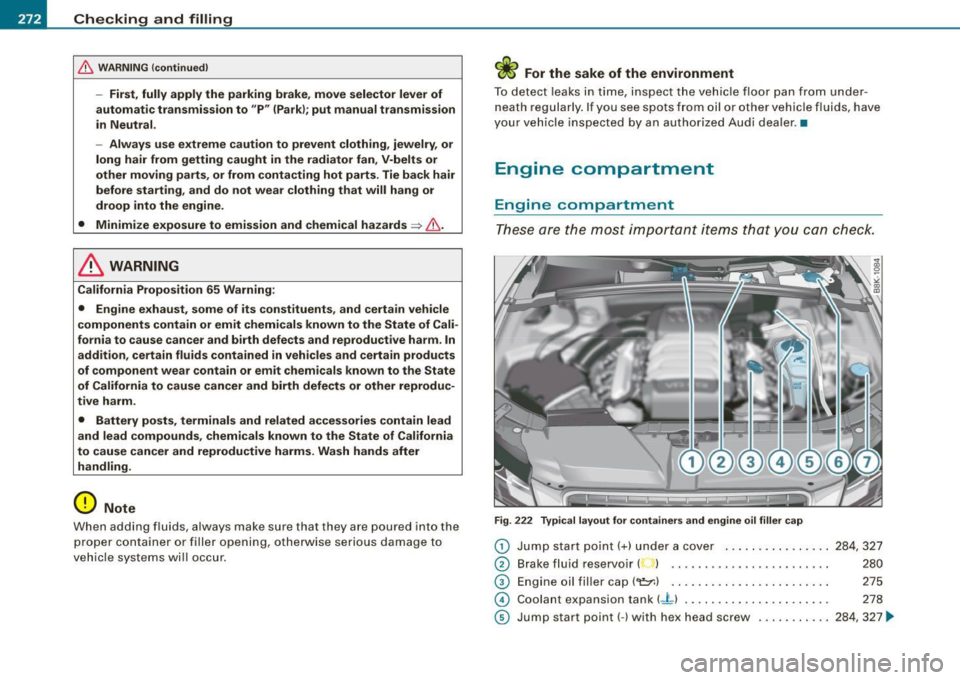
Engine compartment
Thes e are the most impor tant items tha t yo u can check .
Fig. 22 2 Typic al l ayout for containe rs and engine oil filler cap
G) Jump start poin t(+ ) under a cover ..... .... .... ... 28 4, 327
® Brake fluid reservoir I l . . . . . . . . . . . . . . . . . . . . . . . . 280
© E ngine oil fi ller cap ("1:::r.l . . . . . . . . . . . . . . . . . . . . . . . . 275
0 Coolant expansion tank (-L l . . . . . . . . . . . . . . . . . . . . . . 278
© Jump sta rt point( -) with hex head screw ........ ... 28 4, 327 ~
Page 290 of 360

-~_T_ ir_e_ s_ a_ n_d _ w_ h_ e_e _l_s _________________________________________________ _
& WARNING (continued)
crashes and serious personal injuries . Have worn or damaged tires
replaced immediately.
• Tires age even if they are not being used and can fail suddenly,
especially at high speeds. Tires that are more than 6 years old can
only be used in an emergency and then with special care and at
low speed.
Glossary of tire and loading terminology
Accessory weight
means the combined weight (in excess of those standard items
which may be replaced) of automatic transmission, power steering,
power brakes, power windows, power seats, radio, and heater, to
the extent that these items are available as factory-installed equip
ment (whether installed or not).
Aspect ratio means the ratio of the height to the width of the tire in percent.
Numb ers of 55 or lower indicate a low sidewall for improved
steering response and better overall handling on dry pavement.
Bead
means the part of the tire that is made of steel wires, wrapped or reinforced by ply cords and that is shaped to fit the rim.
Bead separation means a breakdown of the bond between components in the bead.
Cord
means the strands forming the plies in the tire.
& WARNING (continued)
• Never mount used tires on your vehicle if you are not sure of
their "previous history." Old used tires may have been damaged
even though the damage cannot be seen that can lead to sudden
tire failure and loss of vehicle control.
• If you notice unusual vibration or if the vehicle pulls to one side
when driving, always stop as soon as it is safe to do so and check
the wheels and tires for damage . •
Cold tire inflation pressure
means the tire pressure recommended by the vehicle manufacturer
for a tire of a designated size that has not been driven for more than
a couple of miles (kilometers) at low speeds in the three hour period
before the tire pressure is measured or adjusted.
Curb weight means the weight of a motor vehicle with standard equipment
including the maximum capacity of fuel, oil, and coolant, air condi
tioning and additional weight of optional equipment.
Extra load tire
means a tire design to operate at higher loads and at higher infla
tion pressures than the corresponding standard tire. Extra load tires
may be identified as "XL",
"xi", "EXTRA LOAD", or "RF" on the side
wall.
Gross Axle Weight Rating ("GAWR")
means the load-carrying capacity of a single axle system, measured
at the tire -ground interfaces.
Gross Vehicle Weight Rating ("GVWR"l
means the maximum total loaded weight of the vehicle.
Page 314 of 360

-What do I do now?
...__ ______________
_
& WARNING
• Never use the spare tire if it is damaged or if it is worn down to
the tread wear indicators.
• If the spare tire is more than 6 years old, use it only in an emer
gency and with extreme caution and careful driving.
• The spare tire is intended only for temporary and short-term
use. It should be replaced as soon as possible with the normal
wheel and tire.
• After mounting the compact spare tire, the tire pressure must
be checked as soon as possible. The tire pressure of the compact
spare tire must be 4.2 bar; otherwise, you risk having an accident.
• Do not drive faster than 50 mph (80 km/h) . You risk having an
accident.
• Avoid full-throttle acceleration, heavy braking, and fast
cornering. You risk having an accident.
• Never drive using more than one spare wheel and tire. You risk
having an accident.
• Normal summer or winter tires must not be mounted on the
compact spare wheel rim.
• For technical reasons, the use of tire chains on the spare tire is
not permitted. If it is necessary to drive with tire chains, the spare
wheel must be mounted on the front axle in the event of a flat in a rear tire . The newly available front wheel must then be installed in
place of the rear wheel with the flat tire. Installing the tire chain
before mounting the wheel and tire is recommended.
• Loose items in the passenger compartment can cause serious
personal injury during hard braking or in an accident.
- Never store the inflatable spare tire or jack and tools in the
passenger compartment .
- Always store all jacking equipment, tools, and the inflatable spare tire in the luggage compartment.
- Tighten the knurled retaining screw for the inflatable spare
tire securely. •
Changing a wheel
Before changing a wheel
Observe the following precautions for your own and your
passenger's safety when changing a wheel.
After you experience a tire failure, pull the car well away
from moving traffic and try to reach level ground before
you stop :::;. & .
All passengers should leave the car and move to a safe
location (for instance, behind the guardrail) :::;,& .
- Engage the parking brake to prevent your vehicle from
rol ling unintentionally :::;.& .
Shift into 1st gear on vehicles with manual transmission,
or move the selector lever to the P position on vehicles
w ith automatic transm ission* .
If you are towing a trailer: unh itch the trailer from your
vehicle.
Take the jack :::;.
page 310 and the spare tire~ page 311
out of the luggage compartment.
& WARNING
You or your passengers could be injured while changing a wheel if
you do not follow these safety precautions:
• If you have a flat tire, move a safe distance off the road. Turn off
the engine, turn the emergency flashers on and use other warning
devices to alert other motorists.
• Make sure that passengers wait in a safe place away from the
vehicle and well away from the road and traffic.
~
Page 315 of 360

What do I do now? -__________________ __;__:....:....:..:: ___ J?rll
•
& WARNING (continued)
• To help prevent the vehicle from moving suddenly and possibly
slipping off the jack, always fully set the parking brake and block
the wheel diagonally opposite the wheel being changed with the
folding chocks or other objects. When one front wheel is lifted off
the ground, placing the Automatic Transmission in "P" (Park) will
not prevent the vehicle from moving.
• Before you change a wheel, be sure the ground is level and firm.
If necessary, use a sturdy board under the jack.
• After installing the inflatable spare tire, make sure that you
replace the flat tire/wheel in its storage area properly and tighten
the knurled retaining screw securely.
0 Note
If you are changing the wheel on a steep incline, use a rock or
similar object to block the opposite wheel to prevent the vehicle
from moving.
[ i] Tips
Obey all laws.•
Changing a wheel
When you change a wheel, follow the sequence described
below step-by-step and in exactly that order.
1. Remove the decorative wheel cover*. For more details
see also =>
page 314, "Decorative wheel covers".
2. Loosen the
wheel bolts=> page 315.
3. Locate the proper mounting point for the jack and align
the jack below that point=>
page 315.
4. Lift the car with the jack=> page 315.
5. Remove the wheel with the flat tire and then install the
spare tire=> page 317.
6. Tighten all wheel bolts lightly.
7.
Lower the vehicle with the jack.
8. Use the wheel bolt wrench and
firmly tighten all wheel
bolts in a crisscross pattern=>
page 315.
9. Replace the decorative wheel cover*.
_& WARNING
Always read and follow all WARNINGS and information => & in
"Raising the vehicle" on
page 315 and => page 318. •
After changing a wheel
A wheel change is not complete without the doing the
following.
- Store and secure the wheel you replaced in the spare
wheel well.
- Replace the tools and the jack in their proper location.
- Check the
tire pressure of the spare tire as soon as
possible.
- As soon as possible, have the
tightening torques on all
wheel bolts checked with a torque wrench. The correct
tightening torque is 90 ft lbs. (120 Nml.
- Have the flat tire
replaced as soon as possible.
Do-it-yourself service
Page 318 of 360

lllffll.,___W_ h_ a _ t_d_ o_ l _d _o_ n_ o_ vv_ ? ______________________________________________ _
Fig. 244 Close-up:
proper positioning of
jack
The location of the jack point is indicated by an indentation
on the underside of the vehicle :::;,
page 315, fig. 243.
- Activate the
parking brake to prevent the vehicle from
rolling unintentionally.
Shift into
1st gear on vehicles with manual transmission
or move the selector lever to the
P position on vehicles
with automatic transmission*.
- Find the
lifting point in the sill that is closest to the faulty
wheel :::;,
page 315, fig. 243.
- Turn the handwheel on the
vehicle jack until the jaw
:::;, fig. 244 @ covers the
notch on the vehicle.
- Align the vehicle jack so the jaw @ covers the notch and
the base plate ® is flat on the floor. The base plate®
must be
vertical under the lifting point @.
Install the rod on the vehicle jack: Insert the rod into the
opening on the handwheel. Turn the rod left or right to
secure it.
- Continue raising the jack with the rod until the wheel lifts
off the ground slightly.
Only position the vehicle jack at the designated points~ page 315,
fig. 243. There is exactly one location for each wheel. Do not position
the jack in any other locations.
Soft ground under the jack can cause the vehicle to slip off the jack.
Always place the jack on firm ground. Use a flat, stable support if
necessary. Use a non -slip surface such as a rubber mat on a
slippery
surface
such as tile.
& WARNING
• You or your passengers could be injured while changing a
wheel if you do not follow these safety precautions:
-Positioning the jack under the vehicle at any other place than
those indicated above may damage the vehicle or may result in
personal injuries.
- A soft or unstable surface under the jack may cause the
vehicle to slip off the jack. Always provide a firm base for the
jack on the ground.
If necessary, use a sturdy board under the
jack.
- On hard, slippery surface (such as tiles) use a rubber mat or
similar to prevent the jack from slipping.
• To help prevent injury to yourself and your passengers:
- Do not raise the vehicle until you are sure the jack is securely
engaged.
- Passengers must not remain in the vehicle when it is jacked
up.
- Make sure that passengers wait
in a safe place away from
the vehicle and well away from the road and traffic.
- Make sure jack position is correct, adjust as necessary and
then continue to raise the jack. •
Page 329 of 360

________________________________________________ E_ m ___ e_r.::g ~e ___ n_c ~y:.- s;_ i_t _u :...:a:..:. t.:.: i...:o :...:n...:..:. s _ __,J_
& WARNING !continued)
• Before you check anything in the engine compartment, always
read and heed all WARNINGS~ page 263, "Engine compartment".
0 Note
• Applying a higher voltage booster battery will cause expensive
damage to sensitive electronic components, such as control units,
relays, radio, etc .
• There must be no electrical contact between the vehicles as
otherwise current could already start to flow as soon as the positive
(+) terminals are connected.
[ i) Tips
• The discharged battery must be properly connected to the
vehicle's electrical system. When jump starting or charging the
battery , never connect the negative ground cable to the battery
negative post because the battery manager system must be able to
detect the battery's state of charge. Always connect the negative
ground cable to the negative ground post of the battery manager
control unit .•
Use of jumper cables
Make sure to connect the jumper cable clamps in exactly
the order described below!
Fig. 251 Engine
compartment : Connec·
tors for jumper cables
and charger
Fig. 252 Jump starting
with the battery of
another vehicle: @
discharged vehicle
battery,
© booster
battery
The procedure described below for connecting jumper
cables is intended to provide a jump start for your vehicle.
Vehicle with discharged battery:
Turn off lights and accessories, move lever of automatic
transmission to
N (Neutral) or P (Park) and set parking
brake.
~
Vehicle care Do-it-yourself service irechnical data
Page 347 of 360

______________________________________________ A_ l_,_ p _h_ a_ b_e _t_ic _ a _ l _in _ d_e _ x __ _
Status messages . . . . . . . . . . . . . . . . . 134
Switching on and off .. .... ...... .. 133
Audi drive se lect .. ...... .... ........ 144
Adaptive dampers .. ...... .... .... 144
Description ... ... .... .... ...... .. 144
Dynamic st eering .. ....... ...... .. 144
Se tting th e driving mode . ...... ... 145
Audi Service Repair Manuals and Literature
339
Auto Lock .......... ................. 42
Auto Safety Hotline ... ... ... .... .... . 177
Auto-Ch eck Contro l .... ... .. .... .... .. 27
Automatic belt retractor .......... .... 183
Automatic car wash
See Washing .. .... .... ... .... .... 253
Automatic climate control A/C mod e ..... .. .... .... ...... ... 95
Au tomatic climate control plus ....... .. 96
A/C mode . . . . . . . . . . . . . . . . . . . . . . . 102
See also Deluxe automatic climate control
plus ...... .. ..... ... ..... .. ..... 96
Automatic c limate control system ...... 90
See also Deluxe automatic climate
control ... .. .... .... ..... ...... . 90
Automatic driving light control ..... .. .. 53
Automatic Shift Lock (ASU .. ..... .... 150
Automatic transmission ...... ...... .. 147
6-speed automatic transmission . ... 147
Automatic Shift Lock (ASU ... . ..... 150
Driving .. .. .. ...... .......... ... 148
Dynamic shift program . ...... ... .. 151
Emergency release . . . . . . . . . . . . . . . 154
Fail -safe mode . ...... .... .. . ..... 153
Controls and equip
ment Safety first
Kick-down
.... ..... .. ..... .. . .... 151
Manual shif t program . ...... ...... 152
Selector lever ...... ........ .... .. 149
Shift buttons . ...... .... ... .. ... . 153
Steering wheel with tiptronic ....... 153
Automatic wip e/wash system ...... ... . 61
Average speed ........... .... .... .... 23
Avoid damaging the vehicle ........... 244
B
Battery . .... .... ...... ....... .... .. 281
Battery location inside the luggage
compartment .. . .. .. .... .... .... 282
Charging ............. .... ... .... 284
Important warnings when working on the
battery ..... .. .. .... .... .... ... 282
Jump starting ............. ... .... 326
Low ... .. .... .. . .. ... ....... .... 241
Replacing the battery ......... .... 285
State of charge . .............. .... 241
W inter operat ion . .... .... .... .... 281
Working on th e battery ...... .... .. 282
Battery voltage ..... ....... .... .... .. 35
Before driving ... ..... .. ... ... .. .... 169
Blended gasoline ... . .. ... ....... .... 265
Body cavity sealing ...... ...... ... .. . 258
Boost er seats .... .... .... ...... ... .. 221
Brake assist ..... .... .... .... .... ... 239
Brake booster .... .. .. ... ..... .. . .... 238
Brake fluid Changing the brake fluid .. .... .... 281
Checking the brake fluid level .. .... 280 Reservoir
.. .... .. .. ... .... .... ... 280
What is the correct brake fluid level? 280
What should I do if the brake fluid warning
light comes on? ..... .... .... .. . . 280
Brake system .... ... .... .... .... .... 280
Anti-lock brake system ............. 15
Brake fluid . ........... .... ....... 280
Brake fluid specifications for refill and
replacement . .... .... .... ...... . 281
Brake light defec tive ... ...... ... .. . 35
Brake pads ..... .. ...... ....... .. 244
Electromechanical parking brake .... 112
General information ...... .... ... . 237
How does moisture or road salt affect the
brak es? . ...... .. ...... .... .... . 237
Malfunc tion ... .. .. .. .... .... ..... 29
Warning/indicator lights .... ...... .. 16
Worn brake pads symbol .. ... .... .. 34
Braking guard
See Audi braking guard .... .... ... . 132
Break -in period ...... .... .. .. .... ... 243
Brake pads ... .... .... ........... 244
Tires ... ..................... .. .. 243
Bulbs .... .... ... ... ... .. ...... .... . 324
C
California Proposition 65 Warning ... .. 272
Battery specific ... .... .... .... ... . 283
Capaciti es .. ... .... .... .... .... ..... 337
Car care ... . .... .. .. .... .... .... .. . . 252
Inter ior .... ... .... .... ...... ..... 259
P lastic and vinyl ....... ......... .. 256
Weatherstrips ... .. .... .. . .... ... . 257
Vehicle operation Vehicle care Do-it-yourself service Technical data
Page 351 of 360

______________________________________________ A_ l_,_ p _h_ a_ b_e _t_i c_ a _ l _in _ d_e _ x __ lll
Fastening
Booster seats .................... 221
Convertible chi ld safety seats ..... . 219
Infant seats .. ...... ...... ........ 218
Flat tire Changing ....... .... .... ...... .. 312
Floor mats . . . . . . . . . . . . . . . . . . . . . . . . . 175
Fog lights . ....... .... ... .. ... ... .. .. 54
Foot pedals ... ... .. .... .... ...... .. 174
For the sake of the environment Gaso line fumes and the environment 267
Reducing engine noise by early upshifting .. ............ ......... 9
Refueling ..................... .. 267
Saving fuel by early upshifting ....... 9
Front ai rbags
Description ...................... 192
How they work . . . . . . . . . . . . . . . . . . . 197
Front ashtray ... .... .... .... .... .... . 87
Front seats . ... ... .... ... .. .... .... .. 69
Adjusting ... .... .... .... .... ... . 171
Child restraints in the front seat .... 190
Fronta l collisions and the laws of physics
180
Fuel Additives . .............. ......... 265
Blended gasoline ................. 265
Consumption .... ..... ... .... .... . 23
Filler neck ....................... 266
Fuel gauge ...... .... .... ..... .. .. 10
Gasoline ... .. .... .... ... .... .... 265
Gasoline additives .. ...... ...... .. 266
Octane rating ..... .... ... .... .... 265
Controls and equip
ment Safety first
Recommendation
.... ... ... .. .... 265
Refuel ling .... .... .... .... ....... 267
Reserve .......................... 10
Tank capacity .... ...... ....... ... 337
Un locking the fue l filler flap by hand 269
Fuel filler flap
Un locking the fuel filler flap by hand 269
Fuel supply too low ....... .. .... .... .. 35
Fuse arrangement ... .... .... ..... .. . 320
G
Garage door opener (Homelink®) 164
Gas discharge lamps .... ........ .... 324
Gauges Engine coolant temperature . .... ..... 8
Fuel ga uge ... .. .... .... .... .... .. 10
Tachometer ..... .... .... .... .... .. 9
Gearshift indicato r .. ........ .... .... . 20
Gearshift lever 6-speed manual transmission ... ... 147
General illustration
I nstruments and contr ols ... .. .... ... 7
G lossary of tire and loading terminology .. .
288
G love compartment ... .. .... ..... .. .. 89
Gross Vehicle Weight Rating (GVWR) ... 335
H
Head lights
Fog lights ... ....... .............. 54
Rear fog lights ... .... .... .. ....... 54 Head restraints
..... . .. .. ...... ..... 173
Adjusting .. .... .... ... .... .... ... 173
Front seats ... .... .... .... ..... ... 76
Rear seats ........................ 77
Headlight Washer system .... .... ... .... ..... 61
Headlight washer rese rvoir ...... ... .. 286
Headlights Adaptive ligh t .. ... .... .... .... .... 57
Head light range control defective .... 36
Heatable Front seats ... .... .... ... ... .... . 105
Heated Rear window ...... .... .... .... 95, 102
Washer fluid nozzles . ..... .... .... . 61
Hea ted outside m irrors ....... .... .... . 65
Heater Deluxe automatic climate contro l .... 90
Hea ting
Deluxe au tomatic c limate con trol plus 96
Heavy clothing and safety be lts .... .... 182
High beam ... .... ..... .. .... ...... .. 58
Warning/indicator lights .... .... .... 15
High vo ltage warning la b el . ...... ... . 334
Home link® universal remote control .. . 164
Hood Opening .. ........ ....... .... ... 270
Release lever ... .... ..... .. ...... . 270
Horn . ...... .... .... ... .... .... ..... . 7
How are chi ld restraint system anchors relat-
ed to child safety .. ...... .... .... 227
How many airbags does my vehicle have? ..
195
Vehicle operation Vehicle care Do-it-yourself service Technical data