roof AUDI A5 COUPE 2010 Owner's Manual
[x] Cancel search | Manufacturer: AUDI, Model Year: 2010, Model line: A5 COUPE, Model: AUDI A5 COUPE 2010Pages: 360, PDF Size: 84.39 MB
Page 222 of 360
___ C_h_ i_ld _ S_ a_ f_ e_ t-= y'------------------------------------------------
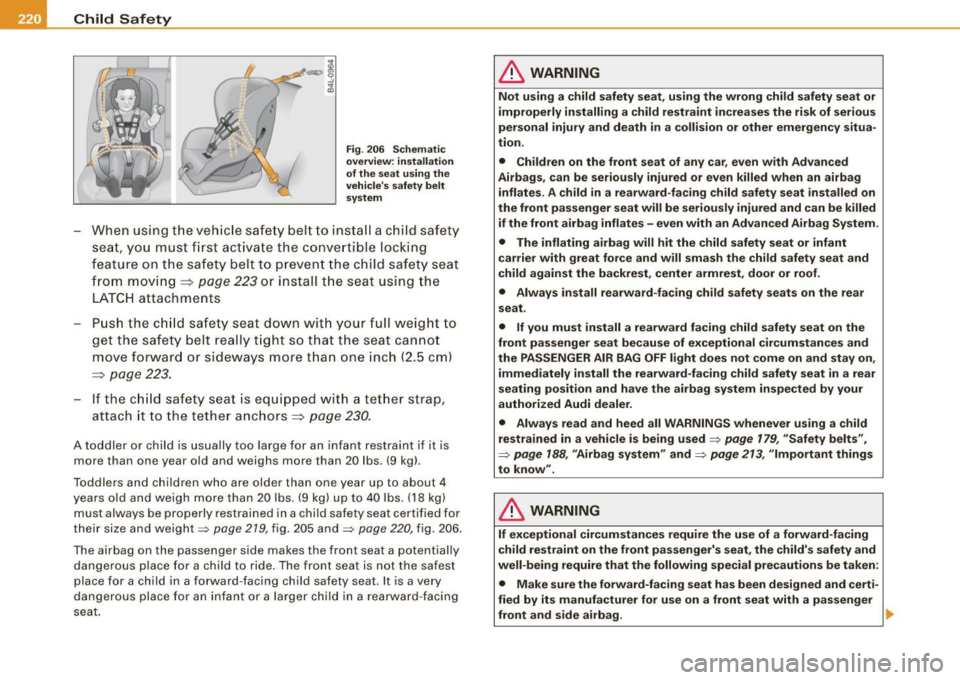
Fig. 206 Schematic
overview: installation
of the seat using the
vehicle's safety belt
system
- When using the vehicle safety belt to install a child safety
seat, you must first activate the convertible locking
feature on the safety belt to prevent the child safety seat
from moving ==>
page 223 or install the seat using the
LATCH attachments
- Push the child safety seat down with your full weight to
get the safety belt really tight so that the seat cannot
move forward or sideways more than one inch (2.5 cm)
==> page 223.
If the child safety seat is equipped with a tether strap,
attach it to the tether anchors==>
page 230.
A toddler or child is usually too large for an infant restraint if it is
more than one year old and weighs more than 20 lbs. (9 kg) .
Toddlers and children who are older than one year up to about 4
years old and weigh more than 20 lbs. (9 kg) up to 40 lbs . (18 kg)
must always be properly restrained in a child safety seat certified for
their size and weight~
page 219, fig. 205 and~ page 220, fig. 206.
The airbag on the passenger side makes the front seat a potentially
dangerous place for a child to ride. The front seat is not the safest
place for a child in a forward-facing child safety seat . It is a very
dangerous place for an infant or a larger child in a rearward -facing
seat.
& WARNING
Not using a child safety seat, using the wrong child safety seat or
improperly installing a child restraint increases the risk of serious
personal injury and death in a collision or other emergency situa
tion.
• Children on the front seat of any car, even with Advanced
Airbags, can be seriously injured or even killed when an airbag
inflates. A child in a rearward-facing child safety seat installed on
the front passenger seat will be seriously injured and can be killed
if the front airbag inflates -even with an Advanced Airbag System.
• The inflating airbag will hit the child safety seat or infant
carrier with great force and will smash the child safety seat and
child against the backrest , center armrest, door or roof.
• Always install rearward-facing child safety seats on the rear
seat.
• If you must install a rearward facing child safety seat on the
front passenger seat because of exceptional circumstances and
the PASSENGER AIR BAG OFF light does not come on and stay on,
immediately install the rearward-facing child safety seat in a rear
seating position and have the airbag system inspected by your
authorized Audi dealer .
• Always read and heed all WARNINGS whenever using a child
restrained in a vehicle is being used~
page 179, "Safety belts",
~ page 188, "Airbag system" and~ page 213, "Important things
to know".
& WARNING
If exceptional circumstances require the use of a forward-facing
child restraint on the front passenger's seat, the child's safety and
well-being require that the following special precautions be taken:
• Make sure the forward-facing seat has been designed and certi
fied by its manufacturer for use on a front seat with a passenger
front and side airbag.
~
Page 225 of 360

Child Safety -
--------------------''----
& WARNING (continued )
• If you must install a booster seat on the front passenger seat
because of exceptional c ircumstances the PASSENGER AIR BAG
OFF light must come on and stay on , whenever the ignition is
switched on.
• If the PASSENGER AIR BAG OFF light does not come on and stay
on , perform the checks described
=> page 199 , "Monitoring the
Advanced A irbag System ".
• Take the ch ild restraint off the front passenger seat and install
it properly at one of the rear seat positions if the PASSENGER AIR
BAG OFF light does not stay on wheneve r the ignition is switched
on .
• Always read and heed all WARNINGS whenever using a child
restrained in a vehicle is being used=>
page 179, "Safety belts",
=> page 188, "Airbag system " and => page 213 , "Important things
to know ".•
Installing a child safety seat
Securing a child safety seat using a safety
belt
S a fety belt s fo r the rear seats and the front passen ger 's
sea t can be l ocked with t he convert ib le lock ing retra cto r
t o prope rly s ecure child saf ety s ea ts .
The s afe ty bel ts e merge ncy lo cking re trac to rs fo r th e rea r sea ts
safety belts and for the front pass enger's seat safety belt have a
c o nve rtible loc king re tr ac tor fo r child r estrai nts. The sa fe ty b elt
must be loc ked so that be lt webbin g cannot unr eel. The re trac tor
c an be activa te d to lock the safety be lt and prevent the safet y belt
w ebbi ng fr om l oos en ing up dur in g n orm al dr ivi ng . A chi ld sa fety
seat can only be properly insta lled when t he safety be lt is locked so
th at th e child and chil d sa fet y seat will sta y in p lace .
Controls and equip ment Safety first Vehicle operation A
lways remember: Even though your vehic le is equipped with an
A dva nce d Airb ag sys tem, all chi ld re n, e sp ec ially those 12 yea rs a nd
youn ger, should a lways ride in the back seat prop erly restrained for
t hei r age and weigh t.
& WARNING
Improperly installed child safety seats increase the risk of serious
personal injury and death in a collision .
• Always make sure that the safety belt retractor is locked when
installing a child safety seat . An unlocked safety belt retractor
cannot hold the child safety seat in place during normal driving or
in a crash .
• Always buckle the child safety seat firmly in place even if a
child is not sitting in it . A loose child safety seat can fly around
during a sudden stop or in a collision .
• Always make sure that the rear seat backrest to which the
center rear safety belt is attached is securely latched whenever
the rear center safety belt is being used to secure a child restraint.
• If the backrest is not securely latched , the child and the child
restraint will be thrown forward together with the backrest and
will strike parts of the vehicle interior. The child can be seriously injured or killed.
• Never install rearward -facing child safety seats or infant
carriers on the front passenger seat . A child will be seriously
injured and can be killed when the passenger airbag inflates.
• The inflating airbag will hit the child safety seat or infant
carrier with great force and will smash the child safety seat and
child against the backrest , center armrest , door or roof .
• Always install rearward -facing child safety seats or infant
c arriers on the rear seat .
• Forward-facing child safety seats or infant carriers installed on
the front passenger's seat may interfere with the deployment of
the airbag and cause serious injury to the child . ..
Vehicle care Do-it-yourself service Technical data
Page 226 of 360
-Child Safety -------=---------------------------------------
& WARNING (continued )
• It is safer to install a forward-f acing child safety seat on the rear
seat.
• Always read and heed all WARNINGS whenever using a child
restrained in a vehicle is being used=>
page 213 . Special precau
tions apply when installing a child safety seat on the front
passenger seat:::::,
page 190 , "Child restraints on the front seat -
some important thing s to know ".
& WARNING
Always take special precautions if you must install a forward or
rearward-facing child restraint on the front passenger's seat in
exceptional situations :
• Whenever a forward or rearward -facing child restraint is
installed on the front passenger seat , the PASSENGER AIR BAG
OFF light must come on and stay on whenever the ignition is
switched on.
• If the PASSENGER AIR BAG OFF light does not come on and stay
on , perform the checks described=>
page 199, "Monitoring the
Advanced Airbag System ".
• Take the child restraint off the front passenger seat and install
it properly at one of the rear seat positions if the PASSENGER AIR
BAG OFF light does not stay on whenever the ignition is switched
on .
• Improper installation of child restraints can reduce their effec
tiveness or even prevent them from providing any prote ction .
• An improperly installed child restraint can interfere with the
airbag as it deploys and seriously injure or even kill the child .
• Always carefully follow the manufacturer's instructions
provided with the child safety seat or carrier .
• Never place additional items on the seat that can increase the
total weight registered by the weight-sensing mat and can cause
injury in a crash .
& WARNING
Forward-facing ch ild restraints :
• Always make sure the forward-facing seat has been designed
and certified by its manufa cturer for use on a front seat with a
passenger front and side airbag .
• Never put the forward-facing child restraint up , against or very
near the instrument panel.
• Always move the passenger seat into its rearmost position in
the seat's fore and aft adjustment range , as far away from the
airbag as possible before installing the forward-facing child
re straint. The backrest must be adjusted to an upright position.
• Make sure that the PASSENGER AIR BAG OFF light comes on
and stays on all the time whenever the ignition is switched on.
& WARNING
Re arward -facing child restraints :
• A child in a rearward -facing child safety seat installed on the
front passenger seat will be seriously injured and can be killed if
the front airbag inflates -even with an Advanced Airbag System.
• The inflating airbag will hit the child safety seat or infant
carrier with great force and will smash the child safety seat and
child against the backrest , center armrest , door or roof .
• Always be e specially careful if you must install a rearward
facing child safety seat on the front passenger seat in exceptional
circumstances .
• A tight tether strap on a rearward-facing child restraint
attached to the front pas senger seat can put too much pres sure
on the weight -m at in the seat and register a heavier weight in the
Advanced Airbag System. The heavier weight registered can make
the system work as though an adult were on the seat and deploy
the Advanced Airbag when it must be suppressed causing ser ious
or even fatal injury to the child.
Ill-
Page 255 of 360
Cleaning and protection -
----------------
•
Under certain circumstances, weekly washing may be necessary.
Under other conditions , a monthly washing and waxing may be
adequate .
After the winter, the
underside of the vehicle should be thoroughly
washed, preferably in a professional car wash.
& WARNING
Always read and heed all WARNINGS and other information
~ page 252. •
Automatic car wash
The vehicle can be washed in almost any modern auto
matic car wash.
The vehicle paint is so durable that the vehicle can normally be
washed without problems in an automatic car wash . However, the
effect on the paint depends to a large extent on the design of the
facility, the filtering of the wash water , the type of wash and care
material, etc. If the paint has a dull appearance after going through
the car wash or is scratched , bring this to the attention of the oper
ator immediately . If necessary, use a different car wash .
Before going through a car wash, be sure to take the usual precau
tions such as closing the windows and the roof . Factory installed
antennas must not be removed.
If you have installed additional accessories on the vehicle - such as
spoilers, roof rack, etc. -it is best to ask the car wash operator if
these should be removed.
& WARNING
Always read and heed all WARNINGS and other information
~ page 252. •
Washing the vehicle by hand
A lot of water is needed when washing a vehicle by hand.
-Before you start washing, make sure you have read and
understood the WARNINGS =:>
& in "General informa
tion" on
page 252.
-First soak all dried dirt until it is soft, then rinse it off.
- As you clean your vehicle, start with the roof and work
your way down to the bottom, using a sponge, a sponge
glove or a clean brush.
- Rinse the sponge or the sponge glove often, flushing it
clean each time.
- Use special car shampoo only for very persistent dirt.
- Rinse the car thoroughly with water.
- Use a chamois leather to gently w ipe the exterior dry.
Use a separate sponge for cleaning the wheels , door sills and other
regions exposed to road dirt. In this way, you will not scratch the
paint with coarse particles imbedded in the sponge the next time
you wash the car.
& WARNING
• Do not clean the underside of the chassis, fenders, wheel
covers, or other hard to reach parts without protecting your hands
and arms. You may cut yourself on sharp-edged metal parts.
• Always read and heed all WARNINGS and other information
~page252. _..
Vehicle care I t •
Page 259 of 360
_____________________________________________ C_ l_ e _a_ n_ in_ g_a _ n_d_ p_ r_ o_ t _e_ c_t _io _ n __ !II
•
T he best way to remove snow from windows and mirrors is to use a
brush . Use a non -abrasive
pla stic ice scraper -better still, a spray
deicer -to remove
ice from w indows and mirrors .
The windows must not be cleaned with insect remover or wax since
these can interfere with the function of the w inds hie ld w iper blades
(chatter).
O il, grease, or silicone res idue can be removed with
glas s cleaner or
silicone remover . However, wax residue requires the use of a
spec ially fo rmulated so lvent . Please contac t your authorized Audi
dea ler for advice on safe products for wax removal.
Windows should also be c leaned on the inside at regular interva ls .
Never dry windows with the same chamois that you use to dry
painted surfaces . Wax residue on the chamois can impair vision
t hrough the windows .
& WARNING
• Always read and heed all WARNING S and other information
=> page 252.
• The windshield mu st not be treated with water -repellent m ate
rials . They can in crea se glare under poor v isibilit y conditio ns su ch
a s wetne ss , darkne ss , or when the sun i s low on the hori zon. In
additio n, they can cau se the windsh ield wipers to chatter .
0 Note
• Never use warm or hot wat er to remove snow and ice from
windows a nd mirrors . This cou ld cause the glass to crack.
• T o prevent damage to the wires of the rear defogger, do not p lace
any adhesive stickers on the inside of the rear window over the
wires .
• To he lp prevent dirt from scratching the window, always scrape
in a forward direction -pushing the scraper away from you -never
back and forth. •
Water leaking from the inside of the rear windows may damage
sensitive e lec trical componen ts located eit her u nder the rear parcel
she lf or in the rear trunk area . Always ensure that water never leaks
t hrough the body section of the vehicle. You can do this by using
waterproof protection over the vehic le 's electrical components (e.g .
when instal ling window tinting).
• Damage or malfunction of e lectrical components due to water
damage or any other outside in fluence is no t cove red by the Audi
New Vehic le Limited Warranty. See your Warranty
& Maintenance
booklet for additional details about your war ranty. •
Weatherstrips
Complete car care includes the weatherstrips as well.
-App ly a suitable rubber cond itioner to the weatherstr ips
from t ime to ti me.
io be able sea l properly, the weatherstrips around the hood, doors,
r ear lid, etc. must rema in pliable . Spray the weatherstr ips with sil i
cone or coat them with talcum powder or g lycerin to retain the flex
ibility of the rubber and to protect them against freezing in the
winter.
& WARNING
Al ways read and heed all WARNINGS and other information
=> page 25 2.
[ i ] Tips
K eep si licone sprays off the windshield to avoid wiper smear in
ra in. •
Vehicle care I t •
Page 261 of 360
_____________________________________________ C_ l_ e _a_ n_ in_ g_a _ n_d_ p_ r_ o_ t _e_ c_t _io _ n __ lfll
•
& WA RNIN G (continu ed )
• Do not apply additi onal undercoating or ru stproofing on or
ne ar the exhau st manifold , ex haust p ipe s, cat alytic con verter or
heat shields . While driving, the s ub stan ce used for under coating
c ould overhe at and cau se a fire.
• Alway s read a nd heed all WARNINGS and other information
=> page 2 52 . •
Care of interior
A pp lies to veh ic le s: wit h MMI
MMI display
-Cle a n the MMI display with a soft c lean clo th and an LCD
cleane r.
The MM I disp lay can be c leaned with a professionally ava ilable "LCD
cleaner" . Th e cloth should be s lightly dampened with the c leaning
fluid to clean the display.
0 Note
To avoid scratching the MMI display, you should never c lean it dry .•
A pplies to veh ic les : wit h MMI
MMI terminal
- First clean t he MMI terminal with a brush to remove dust
f rom the housing .
- Th en wipe the MMI terminal with a clean, soft, s lig htly
d a mp cloth.
The MM I terminal should be c leaned with a brush first so that no
dirt is trapped between the buttons and the housing . We recom
mend giving the MMI terminal a fina l wipe with a c loth moistened
with wa ter and dish washing detergent .
0 Note
To prevent damage, make sure that no f luid ever gets into the MM I
terminal. •
Aluminum trim
Use only neutral -pH products to remove spo ts and deposits from
a luminum surfaces . Chrome care products and alka line cleaners
wi ll attack aluminum surfaces and can damage them over time .
& WARNING
Alway s re ad and heed all WARNING S and other information
=> page 252.•
Fabrics and fabric coverings
Fabrics and fabric coverings (e .g . seats, door trim pane ls, etc.l
shou ld be c leaned at regular intervals with a vacuum cleaner . T his
removes surface dirt partic les which could become embedded in
the fabric through use . Steam cleaners should not be used, because
the steam tends to push the dirt deeper into the fabric and lock it
there.
Normal cleaning
Generally, we recommend using a soft sponge or a lint -free
microfiber c loth to the clean fabric . Brushes should on ly be used for
carpets and floor mats , since other fabric surfaces could be harmed
by b rushes. .,,
Vehicle care I t •
Page 276 of 360

-~_C_ h_e _c _ k_ i_n ...:::g::;...._ a_n_ d_ f_ i_ll _in -'g:::;.._ ___________________________________________ _
than a total of 0.5 qt/liter engine oil that does not conform to Audi
oi l specification VW 502 00.
For more information about engine oi l that has been approved for
your vehicle, please contact e ither your authorized Audi dealer or
Aud i Custo mer Relations at 1 (800) 822 -2834 or visit our web site at
www.audiusa.com or www.audicanada.ca. Here you will a lso find a
current list of o ils (manufacture rs, brand names etc.) that con form
to Audi oi l standard VW 502 00.
Changing the engine oil
The engine oil and oil fil ter must be changed according to the
mi leage (kilometers) and time intervals specified in your vehicle's
Warranty & Maintenance booklet. Do not exceed these intervals -
harmful deposits from old engine oil can reduce engine perfor
mance a nd can lead to expens ive eng ine repairs.
Changing the oil at the recommended intervals is so very important because the lubricating properties of oi l decrease gradual ly during
normal vehicle use. If you are not sure when you have your oil
changed, ask your authorized Audi Service Adviso r.
Under some circumstances the engine oil should even be changed more frequently . Change oil more often if you drive mostly short
distances, ope rate the vehicle in dusty areas or m ostly under stop
and -go traffic cond itions, or when you use your vehicle where
temperatu res stay below freezing point for long per iods.
Detergent additives in the oil will make fresh oil look dark after the
engine has been running for a short time. This is normal and is not
a reason to change the oi l more o ften than recommended.
Dam age or malfunctions d ue to la ck of ma inten ance
It is essential that you change your oi l a t the recommended in terva ls
using on ly engine oil that complies with Audi oil standard
VW 502 00. Your Limited New Vehicle Warranty does not cover
damag e or ma lfunctions due to failure to follow recommended
maintenance and use requirements as set forth in the Audi Owner's
Manual and War ranty & Mai ntenance booklet. Your dealer wi ll have
to deny warranty coverage unless you present to the dealer proof in the form of Service or Repair Orders that all schedu
led maintenance
was performed in a timely manner. •
Engine oil consumption
The e ngine in your vehicle depends on an adequate
amount o f oil to lubricate and cool all of its moving parts.
In order to provide effective lubrica tion and coo ling of in terna l
engine components, all interna l combustion engines consume a
cer tain amoun t of oil. Oi l consump tion varies from e ngine to engine
and may change significantly over the life of the engine. Typical ly,
engi nes w ith a specified break -in p eriod (see =>
page 243) consume
more o il during the break- in period than they consume after oil
consump tion has stabi lized .
Under normal conditions, the ra te of oil consumpt ion depends on
the quality and viscosity of the oil, the R PM (revolutions per minute)
at which the engine is operated, the ambient temperature and road
conditions. Further factors are the amount of oil di lution from water
con densa tion or fue l residue and the oxi dation leve l of t he oi l. As
any engine is subject to wear as mileage builds up, the oil consump
tion may increase over time until replacemen t of wo rn components
may become necessary.
With all these variables coming into play, no standard rate of oi l
consumptio n can be establ ished o r speci fied. There is no alternat ive
to regular and frequent checking of the oil level, see
Note .
If the yel low engine oil l evel warn ing sy mbol in t he instrumen t
cluster ._ lights up, you should check the oil level as soon as
p ossible :::::>
page 275. Top off the o il at your earliest conven ience
=>
page 275.
& WARNING
Befo re you che ck anything in the engine compartment , always
read and heed all WARNINGS
:::::> & in "Working in the engine
c ompartment " on
page 271 .
Page 291 of 360

________________________________________________ T_ i _r_e _s_ a_n_ d_ w_ h_ e_e _ l_s __ lR
•
Groove
means the space between two adjacent tread ribs.
L oad ra ting (code)
means the maximum load that a tire is rated to carry for a given
inflation pressure. You may not find this information on all tires
because it is not required by law.
M ax im um l oad ra tin g
means the load rating for a tire at the maximum permissib le infla
tion pressure for that tire.
Ma ximum l oaded v ehi cle weigh t
means the sum of:
(a) Curb weight
(b) Accessory weight
(c) Vehic le capacity weight, and
(ct) Production options weight
M ax im um (p er mi ssibl e) infl ati on pr essur e
means the maximum cold inflation pressure to wh ich a tire may be
inflated. Also ca lled "maximum inflation pressure."
Normal occ upa nt wei ght
means 150 lbs. (68 kilograms) times the number of occupants
seated in the vehicle up to the to tal seating capacity of your vehicle.
O ccupant di stributi on
means distribution of occupants in a vehicle .
Outer di am eter
means the overall diameter of an inflated new tire.
O ve rall wi dth
means the linear distance between the exteriors of the sidewa lls of
an inflated tire, includ ing elevations due to labeling, decorations, or
protective bands or ribs.
Pl y
means a layer of rubber -coated para lle l cords.
P rodu ction opt io ns wei ght
means the combined weight of those installed regular production
options weighing over 5 lbs . (2.3 kg) in excess of those standard
i t ems wh ich they replace, not previously considered in curb weigh t
or accessory weight, including heavy duty brakes, ride levelers, roof
rack, heavy duty battery, and specia l trim .
Radi al p ly tire
means a pneumatic tire in which the ply cords that extend to the
beads are laid at substantially 90 degrees to the centerline of the
tread .
Reco mm ended infl ati on pr essu re
see => page 288, "Cold tire inflation pressure".
Rein force d tir e
means a tire des ign to operate at higher loads and at higher infla
tion pressures than the corresponding standard tire. Reinforced
t ires may be identi fied as "XL", "x i", "EXTRA LOAD", or "RF" on the
sidewall.
R im
means a metal support for a tire or a tire and tube assembly upon
wh ich the t ire beads are seated.
Rim di amet er
means nominal diameter of the bead seat. If you change your whee l
size, you wi ll have to purchase new tires to match the new rim diam
eter .
Rim siz e de sig nation
means rim diameter and width.
Rim wid th
means nominal distance between rim flanges.
Vehicle care I t •
Page 324 of 360
-Fuses and bulbs Pffl.,___ ______________ _
No. Consum er Ampere
4 Dynamic steering
35
5 Climatized cupholder 10
6 Vehicle electrical system contro l module 1 35
7 Vehicle electrical system control module
1
20
8 Vehicle electrical system con tro l module 1 30
9 Panorama sunroof
20
10 Vehicle e lectrical system contro l module 1
30
1 1 Panorama sunroof shade 20
12 Convenience electronics 5
Fuse Location, Instrument Panel right
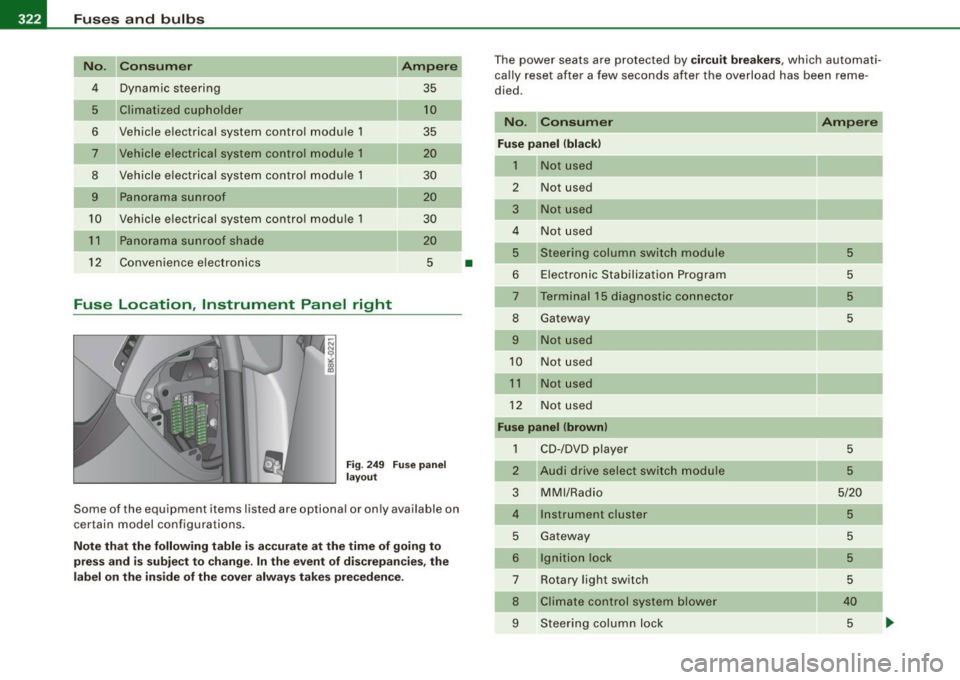
Fig . 2 49 Fuse panel
l ay ou t
Some of the equipment items lis ted are optional or only available on
certain model configurations.
Note th at th e fo llo wi ng t able i s ac cur ate at the time of going to
pr ess an d is s ubje ct to chan ge. In th e eve nt of d iscrep ancies, the
label o n the in side of th e cover alw ays take s pr ece de nce.
•
T he power seats are protected by cir cuit break ers, which automati
cally reset after a few seconds after the overload has been reme
died.
No . Co nsumer
Fu se p anel (blac k)
1 Not used
2 Not used
3 Not used
4 Not used
5 Steering column switch module
6 E
lectronic Stabilization Program
7 Terminal 15 diagnostic connector
8 Gateway
9 Not used
10 Not used
11 Not used
12 Not used
Fu se panel (brown )
1 CD-/DVD player
2 Audi drive select switch mo dule
3 MM I/Radio
4 Instrument cluster
5 Gateway
6 I
gn ition lock
7 Rotary light switch
8 Climate control system blower
9 Steering column lock
Amper e
5
5
5
5
5
5
5/20
5
5
5
5
40
5
Page 337 of 360
General information -
----------------
left door jamb. It shows the month and year of production and the
vehicle identification number of your vehicle (perforation) as well as
the Gross Vehicle Weight Rating (GVWR) and the Gross Axle Weight
Rating (GAWR).
The high voltage warning label
is located on the lock carrier.
The spark ignition system complies with the Canadian
standard ICES-002. •
Applies to vehicles: with MMI
Identification Number in the MMI
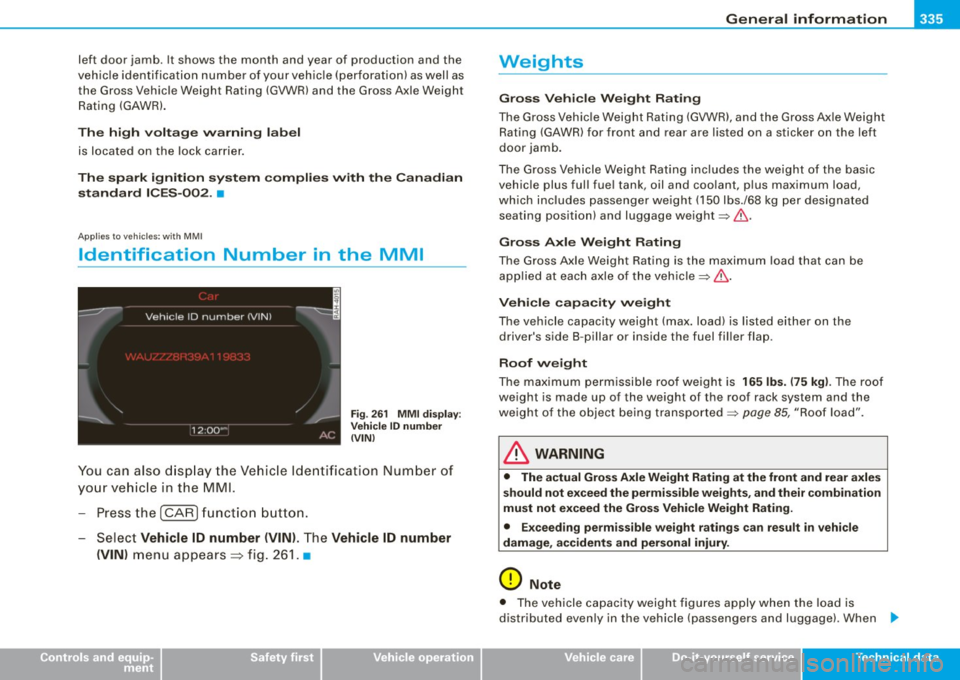
Fig. 261 MMI display:
Vehicle ID number
(VIN)
You can also display the Vehicle Identification Number of
your vehicle in the MMI.
- Press the
I CAR) function button.
- Select
Vehicle ID number (VIN). The Vehicle ID number
(VIN)
menu appears =:> fig. 261. •
Controls and equip
ment Safety first Vehicle operation
Weights
Gross Vehicle Weight Rating
The Gross Vehicle
Weight Rating (GVWR), and the Gross Axle Weight
Rating (GAWR) for front and rear are listed on a sticker on the left
door jamb.
The Gross Vehicle Weight Rating includes the weight of the basic
vehicle plus full fuel tank, oil and coolant, plus maximum load,
which includes passenger weight (150 lbs./68 kg per designated
seating position) and luggage weight:::::,&.
Gross Axle Weight Rating
The Gross Axle Weight Rating is the maximum load that can be
applied at each axle of the vehicle:::::,.&,.
Vehicle capacity weight
The vehicle capacity weight (max. load) is listed either on the
driver's side B -pillar or inside the fuel filler flap.
Roof weight
The maximum permissible roof weight is 165 lbs. (75 kg). The roof
weight is made up of the weight of the roof rack system and the
weight of the object being transported:::::,
page 85, "Roof load".
& WARNING
• The actual Gross Axle Weight Rating at the front and rear axles
should not exceed the permissible weights, and their combination
must not exceed the Gross Vehicle Weight Rating.
• Exceeding permissible weight ratings can result in vehicle
damage, accidents and personal injury.
0 Note
• The vehicle capacity weight figures apply when the load is
distributed evenly in the vehicle (passengers and luggage) . When _,,
Vehicle care Do-it-yourself service Tec hn ica l da ta