warning lights AUDI A5 COUPE 2010 Owner's Manual
[x] Cancel search | Manufacturer: AUDI, Model Year: 2010, Model line: A5 COUPE, Model: AUDI A5 COUPE 2010Pages: 360, PDF Size: 84.39 MB
Page 68 of 360
![AUDI A5 COUPE 2010 Owners Manual Clear vision
[ i ] Tips
If there should be a malfunction in the electrical system, you can
sti ll adjust the outside mirrors by pressing the edge of the mirror. •
Applies to](/img/6/57582/w960_57582-67.png "AUDI A5 COUPE 2010 Owners Manual Clear vision
[ i ] Tips
If there should be a malfunction in the electrical system, you can
sti ll adjust the outside mirrors by pressing the edge of the mirror. •
Applies to")
Clear vision
[ i ] Tips
If there should be a malfunction in the electrical system, you can
sti ll adjust the outside mirrors by pressing the edge of the mirror. •
Applies to ve hicles: with automatically adjusting outside m irrors
Automatic dimming for the outside mirrors
The outside mirrors dim at the same time as the inside mirror. When
the ignition is switched on, the mirrors automatically dim
depending on the amount of light striking the mirrors (such as head lights shining into the vehic le from the rear).
When the inte rior lighting is switched on and when reve rse gear is
engaged, the mirrors are switched back to their original brightness
{not dimmed) .
& WARNING
Broken glass of automati c dimming mirror can cau se e lectrolyte
fl uid leakage. Ele ctrolyte f luid c an irritate skin , eye s, an d re spir a
tory system .
• Repeated or pr olonged e xposure to electrol yte can cause irrita
tion to the resp iratory sy stem , e specially among people with
a sthma or oth er re spir atory condition s. Get fre sh air immedi ately
by leaving the vehi cle or, if that is not po ssibl e, op en windows and
d o ors all the way .
• If electrolyte get s into the eyes , flush them thoroughly with
large amount s of clea n water for at lea st 15 minute s; medi cal
attention is recommended .
• If electrolyte contact s skin, flush affe cted area w ith clean water
for at least 15 minute s and then wa sh affected area with soap and
water ; m edic al a ttention is recommend ed . Thoroughl y wash
affected clothing and shoes before reuse .
• If swallowed and per son is con sciou s, rinse mout h with water
for at least 15 minute s. Do not induce vomiting unles s ins tructed
& W ARN ING (continued )
to do so by m ed ical p rofess ional. Get medic al attent ion immedi
ately .
0 Note
Liquid electro lyte leaked from a broken mirror glass wi ll damage any
plastic surfaces it comes in contact with. C lean up spilled e lectrolyte
immediately with c lear wate r and a spo nge.
[ i ] Tips
• Switching off the dimming function of the inside rear view
mirror al so dea ctivate s the autom atic dimm ing fun ction of the e xte
rior mirrors .
• Automatic dimming for the mirror only operates properly if the
sun shade* for the rear window is not in use or the light striking the
inside mirror is not hindered by other objects. •
Page 118 of 360
• .___O_ n_ t_h _e _ r_o _a_ d __________________________________________________ _
may vary, depending on the type of display in your vehicle. The indi
cator light
CRUISE (US model)/ (7)0 (Canadian model) will also light up
in the instrument cluster .
The speed is kept constant by modifying engine power or through
an active brake intervention.
& WARNING
• Always pay attention to the traffic around you when the cruise
control is in operation. You are always responsible for your speed
and the distance between your vehicle and other vehicles.
• For reasons of safety, cruise control should not be used in the
city, in stop-and-go traffic, on twisting roads and when road condi
tions are poor (such as ice, fog, gravel, heavy rain and hydro
planing) -you could have an accident.
• Switch the cruise control off temporarily when driving in
turning lanes, highway exits or in construction zones.
• Please note that unconsciously "resting" your foot on the
accelerator pedal causes cruise control not to brake. This is due to
the control system being overridden by the driver's acceleration.
[ i] Tips
• Vehicles with manual transmission: You can attain the set speed
only if the gear that is currently engaged will allow it, or if it does not tax the engine and allows it to run smoothly. Therefore shift into
a higher or lower gear in a timely manner.
• The brake lights illuminate as soon as the brakes apply
automatically .•
Changing speed
- Press the lever in the direction of the 0 ~ page 115,
fig. 120 or in the direction of the Q to increase or
decrease your speed. -
Let go of the lever to save that speed.
Change speed in increments of 1 mph (1 km/hi by lightly pressing
the lever . If you keep the lever pressed down, you will alter your
speed in 5 mph (10 km/hi increments.
You can also press the accelerator pedal down to increase your speed, e.g. if you want to pass someone. The speed you saved
earlier will resume as soon as you let off of the accelerator pedal.
If, however, you exceed your saved speed by 5 mph (10 km/h) for
longer than 5 minutes, the cruise control will be turned off tempo
rarily. The green symbol in the display turns white, the saved speed
is retained .•
Pre -selecting speed
You can pre-select your desired speed while the vehicle is
not moving.
Turn on the ignition.
- Pull lever into position 1
~ page 115, fig. 120.
Press the lever in the
0 or Q direction to increase or
decrease your speed.
- Let go of the lever to save that speed.
This function makes it possible, for example, to save the speed you
want before driving on the highway. Once on the highway, activate
the cruise control by pulling the lever toward
(D. •
Switching off
Temporary deactivation
- Step on the brake pedal, or
Page 152 of 360
• ..__T_ r_a _n_ s_ m_ is_ s_i o _ n ______________________________________________________ _
Before you move the selector lever to R, press both the button in the
handle of the selector lever
and the brake pedal at the same time .
When the ignition is on , the backup lights illumina te when the
selector lever is moved into R.
N -N eutr al
The transmission is in neutral in this position. Shift to this position
for standing with the brakes applied=:>
page 150.
When the vehicle is stationary or at speeds below 3 mph (5 km/h) ,
you must always apply the footbrake before and while moving the lever out of
N .
D -N or mal pos itio n fo r d rivi ng forward
Posi tion Dis for normal city and highway driving . It ranges from zero
to top speed and all gears shift automatically, depending on engine load , driv ing spe ed and automa tically selected shift programs .
When the vehicle is s tationary or at speeds below 3 mph (5 km/h).
you must always apply the foot brake befo re and while moving the
lever to
D ou t of N.
In certain circumstances it may be advantageous to temporarily
switch to the manual shift program to manually select gear ratios to
match specific driving conditions=:>
page 152.
S -Sp o rt posit io n*
Select this pos ition for sportier performance. In this position, the
transmission will not upshift as soon , allowing the vehicle to use the
increased power available at higher engine speeds to achieve live
lier acceleration.
When the vehicle is stationary or at speeds below 3 mph (5 km/h) ,
you must always apply the foot brake befo re and while moving the
lever to
S out of N.
& WARNING
R ea d and foll ow all WARNIN GS =:> & in "Dri vin g th e a utom atic
tr an smi ssion " on
pag e 148.
0 Note
Coasting downhill with the transmission in N and the engine not
running will result in damage to the automa tic transmission and
possibly the catalytic converter. •
Applies t o ve hicl es: wit h automa tic trans mis si on
Automatic Shift Lock (ASL )
The Automatic Shift Lock safeguards you against acciden
tally shifting into a forward or the reverse gear and
causing the vehicle to move unintentionally.
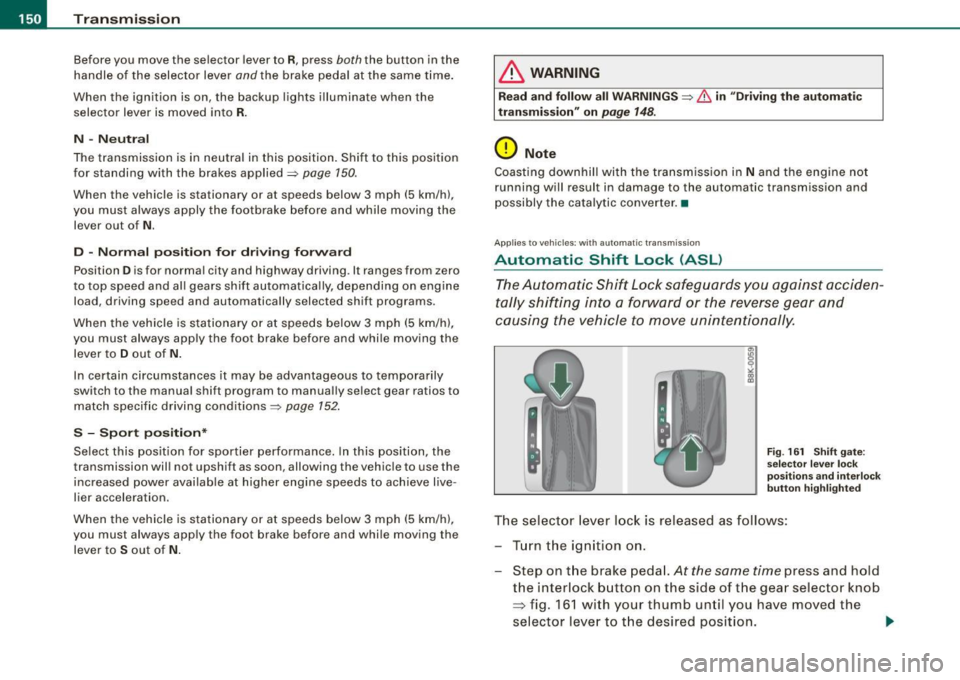
F ig . 16 1 Shift gate:
se lector le ver loc k
posit ions a nd int erl ock
butt on hi gh ligh ted
The selector lever l ock is released as follows :
Turn the ignit ion on .
Step on the brake peda l.
At the same time press and hold
the interlock button on the s ide of the gear selector knob
=> fig. 161 w ith your thumb until you have moved the
selector lever to t he desired position.
~
Page 171 of 360

________________________________________________ D_r_iv _ i _n_ g~ S_ a_ fe_ ly __ BI
Important things to do before driving
Safety is everybody's job! Vehicle and occupant safety
always depends on the informed and careful driver.
For your safety and the safety of your passengers, before
driving always:
-Make sure that all lights and signals are operat ing
correctly.
- Make sure that the tire pressure is correct.
- Make sure that all windows are clean and afford good
visibility to the outside.
- Secure all luggage and other items carefully =>
page 88.
-Make sure that noth ing can interfere w ith the pedals.
- Adjust front seat, head restraint and mirrors correctly for your height .
- Instruct passengers to adjust the head restraints
according to their height.
- Make sure to use the right ch ild restraint correctly to
protect children =>
page 213, "Child Safety ".
- Sit properly in your seat and make sure that your passen
gers do the same=>
page 69, "General recommenda
tions".
- Fasten your safety belt and wear it p roperly. Also instruct
your passengers to fasten the ir safety belts properly
=>
page 179. •
Controls and equip
ment Safety first
Vehicle operation
What impairs driving safety?
Safe driving is directly related to the condition of the
vehicle, the driver as well as the driver's ability to concen
trate on the road without being distracted.
The driver is responsible for the safety of the vehicle and all
of its occupants. If your ability to drive is impaired, safety
risks for everybody in the vehicle increase and you also
become a hazard to everyone else on the road =>& .There
fore:
Do not let yourself be distracted by passengers or by
using a cellular telephone .
NEVER drive when your driving ability is impaired (by
medications, alcohol, drugs, etc.).
- Observe all traffic laws, rules of the road and speed limits
and plain common sense .
- ALWAYS adjust your speed to road, traffic and weather
conditions.
- Take frequent breaks on long trips. Do not drive for more
than two hours at a stretch.
- Do NOT drive when you are tired, under pressure or when
you are stressed .
& WARNING
Impaired driving safety increases the risk of serious personal
injury and death whenever a vehicle is being used. •
Vehicle care Do-it-yourself service Technical data
Page 182 of 360
___ S_a_ f_ e_ t-= y_ b_e_ l_ t _s _______________________________________________ _
- Make sure that your passengers also b uckle up and prop
erly wea r th eir sa fety belts.
Protect your childre n with a child restraint system appro
priate for t he size and age of the children.
The warning light i in the instrument cluster lights up when the
ignition is switched on as a reminder to fasten the safety belts. In
addition, you will hear a warning sound.
After the ignition is switched on, the warning tone will come on for about 6 seconds along w ith a ,!,-warning light in the ins trument
cluster if either the driver or (on USA models on ly) front seat
passenger has not fastened their safe ty belt. As soon as the driver
and front seat passenger have fastened the safety belt, the warning
tone wi ll stop and the warning light will go out.
If both the driver and front seat passenger have not buck led-up
within about 24 seconds after the warning tone has stopped, the
warning tone wi ll sound aga in for about 6 seconds . The warning
tone wi ll sound repeatedly for about 6 seconds at 24 second inter
va ls unti l both the driver and front passenger have buckled-up . The
safety belt warning system is active for about 5 minutes and during
t his time the wa rn ing light in the instrument c luster w ill stay on.
Fa sten your safety belt now and make sure th at your pa ssenger s
a lso proper ly put on the ir saf ety belt s. •
Why safety belts?
Frontal co11isions and the law of physics
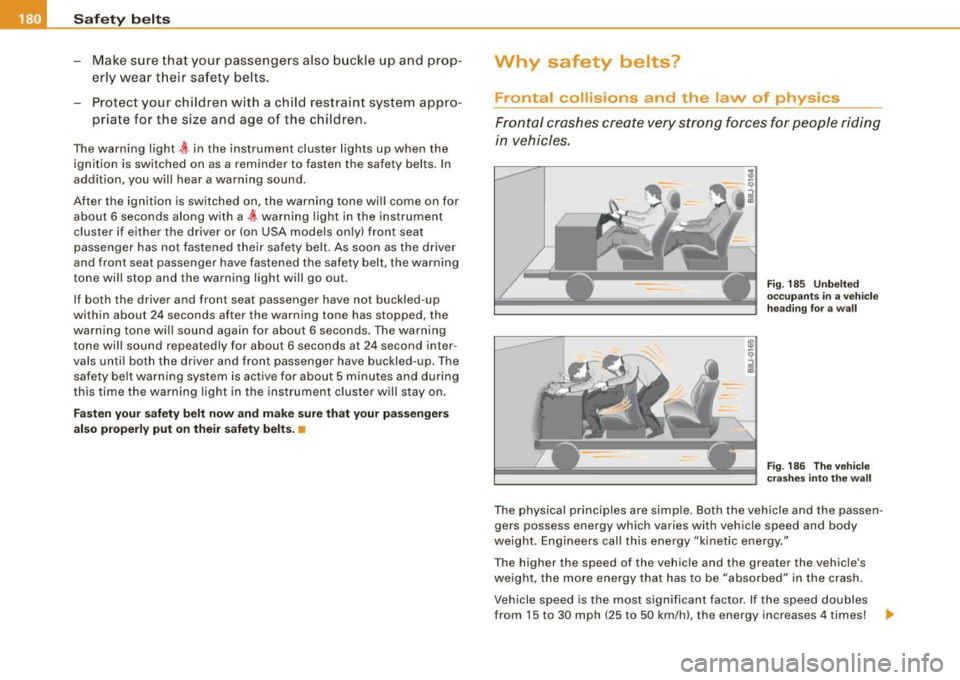
Front al crashes create very strong forces for pe ople rid ing
in vehicles.
Fi g. 185 U nbel ted
o cc up ants in a ve hicle
he ading for a wa ll
F ig . 18 6 The vehi cle
c ras hes in to the wa ll
The physical principles are simple. Both the vehicle and the passen
gers possess energy which varies with vehicle speed and body
we ight. Engineers cal l this energy "kinetic energy ."
T he higher the speed of the vehicle and the greater the vehic le's
we ight, the more energy that has to be "absorbed" in the crash .
Vehicle speed is the most significan t factor. If the speed doubles
from 15 to 30 mph (25 to 50 km/h), the energy increases 4 times! .,
Page 248 of 360
![AUDI A5 COUPE 2010 Owners Manual ___ D_ r_ iv _i_ n- g"""- a_ n_d_ e_ n _ v_i_r _ o _n_ m_ e_ n_t _____________________________________________ _
[ i ] Tip s
The consumption estimates as published by ENVIRONMENTAL
PROTECT](/img/6/57582/w960_57582-247.png "AUDI A5 COUPE 2010 Owners Manual ___ D_ r_ iv _i_ n- g\"\"\"- a_ n_d_ e_ n _ v_i_r _ o _n_ m_ e_ n_t _____________________________________________ _
[ i ] Tip s
The consumption estimates as published by ENVIRONMENTAL
PROTECT")
___ D_ r_ iv _i_ n-' g"'""'- a_ n_d_ e_ n _ v_i_r _ o _n_ m_ e_ n_t _____________________________________________ _
[ i ] Tip s
The consumption estimates as published by ENVIRONMENTAL
PROTECTION AGENCY (EPA) and Transport Canada may not corre
spond to your actua l consumption on the road, which wi ll vary
depending upon vehic le load and speed, road and weather condi
tions, trip length, etc .•
Drive smoothly and keep a tookout ahead
Vehicles use the most fuel when they are accelerating.
- Avoid unnecessary accelerating and brak ing.
Vehicles use the most fuel when they are accelerating . If you antici
pate what is going to happen next, you will need to brake less and,
thus, accelerate less. Let the vehicle coast whenever possible -for
examp le when you see that the next traffic ligh t is red .
Avoid full thrott e
Driving at moderate speeds saves fuel and improves your
mileage.
- Try and keep we ll below your car's maximum speed.
Acce lerating gently reduces fuel consumption, engine wear, and
does not disturb the environment .
Fuel consumption, exhaust emissions and engine noise increase
disproportionately at high speeds. If you drive at approximate ly
three quarters of top speed, fuel consumption will be reduced by
one half. Never drive faster than the posted speed limit and weather
conditions permit. •
Reducing unnecessary idling
Even when your car is just idling it burns up fuel.
- Shut the engine off when you are not driving the vehicle.
-Do not warm up the vehicle by letting the eng ine run at
idle.
It makes sense to shut off the engine in traffic jams, when waiting
for trains to pass at rai lroad crossings, or at traffic lights that have
long waits on red. Turning the engine off for just 30-40 seconds
saves more fuel than is burned starting the engine again .
It takes a long time for the engine to warm up fully when it is
running at idle. However, wear and noxious emissions are especially
high when the engine is warming up. So you should drive away as
soon as you start the engine and avoid running at high rpms while
the engine is sti ll warm ing up .
0 Note
Do not leave engine idling unattended after starting. If warning
lights should come on to indicate improper operation, they would
go unheeded . Extended id ling a lso produces heat, which could
resu lt in overheating or other damage to the vehicle or other
property .•
Regular maintenance
A badly tuned engine unnecessarily wastes a lot of fuel.
- Have your vehicle serviced at regular intervals.
By having your vehicle regularly serviced by an authorized Audi
dea ler helps to ensure that it runs properly and economically. The
condition of your vehicle not only affects its safety and abi lity to
hold its value, it also affects
f ue l co nsu mpti on.
C hec k your o il e ach tim e y ou fill your ta nk.
Page 250 of 360
-Traile r t ow ing
----- -=---------------------------------
Tr a ii er towing
Driving with a trailer
General information
Your Audi was designed primarily for passenger transpor
tation.
If you plan to tow a trailer, please remember that the additional load
wi ll affect durability , economy and performance.
Trai ler towing not on ly p laces more stress on the vehicle, it a lso ca lls
for more concentration from the driver.
For this reason, always fol low the operating and driving instructions
provided and use common sense. •
Technical requirements
Traile r hit ch
Use a weight -carrying hitch conforming to the gross trailer weight.
The hitch must be suitab le for your vehicle and tra iler and must be
mounted secure ly on the vehicle's chassis at a
technically sound
location . Use only a trailer hitch with a removable ball mount.
Always check with the trai ler hitch manufacturer to make sure that
you are using the correct hitch.
D o not u se a b umper hit ch .
The hitch must be installed in such a way that it does not interfere
w ith the impact-absorbing bumper system . No modifications
should be made to the vehicle exhaust and brake systems . From
time to time, check that all hitch mount ing bolts remain securely
fastened.
When you are not towing a trailer, remove the trailer hitch ball
mount. This prevents the hitch from causing damage should your
vehic le be struck from behind =:> & .
Tra iler br akes
If your trailer is equipped with a braking system, check to be sure
that it conforms to al l regu lations.
T he trailer hydraulic brake system must not be directly connected to
the vehicle's hydraulic brake system=:>& .
Safet y cha ins
Always use safety chai ns between y our vehicle and the trailer .
Traile r lights
Trai ler lights mus t meet all regulations. Be su re to check with your
authori zed Audi dealer for correct wiring, switches, and relays .
Mirrors
If you are unable to see the traffic behind you using the regu lar
outside mirrors, then you
must instal l extended m irrors. It is impor
tant that you
always have to the rear .
& WARNING
• If a trailer ha s el ectri cal brake s please note that the se brak es
are n ot act iva ted by the fa ctory -fitted control unit · ri sk of acc i
dent !
• After remo ving the tr ailer hit ch , d o n ot store it in yo ur vehi cle.
In ca se of sudden b raking , th e hitch could fly forw ard and injure
you or your p assengers . •
Operating instructions
M ax imum tr aile r w eight
A trai ler for your vehicle is limited to a typica l class 1 or class 2
trai ler.
Page 256 of 360
___ C_ le_ a _ n_i_n ~g _ a_ n_ d __ p_r _o _t _e _c_ t_ i_o _n ___________________________________________ _
0 Note
• Never try to remove d irt, mud or dust if the surface of the vehicle
is dry . Never use a dry cloth or sponge, since this cou ld scratch your
vehic le's paint or w indows.
• Never wash your car in bright sunlight. Drops of water act as
magnify ing lenses and may damage your paint.
• When you wash your car in the winter : if you rinse your vehicle
with a hose, be careful not to aim the stream of water directly at
locks, or at door or hatch openings -they can freeze shut.
• Never use sponges designed to remove insects, or any kitchen
scouring sponges or similar products. They can damage your paint
finish .
• Never use a dry cloth or sponge to c lean the head ligh ts. Only use
wet cloths or sponges to prevent scratches . It is best to use soapy
water.
For the sake of the environment
In the interest of the environment, the vehicle should on ly be
washed in specia l wash bays. •
Washing your vehicle with a power washer
Cleaning the exterior of your car with a high -p ressure
power washer is safe as l ong as y ou observe a few simple
rules .
-Before using the power washer, make s ure you have read
and understood the WAR NINGS=::;,
& in "General infor
mati on" o n
page 252.
-Always follow the operating instructions for the power
washer. - Make sure that the jet o
n the spray hose pro duces a "fan
sha ped sp ray".
D o
not hold the spray nozzle too close to soft materials.
When cleaning the vehicle with a power washer always follow the
operating instructions. This applies particula rly to the
operating
pre ssure
and the spraying di stance . Maintain a sufficient distance
to soft materia ls such as rubber hoses and sound/vibration dead
ening materia ls (part icularly on the underside of the engine hood).
Do not use a jet which sprays water in a
direct stream or one that
has a
rotating jet.
Water temperature should not exceed 140 °F (60 °Cl.
& WARNING
Never wash tire s with a jet that sp ra ys water in a dir e ct stream .
Thi s could cau se invisible damage to the tire s and we ake n them ,
eve n if th e spra y is from a re lativel y lo ng dis tanc e an d f or a sh o rt
time . Damaged and weakened tire s can f ail and cau se ac cident s
a nd per sona l injur y.
0 Note
To avoid damaging your vehicle, always make sure that there is
suffic ient distance between the spray head and soft materia ls like
rubber hoses, plastic parts and sound -deadening materials . Never
aim the spray head at the same p oint for a long time . This also
applies to cleaning headlights and painted bumpers . Remember :
the c loser the nozzle is to the surface of the material, the greater the
stress on the mater ial. •
Page 276 of 360

-~_C_ h_e _c _ k_ i_n ...:::g::;...._ a_n_ d_ f_ i_ll _in -'g:::;.._ ___________________________________________ _
than a total of 0.5 qt/liter engine oil that does not conform to Audi
oi l specification VW 502 00.
For more information about engine oi l that has been approved for
your vehicle, please contact e ither your authorized Audi dealer or
Aud i Custo mer Relations at 1 (800) 822 -2834 or visit our web site at
www.audiusa.com or www.audicanada.ca. Here you will a lso find a
current list of o ils (manufacture rs, brand names etc.) that con form
to Audi oi l standard VW 502 00.
Changing the engine oil
The engine oil and oil fil ter must be changed according to the
mi leage (kilometers) and time intervals specified in your vehicle's
Warranty & Maintenance booklet. Do not exceed these intervals -
harmful deposits from old engine oil can reduce engine perfor
mance a nd can lead to expens ive eng ine repairs.
Changing the oil at the recommended intervals is so very important because the lubricating properties of oi l decrease gradual ly during
normal vehicle use. If you are not sure when you have your oil
changed, ask your authorized Audi Service Adviso r.
Under some circumstances the engine oil should even be changed more frequently . Change oil more often if you drive mostly short
distances, ope rate the vehicle in dusty areas or m ostly under stop
and -go traffic cond itions, or when you use your vehicle where
temperatu res stay below freezing point for long per iods.
Detergent additives in the oil will make fresh oil look dark after the
engine has been running for a short time. This is normal and is not
a reason to change the oi l more o ften than recommended.
Dam age or malfunctions d ue to la ck of ma inten ance
It is essential that you change your oi l a t the recommended in terva ls
using on ly engine oil that complies with Audi oil standard
VW 502 00. Your Limited New Vehicle Warranty does not cover
damag e or ma lfunctions due to failure to follow recommended
maintenance and use requirements as set forth in the Audi Owner's
Manual and War ranty & Mai ntenance booklet. Your dealer wi ll have
to deny warranty coverage unless you present to the dealer proof in the form of Service or Repair Orders that all schedu
led maintenance
was performed in a timely manner. •
Engine oil consumption
The e ngine in your vehicle depends on an adequate
amount o f oil to lubricate and cool all of its moving parts.
In order to provide effective lubrica tion and coo ling of in terna l
engine components, all interna l combustion engines consume a
cer tain amoun t of oil. Oi l consump tion varies from e ngine to engine
and may change significantly over the life of the engine. Typical ly,
engi nes w ith a specified break -in p eriod (see =>
page 243) consume
more o il during the break- in period than they consume after oil
consump tion has stabi lized .
Under normal conditions, the ra te of oil consumpt ion depends on
the quality and viscosity of the oil, the R PM (revolutions per minute)
at which the engine is operated, the ambient temperature and road
conditions. Further factors are the amount of oil di lution from water
con densa tion or fue l residue and the oxi dation leve l of t he oi l. As
any engine is subject to wear as mileage builds up, the oil consump
tion may increase over time until replacemen t of wo rn components
may become necessary.
With all these variables coming into play, no standard rate of oi l
consumptio n can be establ ished o r speci fied. There is no alternat ive
to regular and frequent checking of the oil level, see
Note .
If the yel low engine oil l evel warn ing sy mbol in t he instrumen t
cluster ._ lights up, you should check the oil level as soon as
p ossible :::::>
page 275. Top off the o il at your earliest conven ience
=>
page 275.
& WARNING
Befo re you che ck anything in the engine compartment , always
read and heed all WARNINGS
:::::> & in "Working in the engine
c ompartment " on
page 271 .
Page 284 of 360

-~_C_ h_e _c _ k_ i_n ...:::g::;...._ a_n_ d_ f_ i_ll _in -'g:::;.._ ___________________________________________ _
Have the battery checked when you take your vehicle in for service.
You are well advised to replace a battery that is older than 5 years.
With certain types of airbag deployment, the battery is discon nected from the vehicle electrical system for safety reasons=>
& in
"Repair, care and disposal of the airbags" on
page 202.
Disconnecting the battery terminals
Some vehicle functions (power window regulators, for example) are
lost if the battery terminals are disconnected. These functions have
to be relearned after the battery terminals are connected again . To
prevent this, the battery should only be disconnected from the
vehic le electr ical system when absolute ly necessary for repairs .
Vehicles not driven for long periods
If you do not drive your vehicle over a period of several days or
weeks, electrical components are gradually cut back or switched off.
This reduces energy consumption and maintains starting capability
over a longer period=>
page 241.
Take into consideration that when you unlock your vehicle, some
convenience functions, such as the master key remote function or power seat adjustment, may not be available. The convenience
functions will be available again when you turn on the ignition and start the engine .
Winter operation
During the winter months, battery capacity tends to decrease as
temperatures drop . This is because more power is also consumed
while starting, and the headlights, rear window defogger, etc., are
used more often.
Avoid unnecessary power consumption, particularly in city traffic or
when traveling only short distances . Let your authorized Audi dea ler
check the capacity of the vehicle battery before winter sets in
=>
page 284 . A well charged battery will not only prevent starting
problems when the weather is cold, but will also last longer.
[ i ] Tips
If your vehicle is left standing for several weeks at extremely low
temperatures, the vehicle battery should be removed and stored
where it will not freeze. This will prevent it from being damaged and
having to be replaced. •
Working on the battery
Be especially careful when working on or near the battery.
The battery is located in the luggage compartment under
the floor. Before you check anything in the luggage
compartment,
read and heed all WARNINGS =:>& .
Always heed the safety warnings, when working on the vehicle
battery or the vehicle electrical system to prevent injury.
The following WARNINGS are very important when
working on the battery:
Always heed the following WARNING SYMBOLS and safety pre
cautions when working on the battery.
Always wear eye protection .
Battery acid contains sulfuric acid. Always wear
gloves and eye protection.