service AUDI A5 COUPE 2010 Repair Manual
[x] Cancel search | Manufacturer: AUDI, Model Year: 2010, Model line: A5 COUPE, Model: AUDI A5 COUPE 2010Pages: 360, PDF Size: 84.39 MB
Page 315 of 360

What do I do now? -__________________ __;__:....:....:..:: ___ J?rll
•
& WARNING (continued)
• To help prevent the vehicle from moving suddenly and possibly
slipping off the jack, always fully set the parking brake and block
the wheel diagonally opposite the wheel being changed with the
folding chocks or other objects. When one front wheel is lifted off
the ground, placing the Automatic Transmission in "P" (Park) will
not prevent the vehicle from moving.
• Before you change a wheel, be sure the ground is level and firm.
If necessary, use a sturdy board under the jack.
• After installing the inflatable spare tire, make sure that you
replace the flat tire/wheel in its storage area properly and tighten
the knurled retaining screw securely.
0 Note
If you are changing the wheel on a steep incline, use a rock or
similar object to block the opposite wheel to prevent the vehicle
from moving.
[ i] Tips
Obey all laws.•
Changing a wheel
When you change a wheel, follow the sequence described
below step-by-step and in exactly that order.
1. Remove the decorative wheel cover*. For more details
see also =>
page 314, "Decorative wheel covers".
2. Loosen the
wheel bolts=> page 315.
3. Locate the proper mounting point for the jack and align
the jack below that point=>
page 315.
4. Lift the car with the jack=> page 315.
5. Remove the wheel with the flat tire and then install the
spare tire=> page 317.
6. Tighten all wheel bolts lightly.
7.
Lower the vehicle with the jack.
8. Use the wheel bolt wrench and
firmly tighten all wheel
bolts in a crisscross pattern=>
page 315.
9. Replace the decorative wheel cover*.
_& WARNING
Always read and follow all WARNINGS and information => & in
"Raising the vehicle" on
page 315 and => page 318. •
After changing a wheel
A wheel change is not complete without the doing the
following.
- Store and secure the wheel you replaced in the spare
wheel well.
- Replace the tools and the jack in their proper location.
- Check the
tire pressure of the spare tire as soon as
possible.
- As soon as possible, have the
tightening torques on all
wheel bolts checked with a torque wrench. The correct
tightening torque is 90 ft lbs. (120 Nml.
- Have the flat tire
replaced as soon as possible.
Do-it-yourself service
Page 317 of 360

What do I do now ? 1111
------------------
Loosening and tightening the wheel bolts
The wheel bolts must be loosened before raising the
vehicle .
Loosening
Fig . 242 C han ging a
wh eel: l oose ning th e
whee l bolts
- Install the wheel bolt wren ch over the w heel bol t an d
push it d own as far as i t will go.
Take tight hold of the
end o f the w rench ha ndle and turn
the wheel bolts
c ounter- clockwi se about one single turn
in the di rection of arrow=::, fig . 242.
Tightening
- Install the wheel bolt wren ch over the w heel bolt and
push it down as far as it will go.
- Take tight hold of the
end of the wrench han dle and turn
each wheel bolt
clockwise until it is seated .
& WARNING
• Do not use for ce or hu rry when ch ang ing a whee l - you can
ca use th e vehicle t o slip off th e jack a nd cause ser ious p erso nal
inj urie s.
& W ARNING (continued )
• Do n ot loo sen the wh eel bolt s more than one turn before y ou
rais e the vehicle with the jack . - You ri sk an injur y.
[ i ] Tip s
• Never use the hexagona l socket in the handle of the screwdriver
to loosen or tighten the wheel bolts .
• If a wheel bolt is
very tight, you may find it easier to loosen by
carefully pushing down on the end of the whee l bolt wrench with
one foot only . As you do so , hold on to the car to keep your balance
and take care not to slip. •
Raising the vehicle
The vehicle must be lifted with the jack first before the
wheel can be removed .
Vehicle care
Fig. 243 Cha nging a
w he el: m oun ting
poi nts for the jack ..
Do-it-yourself service irechnical data
Page 319 of 360

_____________________________________________ W_ h_ a_t _d_ o_l _ d_o _ n_o_ w_ ? _ __._
Taking the wheel off /installing the spare tire
Follow these instructions step -by-step for changing the
wheel.
Fig . 245 Changing a
wheel: using the screwdriver handle
!with the blade
removed) to turn the
bolts
Fig . 246 Changing a
wheel: alignment pin
inside the top hole
After you have loosened all wheel bolts and raised the
vehicle off the ground, remove and replace the wheel as
follows:
Removing the wheel
-Remove the topmost wheel bolt completely with the
hexagonal socket in the screwdriver handle (vehicle tool
kit) => fig. 245 and set it aside on a
clean surface. - Screw the threaded end of the
alignment pin from the
tool kit hand-tight into the empty bolt hole=> fig. 246.
- Then remove the other wheel bolts as described above.
- Take off the wheel leaving the alignment pin in the bolt
hole.
Putting on the inflatable spare tire
- Push the spare tire over the alignment pin.
- Screw on t he wheel bolts and tighten them
slightly using
the hexagonal socket.
- Remove the alignment pin and insert and tighten the
remaining wheel bo lt slightly l ike the rest.
- Turn the jack handle counter -clockwise to lower the
vehicle until the jack is fully released .
- Use the wheel bolt wrench to tighten all wheel bolts
firmly =>
page 315. Tighten them Tighten them in a criss
cross pattern ,
from one bolt to the (approximately) oppo
site one, to keep the wheel centered.
- Perform the steps required after changing the wheel
=>
page 313, "After changing a wheel".
The hexagonal socket makes it easier to remove the wheel bolts
from the rim . Care should be taken when removing the reversible
blade.
[ i] Tips
• When mounting tires wi th unidirectional tread design make sure
the tread pattern is pointed the right way~
page 318.
• The wheel bolts should be clean and easy to turn. Check for dirt
and corrosion on the mating surfaces of both the wheel and the .,
Vehicle care Do-it-yourself service irechnical data
Page 321 of 360

_______________________________________________ W_ h_ a_t _ d_ o_ l _d _o_ n_ o _ w_ ? __ fflll
•
longer work properly and the sensor for the tire pressure moni
toring system* will have to be rep laced by a qualified workshop. •
Do-it-yourself service
Page 323 of 360
Fuses and bulbs -
------------------
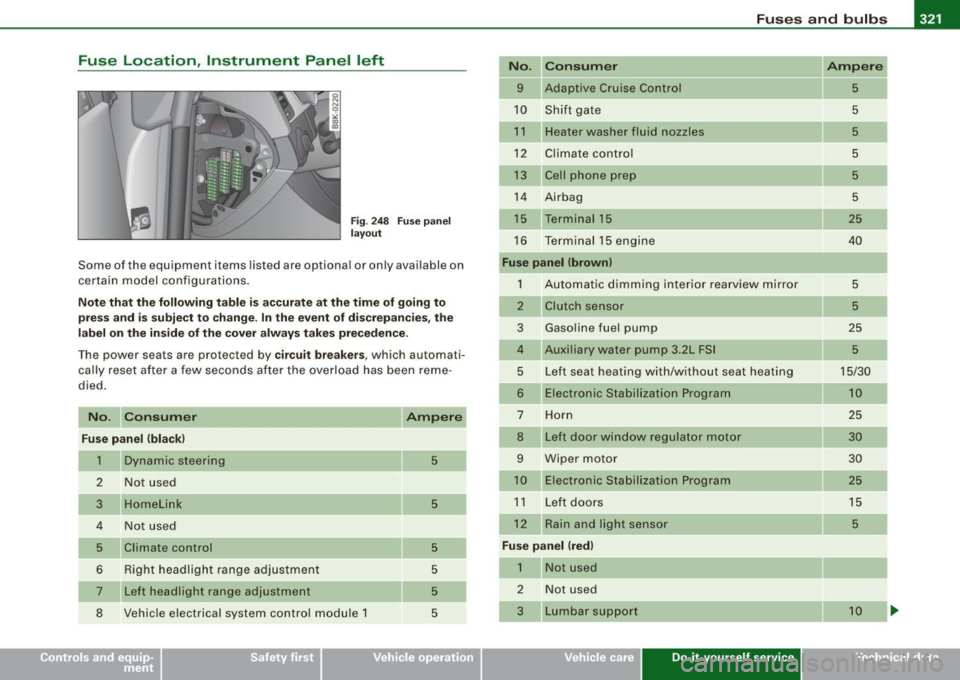
Fuse Location, Instrument Panel left
Fig . 248 Fuse panel
layout
Some of the equipment items listed are optional or only available on
certain model configurations.
Note that the following table is accurate at the time of going to
press and is subject to change. In the event of discrepancies, the
label on the inside of the cover always takes precedence.
The power seats are protected by circuit breakers , which automati
cally reset after a few seconds after the overload has been reme
died.
No. Consumer
Fuse panel (black)
1 Dynamic steering
2 Not used
3 Homelink
4 Not used
5 Climate control
6 Right headlight range adjustment
___ ,
7 Left headlight range adjustment
8 Vehicle electrical system control module 1
5
5
5
5
5
5
No.
9
10
11
12
13
14
16
Consumer
Adaptive Cruise Control
Shift gate
Heater washer fluid nozzles
Climate control
Cell phone prep
Airbag
Terminal 15
Te rminal 15 engine
Fuse panel (brown)
1 Automatic dimming interior rearview mirror
2
3
5
6
7
8
9
Clutch sensor
Gasoline fuel pump
Auxiliary water pump 3.2L FSI
Left seat heating with/without seat heating
Electronic Stabilization Program
Horn
Left door window regulator motor
Wiper motor Electronic Stabilization Program
11 Left doors
12 Rain and light sensor
Fuse panel Ired)
1
2
Not used
Not used
Lumbar support
Vehicle care Do-it-yourself service
Ampere
5
5
5
5
5
5
25
40
5
5
25
5
15/30 10
25
30 30
25
15
5
10
irechnical data
Page 325 of 360

Fuses and bulbs -
------------------
No. Consumer
10 Climate control
11 Terminal 30 diagnostic connector
12 Steering column switch module Ampere
10
10
5
Fuse Location , Luggage Compartment right
Fig . 250 Fuse panel
layout
Read numbers of the fuses in the luggage compartment starting
from inside.
No. Consumer
Fuse panel B !black)
1 Luggage compartment lid control module
(Avant)
2 Trailer control module
3 Trailer control module
4 Trailer control module
5 Electromechanical parking brake
6 Electronic damping control Electromechanical parking brake Ampere
30
15
20
20
5
15
30
•
No. Consumer
8 Vehicle electrical system control module 2
9 quattro Sport
10 Vehicle electrical system control module 2
11 Vehicle electrical system control module
12 Terminal 30
Fuse panel C (brown)
1
2
3
4
5
6
7
8
9
Luggage compartment lid control module
Right front seat heating
DCDC converter path 1
DCDC converter path 2
Socket Not used
Electromechanical parking brake
Rear seat heating
Passenger side door control module
10 Not used
11 Passenger side door control module
12 Not used
Fuse panel D !red)
1 Rear center console outlet
2 Front center console outlet
3 Luggage compartment outlet
4 Cigarette lighter
6 Rear Seat Entertainment supply
Vehicle care Do-it-yourself service
Ampere
30
35
30
20 5
30 15
40
40
30
30
30
30
15
15
15 15
15
5
5
Technical data
Page 327 of 360
Fuses and bulbs -
----------------
•
& WARNING (continu ed )
• Only your authorized Audi dealer or a qualified workshop
should change the bulbs in ga s discharge lamps. There are parts
with sharp edges on the openings and on the bu lb holders that
can cause seriou s cuts .
If you are uncertain about what to do ,
have the work performed by an authori zed Aud i dealer or other
qualified workshop. Serious personal injury may re sult from
improperly performed work .
[ i] Tips
• I f you sti ll prefer to replace the l ight bu lbs yourself, be aware that
t he engine compart ment is a ha zar do us area to w ork in =>
page 263,
"Engine compartment "=> & .
• I t is be st to as k yo ur aut ho rize d Audi d ealer wh enever you wa nt
to change a bulb .•
Do-it -yourself service
Page 329 of 360

________________________________________________ E_ m ___ e_r.::g ~e ___ n_c ~y:.- s;_ i_t _u :...:a:..:. t.:.: i...:o :...:n...:..:. s _ __,J_
& WARNING !continued)
• Before you check anything in the engine compartment, always
read and heed all WARNINGS~ page 263, "Engine compartment".
0 Note
• Applying a higher voltage booster battery will cause expensive
damage to sensitive electronic components, such as control units,
relays, radio, etc .
• There must be no electrical contact between the vehicles as
otherwise current could already start to flow as soon as the positive
(+) terminals are connected.
[ i) Tips
• The discharged battery must be properly connected to the
vehicle's electrical system. When jump starting or charging the
battery , never connect the negative ground cable to the battery
negative post because the battery manager system must be able to
detect the battery's state of charge. Always connect the negative
ground cable to the negative ground post of the battery manager
control unit .•
Use of jumper cables
Make sure to connect the jumper cable clamps in exactly
the order described below!
Fig. 251 Engine
compartment : Connec·
tors for jumper cables
and charger
Fig. 252 Jump starting
with the battery of
another vehicle: @
discharged vehicle
battery,
© booster
battery
The procedure described below for connecting jumper
cables is intended to provide a jump start for your vehicle.
Vehicle with discharged battery:
Turn off lights and accessories, move lever of automatic
transmission to
N (Neutral) or P (Park) and set parking
brake.
~
Vehicle care Do-it-yourself service irechnical data
Page 330 of 360

lllffl.___E_ m _ e _r-==g :...e_ n_ c...:y _ s_ i_t _u _a _t_ i_o _n_ s _______________________________________________ _
Conn ect POSITIVE
(+) to POSITIVE (+) (red )
- Remove the cover above the jump start connection.
- Open the red cover on the positive pole
~ page 327,
fig. 251.
1. Connect one end of the positive cable (red) on the
jump
start bolt~ page 327, fig. 252 G) (Bolts under red cover
= "positive") of the vehicle to be started @.
2. Connect the other end to the positive terminal @ of the
booster battery @.
Connect NEGATIVE (-) to NEGATIVE (-) (black)
3. Connect one end to the negat ive terminal 0 of the
booster battery ®·
4. Connect the other end of the negative cable (black) to the
jump start bolt@ (Bolts with hex head= "negative") of
the vehicle to be started @.
Starting the engine
- Start the engine of the vehicle with the booster battery.
Run the engine at a moderate speed.
- Start engine with discharged vehicle battery in the usual
manner.
- If the engine fails to start : do not keep the starter
cranking for longer than 10 seconds. Wait for about
30 seconds and then try again.
- With engine running, remove jumper cables from both
vehicles in the exact
reverse order .
- Close the red cover on the positive pole.
T he battery is vented to the outside to prevent gases from entering
th e vehicle interior. Make sure that the jumper clamps are well
connected with their
metal parts in full contact with the battery
terminals.
& WARNING
To avoid serious personal injury and damage to the vehicle , heed
all warnings and instructions of the jumper cable manufacturer.
If
in doubt, call for road service.
• Jumper cables must be long enough so that the vehicles do not
touch .
• When connecting jumper cables, make sure that they cannot
get caught in any moving parts in the engine compartment.
• Do not bend over the batteries -danger of chemical burns!
• The battery cell locking screws must be tightened securely.
• Before you check anything in the engine compartment , always
read and heed all WARNINGS ~ page 263, "Engine compartment".
0 Note
Improper hook-up of jumper cables can ruin the generator .
• Always connect POS ITIVE(+) to POS ITIVE(+), and NEGATIVE(-) to
NEGATIVE( -) ground post of the battery manager control unit .
• Check that all screw plugs on the battery cells are screwed in
firm ly. If not, tighten plugs prior to connecting clamp on negative
battery terminal.
• Please note that the procedure for connecting a jumper cable as
described above applies specifically to the case of your vehicle
being jump started . When you are giving a jump start to another
vehicle, do
not connect the negative(-) cable to the negative{-)
terminal on the discharged battery©~
page 327, fig. 252. Instead,
securely connect the negative(-) cable to either a solid metal
component that is firmly bolted to the engine block or to the engine ..
Page 331 of 360
________________________________________________ E_ m_ e_r ,,::g c..e_ n _ c..::y;._ s_ i_t _u _a_ t_ i_o _n_ s _ ___.ffllll
block itself. If the battery that is being charged does not vent to the
outside, escaping battery gas could ignite and explode! •
Emergency towing with commercial
tow truck
General hints
Your Audi requires special handling for towing.
The following information is to be used by commercial tow truck
operators who know how to operate their equipment safely.
• Never tow your Audi , towing will cause damage to the engine
and transmission.
• Never wrap the safety chains or winch cables around the brake
lines.
• To prevent unnecessary damage, your Audi must be transported
with a flat bed truck.
• To load the vehicle on to the flat bed, use the towing loop found
in the vehicle tools and attach to the front or rear anchorage
~ page 329 and ~ page 330.
& WARNING
A vehicle being towed is not safe for passengers. Never allow
anyone to ride in a vehicle being towed, for any reason. •
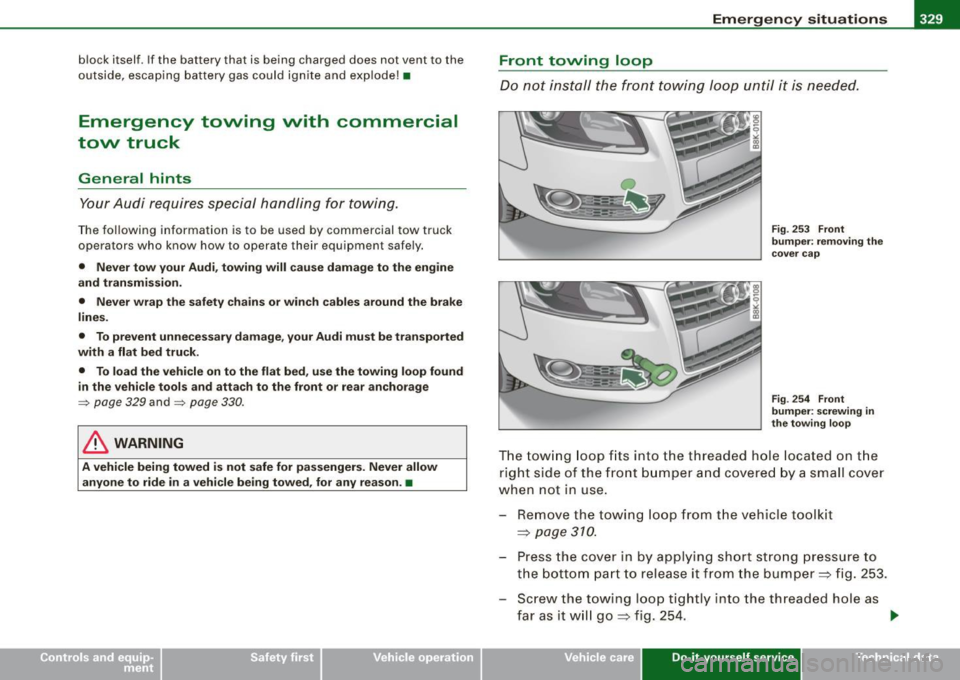
Front towing loop
Do not install the front towing loop until it is needed.
Fig. 253 Front
bumper: removing the
cover cap
Fig . 254 Front
bumper: screwing in
the towing loop
The towing loop fi ts into the thread ed hole located on the
r ight side of the front bumper and covered by a small cover
when not in use.
- Remove the towing loop from the vehicle toolkit
~ page 310.
- Press the cover in by applying short strong pressure to
the bottom part to release it from the bumper~ fig. 253.
- Screw t he towing loop tightly into the threaded hole as
far as it will go
~ fig. 254. ~
Vehicle care Do-it-yourself service irechnical data