sport mode AUDI A5 COUPE 2010 Owners Manual
[x] Cancel search | Manufacturer: AUDI, Model Year: 2010, Model line: A5 COUPE, Model: AUDI A5 COUPE 2010Pages: 360, PDF Size: 84.39 MB
Page 122 of 360
• ..__A_ d_ a-'- p_t _iv _ e_ c_r _u _ i_s _e _ c_o_ n_t _r _o _l _____________________________________________ _
Driving in t raffi c
If a vehicle driving ahead is detected, the adaptive cruise contro l
decelerates (within the limits of the system)~
page 128, "Driver
interven tion prompt" and~
page 130, "Sys tem limita tions" to its
speed and after adjusting, tries to mainta in the set d istance from
the vehicle ahead . The vehicle may temporarily drive slower than
the set speed while adjusting~
& in "Description" on page 118 .
If th e vehicle in front acc ele rates, adaptive cruise control also acce l
e rates up to the speed that you have set.
Situ ation r equiring d river interve ntion
In some s ituations you will have to use the foot brake to s low the
vehic le down in order to keep a safe distance from vehic le in front
of you or to av oid a rear -end c ollisi on. I n this s ituati on, a sy mbol
appears and a warning tone sounds:::::,.
page 128.
Pas sing another vehicle
If you move into the passing lane and no vehicle is det ected ahead ,
the adaptive cr uise control acce lerates to the speed you have set
and maintains it.
Override
You can increase your speed at any time by stepping on the acceler
ator pedal. After you re lease the acce lerat or pedal, the system
adjusts back down to the speed you previously set .
[ i ] Tips
Please note that the amount of acceleration the adaptive cruise
con tro l uses depends on the Dista nce se tting selec ted . DISTANC E 1
gives you acce leration that is dynamic and sporty . D IS TA NCE 4, on
the o ther hand, gives more modera te acce leration . For more infor
mation about the time intervals:::::,.
page 12 3, "How is the distance
( t ime in terval) set?".
• Please note that if the adaptive cruise control has begun braking
th e vehicle and the driver chooses to brake the veh icle additional ly , the brakes may feel "hard".
This is simply due to the pressure build
up of the initial braking.
• Adaptive cruise control is switched off after pressing the foot
b rake . The speed sav ed up thi s poi nt can be resumed. T o re sume the
saved speed, release the brake pedal and pu ll the control lever
:::::,. page 122, "Turning a daptive cruise c ontro l off temporarily ".•
Ap plie s to v ehic les: with a daptiv e c ruis e cont rol
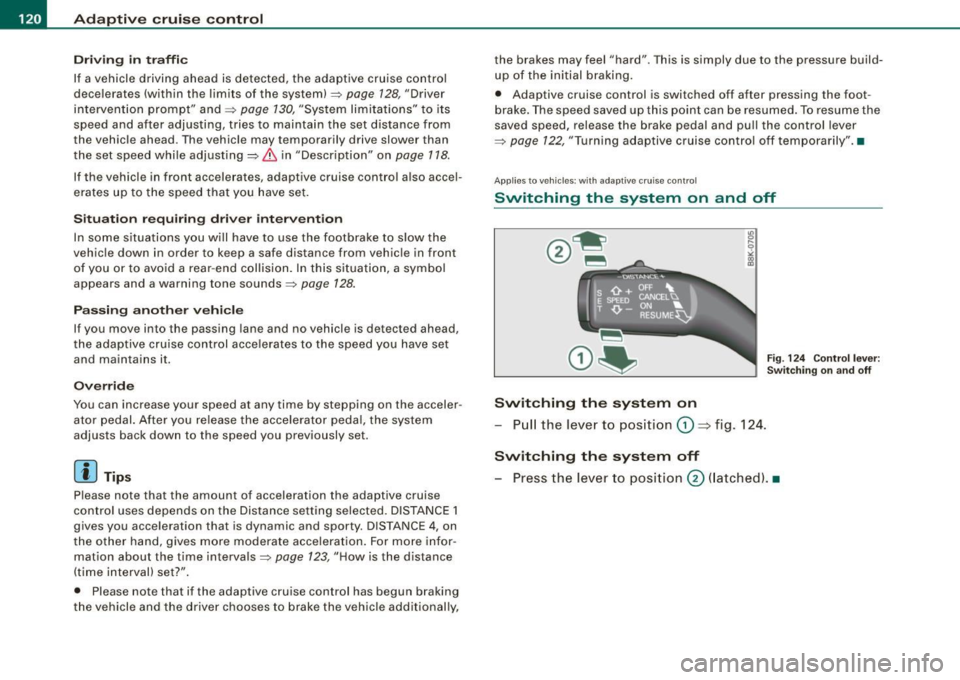
Switching the system on and off
F ig . 12 4 Control l ever:
Swit chi ng on and off
Switching the system on
- Pull the leve r to pos ition
(D ~ fig. 1 24.
Switching the system off
- Press the le ver to posi tion
0 (latch ed). •
Page 146 of 360
• .___A_ u_ d_ i _d _r_iv _ e_ s_e _le _ c_t _______________________________________________ _
Audi drive select
Driving settings
Applies to vehicles: with drive se lect
Introduction
Audi drive select provides the possibility to experience different
t ypes of vehicle settings in one vehic le . For instance, using the t hree
COMFORT, AU TO and DYNAMIC modes, the driver can switch from
a sporty to a comfortab le driving mode with the press of a bu tton .
Additiona lly, in vehicles with MM I*, the vehicle setup for INDI
VIDUAL * mode can be customized by you. This makes it possible to
combine settings such as a sporty engine tuning with l ight steering .
& WARNING
• Impr oper u se of the Audi drive sele ct ca n c aus e colli sion s,
o th er accid ent s and seriou s person al in jur y.
• Neve r dri ve at spe ed s th at are too h igh f or t raffi c, road and
w ea ther condition s. •
App lies to veh icles: with d rive se lect
Description
The vehicle setup in each mode depends on the vehicle's features .
However, the engine and servo tronic a re a lways affected. The auto
matic transmission *, dynamic steering * and adaptive dampers* are
a lso adjustable.
Depending on the mode, the
engin e and autom atic tr ansmis sion *
respond more quick ly or in a more ba lanced manner to accelerator
pedal movements. The
S
ervotroni c (steering servo assistance):::::, page 239 can also be
adapted to driving situations.
D ynami c steering changes the steering ra tio as a func tion of the
driving speed in order to op timi ze the driver's required steering
effort . This sets the steering to be less sensit ive at higher speeds in
order to provide greater control over the vehic le. At reduced speeds,
however, steering is more direct in order to keep the steering effort
as minimal as possible when the driver is maneuvering the vehic le.
At low and average speeds, dynamic steering additional ly provides
more responsive steering performance . The driver can set the basic
steering ratio characteristics .
The
adaptive damper s use sensors to record information regarding
steering movements, braking and acce leration operations by the
driver, road su rface, driving s peed, and load . This makes it possib le
to adapt damping to the driving situation virtually in real time. Audi
drive select also makes it possible to satisfy the desire for sporty
suspension (DYNAM IC) and comfortab le suspension (COMFORT)
without giving up ba lanced tuning (AUTO).
The fol lowing chart provides an overview of the characteristics of
each driving mode.
Systems DYNAMIC
Engine /gearbox
ba la n ced ba
lanced
sporty
Servotronic comfort able ba lance d sporty
Dynam ic steering comfort - bal- sporty/direct
able/ indirect anced/direct
Adaptive dampers comfortable ba lanced sporty
The Servotronic settings are adjusted under the
Dyn. steering menu
i t em. .,_
Page 147 of 360
__________________________________________________ A_ u_ d _ i_ d_ ri_v _ e_ s_ e_ le_ c_t _ __.9'
[ i J Tip s
• Sporty shifting characteristics can be set by selecting the
DYNAMIC mode . The S selector lever position is not available .
• The dynamic steering may make noise when sta rting or stopping
the engine. This does not indicate a problem. •
Applie s to v ehic les: wit h dr ive se le ct
Selecting the driving mode
You can choose between COMFORT, AUTO, DYNAMIC and
INDIVIDUAL* modes.
t
Con tro ls and eq uip
ment
i ;
-
~ ·
Fig. 15 5 Shift g ate:
Co ntr ol fo r Aud i d rive
s el ect
Fi g. 15 6 Center
co nso le: Co ntrol for
Aud i d rive s elect
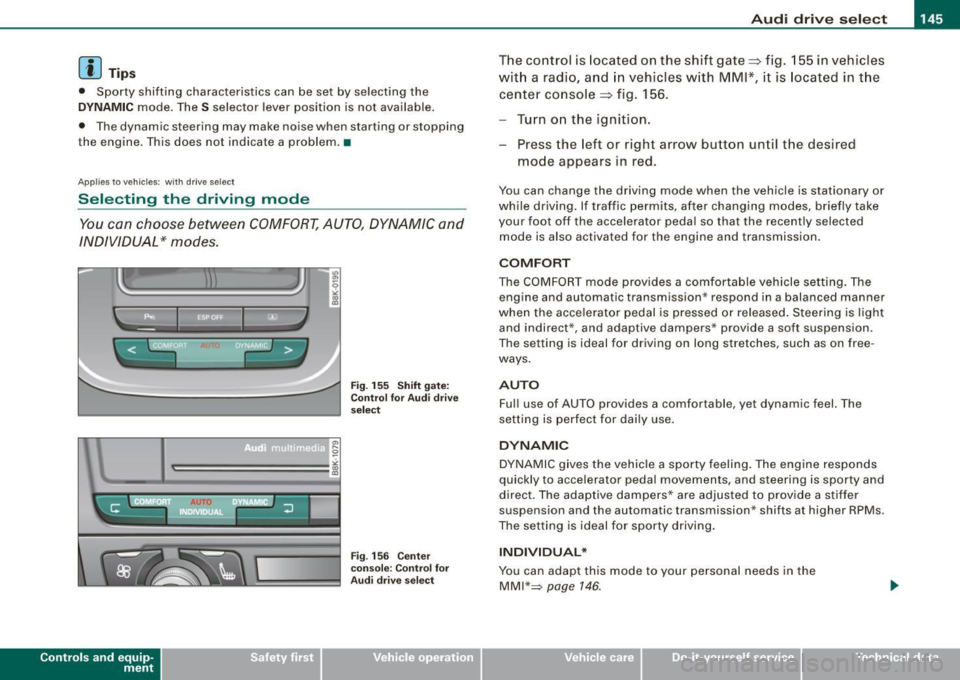
The co ntrol is located on the shift gate=:> fig. 155 in vehicles
wit h a radi o, a nd in vehicles w ith
MMI *, it is located in t he
cente r co nsole =:> fig . 156.
Turn o n the ignit ion.
Press the left or right arrow button unt il the desired
mode appears in red .
You can change the driving mode when the vehicle is stationary or
while driving. If traffic permits, after changing modes, briefly take
your foot off the accelerator peda l so that the recently se lected
mode is also activated for the engine and transmission .
COMFORT
The COMFORT mode provides a comfortable vehicle setting. The
engine and automatic transmission * respond in a balanced manner
when the acce lerator pedal is pressed or released . Steering is light
and indirect* , and adaptive dampers* provide a soft suspension .
The sett ing is ideal for driving on long stretches, such as on free
ways .
AUTO
Ful l use of AUTO prov ides a comfo rtable , yet dynamic feel. The
setting is perfect for dai ly use .
DYNAMIC
DYNAMIC g ives the vehicle a sporty feeling . The engine responds
quickly to accelerator peda l movements, and steering is sporty and
direc t. The adaptive dampers * are adjusted to provide a stiffer
suspension and the automatic transmission * shifts at higher RPMs.
The setting is ideal fo r sporty driving .
INDIVIDUAL *
You can adapt this mode to your pe rsonal needs in the
MMI"~ page 146 .
Vehicle care I I irechnical data
Page 248 of 360
![AUDI A5 COUPE 2010 Owners Manual ___ D_ r_ iv _i_ n- g"""- a_ n_d_ e_ n _ v_i_r _ o _n_ m_ e_ n_t _____________________________________________ _
[ i ] Tip s
The consumption estimates as published by ENVIRONMENTAL
PROTECT](/img/6/57582/w960_57582-247.png "AUDI A5 COUPE 2010 Owners Manual ___ D_ r_ iv _i_ n- g\"\"\"- a_ n_d_ e_ n _ v_i_r _ o _n_ m_ e_ n_t _____________________________________________ _
[ i ] Tip s
The consumption estimates as published by ENVIRONMENTAL
PROTECT")
___ D_ r_ iv _i_ n-' g"'""'- a_ n_d_ e_ n _ v_i_r _ o _n_ m_ e_ n_t _____________________________________________ _
[ i ] Tip s
The consumption estimates as published by ENVIRONMENTAL
PROTECTION AGENCY (EPA) and Transport Canada may not corre
spond to your actua l consumption on the road, which wi ll vary
depending upon vehic le load and speed, road and weather condi
tions, trip length, etc .•
Drive smoothly and keep a tookout ahead
Vehicles use the most fuel when they are accelerating.
- Avoid unnecessary accelerating and brak ing.
Vehicles use the most fuel when they are accelerating . If you antici
pate what is going to happen next, you will need to brake less and,
thus, accelerate less. Let the vehicle coast whenever possible -for
examp le when you see that the next traffic ligh t is red .
Avoid full thrott e
Driving at moderate speeds saves fuel and improves your
mileage.
- Try and keep we ll below your car's maximum speed.
Acce lerating gently reduces fuel consumption, engine wear, and
does not disturb the environment .
Fuel consumption, exhaust emissions and engine noise increase
disproportionately at high speeds. If you drive at approximate ly
three quarters of top speed, fuel consumption will be reduced by
one half. Never drive faster than the posted speed limit and weather
conditions permit. •
Reducing unnecessary idling
Even when your car is just idling it burns up fuel.
- Shut the engine off when you are not driving the vehicle.
-Do not warm up the vehicle by letting the eng ine run at
idle.
It makes sense to shut off the engine in traffic jams, when waiting
for trains to pass at rai lroad crossings, or at traffic lights that have
long waits on red. Turning the engine off for just 30-40 seconds
saves more fuel than is burned starting the engine again .
It takes a long time for the engine to warm up fully when it is
running at idle. However, wear and noxious emissions are especially
high when the engine is warming up. So you should drive away as
soon as you start the engine and avoid running at high rpms while
the engine is sti ll warm ing up .
0 Note
Do not leave engine idling unattended after starting. If warning
lights should come on to indicate improper operation, they would
go unheeded . Extended id ling a lso produces heat, which could
resu lt in overheating or other damage to the vehicle or other
property .•
Regular maintenance
A badly tuned engine unnecessarily wastes a lot of fuel.
- Have your vehicle serviced at regular intervals.
By having your vehicle regularly serviced by an authorized Audi
dea ler helps to ensure that it runs properly and economically. The
condition of your vehicle not only affects its safety and abi lity to
hold its value, it also affects
f ue l co nsu mpti on.
C hec k your o il e ach tim e y ou fill your ta nk.
Page 295 of 360
__________________________________________________ T_ ir_e_ s_ a_ n_d _ w_ h_ e_ e_l_s __ l9III
•
T he correct tire pressure for the spare wheel is located on a label
either on the driver's side B -pi llar or inside the fuel filler flap.
Because technical changes may be made to vehicle equipment
during the mode l year, always compare the tire size designation on
the tire pressure label on your vehicle with the tires on your vehicle. Make sure that the tire size information on the vehicle labe l is the
same as the size of the tires on the vehicle. This is especially impor
tant if the vehicle belongs to someone else or you bought the
vehic le with different rims/tires or you bought the vehicle as a previ
ously owned vehicle.
Remember, your safety and that of your passengers a lso depends
on making sure that load l imits are not exceeded. Vehicle load
includes everybody and everything in and on the vehicle . These load
limits are techn ically referred to as the vehicle's Gross Veh icle
Weight Rating ("GVWR"l. The Gross Axle Weight Rating ("GAWR"l is
the maximum load that can be applied at each of the vehicle's two axles. The Gross Vehicle Weight Rating and the Gross Axle Weight
Rating are l is ted on t he safety compliance sticker labe l located
either on the driver's side B-pillar or on the inside of the fuel fi ller
flap. The ti re pressure labe l on your Audi lists the maximum
combined weight of a ll of the occupants and luggage or other cargo
t hat the vehic le can carry. For the location of the tire pressure label
=>
page 291, fig. 229.
& WARNING
O verl oad ing a vehi cle can c ause lo ss of vehi cle co ntrol , a cras h or
other ac cident , seriou s per sonal injur y, and even death .
• Carry ing m ore w eight t han yo ur vehic le was designed t o carry
will p revent the vehicle from ha ndling properl y and increa se the
ri sk o f a loss of vehi cle co ntrol.
• The br ake s on a ve hicle tha t has been o verloaded may not be
a bl e to st op the veh icle with in a sa fe di stan ce .
• Tires o n a veh icle th at ha s been ov erlo aded ca n fail sudd enl y
ca usin g l oss of co ntrol an d a c rash.
& WARN ING (c ontinued )
• Always m ake sure that the total load being tr ansported -
in cluding the weight of a trailer hitch and the t ongue we ight of a
loaded trailer -do es not m ake the vehicle he avier tha n th e
v ehi cle's Gr oss Vehi cle Weight R ating .
& WARNING
• In corre ct t ire pre ssure s an d/o r underi nfl atio n can lead to a
s eriou s or fatal a ccident.
• In corre ct tire pr essures and/or u nde rin fla tion cau se in cre as ed
tire wear and can affect th e handlin g of the vehicl e.
• Inc orre ct t ir e pre ssu res and /or underinfl ation can a ls o l ead to
s udden tire failure , including a blowout and sudden d eflation ,
ca usi ng loss of vehi cle contr ol. •
Checking tire pressure
The correct tire pressure for the tires originally installed
on your vehicle is listed on the tire pressure label located
either on driver's side B-pillar or inside the fuel filler flap .
The recommended tire pressures are on the ti re pressure label and
in the table=>
page 291, "Cold tire inflation pressure".This means
that the pressure must be checked and adjusted when the tire has
not been driven for more than a couple of mi les (kilometers) at low
speeds during the previous three hours. Air in the tires expands
when the tire heats up as a result of internal friction as i t flexes in
use. The tire pressure is higher when the tire has warmed up than
when it is "cold ."
It is the inflation pressure in a "cold" tire that counts. Therefore, you
should never let air out of a warm tire to match "Co ld tire inf lation
pressure" recommendations=>
page 291. The tires wou ld then be
underinflated and could fail suddenly. .,_
Vehicle care I t •
Page 338 of 360
___ G_ e_n_ e_ r_ a _l _i_n _f _o _ r_ m_ a_ t_ i_ o _ n ________________________________________________ _
transporting a heavy load in the luggage compartment, carry the
load as near to the rear ax le as possible so that the vehic le's
handling is not impaired.
• Do not exceed the maximum perm issib le axle loads or the
maximum gross vehic le weight. Always remember that the vehic le's
handling wil l be affected by the extra load. Therefore , adjust your
speed according ly.
• Always o bserve local regulati ons .•
Dimensions
The s peci fica tions refer to t he basic mode l. Differences may occur
depending on the mode l type and options ordered, for examp le, tire
s izes .
0 Note
When driv ing up steep ramps, on rough roads, over curbs, etc . it is
important to remember that some parts of your vehicle, such as
spoilers or exhaust system components, may be c lose to the
ground . Be carefu l not to damage t hem. •