heating AUDI A5 COUPE 2011 User Guide
[x] Cancel search | Manufacturer: AUDI, Model Year: 2011, Model line: A5 COUPE, Model: AUDI A5 COUPE 2011Pages: 362, PDF Size: 84.88 MB
Page 112 of 362

lffl!l.___w __ a _r_ m __ a_n_ d_ c_ o _ l_d _______________________________________________ _
Seat heating only functions when the seats are loaded with body
we igh t. If a pe rson is no t sit ting on the fron t seats, seat heat ing
should be sw itched off to prevent un intentiona l heating of the seat
surfaces .
(D Note
To avoid damage to the heating e lements in the seats, do not kneel
on the seats or place heavy loads on a small area of t he seat.
(I) Tips
Please note that objects placed o n the seats may be detected. If these
objects are heavy enough, their we ight w ill cause the seat heat ing to
switch on. •
Page 240 of 362
Intelligent t echnology
'-----------------------------------------------
Electronic differential lock (EDL)
The elec tronic differen tial lock monitors the rotational
speed of the drive wheels.
G en era l not es
The electronic differentia l lock (EDL) helps the ca r to sta rt moving,
accelerate and climb a gradient on surfaces provid ing poor or almost
no grip . W ithout ED L, this would be d iff icu lt, if not impossible.
How the sy stem works
The EDL operates automatically. It mo nitors the rota tional speed of
wheels with the help of the ABS sensors~
page 241. If a not iceab le
slip is detected at the wheels (e.g . on slippery g round on one side),
the spinn ing wheels are braked and power is transferred to the other
wheels . This is done up to a speed of about 60 mph (100 km/h).
No ises from the brake system signal that wheel sp in is being
controlled.
Driv ing off
When d riving off, always be s ure to keep road conditions in mind as
you accelerate. If one drive wheel spins because it is on a surface with
less grip, apply
plenty of throttle until the car starts to move.
O verheating of bra kes
To prevent the disc b rake of the bra ked wheel from ove rhea ting if
subjected to excessive loads on this wheel, the EDL cuts out tempo
ra rily. The vehicle remains operat io nal and be haves in the same way
as a veh icle without EDL.
As soon as the brake has coo led down, EDL switches on again auto
matically.
& WARNING
• When ac ce le rating on s lippery surfa ce s, su ch as on ic e or snow,
alwa ys be ca reful when depre ssing the accele rator pedal. Even
& W ARNING (continue d)
with the EDL working , the dri ve wheels c an spin and reduce your
ability to contr ol your car . Ri sk of cra sh!
• The inc reased s afety afforded by E DL does not me an that you
can take safety ri sks. Alwa ys adapt your d rivin g style to the r oad
conditions and t raffic situation .
[ i ] Tips
If a fau lt occurs in the ABS, the EDL is also not funct ion ing. This is
ind ic a ted by the ABS warn ing light ~
page 17. •
Anti-Slip Regulation System (ASR)
The Anti-Slip Regulation System prevents the driven
wheels from spinning when the car is accelerating.
General notes
The Anti-Sl ip Regu lation System (ASR) is integrated in the electronic
stabiliza tion prog ram ( ESP) . When the ve hicle s tarts up and acceler
ates, the wheels are prevented from sp inning by adjusting the engine
powe r to match the amount of g rip available from the road surface .
How the system works
ASR performs au toma tic a lly, i.e. witho ut the dr ive r's intervent ion.
With the aid of the ABS sensors~
page 241, ASR monitors the speed
of the driven wheels. If the whee ls start to spi n, eng ine torq ue is
reduced automatically unti l the tires find enough grip to lock onto
t he road s urface . The system is active across the en tire spee d range.
Th e ASR works in con ju nction with the ABS .
If a malfunction shou ld
occur in the ABS, the ASR wi ll also be out of action.
Act ivating
T he ESP is automatica lly activated when the engine is started and it
performs a self-test . You can act ivate a deact ivated ASR if required by _,,
Page 246 of 362
Intelligent technology
'-------------------------------------------------
vi dual components. It regulates consumption, so that more electrical
energy is not being used than is being generated and ensures an
optimal state of charge for the battery .
[I] Tips
• But even energy management cannot negate the limits of physics.
Consider that the power and life of a battery are limited.
• If starting ability is threatened, you are informed by a warning
~ page 245, "Driver notification in the instrument cluster display" .•
What you should know
The highest priority is given to maintaining starting capa
bility.
Th e battery is severe ly taxed in short-distance driving, in city traffic
and during the cold time of year. Abundant electrical energy is
required, but only a little is generated.
It is also critical if the engine
is not running and electrical components are turned on. In this
instance energy is being consumed but none is being generated.
It is in prec ise ly these sit uations that you will notice energy manage
ment actively regulating the distribution of energy.
Vehicle stands for an extended period
If you do not drive your vehicle over a period of several days or weeks,
electrical components are gradually cut back or sw itched off. This
reduces energy consumption and maintains starting capability over a
longer period.
Take into consideration that when you unlock your vehicle, some
convenience functions, such as the remo te key or power seat adjust
ment, may not be available. The convenience functions will be avail
able again when you turn on the ignition and start the engine.
W ith the engine turned off
If you listen to the radio, for example, with the engine turned off or
use other MMI functions, the battery is being discharged .
If starting capability is jeopardized due to energy consumption, the
following warning appears in the MMI display:
Please start engine, otherwise system will switch off in
3 minutes.
Th e warn ing indicates that the system will be turned off automati
cally after 3 m inutes. If you wish to continue using the functions, you
have to start the engine.
With the engine running
Although electrica l energy is generated when the vehicle is being
driven, the battery can become discharged. This happens most ly
when little energy is being generated and a great deal consumed and
the battery's state of charge is not optimal.
T o br ing the ene rgy balance back into equilibrium, consumers which
require especially large amounts of energy are temporarily cut back
or switched off. Heating systems in particular require a great deal of
energy .
If you notice, for example, that the heated seats* or the
heated rear window are not heating, they have been temporarily cut
back or switched off. These systems will be ava ilable again as soon as
the energy ba lance has been restored.
You will also notice that engine idle speed has been increased
slightly. This is normal and not a cause for concern. By increasing
eng ine id le speed the additional energy required is generated and the
battery is charged. •
Page 284 of 362
___ C_h_ e_c _k _i_n -=g :a,__ a_n_ d_ f_ i_ l _li _n _,g;._ __________________________________________ _
0 Note
• Before w inter sets in, have the coolant checked to see if the
coolant additive in your vehicle is sufficient to meet the climate
conditions. This is especially important if yo u live in a region where
the winter is extremely cold.
If necessary, increase the proportion of
coolant additive to 60% .
• When adding coolant additive to your cooling system, remember :
- We recommend using only coolant additive G12++ (check the
label) for your vehicle. This coolant additive is available at autho
r iz ed Audi dealers. Other types of antifreeze can s ignificantly
reduce corrosion protection. The resulting corrosion can cause a
loss of coolant and serious engine damage.
• Do not add any type of radiator leak sealant to your vehicle 's
engine coolant. Adding radiator repair flu id may adversely affect the
function and performance of your cooling system and cou ld result in
damage not covered by your New Vehicle Limited Warranty .•
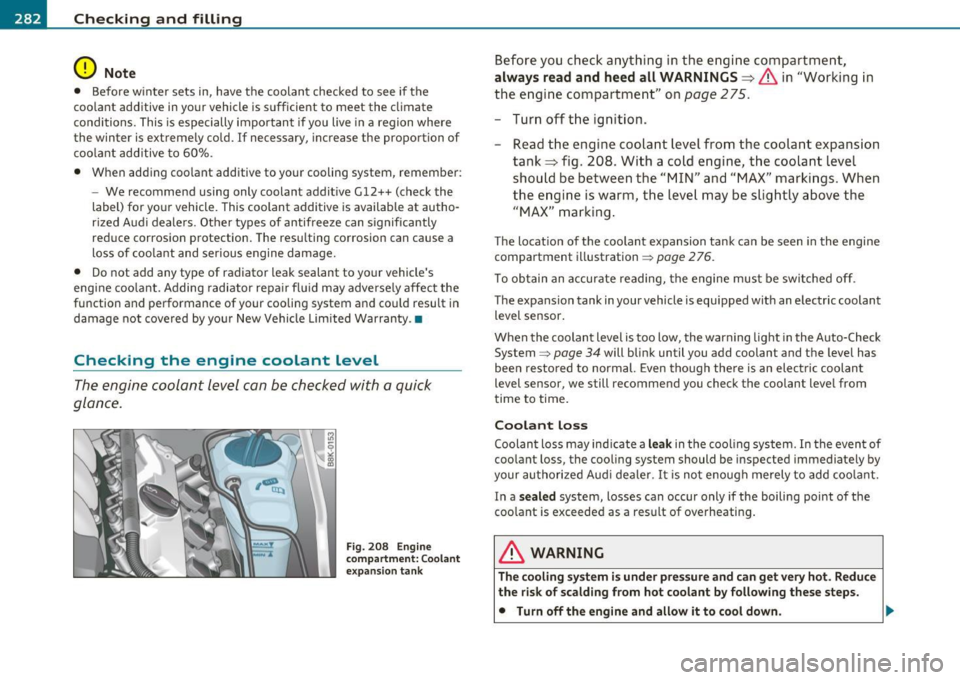
Checking the engine coolant Level
The engine coolant level can be checked with a quick
glance.
Fig. 208 Engine
co mpartment : Coolant
expansion tank
Before you check anything in the engine compartment,
always read and heed all WARNINGS~ & in "Working in
the engine compartment" on
page 275.
-Turn off the ignition.
- Read the engine coolant level from the coolant expansion
tank~ fig. 208 . With a cold engine, the coolant level
should be between the "MIN" and "MAX" markings. When
the engine is warm, the level may be slightly above the
"MAX" marking.
The locat io n of the coolant expansion tank can be seen in the engine
compartment illustration~
page 276.
To obtain an accurate reading, the engine must be switched off.
The expansion tank in your vehicle is equipped with an electric coolant level sensor.
When the coolant level is too low, the warning light in the Auto-Check
System =>
page 34 will blink until you add coolant and the level has
been resto red to normal. Even though there is an electric coolant
level sensor, we still recommend you check the coolant level from
time to time.
Coolant loss
Coolant loss may indicate a leak in the coo ling system. In the event of
coolant loss, the cooling system should be inspected immediately by
your authorized Audi dealer. It is not enough merely to add coolant.
In a
sealed system, losses can occur only if the boiling point of the
coo lant is exceeded as a result of overheating .
& WARNING
The cooling system is under pressure and can get very hot. Reduce
the risk of scalding from hot coolant by following these steps.
• Turn off the engine and allow it to cool down.
Page 326 of 362
-Fuses and bulbs
~-;,_;__:_:_;..:..:.:....::~=---------------------------
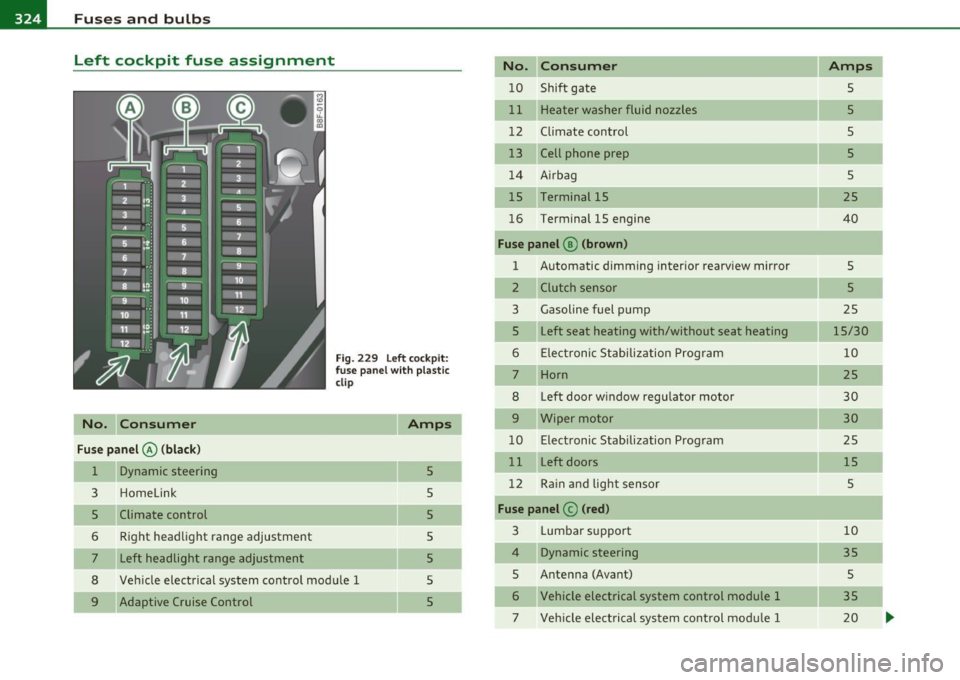
Left cockpit fuse assignment
No. C onsumer
Fu se p anel@ (bla ck )
1 Dynamic steering
3 Homelink
5 Climate control
6 Right headlight range adjustment
7 Left headlight range adjustment
F ig. 229 Left cockpit:
f use panel w ith p lastic
clip
Amps
5
5
5
8 Vehicle electrical system control module 1
5
5
5
5 9 Adaptive Cruise Control No. Con
sumer Amps
10 Shift gate 5
11 Heater washer fluid nozzles 5
12 Climate control 5
13 Cell phone prep 5
14 A irbag 5
15 Terminal 15 25
16 Terminal 15 engine
40
Fuse panel ® (brow n)
1 Automatic dimming interior rearv
iew mirror
5
2 Clutch sensor 5
3 Gasoline fuel pump
25
5 Left
seat heating with/without seat heating
15/30
6 Elect ronic Stabilization Program 10
7 Horn
25
8 Left door w
indow regulator motor
30
9 Wiper motor 30
10 Electronic Stabilization Program 25
11 Left doors 15
12 Ra in and light sensor 5
Fuse p an el © (red )
3 Lumbar support 10
4 Dynamic steering 35
5 Antenna (Avant)
5
6 Vehicle electrical system control module 1 35
7 Vehicle electrical system control modu le 1 20
Page 328 of 362
m...__F_ u_ s_e _ s_ a_n_d _b_u _ l_ b_s _______________________________________________ _
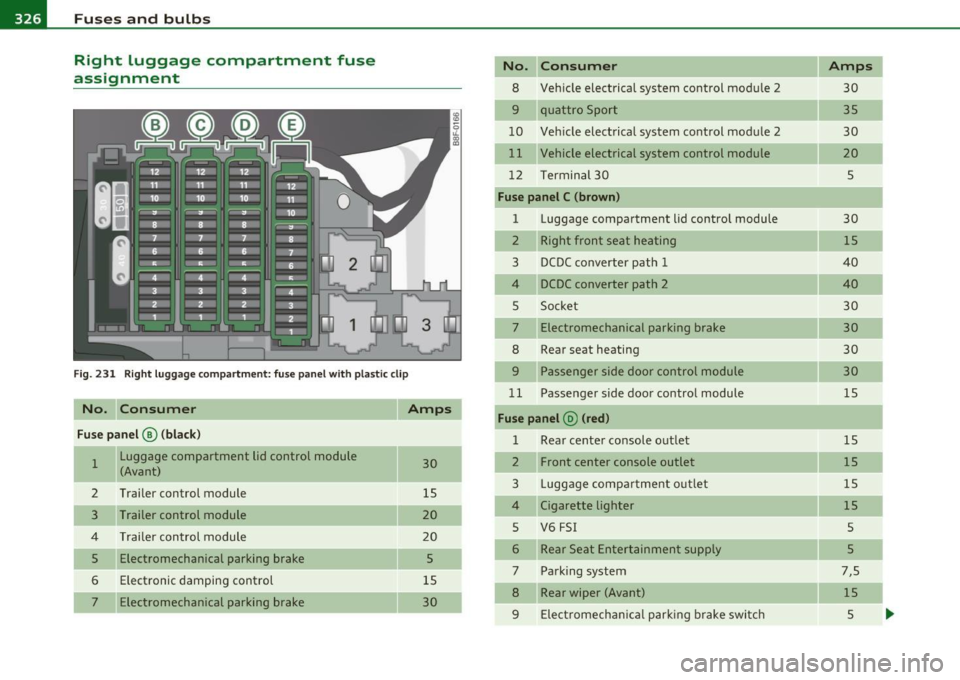
Right luggage compartment fuse
assignment
Fi g. 23 1 Ri ght luggage co mp artment : fu se pa nel with pl astic clip
No. Consumer Amps
Fuse panel @ (black)
1 Luggage compartment lid control module 30 (Avant)
2 Trai ler control module 15
3 Trailer control module 20
4 T rai ler control module 20
5 Electromechanical parking brake 5
6 Electronic damping control 15
Electromechanical parking b ra ke 30
No . Consumer
8 Ve hicle electrical system control mod ule 2
9 quattr o Sport
10 Veh icle elect rical system control modu le 2
11
Vehicle electrical system control module
12 T ermin al 30
Fuse panel C (brown )
1 Luggage compartment lid contro l modu le
2 R ight front seat heating
3 D CDC converter path 1
4 DCDC converter path 2
5 Soc ket
7 Electromechanical parking brake
8 Rear seat heating
9 Passenger side door control module
1 1 Passe nger s ide door control module
Fuse panel @ (red )
1 Rear center console o utlet
2 Front center console outlet
3 L ugg age compa rtme nt o utlet
4 Cigaret te lighter
5 V6 FSI
6 Rear Seat Enter tainmen t supply
7 Pa rking system
8 Rear wiper (Avant)
9 Elect romec ha ni ca l p arkin g br ake switc h
Amps
30
35
30
20
5
30
1 5
40
40
30
30
30
30
15
15
15
15
15
5
5
7,S
15
5
Page 354 of 362
-Alphabetical inde x lffi'f ___,__ ______________ _
Heating
Deluxe automatic climate control plus
101
Heavy clothing and safety belts . ... ... . 184
High beam ................ ...... .. . 62
Warning/indicator lights . .......... 17
H igh vo ltage warning labe l ......... .. 336
HomeL ink® un iversal remote control . .. 166
Hood
Opening ................ ...... ..
274
Release lever ............ .. .... .. 2 7 4
Horn ................. .. .. .. .. .... .. 9
How are child restraint system anchors related to chi ld safety ..... .............
229
How many a irbags does my vehicle have? .. ..
197
How often should I check my tire pressures? .
298
How safety belt pretensioners work ... . 188
Indicator lights ... .......... ..... .. .. 14
Airbag system .......... .. ... 201, 202
PASSENGER AIR BAG OFF .......... 202
Infant seats ....... ... .. .... ....... 221
Ins ide rear view mirror ........ .. .. .. .. 68
Installing child safety seats
Safety belts ............... ... .. .
225
Installing the upper tether strap on the
anchorage ... .... ... ..... .... ..
233
Instrument lighting .......... .. .. .. .. 61
Instruments and controls ..... .. .... .. 10
General illustration .............. ... 9
Interior lights Dimming . .... ... .. .. .. .. .. .. .. ..
63
Front .. ................. .. .. .. .. 63
Rear ... ................. .. .. .. .. 64
Interval wiping . .. .. ............... .. 65
Rain sensor ......................
65
Hydroplaning . .. ............ ....... 302 J
I Jumper cables .. .. .................. 329
Jump-sta rting ................ .... .. 328
Ignition key ........ ............. ... 112
Emergency unlocking .. ....... ..... 44 K
Ignition lock .. .... .. .. .... ......... 112
Malfunction ............. ...... 36, 40 Key ........ ...... ... .. .... ........ 42
Immobilizer . ... ..... ............... 42 Battery replacement ............... 43
Important things to do before driving .. 171
Improperly worn safety belts ......... 188
Indicato r light
Dynamic steer ing .......... ....
15, 37
Key replacement ..... ............. 42
Master key with remote control .. .. .. 42
Mechanica l key ................. .. 44
Kick-down tiptronic ....... .............. ...
154
Knee airbags .. .... .... ...... ... .. .. 206
Description .. .. .. ............... 206
How they work .............. ... . 207
Important safety instructions ...... 208
L
LATCH 229
Description .. ...... ............. 230
Insta lling a child restraint ....... .. 231
Location . ........... .. .... .... .. 230
Mounting and releasing the anchorage
hook .. ...... .. .. ..... .. .. .. ..
231
Leather .................... ... .. .. 264
Cleaning ........... .. .... .... .. 265
Lifting jack .......... ... . .. .... .. .. 319
Lifting vehicle ...................... 333
Light
Coming home ............ ... ... ..
60
Daytime running lights ............. 60
Driving light control ............... 58
Exterior lighting .. .. .... ......... . 60
Leaving home ....... .. .. .. .... .. . 60
Switching on and off ....... ... .. .. . 58
Light sensor ................ ... .. .. . 58
Light sensor defective ...... .. .. ... ... 38
Lighting ..... .. .. .... .............. 58
Lights
Emergency flashers . . . . . . . . . . . . . . .
62
High beam ...... . .. .............. 62
High beam warning/indicator light ... 17
Turn signals .................... .. 62
Xenon headlights . .. .... .......... 61
Page 357 of 362
Alphabetical index -________________ fNi'II
Release lever for hood ...... .. .. .. .. . 274 Safety belts .... ..... ... ......... ... 185
Remote control garage door opener Cleaning ... ................ ..... 267
(Homel ink ®) ........... .... ... . 166 Danger to passengers who do not wear a
Remote control key safety belt ..................... 183
Unlocking and locking ... .. .. ....... 47 Fastening .... .. .... .. ........... 185
Remote rear lid release ........... .. .. 51 Improperly worn · · · · . · · · · · · · · .... 188
Repair manuals ................ ..... 340 Not worn · · · · · · · · · · · · · · · · · · · · · · · 183
Safety belt position ............. .. 186
Repairs
Airbag system .................. . 204
Rep lacing bulbs ........ .... .. .. .. .. . 327
Replacing tires and wheels ......... .. . 303
Replacing windshield wiper blades ...... 67
Reporting Safety Defects ........ 179, 180
Reset button .......... ...... .. .. .. .. 13
Retractor ....... .. .... .. ... ... ..... 185
Rims Cast alloy .............. .. .... .. . 261
Roof luggage rack Mounting points .................. 89
Roof rack ............. ...... ... . .. .. 88
Roof load . ............. ...... .. .. 90
See also Roof luggage rack .......... 88
s
Safe dr iving habits ............... ... 170
Safety belt position .. .. .. ........ .... 186
Safety belts worn by pregnant women . ..
187
Safety belt pretensioner .. .. ... .... ... 188
Service and disposal ............. . 189
Safety belt warning light . . . . . . . . . 16, 181 Safety instructions
.. .. .. ...... .. . 184
Securing child safety seats . ........ 225
Special considerat ions for pregnant
women ........................ 187
Unfastening .. ................... 188
Warning/indicator light .. ....... .. 181
Why YOU MUST wear them ......... 181
Worn properly .. ..... ......... .. . 183
Safety compliance sticker ............. 336
Safety equipment .... ............. .. 170
Safety features for occupant restraint and
protection ................... .. 170
Safety guidelines Seat adjustment .................. 73
Safety instructions
Engine compartment ... .......... 275
for side curtain airbags ... .. .. ..... 213
for using child safety seats ....... .. 218
for using safety bel ts ...... ...... .. 184
Monitoring the Advanced Airbag System .
203
Seat adjustment Driver's seat .... ....... .... ...... . 73
Easy entry funct ion ............. .. . 78
Easy entry manual function ......... 76
For-and-aft manually .. .. .. ........ 7 5 Front passenger's seat .
... .. .. .. ... 7 4
Front seats ...... ................. 73
Head restraints ................ .. 17 4
Manual . ........... .. .... .. .. .. .. 74
Power ............. .. .... .... .. .. 76
Seat back angle manual ly ....... .. .. 75
Seat height manually ............ .. 75
Seat belts
See Safety belts .................. 181
Seat heating
Front seats ...................... 109
Seat memory ... ...... ............... 78
Seat symmetry ... .. .. ... ... .. .. ... .. 80
Seating capacity ............. ....... 181
Seat ing position
Driver ............. .. .. .. .... .. . 172
Front passenger .. .. ............. . 173
How to adjust the front seats ....... 173
Incorrect seat position . ........... 175
Occupants .................... .. 172
Rear passengers ................. 174
Seats Number of seats . .. ............. . 181
Selective unlock feature ............... 47
Selector lever . ... .. .. ............ .. 152
Emergency release ............... 156
Service and disposal Safety belt pretensioner .......... . 189
Service interval display ................ 23
Service position for windshie ld wipers ... 66
Servotron ic
Power steering ........... ... ... .. 242
SET button . ...... .... .. .. .. .. .. .. .. 11
Controls and equip
ment Safety first Vehicle operation
Vehicle care Do-it-yourself service Technical data
Page 360 of 362
___ A_ l_. p_ h _ a_b_ e_ t_ic _a_ l_ in_ d_e _ x ____________________________________________ _
What should I do after changing a wheel? ...
298
What should I do after replacing wheels? 298
Wheel bolts Torque ............. .... .. .... .. 308
Wheels ........................... 291
Cast alloy .. ... ........... ..... .. 261
Checking tire pressure ............ 297
Cold tire inflation pressure ......... 295
General notes ................... 291
Glossary of tire and loading terminology . 292
New tires and wheels .. ..... ..... . 303
T ires and vehicle load limits ........ 299
When must a safety belt be replaced? . . 184
When must the a irbag system be inspected? .
201
When shou ld I adjust the tire pressures? 298
When should I check the tire pressures? 298
Where can I find the tire pressures for my car?
297
Why safety belts? ........... .... 181, 182
Window regulators Malfunct ions . ............. .... .. . 54
Power locks .. ................. .. . 54
Windows Clean ing . ...... ...... .... ..... .. 260
Windshield defogging/defrosting .. 100, 106
Windshield washer fluid Low level .. .. .. .. .... .. ... ....... 39 Windshield wipers
.. .......... ... .. .. 65
Faulty ...... .................. ... 41
Replacing w indshield wiper blades ... 67
Service position . . . . . . . . . . . . . . . . . . . 66
Was her reservoir ................. 290
Winter operation Battery .... .. .. .. .. .... ......... 285
Coolant system ... .. .. .. .. .. .. .. . 281
Defrosting windows .......... . 99, 106
Front seat heating ...... ......... 109
Tir es ......... ............. .... . 242
Windows ............ .. .. .. .... . 260
Winter tires ....................... 307
All-wheel drive .................. 307
Wiper blades Replacing windshield wiper blades ... 67
See also Windshield wipers ... .. .... 67
X
Xenon headlights ............ .. .. 61,327
y
Yellow symbols . .. .. ............... .. 36