trailer AUDI A5 COUPE 2011 User Guide
[x] Cancel search | Manufacturer: AUDI, Model Year: 2011, Model line: A5 COUPE, Model: AUDI A5 COUPE 2011Pages: 362, PDF Size: 84.88 MB
Page 256 of 362

Trailer towing
"-------------------------------------------------
- Place an automatic transmission* in P, respectively a
manual transmission in first or reverse gear.
When restarting after parking:
- Apply the foot brake.
- Start the engine.
- Move the selector lever to
D, respectively a manual trans-
mission in first gear.
- Release the parking brake and slowly pull out and away
from the wheel chocks.
- Stop and have someone retrieve the wheel chocks.
00 Tips
If you move the selector lever of the automatic transmission* to P
before applying the parking brake and before blocking the wheels,
you may have to use more force later to move the lever out of the P
position. •
Page 299 of 362
______________________________________________ T_i_r _e _s _ a _ n_d_ w_ h_e_ e_ ls __ l!'II
Remember, your safety and t hat o f your passengers also depends o n
making sure th at load limit s are not exc ee ded . V ehicle load in cludes
every body and everything in a nd on the veh icl e. These load limits are
tec hnically refer red to as t he ve hicle's G ross Vehicle Weight Rating
("G VWR") . The Gross Axle Weight Rat ing ("GA WR") is th e max imum
load that can be a pplied at each of the ve hicle's two ax les. The Gross
Vehicle Weigh t Rating and the G ross Ax le W eig ht R ating are listed on
the safety comp liance st ic ker label located either on the driver's side
B -pillar or on t he inside of th e f uel fi ller f lap. T he tire press ure label
on yo ur Audi lists the maximum comb ined weig ht of all of the occu
p ants a nd lugg age o r othe r car go tha t t he ve hicl e c an ca rry . Fo r the
location of t he tire pressure label~
page 295, fig. 212.
& WARNING
Overloading a vehicle can cause loss of vehicle control , a crash or
other accident, serious personal injury, and even death .
• Carrying more weight than your vehicle was designed to carry
will prevent the vehicle from handling properly and increase the risk of a loss of vehicle control.
• The brakes on a vehicle that has been overloaded may not be
able to stop the vehicle within a safe distance.
• Tires on a vehicle that has been overloaded can fail suddenly
causing loss of control and a crash.
• Always make sure that the total load being transported -
including the weight of a trailer hitch and the tongue weight of a
loaded trailer -does not make the vehicle heavier than the
vehicle's Gross Vehicle Weight Rating.
& WARNING
• Incorrect tire pressure s and/or underinflation can lead to a
serious or fatal accident .
• Incorrect tire pressures and/or underinflation cause increased
tire wear and can affect the handling of the vehicle .
Safety first
& WARNING (cont inued )
• Incorrect tire pressures and/or underinflation can also lead to
sudden tire failure, including a blowout and sudden deflation,
causing loss of vehicle control. •
Checking tire pressure
The cor rect t ire pres sure fo r the tires o rig inall y installed
on you r veh icle is list ed o n the t ire pr ess ure la bel l ocat ed
e ither on driver's s ide 8-pillar or insi de th e fue l fill er flop.
Th e recommended tire pressure s are on the tire pressur e l abe l and in
the table ~
page 295, "Cold tire inflation press ure" .This means that
t he pressure must be check ed an d a dju sted w hen the tire h as no t
been dr iven for more tha n a cou ple of m iles (k ilometers) at low
s peeds dur ing t he pr evious t hree hour s. Air in the tires ex pands w hen
t he tire heats up as a resu lt of i nterna l fric tion as it flexes in use. The
tire pressu re is hig he r when the t ire has warmed up than when it is
"cold ."
It is the in flation press ure in a "cold" t ire that counts. Therefore, yo u
sh oul d n eve r le t a ir ou t of a warm t ir e to ma tch "C old tire in flatio n
pressure" recommendations~
page 295. The t ires would then be
unde rin flat ed and co uld fail su ddenly.
Th e tire pressu re labe l on yo ur Audi lists t he recommended co ld t ire
inflation pressures at ma ximum capacity fo r th e new, o rigina l equip
me nt t ires that were on yo ur vehicl e at th e time it wa s manuf actured .
For the location of t he label ~
page 295, fig. 212.
M ost t ires lose air natura lly ove r time. T hey c an also lose some air if
you d rive over a potho le or hit a curb while pa rking . It is usually not
poss ible to see whether the radia l ti res used today are unde rinflate d
just by loo king at them .
T he refore, be sure to check t ire pressures at least once a month and
alw ay s before go ing on a lo ng trip. Make sure to take the num ber of
people and the amount of luggage into account whe n ad justing tire .,.
Vehicle care Technical data
Page 301 of 362
________________________________________________ T_i_r _e _s _ a_n _ d_ w_ h_ e _ e_l_s __ _
& WARNING (co ntinued )
• Only when all tire s on the vehicle are filled to the correct pre s
sure, the tire pressure monitoring sy stem* can work correctly .
• The u se of incorrect tire pressure values can lead to accidents or
other damage. Therefore it is essential that the driver observe the
specified tire pressure values for the tires and the correct pres
sures for the function of the tire pre ssure monitoring system *.
• Always inflate tires to the recommended and correct ti re pre s
sure before driving off.
• Driving with underinflated tire s bend more , letting them get
too hot resulting in tread separat ion, sudden tire failure and loss
of control.
• Excessive speed and /overload ing can cause heat build-up ,
sudden tire failure and loss of control.
• If the tire pressure is too low or too high , the tires will wear
prematurely and the vehicle will not handle well.
• If the tire is not flat and you do not have to change a wheel
immediately, drive at reduced speed to the neare st service station
to check the tire pressure and add air as requ ired.
0 Note
Dr iv ing without valve stem caps can cause damage to the tire valves.
T o preven t this, a lways make su re t hat fac tory ins talle d va lve stem
caps on all wheels a re securely mo unted on the valve.
'£> For the sake of the environment
Under inflated t ires will a lso increase the fuel consumption .•
Tires and vehicle Load Limits
T here are lim its to the amount of load or we ight that any vehicle a nd
any t ire can c arry . A veh icle t hat is over loaded w ill not hand le well an d
Safety first
is more difficult to stop . Overloading can not only lead to loss of
veh icle co ntro l, bu t ca n also d amage important p art s o f the ve hicl e
and can lead to sudden ti re failure, including a blowout and sudden
deflation that can cause the vehicle to crash.
Your safety a nd tha t of you r passe ngers also depe nds o n mak ing s ure
that load limits are not exceeded. Vehicle load incl udes everybody
and everyt hing in and on t he ve hicle. T hese lo ad lim its are techn ic a lly
referred to as the vehicle's
Gross Vehicle Weight Rating ("GVWR").
Th e "GVWR" includes the weight of the basic vehi cle, all facto ry
installed accessories, a fu ll tank of fue l, o il, coo la nt and other fluids
plus maxim um loa d. Th e maxim um loa d includes t he nu mber of
passeng ers th at t he ve hicl e is intended to car ry ("sea ting capa city ")
with an ass umed weig ht of 150 lbs . (68 kg) for each passenger at a
design ated seating posit ion a nd the to tal weig ht of any luggage in
the vehicle. If yo u tow a tra iler, the weight of the trailer hitch and the
t ongue weig ht of the lo ad ed t railer mus t be include d as pa rt of the
vehicle load.
Th e
Gross Axle Weight Rating ("GAWR") is the maximum load that
can be a pplied at each of t he ve hicle's two axles .
The Gross Vehicle We ight Rating and the Gross Ax le We ight Rating
are li sted on the safety comp lia nce s tick er label loca ted either on the
dr ive r's side B-pilla r o r on the inside of the fuel filler flap . Aud i has
4 se ating posi tions, 2 in the fron t and 2 in the rea r for tot al s eating
capacity of 4. Each seating position has a seat belt~
page 181,
"Safety be lts".
Th e fact t hat there is an upper lim it to your v eh icle 's Gross Vehicle
Weight Rating means that t he tota l weight of whatever is being
c a rried in th e veh icle ( in cl ud ing the w eight of a t railer hitch and the
tongue weight of the loaded tra iler) is limited. The mo re passengers
in the veh icle or p assengers who are heavier th an the sta ndar d
we ights assumed mean that less we ight can be carried as luggage.
Th e ti re pressure label on yo ur Audi also lis ts th e maxim um combined
we ight of all of the occupants and luggage or other cargo that the
vehicle can car ry. For the location o f the labe l~
p age 2 95, fig . 21 2. ~
Vehicle care Technical data
Page 302 of 362
-Tires and wheels
in. WARNING
Overloading a vehicle can cause loss of vehicle control, a crash or
other accident, serious personal injury, and even death.
• Carrying more weight than your vehicle was designed to carry
will prevent the vehicle from handling properly and increase the risk of the loss of vehicle control.
• The brakes on a vehicle that has been overloaded may not be
able to stop the vehicle within a safe distance.
• Tires on a vehicle that has been overloaded can fail suddenly,
including a blowout and sudden deflation, causing loss of control
and a crash.
• Always make sure that the total load being transported -
including the weight of a trailer hitch and the tongue weight of a
loaded trailer -does not make the vehicle heavier than the
vehicle's Gross Vehicle Weight Rating. •
Determining correct load limit
Use the example below to calculate the
total weight of the passengers and luggage
or other things that you plan to transport so
that you can make sure that your vehicle
will not be overloaded.
Steps for Determining Correct
Load Limit
1.Locate the statement "THE COMBINED WEIGHT OF OCCUPANTS AND CARGO
SHOULD NEVER EXCEED XXX KG OR XXX LBS"on your vehicle's placard (tire infla
tion pressure label)==>
page 295J
fig. 212.
2. Determine the combined weight of the driver and passengers that will be riding
in your vehicle.
3. Subtract the combined weight of the driver and passengers from
"XXX" kilo
grams or
"XXX" pounds shown on the
sticker==>
page 295J fig. 212.
4. The resulting figure equals the available amount of cargo and luggage load
capacity. For example, if the
"XXX"
amount equals 1400 lbs. and there will
be five 150 lbs. passengers in your
vehicle, the amount of available cargo
and luggage load capacity is 650 lbs. (1400- 7 SQ (5
X 150) = 650 lbs.) ~
Page 303 of 362
_________________________________________ T_ i_re _ s_a _n_ d_ w_ h_e _e _l_s _ ..... fflll
5. Determine the combined weight of
luggage and cargo being loaded on the
vehicle. That weight may not safely
exceed the available cargo and luggage
load capacity calculated in Step 4.
6. If your vehicle will be towing a trailer,
load from your trailer will be transferred
to your vehicle. Consult this manual to
determine how this reduces the available
cargo and luggage load capacity of your
vehicle.
Check the tire sidewall(~
page 303~
fig. 216) to determine the designated
load rating for a specific tire .•
Vehicle OP-eration
Tire service life
The service life of tires depends on a lot of different
things including proper installation and balancing,
correct tire pressure and driving style .
(-----~
_____ __,,:)
Tread Wear Indicator (TWI)
N
"' 0 9
"" ~
Fig. 214 Tire tread:
tread wear indicators
(TWI)
Fig. 215 Rotating
tires for more even
wear
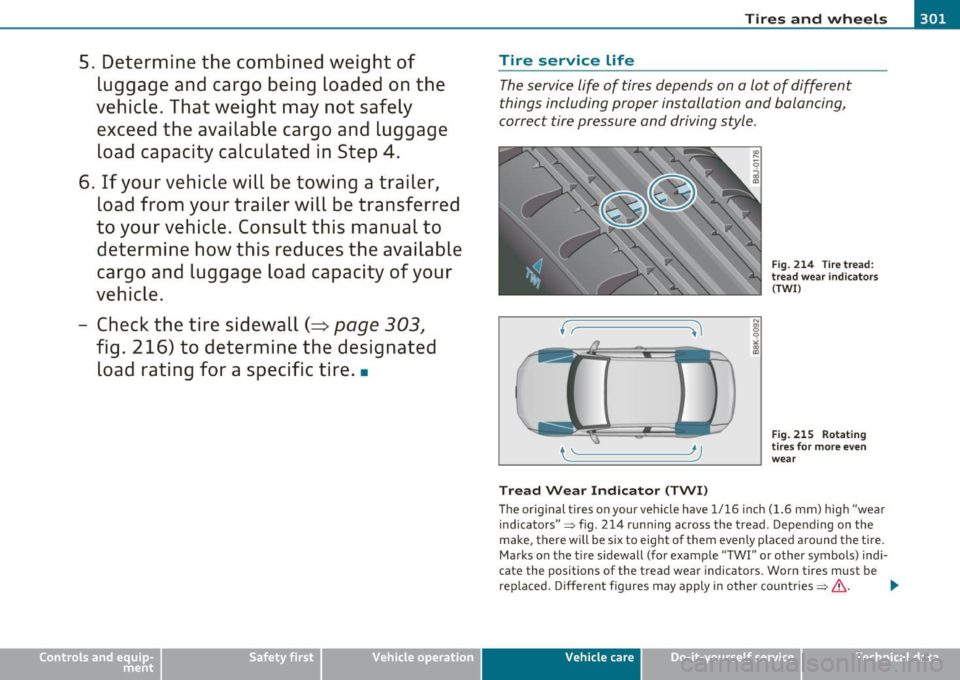
Th e original tires on your vehicle have 1/16 inch (1.6 mm) high "wear
indicators "~ fig. 214 running across the tread. Depending on the
make, there will be six to eight of them even ly placed around the tire.
Marks on the tire sidewall (for example "TWI" or other symbols) indi
cate the positions of the tread wear indicators. Worn tires must be
rep laced. Different figures may apply in other countries ~
&- .,_
Vehicle care Do-it-yourselt service iTechnical data
Page 318 of 362
lffll.___W __ h_a_ t_ d_ o_ I_ d_o_ n_ o_w _ ? _____________________________________________ _
Changing a wheel
Before changing a wheel
Observe the following precautions for your own and your
passenger's safety when changing a wheel.
- After you experience a tire failure, pull the car well away
from moving traffic and try to reach
level ground before
you stop
~ & .
- All passengers should
leave the car and move to a safe
location (for instance, behind the guardrail)~& .
- Engage the
parking brake to prevent your vehicle from
rolling unintentionally~ &.
- Shift into
1st gear on vehicles with manual transmission,
or move the
selector lever to the P position on vehicles
with automatic transmission*.
- If you are towing a trailer: unhitch the trailer from your vehicle.
- Take the
jack~ page 314 and the spare tire~ page 314
out of the luggage compartment.
& WARNING
You or your passengers could be injured while changing a wheel if
you do not follow these safety precautions:
• If you have a flat tire, move a safe distance off the road. Turn
off the engine, turn the emergency flashers on and use other
warning devices to alert other motorists.
• Make sure that passengers wait in a safe place away from the
vehicle and well away from the road and traffic.
& WARNING (continued)
• To help prevent the vehicle from moving suddenly and possibly
slipping off the jack, always fully set the parking brake and block
the wheel diagonally opposite the wheel being changed with the
folding chocks or other objects. When one front wheel is lifted off
the ground, placing the Automatic Transmission in "P" (Park) will
not prevent the vehicle from moving.
• Before you change a wheel, be sure the ground is level and
firm. If necessary, use a sturdy board under the jack.
• After installing the inflatable spare tire, make sure that you
replace the flat tire/wheel in its storage area properly and tighten
the knurled retaining screw securely.
0 Note
If you are changing the wheel on a steep incline, use a rock or simila r
object to block the opposite wheel to prevent the vehicle from
moving.
[ i] Tips
Obey all laws. •
Changing a wheel
When you change a wheel, follow the sequence described
below step-by-step and in exactly that order.
1. Remove the decorative wheel cover* or the wheel bolt
caps* .
For more details see also~ page 317, "Decorative
wheel covers" or~
page 318, "Wheels with wheel bolt
caps".
2. Loosen the
wheel bolts~ page 318. .,_
Page 328 of 362
m...__F_ u_ s_e _ s_ a_n_d _b_u _ l_ b_s _______________________________________________ _
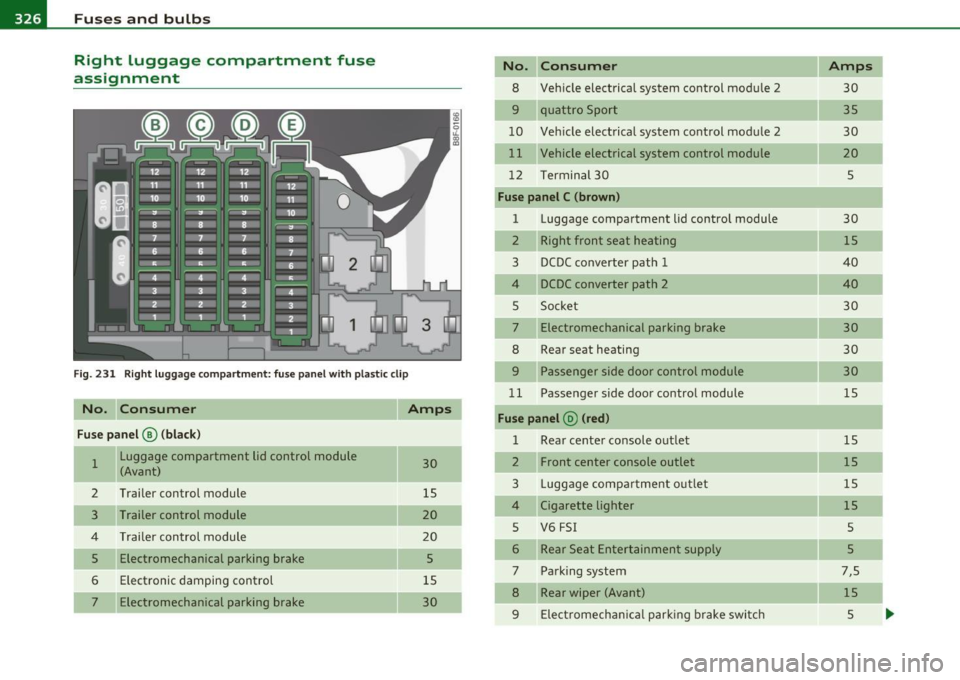
Right luggage compartment fuse
assignment
Fi g. 23 1 Ri ght luggage co mp artment : fu se pa nel with pl astic clip
No. Consumer Amps
Fuse panel @ (black)
1 Luggage compartment lid control module 30 (Avant)
2 Trai ler control module 15
3 Trailer control module 20
4 T rai ler control module 20
5 Electromechanical parking brake 5
6 Electronic damping control 15
Electromechanical parking b ra ke 30
No . Consumer
8 Ve hicle electrical system control mod ule 2
9 quattr o Sport
10 Veh icle elect rical system control modu le 2
11
Vehicle electrical system control module
12 T ermin al 30
Fuse panel C (brown )
1 Luggage compartment lid contro l modu le
2 R ight front seat heating
3 D CDC converter path 1
4 DCDC converter path 2
5 Soc ket
7 Electromechanical parking brake
8 Rear seat heating
9 Passenger side door control module
1 1 Passe nger s ide door control module
Fuse panel @ (red )
1 Rear center console o utlet
2 Front center console outlet
3 L ugg age compa rtme nt o utlet
4 Cigaret te lighter
5 V6 FSI
6 Rear Seat Enter tainmen t supply
7 Pa rking system
8 Rear wiper (Avant)
9 Elect romec ha ni ca l p arkin g br ake switc h
Amps
30
35
30
20
5
30
1 5
40
40
30
30
30
30
15
15
15
15
15
5
5
7,S
15
5
Page 359 of 362
_________________________________________ ..!.A~ lp~ h~a ~b~ e~ t~ i~c ~a ~l ...!_i~n ~d ~e~ x~ _ffllll
Tires and vehicle load limits .. .. .... 299 Trunk pass-through .... .. .. .. ... ..... 88 W
Wheel bolts ..................... 308 Turn s ignals ... .. ... .... ..... .. .. .. .. 62
W inter t ires ............. ... ... .. 307 Warning/indicator lights ... ..... .. . 16 Warning lights . .. ................... 14
T ires/Wheels
Low aspect ratio tires ............. 309
Tire pressure mo nitoring system 16,310
T ool kit .. ................... .. .. .. . 314
T orn or frayed safety be lts ............ 184
T ouch -up paint ....... .. .. .. ... .. .. . 260
T ow ing
Fro nt eye let ..................... 331
Rea r eye let ...................... 332
T ow tr uck procedu res . .. .......... 3 31
TP MS
Ti re pressure monito ring system . .. . 3 11
Trailer towing ................... .. . 251
Operating instructions ... ...... .. .
251
Tech nica l requirements ..... .. 251,252
Tips .................... ... .. .. . 253
T .. ransm1ss1on ... ..... .... ... ... .. .. . 150
6-speed manual transmission . .. . ... 150
tiptronic . ... .. .. ... ..... .... . .. . 150
Tr ansport Canada . .................. 180
Tread Wear Indicator (TWI) ........... 301
T rip comp uter
Fuel consumption ... .. .. .. .... .. .. 24
Mileage ......... .. .. ... .... .. .. .. 24
Single-trip memory ............ .. .. 25
Total-trip memory ................. 25
Tr ip odometer .... .. ... . ..... .. .. .. .. 13
T runk escape handle .................. 52
T ru nk lid
See Luggage compartment .......... 51
Controls and equip
ment Safety first
Warning/indicator lights .
... .... .. .. .. 10
u Adaptive cruise control ............ 129
Airbag system ...... ...... .. .... .. 16
Undercoating ... .. ... ... .. .. .. .. ... 2 62
Anti-lock brake system (ABS) ........ 17
Unfasteni ng safety be lts .. ... ........ 188
Brake system .. ..... ..... ... . ... .. 18
Unidirect ional tires .. ... .. .. .. .. ..... 291 Cru
ise con trol . ................... 17
Uniform t ire quali ty g r.ad ing . ......... 306 Electromechanical
parking brake ..... 18
Unlocking Lu ggage compartment lid ....... .... 51
Powe r locking switch ... ........ ... . SO
Remote cont rol key ................ 47
Us ing the me chanical key ........ .. . 4 9 E
lectron ic power cont rol . ........... 15
E lectron ic stabi liz ation prog ram ( ESP) 15
Hi gh beam ........ ............. .. 17
Ma lf u n ction Indi cato r L amp ( MIL) .... 17
Sa fety belt . ... ... ... .... .. .. ... .. 16
Use of jumper cables ... .. .. .. .. .. ... 329 T
ir e pressure mon itoring system ... .. 16
T urn signals ... ... ... ... .. ... ... .. 16
V Warra nty cove rages . .. ..... ......... 340
Washer reservo ir ............. .. .. .. . 290
Valet parking .................... ... . 55
w h'
a s ing .... .. ... .... .. .. .. .... .. . 2 56
Vani ty mir ror . ... ...... .. .. ... .... .. . 64 Automatic car wash ... ... .... .. .. . 257
Vehicle Ide ntificat io n Numbe r (VIN) .. .. 336 by hand ......
... .. .. .. .. .... .. . 257
Vehicle jac k ................ .. ...... 319 Genera
l informat ion ...... ... .. .. . 256
Vehicle lite rat ure ... ............ .... .. S with
a power washer ............. . 258
Vehicle tool kit ..................... 314 Waxing .
.. .... ....... ...... .. .... . 2 59
Vehicle-care products ... .... ... ... .. . 256 Wea r indicator ... ... ...... ... .... .. 301
Ventilation Deluxe au tomatic climate control .... 95
Delu xe au tomati c clim ate cont rol p lu s
101 Weatherstrips .
... .. .. ...... .. .. ... . 26 1
w' h e1g ts ... ..... ....... ....... . ... . 337
What happens if you wear your safety belt too
loose? ........... .. .... .... .. . 186
What happens to u nbelted occupants? .. 183
What impairs driving safety? . .... . .. .. 171
Vehicle operation Vehicle care Do-it-yourself service Technical data