instrument cluster AUDI A5 COUPE 2011 Owner's Manual
[x] Cancel search | Manufacturer: AUDI, Model Year: 2011, Model line: A5 COUPE, Model: AUDI A5 COUPE 2011Pages: 362, PDF Size: 84.88 MB
Page 65 of 362

High beam l[D ®
-Push the lever forward to switch on the high beam.
- Pull the lever back towards you to switch off the high
beam.
Headlight flasher l[D ©
-Pu ll the lever toward the steering wheel to use the head
light flasher.
Notes on the se fea ture s
• The turn signals only work with the ignition turned on. The indi
cato r lights ¢ or¢ in the instrument cluste r also blink.
• After you have turned a corner, the turn signal switches off auto
matically.
• The
high beam works only when the headlights are on. The indi
cato r light [D in the instrument cluster illuminates when the h igh
beams are on.
• T he
headlight flasher works only as long as you ho ld the lever -
even if there are no lights switched on. The ind icator light [Din the
instrument cluste r illuminates when yo u use the headlight flasher.
0 Note
Do not use the high beam or headlight flasher in if you know that
these could be blinding oncoming traffic. •
Contro ls a nd e quip
m en t Vehicle
OP-eration
Clear vision
Interior lights
Front interior lights
The front interior lights also contain reading lights for
the driver and passenger.
Fig. 56 Headli ner:
Fron t interior lig hts
The rocker switch©==> fig . 56 for operating the inter ior
light ing has the following functions:
Doo r contact switch
- Place the switch© in the middle position.
Interior light switched on
-Place the switch© in position I.
Interior light switched off
-Place the switch© in position 0 .
Front reading lights ~
-Press one of the switches ® to turn the r ight or left
reading light on or off.
Vehicle care Do-it-yourselt service iTechnical data
Page 114 of 362

-On the road .,.,..___ ______________ _
Ignition Lock and ignition switch
Starting engine with the key
The ignition is switched on and the engine started with
the ignition key.
Fig. 107 Ignition key
-Insert the key into the ignition lock.
-fvtanual transmission: Fully depress the clutch pedal and
move the shift lever to the neutral position.
-Automatic transmission*: Step on the brake pedal and
move the selector lever to the
P or N position.
- Press the key=> fig. 107 -the engine will start .
By pressing the key without stepping on the clutch or the brake, the
ign ition is switched on and off. With the ignition on, the steering
wheel is unlocked.
You can only remove the key with the ignition switched off . To do this,
you have to press on the key again. With an automatic transmiss ion,
the selector lever must be in the
P position.
When starting the engine, major electrical loads are switched off
temporarily . After
starting a cold engine, there may be a brief period of increased
noise because the oil pressure must first build up in the hydraulic
valve adjusters . This is normal and not a cause for concern .
If the engine should not start immediately, the starting process is
automatically stopped after a short time. Repeat starting procedure.
Driver message in the instrument cluster display
Press brake pedal to start engine
This message appears if you do not step on the brake pedal to start
the engine on a vehicle w ith an automatic transmission .
Press clutch pedal to start engine
This message appears if you do not step on the clutch pedal to start
th e engine on a vehicle with a manual transmission.
Engage N or P to start engine
This message appears when attempting to start the engine if the
selector lever for the automatic transmission is not in the
P or N posi
tion . The engine can only be started with the selector in these posi
tions.
Shift to P, otherwise vehicle can roll away. Doors do not lock if lever
is not in P.
Thi s message appears for safety reasons along with a warning signal.
It appears if the selector lever for the automatic transmission is not
in the
P position after the ignition is switched off . Move the selector
lever to the
P position, otherw ise the vehicle is not secured against
rolling away. You also cannot lock the vehicle using the locking
button on the door handle or using the remote key.
& WARNING
• Always take the key with you whenever you leave your vehicle.
Otherwise, the engine could be started or electrical equipment
such as the power windows could be operated. This can lead to
serious injury.
Page 116 of 362

llffl..__O_ n_ t_h _e_ r_o _ a_ d _________________________________________________ _
Starting and stopping the engine
with convenience key
A pplies to veh ic le s: with conven ience ke y
Starting the engine with the
[START ENGINE S TOP] button
This button switches on the ignition and starts the
engine.
Fig. 108 Convenience
key: START ENGINE
STOP button
-Manual transmission: Fully depress the clutch pedal and
move the shift lever to the neutral position.
- Automatic transmission*: Step on the brake pedal and
move the selector lever to
P or N ==> & .
- Press on the [START ENGINE STOP) button==> fig. 108 -
the engine will start.
By pressing the [START ENGINE STOP I button without depressing
the clutch or the brake peal, the ignition is switched on and switched off by pressing it again.
If the engine does not start immediately, stop trying after 10 seconds
and then try to restart the engine about 30 seconds later. After a cold engine is started, there may be a brief period of
increased
noise because oil pressure must first build up in the hydraulic valve
adjusters. This is normal and not a cause for concern.
Driver message in the instrument cluster display
No key identified
This message appears when the !START ENGINE STOP! button is
pressed if there is no master key inside the vehicle or if the system
does not recognize it. For example, the master key cannot be recog
nized if it is covered by an object (e .g. aluminum brief case) which
screens the radio signal. Electronic devices such as cell phones can
also interfere with the radio signal.
Press brake pedal to start engine
This message appears ifyou pressthe!START ENGINE STOP!
button to start the engine and do not depress the brake pedal. The
engine can only be started if the brake pedal is depressed.
Press clutch pedal to start engine
Th is message appears with a manual transmission when you press
the [START
ENGINE STOP ! button to start the engine and do not
depress the clutch pedal. The engine can only be started when the
clutch pedal is depressed.
Engage N or P to start engine
This message appears when attempting to start the engine if the
selector lever for the autom atic transmission is not in the
P or N posi
tion. The engine can only be started with the selector in these posi
tions.
Key not in vehicle
This message appears along with the symbol if the master key is
removed from the vehicle with the engine running. It is intended to
remind you (e.g. when changing drivers) not to continue the journey
without the master key.
If the master key is no longer in the vehicle, you cannot switch on the
ig nition after stopping the engine and you also cannot start the .,_
Page 118 of 362
lffll..__O_ n_ t_h _e_ r_o _ a_ d _________________________________________________ _
& WARN ING (con tinu ed)
• For safety rea sons , y o u should alwa ys park your vehicle with
the selector lever in P . Otherw ise, the vehicle could inadvertently
roll
away.
• After the engine has been switched off, the radiator fan can
continue to run for up to 10 minutes -even with the ign ition
switched off.
It can al so switch on again after some time if the
c oolant tempe rature rises as the result of a heat buildup o r if the
engine i s hot and the engine compartment is additionally heated
by the sun 's rays.
0 Note
If the eng ine has been under heavy load for an extended per iod, heat
build s up i n the engine comp artment afte r the engine is swi tched off
- there is a risk of damaging t he engine. Allow the engine to run at id le
for about 2 m inutes befo re swi tc h ing it off. •
Electromechanical parking brake
Operation
The ele ctromechanical parking bra ke re places the hand
brake.
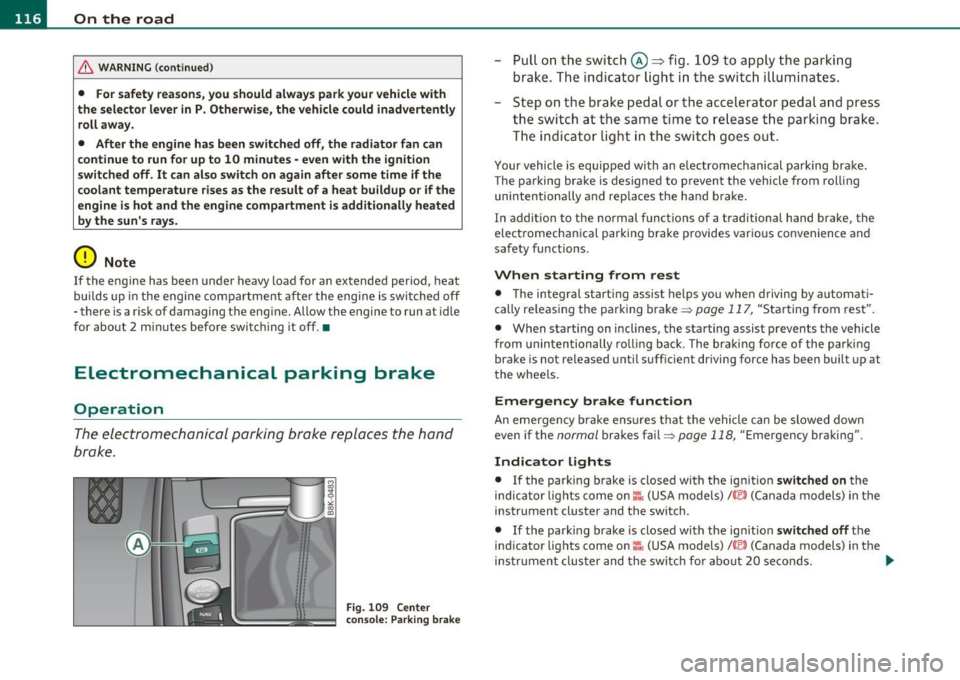
Fig. 1 09 Center
c o ns ole: P arki ng bra ke
- Pull o n the switc h@ ~ fig . 109 to app ly the parking
brake . The ind icator ligh t in the switc h illu minates.
- Step o n the brake pedal or the accelerator pedal a nd press
t he swit ch at the same ti me to release t he parking brake.
T he indicator lig ht in th e swi tc h go es o ut.
Your vehicle is equ ip ped with an e lectromechanical pa rking bra ke.
The parking brake is designed to prevent the vehicle from rol ling
unintentio nally and rep laces t he ha nd b rake.
In addit ion to the normal functions of a traditional hand brake, the
elect romecha nica l par kin g brake provides various convenience and
safety functions .
When starting from rest
• The integral start ing assist helps you when driving by automat i
cally re leas ing the parking bra ke =>
page 11 7, "Starting from res t".
• When starting on inclines, the sta rting assist prevents the vehicle
from uninten tionally ro llin g back. The br aking f orce of the par king
brake is not released unti l suff icient dr iving force has been built up at
t he whee ls.
Emergency brake function
An e mergency b rake ens ures t hat the vehicle can be sl owed down
even if the
normal brakes fail=> page 118, "Emergency bra kin g" .
Indicator lights
• If the park ing brake is closed w ith the ign it io n switched on the
indic ator lig hts come on
::'fa (USA models)/ © (Can ada models) in the
instrument cluster and the switch.
• If the park ing b rak e is closed with the ign it io n switched off the
indicator lights come on ::':. (USA models)/ © (Canada models) in the
in st rum ent cl ust er and the swit ch for abou t 20 se conds. ._
Page 120 of 362

_____ o_ n_ t_h _e_ r_o _a _ d ________________________________________________ _
When stopping at a traffic signal or stopping in city traffic on vehicles
with an automatic transmission, the parking brake can be applied.
The vehicle does not have to be held with the footbrake . The parking
brake eliminates the tendency to creep with a drive range engaged.
As soon as you drive
off as usual, the parking brake is released auto
matically and the vehicle starts to move.
Starting on slopes
When starting on inclines, the starting assist prevents the vehicle
from unintentionally rolling back. The braking force of the parking
brake is not released until sufficient driving force has been built up at
the wheels .
[I) Tips
For safety reasons, the parking brake is released automatically only
when the driver 's safety belt is engaged in the buckle. •
Starting off with a trailer
To prevent rolling back unintentionally on an incline, do
the following:
- Keep the switch pulled and depress the accelerator. The
parking brake stays applied and prevents the vehicle from
rolling backward.
- You can release the switch once you are sure that you are
developing enough driving force at the wheels by
depressing the accelerator.
Depending on the weight of the rig (vehicle and trailer) and the
severity of the incline, you may roll backwards as you start. You can
prevent rolling backwards by holding the parking brake switch pulled
out and accelerating -just as you would when starting on a hill with a
conventional hand brake. •
Emergency braking
In the event that the conventional brake system fails or
locks.
- In an emergency, pull the switch and continue to pull it to
slow your vehicle down with the parking brake .
- As soon as you release the switch or accelerate, the
braking process stops.
If you pull the switch and hold it above a speed of about 5 mph (8
km/h), the emergency braking function is initiated. The vehicle is
braked at all four wheels by activating the hydraulic brake system.
The brake performance is similar to making an emergency stop:::>& .
In order not to activate the emergency braking by mistake, an audible
warning tone (buzzer) sounds when the switch is pulled. As soon as
the switch is released, or the accelerator pedal is depressed, emer
gency braking stops.
& WARNING
Emergency braking should only be used in an emergency, when
the normal foot brake has failed or the brake pedal is obstructed.
Using the parking brake to perform emergency braking will slow
your vehicle down as if you had made a full brake application. The laws of physics cannot be suspended even with ESP and its associ
ated components (ABS, ASR, EDS). In corners and when road or
weather conditions are bad, a full brake application can cause the
vehicle to skid or the rear end to break away· risking an accident. •
Driver messages in the instrument cluster
Warning Vehicle incline is excessive
This message appears when the parking brake is applied on an incline
that exceeds about 30%. ._
Page 129 of 362
____________________________________________ A_ d_ a.:.p _t_ i_ v _e_ c_r_u _ i_ s _e_ c_o_ n_ t_r _o _l __ ffl'II
A ppli es to ve hicl es: wi th a daptive cruise cont rol
How is the distance (time interval) set?
Distance con be set in four stages.
m 0 [;; ,.: 00 a,
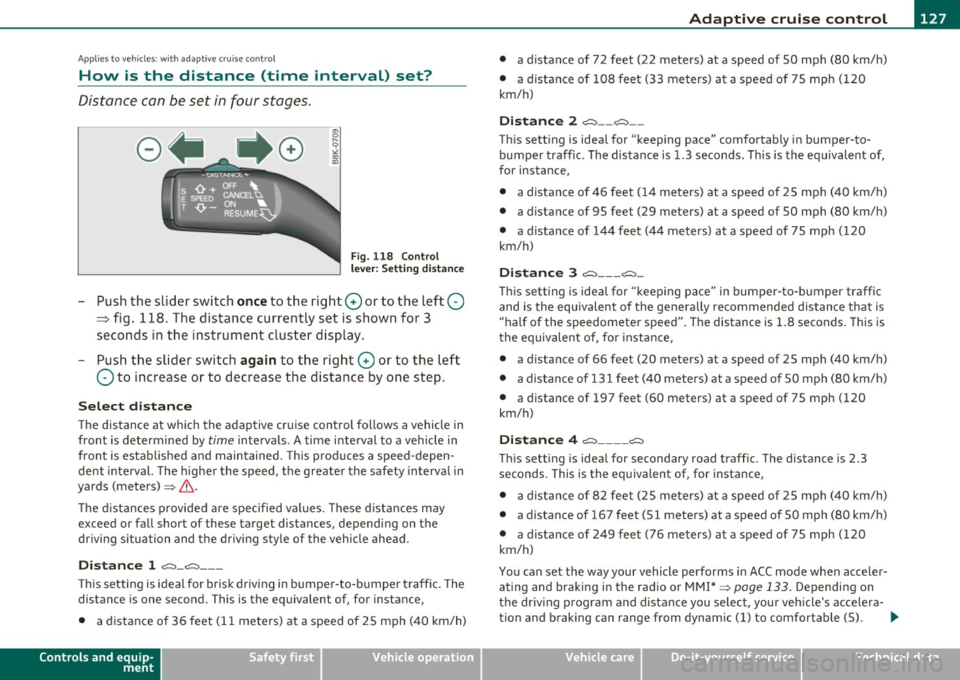
Fig . 118 Control
l ever : Sett ing distance
-Push the slider switch once to the right 0 or to the left Q
~ fig. 118. The distance currently set is shown for 3
seconds in the instrument cluster display.
- Push the slider switch again to the right 0 or to the left
Q to increase or to decrease the distance by one step.
Select distance
The distance at which the adaptive cru ise control follows a vehicle in
front is determined by
time intervals . A time interval to a vehicle in
front is estab lished and maintained. This produces a speed-depen
dent interval. The higher the speed, the greater the safety interval in
yards (meters) ~
&-
Th e distances provided are specified values. These distances may
exceed or fall short of these target distances, depending on the
driving situation and the driving style of the vehicle ahead.
Distance 1 ~-~ ---
Thi s sett ing is ideal for brisk driving i n bumper-to-bumper traffic. The
distance is one second. This is the equivalent of, for instance,
• a distance of 36 feet (11 meters) at a speed of 25 mph (40 km/h)
Controls and equip
ment Safety first
•
a distance of 72 feet (22 meters) at a speed of 50 mph (80 km/h)
• a dist ance of 108 feet (33 meters) at a speed of 75 mph (120
km/h)
Distance 2 ,;::::,-- ~--
This setting is ideal for "keeping pace" comfortably in bumper-to
bumper traffic. The distance is 1.3 seconds. This is the equ ivalent of,
for instance,
• a distance of 46 feet (14 meters) at a speed of 25 mph (40 km/h)
• a dista nce of 95 feet (29 meters) at a speed of 50 mph (80 km/h)
• a distance of 144 feet (44 meters) at a speed of 75 mph ( 120
km/h)
Distance 3 ~--- ~-
This setting is idea l for "keeping pace" in bumper-to-bumper traffic
and is the equivalent of the generally recommended distance that is
"half of the speedometer speed" . The distance is 1 .8 seconds. This is
th e equivalent of, fo r instance,
• a distance of 66 feet (20 meters) at a speed of 25 mph (40 km/h)
• a distance of 131 feet (40 meters) at a speed of 50 mph (80 km/h)
• a distance of 197 feet (60 meters) at a speed of 75 mph (120
km/h)
Distance 4 ~---- ~
This sett ing is ideal for secondary road traffic. The distance is 2.3
seconds. This is the equivalent of, for instance,
• a distance of 82 feet (25 meters) at a speed of 25 mph (40 km/h)
• a distance of 167 feet (51 meters) at a speed of 50 mph (80 km/h)
• a distance of 249 feet (76 meters) at a speed of 75 mph (120
km/h)
You can set the way your vehicle performs in ACC mode when acce ler
ating and braking in the radio or MM !* ~
page 133. Depending on
the driving program and distance you select , you r veh icle's accelera-
tion and braking can range from dynam ic (1) to comfortable (5) . _,.
Vehicle care Technical data
Page 130 of 362
IIII..__A_ d_a_ p,__ t_iv _ e_ c_r_ u _i _ s _e _ c_o _n _ t_ r_ o_ l ___________________________________________ _
Driving pro
gram
Dis tance 1
Distance 2
Distance 3
& WARNING
dynamic
1
2
2
3
standard
2
3
3
4
comfort
3
4
4
5
-
When setting the distance, the dri ver is responsible for adhering
to the respect ive national and country -specific regulations .
• Following other vehicles too closely increase s the risk of colli
sions and serious personal injury.
• Setting short distance s to the traffic ahead reduce s the time
and d istanc e av ailable to bring your vehicle to a safe stop and
makes it even more neces sary to pay clo se attention to traffi c.
• Always use good judgment and select a safe following distance
for the traffic , road and weather condition s.
(I] Tips
The d istance setting is reset to the factory default DISTANCE 3 the
next time the ignition is t urned on .•
Driver information
Ap plies to veh icles: w it h ad aptiv e c ru is e co ntro l
Displays in the instrument cluster
Depending on the driving situation, driver information is
displayed in the instrument cluster.
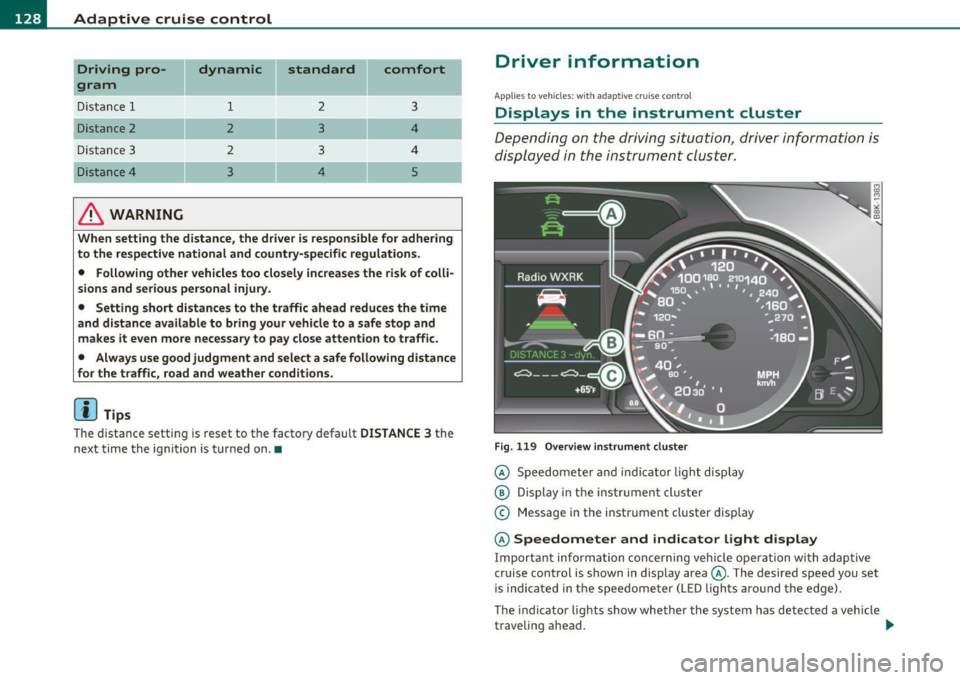
Fig. 11 9 Ove rv iew i nstrum ent clu ste r
© Speedomete r and indicator light disp lay
@ Display in the ins trument cluste r
© Message in the instr ument cluster disp lay
© Speedometer and indicator light d isplay
Important informa tion concerning vehicle ope ration wi th adap tive
cruise control is shown in display area@. The desired speed you set
is indica ted in the speedome ter (L ED ligh ts aro und the edge).
T he indicator lights show whether the system has detected a veh icle
traveling ahead . .,,.
Page 131 of 362
____________________________________________ A_ d_ a.._p _t_ i_ v _e_ c_r_u _ i_ s _e_ c_o_ n_ t_r _o _l __ _
@ Display in the instrument cluster
In disp lay area @ information from the navi gation system * and the
tr ip computer is displayed in add it ion to informa tion about adaptive
c ruise contro l.
You can sele ct among the differe nt info rmatio n by repeated b rief
taps on the
I RESET! button on the winds hield w iper lever => page 26,
"Operat io n".
© Status indicator
Th e info rmation i n area © is no t disp layed per manently. Infor mat ion
is d isplayed o nly if yo u set or c hange the speed setting, change the
ti me in terva l, when messages a re displayed or if the ad apt ive cru ise
cont rol is turned off for safety reasons. •
Appli es to vehicles : w ith a daptive cruise c on tro l
Speedometer and indicator light display
----
- -
- -
@ ®
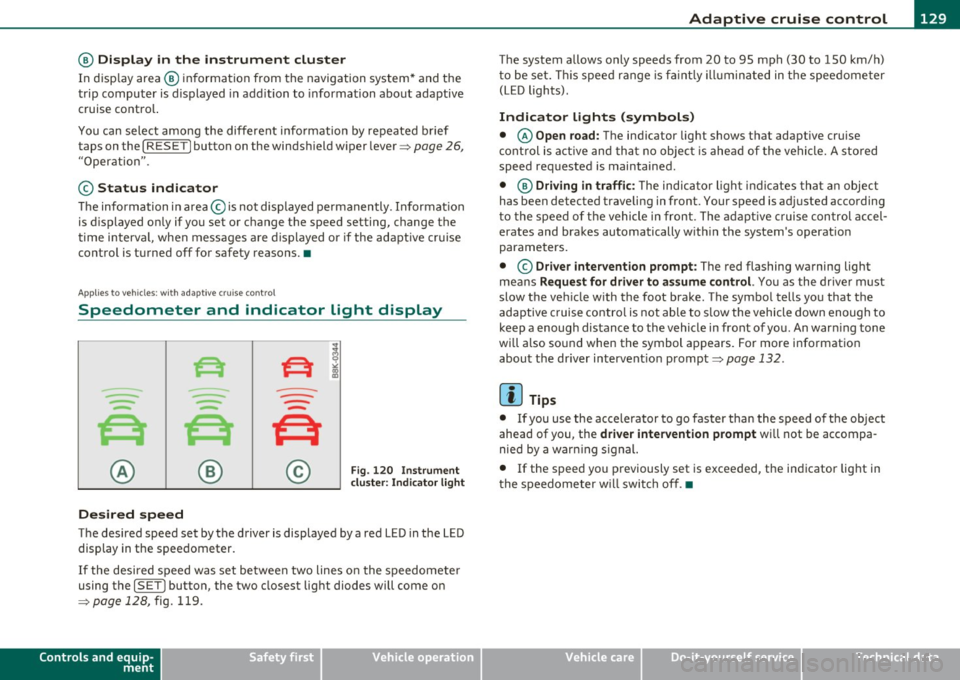
Desired speed
- -
--
Fig . 120 I nstru ment
cl uste r: Indicator light
T he desired speed set by the driver is displayed by a red LED in the LED
disp lay in the spee dometer.
If the desi red s peed was set be twee n two lines o n the speedo mete r
using the
[ SET J button, the two closest light diodes will come on
=>
page 12 8, fig. 119.
Controls and equip
ment Safety first
T
he system allows only speeds from 20 to 95 mph (30 to 150 km/ h)
t o be se t. T his spee d range is f aint ly ill um inat ed in t he s pee dome ter
(LED lights) .
Indicator lights (symbols)
• © Open road: The indicator light shows t hat adaptive cruise
co ntrol is a ctive and t hat no objec t is ahe ad of the vehi cle. A sto red
speed req uested is maintained.
• @
Driving in traffic : The indicator l igh t ind icates th at an object
has been detected traveling in front . Your speed is ad justed according
t o the spee d of t he vehicle in front. The adaptive c ruise con trol accel
erates and bra kes au tomatically w it hin the system's operat io n
parame ters.
• ©
Driver intervention prompt : The red flashing warning light
me ans
Request for driver to as sume control. You as the drive r m ust
slow t he ve hicle w ith the foot brake . The symbo l tells yo u that the
adaptive cruise contro l is not able to s low the vehicle down enough to
keep a enough distance to the vehicle in front o f you. An war ning tone
wi ll also so und when the symbol ap pears. Fo r more informat ion
abou t the driver intervent ion prompt=>
page 132 .
W Tips
• If you use the ac cele rator to go fa ster than the speed of the object
ahead of you, the
driver intervention prompt will not be accompa
nied by a war ning signal.
• If the speed you p reviously set is exceeded, the ind icator light in
t he s peedometer w ill swit ch off .•
Vehicle care Technical data
Page 132 of 362
ffl..__A_ d_a_ p,__ t_iv _ e_ c_r _ u _i _ s _e _ c_o _n _ t_ r_ o_ l ___________________________________________ _
Applie s to vehicles : w ith a daptiv e cr uise co ntrol
Display in the instrument cluster
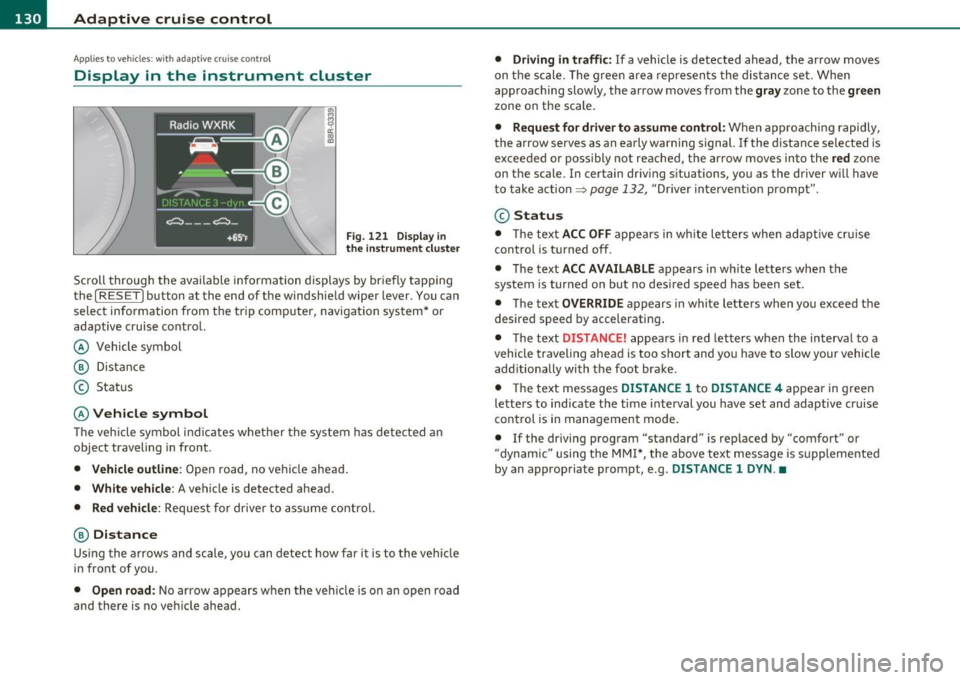
Fig. 121 Disp la y in
the instrum ent clu ster
Scroll throug h the available information displays by briefly tapping
the
[ RESE T] button at the end of the windshie ld wiper lever . You can
select information from the tr ip computer, navigation sys tem * or
adaptive cruise contro l.
@ Vehicle symbol
@ Distance
© Status
© Vehicle symbol
Th e veh icle symbol i ndicates w hether the sys tem has de te ct ed an
object traveling in front .
• Vehicle outline : Open road, no vehicle ahead .
• White v ehicl e: A vehicle is detected ahead.
• Red vehicle : Request for driver to ass ume control.
® Distance
Us ing the a rrows and scale, you can detect how far it is to the vehi cle
in front of you.
• Open road : No arrow appears when the ve hicle is o n an o pen road
and there is no ve hicle ahead.
• Driving in t raffic : If a vehicle is detected ahead, the arrow moves
on t he sc ale. The g ree n area represents the distan ce set . When
approaching slow ly, the arrow moves from the
gray zone to the green
zone on the scale .
• Request for driver to as sume control: When approach ing rapidly,
the arrow serves as an early warning signal. If the distance selected is
exceeded or poss ibly no t reached, t he arrow moves in to the
red z o ne
on the scale. In certain driving s ituations , you as the driver wi ll have
t o take action =>
page 132, "Driver in tervent io n prompt".
@ Status
• T he text ACC OFF appea rs in w hite le tters whe n ad apt ive cr uise
control is turned off.
• T he text
ACC AVAILABLE appears in wh ite lette rs when the
system is turned on but no desired speed has been set .
• T he text
OVERRIDE appears in white letters when you exceed the
desired speed by accelerating .
• T he text
DISTANCE! appears in red letters when the interval to a
vehicle traveling ahead is too short and you have to slow your vehicle
add itionally with the foot brake .
• T he te xt messages
DISTANCE 1 to DISTANCE 4 appea r in green
letters to indicate the time i nterval you have set and adaptive cruise
control is in manageme nt mode .
• If the driving program "standard" is replaced by "comfort" or
"dynam ic" using the MM I*, t he above text message is s upplemented
by an appropriate prompt, e .g .
DISTANCE 1 DYN . •
Page 134 of 362
Ill Adaptive cruise control ..__..,___ _____________ _
Engine speed !
The text message Engine speed ! appears in vehicles with manual
transmission when the driver did not shift up or down in time while
using adaptive cruise control braking or accelerating, causing the
vehicle to exceed or not reach the permitted limit speed. This causes
adaptive cruise control to deactivate automatically. A chime sounds
as a reminder .
Parking brake!
The text message Parking brake! appears if emergency braking was
manually initiated with the Electromechanical Parking Brake (EPB).
The adaptive cruise control is turned off . This is accompanied by a
warning tone.
Stabilisation program
The text message Stabilisation program appears if the Electronic
Stab ilizat ion Program (ESP) has inter vened. In this case the adaptive
cruise control is automatically turned off. This is accompanied by a
warning tone.
Speed
The set speed in mph (Canada km/h) always appears when saving or
changing the speed in adaptive cruise control~
page 125, "How is
the speed stored?" and~
page 125, "Chang ing stored speed".
Speed too low
The text message Speed too low appears if the current speed is too
low
to set or to hold the requested speed.
When setting a desired speed, it must be at least 20 mph (30 km/h).
At speeds be low 12 mph (20 km/h), the cruise control is turned off.
In speeds over 95 mph (150 km/h), the system remains active and
resumes the speed of 95 mph (150 km/h) if the driver removes the
foot from the acce lerator .
Selector lever position!
The text message Selector lever position! appears when the selector
lever is moved to position
N. In this position, adaptive cruise control
is not available. •
Appli es to veh icles : w ith a daptive cr uise c ontro l
Driver intervention prompt
The driver intervention prompt calls on the driver to take
over the situation.
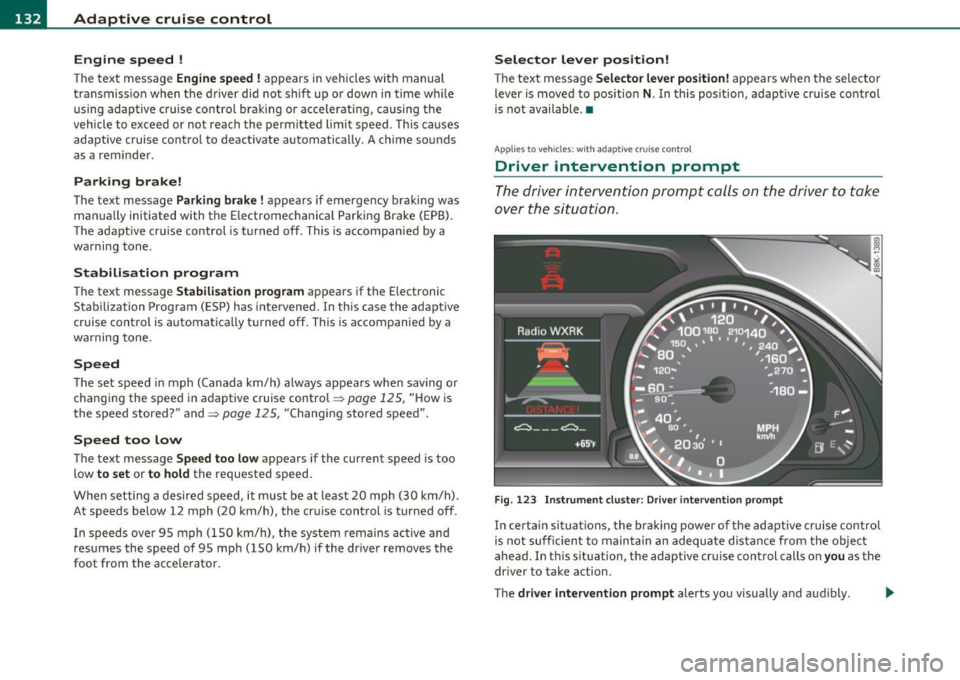
Fig. 123 Instrument cluster: Driver intervention prompt
In certain situations, the braking power of the adaptive cruise control
is not sufficient to maintain an adequate distance from the object
ahead. In this situation, the adaptive cruise control calls on
you as the
driver to take action.
The
driver intervention prompt alerts you visually and audibly. -.,