seats AUDI A5 COUPE 2011 Owner's Manual
[x] Cancel search | Manufacturer: AUDI, Model Year: 2011, Model line: A5 COUPE, Model: AUDI A5 COUPE 2011Pages: 362, PDF Size: 84.88 MB
Page 93 of 362
Opening rear beverage holders
-Press on t he symbol W @ ~ page 90, fig. 91 .
Holding beverages at the rear
To adjust the arm@, swing it in the d irectio n of t he arrow .
- Plac e th e be verage in the holder and r elease t he arm. T he
arm swings bac k by its elf a nd automati cally se c ur es th e
bev erage .
Closing cup holders
-Press on t he center sec tion between t he two arms and
push t he cup ho lder in t he slot as far as it wi ll go .
The ho ld ing arm must be adjusted such that it lies close ly against the
c u p ho lde r.
A max imum of two beverages can be placed i n th e cente r armr est.
& WARNING
Spilled hot liquid can cause an accident and personal injury.
• Never carry any beverage containers with hot liquids, such a s
hot coffee or hot tea, in the vehicle wh ile it is moving. In case of
an accident, sudden braking or other vehicle movement , hot liquid
could spill, causing scalding burns. Spilled hot liqu id can also
cause an accident and personal injury .
• Use only soft cups in the cupholder. Ha rd cups and glasses can
c ause injury in an a ccident .
• Never use the cupholder or adapter a s an ashtray· risk of fire .
0 Note
Only drink containers with lids should be carr ied in the cupholder.
Li quid could spill ou t and damage your ve hicle 's e lec tron ic e quipment
or stain the upho lstery, etc. •
Contro ls a nd e quip
m en t Vehicle
OP-eration
Seats and storage
Ashtray
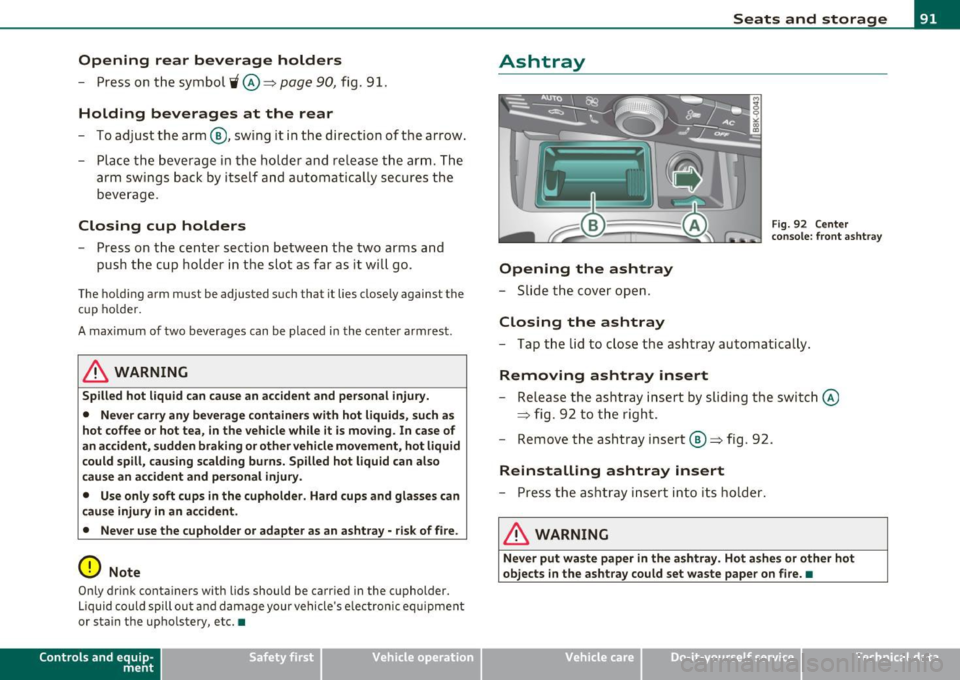
Fig. 92 Center
c ons ole : front ashtr ay
Opening the ashtray
- Slide the cov er open .
Closing the ashtray
-Tap t he lid to c lose the ashtray automatica lly .
Removing ashtray insert
- Release the ash tray i nsert by sliding the switc h@
~ fig . 92 to t he right.
- Remove the ashtray insert@~ fig. 92 .
Reinstalling ashtray insert
-Press th e as htray i nsert i nto its ho lder .
& WARNING
Never put waste paper in the ashtray. Hot ashes or other hot
objects in the ashtray could set waste paper on fire .•
Vehicle care Do-it-yourselt service iTechnical data
Page 94 of 362
Seats and storage
Cigarette lighter/outlet
Cigarette lighter
Using the cigarette lighter
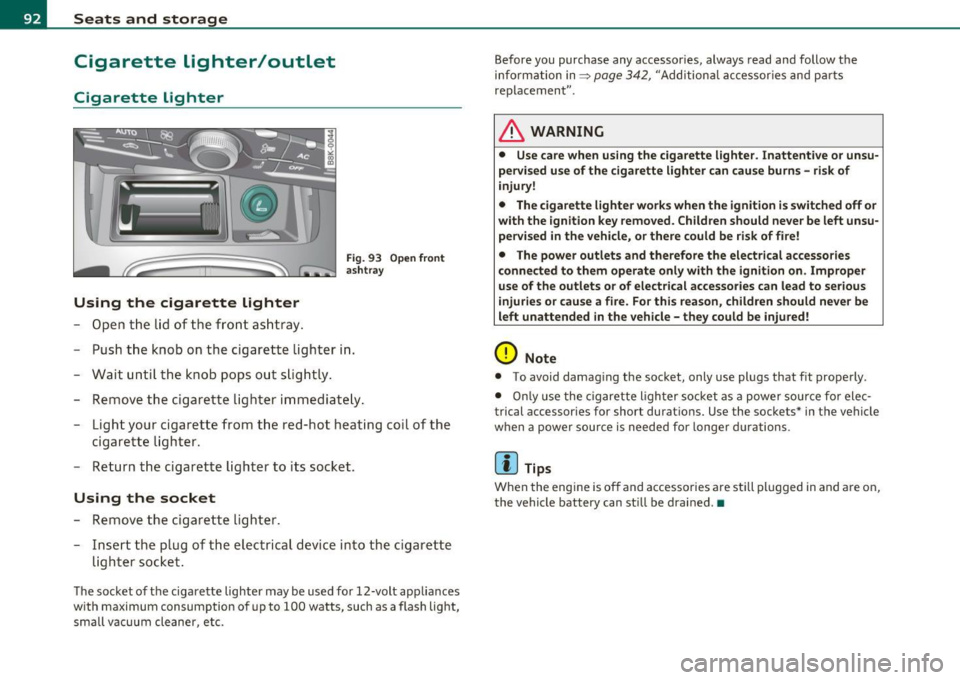
-Open the lid of th e front ashtr ay.
Fig . 93 Open front
ash tray
- P ush t he kn ob on the cig are tte lig hter i n.
- Wa it until the knob p ops out s lig htly.
- R emove the ciga rett e lig hter immed iat ely.
- Ligh t yo ur cigaret te fro m t he red- hot heat in g coi l of the
ciga rett e li ghter.
- Return t he cigaret te ligh ter to its socket .
Using the socket
- Remove the cigarette light er.
- In ser t the p lug o f the elect rical d evice i nto the c iga re tt e
li g hter socke t.
The socket o f the cigare tte lighter may be used fo r 12-volt applia nces
with maximum consumption o f up to 100 watts, such as a flash light,
small v acuum cle aner, etc. Before you purchase any accessor
ies, always read and follow the
inf ormat ion in ~
page 342 , "Add it io nal acc esso ries and part s
replac ement" .
& WARNING
• Use care when using the cigarette lighte r. Inattentive or unsu
pervised u se of the cigarette lighter can cause burns - risk of
i njury!
• The cigarette lighter works when the ignition is switched off or
with the ignition key removed . Children should never be left unsu
pervised in the vehicle, or there could be risk of fire!
• The power outlets and therefore the electrical accessories
connected to them operate only with the ignition on. Improper
use of the outlets or of electrical accessories can lead to serious
injuries or cause a fire. For thi s rea son , children should never be
left unattended in the vehicle -they could be injured!
0 Note
• To avoid damag ing the socket, only use plugs that fit properly .
• O nly use the cig are tte ligh ter socket a s a powe r sou rce fo r elec
trical accessories for short durat ions . Use the sockets* in the v ehicle
w hen a powe r sou rce is needed fo r longe r d ur ations.
[ i ] Tips
W hen the eng ine is of f and accessories are sti ll p lu gged in and a re o n,
the vehicle battery can st ill be drai ned .•
Page 95 of 362

Storage
General overview
There are numerous places to store items in your vehicle.
Glove compartment
Storage compartment in the roof
Coat hooks
Storage in the tr im panels in the luggage
compartment
ln. WARNING
:::>page 93
::::>page94
=> page 94
• Alway s remove object s from the instrument panel. Any items
not put away could slide around in side the vehicle while dr iving or
when accelerating
or when applying the brake s or when driving
around a corner.
• When you are driving make sure that anything you may have
placed in the center console or other sto rage locat ions cannot fall
out into the footwells. In ca se of sudden braking you would not be
able to brake, depress the clutch or accelerate.
• Any pieces of clothing that you have
hung up must not int er
fere with the driver 's view . The coat hooks a re designed only for
lightweight clothing . Never hang any clothing with hard, pointed
or heavy objects
in the pockets on the coat hooks. During sudden
braking or in an accident -especially if the airbag is deployed -
these objects could injure any passengers inside the vehicle. •
Controls and equip
ment Safety first
Seats and storage
Glove compartment
The glove compartment is illuminated and can be locked.
...
•
To open glove compartment
Fig. 94 Glov e
c om partment
- Pull the ha ndle in th e di rec tion of the arr ow ~ fig. 94 and
swi ng th e cov er d own to o pen .
To close glove compartment
- Push t he g love compartment lid upward u ntil the lock
engages.
T here are holders fo r a pen and a pad of paper in the glove compart
ment lid.
On the righ t side in the glove compartmen t is a holder with the key
body into which t he eme rgency key mus t be clip ped to be able to start
the vehicle.
ln. WARNING
To reduce the risk of personal injury in an accident or sudden stop, always keep the glove compartment closed while driving. •
Vehicle care Technical data
Page 96 of 362
Seats and storage
Storage compartment in the roof
""' G;F) 11111
W([j'\8
o .. o
•~} -........i
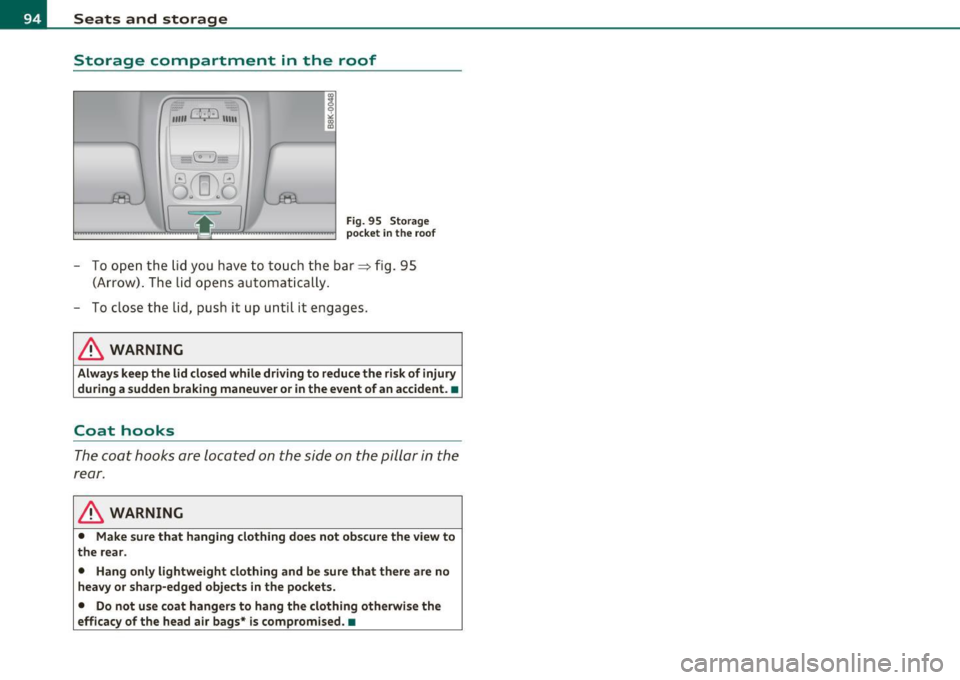
Fig. 95 Storage
pocket in the roof
-To open the lid you have to touch the bar => fig. 95
(Arrow ). The lid opens automatically.
- To close the lid, push it up until it engages .
& WARNING
Always keep the lid closed while driving to reduce the risk of injury
during a sudden braking maneuver or in the event of an accident. •
Coat hooks
The coat hooks are located on the side on the pillar in the
rear .
& WARNING
• Make sure that hanging clothing does not obscure the view to
the rear.
• Hang only lightweight clothing and be sure that there are no
heavy or sharp-edged objects in the pockets.
• Do not use coat hangers to hang the clothing otherwise the
efficacy of the head air bags* is compromised. •
Page 110 of 362
![AUDI A5 COUPE 2011 Owners Manual 1111....__w __ a _r_ m __ a_n_ d_ c_ o _ l_d _______________________________________________ _
(I] Tips
If the climate control is running in cooling mode, air flows mainly
from vents @ and @. T](/img/6/57583/w960_57583-109.png "AUDI A5 COUPE 2011 Owners Manual 1111....__w __ a _r_ m __ a_n_ d_ c_ o _ l_d _______________________________________________ _
(I] Tips
If the climate control is running in cooling mode, air flows mainly
from vents @ and @. T")
1111....__w __ a _r_ m __ a_n_ d_ c_ o _ l_d _______________________________________________ _
(I] Tips
If the climate control is running in cooling mode, air flows mainly
from vents @ and @. To achieve adequate cooling, you should never
close these vents completely. •
Applies to vehicles: with Deluxe automatic cl imate control plus
Rear air vents
The rear air vents are located in the center console.
- Rotate the thumbwheel to open and close the vents .
- To adjust the direction of the airflow from the outlet,
move the tab in the center of the outlet in the desired
direction . The direction of the air delivered from the vents
can be adjusted horizontally and vertically.
The air vents are actuated either automatically or manually
depending on the operating mode selected. Heated or unheated
fresh air, or cooled air flows from the vents .
The air vents to heat the rear footwell are located under the front
seats.
(I] Tips
If the climate control is operating in cooling mode, air flows primarily
from the vents in the center console. To achieve adequate cooling,
you should never close these vents completely. •
Applies to vehicles: with De luxe automatic climate contro l p lus
Economical use of the climate control
system
Economical use of the climate control system helps save
fuel.
When the climate control system is working in cooling mode,
engine performance is reduced and fuel consumption is
affected. To keep the time the climate control system is on as
short as possible, you should do the following:
- To save fuel, turn off cooling mode by pressing the AC
button (indicator light goes out).
- In addition, if you open the window or the panoramic
sliding/tilting sunroof* while driving, turn off cooling
mode by pressing the AC button (indicator light goes out).
- If the vehicle is extremely hot due to the heat of the sun,
briefly open doors and windows.
~ For the sake of the environment
When you save fuel, you reduce emissions from the vehicle. •
Deluxe automatic climate control
plus - basic settings
Applies to veh icles: with De luxe automatic climate control plus
General information
The basic climate control settings can be adjusted in the
radio or f\1/\11*.
-Select: Function button I CAR] > Control button AC. ~
Page 111 of 362

_______________________________________________ W_ a _r_m _ a_ n_d _ c_o _l_ d _ __.ffl'I
The following functions can be selected :
• Auto recirculat.
~ page 109
• Synchronization~
page 109 •
Applies to vehicles: with D eluxe automatic climate con trol plus
Automatic recirculation
An air quality sensor detects increased concentrations of
pollutants in the outside air and automatically switches to recirculation mode.
We recommend that you always keep automatic recirculation ON to
prevent polluted outside air from entering the vehicle interior .
If the
air quality sensor located in the climate control system detects
polluted outside air, the sensor decides whether the air pollution can
be reduced by the factory-installed pollutant filter or whether it is
necessary to switch to recirculation. With heavy concentrations of
pollutants, the climate control system is switched automatically to
recirculation mode and the supply of outside air is blocked . As soon
as the concentration of pollutants in the outside air drops, fresh air is
supplied to the vehicle interior again.
I n the event that the windows fog up during automatic recirculation ,
press the
l<:wl button immediately.
Under certain operating conditions, automatic recirculation is
switched off automatically. When outside temperatures are below
about
50 °F ( +10 °C), automatic recirculation is limited to
30 seconds. When outside temperatures are below about 30 °F (-
1 °C),
automatic recirculation is limited to 15 seconds.•
Con tro ls a nd e quip
m en t Vehicle
OP-eration
Applies to vehicles: with Deluxe automatic climate control plus
Synchronization
One climate control setting for all seats .
After Synchronization is set to On, all of the subsequent climate
control settings (except for seat heating*) for the driver are trans
ferred to the front passenger .
Synchronization is canceled when settings are adjusted on the front
passenger's side .•
Seat heating
App lies to v ehicl es: w ith front se at heati ng
Front seat heating~
The seat cushion and the seatback of the front seats can
be heated electrically.
- Press the (g button.
Fig. 105 Seat heating
button and regulator
-Rotate the regulator to the desired setting.
In position 0, seat heating is turned off. The control range is from 1
to 6 . .,,
Vehicle care Do-it-yourselt service iTechnical data
Page 112 of 362

lffl!l.___w __ a _r_ m __ a_n_ d_ c_ o _ l_d _______________________________________________ _
Seat heating only functions when the seats are loaded with body
we igh t. If a pe rson is no t sit ting on the fron t seats, seat heat ing
should be sw itched off to prevent un intentiona l heating of the seat
surfaces .
(D Note
To avoid damage to the heating e lements in the seats, do not kneel
on the seats or place heavy loads on a small area of t he seat.
(I) Tips
Please note that objects placed o n the seats may be detected. If these
objects are heavy enough, their we ight w ill cause the seat heat ing to
switch on. •
Page 172 of 362
........ _D_ r_iv _i_ n .... g=-- S_ a_f _e _Ly :,.._ ______________________________________________ _
Driving Safely
General notes
Safe driving habits
Please remember -safety first!
Th is chapter contains important information, t ips, instructions and
warnings that you need to read an d observe fo r you r own safe ty, the
safety of you r passengers and others . We have summarized here
w hat you need to know about sa fety belts, airbags, child restra ints as
we ll as child safety . You r safety is for us
priority number 1. Always
observe the information and warnings in this section -for your own
safety as well as t hat of your passengers.
The informat ion in this section applies to all mode l versions of yo ur
veh icle . Some of the fe atures des cribed in this se ctions m ay be st an
dard equ ipment on some models, or may be optional eq uipment on
others. If you a re not sure, ask your a uth o rized Audi dealer.
& WARNING
• Always make sure that you follow the instructions and heed
the WARNINGS in th is Manual. It is in your interest and in the
intere st of your passengers.
• Always keep the complete Owner's Literatu re in your Audi
when you lend or sell your vehicle so that this important informa
tion will always be available to the driver and passengers .
• Always keep the Owner's literature handy so that you can find
it easily if you have questions . •
Safety equipment
The safety features are part of the occupant restraint
s y stem and wor k together to he lp reduce the ris k of injury
in a wide variety of accident situations.
Your sa fety and t he safety o f yo ur passenge rs shou ld no t be left to
chance . Adva nces in technology have made a variety of features avai l
a b le to help re duce the risk of injury in an a cc ident . The fo llow ing is a
list of jus t a few of the safety features in your Audi:
• sophisticated safety belts for driver and a ll passenger seating
p osi tion s,
• belt force limiters for the seats,
• belt pr etensioners fo r th e sea ts,
• hea d restrain ts f or eac h se ating posi tion,
• front airbags,
• side airbags i n the fro nt s eats,
• side c urtain air bags,
• special LATCH anchorages for chi ld restraints,
• a djustable stee ring co lumn.
These ind ividual safety feat ures, can work together as a system to
he lp protec t you and yo ur passengers in a wide r ange of accide nts.
T hese feat ures ca nnot work as a system if they are not a lways
co rrect ly adjusted and correct ly used.
Safety is everybody' s responsibility! •
Page 175 of 362
Driving Safely ---------------------" ~'---
& WARNING (continued)
• Always sit in an upright position and never lean against or
place any part of your body too close to the area where the airbags
are located.
• Before driving, always adjust the front seats and head
restraints properly and make sure that all passengers are properly
restrained.
• Never adjust the seats while the vehicle is moving. Your seat
may move unexpectedly and you could lose control of the vehicle.
• Never drive with the backrest reclined or tilted far back! The
farther the backrests are tilted back, the greater the risk of injury
due to incorrect positioning of the safety belt and improper
seating position.
• Children must always ride in child safety seats~
page 215.
Special precautions apply when installing a child safety seat on
the front passenger seat~
page 190. •
Proper seating position for the front
passenger
The proper front passenger seating position is important
for safe, relaxed driving .
For your own safety and to reduce the risk of injury in the
event of an accident, we recommend that you adjust the seat
for the front passenger to the following position:
- Move the front passenger seat back as far as possible.
There must be a minimum of 10 inches (25 cm) between
the breastbone and the instrument panel~&.
- Adjust the angle of the seatback so that it is in an upright
position and your back comes in full contact with it when
ever the vehicle is moving.
Controls and equip
ment Safety first Vehicle operation
-
Applies to vehicles with adjustable head restraints: Adjust
the head restraint so the upper edge is as even as possible
with the top of your head . If that is not possible, try to
adjust the head restraint so that it is as close to this posi
tion as possible.
- Keep both feet flat on the floor in front of the front
passenger seat.
- Fasten and wear safety belts correctly~
page 185.
For detailed information on how to adjust the front passenger's seat,
see ~
page 73.
& WARNING
Front seat passengers who are unbelted, out of position or too
close to the airbag can be seriously injured or killed by the airbag
as it unfolds. To help reduce the risk of serious personal injury:
• Passengers must always sit in an upright position and never
lean against or place any part of their body too close to the area
where the airbags are located.
• Passengers who are unbelted, out of position or too close to
the airbag can be seriously injured by an airbag as it unfolds with great force in the blink of an eye.
• Always make sure that there are at least 10 inches (25 cm)
between the front passenger's breastbone and the instrument
panel.
• Each passenger must always sit on a seat of their own and
properly fasten and wear the safety belt belonging to that seat.
• Before driving, always adjust the front passenger seat and
head restraint properly.
• Always keep your feet on the floor in front of the seat. Never
rest them on the seat, instrument panel, out of the window, etc.
The airbag system and safety belt will not be able to protect you
properly and can even increase the risk of injury in a crash. .,
Vehicle care Do-it-yourself service Technical data
Page 176 of 362
1111....__D_ r_iv _i_ n_, g=-- S_ a _ f_e _,Ly _ ______________________________________________ _
& WARNING (continued)
• Never drive with the backrest reclined or tilted far back! The
farther the backrests are tilted back, the greater the risk of injury due to incorrect positioning of the safety belt and improper
seating position.
• Children must always ride in child safety seats~
page 215.
Special precautions apply when installing a child safety seat on
the front passenger seat~
page 190. •
Proper seating positions for passengers in
rear seats
Rear seat passengers must sit upright with both feet on
the floor consistent with their physical size and be prop
erly restrained whenever the vehicle is in use.
To reduce the risk of injury caused by an incorrect seating
position in the event of a sudden braking maneuver or an
accident , your passengers on the rear bench seat must
always observe the following :
- Make sure that the seatback is securely latched in the
upright position ~
page 84.
-Keep both feet flat in the footwell in front of the rear seat.
- Fasten and wear safety belts properly~
page 185.
-Make sure that children are always properly restrained in a
child restraint that is appropriate for their size and age
~page 215.
& WARNING
Passengers who are improperly seated on the rear seat can be seri
ously injured in a crash.
& WARNING (continued)
• Each passenger must always sit on a seat of their own and
properly fasten and wear the safety belt belonging to that seat.
• Safety belts only offer maximum protection when the seatback
is securely latched in the upright position and the safety belts are
properly positioned on the body. By not sitting upright, a rear seat
passenger increases the risk of personal injury from improperly
positioned safety belts!
• Always adjust the head restraint properly so that it can give
maximum protection. •
Proper adjustment of head restraints
Correctly adjusted head restraints are an important part
of your vehicle 's occupant restraint system and can help
to reduce the risk of injuries in accident situations .
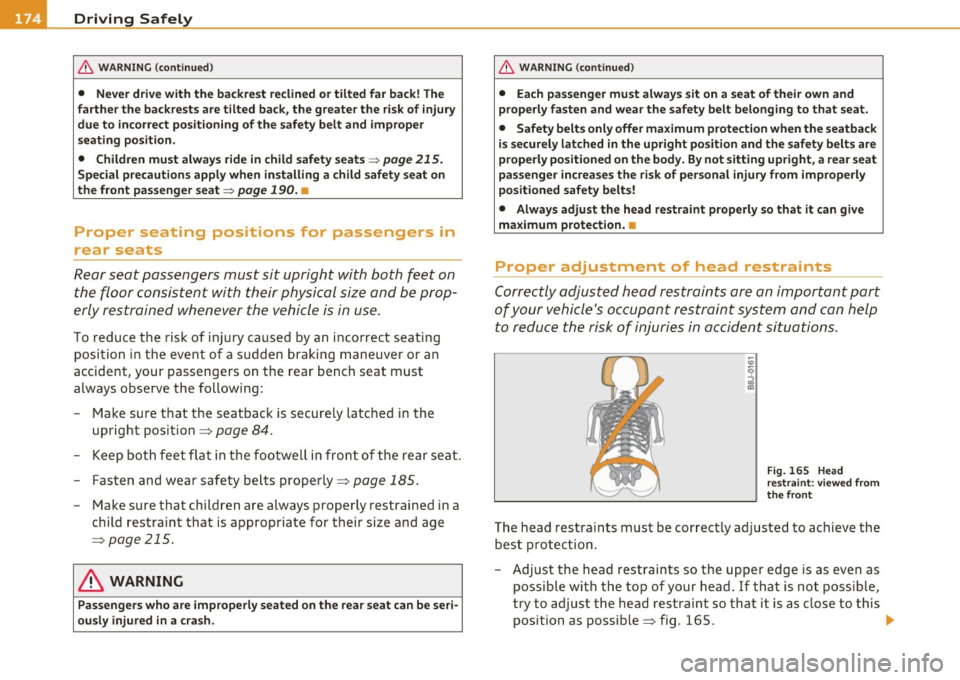
Fig. 165 Head
restraint: viewed from
the front
The head restraints must be correctly adjusted to achieve the
best protection.
- Adjust the head restraints so the upper edge is as even as
possible with the top of your head. If that is not possible,
try to adjust the head restraint so that it is as close to this
position as possible~ fig . 165. .,