airbag AUDI A5 COUPE 2011 Workshop Manual
[x] Cancel search | Manufacturer: AUDI, Model Year: 2011, Model line: A5 COUPE, Model: AUDI A5 COUPE 2011Pages: 362, PDF Size: 84.88 MB
Page 225 of 362
& WARNING (continued)
• Always install rearward-facing child safety seats on the rear
seat.
• If you must install a rearward facing child safety seat on the
front passenger seat because of exceptional circumstances and
the PASSENGER AIR BAG
OFF light does not come on and stay on,
immediately install the rearward-facing child safety seat in a rear
seating position and have the airbag system inspected by your
authorized Audi dealer.
• Always read and heed all WARNINGS whenever using a child
restrained in a vehicle is being used~
page 181, "Safety belts",
~ page 190, "Airbag system" and~ page 215, "Important
things to know".
& WARNING
If exceptional circumstances require the use of a forward-facing
child restraint on the front passenger's seat, the child's safety and
well-being require that the following special precautions be
taken:
• Make sure the forward-facing seat has been designed and certi
fied by its manufacturer for use on a front seat with a passenger
front and side airbag.
• Always follow the manufacturer's instructions provided with
the child safety seat or infant carrier.
• Always move the front passenger seat into the rearmost posi
tion of the passenger seat's fore and aft adjustment range, and as
far away from the airbag as possible before installing the child
restraint.
• Always make sure that nothing prevents the front passenger's
seat from being moved to the rearmost position in its fore and aft
adjustment range.
• Always make sure the backrest is in an upright position.
Safety first Vehicle OP-eration
Child Safety
& WARNING (continued)
• Make sure that the PASSENGER AIR BAG OFF light comes on
and stays on all the time whenever the ignition is switched on.
• If the light does not stay on, perform the checks~
page 201,
"Monitoring the Advanced Airbag System".
• Take the child restraint off the front passenger seat and install
it properly at one of the rear seat positions if the PASSENGER AIR
BAG
OFF light does not stay on whenever the ignition is switched
on.a
Booster seats and safety belts
Properly used booster seats can help protect children
weighing between about 40 lbs. and 80 lbs. (18 kg and
36 kg) who are less than 4 ft. 9 in.
(57 inches/1.45 meters) tall.
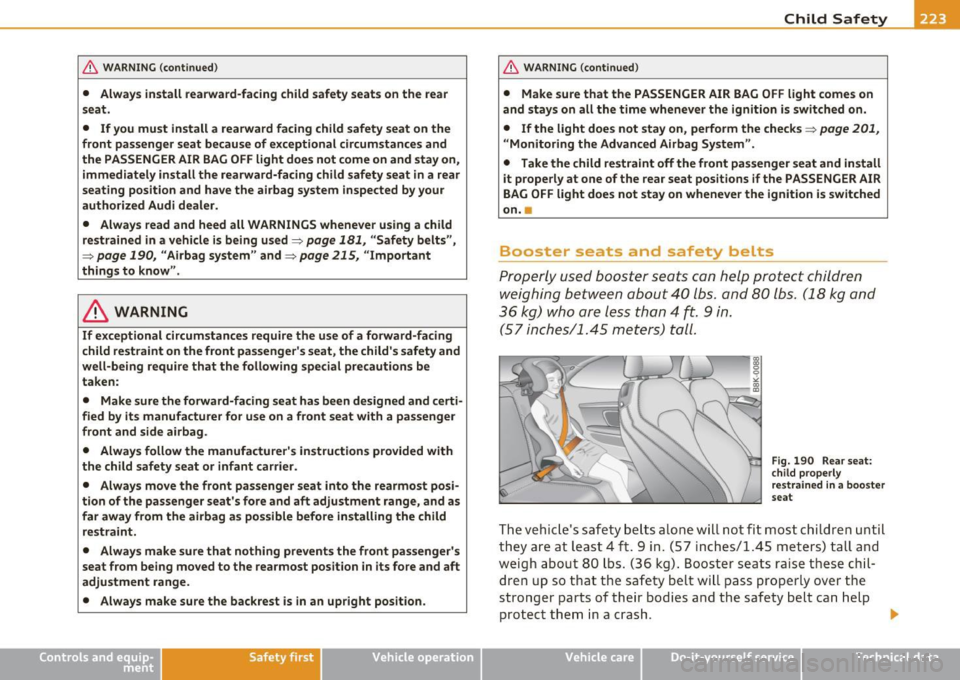
Fig. 190 Rear seat:
child properly
restrained in a booster
seat
The vehicle's safety belts alone will not fit most children until
they are at least 4 ft. 9 in. (57 inches/1.45 meters) tall and
weigh about 80 lbs. (36 kg). Booster seats raise these chil
dren up so that the safety belt will pass properly over the
stronger parts of their bodies and the safety belt can help
protect them in a crash.
~
Vehicle care Do-it-yourselt service iTechnical data
Page 226 of 362
-L~C:_.!:h~ i~ld ~ S~ a:!: f~ e~ t~ y ~ ------------------------------------------
- Do not use the convertible locking retractor when using
the vehicle's safety belt to restrain a child on a booster
seat.
- Always position the shoulder portion of the safety belt midway over the child's shoulder . If you must transport an
older child in a booster seat on the front passenger seat,
you can use the safety belt height adjustment to help
adjust the shoulder port ion properly .
- Always make s ure that the shoulder por tion of the safety
belt never rests against or across the child's neck .
- Always make sure that the child can properly wear the lap portion of the belt low across the thighs or pelvis and
never over the stomach or abdomen .
Children up to about 40 lbs. (18 kg) are best protected in child safety
seats designed for their age and weight. Experts say that the skeletal
st ruct ure, particularly the pelv is, of these chi ldren is not fully deve l
oped, and they must not use the vehicle safety belts without a suit
able child rest raint .
Children who are at least 4 ft. 9 in . (57 inches/1.45 meters) tall can
generally use the vehicle's three point lap and shoulder belts . Never
use the lap belt port ion of the vehicle's safety belt alone to restra in
any child, regard less of how big the child is. Always remember that
childre n do not have the pronounced pelvic structure required for the
proper function of lap belt portion of the vehicle's three point lap and
shoulder belts. The ch ild's safety absolutely requires that a lap belt
portion of the safety belt be fastened snugly and as low as possible
around the pelvis. Neve r let the lap belt po rtion of the safety bel t
pass over the child's stomach or abdomen.
It is usua lly best to p ut these ch ildren in appropriate booster seats.
Be sure the booster seat meets all appl icable safety standards .
Booster seats raise the seating position of the child and reposition
both the lap and shoulder parts of the safety belt so that they pass across the child
's body in the right places . The rout ing of the belt over
t he c hild's body is very impo rtan t for the chi ld's p ro tect io n, whether
or not a booster seat is used. Children age 12 and under must always
ride in the rear seat .
In a crash, airbags m ust inflate with in a blink of an eye and with
considerable force. In order to do its job, the airbag needs room to
infl ate so that it w ill be t he re to protect t he oc cupan t as the occupant
moves forward into the a irbag.
A vehicle occupant who is out of position and too close to the airbag gets in the way of an inflating a irbag . When a n occupant is too close,
he or she will be struck violently and will receive serious or possibly
even fatal injury.
In order for the airbag to offer protection, it is important that all
veh icle occupants , espec ia lly any ch ild ren, who must be in the front
seat because of exceptional c ircumstances, be properly restra ined
and as far away from the airbag as possib le . By keeping room
between the child's body and the front of the passenger compart
ment, the airbag can inflate completely and provide supplemental
protection in certa in frontal collisions.
& WARNING
Not using a booste r sea t, using th e boo ste r seat improp erl y, inc or
rectl y installing a boo ste r seat or u sing the vehicle saf ety b elt
i mp roperly increa se s the risk of serio us per sonal injur y and death
i n a colli sion or oth er emergenc y situatio n. To he lp red uce the ri sk
of s eriou s pers onal injury and /or d eath:
• Alway s make su re to po sition the shoulder portion of the three
point b elt ove r the middl e of child' s sho ulder.
• Never l et the shoulder p orti on of the b elt re st again st or acro ss
th e neck, fa ce, chin , or thro at of the ch ild.
• Alwa ys make sure the lap belt portion of th e thr ee -point belt i s
worn snug and pa sses as low a s pos sible across the ch ild 's pel vis.
N ever le t th e be lt pa ss over the soft abdomen .
liJ>
Page 227 of 362
__________________________________________ ___:C~ h~il ~d ~ S~a ~f ~e ~t z._y __ _
& WARNING (c on tinued )
• Failure to properly route safety belt s ov e r a child' s body will
cause severe injurie s in an accident or oth er emergency situation
~ page 181 .
• The r ear side of the booster seat should be positioned as clo se
as possible to the backrest on the vehicle seat. Adjust o r remove
the rear seat head restraint if it is difficult to install the child seat
with the head restraint in place~
page 81. Install the head
restraint again immediatel y once the child seat is removed .
Driving without head restraints or with head restraints that are
not properly adju sted increases the risk of seriou s or fatal neck
injury dramat ically.
• Children on the front seat of any car, even with Advanced
Airbags , can be seriously injured or even killed when an airbag
inflates.
• Never let a child stand or kneel on any se at.
• Never let a child ride in the cargo area of your vehicle. • Alway s remember that a child leaning forward , sitting side
ways or out of position in any way during an accident can be struck by a deploying airbag. This will result in se rious personal injury or
death .
• If you must install a booster seat on the front passenger seat
because of e xceptional circumstances the PASSENGER AIR BAG
OFF light must come on and stay on, whenever the ignition is
switched on.
• If the PASSENGER AIR BAG OFF light does not come on and
stay on, perform the checks described
~ page 201, " Monitoring
the Advanced Airbag System ".
• Take the child restraint off the front passenger seat and install
it properly at one of the rear seat positions if the PASSENGER AIR BAG OFF light does not stay on whenever the ignition is sw itched
on.
• Always read and heed all WARNINGS whenever using a child
restrained in a vehicle is being used
~ page 181 , "Safety belts",
Controls and equip ment Safety first Vehicle operation
& WARNING
(co ntinued )
~ page 190, "Airbag system " and ~ page 215, "Important
things to know ".•
Installing a child safety seat
Securing a child safety seat using a safety
belt
Sa fety belts for the r ear seats and th e front passenger 's
seat c an be locked with the convertible locking retractor
t o pr operly secu re c hild safety se ats.
Th e safety bel ts emergency lock ing re trac to rs for the rear seats
safety belts and for the front passenger's seat safety belt have a
c onve rtible locking retractor for child res traints. The saf ety belt m ust
be locked so that belt webbing cannot un reel. The retractor can be
act ivate d to loc k the safety belt and prevent the safety belt webb ing
from loosening up during normal dr iv ing. A child safety seat can on ly
be pro pe rly in stall ed when the sa fety belt is locke d so th at th e child
and child safety seat will stay in place.
Always remembe r: E ven tho ugh yo ur vehicle is equippe d with an
Advanced Airbag system, all ch ild ren, espec ially those 12 yea rs and
younger, should a lways ride in t he back seat properly restrained for
their age and we ight.
& WARNING
Improperly installed child safety seats increase the risk of serious
personal injury and death in a collision.
• Always make sure that the safety belt retractor is locked when
installing a child safety seat . An unlocked safety belt retractor
cannot hold the child safety seat in place during normal driving or
in a cra sh. .,,
Vehicle care Do-it-yourself service Technical data
Page 228 of 362
•L_---=C:..:h..:.. i:..: l .=d ~S=-= a..:..f .= e ~ty ~ --------------------------------------------
& WARNING (cont inued)
• Always buckle the child safety seat firmly in place even if a
child is not sitting in it. A loose child safety seat can fly around
during a sudden stop or in a collision.
• Always make sure that the rear seat backrest to which the
center rear safety belt is attached is securely latched whenever the
rear center safety belt is being used to secure a child restraint.
• If the backrest is not securely latched, the child and the child restraint will be thrown forward together with the backrest and
will strike parts of the vehicle interior. The child can be seriously
injured or killed.
• Never install rearward-facing child safety seats or infant
carriers on the front passenger seat. A child will be seriously injured and can be killed when the passenger airbag inflates .
• The inflating airbag will hit the child safety seat or infant
carrier with great force and will smash the child safety seat and
child against the backrest, center armrest , door or roof.
• Always install rearward-facing child safety seats or infant
carriers on the rear seat.
• Forward-facing child safety seats or infant carriers installed on
the front passenger's seat may interfere with the deployment of
the airbag and cause serious injury to the child.
• It is safer to install a forward-facing child safety seat on the
rear seat.
• Always read and heed all WARNINGS whenever using a child
restrained in a vehicle is being used=>
page 215. Special precau
tions apply when installing a child safety seat on the front
passenger seat=>
page 192, "Child restraints on the front seat -
some important things to know".
& WARNING
Always take special precautions if you must install a forward or
rearward-facing child restraint on the front passenger's seat in
exceptional situations :
• Whenever a forward or rearward-facing child restraint is
installed on the front passenger seat, the PASSENGER AIR BAG
OFF light must come on and stay on whenever the ignition is
switched on.
• If the PASSENGER AIR BAG OFF light does not come on and
stay on, perform the checks described =>
page 201, "Monitoring
the Advanced Airbag System".
• Take the child restraint off the front passenger seat and install
it properly at one of the rear seat positions if the PASSENGER AIR
BAG OFF light does not stay on whenever the ignition is switched
on .
• Improper installation of child restraints can reduce their effec
tiveness or even prevent them from providing any protection.
• An improperly installed child restraint can interfere with the
airbag as it deploys and seriously injure or even kill the child.
• Always carefully follow the manufacturer 's instructions
provided with the child safety seat or carrier.
• Never place additional items on the seat that can increase the
total weight registered by the weight-sensing mat and can cause
injury in a crash .
& WARNING
Forward-facing child restraints:
• Always make sure the forward-facing seat has been designed
and certified by its manufacturer for use on a front seat with a
passenger front and side airbag .
• Never put the forward-facing child restraint up, against or very
near the instrument panel. .,_
Page 229 of 362
Child Safety --------------------"'----
& WARNING (continued)
• Always move the passenger seat into its rearmost position in
the seat's fore and aft adjustment range, as far away from the airbag as possible before installing the forward-facing child
restraint. The backrest must be adjusted to an upright position.
• Make sure that the PASSENGER AIR BAG OFF light comes on
and stays on all the time whenever the ignition is switched on.
& WARNING
Rearward-facing child restraints:
• A child in a rearward-facing child safety seat installed on the
front passenger seat will be seriously injured and can be killed if
the front airbag inflates -even with an Advanced Airbag System.
• The inflating airbag will hit the child safety seat or infant
carrier with great force and will smash the child safety seat and
child against the backrest, center armrest, door or roof.
• Always be especially careful if you must install a rearward
facing child safety seat on the front passenger seat in exceptional
circumstances.
• A tight tether strap on a rearward-facing child restraint
attached to the front passenger seat can put too much pressure on
the weight-mat in the seat and register a heavier weight in the
Advanced Airbag System. The heavier weight registered can make
the system work as though an adult were on the seat and deploy the Advanced Airbag when it must be suppressed causing serious
or even fatal injury to the child.
• Make sure that the PASSENGER AIR BAG OFF light comes on
and stays on all the time whenever the ignition is switched on.
• If the PASSENGER AIR BAG OFF light does not come on and
stay on, immediately install the rearward-facing child safety seat
in a rear seating position and have the airbag system inspected by
your authorized Audi dealer. •
Controls and equip ment Safety first Vehicle operation
Activating the convertible Locking retractor
Use the convertible locking retractor to secure
a child
restraint.
Always heed the child safety seat manufacturer's instruc
tions when installing a child restraint in your vehicle. To acti
vate the convertible locking retractor:
- Place the child restraint on a seat, preferably on the rear
seat .
- Slowly pull the belt
all the way out.
- Route it around or through the child restraint belt path
::::>& .
- Push the child safety seat down with your full weight to
get the safety belt really tight.
- Insert the belt tongue into the buckle for that seating
position.
- Guide the safety belt back into the retractor until the belt
lies flat and snug on the child safety seat .
- You should hear a "clicking" noise as the belt winds back
into the inertia reel. Test the convertible locking retractor
by pulling on the belt. You should no longer be able to pull
the belt out of the retractor. The convertible locking
retractor is now activated.
- Make sure that the red release button is facing away from
the child restraint so that it can be unbuckled quickly.
- Pull on the belt to make sure the safety belt is properly
tight and fastened so that the seat cannot move forward
or sideways more than one inch (2.5 cm) . .,
Vehicle care Do-it-yourself service Technical data
Page 234 of 362
lffll.,___C_h_ i_ ld _ S_ a_ f_ e_ t...:: y ;....__ _________________________________________ _
in. WARNING
Improper installation of child restraints will increase the r isk of
injury in an accident.
• Always follow the child restraint system manufacture r's
instructions for proper in stallation of the child restraint sy stem
and proper use of tether straps as well as the lower anchorages or
s afety belts in your vehicle .
• Always read and heed the important informat ion and WARN·
INGS about child safety and the installation of child restraint
systems ~
page 215, "Child Safety ".•
Tether anchors and tether straps
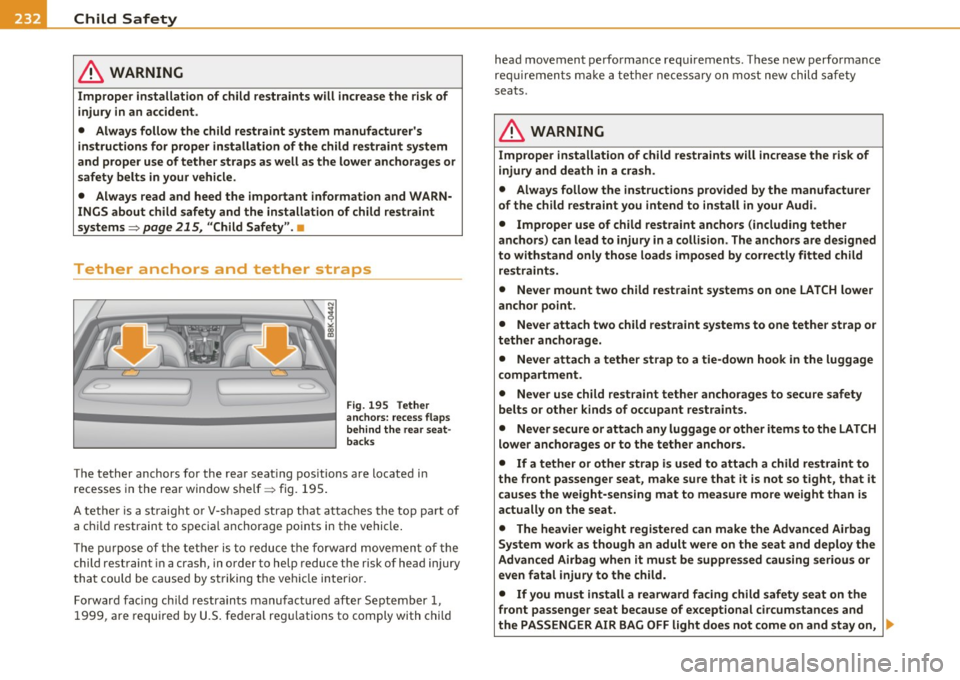
Fig . 1 9 5 T ether
a n ch ors : rece ss fl aps
behind th e rear seat
bac ks
The tether anchors for the rear seat ing pos itions are located i n
recesses in the rear win dow sh elf ~ fig. 195 .
A tet he r i s a st raight o r V-shaped strap t hat attac hes the top pa rt of
a ch ild restraint to spec ia l anchorage points in the vehicle .
T he p urpo se of the tethe r is to reduce t he f orwar d movemen t of the
child restraint in a crash, in order to help reduce t he risk of head injury
t ha t could be caused by st riking the ve hicle in terior .
Forward fac ing ch ild restraints manufactured after September 1,
1 999, are required by U.S . federa l reg ulations to comply with child head movement performance req
uirements . T hese new performance
re qu iremen ts m ake a tet he r ne cessa ry on most new child sa fe ty
seats.
in. WARNING
Improper installation of child restraints will inc rease the risk of
injury and death in a cra sh .
• Alw ays follow the instructions pro vided by the manuf acturer
of the child restraint you intend to install in your Audi.
• Improper use of child re straint anchors (including tether
anchors) can lead to injury in a collision. The anchor s are designed
to withstand only those loads imposed by co rrectly fitted child
restraint s.
• Never mount two child restraint systems on one LATCH lower
anchor point .
• Never attach two child restraint systems to one tether strap or
tether anchorage.
• Never attach a tether strap to a tie-down hook in the luggage
compartment .
• Never u se child restraint tether anchorage s to secure safety
belts or other kinds of occupant rest raints.
• Never secure or atta ch any luggage or other items to the LATCH
lower anchorages or to the tethe r ancho rs.
• If a tether or other strap is used to attach a child restraint to
the front passenger seat , make sure that it is not so tight , that it
causes the weight -sensing mat to mea sure more weight than is
actually on the seat.
• The heavier weight register ed can make the Advanced Airbag
System work as though an adult were on the seat and deploy the
Advanced Airbag when it must be suppre ssed causing serious or
even fatal injury to the child.
• If you must install a rearward facing child safety seat on the
front passenger seat because of e xcept ional circumstances and
the PASSENGER AIR BAG OFF light does not come on and stay on,
~
Page 235 of 362
& WARNING (co ntinued )
immediately install the rear -facing child safety seat in a rear
s eating position and have the airbag sy stem in spected by your
Audi deale r.•
Installing the upper tether strap on the
anchorage
(
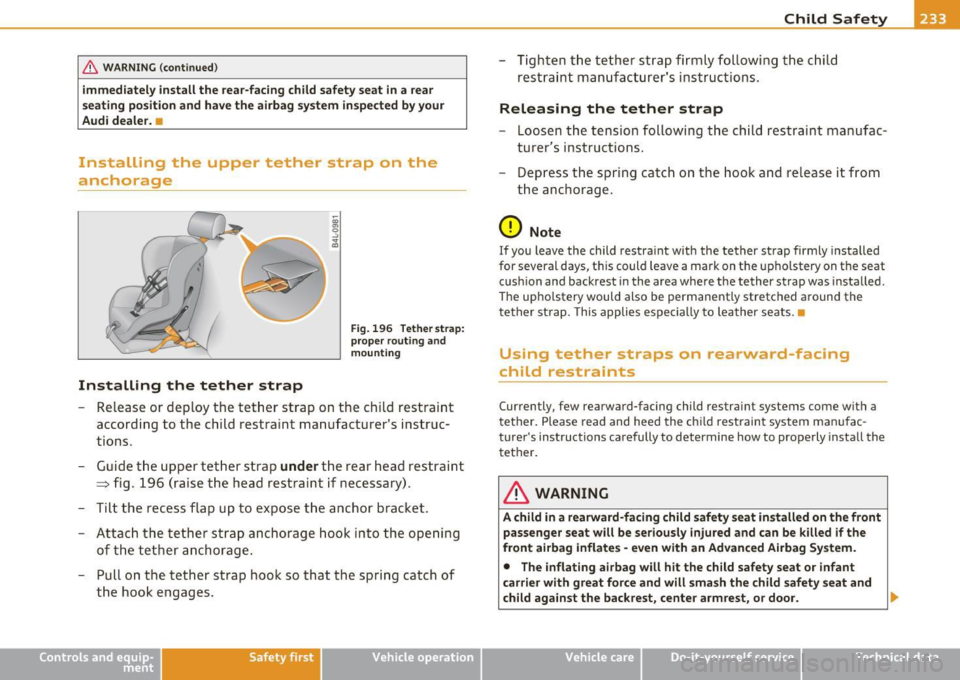
Installing the tether strap
Fig . 1 9 6 Te ther st rap :
prop er routi ng and
mounting
- Release or dep loy the tet her strap on the ch ild rest raint
acco rd ing to the ch ild restra int ma nufacturer's instruc
tions.
- Guide t he upper tet her st rap
under t h e rear head restraint
:::;, fig. 196 (raise t he head restra int if necessary).
- Tilt the recess fla p up to expose the anchor bracket.
- Attac h the t ether st rap anchora ge h ook in to the op ening
o f th e tet her anchorage .
- Pull on the tethe r strap hook so that the spring catch of
t h e hoo k engages.
Safety first Vehicle OP-eration
Child Safety
-Tig hten t he tether strap firmly fo llowi ng th e ch ild
restra int man ufacturer 's ins tructions .
Releasing the tether strap
- Loosen t he tension following t he chil d restrai nt manufac
turer's i nstructions.
- D epress t he spr ing catc h on the hoo k and release it f rom
t h e anchorage.
0 Note
If you leave the child restra int wit h the tether st rap firmly installed
for several days, t his could leave a mark on t he up holstery on t he seat
c u shi on and backrest in the area whe re the tether strap was insta lled .
Th e up ho lstery would also be permanent ly stretched a round the
tether st rap. This appli es especially to leather seats. •
Using tether straps on rearward-facing
child restraints
Currently, few rearward-facing child restraint systems come wit h a
t e ther. Please read and heed the ch ild restraint system ma nufac
t u rer 's instructions care fully to determine how to properly install the
t ether.
& WARNING
A child in a rearward-facing child safety seat installed on the front
passenger seat will be seriously injured and can be killed if the
front airbag inflates -even with an Ad vanced Airbag System.
• The inflating airbag will hit the ch ild safety seat or infant
carrier with great force and will sma sh the child safety seat and
child against the bac krest, center armrest , or door . •
Vehicle care Do-it-yourselt service iTechnical data
Page 236 of 362
ffl.___C_ h_ il_d _ S_a _ f_ e _ t--= y '------------------------------------------------
& WA RNING (conti nued)
• A tight tether or other strap on a rearward-facing child
restraint attached to the front passenger seat can put too much
pressure on the weight -mat in the seat and registe r a hea vier
weight in the Advanced Airbag System . The heavier w eight regis
tered can make the system work as though an adult were on the
s eat and deploy the Advanced Airbag when it mu st be suppressed
causing se rious or e ven fatal injury to the child.
• If you must install a rearward facing child safety seat on the
front p assenger seat because of e xceptional circumstances and
the PASSENGER AIR BAG OFF light does not come on and stay on,
immed iately install the rearward-facing ch ild safety seat in a rear
s eating position and have the airbag system inspected by your
authorized Audi dealer .•
Additional Information
Sources of information about child
restraints and the ir use
There are a number of sources of additional information abo ut child
restrain t selec tion, insta llation and use:
NHTSA adv ises that the best chi ld safety seat is the o ne that fits you r
child and fits in your vehicle, and that you will use correctly and
c ons iste ntly .
Try before you buy !
U.S National Highway Traffic Safety Administration
T e l. : 1-888-327 -4236 (T TY: 1-800 -424 -9 153)
www.n htsa.gov
National SAFE KIDS Campaign
Tel. : (202) 662-0600
www.safekids .org
Safety BeltSafe U.S.A
T e l. : (8 00) 74 5-SAF E (E ng lish)
Tel.: (800) 747 -SANO (Spa nish)
www.carseat .or g
Transport Canada Information Centre
Te l. : 1 (800) 333-0371 or call 1 (6 13) 998 -8 6 16 if yo u are in t he
Ottawa area
www. tc.gc.ca/roads afety
Audi Customer CARE
T el.: (800) 822-2834 •
Page 238 of 362
Intelligent technology
~----------------------------------------------
Intelligent technology
Notice about data recorded by
vehicle control modu Les
Your vehicle is not equipped with an Event Data Recorder (EDR),
installed by some manufacturers for the express purpose of
capturing data for retrieval after an accident or crash event. EDR's are
sometimes called "crash recorders".
Some state laws restrict the retrieval or downloading of data stored
by ED R's that were installed in a vehicle for the express purpose of
retrieving data after an accident or crash event without the owner's
consent.
Although your vehicle is not equipped with an EDR, it is equipped with
a number of e lectronic control modules for various vehicle systems
such as, for example, eng ine function, emission control, as well as for
the airbags and safety belts.
These electronic control modules also record vehicle-related data
during normal vehicle operation for diagnostic and repair purposes .
The recording capacity of the electronic control modu les is limited to
data (no sound is recorded) and only a sma ll amount of data is actu
ally recorded over a very limited period of time and stored when a
system fault or other condition is sensed by a control unit. Some of
the data then stored may relate to vehicle speed, direction, braking
as well as restraint system use and performance in the event of a
crash or other condition. Stored data can only be read and down
loaded with special equipment .•
Electronic stabilization Program
(ESP}
Ce-ieral lnforrrc:t~on
The ESP improves the vehicle stability.
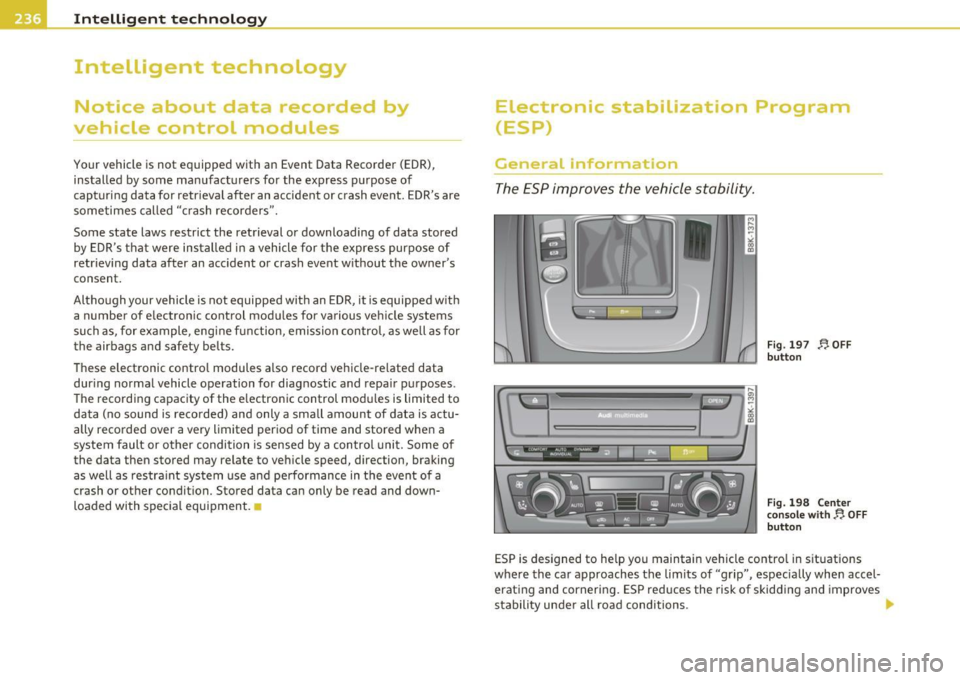
Fig. 197 ;';. OFF
button
Fig. 198 Center
console with;';.
OFF
button
ESP is designed to he lp you maintain vehicle control in situations
where the car approaches the limits of "grip", especially when accel
erat ing and cornering. ESP reduces the risk of skidding and improves
stability under all road conditions.
Page 266 of 362
-~_C_ le_ a_n_ i_ n_ g=- a_ n_d___. p_ro _t_e _c_ t_ i_o _n ___________________________________________ _
Normal surface stains can be cleaned using a comme rcially avai lab le
fo am cle aner. Spread t he fo am o n th e sur fa ce of the fabr ic wit h a soft
sponge and work it in gently . Do not saturate the fabr ic . T hen pat the
foam dry using absorbent, dry cloths (e .g . m icrofiber cloth) a nd
vacuum it afte r it has dr ied com plete ly.
Cleaning stains
Sta ins caused by beverages (e .g . coffee, fruit juice, etc .) can be
t re ate d wi th a mild detergen t sol utio n. Apply the dete rgent solu tion
w ith a s ponge . In the case o f stubbo rn stains, a detergent pas te ca n
be applied directly to the stain an d wo rked into the fabric . Afte r
wa rds, use copious amo unts o f clean water to remove the rema ining
detergent . App ly t he water with a damp cloth o r sponge an d pat the
f abr ic dr y wi th a n absorbe nt, dr y cloth .
Sta ins from choco late or makeup sho uld have detergent paste
r u bbed into the m. Afte rw ards, remove the so ap wi th w ate r (dam p
sponge) .
Alcoho l can be used to treat stains from grease, oil, lipstic k or a ba ll
point pen . M elte d gre as e o r dye mus t be pa tted off using abso rbe nt
material. It may be necessary to ret reat t he a reas with detergent
p ast e and water.
In the case of ge nera l soiling o f the upholste ry and cover mater ia l, we
recommend hiring a specialis t that has the equ ipmen t to clean the
seat covers and other fa bric surfaces by shampoo ing and sp ray
extraction .
& WARNING
Always read and heed all WARNINGS and the information
~page 256 .
[I] Tips
Open Velcro fasteners on your clothing can damage the seat cover.
Please make s ure t hat Velcro fasteners are close d.•
Plastic parts and instrument panel
Always use a clean cloth moistened in clear wate r to clean these
a reas . For pe rsis te nt di rt use an A udi appr ove d
solvent-free plastic
cleaner /protectant.
& WARNING
Solvents can change the propert ies of some plastics and make it
harder for the airbag to deploy.
• Never clean the instrument panel or the surface of airbag
modules with cleaning products that contain solvents.
• Products containing solvents will make the surface of this part
porous.
• Serious injuries can result if pla stic parts come loose when the
airbag is deployed .
• Alway s read and heed all WARNINGS and other information
~ page 256 .
0 Note
Cleaning agents contai ning solvents will attac k the material and can
ch ange the w ay i t be have s. •
Appli es to veh icl es: wit h nat ura l leather
Natural leather
A udi makes gre at e ffo rts t o m ain tain the prop ert ies,
n a tu ra l loo k and fee l of inte rio r leat her .
General
We offe r many differen t types o f leat he r on our vehi cles. Most are
different types of nappa leather, wh ich has a smooth s urface and
comes in va rious co lo rs . _,,,