warning AUDI A5 COUPE 2012 Owners Manual
[x] Cancel search | Manufacturer: AUDI, Model Year: 2012, Model line: A5 COUPE, Model: AUDI A5 COUPE 2012Pages: 316, PDF Size: 78.59 MB
Page 254 of 316
252 Tire s and wheel s
Tires and wheels
Tires
General notes
Tires may be the least appreciated and most
abused parts of a motor vehicle .
Tires may be the least appreciated and most
abused parts of a motor vehicle . Tires are,
however, one of the most important parts of a
vehicle, particularly considering the compara
tive ly small patch of rubber on each tire that
assures that a ll-impo rtant contact between
you, your vehicle and the road.
Maintaining the correct tire pressure, mak ing
sure that your vehicle and its tires do not have
to carry mo re weight than they can safe ly han
d le, avoiding damage from road hazards and
reg ularly inspecting t ires for damage includ
ing cuts, slashes irregu la r wear and ove rall
condition are the most important things that
you can do to he lp avoid sudden tire failure in
cluding tread separation and blowouts.
Avoiding damage I f you have to drive over a curb or similar ob
stacle, drive very s low ly and as close as possi
b le at a right angle to the curb.
A lways keep chem ica ls includ ing gre ase, o il,
gasoline and b rake fluid off the ti res .
Inspect the t ires regularly for damage (cuts,
cracks or b listers, etc.). Remove any fo reign
bod ies embedded in the treads.
Storing tires Mark tires when you remove them to indicate
the direction of rotation . Th is ensures you to
be ab le to mount them correctly when you re
install t hem.
When removed, the whee ls or t ires should be
stored in a cool, d ry and preferably dark place .
Store tires in a vertical pos ition if they are not
mounted on rims, in a horizontal pos it ion if
they are mounted on rims. New tire
s
New t ires have to be broken in¢&,. .
T he tread depth of new t ires may vary, accord
ing to the type a nd make of t ire and the tread
pa tte rn .
Hidden damage
Damage to tires and r ims is ofte n not readily
vis ible . If you notice unusual v ibrat ion or the
vehicle p ulls to one side, th is may ind icate
t h at one of the t ires has been damaged . Th e
t ir es m ust be checked immed iate ly by an au
tho rized Aud i dea le r or q uali fied wor ks hop.
Unidirectional t ires
A un idirectional tire can be identified by ar
rows on the sid ewa ll, that po int in the direc
t ion the t ire is desig ned to rotate. You mus t
f ol low the specified d irection of rotation . This
is necessary so that these tires can develop
their optimum characterist ics regarding grip,
road no ise, wear and hyd rop laning resistance.
For more information ¢
page 2 79.
A WARNING
-New tires or tires that are old, worn or
damaged cannot provide maximum con
trol and braking ability .
-
-New tires tend to be slippery and must
also be broken-in. To reduce t he risk of
losing control, a collision and se rious
pe rsonal injuries, drive w it h specia l care
for the first 350 miles (560 km).
- Driving with worn or damaged tires can
le ad to loss of control, sudden tire fail
ure, including a blowou t and sudden de
fl ation, c rashes and seriou s personal in
juries . Have wo rn or damaged t ires re
p laced immediate ly .
- T ires age even if they are not being used
an d can fai l sudden ly, especially at high
speeds. Tires that are more than 6 years
old can only be used in an emergency
and then w ith specia l care and at low
speed.
Page 256 of 316
254 Tires and wheels
Maximum loaded vehicle weight
means the sum of:
(a) Curb weight
(b) Accessory weight
(c) Vehicle capacity weight, and
(d) Production options weight
Maximum (permissible) inflation pressure
means the maximum cold inflation pressu re
to which a tire may be inflated. Also called
"maximum inflation p ressure."
Normal occupant weight
means 150 lbs. (68 kilograms) times the
number of occupants seated in the vehicle up
to the total seating capacity of your vehicle.
Occupant distribution means distribution of occupants in a vehicle .
Outer diameter means the overa ll diameter of an inf lated new
tire.
Overall width
means the linear distance between the exteri
ors of the sidewalls of an inflated tire, includ
ing e levations due to labeling, decorations, or
protective bands or ribs.
Ply
means a layer of rubber-coated parallel cords.
Production options weight
means the comb ined weight of those installed
regular production options weighing over 5
lbs . (2 .3 kg) in excess of those standard items
which they replace, not previously considered
in curb weight or accessory weight, including
heavy duty brakes, r ide leve lers, roof rack,
heavy duty battery, and specia l trim .
Radial ply tire
means a pneumatic tir e in which the p ly cords
that extend to the beads are laid at substan
tially 90 degrees to the centerline of the
tread . Recommended inflation pressure
see
~
page 253, Cold tire inflation pressure.
Reinforced tire
means a t ire design to operate at higher loads
and at h igher inflation pressures than the cor
responding standard tire. Reinforced tires
may be identified as "XL", "xl", "EXTRA LOAD",
o r "R F" on the sidewall.
Rim
means a metal support for a tire or a t ire and
tube assembly upon which the tire beads are
seated.
Rim diameter
means nom inal d iameter of the bead seat.
If
you change your wheel s ize, you will have to
purchase new tires to match the new rim di
ameter .
Rim size designation
means rim diameter and width.
Rim width
means nominal distance between rim flanges.
Sidewall
means that portion of a tire between the
t read and bead.
Speed rating (letter code)
means the speed at which a tire is designed to
be driven for extended periods of time. The
ratings range from 93 mph (150 km/h) to
186 mph (298 km/h)
~ page 264 . You may
not find this information on all tires because
it is not requ ired by law.
The speed rating letter code, where applica
ble , is molded on the tire sidewall and indi
cates the max imum perm issible road speeds
~ A in Winter tires on page 268.
Tire pressure monitoring system*
means a system that detects when one or
more of a veh icle's tires are underinflated and
illuminates a low tire pressure warning tell
tale.
Page 259 of 316
Tires an d wheel s 257
labe l and exact location on the vehicle wi ll
va ry slightly). inside the f
uel fi ller flap) always takes p rece
dence.
Note that the f ollowing tab le is accurate at
t he t ime o f go ing to press and is subject to
change. In the event of discrepancies, the tire
pressure label (On USA vehicles, the tire pres
sure label is located on the dr iver's side B-pil
lar. On Canada vehicles, the tire pre ssure labe l
is located either on the driver's side B-pillar or T
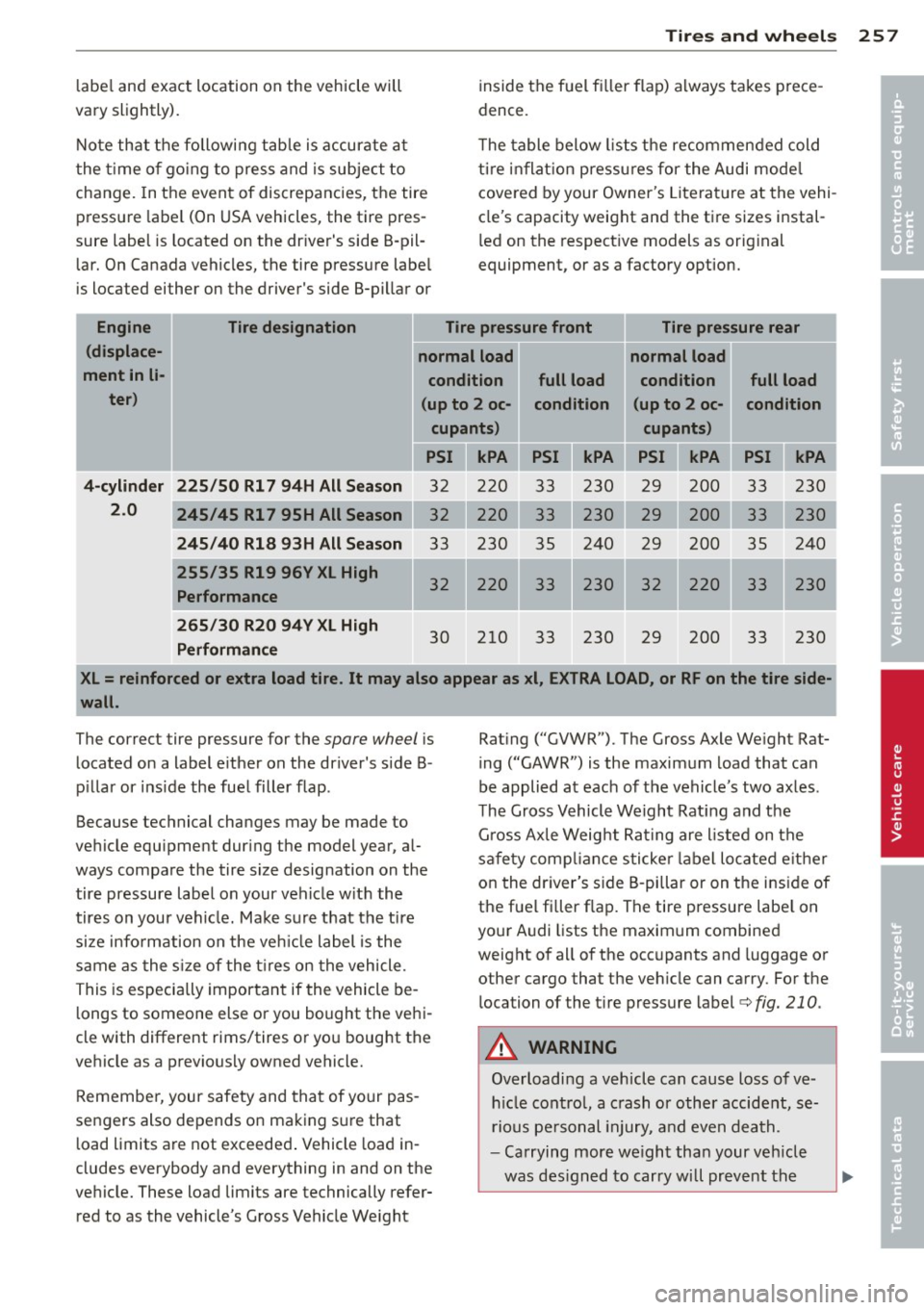
he table below lists the recommended cold
ti re in flat ion p ressu res for the Audi mode l
cove red by your Owner 's Literat ure at the vehi
cle's capacity weight and the t ire sizes instal
l ed on the respect ive models as orig inal
equipment, or as a factory option.
Engine Tire designation Tire pressure front Tire pressure rear
( displace-
normal load normal load
ment in li- condition full load condition
full load
ter) (up to 2 oc-condition (up to 2 oc- condition
cupant s) cupants)
PSI kPA PSI kPA PSI kPA
4-cylinder 225 /50 Rl 7 94H All Season
230
33 230
2
.0
245/45 Rl 7 95H All Season 230
245 /40 R18 93H All S eason 33 230 35 240 29 200 35 240
255 /35 R19 96V XL High 32 220 33 230 32 220 33 230 Performance
265 /30 R20 94V XL H igh
Perfo rmance
30 210 33 230 29 200 33 230
XL= reinforced or extra load tire. It may also appear as xl , EXTRA LOAD, or RF on the tire side
wall.
The correct tire pressure for the spare wheel i s
located on a label e ither on the driver's side B
p illar or ins ide the fuel filler flap .
Because technical changes may be made to
vehicle equ ipment dur ing the model year, a l
ways compare the tire s ize designation on the
tire pressure label on your vehicle w it h the
tires on your veh icle. Ma ke sure that the tire
size info rmation on the ve hicle label is the
s a me as the s ize of the t ires on the vehicle.
This is especia lly important if the vehicle be
l ongs to someone else or you bought the vehi
cle with different rims/tires o r you bought the
vehicle as a previously owned vehicle.
Remember, your safety and that of your pas
sengers also depends on mak ing su re that
l oad limits a re not exceeded . Vehicle load in
cludes everybody and everything in and on the
ve hicle. These load limits are technically refer
red to as the vehicle's G ross Vehicle We ight Rat
ing ("GVWR"). The Gross Axle We ight Rat
ing ("GAWR") is the maximum load that can
be applied at each of the vehicle's two axles .
T he Gross Vehicle Weight Rat ing and the
G ross Ax le Weig ht Rating are listed on the
sa fe ty comp liance sticke r label lo cated e ither
on the dr iver's s ide B-pillar or on the ins ide of
the fue l filler flap. The tire pressure labe l on
your A udi lists the maximum combined
weight of all of the occ upants and luggage or
other cargo that the veh icle can carry . For t he
loca tion of the t ire p ressure label¢
fig. 210.
A WARNING
Overloading a vehicle can cause loss of ve
h icle cont ro l, a c rash or other accide nt, se
rious pe rsonal injury, and even death.
- Ca rrying more we ight than your veh icle
was des igned to carry will prevent the
1
I
•
•
Page 260 of 316
258 Tire s and whee ls
vehicle from handling properly and in
crease the risk of a loss of vehicle
control.
- The brakes on a vehicle that has been
overloaded may not be able to stop the
vehicle within a safe distance.
- Tires on a vehicle that has been overload ed can fail suddenly causing loss of con
tro l and a crash.
- Always make sure that the tota l load be
ing transported -including the weight of
a tra iler hitch and the tongue weight of a
loaded trailer -does not make the veh i
cle heav ier than the veh icle's Gross Vehi
cle Weight Rating.
_& WARNING
- Incorrect tire pressures and/or underin
flation can lead to a serious o r fatal acci
dent.
- Incorrect tire pressures and/or underin
flation cause increased tire wear and can
affect the handling of the vehicle.
- Incorrect tire pressures and/or underin
flation can also lead to sudden tire fai l
ure, including a blowo ut and sudden de
flation, causing loss of vehicle control.
Checking tire pressure
.
The correct tire pressure for the tires original
ly installed on your vehicle is listed on the tire
pressure label located either on driver's side 8-pillar or inside the fuel filler flap.
The recommended tire pressures are on the
tire pressure labe l and in the tab le
¢ page 256, Cold tire inflation pressure .This
means that the pressure must be checked and
adjusted when the tire has not been driven for
more than a couple of miles (kilometers) at
low speeds during the previous three hours .
A ir in the tires expands when the tire heats up
as a result of inte rna l fr iction as it flexes in
use. The ti re p ress ure is higher when the tire
has warmed up than when it is "cold."
It is the inflat ion pressure in a "cold" tire that
counts. Therefo re, you should never let air out of a warm tire to match "Cold tire
inflation
pressure" recommendations ¢
page 256. The
t ires wo uld then be underinf lated and co uld
fail suddenly.
The tire pressure label on your Audi lists the
recommended co ld tire inflation pressures at
maximum capacity for the new, orig inal
equipment tires that were on your vehicle at
the time it was manufactured. For the loca
t ion of the labe l
¢page 256, fig . 210 .
Most tires lose air natura lly over t ime. They
can a lso lose some air if you drive over a pot
hole or hit a curb while park ing. It is usually
not possible to see whether the rad ial tires
used today are underinflated just by look ing
at them.
Therefore, be sure to check t ire pressures at
least once a month and a lways before going
on a long trip . Make sure to take the number
of peop le and the amount of luggage into ac
count when adjust ing ti re pressu re for a trip -
even one that yo u wou ld not consider to be
" long." See
¢ page 260, Tires and vehicle
load limits
for mo re important information.
Always use an accurate tire p ressu re ga uge
when checking and ad justing inflat ion pres
sures . Check a ll of the tires and be s ure not to
forget the spare tire. If the pressure in any tire
is too high when the tire is "cold," let air o ut
of the tire s low ly with the edge of the tire
gauge and keep checking the pressure until
you reach the pressure that is correct for the load (passengers and luggage) and k ind of
dr iv ing you plan to do .
If the pressure in any tire is too low, note the
difference between the pressure in the co ld
t ire and the pressure you need and add the air
that you need to reach the correct pressure for
the vehicle load (passengers and luggage) for
the tires on your vehi cle as listed on the on
yo ur vehicle and in th is m anu al and the kind
of d riving you plan to do.
Ne ver e xceed th e maximum infl ation pre s
sure lis ted o n the tir e side wall for any rea
s on.
Page 261 of 316
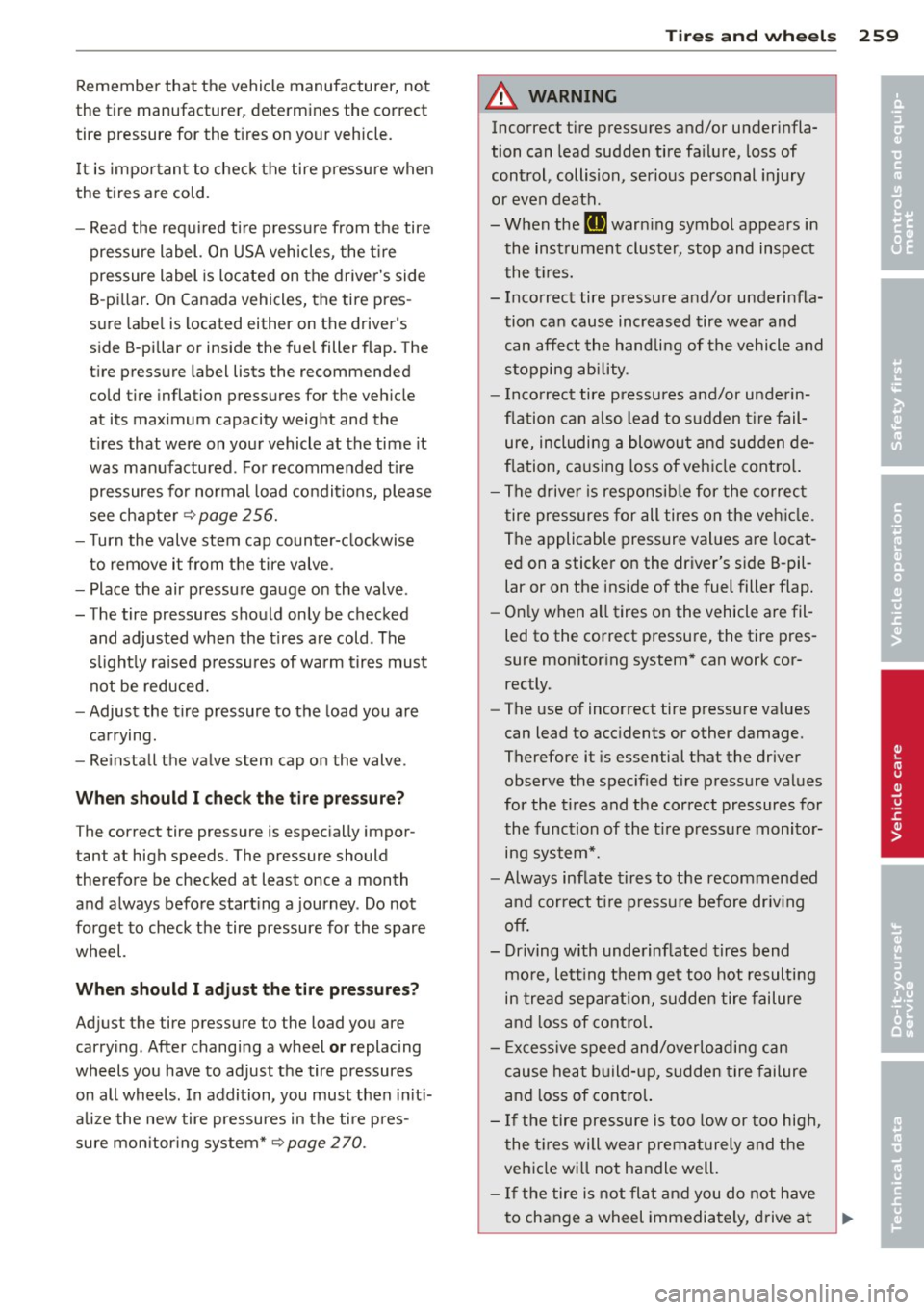
Remember that the vehicle manufacturer, not
the tire manufacturer, determines the correct
tire pressure for the t ires on your vehicle .
It is importan t to check the tire pressu re when
the t ires a re cold .
- Read the requ ired ti re p ressure from the tire
pressure label. On USA veh icles, the t ire
pressure label is located on the drive r's side
B-pi llar . On Canada vehicles, the tire pres
s u re label is located either on the driver's
s ide B-pi llar or inside the fue l filler flap . The
t ire press ure label lists the recommended
cold tire inflation pressures for the veh icle
at its max imum capacity weight and the
t ires that were on your vehicle at the time it
was manufactured . Fo r recommended t ire
pressures fo r normal load condit ions, please
see chapter
9page 256.
- T urn the valve stem cap counter-clockwise
to remove it from the tire valve .
- Place the air pressu re ga uge on the valve .
- The tire pressures should only be checked
and adjusted when the tires a re cold . The
s li ghtly raised p ressures of warm tires must
not be reduced.
- Adjust the tire pressure to the load you a re
c a rrying.
- Re install the valve stem cap o n the valve .
When should I check the ti re pres sure ?
The correct tire pressure is espec ially impor
tant at high speeds. The pressure should
therefore be checked at least once a month
and a lways befo re start ing a journey . Do not
forget to check the tire pressure for the spare
wheel.
When should I ad ju st the tire p re ss ures?
Adjust the tire pressure to the load you are
carry ing . After chang ing a wheel
or replacing
wheels you have to adjust the tire pressures
on all wheels. In addition , you must then in it i
alize the new tire pressures in the tire pres
sure mon itor ing system*
9 page 270.
Tire s an d wheel s 259
_& WARNING
Incorrect tire pressures and/or underinfla
tion can lead sudden tire fa ilure, loss of
control, collision, serio us pe rsonal injury
or even death.
- When the
ti] warn ing symbol appears in
the instrument cluster, stop and inspect
the t ires.
- Inco rrect tire pressure and/or underinfla
tion can cause increased tire wea r and
can affect the handling of the vehicle and
s topping ability.
- I nco rrect tire pressures and/or unde rin
f lation can a lso lead to sudden t ire fail
ure, including a blowou t and sudd en de
f lation, ca using loss of veh icle cont ro l.
- T he drive r is responsi ble for the co rrec t
tire pressures for all tires on the veh icle.
The appli cable pressure values a re locat
ed on a sticke r on the dr iver's side B -pil
lar or on the inside of the fuel filler flap.
- On ly when all tires on the vehicle are fil
led to the correct pressure, the t ire pres
sure mon itor ing system * can work cor
rectly.
- The use of incorrect tire pressu re va lues
can lead to acc idents or other damage.
Therefore it is essential that the driver
observe the spec ified t ire pressure values
for the tires and the correct pressures for
the function of th e ti r e p ress ure monito r
ing system*.
- Always inf late tires to the recommended
a nd correct t ire p ress ure before dr iv ing
off.
- Driving with unde rinflated tir es bend
mo re, lett ing t hem get too hot resulting
in tre ad separation, sudden tir e fa ilure
and loss of cont rol.
- Exces sive speed and/overloading can
cause heat b uild- up, s udden tire failure
an d l oss of cont rol.
- If the tire pressure is too low or too high,
the t ires will wear prema turely and the
vehicle wi ll not handle well.
- I f the tire is not fla t and you do not have
to change a wheel immedia tely, drive a t •
•
Page 262 of 316
260 Tire s and wheel s
reduced speed to the nearest service sta
t ion to c heck t he tire pressure a nd add
air as required.
Driving without va lve stem caps can cause
damage to the tire va lves. To prevent this,
always make sure that factory installed
valve stem caps on all wheels are secure ly
mounted on the valve .
@I For the sake of the environment
Underinflated tires will also increase the
fue l consumption .
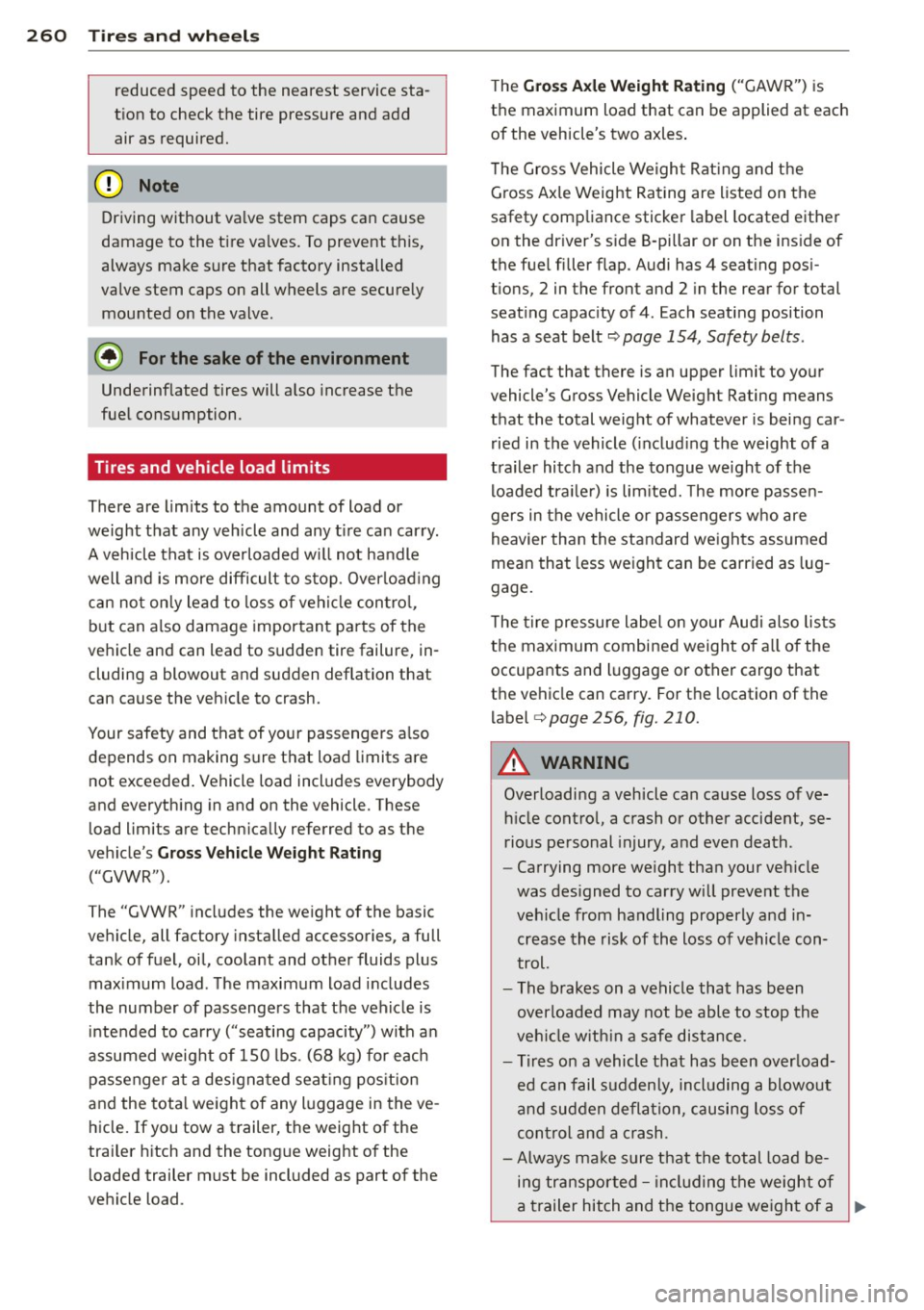
Tires and vehicle load limits
There are limits to the amount of load or
weight that any vehicle and any t ire can carry.
A vehicle that is ove rloaded w ill not ha ndle
well and is more difficult to stop. Over load ing
can no t on ly lead to loss of vehi cle contro l,
but can also damage important pa rts of the
ve hicle and can lead to sudden tire failure, in
cluding a blowout and sudd en deflation that
can cause the veh icle to crash.
Your safety and that of yo ur passenge rs a lso
depends on making s ure that load limits are
not exceeded . Vehicle load includes everybody
and everyth ing in and on the vehicle . These
load limits are techn ically referred to as the
ve hicle's
Gross Veh icle W eight Rat ing
(" GVWR ").
T he "GVWR" incl udes the we ight of the basic
vehicle, all f actory installed accessories, a full
tank of fuel, oil, coolant and other fluids plus maximum load . T he maximum load includes
the number of passengers that the vehicle is in tended to carry ("seating capacity") with a n
assumed weig ht of 150 lbs . (68 kg) for e ach
passenger at a des igna ted seat ing pos ition
and the tota l we ight of any l uggage in the ve
h icle. If you tow a trailer, the weight of the
tra iler hitch and the tong ue weight of the
loaded trailer must be included as part of the
ve hicle load . T
he
Gro ss Axle We ight Rating ("GAWR") is
the maximum load that can be applied at each
of the veh icle's two axles .
T he Gross Vehicle Weigh t Rat ing and the
G ross Ax le Weight Rating are listed on the
safety comp liance sticker label located either
on the dr iver's s ide B-pillar or on the ins ide of
the fuel fi ller flap . Audi has
4 seating pos i
t ions, 2 in the front and 2 in the rear for to tal
seat ing capac ity of 4 . Each seating position
has a seat belt ¢
page 154, Safety belts.
The fact that there is an upper limit to yo ur
vehicle 's Gross Vehicle Weight Rating means
that the total weight of whatever is being car ried in the vehicle ( includ ing t he weight of a
t railer hitch and the tongue weight of the
l oaded tra ile r) is lim ited. The more passen
gers in the vehicle or passengers w ho are
heavier tha n t he standard we ights assumed
mean that less weight can be carried as lug
gage.
T he tire pressure label o n your Aud i also lis ts
the max imum combi ned weight of a ll of the
occupants and luggage or other cargo that
t h e vehicle can carry. Fo r the location of the
label ¢
page 256 , fig. 210.
A WARNING
-Overloading a vehicle can cause loss of ve-
h icle contro l, a crash or other accident, se
rious pe rsonal injury, and even death .
- Carrying more we ight than your veh icle
was des igned to carry will prevent the
veh icle from handling properly and in
crease the risk of the loss of vehicle con
trol.
- The b rakes on a vehicle that has been
overloaded may not be abl e to stop the
veh icle w it hi n a safe distance .
- Tires on a vehicle that has been overload
ed can fail s udden ly, incl uding a blowo ut
a nd sud den defla tion, causing loss of
con trol an d a crash.
- Always make sure that the total load be
i n g tr anspor ted - incl ud ing t he weight o f
a trailer hitch and the tongue we igh t of a
~
Page 265 of 316
A WARNING
Sudden tire failure can lead to loss of con
trol, a crash and serious personal injury!
- Never drive a vehicle when the tread on
any tire is worn down to the wear indica
tors.
- Worn tires are a safety hazard, they do
not grip well on wet roads and increase
your risk of "hydroplaning" and loss of
control.
- Always keep chemicals that can cause
tire damage, such as grease, oil, gasoline
and brake fluid away from t ires.
- Tires age even if they are not be ing used
and can fail suddenly, especially at high
speeds . Tir es that are more than 6 years
old can only be used in an emergency
and then with special care and at lower
speeds.
- Never mount used tires on your vehicle if
you are not sure of their" previous histo
ry ." Old used tires may have been dam
aged even though the damage cannot be
seen that can lead to sudden tire failure
and loss of vehicle control.
Tires and wheels 263
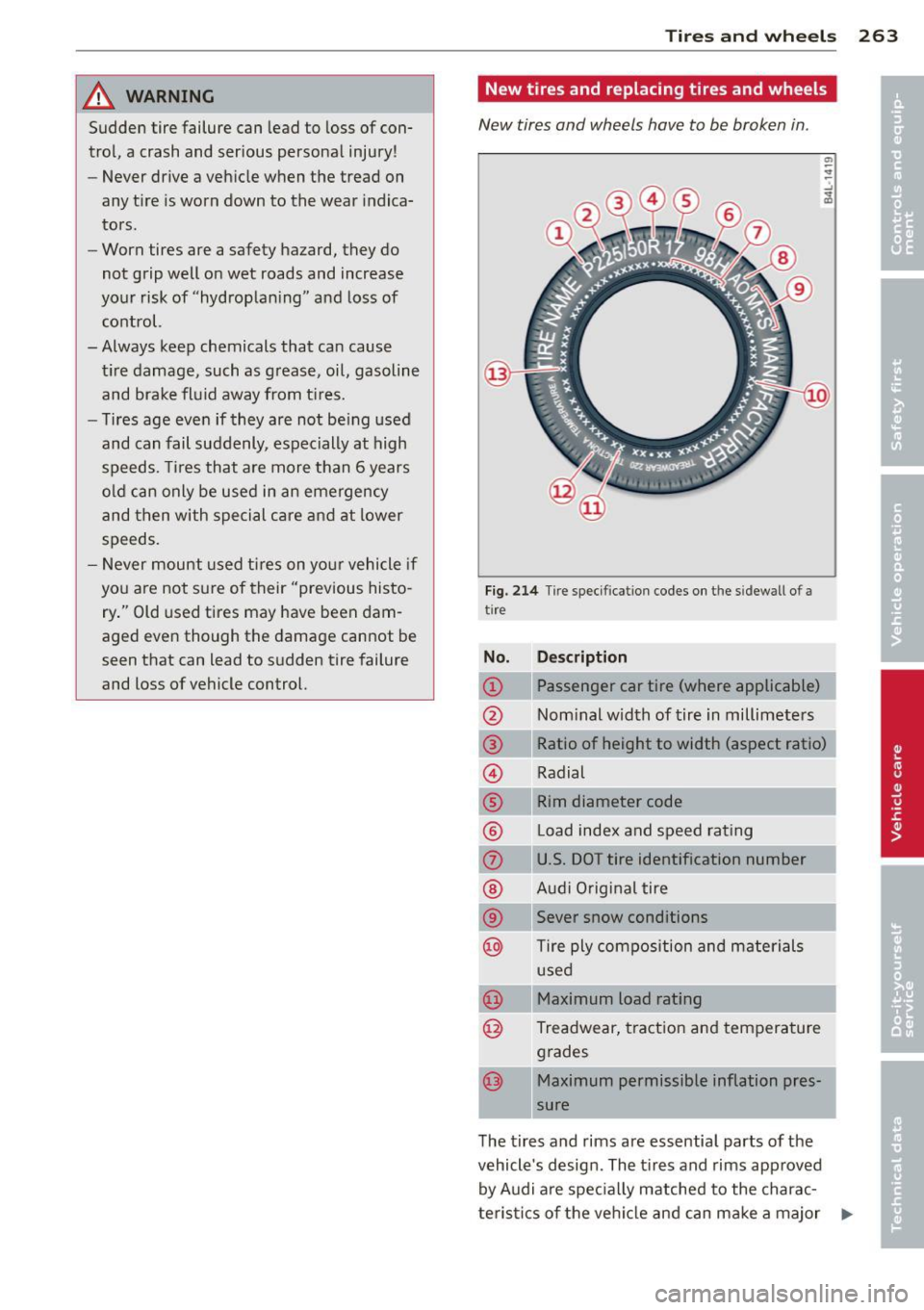
New tires and replacing tires and wheels
New tires and wheels have to be broken in .
Fig. 214 Tir e specificat ion codes on t he s idewall o f a
tire
No. Description
CD Passenger car tire (where applicable)
@ Nominal width of tire in millimeters
® Ratio of height to width (aspect ratio)
© Radial
® Rim diameter code
® Load index and speed rat ing
(f) U.S. DOT tire identification number
® Audi Original tire
® Sever snow conditions
@ Tire ply composition and materials
used
@ Maximum load rating
@ Treadwear, traction and temperature
grades
@ Maximum permissible inflation pres-
sure
The tires and rims are essential parts of the
vehicle's design . The tires and rims approved
by Audi are specially matched to the charac
teristics of the vehicle and can make a major .,.
•
Page 267 of 316
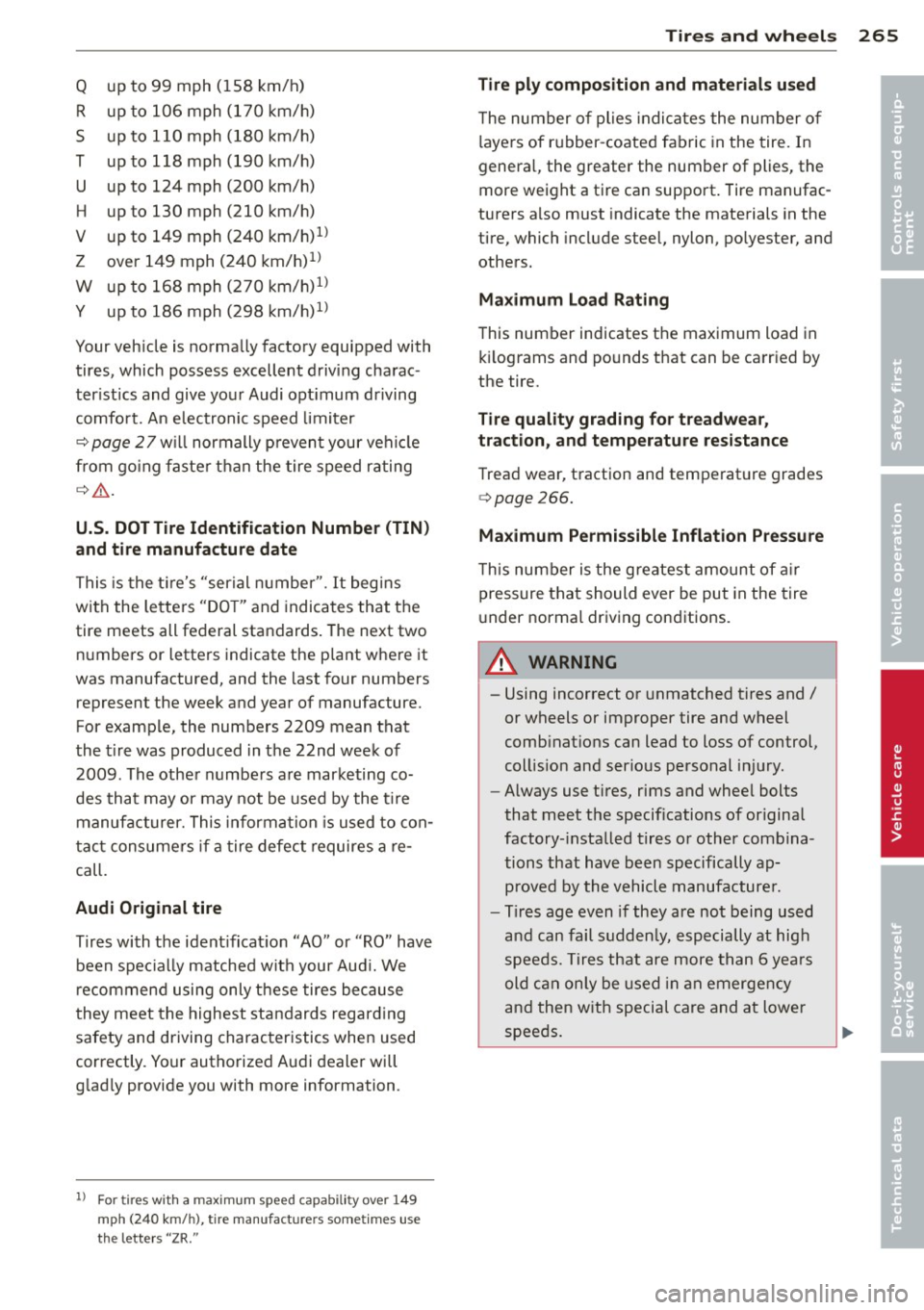
Q up to 99 mph (158 km/h)
R up to 106 mph (170 km/
h)
s up to 1 10 mph (180 km/ h)
T up to 118 mph (190 km/h)
u up to 124 mph (200 km/h)
H up to 130 mph (210 km/h)
V up to 149 mph (240 km/h)1
)
z over 149 mph (240 km/h)ll
w up to 168 mph (270 km/h)1l
y up to 186 mph (298 km/h)1l
Your veh icle is normally factory equipped with
tires, which posse ss excellent driving charac
ter ist ics and give your Audi opt imum dr iving
comfort. An electronic speed limiter
q page 27 w ill normally p revent your vehi cle
from go ing faster than the tire speed ra ting
Q .&. .
U.S. DOT Tire Identification Number (TIN)
and tire manufa ctur e date
This is the t ire's "serial number". It begins
with the lette rs "DO T" and indicates that the
tire meets all federal standards . The next two
numbers or letters indicate the p lant where it
w as manufactured, and the last four numbers
represen t the week and ye ar of manufacture .
For example, the numbers 2209 mean that
the t ire was produced in the 22nd week of
2009 . The othe r numbe rs are marketing co
des that may or may not be used by the t ire
manufacturer. This informa tion is used to con
t act consume rs if a tire defect requires a re
call.
Audi Original tir e
Tires with the ident ificat ion "AO" or "RO " have
been spec ially matched with your Aud i. We
recommend using only t hese tires because
they meet the highest standards regard ing
safety and driving characteristics when used
correctly. Your authorized Audi dealer will
g lad ly p rovide you with mo re info rmation .
ll Fo r tires wit h a m ax im um s pee d ca pabil ity over 149
mph (2 4 0 k m/h) , tire ma nufa cturers some times use
t h e le tters "Z R."
Tire s an d wheel s 265
Tire ply composition and material s used
The number o f plies indicates the number o f
l aye rs of r ubber-coated fabric in the tire. In
genera l, the greater the number of plies, the
more weight a tir e can support . Tire manufac
turers also must indicate the materials in the
tire, which include steel, nylon, po lyester, and
others.
Maximum Load Rating
T his number indicates the maximum load in
ki lograms and po unds that can b e carried by
the tire.
Tire quality grading for treadwear,
tract ion , and temperature resistance
Tread w ear, traction and t emperat ure grades
q page 266.
Ma ximum Permissible Inflat ion Pre ssure
T his number is the greatest amount of a ir
pressure that should ever be put in the tire
u nder normal dr iving conditions.
A WARNING
- Using incorrect or unmatched tires and I
or wheels or improper tire and wheel
comb inat ions can lead to loss of control,
col lis ion and serious personal injury.
- Always use t ires, rims and whee l bolts
that meet the specifications of original
factory- installed tires or other combina
tions that have been specifically ap proved by the vehicle manufacture r.
- Tires age even if they are not being used
and can fail sudden ly, especially at high
speeds. Tires that are more than 6 yea rs
old c an only be used in an emerge ncy
an d then w ith special care and at lower
spee ds.
•
•
Page 269 of 316
tire's ability to stop on wet pavement as measured under controlled conditions on
specif ied government test surfaces of asphalt
and concrete. A tire marked C may have poor
t raction performance¢ .&,.
Temp eratu re
The temperature grades are A (the highest),
B, and
C, representing the tire's resistance to
the generation of heat and its ability to dissi pate heat when tested under controlled condi
tions on a specified indoor laboratory test
wheel.
Sustained high temperature can cause the material of the tire to degenerate and reduce
tire life, and excessive temperature can lead
to sudden tire failure ¢.&, .
T he grade
C corresponds to a level of perform
ance which all passenger car tires must meet
under the Federa l Motor Veh icle Safety Stand
ard No.
109 . Grades Band A represent higher
levels of performance on the laboratory test
wheel than the m inimum required by law.
.8, WARNING
The trac tion grade assigned to this t ire is
b ase d on stra ight-ahead brak ing t raction
t ests, and does not inclu de acceleration,
co rnering, hydrop laning or peak traction
characteristics .
.8, WARNING
The temperature grade for this tire is es
tablished for a t ire that is properly inflated
and not overloaded . Excessive speed, un
derinflation, or excessive loading, either
separate ly or in combination, can cause
heat buildup and possible ti re fa ilu re.
Winter tires
Winter tires can improve vehicle handling on
snow and ice . At temperatures below 45 °F
(7 °C) we recommend changing to winter
tires.
-
In some heavy snow a reas, loca l governme nts
may require t rue winter or "snow" tires, those
Tires an d wheel s 267
with very deeply cut tread. These tires should
o nl y be used in pairs and be installed o n all
fo ur wheels. Make sure you purchase snow
tires that are the same si ze and construction
type as the other tires on your vehicle.
Your vehicle is equipped with a ll-wheel drive,
th is w ill imp rove traction d uring winter driv
ing, even with the standard tires. However, we
strong ly rec ommend that you always equip all
fou r wheels on you r vehicle with correctly fit
ted w inter t ires or al l-season t ires, when win
te r road cond itions ar e expected . This also im
proves the veh icle's b ra ki ng perfo rman ce and
reduces stopping d ista nces .
Summe r tires p rovide less grip on ice and
snow .
Winter tires (snow tires) must always be fitted
o n all four wheels .
Ask your authorized A udi dealer or qualified
workshop for permitted
winter tire sizes . Use
only rad ial winter t ires.
Winter tires lose their effectiveness whe n the
tread is worn down to a depth of
0.157 inch
(4 mm).
Only drive with winter tires under winte r con
ditions. S ummer t ires handle better when
there is no snow or ice on the roads and the
temperature is above 45 °F (7 °().
If you have a flat t ire, see no tes on spare
whee l ¢ page 263.
P lease alway s remember tha t win ter tire s m ay
have a lowe r speed ra ti ng than the tires orig i
nally installed on your vehi cle at the time it
was man ufactured. Please see ¢page 264,
Speed rating (letter code) for a listing of the
speed rating letter codes and the max imum
speed at which the tires can be driven.
T he spee d rating letter code (¢ page 254) is
on the side wall of the t ire ¢page 263.
.8, WARNING
Winter t ires have maximum speed limits
that may be lower than yo ur vehicle's max-
imum speed . Always know the max imum
~
•
•
Page 270 of 316
268 Tire s and wheel s
speed before driving off . Never drive faster
than the speed permitted for your specific
winter t ires. This will cause damage to the
tires leading to an accident and serious
personal injury to you and your passen
gers .
A WARNING
Driv ing faster than the maximum speed
for which the w inter t ires on your vehicle
were designed can cause tire fa ilu re in
cluding a blowout and sudden deflat ion,
loss of control, crashes and serious per
sonal injuries. Have worn or damaged tires
rep laced immed iate ly.
- Winter tires have maximum speed rating
that may be lower than your vehicle's
maximum speed .
- Never drive faster t han the speed for
which the winter or other tires installed
on your vehicle are rated.
A WARNING
Always adjust your driving to the road and
traffic conditions. Never let the good ac
celeration of the winte r tires and all -wheel
drive tempt you into taking extra r is ks. Al
ways remembe r:
- When brak ing, an all -wheel drive vehicle
handles in the same way as a front drive
vehicle .
- Drive carefu lly and reduce your speed on
icy and slippery roads, even winter tires
canno t he lp under black ice condit io ns.
@ For the sake of the environment
Use summer tires when weather cond i
tions permit . They are quieter, do not wea r
as quickly and reduce fue l consumption .
Snow chains
Snow chains may be fitted on ly to the front
wheels, a nd only to certa in tire sizes. Ask yo ur
author ized Audi dealer on wh ich tire sizes
snow chains can be used. The snow chains must have
low -profile links
and must not be thicker than 0 .53 inch
(13.S mm), includ ing the lock.
Remove whee l cen ter cove rs and t rim discs
before putting snow chains on your vehicle
¢ 0 . For safety reasons cover caps m ust then
be fitted over the wheel bolts. These are avail
a ble from authori zed Aud i dealers.
A WARNING
Using the wrong snow chains for your veh i
cle o r instal ling them incorrectly can in
crease the risk of loss of cont rol leading to
serious pe rsonal injury .
- Snow chains are available in different
sizes . Always make sure to follow the in
structions p rov ided by t he snow cha in
manufac turer.
- When driving with snow cha ins never
d rive faster than the speed permitted for
your specifi c snow chains.
- Always observe local regulations.
@ Note
-Remove snow chains before dr iv ing o n
roads not covered with snow to avoid
damaging tires and wea ring the snow
chains down un necessa rily .
- Snow chains, which come into direc t con
tact with the whee l rim, can scratch or
damage i t. Therefo re , make sure tha t the
snow chains are s uitably covered. Check
t he pos ition of t he snow chains after
driving a few yards and correct if neces
sary. Follow the inst ructions from the
snow chain man ufacturer when do ing so.
(I) Tips
Where snow chains are mandatory on cer
tain roads, th is normally a lso applies to ve
hicles w ith all whee l dr ive .