air condition AUDI A5 COUPE 2012 User Guide
[x] Cancel search | Manufacturer: AUDI, Model Year: 2012, Model line: A5 COUPE, Model: AUDI A5 COUPE 2012Pages: 316, PDF Size: 78.59 MB
Page 168 of 316
166 Airbag system
-Never place additiona l items on the seat
that can increase the total weight regis
tered by the weight-sensing mat and can
cause injury in a crash.
Front airbags
Description of front airbags
The airbag system can provide supplemental
protection to properly restrained front seat
occupants.
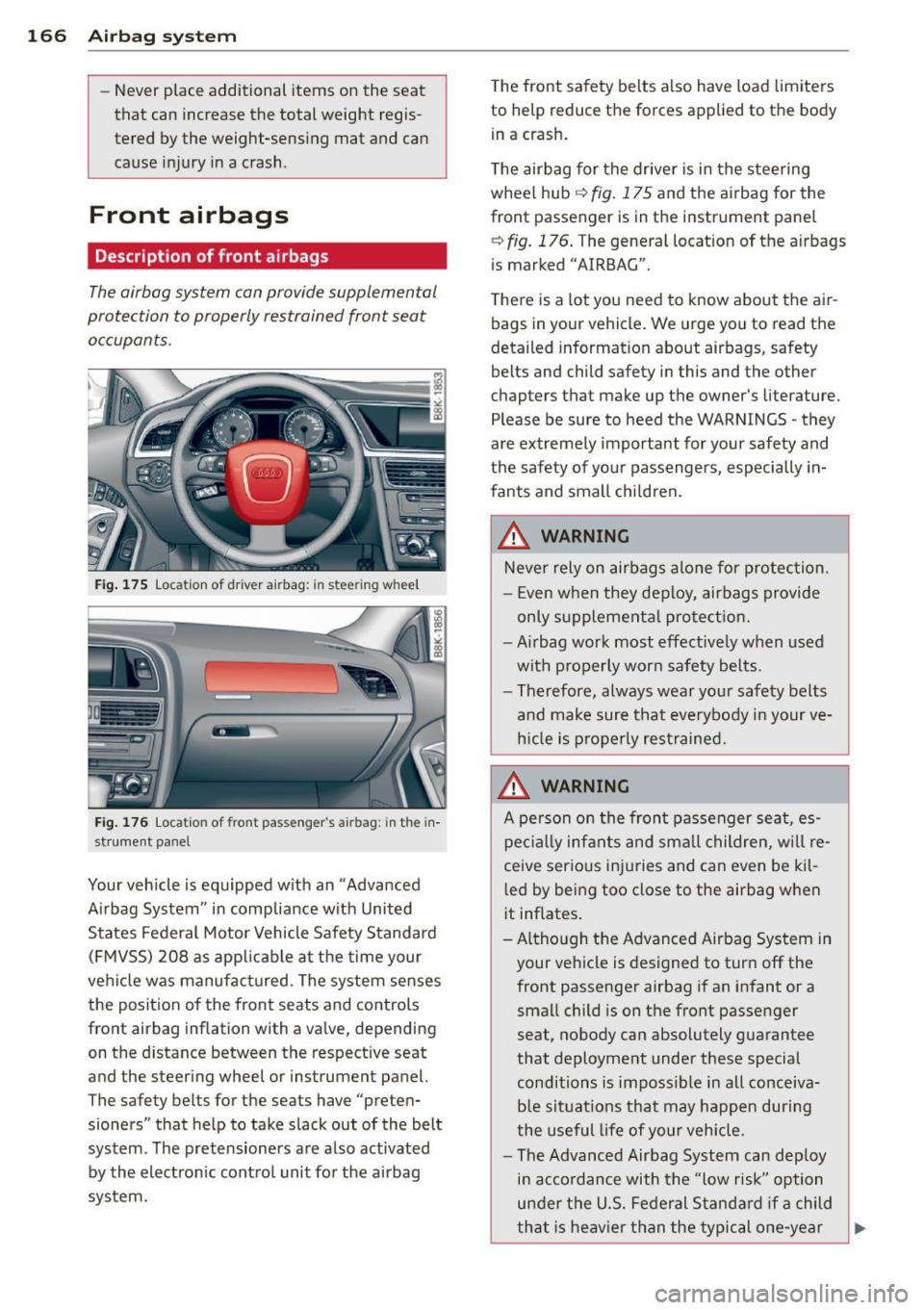
F ig . 175 Location of driver airbag: in steer ing whee l
Fig. 176 Location of front passenger's airbag: in the in
strument panel
Your veh icle is equipped with an "Advanced
A irbag System" in compliance with United
States Federal Motor Vehicle Safety Standard ( FM VSS) 208 as app licab le at the time your
ve hicl e was manufac tured. The system senses
the position of the front seats and controls
front airbag inflation with a valve, depending
on the distance between the respect ive seat
and the steering wheel or instrument panel.
The safety belts for the seats have "preten
sioners" that he lp to take slack out of the belt
system . The pretensioners a re also activated
by the electron ic cont ro l unit for the ai rbag
system. T
he front safety belts also have load limiters
to help reduce the forces applied to the body
i n a crash .
T he airbag for the drive r is in the stee ring
whee l hub¢
fig. 175 and the airbag for the
front passenger is in the instrument panel
~ fig. 176. The general locat ion of the a irbags
is marked "AIRBAG".
T here is a lot you need to know about the ai r
bags in your vehicle. We urge you to read the
detailed information about airbags, safety
belts and child safety in this and the other
chapters that make up th e owner's literature.
P lease be sure to heed the WARNINGS -they
are extremely importa nt for your safety and
the safety of your passengers, especially in
fants and small chi ldren.
_&. WARNING
Neve r rely on airbags alone for p rotection.
- Even w hen they deploy, airbags provide
only s upplement al pro te ctio n.
- Airbag work most effect ive ly when used
with p roperly wor n safety bel ts.
- Therefore, always wea r you r safety belts
a nd make sure tha t eve rybody in your ve
h icle is properly res trained.
_&. WARNING
A pe rson on the front passenger seat, es
pe cial ly infa nts and sm all ch ildren, w ill re
ceive serio us inju ries and can even be kil
l ed by being too close to the airbag when
it inflates .
- Although t he Advanced Airbag System in
your veh icle is designed to tur n off the
front passenger airbag if an infant or a
small child is on the front passe nger
seat, nobody can absolutely guarantee
that deployment under these special
conditions is imposs ible in all conceiva
b le sit uat ions that may happen dur ing
the useful life of your vehicle.
- The Advanced Airbag System can dep loy
i n acco rdance with the "low risk" option
unde r the U.S . Feder al Standa rd if a child
th at is heav ie r than the typical one -year
-
.
Page 169 of 316
old child is on the front passenger seat
and the other conditions for airbag de
ployment are met.
- Accident statistics have shown that chil
dren are generally safer in the rear seat
area than in the front seating position.
- For their own safety, all children, espe cially 12 years and younger, should al
ways ride in the back properly restrained
for their age and size.
Advanced front airbag system
Your vehicle is equipped with a front Advanced
Airbag System in compliance with United
States Federal Motor Vehicle Safety Standard
208 as applicable at the time your vehicle was
manufactured.
The front Advanced Airbag System supple ments the safety belts to provide additional
protection for the driver's and front passeng
er's heads and upper bodies in frontal crashes.
The airbags inflate only in frontal impacts
when the vehicle deceleration is high enough .
The front Advanced Airbag System for the
front seat occupants is not a substitute for
your safety belts. Rather, it is part of the over
all occupant restraint system in your vehicle.
Always remember that the ai rbag system can
only help to protect you, if you are sitting up right, wearing your safety belt and wearing it
properly . This is why you and your passengers
must always be properly restrained, not just
because the law requires you to be.
T he Advanced Airbag System in your vehicle
has been certified to meet the "low risk" re
quirements for 3 and 6 year-old children on
the passenger side and very small adults on
the driver side. The low risk deployment crite
ria are intended to help reduce the risk of in
jury through interaction with the front airbag
that can occur , for example , by being too
close to the steering wheel and instrument panel when the airbag inflates.
In addition, the system has been certified to
comply with the "suppression" requirements
Airbag system 167
of the Safety Standard, to turn off the front
airbag for infants 12 months old and younger
who are restrained on the front passenger
seat in child restraints that are listed in the
Standard ¢
page 188 , Child restraints and
Advanced Airbags .
"Suppression" requires the front airbag on the
passenger side to be turned off if:
- a child up to about one year of age is re
strained on the front passenger seat in one
of the rear-facing or forward-facing infant restraints listed in Federal Motor Vehicle
Safety Standard 208 with which the Ad
vanced Airbag System in your vehicle was
certified . For a listing of the child restraints
that were used to certify your vehicle's com pliance with the US Safety Standard
¢page 188,
-weight less than a threshold level stored in
the control unit is detected on the front pas
senger seat.
When a person is detected on the front pas
senger seat, weighing more than the total
weight of a child that is about 1 year old re
strained in one of the rear-facing or forward
facing infant restraints (listed in Federal Mo
tor Vehicle Safety Standard 208 with which
the Advanced Airbag System in your vehicle
was certified), the front airbag on the passen ger side may or may not deploy.
The
PASSENGER AIR BAG OFF light comes on
when the electronic control unit detects a to
tal weight on the front passenger seat that re
quires the front airbag to be turned off. If the
PASSENGER AIR BAG OFF light does not
come on, the front airbag on the passenger
side has not been turned off by the control unit and can deploy if the control unit senses
an impact that meets the conditions stored in
its memory.
If the total weight on the front passenger
seat is more than that of a typical 1 year-old ,
but less than the weight of a small adult, the
front airbag on the passenger side may deploy
(the
PASSENGER AIR BAG OFF light does not
come on). ..,. •
•
Page 174 of 316
172 Airbag system
must always sit in an upright position,
must not lean against or place any part
of their body too close to the area where
the airbags are located .
- Occupants who are unbelted, out of posi
tion or too close to the airbag can be se riously injured by an airbag as it unfolds
with great force in the blink of an eye
~page 163.
A WARNING
A child in a rearward-facing child safety
seat installed on the front passenger seat
will be seriously injured and can be killed if
the front airbag inflates -even with an Ad
vanced Airbag System.
- The inflating airbag will hit the child
safety seat or infant carrier with great
force and will smash the child safety seat
and child against the backrest, center
armrest, door or roof.
- Always install rear-facing child safety
seats on the rear seat.
- If you must install a rearward facing
child safety seat on the front passenger
seat because of exceptional circumstan
ces and the
PASSENGER AIR BAG OFF
light does not come on and stay on, im
mediately install the rear-facing child
safety seat in a rear seating position and
have the airbag system inspected by your
authorized Audi dealer.
A WARNING
Objects between you and the airbag will
increase the risk of injury in a crash by in
terfering with the way the airbag unfolds
or by being pushed into you as the airbag
inflates.
- Never hold things in your hands or on
your lap when the vehicle is in use.
- Never transport items on or in the area of the front passenger seat. Objects
could move into the area of the front air
bags during braking or other sudden ma
neuver and become dangerous projec- tiles that can cause serious personal in
jury if the airbags inflate.
- Never place or attach accessories or oth
er objects (such as cupholders, tele phone brackets, large, heavy or bulky ob
jects) on the doors, over or near the area marked "AIRBAG" on the steering wheel,
instrument panel, seat backrests or be
tween those areas and yourself. These
objects could cause injury in a crash, es
pecially when the airbags inflate.
- Never recline the front passenger's seat
to transport objects. Items can also
move into the area of the side airbag or
the front airbag during braking or in a
sudden maneuver. Objects near the air
bags can become projectiles and cause
injury, particularly when the seat is re
clined.
A WARNING
'-
The fine dust created when airbags deploy
can cause breathing problems for people
with a history of asthma or other breath
ing conditions.
- To reduce the risk of breathing problems, those with asthma or other respiratory
conditions should get fresh air right
away by getting out of the vehicle or
opening windows or doors.
- If you are in a collision in which airbags
deploy, wash your hands and face with
mild soap and water before eating.
- Be careful not to get the dust into your
eyes, or into any cuts or scratches.
- If the residue should get into your eyes,
flush them with water.
Page 176 of 316
174 Airbag sys te m
Vehicle Safety Standard 208 with which the
Advanced Airbag System in your vehicle was certified.
I f the front passenger seat is not occupied,
the front airbag will not deploy, and the
PAS
SENGER AIRBAG OFF
light will stay on . Never
install a rearward-facing chi ld restraint on the
front passenger seat, the safest p lace for a
child in any kind of child restraint is at one of
the seating posit ions on the rear seat
c::> page 163, Child restraints on the front seat
- some important things to know
and
c::> page 186, Child Safety .
If the PASSENG ER A IRBAG OFF light com es
on
when one of the conditions l isted above is
met, be sure to check the light regularly to
make certa in that the
PASSENGER AIRBAG
OFF
l igh t stays on cont inuo usly whenever the
ignition is on.
If the PAS SENGER AIRBAG OFF
light does not appear and not stay on all the
time, stop as soon as it is safe to do so and
- react iva te the system by turning the ignition
off and then turning it on again;
- remove and re insta ll the chi ld restraint.
Make su re that the child res traint is properly
insta lled and that the safety be lt for the
front passenger seat has been correct ly
ro uted around the child restraint as descri
bed in the chi ld restraint manufacturer's in
structions;
- make sure that the convertible locking fea
ture on the safety be lt for the front passen
ger seat has been activated and that the
safety belt has been pulled tight. The belt must not be loose or have loops of slack so
t h at the sensor below the safety be lt latch
on the sea t can do its job
c::> page 195.
- make sure that th ings that may increase the
we ight of t he chi ld and child safety seat are
not be ing tra nspo rted on the front passen
ger seat;
- make su re that the safety be lt tension sen
so r is not b locked. Shake t he safety be lt
l atch on the front passenger seat back and
forth;
- If a st rap or te ther is being used to tie the
child safety seat to the front passenger seat, make sure that
it is not so tight that it
causes the weight-sensing mat to measure
more weight than is act ually on the seat.
If the PASSENGER AIRBAG OFF light still
does not come on
and does not stay on con
tin uous ly (when the ignition is switched on),
- t ake the child res train t off the front passen-
ge r seat and ins tall it properly at one of the
rear seat positions. Have the airbag system
inspected by your authorized Audi dea ler
immed iate ly .
- move the child to a rear seat position and
make sure t hat the c hild is properly restra in
ed in a ch ild restra int that is appropriate for
its size and age.
The
PASSENGER AIRBAG OFF light should
NOT come on when the ignit ion is on and an
adult is s itting in a proper seating position on
the front passenger seat. If the
PASSENGER
AIRBAG OFF
lig ht comes on a nd stays on or
flashes fo r about 5 seconds wh ile driving, un
der these c ircumstances, make sure that:
- the adult on the front passenger seat is
properly seated on the center of the seat
cushion with his or her back up aga inst the
backrest and the backrest is not recl ined
c::> page 145, Proper occupant seating posi
tions,
- the adult is not tak ing weight off the seat by
holding on to the passenger assist handle
above the fron t passenger door or s upport
ing their weight on the armres t,
- t he safety belt is be ing properly wo rn and
t hat the re is not a lot o f slack in the safety
be lt webb ing,
- accessory seat covers or cushions or othe r
t hings tha t may cause an incorrec t reading
or impression on the weight-sensing mat
under the upho lstery of the seat have been
removed from the front passenger seat,
- a safety belt extender has not been left in
the safety belt latch for the front passenger
seat.
In add ition to the
PASSENGER AIRBAG OFF
light in the center of the instrument panel,
the message
PASSENGER AIRBAG OFF or
Page 188 of 316
186 Child Saf ety
Child Safety
Important things to
know
Introduction
The rear seat is generally the safest place in a
collision .
The physical principles of what happens when
your veh icle is in a crash app ly also to chi ldren
q page 155, What happens to occupants not
wearing safety belts? .
But unlike adults their
muscles and bones are not fully developed. In
many respects children are at greater risk of
serious injury in crashes than adults.
Because children's bodies are not fully deve l
oped, they require restra int systems especial
l y designed for their size , weight, and body
structure. Many countries and all states of the United States and p rovinces of Canada have
laws requiring the use of approved child re
straint systems for infants and small children .
In a frontal crash at a speed of 20 -35 mph
(30-56 km/h) the forces acting on a 13-pound
(6 kg) infant will be more than 20 times the
weight of the child . This means the weight of
the child would suddenly be more than
260 pounds (120 kg) . Under these conditions,
only an appropriate ch ild restraint properly
used can reduce the risk of serious injury.
Ch ild restra ints must be used properly to be
effective. Used improperly, they can increase
the risk of serious injury in an accident .
Consult the child safety seat manufactu rer's
instructions to be sure the seat is right for
your chi ld's size
q page 189, Important safe
ty instructions for using child safety seats .
Please be sure to read and heed all of the im
portant information and WARNINGS about
child safety, Advanced Airbags, and the instal lation of child restraints in this chapter .
There is a lot you need to know about the Ad
vanced Airbags in your vehicle and how they
work when infants and children in child re
straints are on the front passenger seat . Be
cause of the large amount of important infor- mation, we cannot repeat it all here
. We urge
you to read the detailed information in this
owner's manua l about airbags and the Ad
vanced Airbag System in your vehicle and the
very important information about transport
ing children on the front passenger seat .
Please be sure to heed the WARNINGS - they
are extremely important for your safety and
the safety of your passengers, especially in
fants and small children.
A WARNING
- Accident statistics have shown that chil
dren are generally safer in the rear seat
area than in the front seating position.
Always restrain any child age 12 and un
der in the rear.
- All vehicle occupants and especially chil
dren must be restrained properly when
ever riding in a vehicle. An unrestrained
or improperly restrained chi ld could be
injured by str ik ing the interior or by be
ing ejected from the vehicle dur ing a
sudden maneuver or impact. An unre
strained or improperly restrained ch ild is
also at greater risk of injury or death
through contact with an inflating airbag.
- A suitable child restraint properly instal
led and used at one of the rear seating
positions provides the highest degree of
protection for infants and small children
in most accident situations.
A WARNING
Children on the front seat of any car even
with Advanced Airbags can be seriously in
jured or even killed when an airbag in
flates . A child in a rearward-facing child
safety seat installed on the front passen
ger seat w ill be ser iously injured and can
be killed if the front airbag inflates.
- The inflating airbag will h it the child
safety seat or infant carrier with great
force and will smash the child safety seat
and child against the back rest, center
armrest or door .
- Always install rearward-facing child safe-
ty seats on the rear seat.
IJi,,,
Page 206 of 316
204 Intelligent technology
Intelligent technology
Notice about data
recorded by vehicle
control modules
Your veh icle is not equipped with an Event Da
ta Recorder (EDR), installed by some manu
facturers fo r the express purpose of capturing
data for retrieval after an accident or crash
event. EDR's are sometimes called "crash re
corders".
Some state laws restrict the retrieval or down
loading of data stored by EDR's that were in
stalled in a vehicle for the express purpose of retrieving data after an accident or crash
event without the owner's consent.
Although your vehicle is not equipped with an
EDR, it is equipped with a number of electron
ic control modules for various vehicle systems
such as, for example, engine function, emis
sion control, as well as for the airbags and
safety belts .
These electronic control modules also record
vehicle-related data during normal vehicle op
eration for diagnostic and repair purposes .
The recording capacity of the electronic con
trol modules is limited to data (no sound is re
corded) and only a small amount of data is ac
tually recorded over a very limited pe riod of
time and stored when a system fault or other condition is sensed by a control unit. Some of
the data then stored may relate to vehicle
speed, direction, braking as we ll as restraint
system use and performance in the event of a
crash or other condition. Stored data can only be read and downloaded with special equip
ment .
Electronic stabilization
Program (ESP)
General information
The ESP improves the vehicle stability .
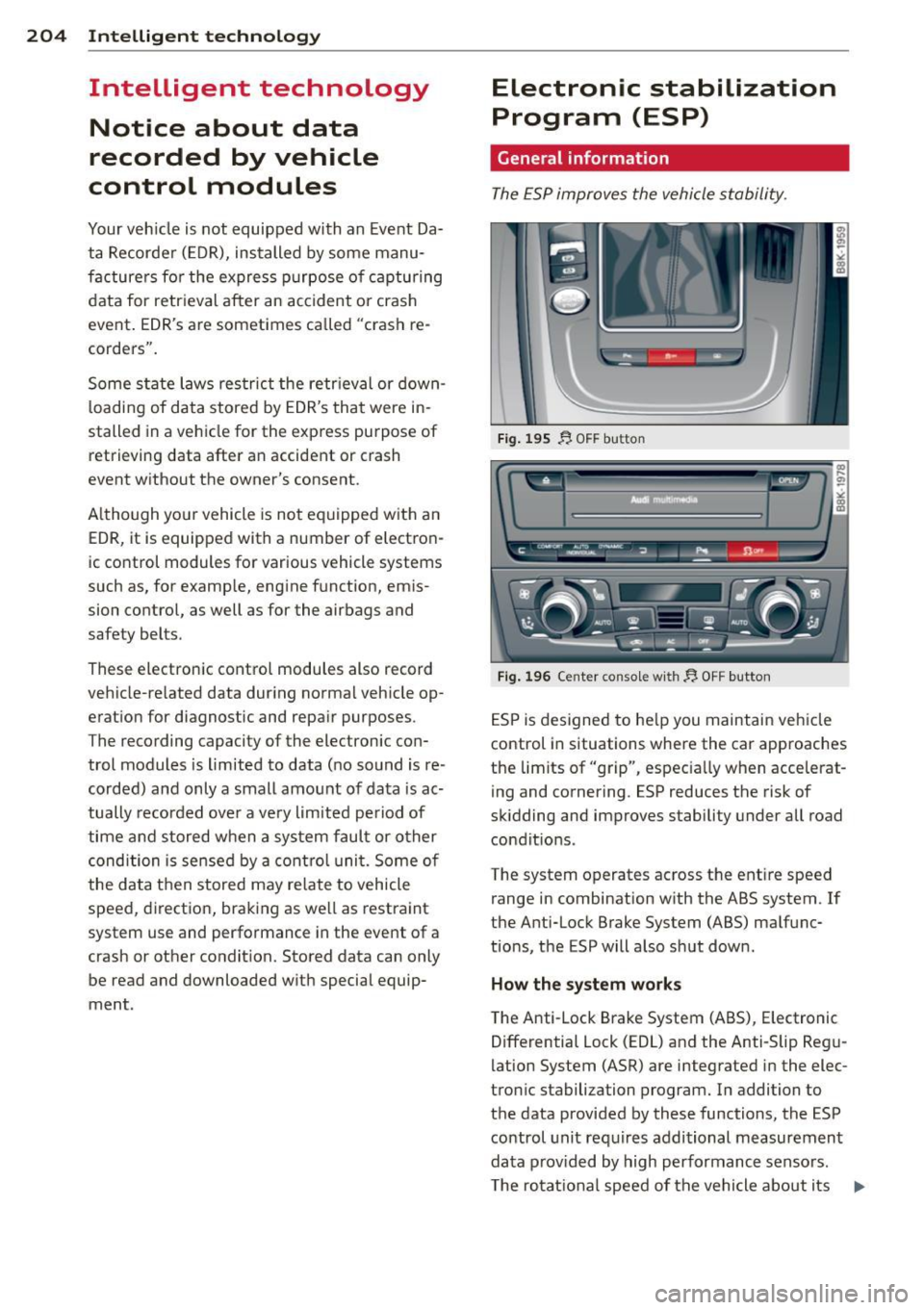
Fig. 195 f;. OFF button
Fig. 196 Center console wit h ~ OFF button
ESP is designed to help you maintain vehicle
control in situations where the car approaches
the limits of "grip", especia lly when accelerat
ing and cornering . ESP reduces the risk of
skidding and improves stability under all road
conditions .
The system operates across the ent ire speed
range in combination with the ABS system . If
the Anti-Lock Brake System (ABS) malfunc
tions, the ESP will also shut down.
How the system works
The Anti -Lock Brake System (ABS), Electronic
Differential Lock (EDL) and the Anti-Slip Regu
lation System (ASR) are integrated in the elec
tronic stabilization program. In addition to
the data provided by these functions, the ESP
control unit requires additional measurement
data provided by high performance sensors.
T he rotational speed of the vehicle about its
II>-
Page 218 of 316

216 Driving and environment
Reducing unnecessary idling
Even when your car is just idling it burns up
fuel.
.,. Shut the engine off when you are not driv
ing the vehicle.
.,. Do not warm up the vehicle by letting the
engine run at idle .
It makes sense to shut off the engine in traffic
jams, when waiting for trains to pass at rail
road crossings, or at traff ic lights that have
l ong wa its on red. Turning the engine off for
just 30-40 seconds saves more fue l than is
burned starting the eng ine again .
It takes a long time for the engine to warm up
fully when it is running at idle. However , wear
and noxious emissions are especially high
when the engine is warming up. So you should
drive away as soon as you start the engine and
avoid running at high rpms while the engine is
still warming up .
(D Note
Do not leave engine idling unattended af
ter starting . If warning lights should come
on to indicate improper operation, they
wou ld go unheeded. Extended idling also
produces heat, which cou ld result in over
heating or other damage to the vehicle or
other property .
Regular maintenance
A badly tuned engine unnecessarily wastes a
lot of fuel .
... Have your vehicle serviced at regular inter-
vals.
By having your vehicle regularly serviced by an
authorized Audi dealer helps to ensure that it runs properly and economically . The condition
of your vehicle not only affects its safety and
ability to hold its value, it also affects
fuel
consumption .
Check your oil each time you fill your tank.
The amount of oi l used is re lated to engine
load and speed.
It is normal for the oil consumption of a new
engine to reach its lowest value after a certa in
mileage has been driven.
You must drive your veh icle about 3,000 m iles
(5,000 kilometers) before you can properly
assess oil consumpt ion.
This also app lies to fue l consumption and en
gine output.
(D Note
- Have your veh icle ma inta ined properly
and in accordance with the service rec
ommendations in your Warranty
& Main
tenance booklet . Lack of proper mainte
nance as well as improper use of the ve
hicle will impair the function of the
emission contro l system and cou ld lead
to damage.
- Do not alter or remove any component of
the Emission Control System unless ap
proved by the manufacturer.
- Do not alter or remove any device, such
as heat shields, switches, ignition wires,
valves, which are designed to protect
your vehicle's Emission Control System and other important vehicle compo
nents.
Fewer short trips
Fuel consumption will always be relatively
high on short trips .
.,. Try to avoid driv ing short distances with a
cold engine .
The engine and cata lytic converter have to
reach their optimal
operating temperature to
reduce fuel consumpt ion and noxious emis
s ions effectively .
Just after starting, a co ld engine in a mid-size
car only achieves a fuel economy of 6-8 mi les
per gallon (30-40 l/100 km). After about a
half a mile, fuel economy cl imbs to 12 mpg
(20 l/100 km) . After about
2 .5 miles (4 km), ll>
Page 223 of 316
Cleaning and protect ion
General information
Regular core preserves vehicle value.
Any automobile is exposed to industrial
fumes , corrosive road salt, etc. A well cared
for Audi can look like new many years after purchase . Regu lar and correct care w ill con
tr ibute to maintaining the beauty and value of
your Aud i.
F u rth ermor e, good c are may be a conditi on
for subs tantiati ng a w arrant y claim sho uld
c orrosion d amag e or paint d efects oc cur.
Your authorized Audi dealer has a variety of
dedic ated veh icle-car e products and can ad
vise which ones to use for cleaning the exter i
or and interior of your vehicle.
Whether you use products recommended by
Aud i or other commercially available clean ing
agents, please make sure you apply them cor
rectly .
.&, WARNING
-Cleaning agents may be poisonous. Keep
them out of the reach of children.
- Heed all caut ion labels.
- Always read directions on the container
before using any product. Follow the di
rect ions carefu lly.
- Most chemical cleaners are concentrated
and have to be diluted .
- Use spot removing fluids only in well
ventilated areas.
- Do not use gasoline, kerosene, d iesel
fuel, nail polish remover or other volatile
fluids. They may be toxic, flammab le or
haza rdous in other ways. Do not wash,
wax or dry the vehicle with the ign it ion
on or the engine running.
- Do not clean the undersides of chassis,
fenders, wheel covers, e tc. w ithout pro
tecting your hands and arms. You may c u t yourself on sharp -edged metal parts .
Cleaning and protec tion 221
- Moisture and ice on brakes may impair
brak ing effic iency¢
page 207, General
information.
Test the brakes carefully
each time you wash the vehicle.
@) For the sake of the environment
Select on ly environmentally friend ly clean
i ng products . Leftover cleaning products
should not d isposed of in the household
waste.
Care of exterior
Washing
Frequent washing protects the vehicle .
The best protection against environmental i n
fluences is
frequent washing and waxing . How
often t his is required depends on:
- How much the veh icle is used
- Where the veh icle is parked (garage, in the
open under trees, etc.)
- The seasonal and weather conditions
- Environmental infl uences
T he longer b ird droppings, insects, tree resin,
road and indus tria l gr ime, ta r, soot, road salt
and other materials remain on the vehicle body, the more lasting their destructive ef
fects wi ll be . High temperatures caused by ex
posure to intense sun light intens ify the corro
s ive effect, particularly when humid ity is high
as well.
Under certain circumstances,
weekl y washing
may be necessary. Under other cond itions, a
monthly washing and waxing may be ade
quate .
After the winter, the underside of the vehicle
should be thoroughly washed, preferab ly in a
professional car wash .
.&, WARNING ,_
A lways read and heed all WARNINGS and
other information ¢
page 221.
•
•
Page 242 of 316
24 0 Ch eck ing and filling
Modern engine lubrication has taken a quan
tum leap in the last few years. Many synthetic
oils ava ilable today provide better engine lu
brication that can outlast traditional petrole
um-based oils, making them a smart choice
for use throughout the life of your Audi .
Whether you use synthetic or petroleum
based engine oil, the oil that you use must
conform to Audi 's oil quality standard
VW 502 00 to help keep your vehicle 's engine
running smoothly and help prevent the for
mat ion of harmfu l deposits, sometimes called
"sludge ", that ove r time can lead to expensive
repairs .
At the time of print ing , engine o ils available in
the U .S . and Canada that meet the exacting
specifications of Audi oi l standard VW 502 00
a re synthetic engine oils. This does not mean,
however, that every synthetic engine oil will
meet Audi oil standard VW 502 00. So always
be sure that you use an approved oil.
To help prevent the format ion of harmful de
posits use only oi l with the fo llowing specifi
cations printed on the oil container :
Audi oil standard VW 502 00
O il container labe ls may carry the specif ica
tion s ingly or in comb inat ion with other des ig
nations and oil qua lity standards .
Visco sity
Engine oils are graded accord ing to their vis
cosity. The proper viscosity grade oil for your
engine depends on cl imactic or seasonal con
d itions where you drive. You can use oil with a
viscosity grade of SA E 5W40 across all tem
pe ratu re ranges for normal driving conditions .
However, if eng ine o il viscos ity grade SA E
5W40 is not available, you can also use viscos
ity grade SAE 5W -30 or SAE OW-40 as long as
it meets Audi o il quality standard VW 502 00
specif ications .
Because engine oil that meets the Audi oil
standard may not be available everywhere
when you need it, we strongly recommend
that you always carry with you an extra quart (
li ter) of oil that exp ress ly con forms to the
VW 502 00 specification , in case you have to
top
off the oil while on the road.
Only if the level of the o il is at or be low the
minimum mark -and no oi l that expressly
conforms to Audi oil standard VW 502 00
specifications is available - may you top
off
with a high quality engine o il, preferab ly syn
thet ic-based, tha t mee ts ACEA A3 or API SM
specifications, but even then , only in v iscosity
grades SAE 5W-40 , SAE 5W-30, or SAE
OW-40. However, dur ing the entire time be
tween oil change inte rva ls , never top
off with
more than a total of 0.5 q t/ liter engine o il
t h at does not con form to Audi oi l specification
vw 502 00.
For more informa tion about eng ine oi l that
has been approved for your veh icle, please
contact e ither your authorized Aud i dealer or
Audi C ustomer Re lations at 1 (800) 822 -2834
or visit our web site at www .audiusa.com or
www.aud icanada .ca. Here you w ill also find a
current list of oils (manufacturers, brand
names e tc.) tha t conform to Audi oil s tandard
vw 502 00 .
Changing the engine oil
The eng ine oi l and oil fi lter must be changed
according to the mileage (kilometers) and
time intervals specified in your ve hicle's War
ranty
& Maintenance booklet. Do not exceed
these intervals -harmful deposits from old
engine oil can reduce engine performance and
can lead to expensive engine repairs .
Changi ng the oil at the recommended inter
vals is so very important because the lubricat ing proper ties of oil decrease gradually during
normal veh icle use . If you are not sure when
you have your oil changed, ask your author ized Audi Serv ice Adv isor.
Under some circumstances the engine oil
should even be changed more frequent ly .
Change oil more often if you drive mostly
short distances, operate the ve hicle in dusty
areas o r most ly unde r stop-and-go t raff ic con-
ditions, o r when you use your vehi cle where .,..
Page 246 of 316
244 Checking and filling
Engine cooling system
Coolant
The engine coolant performs two functions: it
keeps the engine from overheating and it pro
tects the engine from freezing in the winter .
The cooling system is sealed and generally re
quires little attention .
The cooling system has been filled at the fac tory with a permanent coolant which does not need to be changed. The coolant consists of a
mixture of water and the manufacturer's gly
col-basedcoolant additive G12++ antifreeze
with anticorrosion add itives (SO% for USA
models; 60% for Canadian models). This mix
ture bo th assures the necessary frost protec
tion and protects metal components in the
engine's coo ling system from corrosion and
scaling. It also raises the boiling point of the
coolant.
Do not reduce the concentration of the cool
ant in the summer by adding plain water .
The
proportion of coolant additive must be at
least 50 % but not more than 60%
to main
tain antifree ze protection and cooling efficien
cy. If the coolant frost protection is too low,
the coolant could freeze and damage the vehi
cle heating and engine cooling system .
For year-round driving, antifree ze is added at
the factory for temperatures down to:
- - 31°F (- 35 °C) USA
- -40°F ( - 40°C) Canada.
You can mix the G12 ++ coolant additive with
other additives (G12+ or G12). Always check
with your authorized Audi dealer.
_&. WARNING
Before you check anything in the engine
compartment, always read and heed all
WARNINGS ¢
A in Working in the engine
compartment on page 237.
(D Note
- Before winter sets in, have the coolant
checked to see if the coolant additive in your vehicle is sufficient to meet the cli
mate conditions. This is especia lly impor
tant if you live in a reg ion where the win
ter is extreme ly cold. If necessary, in
crease the proportion of coolant additive
to 60% .
- When adding coolant additive to your
cooling system, remember :
- We recommend using only coolant ad
ditive G12++ (check the label) for your
vehicle . This coolant additive is availa
b le at authorized Audi dealers . Other
types of antifreeze can significant ly re
duce corrosion protection. The result
ing corrosion can cause a loss of cool
ant and serious engine damage.
- Do not add any type of radiator leak seal
ant to your vehicle's engine coolant.
Add ing radiator repair fluid may adverse
ly affect the function and performance of
your cooling system and cou ld resu lt in
damage not covered by your New Vehicle
Limited Warranty.
Checking the engine coolant level
The engine coolant level can be checked with
a quick glance.
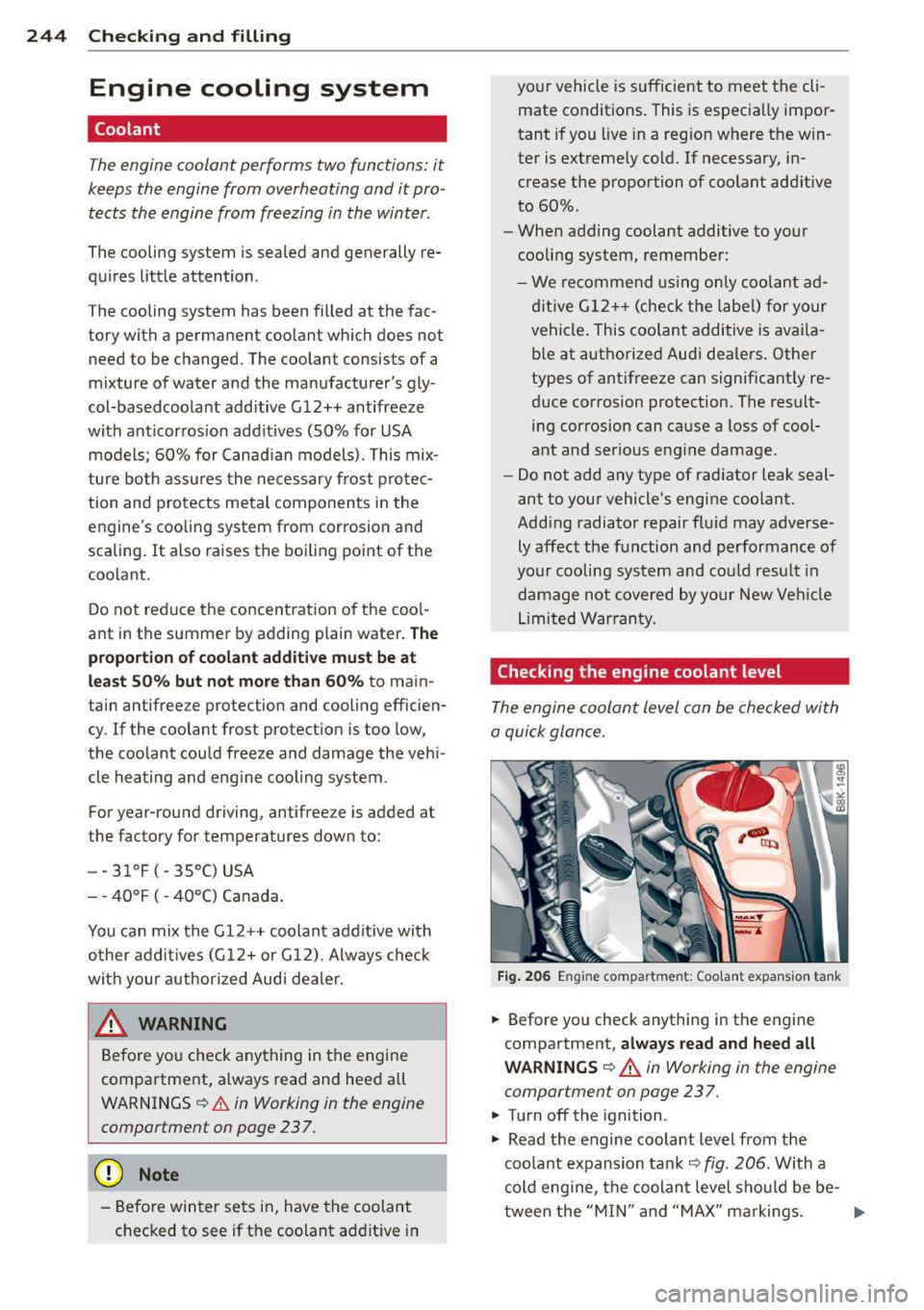
Fig. 206 E ngin e compart men t: Coo lant expans ion tank
.,. Before you check anything in the engine
compartment,
always read and heed all
WARNINGS ¢&. in Working in the engine
compartment on page 23
7.
.,. Turn off the ignition .
.,. Read the engine coolant level from the
coo lant expansion tank¢
fig. 206. With a
cold engine, the coolant level should be be-
tween the "MIN" and "MAX" markings . ..,..