air condition AUDI A5 COUPE 2012 Owner's Manual
[x] Cancel search | Manufacturer: AUDI, Model Year: 2012, Model line: A5 COUPE, Model: AUDI A5 COUPE 2012Pages: 316, PDF Size: 78.59 MB
Page 258 of 316
256 Tires and wheels
Cold tire inflation pressure
Tire pressure affects the overall handling, performance and safety of a vehicle.
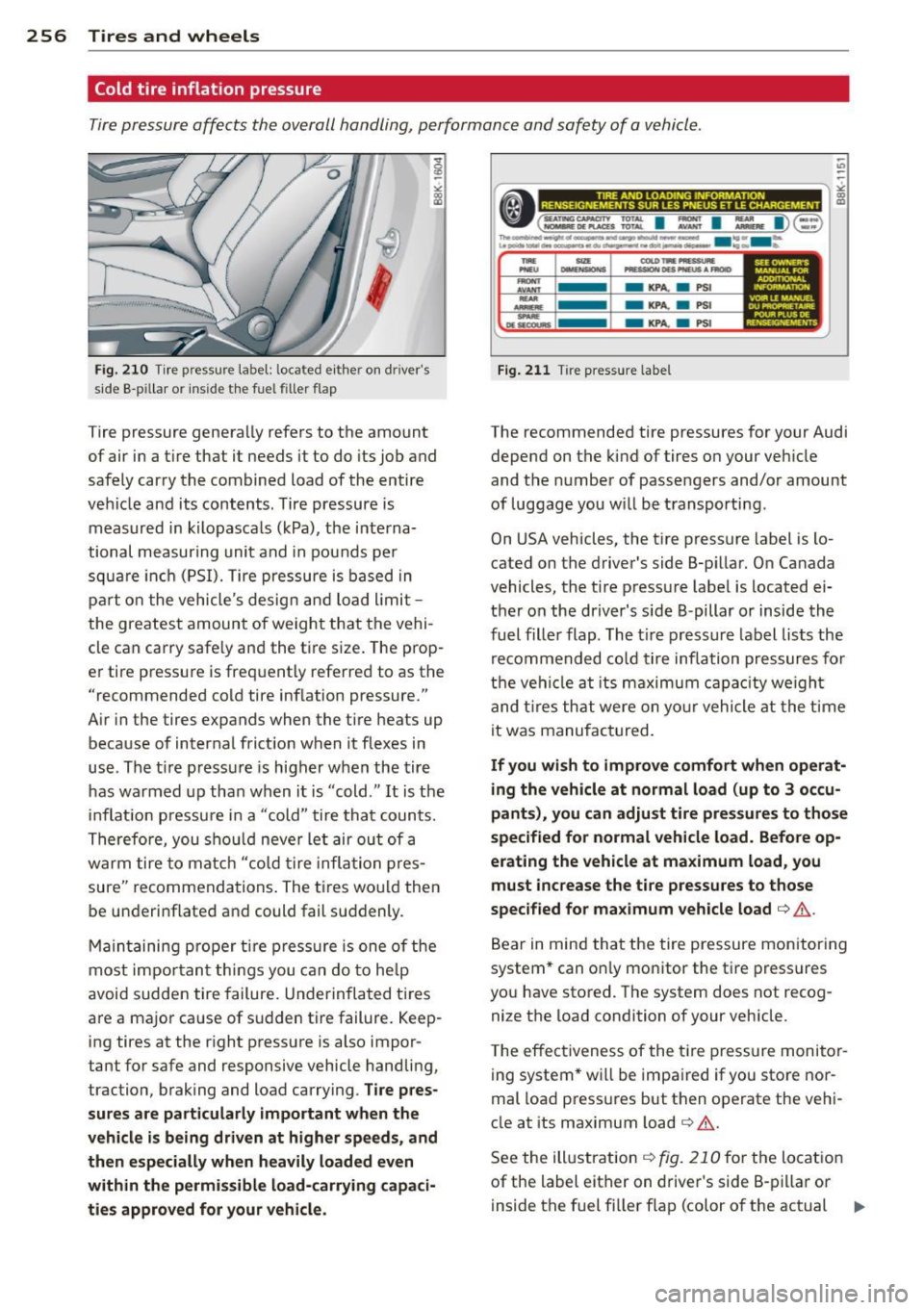
Fig. 210 Tire p ress ure labe l: loca ted e ith er on d river 's
side 8 -pillar or ins ide t he fue l filler flap
Tire pressure genera lly refers to the amount
of air i n a t ire that it needs it to do its job and
safely carry the combined load of the entire
vehicle and its contents . Tire pressure is
measured in kilopasca ls (kPa), the inte rna
tional measuring unit and in pounds pe r
squa re inch ( PSI). Tire pressure is based in
pa rt o n the vehicle's design an d load limit
the greatest amount of weight that the vehi
cle can carry safe ly and the t ire size . The prop
er tire pressure is freq uently referred to as the
"recommended cold tire inf lation pressure."
A ir in the tires expands when the tire heats up
because of internal frict ion when it flexes in
use . The t ire p ress ure is higher when the tire
h as warmed up than when i t is "cold ." It is the
in flat ion pressu re i n a "cold " tire that coun ts.
T herefore, you sho uld neve r let air ou t of a
warm tire to match " co ld tir e infla tion pres
sure" recommendations . The ti res wo uld then
be underinflated and could fail su ddenly .
M ain taining p roper t ire pr es su re is one o f the
most impor tan t things you can do to he lp
avoid sudden tire failure. Underinfla ted ti res
a re a major ca use of s udden tire failure. Keep
ing tires at the r ight pressure is also impor
tant for safe and responsive vehicle handling,
traction, braking and load carrying .
Tire pres
sur es are particularly important when th e
vehicle is being driven at higher speeds , and
then especially when heav ily loaded even
w ithin the permissible load -carrying capaci
tie s approved for y our vehicle .
,;
•(=~ : I : I :,.. I)@ ~
The~-----~---w-o- ....... -e.....i -·· - u ........ -.-..,.0, ... -....,.,...tot~---....... ._.,. -..
....
-..... ...........
- KPA. a PSI
- KPA.
a PSI
- KPA. a PSI
Fig. 21 1 Tir e pressure la bel
SU OWNER'S MANUAl FOR AD0"10NAL l10N VOl!ILEMANU£1. DU _,...,
POUR Pl.US DE
REHSEKi.\'IEME NTS
The recommended tire pressures for your Audi
depend on t he kind of tires o n your veh icle
and the numbe r of passengers and/or amount
of luggage you w il l be transporting .
On USA vehicles, the t ire pressure label is lo
cated on the driver's side B-p illar. On Canada
vehicles, the tire press ure label is located ei
ther on the dr iver's s ide B-pillar or inside the
fuel fille r flap. The t ire press ure l abel lists the
recommended co ld tire inflation pressures for
t h e veh icle at its ma ximum ca pa ci ty we igh t
and t ires th at were on yo ur vehicle at the t ime
it was manufac tured.
If you wish to improve comfort when operat
ing the vehicle at normal load (up to 3 oc cu
pant s), you can adjust tire pre ssures to those
specified for normal vehicle lo ad. Before op
erating the vehicle at maximum load, you
must increase the ti re pressures to those
specified for ma ximum veh icle load ¢.&..
Bear in mind that the tire pressure mon itor ing
system * can o nly monitor the tire press ures
yo u have sto red. The system does not recog
ni ze the load condition of your vehicle.
T he effectiveness of the tire press ure monitor
ing system * w ill be impa ired i f you store nor
mal load press ures but then operate the veh i
cle at its maximum load
¢ .&. .
See the ill ustration ¢ fig. 210 fo r the location
of the label eit her on driver's side B -p ill ar or
i nside the fuel fi ller flap (color of the actual
IJI>
Page 266 of 316
264 Tire s and wheel s
contribution to good road ho lding and safe
handling when in good condition and properly
inflated ¢
,&.
We recommend that all work on tires and
wheels be perfo rmed by an authorized Audi
dea ler. They are familiar with recommended
proced ures and have the necessary spec ial
too ls and spare parts as well as the proper fa
cilities for disposing of the old tires.
Authorized Audi dealers have the necessary information about techn ica l requ irements for
installing or changing tires and r ims.
R eplacing t ires and whe els
Tires sho uld be rep laced at least in pairs and
not individua lly (for examp le both front tires
or both rear tires together).
Be sure to read and heed the information to
the tire pressure monitoring system*
¢page 270.
Always buy rep lacement radial tires that have
the same specifications as the tires approved
for your vehicle by Audi. Replacement t ires
must always have the same load rating speci
fication as the original equipment or approved
optional tires listed in the table
c:> page 256.
Aud i-approved specification ti res are specially
matched to your vehicle and its load limits,
and can contribute to the important road ho ld
ing, driving characteristics, and safety of the
vehicle. The table
(<:>page 256) lists spec ifica
tions of the tires approved for the Audi mod
els covered by your Owner's Literature .
The tire pressure labe l (On USA vehicles, the
tire pressure label is located on the driver's
side B-pillar. On Canada veh icles, the tire pres
sure label is located either on the driver's s ide
B-pillar or inside the fuel filler flap)
(¢page 256, fig. 211) lists the spec ificat ions
of the origina l equipment ti res installed on
your ve hicle a t the time it was manufactured.
Federal law requires t ire manufacturers to
p lace standard ized information on the s ide
wall of all tires
c:> fig. 214. This information
ident ifies and describes the fund amental characteristics, the q
uality grade of the ti re
and also provides a tire identification n umber
for safety standard certification and in case of
a reca ll.
Tire specification s
Knowledge of ti re specif ications makes it eas
ier to choose the co rrect tires. Radial tires
have the tire specifications marked on the
sidewa ll, for examp le:
P255 / 35 R1 9 96Y XL
This conta ins the following information :
P Indicates the tire is for passenger cars
(where app licab le)
2 55 Nom inal tire w idth in mm of the tire
from sidewall edge to sidewall edge. In
general, the larger the number, the wider
the tire
35 Height/w idt h ratio in percent (aspect ra-
t io)
R Tire construct ion: Radial
19 Rim diameter code (in inches)
96 Load rating code
Y Speed rating letter code
XL (or "xl", "E XTRA LOAD", or "RF" Indica tes
that the t ire is a"Re in forced" or an "Extra
Load" ti re
M+S (or "M/5") Indicates that the tire h as
some mud and snow capability
T he tires could also have the information of
direction of rotat io n ¢
page 252.
Tire manuf acturing date
The manufacturing date is also indicated on
the tire sidewall (possibly only on the
inner
side of the wheel):
"DOT ... 2209 ... "means, for example, that
the tire was produced in the 22nd week of
2009.
Speed rating (letter c ode )
The speed rating letter code on the whee ls in
dicates the maximum permiss ible road speeds
c:> & in Winter tires on page 268 .
P up to 93 mph (150 km/h)
Page 268 of 316
26 6 T ire s and whee ls
- Never mount used tires on yo ur vehicle if
you are not sure of their "previous histo
ry." Old used tires may have been dam
aged even though the damage cannot be
seen that can lead to sudden tire failure
and loss of vehicle control.
- All four wheels must be fitted with radial
tires of the same type, size (roll ing c ir
cumference) and the same tread pattern.
Driv ing with different ti res reduces veh i
cle handling and can lead to a loss of
control.
- If the spare t ire is not the same as the
t ires that are mounted on the veh icle -
f or example with winte r tires -on ly use
the spare tire for a short period of time
and dr ive with extra care. Refit the nor
ma l road whee l as soon as safely possi
ble.
- Never drive faster than the maximum speed for which the tires on your veh icle
are rated because tires that are driven
faster than their rated speed can fail
suddenly.
- Overloading t ires cause heat build-up,
sudden tire failure, including a blowout
and sudden deflation and loss of control.
- Temperature grades apply to tires that
are properly inflated and not over or un
derinflated .
- For technical reasons it is not always
poss ible to use wheels from other vehi
cles -in some cases not even whee ls
from the same vehicle model.
- If you install wheel tr im discs on the ve
hicle whee ls, make sure that the air flow
to the brakes is not blocked. Reduced air
flow to the brakes can them to overheat, increasing stopping distances and caus
ing a collision.
0 Note
- For technical reasons , it is not general ly
possib le to use the whee l rims from oth
er vehicles . This can ho ld true for wheels
of the same vehicle type.
- If the spare tire is different from the
tires that you have mounted on your ve- hicle (fo
r example winter tires or wide
profi le tires), then use the spare tire for a
short period of time only and drive w ith
extra care. Replace the flat tire with the
tire matching the others on your vehicle
as soon as possib le.
- Never drive without the valve stem cap.
The va lves could get damaged.
@ For the sake of the env ironment
D ispose of o ld tires in accordance with the
l ocal requirements.
Uniform tire quality grading
- Tread wear
- Traction AA A B C
- Temperature ABC
Quality g rades can be found where applicab le
on the tire side wall between tread sho ulder
and maximum section width
~ page 263,
fig . 214.
For exampl e: Tread wear 200, Trac tion AA ,
Tempe rature A.
All passenge r car t ires must conform to Feder
al Safety Requirements in add ition to these
grades .
Tread w ear
The tread wear grade is a comparative rating
based on the wear rate of the t ire when tested
under controlled conditions o n a specified
government test course.
For example, a tire graded 150 would wear
one and one ha lf (1 1/2) times as well on the
gover nment course as a ti re g raded 100 .
The relative performance of tires depends upon the actual conditions of their use, how
ever, and may depart s ignificantly from the
no rm due to va riations i n driving hab its, se rv
ice practices and differences in road charac ter
istics and cl imate.
Traction
The traction grades, from highest to lowest,
are AA, A, Band
C. Those grades represent the ..,.
Page 269 of 316
tire's ability to stop on wet pavement as measured under controlled conditions on
specif ied government test surfaces of asphalt
and concrete. A tire marked C may have poor
t raction performance¢ .&,.
Temp eratu re
The temperature grades are A (the highest),
B, and
C, representing the tire's resistance to
the generation of heat and its ability to dissi pate heat when tested under controlled condi
tions on a specified indoor laboratory test
wheel.
Sustained high temperature can cause the material of the tire to degenerate and reduce
tire life, and excessive temperature can lead
to sudden tire failure ¢.&, .
T he grade
C corresponds to a level of perform
ance which all passenger car tires must meet
under the Federa l Motor Veh icle Safety Stand
ard No.
109 . Grades Band A represent higher
levels of performance on the laboratory test
wheel than the m inimum required by law.
.8, WARNING
The trac tion grade assigned to this t ire is
b ase d on stra ight-ahead brak ing t raction
t ests, and does not inclu de acceleration,
co rnering, hydrop laning or peak traction
characteristics .
.8, WARNING
The temperature grade for this tire is es
tablished for a t ire that is properly inflated
and not overloaded . Excessive speed, un
derinflation, or excessive loading, either
separate ly or in combination, can cause
heat buildup and possible ti re fa ilu re.
Winter tires
Winter tires can improve vehicle handling on
snow and ice . At temperatures below 45 °F
(7 °C) we recommend changing to winter
tires.
-
In some heavy snow a reas, loca l governme nts
may require t rue winter or "snow" tires, those
Tires an d wheel s 267
with very deeply cut tread. These tires should
o nl y be used in pairs and be installed o n all
fo ur wheels. Make sure you purchase snow
tires that are the same si ze and construction
type as the other tires on your vehicle.
Your vehicle is equipped with a ll-wheel drive,
th is w ill imp rove traction d uring winter driv
ing, even with the standard tires. However, we
strong ly rec ommend that you always equip all
fou r wheels on you r vehicle with correctly fit
ted w inter t ires or al l-season t ires, when win
te r road cond itions ar e expected . This also im
proves the veh icle's b ra ki ng perfo rman ce and
reduces stopping d ista nces .
Summe r tires p rovide less grip on ice and
snow .
Winter tires (snow tires) must always be fitted
o n all four wheels .
Ask your authorized A udi dealer or qualified
workshop for permitted
winter tire sizes . Use
only rad ial winter t ires.
Winter tires lose their effectiveness whe n the
tread is worn down to a depth of
0.157 inch
(4 mm).
Only drive with winter tires under winte r con
ditions. S ummer t ires handle better when
there is no snow or ice on the roads and the
temperature is above 45 °F (7 °().
If you have a flat t ire, see no tes on spare
whee l ¢ page 263.
P lease alway s remember tha t win ter tire s m ay
have a lowe r speed ra ti ng than the tires orig i
nally installed on your vehi cle at the time it
was man ufactured. Please see ¢page 264,
Speed rating (letter code) for a listing of the
speed rating letter codes and the max imum
speed at which the tires can be driven.
T he spee d rating letter code (¢ page 254) is
on the side wall of the t ire ¢page 263.
.8, WARNING
Winter t ires have maximum speed limits
that may be lower than yo ur vehicle's max-
imum speed . Always know the max imum
~
•
•
Page 295 of 316
Consumer Information
Warranty coverages
Your Audi is covered by the following war
ranties :
- New Vehicle Limited Warranty
- Limited Warranty Against Corrosion Perfo-
ration
- Emissions Control System Warranty
- Emissions Performance Warranty
- California Emissions Con trol Warranty (USA
vehicles only)
- California Emissions Performance Warranty
(USA vehicles only)
Detailed information regarding your warran
ties can be found in your
Warranty & Mainte
nance booklet .
Operating your vehicle
outside the U.S.A. or
Canada
Government regulations in the United States
and Canada require that automobiles meet
specific emission regulations and safety
standards. Therefore, veh icles built for the
U.S.A. and Canada differ from vehicles sold in
other countries .
If you p lan to take your vehicle outside the
continental limits of the United States or Can
ada, there is the possibility that
- unleaded fuels for vehicles with cata lytic
converter may not be available;
- fuel may have a considerably lower octane
rating . Improper fuel may cause engine
damage ;
- service may be inadequate due to lack of
proper service facilities, tools or testing
equipment ;
- replacement parts may not be readily availa
ble.
- Navigation systems for vehicles built for the
U.S.A. and Canada will not necessari ly work
in Europe, and may not work in other coun
tries outside of North America.
Consumer Information 293
@ Note
Audi cannot be responsible for mechanical
damage that could result from inadequate
fuel, service or parts availab ility.
Audi Service Repair
Manuals and Literature
Audi Offic ial Factory Service Manuals and Lit
erature are published as soon as possible after
model introduction. Service manuals and lit
erat ure are available to order from the Audi
T echnical Literature Ordering Center at:
www.audi.techliterature.com
Maintenance
' General
Your vehicle has been designed to help keep
maintenance requirements to a minimum.
However, a certain amount of regular mainte
nance is still necessary to assure your vehicle's
safety, economy and reliability . For detailed
vehicle maintenance consult your Warranty
&
Maintenance booklet.
Under difficult operating conditions , for ex
ample at extremely low outside temperatures ,
in very dusty regions, when towing a tra iler
very frequently, etc., some serv ice work
shou ld be pe rformed between the intervals
specified. This applies particularly to:
- oil changes, and
- cleaning or replacing the air filter .
® For the sake of the environment
By regularly maintaining your vehicle, you
help make sure that emission standards
are maintained, thus min imizi ng adverse
effects on the environment .
Important considerations for you and
your vehicle
The increasing use of electronics , sophisticat
ed fuel injection and emission contro l sys-
tems, and the genera lly increasing technica l ..,_
•
•
Page 296 of 316
29 4 Con sum er Inf ormation
comp lexity of today's automobi les, have
steadi ly reduced the scope of maintenance
and repairs which can be carried out by vehicle
owners.
Also, s afety an d e nvir onm ent al con
cerns place very strict limits on the nature of repairs and adjustments to engine and trans
miss ion pa rts which an owner can perform .
Maintenance, adjustments and repa irs usua lly
require special tools, testing devices and oth
er equipment avai lab le to specially trained
workshop personnel in order to assure proper
performance, reliab ility and safety of the vehi
cle and its many systems .
Improper ma intenance, adjustments and re
pa irs can impair the operation and reliab ility
of your vehicle and even void your vehicle war ranty. Therefo re , proof of servici ng in accord
ance w it h the ma intenance sched ule may be a
condition for upholding a poss ible warranty
claim made within the warran ty period.
Above all, operational safety can be adve rsely
affected, c reating unnecessary risks for you
and your passengers.
If in doubt about any serv icing, have it done
by your author ized Audi dealer or any other
p roperly equipped and qualified workshop .
We strong ly urge you to give your authorized
Audi dealer the opportunity to perform all
schedu led maintenance and necessary repairs .
Your dea ler has the facilities, or iginal parts
and tra ined spec ialists to keep your vehicle
running properly .
Performing lim it e d m aint en anc e y ourself
The fo llowing pages describe a limited num
ber of procedures which can be performed on
you r vehicle with ordinary too ls, shou ld the
need arise and trained personnel be unavaila
ble. Before performing any of these proce
dures, always thoroughly read all of the app li
cable text and ca refully follow the instruc
tions given. Always rigorously obse rve the
WARNINGS p rovided .
Before you ch eck anything in th e engin e
compartme nt, alway s read an d heed all WARNINGS
¢ & a
nd ¢ & in Working in the
engine comportment on page 23
7 .
A WARNING
-- Serious personal in jury may occur as a re-
sult of improperly performed mainte nance, adjustments or repa irs.
- Always be extremely careful when work
ing on the vehicle. Always follow com
monly accepted safety pract ices and gen
eral common sense. Never r isk personal
in jur y.
- Do not attempt any of the maintenance,
checks or repairs descr ibed o n the fol
lowing pages if you are not fu lly fam iliar
with these or other procedures with re spect to the ve hicl e, or are uncerta in how
to proceed .
- Do not do any work withou t the proper
too ls and equipment . Have the necessary
work done by your authorized A udi deal
er or anothe r properly equipped and
qualified workshop.
- The engine compar tment o f any motor
vehicle is a potentially hazardous area. Never reach into the area around or
touch the rad iator fan. It is temperature
control led and can sw itch on suddenly -
even when the engine is off and the igni
tion key has been removed. The rad iator
fan switches on automatically when the coo lant reaches a certai n tempera ture
and will cont inue to run until the coo lant
temperature drops .
- Always remove the ign ition key befo re
a nyone gets under the veh icle.
- Always suppor t your veh icle with safety
s tands if it is necessary to work under
neath the vehicle. The jack s upplied with
the vehicle is not adequate for this pur
pose and co uld co llapse causing serio us
personal injury.
- If you must work unde rneath the vehicle
wit h the wheels on the ground, a lways
make sure the vehicle is on leve l ground,
that the wheels are always secure ly
blocked and that the engine cannot be
started.
Page 298 of 316
296 Consumer Information
Technical Modifications
Our guidelines must be complied with when technical modifications are made .
Always consult an authorized Audi dealer be
fore starting work on any modifications.
This will help ensure that vehicle function,
performance and safety are not impaired
¢ &. .
Attempting to work on electronic components
and the software used with them can cause
malfunctions. Because of the way electronic
components are interconnected with each
other, such malfunctions can also have an ad
verse affect on other systems that are not di
rectly involved. This means that you risk both
a substantial reduction in the operational
safety of your vehicle and an increased wear of
ve hicle parts ¢
A:,..
Author ized Audi dealers will perform th is
wo rk in a professiona l and competent manner
or, in special cases, refer you to a professional
company that specializes in such modifica
tions .
A WARNING
-
Improper repairs and modifications can
change the way vehicle systems work and
cause serious personal injury.
(D Note
If emergency repairs must be performed
elsewhere, have the vehicle examined by
an authorized A udi dealer as soon as possi
ble.
Declaration of
Compliance, Telecom
munications and
Electronic Systems
Radio Frequency Devices and Radiocommuni
cation Equipment User Manual Notice.
The manufacturer is not responsib le for any
radio or TV interference caused by unauthor
ized modifications to this equipment.
Devices
T he following devices each comply with FCC
Part 15.19, FCC Part 15.21 and RSS-Gen Iss ue
1:
- Adapt ive cru ise control*
- Conven ience key*
- Aud i side assist*
- Cell phone package*
- Electron ic immobilizer
- Homelink ® universal remote control*
- Remote control key
- Tire pressure monitoring system*
FCC Part 15.19
This device complies with part 15 of the FCC
Rules . Operation is subject to the follow ing
two conditions:
(1) This device may not cause harmful inter
ference, and
(2) this device must accept any interference
received, including interference that may
cause undesired operation.
FCC Part 15.21
CAU TION:
Changes or mod ifications not expressly ap
proved by the party responsible for compli
ance could void the user 's authority to operate
the equipment .
RSS-Gen Issue 1
Operation is subject to the following two con
ditions: