airbag AUDI A5 COUPE 2012 User Guide
[x] Cancel search | Manufacturer: AUDI, Model Year: 2012, Model line: A5 COUPE, Model: AUDI A5 COUPE 2012Pages: 316, PDF Size: 78.59 MB
Page 79 of 316
_& WARNING
-Always remove objects from the instru
ment panel. Any items not put away
could slide around inside the vehicle
whi le driving or when accelerating or
when applying the brakes or when driv
ing around a corner.
- When you are driving make sure that
anything you may have placed in the cen
ter console or other storage locat ions
cannot fa ll out into the footwells. In case
of sudden braking you would not be able
to brake, depress the clutch or acceler
ate.
- Any pieces of clothing that you have
hung up must not interfere with the driv
er's v iew. The coat hooks are designed
only for lightweight clothing. Never hang
any clothing with hard, pointed or heavy
objects in the pockets on the coat hooks.
During sudden braking or in an accident -
especially if the airbag is deployed -
these objects cou ld injure any passen
gers inside the vehicle.
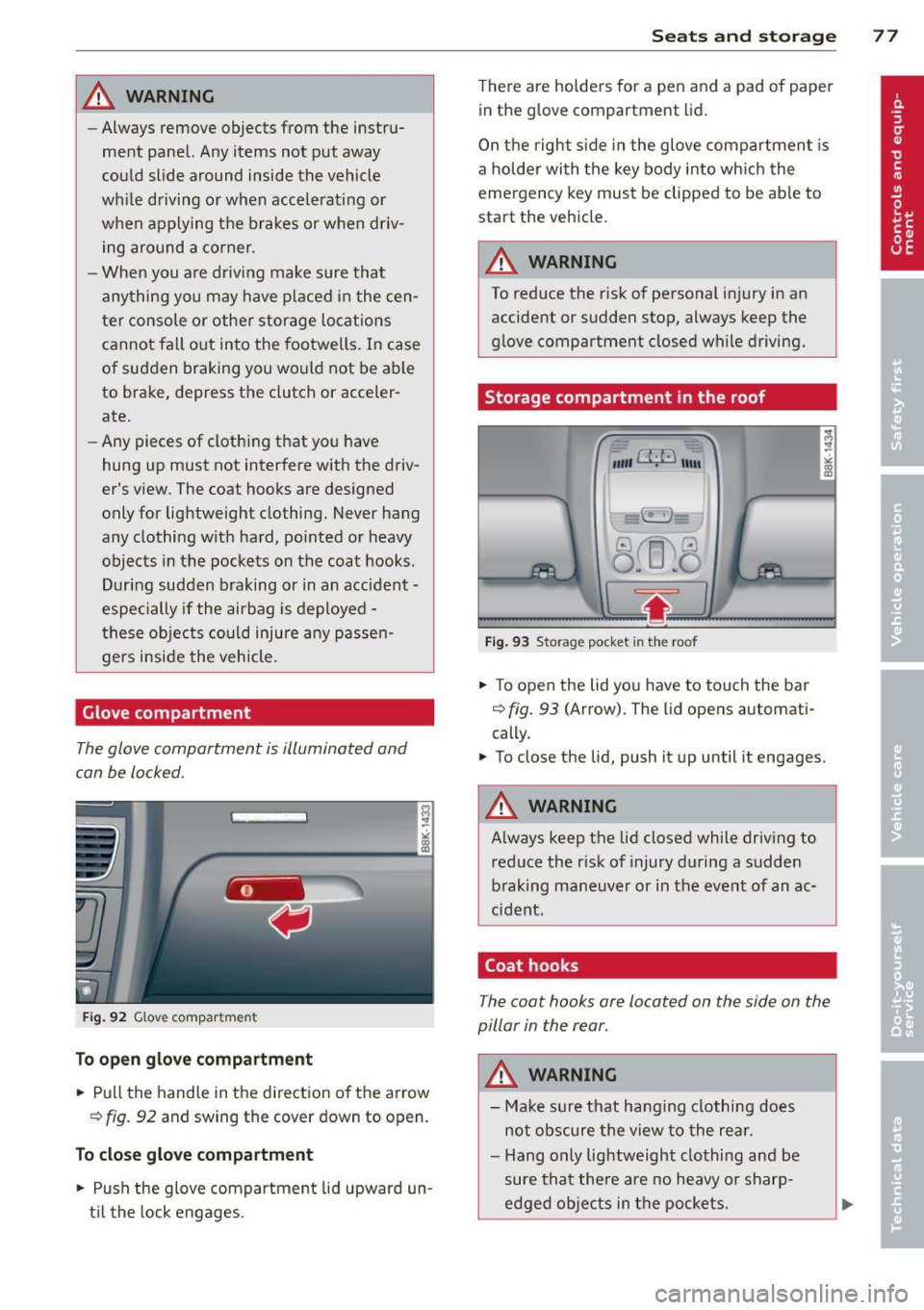
Glove compartment
The glove compartment is illuminated and
can be locked.
F ig . 92 G love compartme nt
To open glove compa rtment
.. Pu ll the hand le in the direction of the a rrow
~ fig . 92 and swing the cover down to open.
T o clos e glo ve compartm ent
.,. Push the glove compartment lid upward un
t il the lock engages .
Sea ts a nd s to rage 77
There are holders for a pen and a pad of paper
in the glove compartment lid.
On the right s ide in the glove compartment is
a holde r with the key body into which the
emergency key must be clipped to be able to
start the vehicle.
A WARNING
To reduce the risk of personal injury in an
accident or sudden stop, always keep the
glove compartment closed while driving.
Storage compartment in the roof
"'" CfJ:' 11111
.8=5: ~I
Fig . 93 Storage pocket in the roof
.,. To open the lid yo u have to touch the bar
~ fig. 93 (Arrow). The lid opens automati
cally.
.. To close the lid, push it up until it engages.
A WARNING
-
Always keep the lid closed while driv ing to
reduce the risk of injury during a sudden
braking mane uver or in the event of an ac
cident.
Coat hooks
The coat hooks are located on the side on the
pillar in the rear .
A WARNING
--Ma ke sure that hanging clothing does
not obscure the view to the rear.
- Hang only lightweight clothing and be
sure that there are no heavy o r sharp
edged objects in t he pockets.
-
Page 94 of 316

92 On the road
On the road
Steering
Manually adjustable steering wheel
The height and reach of the steering wheel
can be adjusted .
Fig. 104 Lever under the s tee ring colum n
First, adjust the driver's seat correctly .
• Pull the lever
o fig . 104 -Arrow -o &_.
" a, a,
• Move the steering whee l to the desired po
s it ion.
• Push the lever aga inst the steering column
u ntil it locks.
There must be at least 10 inches (25 cm) be tween your chest and the center of the steer
ing wheel. If you cannot si t more than 10 in
ches (25 cm) from the steering whee l, see if
adaptive equipment is available to help you
reach the pedals and increase the distance
from the steering whee l.
F or detai led information on how to adjust the
driver's seat, see
o page 63.
The steering wheel can be adjusted even when
the ign ition is turned off. For vehicles wi th
seat memory, the individual positions for the
steering wheel can be stored a long with the
seat position .
A WARNING
Improper use of steering wheel adjust
ment and improper seating position can
cause serious personal injury .
-Adjust the steer ing whee l co lumn on ly
when the vehicle is not moving to pre
vent loss of veh icle control.
-
- Adjust the driver's seat or steering whee l
so that there is a m inimum of 10 inches
(25 cm) between your chest and the
steer ing whee l
r::;,page 145, fig . 162 . If
you cannot maintain th is m inimum dis
tance, the a irbag system cannot protect
you properly.
- If physical limitations prevent you from
sitting 10 inches (25 cm) or more from
the steering wheel, check with your au
thorized Audi dealer to see if adaptive equ ipment is ava ilable .
- If the steer ing whee l is aligned with your
face, the supplementa l dr iver's a irbag
cannot provide as much protection in an
accident. Always make sure that the
steer ing whee l is aligned with your
chest .
- Always hold the steering wheel with your
hands at the 9 o'clock and 3 o'clock posi
tions to reduce the risk of persona l injury
if the driver's airbag deploys.
- Never hold the steering wheel at the 12 o'clock position or with your hands inside
the steeri ng wheel rim or on the steering
wheel hub. Holding the steer ing wheel
the wrong way can cause serious injuries
to the hands, arms and head if the driv
er's airbag deploys.
Ignition lock and ignition switch
Starting engine with the key
The igni tion is switched on and the engine
started with the ignition key .
Fig. 105 Ig nitio n key
Page 146 of 316
144 Driving Safel y
Driving Safely
General notes
Safe driving habits
Please remember -safety first!
This chapter contains important information,
tips, instructions and warnings that you need
to read and observe for your own safety, the
safety of your passengers and others . We have
summarized here what you need to know
about safety belts, a irbags, ch ild restra ints as
well as child safety. Your safety is for us
priori
ty number 1.
Always observe the info rmat ion
and warn ings in th is sect ion -fo r yo ur own
safety as well as that of your passengers .
The information in this se ction app lies to all
model ve rsions of your veh icle . Some of the
feat ures desc ribed in this sec tions may be
standard equipment on some models, or may
be optional equipment on others . If you are
not sure, ask your authorized Aud i dealer.
A WARNING
- Always make sure that you follow the in
struct ions and heed the WARNINGS in
this Manual. It is in your interest and in
the inte rest of you r passengers.
- Always keep the complete Owner's Liter
ature in your Audi when you lend or sell
yo ur vehicle so that this important info r
mation will always be ava ilable to the
dr iver and passengers.
- Always keep the Owner's literature handy
so that you can find i t eas ily if you have
ques tions.
Safety equipment
The safety features are part of the occupant
restraint system and work together to help
redu ce the risk of injury in a wide variety of
accident situations.
Your safety and the safety of your passenge rs
should not be left to chance. Advances in
technology have made a varie ty o f fea tures
avai la bl e to he lp re duce the risk of inj ury in an accident
. The following is a list of just a few of
the safety features in your Audi:
- sophis tic ated s afety be lts for d rive r and a ll
passenger sea ting pos it ions,
- be lt fo rce limi ters fo r the seats,
- be lt p retensioners for the seats,
- head restra ints for each seating posit io n,
- front airbags,
- side airbags in the front seats,
- side curtain a irbags,
- specia l LATCH an chorages for child re-
s tr aints,
- ad justab le steer ing colum n.
These ind iv idual safety features, can work to
gether as a system to he lp protect you and
you r passengers in a w ide range of accidents .
T hese fe atures canno t work as a system if
they a re not always correct ly adjusted and co r
rect ly used.
Safety i s everybody' s respon sibility!
Important things to do before driving
Safety is everybody's job! Vehicle and occu
pant safety always depends on the informed and careful driver.
Fo r yo ur safety and the safety of you r passen
gers,
before driv ing alway s:
.,. Make sure that all lights and signals a re op
erati ng correctly .
.,. Make su re that the tire pressu re is co rrect .
.,. Make su re that all w indows are clean and
afford good v is ib il ity to the o utside.
.,. Sec ure a ll lugg age and o ther items caref ully
qpage 76 .
.,. Make s ure that nothing can interfere with
the peda ls .
.,. Adjust front seat, head restraint and mir
rors correc tly for your height.
.,. Instruct passenge rs to adjust the head re
straints according to the ir height .
.,. Make su re to use the right child restraint
co rrectly to p rotect chi ldren ¢
page 186,
Child Safety. "'
Page 147 of 316
.. Sit properly in your seat and make sure that
your passengers do the same ¢
page 61,
General recommendations.
.. Fasten your safety belt and wear it properly.
Also instruct your passengers to fasten their
safety belts properly¢
page 154.
What impairs driving safety?
Safe driving is directly related to the condi
tion of the vehicle , the driver as well as the
driver's ability to concentrate on the road
without being distracted .
The driver is responsible for the safety of the
vehicle and all of its occupants. If your ability
to drive is impaired, safety r isks for everybody
in the vehicle increase and you a lso become a
hazard to everyone else on the road
~ .&,.
Therefo re:
.. Do not let yourself be distracted by passen
gers or by using a cellular telephone .
.. NEVE R drive when yo ur driv ing ability is im
paired (by medicat ions, alcohol, drugs, etc.).
.. Observe all traffic laws, rules of the road
and speed limits and plain common sense .
.. ALWAYS adjust your speed to road, traffic
and weather conditions .
.,. Take frequent breaks on long trips. Do not
drive for more than two hours at a stretch.
.. Do NOT drive when you are tired, under
pressure or when you are stressed .
& WARNING
Impaired driving safety increases the risk
of serious personal injury and death when
ever a vehicle is being used.
Driving Safely 145
Proper occupant
seating positions
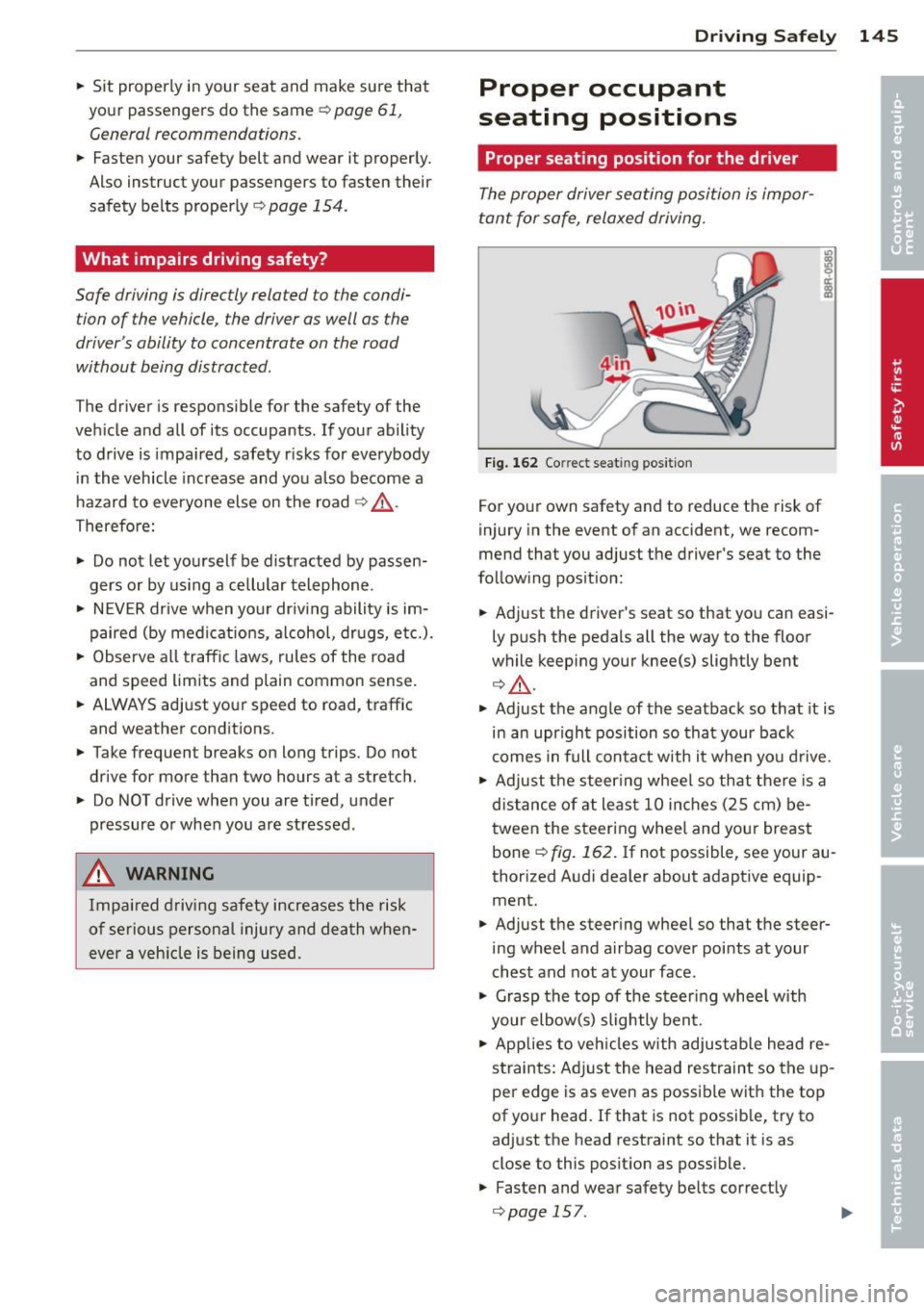
Proper seating position for the driver
The proper driver seating position is impor
tant for safe, relaxed driving.
Fig. 162 Correct seat ing pos it ion
For your own safety and to reduce the risk of
injury in the event of an accident, we recom
mend that you adjust the driver's seat to the
follow ing pos ition:
.. Adjust the driver's seat so that you can easi
ly push the pedals all the way to the floor
wh ile keeping your knee(s) slightly bent
¢&, .
.. Adjust the angle of the seatback so that it is
in an upr ight position so that your back
comes in full contact w ith it when you drive.
.. Adjust the steering wheel so that there is a
distance of at least 10 inches (25 cm) be
tween the steering wheel and yo ur breast
bone
~ fig. 162. If not possible, see your au
thorized Audi dealer about adaptive equip
ment.
.. Adjust the steer ing wheel so that the steer
ing wheel and airbag cover points at your
chest and not at your face .
.,. Grasp the top of the steering whee l with
your elbow(s) slightly bent .
.. App lies to vehicles with adjustable head re
s tra ints: Ad just the head restraint so the up
per edge is as even as possible with the top
of your head. If that is not possible, try to
adjust the head restraint so that it is as
close to this pos it ion as possible .
.. Fasten and wear safety be lts correctly
¢ page 15 7 . .,.
Page 148 of 316
146 Driving Safely
• Always keep both feet in the footwell so
that you are in control of the vehicle at all
times.
For detailed information on how to adjust the
driver's seat, see
¢ page 63.
A WARNING
Drivers who are unbelted, out of position
or too close to the airbag can be seriously
injured by an airbag as it unfolds. To help
reduce the risk of serious personal injury:
- Always adjust the driver's seat and the
steering wheel so that there are at least
10 inches (25 cm) between your breast
bone and the steering wheel.
- Always hold the steering wheel on the
outside of the steering wheel rim with
your hands at the 9 o'clock and 3 o'clock positions to help reduce the risk of per
sonal injury if the driver's airbag inflates.
- Never hold the steering wheel at the
12 o'clock position or with your hands at
other positions inside the steering wheel
rim or on the steering wheel hub. Hold
ing the steering wheel the wrong way
can cause serious injuries to the hands,
arms and head if the driver's airbag de
ploys.
- Pointing the steering wheel toward your
face decreases the ability of the supple
mental driver 's airbag to protect you in a
collision .
- Always sit in an upright position and nev
er lean against or place any part of your
body too close to the area where the air
bags are located.
- Before driving, always adjust the front
seats and head restraints properly and
make sure that all passengers are prop
erly restrained.
- Never adjust the seats while the vehicle
is moving . Your seat may move unexpect
edly and you could lose control of the ve
hicle.
- Never drive with the backrest reclined or
tilted far back! The farther the backrests
are tilted back, the greater the risk of in- jury due to incorrect positioning of the
safety belt and improper seating posi
tion.
- Children must always ride in child safety
seats ¢
page 186. Special precautions
apply when installing a child safety seat
on the front passenger seat¢
page 162 .
Proper seating position for the front
passenger
The proper front passenger seating position
is important for safe, relaxed driving .
For your own safety and to reduce the risk of
injury in the event of an accident, we recom
mend that you adjust the seat for the front
passenger to the following position :
• Move the front passenger seat back as far
as possible . There must be a minimum of
10 inches (25 cm) between the breastbone
and the instrument panel¢,&. .
• Adjust the angle of the seatback so that it is
in an upright position and your back comes
in full contact with it whenever the vehicle is
moving.
• Applies to vehicles with adjustable head re
straints: Adjust the head restraint so the up
per edge is as even as possible with the top
of your head. If tha t is not possible, try to
adjust the head restraint so that it is as
close to this position as possible.
• Keep both feet flat on the floor in front of
the front passenger seat.
• Fasten and wear safety belts correctly
¢page 157.
For detailed information on how to adjust the
front passenger's seat, see
¢ page 61.
A WARNING
-
Front seat passengers who are unbelted,
out of position or too close to the airbag
can be seriously injured or killed by the air
bag as it unfolds. To help reduce the risk of
serious personal injury:
Page 149 of 316
-Passengers must always sit in an upright
position and never lean against or place
any part of their body too close to the
area where the airbags are located.
- Passengers who are unbelted, out of po
sition or too close to the airbag can be
seriously injured by an airbag as it un
folds with great force in the blink of an
eye .
- Always make sure that there are at least
10 inches (25 cm) between the front
passenger's breastbone and the instru
ment panel.
- Each passenger must always sit on a seat
of their own and properly fasten and
wear the safety belt belonging to that seat.
- Before driving, always adjust the front
passenger seat and head restraint prop
erly.
- Always keep your feet on the floor in
front of the seat. Never rest them on the
seat, instrument panel, out of the win
dow, etc. The airbag system and safety
belt will not be able to protect you prop
erly and can even increase the risk of in
jury in a crash .
- Never drive with the backrest reclined or
tilted far back! The farther the backrests
are tilted back, the greater the risk of in
jury due to incorrect positioning of the
safety belt and improper seating posi
tion.
- Children must always ride in child safety
seats <=:>
page 186 . Special precautions
apply when installing a child safety seat
on the front passenger seat
<=:> page 162.
Proper seating positions for passengers
in rear seats
Rear seat passengers must sit upright with
both feet on the floor consistent with their
physical size and be properly restrained
whenever the vehicle is in use.
To reduce the risk of injury caused by an incor
rect seating position in the event of a sudden
braking maneuver or an accident, your pas-
Driving Safely 147
sengers on the rear bench seat must always
observe the following:
.,. Make sure that the seatback is securely
latched in the upright position<=:>
page 70.
.,. Keep both feet flat in the footwell in front
of the rear seat.
.,. Fasten and wear safety belts properly
<=:>page 157 .
.,. Make sure that children are always properly
restrained in a child restraint that is appro
priate for their size and age
Q page 186.
A WARNING
Passengers who are improperly seated on
the rear seat can be seriously injured in a
crash.
- Each passenger must always sit on a seat
of their own and properly fasten and
wear the safety belt belonging to that
seat.
- Safety belts only offer maximum protec
tion when the seatback is securely latch
ed in the upright position and the safety
belts are properly positioned on the
body. By not sitting upright, a rear seat
passenger increases the risk of personal
injury from improperly positioned safety
belts!
- Always adjust the head restraint properly
so that it can give maximum protection .
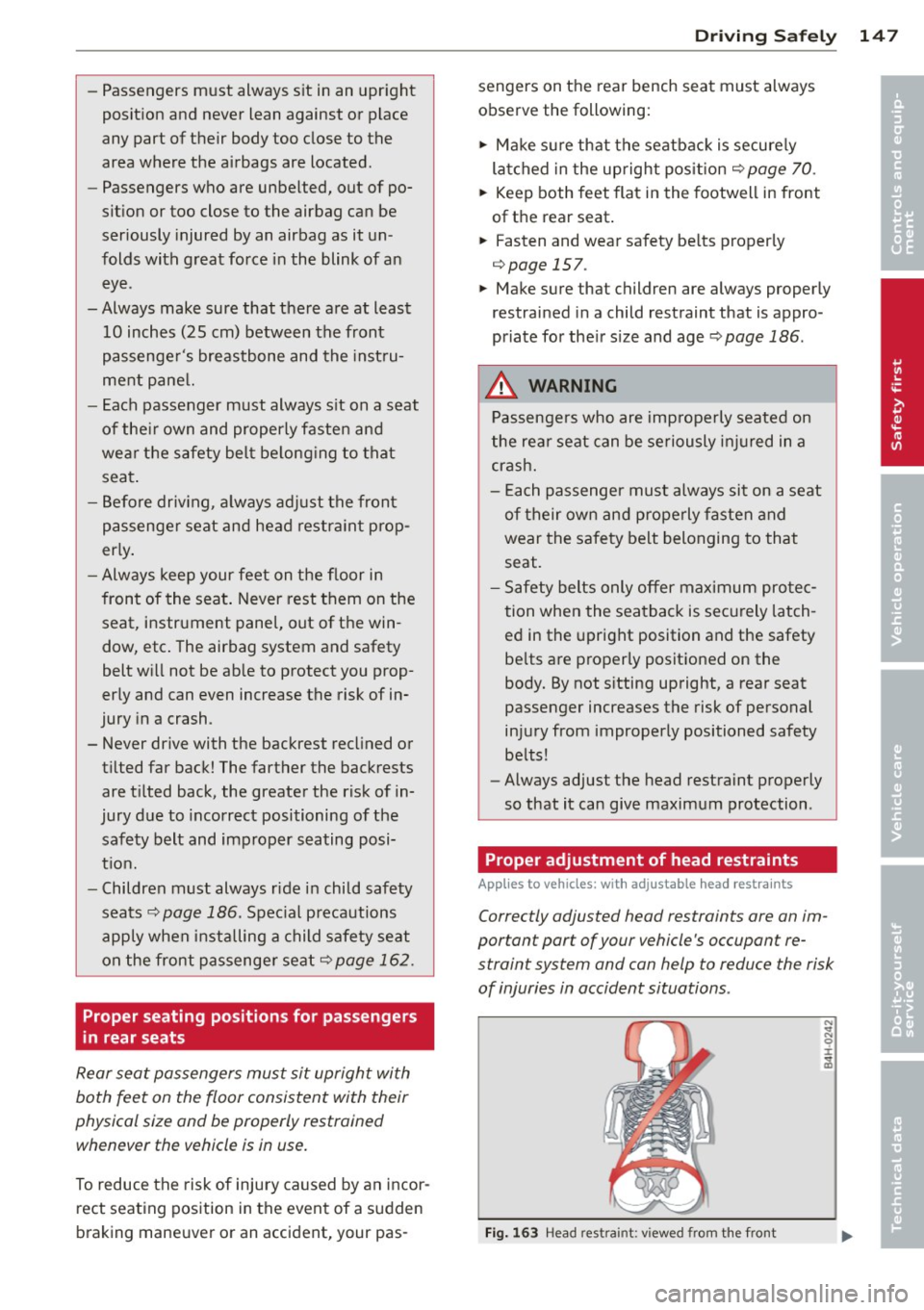
Proper adjustment of head restraints
Applies to vehicles: with adjustable head restra ints
Correctly adjusted head restraints ore on im
portant por t of your vehicle 's occupant re
straint system and con help to reduce the risk
of injuries in occident situations .
Fig. 163 Head restra int: v iewed from the front
"' ...
"' 0 ±
~
•
•
Page 151 of 316

Driver and passenger
side footwell
Important safety instructions
Applies to vehicles: with knee airbags
A WARNING
Always make sure that the knee a irbag can
inflate without interference . Objects be
tween yourself and the airbag can increase
the risk of inju ry in an acc ident by interfer
ing w ith the way the a irbag deploys or by
be ing p ush ed into you as the airbag de
ploys .
- No persons (ch ild ren) or animals should
ride in the footwell in front of the pas
senger seat. If the airbag deploys, this
can result in serious or fata l injuries .
- No objec ts of any k ind sho uld be car ried
in t he footwell area in front of the driv
er's or passenger's seat . B ulky objects
(shopping bags, for example) can ham
per or prevent proper deployment of the
airbag . Small objects can be thrown
through the vehicle if the airbag deploys and injure you o r your passengers .
Pedal area
Pedals
The pedals must always be free to move and
must never be interfered with by a floor mat
or any other object.
M ake sure t hat all pedals move freely witho ut
in te rference and th at nothing prevents them
from returning to the ir origina l positions.
Only use floo r mats that leave the peda l area
free and can be secured w it h floor mat fas ten
e rs.
If a b rake circuit fails, increased b rake pedal
travel is req uired to br ing the vehi cle to a full
stop.
Dr iving S afel y 149
A WARNING
Pedals that cannot move free ly can cause
loss of vehicle control and increase the risk
of ser ious inju ry .
- Never p lace any objects in the drive r's
footwell . An ob ject cou ld get into the
pedal area and inte rfe re with pedal func
tion . In case of sudde n bra ki ng o r an ac
cident, yo u wo uld not be a ble to brake or
ac celer ate!
- Always ma ke su re tha t no thing can fall
or m ove into the driver's footwel l.
Floor mats on the driver side
Always use floor mats that can be securely
attached to the floor mat fasteners and do
not interfere with the free movement of the
pedals .
"' Ma ke s ure that the floor mats are prope rly
secured and cannot move and inte rfe re with
t he ped als~ ,&. .
U se on ly floor mats that leave the pedal area
unobst ructed and that are firmly secu red so
that they cannot slip o ut of posi tion . You ca n
obt ain suitab le floo r mats from yo ur aut ho r
ized Audi dea ler .
Floor mat fastene rs a re insta lled in your Aud i.
Floor mats used in your vehicle must be at
tac hed to these fastene rs . Prope rly secur ing
the floor mats will prevent them from sliding
i nto positions that could interfere with the
peda ls o r impa ir safe ope rat io n of yo ur vehicle
i n othe r ways.
A WARNING
Pedals that cannot move free ly can result
in a loss of vehicle control and inc rease the
risk of serious persona l injury.
- Always ma ke s ure that floo r mats a re
properly secu red.
- Never p lace or ins tall floor mats o r other
f loor coverings in the vehicle that cannot
be properly secured in p lace to prevent
them from slipping and interfer ing with
~
•
•
Page 158 of 316
156 Safety belts
with the vehicle interior has all the energy
they had just before the crash. Never rely on airbags alone for protection.
Even when they deploy, airbags provide only
additional protection. Airbags are not sup
posed to deploy in all kinds of accidents. Al
though your Audi is equipped with airbags, all
vehicle occupants, including the driver, must
wear safety belts correctly in order to mini mize the risk of severe injury or death in a
crash.
Remember too, that airbags will deploy only
once and that your safety belts are always
there to offer protection in those accidents in
which airbags are not supposed to deploy or when they have already deployed . Unbelted
occupants can also be thrown out of the vehi
cle where even more severe or fatal injuries
can occur.
It is also important for the rear passengers to
wear safety belts correctly. Unbelted passen
gers in the rear seats endanger not only them
selves but also the driver and other passen
gers <=>
fig. 169. In a frontal collision they will
be thrown forward violently, where they can
hit and injure the driver and/or front seat pas
senger.
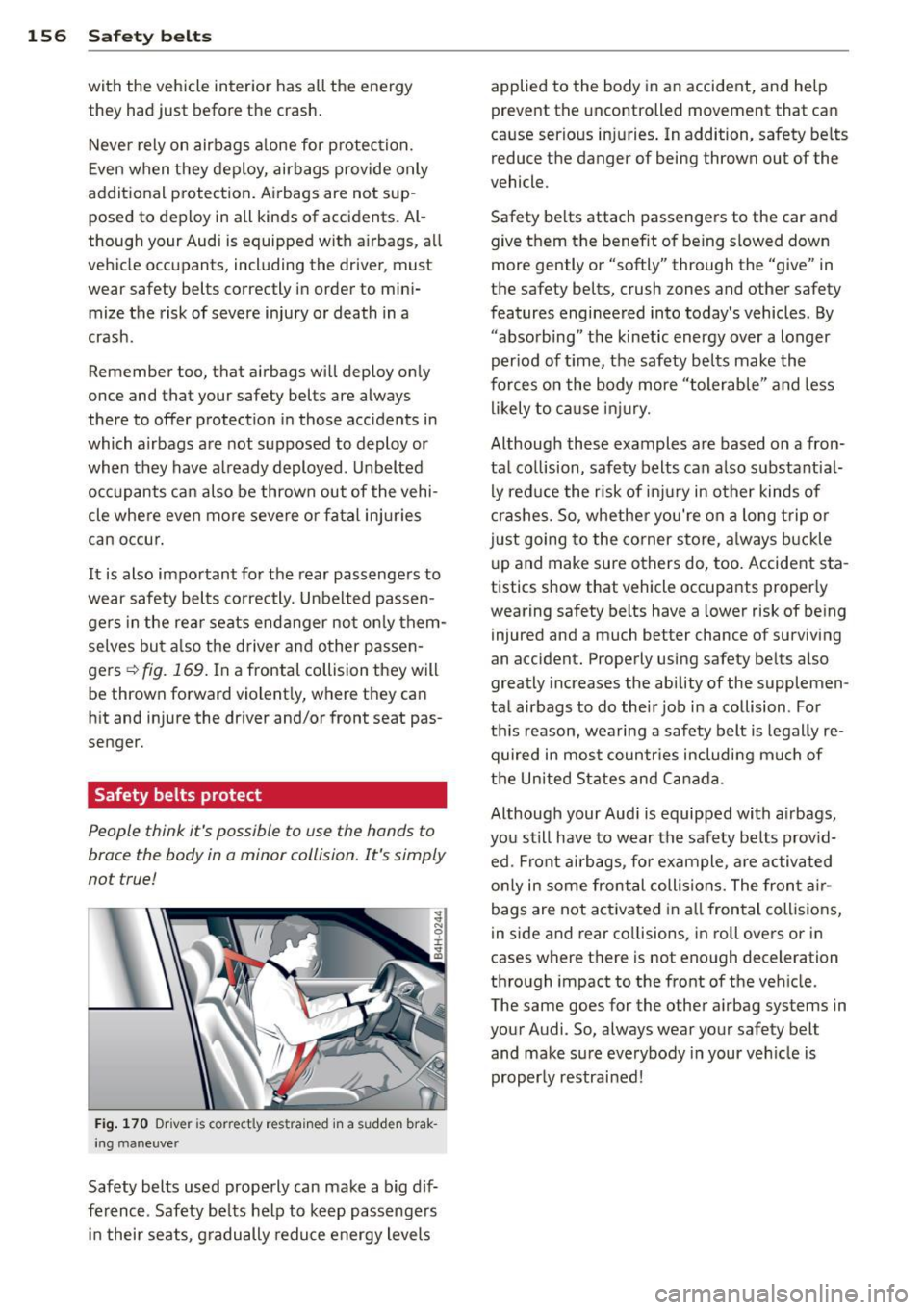
Safety belts protect
People think it's possible to use the hands to
brace the body in a minor collision. It's simply
not true!
Fig. 170 Drive r is co rrect ly res trained in a sudden brak
ing maneuve r
Safety belts used properly can make a big dif
ference . Safety belts help to keep passengers
in their seats , gradually reduce energy levels applied to
the body in an accident, and help
prevent the uncontrolled movement that can
cause serious injuries. In addition, safety belts
reduce the danger of being thrown out of the
vehicle .
Safety belts attach passengers to the car and give them the benefit of being slowed down
more gently or "softly" through the "give" in
the safety belts, crush zones and other safety
features engineered into today's vehicles. By
"absorbing" the kinetic energy over a longer
period of time, the safety belts make the
forces on the body more "tolerable" and less
likely to cause injury.
Although these examples are based on a fron
tal collision, safety belts can also substantial ly reduce the risk of injury in other kinds of
crashes. So, whether you're on a long trip or
just going to the corner store, always buckle
up and make sure others do, too. Accident sta
tistics show that veh icle occupants properly
wearing safety belts have a lower risk of being
injured and a much better chance of surviving
an accident. Properly using safety belts also
greatly increases the ability of the supplemen
tal airbags to do their job in a collision. For
this reason, wearing a safety belt is legally re
quired in most countries including much of
the United States and Canada .
Although your Audi is equipped with airbags,
you still have to wear the safety belts provid
ed . Front airbags, for example , are activated
only in some frontal collisions. The front air
bags are not activated in all frontal collisions,
in side and rear collisions, in roll overs or in
cases where there is not enough deceleration
through impact to the front of the vehicle.
The same goes for the other airbag systems in
your Audi. So, always wear your safety belt and make sure everybody in your vehicle is
properly restrained!
Page 162 of 316

160 Safety belts
_& WARNING
Never unfasten safety belt while the veh i
cle is moving . Doing so will increase your
r isk of being injured or killed.
Improperly worn safety belts
Incorrectly positioned safety belts can cause
severe injuries.
Wear ing safety belts improperly can cause se
rious in jury or death. Safety belts can only
work when they are correct ly positioned on
the body. Improper seating positions reduce
the effect iveness of safety belts and will even
increase the risk of injury and death by mov
ing the safety belt to critical areas of the
body. Improper seating positions also in
crease the risk of serious injury and death
when an airbag deploys and str ikes an occu
pant who is not in the correct seating posi
tion . A driver is responsib le for the safety of
a ll vehicle occupants and especially for chi l
dren. Therefore:
• Never permit anyone to assume an incorrect
s itting position in the veh icle wh ile traveling
Q 8_ .
_& WARNING
Improperly worn safety belts increase the
risk of serious personal injury and death
whenever a vehicle is being used.
- Always make sure that all vehicle occu-
pants are correct ly restrained and stay in
a correct seating position whenever the
vehicle is be ing used.
- Always read and heed all WARNINGS and
other important information
Qpage 157.
Safety belt preten
sioners
How safety belt pretensioners work
In front, side and rear-end collisions above a
particular severity, safety belts are tensioned
automatically.
T he safety belts are equipped with safety belt
pretensioners. The system is activated by sen
sors in front, side and rear-end collisions of
great severity. This tightens the belt and takes
up belt slack
Q & in Service and disposal of
safety belt pretensioner on page 161.
Taking
up the slack helps to reduce forward occupant
movement during a collision.
([) Note
Never let the belt remain over a rear seat
back that has been fo lded forward.
(D Tips
The safety belt pretensioner can only be
activated once.
-In minor frontal and side collisions, in
rear-end collisions, in a rollover and in
accidents involving very little impact
force, the safety belt pretensioner are
not activated .
- In the case of a side crash, the safety
belt pretensioners will activate on the
driver's or front passenger's sides only,
depending on which side of the veh icle
the crash occurs.
- When the safety belt pretensioners are
act ivated, a fine dust is released. This is
normal and is not caused by a fire in the
vehicle.
- The relevant safety requ irements must
be observed when the vehicle or compo
nents of the system are scrapped. An au
thorized Audi dealer or qualified work
shop is familiar with these regulations
and wi ll be pleased to pass on the infor
mation to you.
Page 163 of 316

-Be sure to observe all safety, environ
mental and other regulations if the vehi
cle or individual parts of the system, par
ticularly the safety belt or airbag, are to
be disposed. We recommend you have
your authorized Audi dealer perform this service for you .
Service and disposal of safety belt
pretension er
The safety belt pretensioners are parts of the
safety belts on your Audi. Installing, remov ing, servicing or repairing of belt pretension
ers can damage the safety belt system and
prevent it from working correctly in a colli
sion.
There are some important things you have to know to make sure that the effectiveness of
the system will not be impaired and that dis
carded components do not cause injury or pol
lute the env ironment.
A WARNING
Improper care, servicing and repair proce
dures can increase the risk of personal in
jury and death by preventing a safety belt
pretens ioner from activating when needed
or activating it unexpectedly:
- The belt pretensioner system can be acti
vated on ly once. If belt pretensioners
have been activated, the system must be
replaced.
- Never repair, adjust, or change any parts
of the safety belt system.
- Safety belt systems including safety be lt
pretensioners cannot be repaired. Spe
cial procedures are required for removal,
installation and disposal of this system.
- For any work on the safety belt system,
we strongly recommend that you see
your authorized Audi dealer or qualified
technician who has an Audi approved re pair manual, training and special equip
ment necessary .
Safety belts 161
@:) For the sake of the environment
Undeployed airbag modules and preten
sioners might be classified as Perchlorate
Material -special handling may apply, see
www. dtsc. ca.gov/hazard o u swa ste/ per-
ch lo rate. When the veh icle or parts of the
restraint system including airbag modules
safety be lts with pretensioners are scrap
ped, all applicable laws and regulations
must be observed. Your authorized Audi
dealer is familiar with these requirements
and we recommend that you have your
dealer perform this service for you.
•
•