fuel cap AUDI A5 COUPE 2012 User Guide
[x] Cancel search | Manufacturer: AUDI, Model Year: 2012, Model line: A5 COUPE, Model: AUDI A5 COUPE 2012Pages: 316, PDF Size: 78.59 MB
Page 257 of 316
Tires and wheels 255
Tread
means that portion of a tire that comes into
contact with the road.
Tread separation
means pull ing away of the tread from the tire
carcass .
Treadwear indicators (TWI)
means the projections within the principal
grooves designed to give a visual indication of
the degrees of wear of the tread. See
c:> page 262, Tread Wear Indicator (TWI) for
more informat ion on measuring tir e wear.
Uniform Tire Quality Grading
is a tire information system developed by the
United States National Highway Traffic Safety
Administration (NHTSA) that is designed to help buyers make relative comparisons among
tires. The UTQG is not a safety rating and not a
guaran tee that a tire will last for a prescribed
number of miles (kilometers) or perform in a
certain way.
It simply gives tire buyers addi
tional information to combine with other con
siderat ions, such as pr ice, brand loya lty and
dealer recommendations. Under UTQG, tires
are graded by the tire manufacturers in three
areas: treadwear, traction, and temperature
res istance . The UTQG information on the tires,
mo lded into the sid ewa lls.
U.S . DOT Tire Identification Number (TIN)
This is the t ire's "serial number". It begins
with the letters "DOT" and indicates that the tire
meets all federal standards. The next two
numbers or letters indicate the plant where it
was man ufactured, and the last four numbers
represent the week and year of man ufacture.
For example,
DOT . .. 2209 ...
means tha t the tire was produced in the 22nd
week of 2009. The other numbers are market
ing codes that may or may not be used by the
tire manufacturer . This information is used to
contact consumers if a tire defect requires a
recall.
Vehicle capacity weight
means the rated cargo and luggage load plus
150 lbs.
(68 kilograms) times the vehicle's to
ta l seating capacity as listed on the label lo
cated either on the driver's side B-pillar or on
the inside of the fuel filler flap.
Vehicle maximum load on the tire
means that load on an individua l tir e that is
determined by distributing to each ax le its
share of the maximum loaded vehicle weight
and dividing by two.
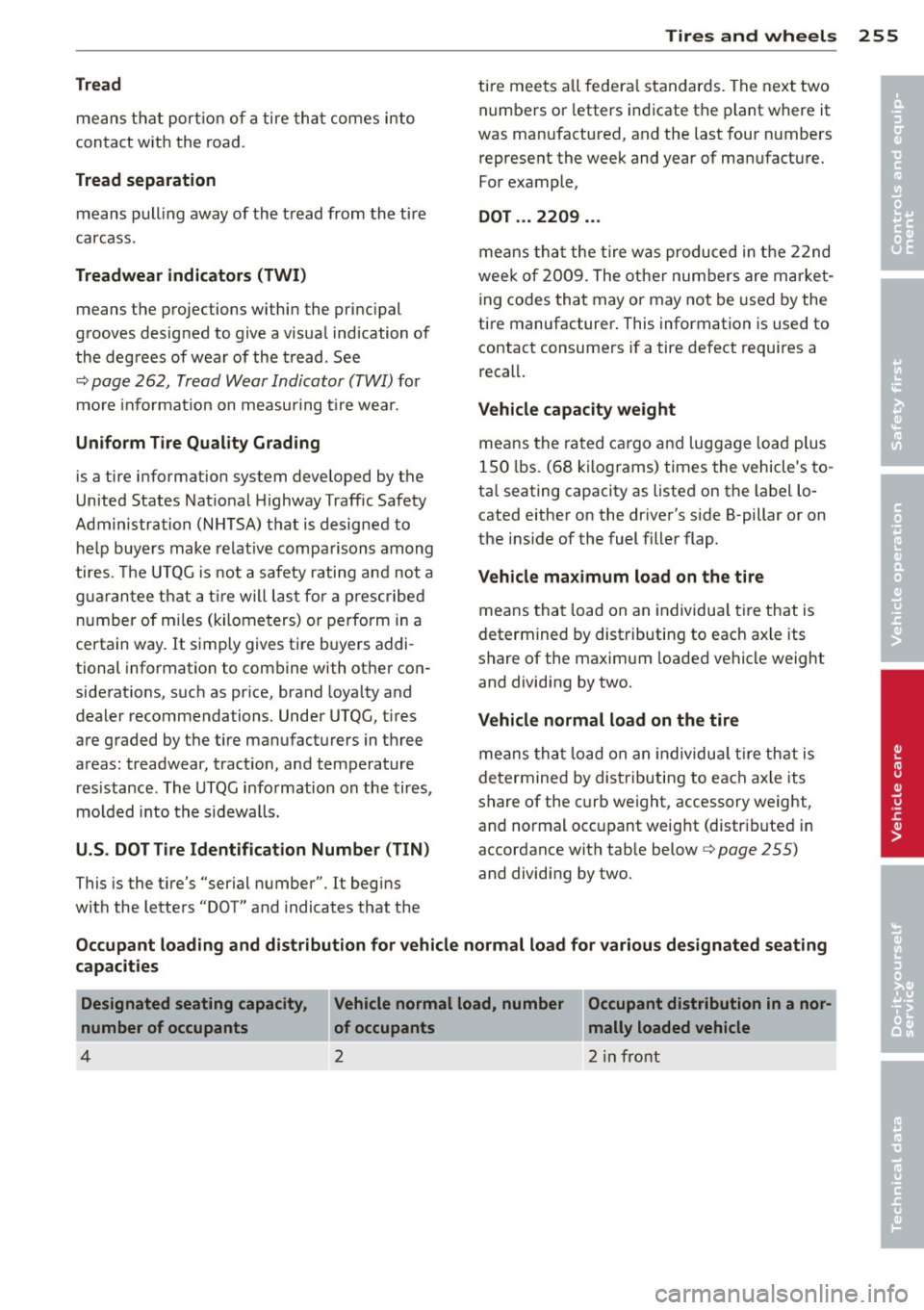
Vehicle normal load on the tire
means that load on an individua l tir e that is
determined by distributing to each axle its
share of the curb weight, accessory weight,
and normal occupant weight (distributed in
accordance with tab le below
c:> page 255)
and dividing by two.
Occupant loading and distribution for vehicle normal load for various designated seating
capacities
Designated seating capacity,
number of occupants
4
Vehicle normal load, number Occupant distribution in a nor-
of occupants _____ mally loaded vehicle
2 2 in front
•
•
Page 258 of 316
256 Tires and wheels
Cold tire inflation pressure
Tire pressure affects the overall handling, performance and safety of a vehicle.
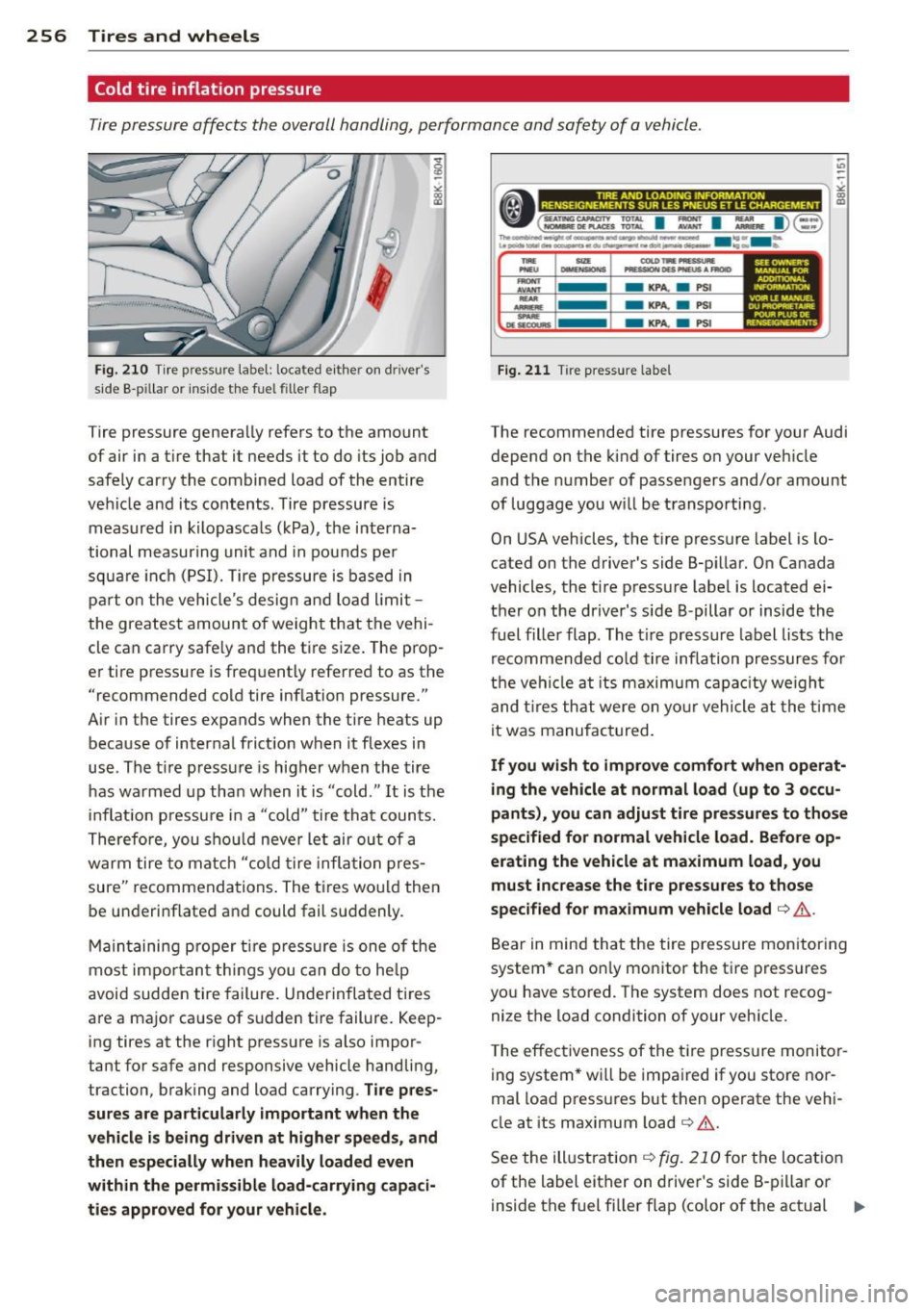
Fig. 210 Tire p ress ure labe l: loca ted e ith er on d river 's
side 8 -pillar or ins ide t he fue l filler flap
Tire pressure genera lly refers to the amount
of air i n a t ire that it needs it to do its job and
safely carry the combined load of the entire
vehicle and its contents . Tire pressure is
measured in kilopasca ls (kPa), the inte rna
tional measuring unit and in pounds pe r
squa re inch ( PSI). Tire pressure is based in
pa rt o n the vehicle's design an d load limit
the greatest amount of weight that the vehi
cle can carry safe ly and the t ire size . The prop
er tire pressure is freq uently referred to as the
"recommended cold tire inf lation pressure."
A ir in the tires expands when the tire heats up
because of internal frict ion when it flexes in
use . The t ire p ress ure is higher when the tire
h as warmed up than when i t is "cold ." It is the
in flat ion pressu re i n a "cold " tire that coun ts.
T herefore, you sho uld neve r let air ou t of a
warm tire to match " co ld tir e infla tion pres
sure" recommendations . The ti res wo uld then
be underinflated and could fail su ddenly .
M ain taining p roper t ire pr es su re is one o f the
most impor tan t things you can do to he lp
avoid sudden tire failure. Underinfla ted ti res
a re a major ca use of s udden tire failure. Keep
ing tires at the r ight pressure is also impor
tant for safe and responsive vehicle handling,
traction, braking and load carrying .
Tire pres
sur es are particularly important when th e
vehicle is being driven at higher speeds , and
then especially when heav ily loaded even
w ithin the permissible load -carrying capaci
tie s approved for y our vehicle .
,;
•(=~ : I : I :,.. I)@ ~
The~-----~---w-o- ....... -e.....i -·· - u ........ -.-..,.0, ... -....,.,...tot~---....... ._.,. -..
....
-..... ...........
- KPA. a PSI
- KPA.
a PSI
- KPA. a PSI
Fig. 21 1 Tir e pressure la bel
SU OWNER'S MANUAl FOR AD0"10NAL l10N VOl!ILEMANU£1. DU _,...,
POUR Pl.US DE
REHSEKi.\'IEME NTS
The recommended tire pressures for your Audi
depend on t he kind of tires o n your veh icle
and the numbe r of passengers and/or amount
of luggage you w il l be transporting .
On USA vehicles, the t ire pressure label is lo
cated on the driver's side B-p illar. On Canada
vehicles, the tire press ure label is located ei
ther on the dr iver's s ide B-pillar or inside the
fuel fille r flap. The t ire press ure l abel lists the
recommended co ld tire inflation pressures for
t h e veh icle at its ma ximum ca pa ci ty we igh t
and t ires th at were on yo ur vehicle at the t ime
it was manufac tured.
If you wish to improve comfort when operat
ing the vehicle at normal load (up to 3 oc cu
pant s), you can adjust tire pre ssures to those
specified for normal vehicle lo ad. Before op
erating the vehicle at maximum load, you
must increase the ti re pressures to those
specified for ma ximum veh icle load ¢.&..
Bear in mind that the tire pressure mon itor ing
system * can o nly monitor the tire press ures
yo u have sto red. The system does not recog
ni ze the load condition of your vehicle.
T he effectiveness of the tire press ure monitor
ing system * w ill be impa ired i f you store nor
mal load press ures but then operate the veh i
cle at its maximum load
¢ .&. .
See the ill ustration ¢ fig. 210 fo r the location
of the label eit her on driver's side B -p ill ar or
i nside the fuel fi ller flap (color of the actual
IJI>
Page 259 of 316
Tires an d wheel s 257
labe l and exact location on the vehicle wi ll
va ry slightly). inside the f
uel fi ller flap) always takes p rece
dence.
Note that the f ollowing tab le is accurate at
t he t ime o f go ing to press and is subject to
change. In the event of discrepancies, the tire
pressure label (On USA vehicles, the tire pres
sure label is located on the dr iver's side B-pil
lar. On Canada vehicles, the tire pre ssure labe l
is located either on the driver's side B-pillar or T
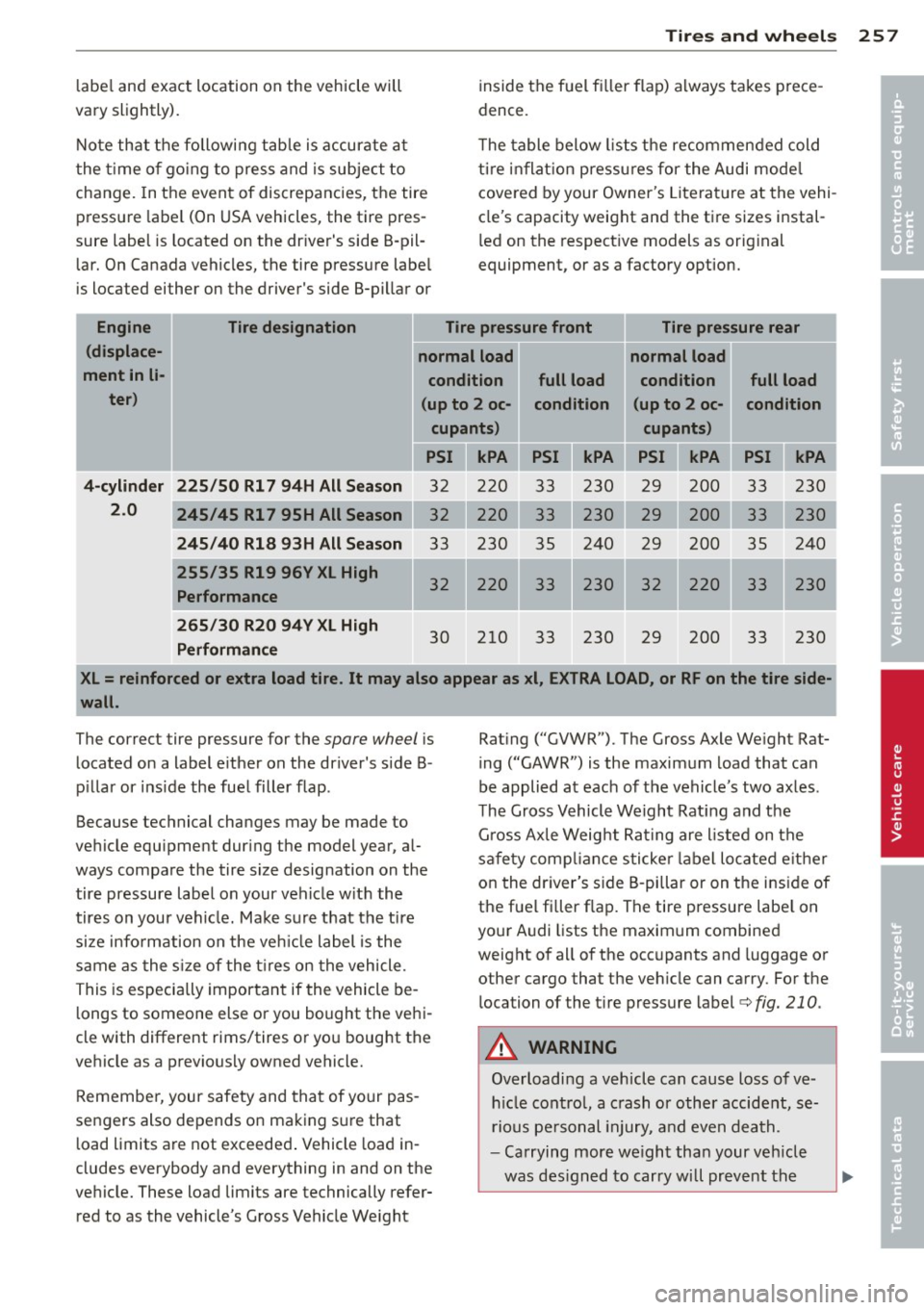
he table below lists the recommended cold
ti re in flat ion p ressu res for the Audi mode l
cove red by your Owner 's Literat ure at the vehi
cle's capacity weight and the t ire sizes instal
l ed on the respect ive models as orig inal
equipment, or as a factory option.
Engine Tire designation Tire pressure front Tire pressure rear
( displace-
normal load normal load
ment in li- condition full load condition
full load
ter) (up to 2 oc-condition (up to 2 oc- condition
cupant s) cupants)
PSI kPA PSI kPA PSI kPA
4-cylinder 225 /50 Rl 7 94H All Season
230
33 230
2
.0
245/45 Rl 7 95H All Season 230
245 /40 R18 93H All S eason 33 230 35 240 29 200 35 240
255 /35 R19 96V XL High 32 220 33 230 32 220 33 230 Performance
265 /30 R20 94V XL H igh
Perfo rmance
30 210 33 230 29 200 33 230
XL= reinforced or extra load tire. It may also appear as xl , EXTRA LOAD, or RF on the tire side
wall.
The correct tire pressure for the spare wheel i s
located on a label e ither on the driver's side B
p illar or ins ide the fuel filler flap .
Because technical changes may be made to
vehicle equ ipment dur ing the model year, a l
ways compare the tire s ize designation on the
tire pressure label on your vehicle w it h the
tires on your veh icle. Ma ke sure that the tire
size info rmation on the ve hicle label is the
s a me as the s ize of the t ires on the vehicle.
This is especia lly important if the vehicle be
l ongs to someone else or you bought the vehi
cle with different rims/tires o r you bought the
vehicle as a previously owned vehicle.
Remember, your safety and that of your pas
sengers also depends on mak ing su re that
l oad limits a re not exceeded . Vehicle load in
cludes everybody and everything in and on the
ve hicle. These load limits are technically refer
red to as the vehicle's G ross Vehicle We ight Rat
ing ("GVWR"). The Gross Axle We ight Rat
ing ("GAWR") is the maximum load that can
be applied at each of the vehicle's two axles .
T he Gross Vehicle Weight Rat ing and the
G ross Ax le Weig ht Rating are listed on the
sa fe ty comp liance sticke r label lo cated e ither
on the dr iver's s ide B-pillar or on the ins ide of
the fue l filler flap. The tire pressure labe l on
your A udi lists the maximum combined
weight of all of the occ upants and luggage or
other cargo that the veh icle can carry . For t he
loca tion of the t ire p ressure label¢
fig. 210.
A WARNING
Overloading a vehicle can cause loss of ve
h icle cont ro l, a c rash or other accide nt, se
rious pe rsonal injury, and even death.
- Ca rrying more we ight than your veh icle
was des igned to carry will prevent the
1
I
•
•
Page 260 of 316
258 Tire s and whee ls
vehicle from handling properly and in
crease the risk of a loss of vehicle
control.
- The brakes on a vehicle that has been
overloaded may not be able to stop the
vehicle within a safe distance.
- Tires on a vehicle that has been overload ed can fail suddenly causing loss of con
tro l and a crash.
- Always make sure that the tota l load be
ing transported -including the weight of
a tra iler hitch and the tongue weight of a
loaded trailer -does not make the veh i
cle heav ier than the veh icle's Gross Vehi
cle Weight Rating.
_& WARNING
- Incorrect tire pressures and/or underin
flation can lead to a serious o r fatal acci
dent.
- Incorrect tire pressures and/or underin
flation cause increased tire wear and can
affect the handling of the vehicle.
- Incorrect tire pressures and/or underin
flation can also lead to sudden tire fai l
ure, including a blowo ut and sudden de
flation, causing loss of vehicle control.
Checking tire pressure
.
The correct tire pressure for the tires original
ly installed on your vehicle is listed on the tire
pressure label located either on driver's side 8-pillar or inside the fuel filler flap.
The recommended tire pressures are on the
tire pressure labe l and in the tab le
¢ page 256, Cold tire inflation pressure .This
means that the pressure must be checked and
adjusted when the tire has not been driven for
more than a couple of miles (kilometers) at
low speeds during the previous three hours .
A ir in the tires expands when the tire heats up
as a result of inte rna l fr iction as it flexes in
use. The ti re p ress ure is higher when the tire
has warmed up than when it is "cold."
It is the inflat ion pressure in a "cold" tire that
counts. Therefo re, you should never let air out of a warm tire to match "Cold tire
inflation
pressure" recommendations ¢
page 256. The
t ires wo uld then be underinf lated and co uld
fail suddenly.
The tire pressure label on your Audi lists the
recommended co ld tire inflation pressures at
maximum capacity for the new, orig inal
equipment tires that were on your vehicle at
the time it was manufactured. For the loca
t ion of the labe l
¢page 256, fig . 210 .
Most tires lose air natura lly over t ime. They
can a lso lose some air if you drive over a pot
hole or hit a curb while park ing. It is usually
not possible to see whether the rad ial tires
used today are underinflated just by look ing
at them.
Therefore, be sure to check t ire pressures at
least once a month and a lways before going
on a long trip . Make sure to take the number
of peop le and the amount of luggage into ac
count when adjust ing ti re pressu re for a trip -
even one that yo u wou ld not consider to be
" long." See
¢ page 260, Tires and vehicle
load limits
for mo re important information.
Always use an accurate tire p ressu re ga uge
when checking and ad justing inflat ion pres
sures . Check a ll of the tires and be s ure not to
forget the spare tire. If the pressure in any tire
is too high when the tire is "cold," let air o ut
of the tire s low ly with the edge of the tire
gauge and keep checking the pressure until
you reach the pressure that is correct for the load (passengers and luggage) and k ind of
dr iv ing you plan to do .
If the pressure in any tire is too low, note the
difference between the pressure in the co ld
t ire and the pressure you need and add the air
that you need to reach the correct pressure for
the vehicle load (passengers and luggage) for
the tires on your vehi cle as listed on the on
yo ur vehicle and in th is m anu al and the kind
of d riving you plan to do.
Ne ver e xceed th e maximum infl ation pre s
sure lis ted o n the tir e side wall for any rea
s on.
Page 261 of 316
Remember that the vehicle manufacturer, not
the tire manufacturer, determines the correct
tire pressure for the t ires on your vehicle .
It is importan t to check the tire pressu re when
the t ires a re cold .
- Read the requ ired ti re p ressure from the tire
pressure label. On USA veh icles, the t ire
pressure label is located on the drive r's side
B-pi llar . On Canada vehicles, the tire pres
s u re label is located either on the driver's
s ide B-pi llar or inside the fue l filler flap . The
t ire press ure label lists the recommended
cold tire inflation pressures for the veh icle
at its max imum capacity weight and the
t ires that were on your vehicle at the time it
was manufactured . Fo r recommended t ire
pressures fo r normal load condit ions, please
see chapter
9page 256.
- T urn the valve stem cap counter-clockwise
to remove it from the tire valve .
- Place the air pressu re ga uge on the valve .
- The tire pressures should only be checked
and adjusted when the tires a re cold . The
s li ghtly raised p ressures of warm tires must
not be reduced.
- Adjust the tire pressure to the load you a re
c a rrying.
- Re install the valve stem cap o n the valve .
When should I check the ti re pres sure ?
The correct tire pressure is espec ially impor
tant at high speeds. The pressure should
therefore be checked at least once a month
and a lways befo re start ing a journey . Do not
forget to check the tire pressure for the spare
wheel.
When should I ad ju st the tire p re ss ures?
Adjust the tire pressure to the load you are
carry ing . After chang ing a wheel
or replacing
wheels you have to adjust the tire pressures
on all wheels. In addition , you must then in it i
alize the new tire pressures in the tire pres
sure mon itor ing system*
9 page 270.
Tire s an d wheel s 259
_& WARNING
Incorrect tire pressures and/or underinfla
tion can lead sudden tire fa ilure, loss of
control, collision, serio us pe rsonal injury
or even death.
- When the
ti] warn ing symbol appears in
the instrument cluster, stop and inspect
the t ires.
- Inco rrect tire pressure and/or underinfla
tion can cause increased tire wea r and
can affect the handling of the vehicle and
s topping ability.
- I nco rrect tire pressures and/or unde rin
f lation can a lso lead to sudden t ire fail
ure, including a blowou t and sudd en de
f lation, ca using loss of veh icle cont ro l.
- T he drive r is responsi ble for the co rrec t
tire pressures for all tires on the veh icle.
The appli cable pressure values a re locat
ed on a sticke r on the dr iver's side B -pil
lar or on the inside of the fuel filler flap.
- On ly when all tires on the vehicle are fil
led to the correct pressure, the t ire pres
sure mon itor ing system * can work cor
rectly.
- The use of incorrect tire pressu re va lues
can lead to acc idents or other damage.
Therefore it is essential that the driver
observe the spec ified t ire pressure values
for the tires and the correct pressures for
the function of th e ti r e p ress ure monito r
ing system*.
- Always inf late tires to the recommended
a nd correct t ire p ress ure before dr iv ing
off.
- Driving with unde rinflated tir es bend
mo re, lett ing t hem get too hot resulting
in tre ad separation, sudden tir e fa ilure
and loss of cont rol.
- Exces sive speed and/overloading can
cause heat b uild- up, s udden tire failure
an d l oss of cont rol.
- If the tire pressure is too low or too high,
the t ires will wear prema turely and the
vehicle wi ll not handle well.
- I f the tire is not fla t and you do not have
to change a wheel immedia tely, drive a t •
•
Page 262 of 316
260 Tire s and wheel s
reduced speed to the nearest service sta
t ion to c heck t he tire pressure a nd add
air as required.
Driving without va lve stem caps can cause
damage to the tire va lves. To prevent this,
always make sure that factory installed
valve stem caps on all wheels are secure ly
mounted on the valve .
@I For the sake of the environment
Underinflated tires will also increase the
fue l consumption .
Tires and vehicle load limits
There are limits to the amount of load or
weight that any vehicle and any t ire can carry.
A vehicle that is ove rloaded w ill not ha ndle
well and is more difficult to stop. Over load ing
can no t on ly lead to loss of vehi cle contro l,
but can also damage important pa rts of the
ve hicle and can lead to sudden tire failure, in
cluding a blowout and sudd en deflation that
can cause the veh icle to crash.
Your safety and that of yo ur passenge rs a lso
depends on making s ure that load limits are
not exceeded . Vehicle load includes everybody
and everyth ing in and on the vehicle . These
load limits are techn ically referred to as the
ve hicle's
Gross Veh icle W eight Rat ing
(" GVWR ").
T he "GVWR" incl udes the we ight of the basic
vehicle, all f actory installed accessories, a full
tank of fuel, oil, coolant and other fluids plus maximum load . T he maximum load includes
the number of passengers that the vehicle is in tended to carry ("seating capacity") with a n
assumed weig ht of 150 lbs . (68 kg) for e ach
passenger at a des igna ted seat ing pos ition
and the tota l we ight of any l uggage in the ve
h icle. If you tow a trailer, the weight of the
tra iler hitch and the tong ue weight of the
loaded trailer must be included as part of the
ve hicle load . T
he
Gro ss Axle We ight Rating ("GAWR") is
the maximum load that can be applied at each
of the veh icle's two axles .
T he Gross Vehicle Weigh t Rat ing and the
G ross Ax le Weight Rating are listed on the
safety comp liance sticker label located either
on the dr iver's s ide B-pillar or on the ins ide of
the fuel fi ller flap . Audi has
4 seating pos i
t ions, 2 in the front and 2 in the rear for to tal
seat ing capac ity of 4 . Each seating position
has a seat belt ¢
page 154, Safety belts.
The fact that there is an upper limit to yo ur
vehicle 's Gross Vehicle Weight Rating means
that the total weight of whatever is being car ried in the vehicle ( includ ing t he weight of a
t railer hitch and the tongue weight of the
l oaded tra ile r) is lim ited. The more passen
gers in the vehicle or passengers w ho are
heavier tha n t he standard we ights assumed
mean that less weight can be carried as lug
gage.
T he tire pressure label o n your Aud i also lis ts
the max imum combi ned weight of a ll of the
occupants and luggage or other cargo that
t h e vehicle can carry. Fo r the location of the
label ¢
page 256 , fig. 210.
A WARNING
-Overloading a vehicle can cause loss of ve-
h icle contro l, a crash or other accident, se
rious pe rsonal injury, and even death .
- Carrying more we ight than your veh icle
was des igned to carry will prevent the
veh icle from handling properly and in
crease the risk of the loss of vehicle con
trol.
- The b rakes on a vehicle that has been
overloaded may not be abl e to stop the
veh icle w it hi n a safe distance .
- Tires on a vehicle that has been overload
ed can fail s udden ly, incl uding a blowo ut
a nd sud den defla tion, causing loss of
con trol an d a crash.
- Always make sure that the total load be
i n g tr anspor ted - incl ud ing t he weight o f
a trailer hitch and the tongue we igh t of a
~
Page 266 of 316
264 Tire s and wheel s
contribution to good road ho lding and safe
handling when in good condition and properly
inflated ¢
,&.
We recommend that all work on tires and
wheels be perfo rmed by an authorized Audi
dea ler. They are familiar with recommended
proced ures and have the necessary spec ial
too ls and spare parts as well as the proper fa
cilities for disposing of the old tires.
Authorized Audi dealers have the necessary information about techn ica l requ irements for
installing or changing tires and r ims.
R eplacing t ires and whe els
Tires sho uld be rep laced at least in pairs and
not individua lly (for examp le both front tires
or both rear tires together).
Be sure to read and heed the information to
the tire pressure monitoring system*
¢page 270.
Always buy rep lacement radial tires that have
the same specifications as the tires approved
for your vehicle by Audi. Replacement t ires
must always have the same load rating speci
fication as the original equipment or approved
optional tires listed in the table
c:> page 256.
Aud i-approved specification ti res are specially
matched to your vehicle and its load limits,
and can contribute to the important road ho ld
ing, driving characteristics, and safety of the
vehicle. The table
(<:>page 256) lists spec ifica
tions of the tires approved for the Audi mod
els covered by your Owner's Literature .
The tire pressure labe l (On USA vehicles, the
tire pressure label is located on the driver's
side B-pillar. On Canada veh icles, the tire pres
sure label is located either on the driver's s ide
B-pillar or inside the fuel filler flap)
(¢page 256, fig. 211) lists the spec ificat ions
of the origina l equipment ti res installed on
your ve hicle a t the time it was manufactured.
Federal law requires t ire manufacturers to
p lace standard ized information on the s ide
wall of all tires
c:> fig. 214. This information
ident ifies and describes the fund amental characteristics, the q
uality grade of the ti re
and also provides a tire identification n umber
for safety standard certification and in case of
a reca ll.
Tire specification s
Knowledge of ti re specif ications makes it eas
ier to choose the co rrect tires. Radial tires
have the tire specifications marked on the
sidewa ll, for examp le:
P255 / 35 R1 9 96Y XL
This conta ins the following information :
P Indicates the tire is for passenger cars
(where app licab le)
2 55 Nom inal tire w idth in mm of the tire
from sidewall edge to sidewall edge. In
general, the larger the number, the wider
the tire
35 Height/w idt h ratio in percent (aspect ra-
t io)
R Tire construct ion: Radial
19 Rim diameter code (in inches)
96 Load rating code
Y Speed rating letter code
XL (or "xl", "E XTRA LOAD", or "RF" Indica tes
that the t ire is a"Re in forced" or an "Extra
Load" ti re
M+S (or "M/5") Indicates that the tire h as
some mud and snow capability
T he tires could also have the information of
direction of rotat io n ¢
page 252.
Tire manuf acturing date
The manufacturing date is also indicated on
the tire sidewall (possibly only on the
inner
side of the wheel):
"DOT ... 2209 ... "means, for example, that
the tire was produced in the 22nd week of
2009.
Speed rating (letter c ode )
The speed rating letter code on the whee ls in
dicates the maximum permiss ible road speeds
c:> & in Winter tires on page 268 .
P up to 93 mph (150 km/h)
Page 293 of 316
designated seating position) and luggage
weight~&. .
Gros s Axle W eight Rating
The G ross Axle Weight Rating is the maximum
l oad that can be applied at each axle of the
vehicle
q .&. .
Vehicle capacit y weight
The vehicle capac ity we ight (max. load) is list
ed either on the dr iver's side B-pillar or inside
the fuel filler flap.
Roof weight
The maximum perm issible roof weight is 165
lbs. (7 5 kg). The roof we ight is made up of
the we ight of the roof rack system and the
weight of the object be ing transported
qpage 74, Roof load .
.&, WARNING
- The actual Gross Axle Weight Rat ing at
the front and rear axles shou ld not ex
ceed the permiss ible weights, and their
combination must not exceed the Gross
Vehicle Weight Rat ing .
- Exceeding permissib le weight ratings can
result in vehicle damage, accidents and
personal injury.
CD Note
- The vehicle capacity weight figures apply
when the load is distributed evenly in the
vehicle (passengers and luggage). When
transporting a heavy load in the luggage
compartment, carry the load as near to
the rear axle as possib le so that the vehi
cle's handling is not impa ired.
- Do not exceed the maximum permissible
axle loads or the maximum gross vehicle
weight. Always remember that the vehi
cle's handling will be affected by the ex
tra load. Therefore, adjust you r speed ac
cord ingly.
- Always observe loca l regu lations.
-
G ene ral in formation 29 1
Dimensions
The specifications refer to the basic model.
Differences may occur depending on the mod
el type and options ordered, for example, tire
sizes.
CD Note
When driving up steep ramps, on rough roads, over curbs, etc. it is important to re
member that some parts of your vehicle,
such as spoilers or exhaust system compo nents, may be close to the ground . Be
careful not to damage them .
•
•
Page 294 of 316
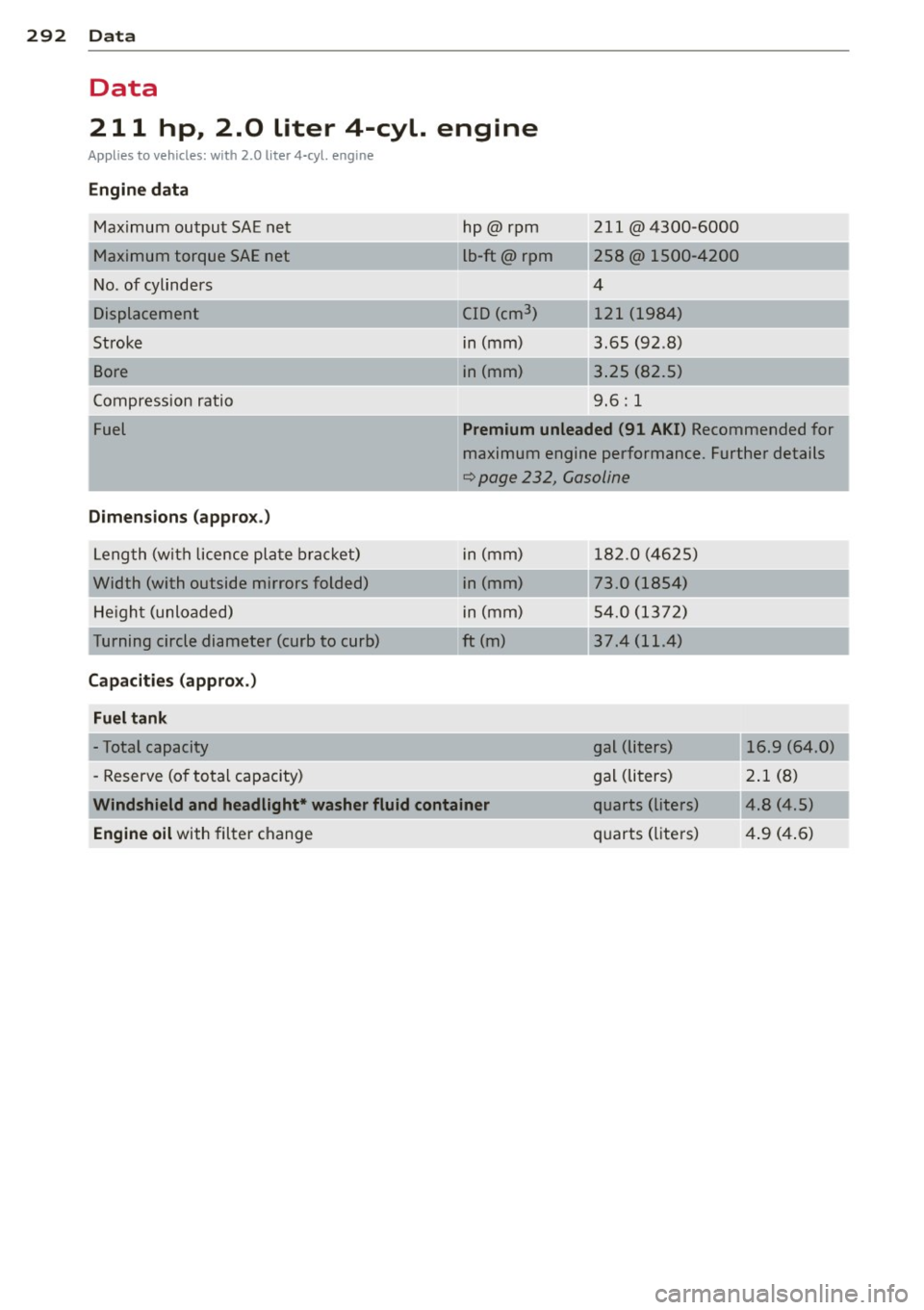
292 Data
Data
211 hp, 2.0 liter 4-cyl. engine
Applies to vehicles: with 2.0 liter 4-cyl. engine
Engine data
Ma ximum output SAE ne t
M aximum torque SAE net
No . of cylinders
Displacement
Stroke
Bore
C ompress ion ratio
Fuel
Dimensions (approx .)
Leng th (wit h licence pl ate brack et)
Width (with outside mirrors folded) He igh t (unloaded)
T urning circle diameter (curb to curb)
Capacities (appro x.)
Fuel tank
- Total capacity
- Reserve (o f to tal capacity) h
p@rpm
L b-ft@ rpm
C ID (cm
3
)
in (mm)
i n (mm)
-~,
211 @4300-6000
258@ 1500-420 0
4 121 (1984)
3.65 (92 .8 )
3 .25 (82 .5)
9 .6: 1
Premium unleaded (91 AKI) Recommended for
m aximum engine performance . Further details
q page 232, Gasoline
i n (mm) 1 82.0 (4 625)
i n (mm) 73.0 (1854)
i n (mm) 5 4.0 (1 37 2)
ft (m) 37.4 (11.4)
gal (liters) 16.9 (64 .0)
gal (li ters) 2.1
(8 )
Windshield and headlight* washer fluid container quarts (liters) 4.8 (4 .5)
Engine
oil with filter c hange qu
arts (lite rs) 4 .9 (4 .6)
Page 305 of 316

Index 303
-----------------------------------.......
Unleaded fuel ..................... 232
What should I do with an old battery? . 251
Environmental note
Rear window defogger . . . . . . . . . . . 83, 88
Roof rack .. .. ........... .. .. .. .... 74
EPC
refer to Electronic power control .... .. 15
E SP
refer to Electronic stabili zation program
(ESP) .... .. ................. .. .... 15
Event Data Recorder (EDR) ............ 204
Exhaust tail pipes Cleaning . .. ............. .. .. .. .. . 226
Expansion tank ............ .... .. ... 244
Exterior mirrors
Adjusting . ................. ... .... 57
Dimming ... ................ ... .... 58
Heating .. .. ............. .... .. .. .. 57
Eyeglasses compartment .... .. .. .. .. .. 77
F
Fan
Deluxe automatic climate control .. .. .. 81
Deluxe automatic climate control plus . . 87
Radiator ... .. .............. ... ... 246
Fastening Booster seats ............ .. .. .. .. . 194
Convertible child safety seats . .. .. .. . 192
I nfant seats ............. .... .. .. . 191
Flat tire Changing .. .. ........ ... .. .. .. .. . 274
Floor mats . . . . . . . . . . . . . . . . . . . . . . . . . 149
F og lights . . . . . . . . . . . . . . . . . . . . . . . . . . 50
Foot pedals . . . . . . . . . . . . . . . . . . . . . . . . 149
For the sake of the environment
Gasoline fumes and the environment .. 234
Reducing engine noise by early upshift-
ing .. .. .. .. .. .. ........... .. .. .... 11
Refueling .. .. ........ ... .. .. .. .. . 234
Saving fuel by early upshifting .. . ... .. 11
Front airbags
Description . .. ........... .. .. .. ... 166
Howtheywork .................... 171
Fr ontal collisions and the laws of physics 155
Front ashtray ............... ... ... ... 75 Front seats
. . . . . . . . . . . . . . . . . . . . . . . . . 61
Adjusting ..... .... ............... 146
Child restraints in the front seat .... .. 163
Convenience side view . . . . . . . . . . . . . . . 66
Symmetrical seat positions . . . . . . . . . . . 66
Fuel Additives ... ..... .. ............... 232
Blended gasoline ... .............. . 232
Consumption .. .. .... ......... .. .. . 22
Filler neck . .. .. .. .. . .............. 233
Fuel gauge . . . . . . . . . . . . . . . . . . . . . . . . 12
Gasoline .. .. .. .. .. . .. .... ........ 232
Gasoline additives .. .............. . 233
Octane rating .. .. ................. 232
Recommendation . .... ......... .. .. 232
Refuelling ..... .. .. ............... 234
Reserve ....... .... ................ 12
Tank capacity .................... . 292
Unlocking the fuel filler flap by hand .. 235
Fuel economy messages (efficiency pro-
gram) .... .. .. .. .. .. . .............. . 26
Fuel filler flap Unlocking the fuel filler flap by hand .. 235
Fuel supply too low ................. . 35
Fuses Assignment . . . . . . . . . . . . . 280, 281, 282
Replacing ........................ 280
G
Garage door opener (Homelink ®) .. .. .. 140
Gas discharge lamps .. ..... .......... 283
Gauges Engine coolant temperature . . . . . . . . . . 10
Fuel gauge .. .. .. ............... .. . 12
Tachometer . . . . . . . . . . . . . . . . . . . . . . . 11
Gear recommendation .............. .. 25
Gearshift indicator . .. ... ....... ...... 20
Gearshift lever 6-speed manual transmission ...... .. 126
General illustration Instruments and controls .......... ... 8
Glossary of tire and loading terminology 253
Glove compartment . . . . . . . . . . . . . . . . . . 77
Gross Vehicle Weight Rating (GVWR) . .. 290
•
•