instrument cluster AUDI A5 COUPE 2012 Owner's Guide
[x] Cancel search | Manufacturer: AUDI, Model Year: 2012, Model line: A5 COUPE, Model: AUDI A5 COUPE 2012Pages: 316, PDF Size: 78.59 MB
Page 131 of 316
Automatic Shift Lock (ASL)
Applies to vehicles: with a utomat ic transm ission
The Automatic Shift Lock safeguards you
against accidentally shi~ing into a forward or
the reverse gear and causing the vehicle to
move unintentionally .
;_ '"''1
·- I , . ,......._
W'.o ,)
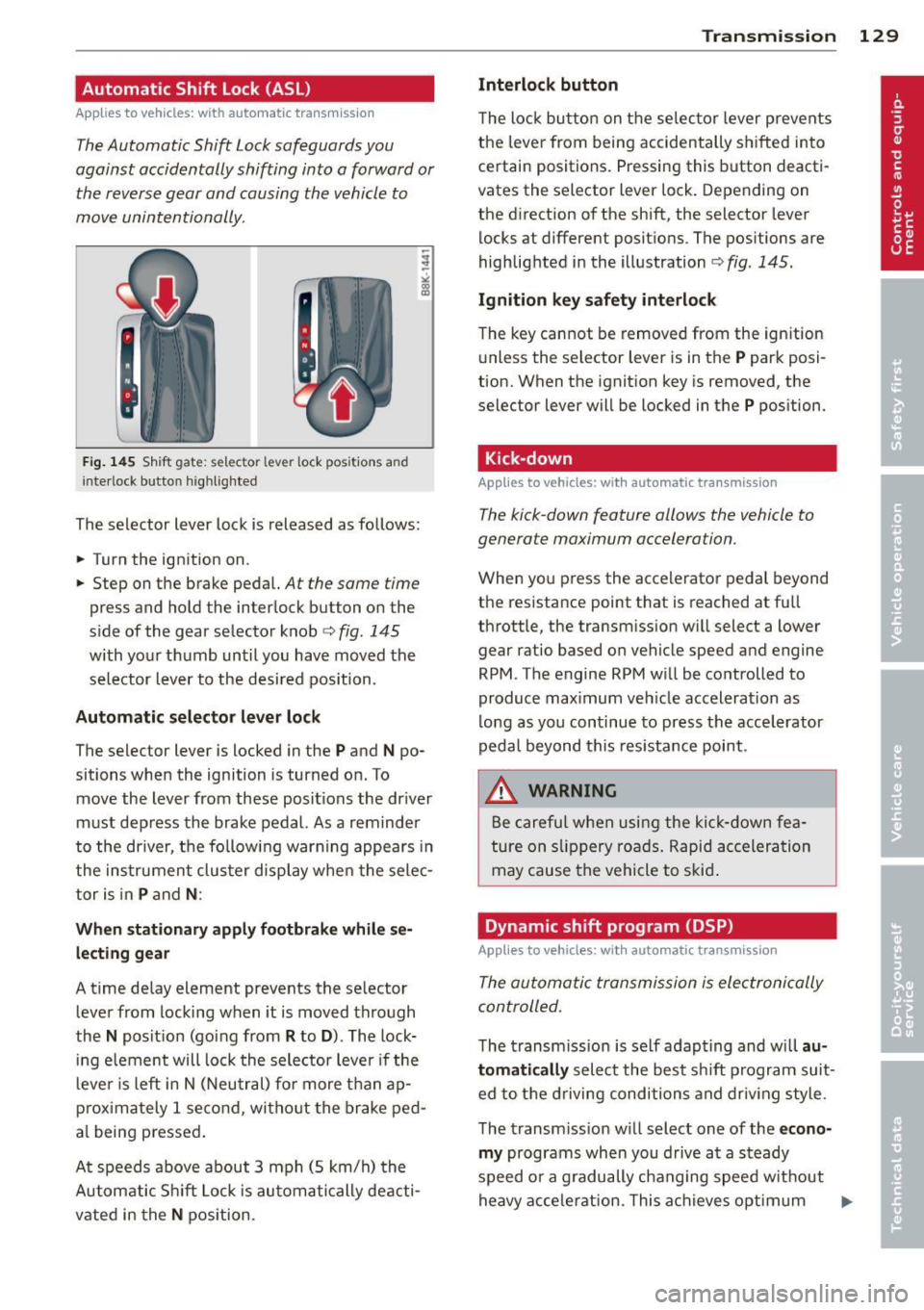
Fig. 145 Shift gate: selector lever lock positions and
in terlock b utto n highlighted
The selector lever lock is released as follows:
.. Turn the ignition on.
.. Step on the brake pedal.
At the same time
press and hold the interlock button on the
s ide of the gear selector knob
c::> fig. 145
with your thumb until you have moved the
selector lever to the desired position.
Automatic selector lever lock
The select or lever is Locked in the P and N po
sitions when the ignition is turned on. To
move the lever from these positions the driver
must depress the brake pedal. As a reminder
to the driver, the following warning appears in
the instrument cluster display when the selec
tor is in
P and N:
When stationary apply footbrake while se
lecting gear
A time delay element prevents the selector
lever from locking when it is moved through
the
N position (going from R to D ). The lock
ing element will lock the selector lever if the
lever is left in N (Neutral) for more than ap
proximately 1 second , without the brake ped
a l being pressed.
At speeds above about 3 mph (5 km/h) the
Automatic Shift Lock is automatically deacti
vated in the
N position.
Transmission 129
Interlock button
The lock button on the selector lever prevents
the lever from being accidentally shifted into
certain positions. Pressing this button deacti
vates the selector lever lock. Depending on
the direction of the shift, the selector lever
locks at different positions. The positions are
highlighted in the illustration
c::> fig . 145.
Ignition key safety interlock
The key cannot be removed from the ignition
unless the selector lever is in the
P park posi
tion. When the ignition key is removed, the
se lec tor Lever will be locked in the
P position.
Kick-down
App lies to vehicles: with automatic transmission
The kick-down feature allows the vehicle to
generate maximum acceleration .
When you press the accelerator pedal beyond
the resistance point that is reached at full
throttle, the transmission will select a lower
gear ratio based on vehicle speed and engine
RPM . The engine RPM will be controlled to
produce maximum vehicle acceleration as
long as you continue to press the accelerator
pedal beyond this resistance point.
.&, WARNING
Be careful when using the kick-down fea
ture on slippery roads. Rapid acceleration
may cause the vehicle to skid .
Dynamic shift program (DSP)
Applies to vehicles: wit h automatic transmission
The automatic transmission is electronically
controlled.
-
The transmission is self adapting and will au
tomatically
select the best sh ift program suit
ed to the driving conditions and driving style .
The transmission will select one of the
econo
my
programs when you drive at a steady
speed or a gradually changing speed w ithout
heavy acceleration. This achieves optimum ..,.
Page 156 of 316
154 Safety belts
Safety belts
General notes
Always wear safety belts!
Wearing safety belts correctly saves lives!
This chapter explains why safety be lts are nec
essary, how they work and how to adjust and
wear them correctly .
.. Read a ll the information that fo llows and
heed all of the instruct ions and WARNINGS.
A WARNING
Not wearing safety belts or wearing them
improperly increases the risk of ser ious
personal in jury and death .
- Safety belts are the sing le most effective
means avai lab le to reduce the risk of se
r ious injury and dea th in a utomob ile acci
dents. For your protection and that of
yo ur passenge rs, always co rrectly wear
safety belts when the vehicle is moving.
- P regnant women, injured, or physically
im paired perso ns mu st also use safety
bel ts. Lik e all veh icle occup ants, they are
more like ly to be ser iously injured if they
do not wea r safety be lts . The best way to
protect a fetus is to protect the mother -
throughout the entire pregnancy.
Number of seats
Your Audi has a total of four seating positions: two in the front and two in the rear. Each seat
ing position has a safety belt .
A WARNING
Not wearing safety belts or weari ng them
improp erly increases th e risk of ser ious
pe rsonal i njury and dea th.
- N ever st rap more than one pe rson, in
cl uding small ch ild ren, into any belt.
It is
e speci ally dange rous to pla ce a safety
belt over a child s itting on yo ur lap.
- N ever le t mo re people ride in the ve hicl e
than there are s afe ty be lts avail able. -
Be s ure everyone riding in the vehicle is
properly restrained w ith a separate safe
ty belt or child restra int.
Safety belt warning light
Your vehicle hos o warning system for the
driver and (on USA models only) front seat
passenger to remind you about the impor
tance of buckling-up .
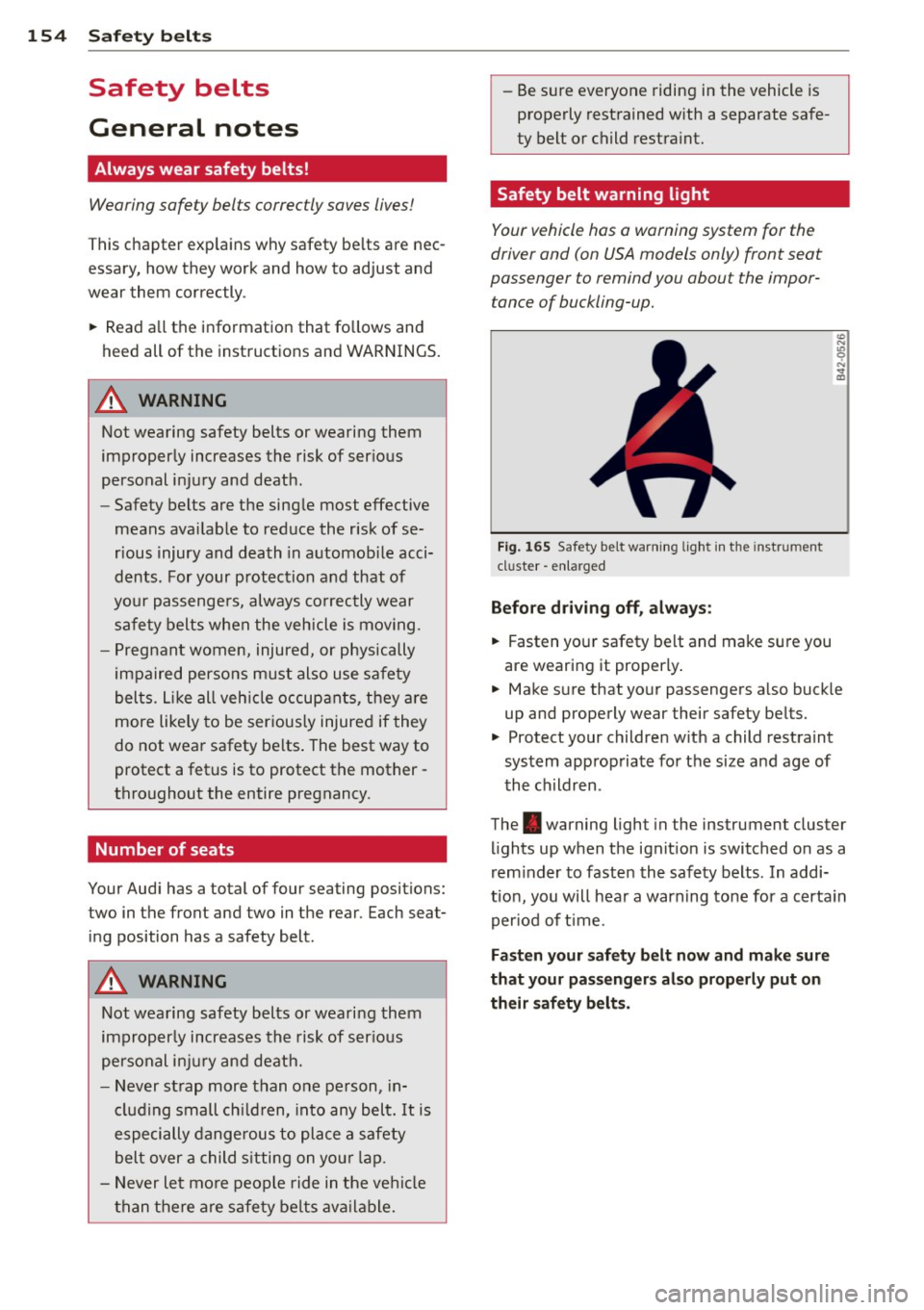
Fi g. 165 Safety belt warni ng lig ht in the instrument
cluster -en larged
Before driving off, always :
.. Fasten you r safety belt and make sure you
are wearing it properly .
.. Make s ure that yo ur passengers a lso buck le
up and properly wear their safety be lts.
.. Protect your children w ith a child rest raint
system approp riate fo r the size and age of
t he children.
The . warning light in the instrument cluster
li ghts up when the ignit ion is switched on as a
r em inder to faste n the safety belts. In addi
t io n, you will hear a warn ing tone for a certa in
per iod of t ime.
Fasten your safety b elt now and make sure
that your pas sengers al so properly put on
their safety belts.
Page 166 of 316
164 Airbag sys te m
Even though your vehicle is equipped with an
Advanced Airbag System, make certain that
all c hildren, especially those 12 years and
younger, a lways ride in the back seat properly
restra ined for their age and size. The airbag
on the passenger side makes the front seat a potentially dangerous place for a ch ild to r ide.
The front seat is not the safest place for a
child in a fo rward-facing ch ild safety seat. It
can be a very dangerous place for an infant or
a child in a rearward-facing seat.
The Advanced Airbag System in your veh icle
has been certified to comp ly with the Requ ire
ments of United States Federa l Mo tor Veh icle
Safety Standard 208 as applicable at the time
your vehicle was manufactured.
The Standard requires the front a irbag on the
passenger side to be turned off ("sup
pressed") if a ch ild up to about one year of
age restrained in one of the rear -facing or for
ward -facing infant restraints listed in Federal
Motor Vehicle Safety Standard 208 with which
the Advanced A irbag System in your vehicle
was certified has been installed on the front passenger seat . For a listing of the child re
strai nts that we re used to certify compliance
with the US Safety Standard
r=v page 188.
The PASSENGE R AIR BAG OFF light in the in
strument panel te lls you when the front Ad
vanced A irbag on the passenger side has been
turned off by the e lectronic control unit.
Each t ime you turn on the ignition, the
PAS
SENGER AIR BA G OFF
light will come on for a
few seconds and:
- will stay on if the front passenger seat is not
occupied,
- wi ll stay on if there is a small child or child
restraint on the front passenger seat,
- wi ll go off if the front passenger seat is oc
cupied by an adult as registered by the
weight-sensing mat
r=v page 173, Monitor
ing the Advanced Airbag System .
The PASSENGE R AIR BAG OFF light comes on
when the control un it detects a total weight
on the front passenger seat that requires the
front airbag to be turned off.
If the total weight on the front passenge r
seat is more than that of a typica l 1 year -old
chi ld but less than the weight of a small
adult, the front airbag on the passenger side
can deploy (the
PASSENGER AIR BAG OFF
li ght does not come on). If the PAS SENGER
AI R BAG OFF
light does not come on, the
front a irbag on the passenger side has not
been tu rned off by the elect ronic con trol unit
and can deploy if the control unit se nses an
impact that meets the cond itions stored in its
memory .
For exampl e, th e airbag ma y deploy if:
-a small ch ild that is heav ier than a typical 1
year-old ch ild is on the front passenger seat
( r egard less of whether the child is in one of
t he child safety seats listed
r=v page 188), or
- a child who has outgrown ch ild restraints is
on the front passenger seat.
If the front passenger airbag is turned off, the
PASSENGER AIR BAG OFF light comes on in
the instrument cluster and stays on.
The front airbag on the passenger s ide may
not deploy (the PASSENGER AIR BAG OFF
light does not illum inate and stay lit) even if a
small adult or teenager, or a passenger who is
not sitt ing up rig ht w ith their back against a
non- recl ined ba ck res t w it h thei r feet on the
vehicle floor in front of the sea t is on the front
passenger seat
r=v page 145, Proper seating
position for the driver.
If the front passenger a irbag dep loys, the
F ede ra l Standard req uires the airbag to meet
the "low risk" dep loyment criteria to reduce
the risk of injury t hro ugh interaction wit h the
airbag. "Low risk" dep loyment occ urs in those
crashes that take place at lower dece lerat ions
as defined in the electronic control unit
r=v page 173, PASSENGER AIRBAG OFF light.
Always remember, a ch ild safety seat or infant
carr ier installed on the front seat may be
struck and knocked out of posit ion by the rap
idly inflat ing passenger's airbag in a fronta l
collision . T he a irbag could greatly reduce the
effectiveness of the ch ild restraint and even
seriously injure t he ch ild during inflation .
Page 171 of 316
-Always move the passenger seat into its
rearmost position in the seat's fore and
aft adjustment range, as far away from
the a irbag as poss ible, before installing
the forward-facing child restraint. The backrest must be adjusted to an upr ight
posit ion.
- Make sure that the
PASSENGER AIR BAG
OFF
light comes on and stays on all the
t ime w henever the ignition is sw itched
on.
Advanced Airbag System components
The fron t passenger seat in your vehicle has a
lot of very important parts of the Advanced
Airbag System in it. These parts include the
weight-sensing mat, sensors, wiring, brack
ets, and more. The function of the system in
the front passenger seat is checked by the
e lectronic control u nit when the ignit ion is on .
The control un it mon itors the Advanced Air
bag System and turns the airbag indicator
l ight on whe n a ma lfunction in t he sys tem
components is de tected. The function of the
airbag indicator light is described in greater
detai l below . Because the front passenger
seat contains important parts of the Ad
vanced A irbag System, you m ust take care to
prevent it from being damaged. Damage to
the seat may prevent the Advanced Airbag for
the front passenger seat from doing its job in
a crash .
The front Advanced Airb ag Sy stem
consists of the following:
- Crash sensors in the front of the veh icle that
measure veh icle acceleration/decele ration
to provide information to the Advanced Air
bag System about the seve rity of the crash.
- An electronic co ntrol unit, with integrated
c rash se nsors for front and side impacts .
T he cont ro l unit " decides " whethe r to fire
the front airbags based on the inform ation
received from the crash senso rs . The contro l
unit a lso "decides" whether the safety belt
pretensioners should be activated .
Airbag system 169
-An Advanced A irbag w ith gas gene rator and
contro l valve fo r the driver ins ide the steer
ing wheel h ub.
- An Advanced Airbag w ith gas gene rator and
contro l valve inside the instrument pane l for
the front passenger.
- A weight-sensing mat under the upholstery
padding of the front passenger seat cushion
that measures the total weight on the seat.
The informat ion reg istered is sent continu
ously to the electronic control unit to regu
late deployment of the front Advanced Air
bag on the passenger side.
- An airbag monitor ing system and ind icator
light in the instrument cluster
q page 173 .
-A sensor in each front seat registers the dis
tance between the respective seat and the
steer ing whee l o r inst rument panel. The in
forma tion registered is sent cont inuo usly to
t he elect ron ic cont ro l uni t to regula te de
ployment o f the front Advance d Airbags .
- The
PASSENGER AIR BAG OFF ligh t comes
on and st ays on in the cen ter o f th e instr u
ment panel
q page 1 73, fig . 178 and tells
you whe n the front Advanced Airbag on the
passenger side has been tu rned
off .
-A sensor below the safety be lt latch fo r the
front seat passenger to measure the tension on the safety be lt . The tension on the safety
be lt and the weight registered by the
weight-sensing mat he lp the control unit
"decide" whether the front a irbag for the
front passenge r seat should be turned
off or
not
~ pag e 163, Child restraints on the
front seat -some important things to
know.
- A senso r in the safety belt latch fo r the d riv
er a nd fo r the fro nt sea t passenger tha t
senses w hethe r that safe ty belt is latched or
no t and transmi ts this informa tion to the
electronic control unit.
_&. WARNING
Damage to the front passenger seat can
prevent the front airbag from work ing
properly.
-
•
•
Page 177 of 316
PASSENGER AIRBAG ON will briefly appear in
the instrument cluster display. This is to in
form the driver of the current front passenger
airbag status .
Important safety instructions on
monitoring the Advanced Airbag System
A WARNING
An airbag system that is not functioning
properly cannot provide supplemental pro
tection in a frontal crash.
- If the airbag indicator light comes on, it
means that there may be someth ing
wrong with the Advanced Airbag System .
It is possible that the airbag will inflate
when it is not supposed to, or w ill not in
flate when it should .
- Have the airbag system inspected imme
diately by your author ized Audi dealer .
A WARNING
If the front airbag inflates, a ch ild without
a child restra int, in a rearward-facing child
safety seat or in a forward-facing chi ld re
straint that has not been prope rly insta lled
w ill be seriously injured and can be k illed.
- E ven thoug h your veh icle is equipped
with an Advanced Airbag System, make certain that a ll children, especially 12
years and younger, a lways ride on the
back seat properly restrained for their
age and size.
- Always insta ll forward or rear -facing
child safety seats on the rear seat -even
with an Advanced Airbag System.
- If you must install a rearward-facing
child safety seat on the front passenger
seat because of exceptional circumstan ces and the
PASSENGER AIR BAG OFF
light does not appear and stay on, imme
diately insta ll the rear-fac ing ch ild safety
seat in a rear seating position and have
the a irbag system inspected by you r au
thorized Aud i de aler.
- A tight tether or other st rap on a rear
wa rd-fac ing child restra int attached to
-
A irbag system 1 75
the front passenger seat can p ut too
m uch pressu re on the weight-sensing
mat in the seat and reg ister more weight
than is actually o n the seat . The heavier
weight registered can make the system
wo rk as tho ugh an adult we re on the seat
a nd deploy the Advanced Airbag w hen it
m ust be suppressed causing ser ious or
even fata l injury to the ch ild .
- I f, in exceptiona l circumstances , you
m ust install a forward-fac ing ch ild re
s traint on the front passenger seat, al
ways move the seat into its rearmost po sition in the seat's fore and aft adjust ment range, as far away from the a irbag
as poss ible. The backrest must be ad just
ed to an upright pos ition. Make sure that
the
PASSENGER AIR BAG OFF light
comes on and stays o n all t he time when
eve r the ignit ion is switched on.
A WARNING
-
- I f the PASSENGER AIR BAG OFF light
does not go o ut when an ad ult is sitting
on the front passenger sea t after tak ing
the steps described above, make su re the
ad ult is properly seate d and restra ined at
one o f the rea r seat ing pos itions.
- Have the airbag system inspected by your authorized Audi dealer before transport ing anyone on the front passenger
seat .
(D Tips
If the weight -sensing mat in the front pas
senger seat detects an empty seat, the
front airbag on the passenger side wi ll be
turned off, and
PASSENGER AIR BAG OFF
will stay on.
Repair , care and disposal of the airbags
Parts of the airbag system are i nstalled at
many different p laces o n your Aud i. Insta lli ng,
removing, servicing or repa iring a par t in an
area o f the veh icle can damage a par t of an
airbag sys tem and preven t that system from
working properly in a coll is ion . ..,.
•
•
Page 182 of 316
180 Airbag system
Side airbags
Description of side airbags
The airbag system can provide supplemental
protection to properly restrained occupants .
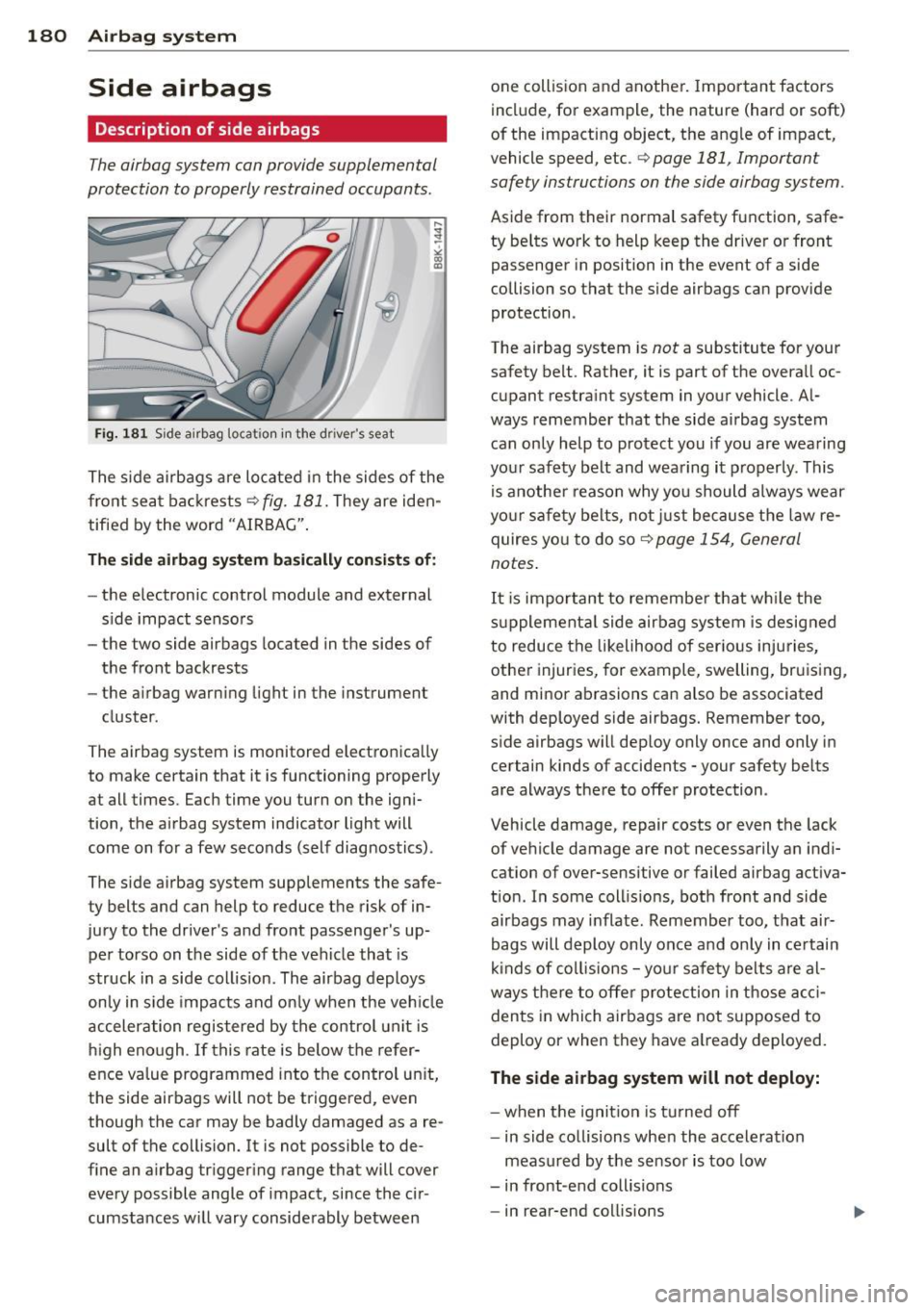
Fig. 18 1 Side a irbag locat io n in the d river 's seat
The s ide airbags are located in the sides of the
front sea t bac krests
~ fig. 181. They are iden
tified by the word "AIRBAG" .
The sid e airbag system basicall y consis ts of :
-the electronic control module and external
side impact sensors
- the two side airbags located in the sides of
t h e front backrests
- the a irbag warn ing light in the instrument
cluster.
The airbag system is monitored electronica lly
to make certain that it is functioning properly at all times. Each time you turn on the igni
tion, the airbag system indicator light will
come on for a few seconds (self diagnostics) .
The s ide airbag system supplements the safe
ty belts and can help to reduce the risk of in
jury to the drive r's and front passenger's up
pe r torso on the side of the vehicle that is
struck in a side col lision . The airbag deploys
on ly in side impacts and on ly when the veh icle
acceleration registered by the control unit is h igh eno ugh . If this rate is below the refer
ence va lue programmed into the control un it,
the side airbags will not be triggered,
even
though the car may be badly damaged as a re
sult of the collision. It is not possible to de
f ine an a irbag tr igger ing range that will
cover
every
possible angle of impact, since the cir
cumstances w ill
vary considerably between one collision and another.
Important factors
incl ude, for example, the nature (hard or soft)
of the impacting object, the angle of impact,
vehicle speed, etc .
c:> page 181, Important
safety instructions on the side airbag system .
Aside from their normal safety function, safe
ty belts work to help keep the driver or front
passenger in position in the event of a side
collision so that the side airbags can provide
protection .
The airbag system is
not a substitute for your
safety belt . Rather, it is part of the overa ll oc
cupant restra int system in your vehicle . Al
ways remember that the side airbag system
can only help to protect you if you are wea ring
you r safety belt and wea ring it p roperly . This
is anothe r reason why yo u should always wear
yo ur s afe ty be lts, no t ju st because the law re
quires yo u to do so~
page 154, General
notes .
It is impo rtant to remembe r th at w hile the
s u pplementa l side airbag system is designed
to reduce the likelihood of ser io us inju ries,
othe r injuries, for example, swelling, br uising ,
and minor abrasions ca n also be associated
with deployed side airbags. Remember too,
s ide airbags will deploy only once and only in
certain kinds of accidents -your safety belts
are always there to offer protection .
Vehicle damage, repair costs or even the lack
of ve hicle damage are not necessarily an ind i
cation of over-sensitive or failed airbag activa
t io n. In some coll is ions, both front and side
airbags may inflate . Remembe r too, t hat air
bags will deploy only once and on ly in ce rtain
ki nds of col lisions -yo ur safety belts a re a l
ways there to offer pro tection in those a cc i
den ts in which airbags are no t su pposed to
deploy or when they have a lready deployed.
The side airbag system will not deploy:
- when t he ig nit ion is tu rned off
- in side co llisions when the acceleration
measured by the sensor is too low
- in front -end collisions
- in rear-end collisions
Page 213 of 316
Energy management
Starting ability is optimized
Energy management controls the distribution
of electrical energy and thus optimizes the
availability of electrical energy for starting the engine .
If a vehicle with a conventional energy system
is not driven for a long period of time , the bat
tery is discharged by idling current consumers
(e.g. immobilizer). In ce rtain c ircumstances it
can result in there being insuff icient ene rgy
avai lab le to start the engine .
Intell igent energy management in your vehi
cle hand les the d istribution of electrical ener
gy. Starting ab il ity is markedly improved and
the life of the battery is extended.
Basically, energy management consists of
batt ery di ag nosis, idlin g current man ag e
m ent
and dyn ami c en ergy manage ment .
Batter y diagnosis
Battery diagnosis continuously determines
the state of the battery . Sensors determ ine
battery vo ltage, battery current and battery
temperature. This determ ines the current
state of charge and the powe r of the battery.
Idling curr ent man agement
Idling current management reduces ene rgy
consumption while the vehicle is stand ing .
W ith the ignition switched off, it cont ro ls the
energy supply to the va rious electr ical compo
nents . Data from battery diagnosis is consid
ered.
Depending on the battery's state of charge,
i nd ividua l consumers are gradual ly t urned off
to prevent excess ive d ischarge of the bat tery
and thus maintain starting capability .
Dynam ic en ergy management
While the vehicle is being driven, dynamic en
e rgy management dist ributes the energy gen
e rated according to the needs of the individu
a l components.
It reg ulates cons umption, so
that more electrical energy is not being used
Int ellig ent technolog y 211
than is being generated and ensures an opti
mal state of charge for the battery.
(0 Tips
- But even energy management canno t
negate the limits of physics . Consider
that the power and life of a battery are
limited .
- If starting ability is threatened, you are
informed by a warning
r:!) page 212,
Driver notification in the instrument
cluster display.
What you should know
The highest priority is given to maintaining
starting capability.
The battery is severe ly taxed in short -distance
driving, in city traffic and during the cold time
of year. Abundant electrical energy is re quired, but only a little is generated .
It is also
critical if the engine is not running and electri
cal components are turned on . In this in
stance energy is be ing consumed but none is
being generated.
It is in precisely these situations that you will
notice energy management actively regulat
ing the d istribution of energy .
Vehicle stands for an e xtended peri od
If you do not drive your vehicle over a period
of several days or weeks, e lectr ical compo
nents are gradually cut back or switched off.
This reduces energy consumption and ma in
ta ins start ing capability over a longer period .
Some of the convenience functions may not
operate, such as the interior lights or the power seat adjustment . The convenience
funct ions w ill be available again when you
tu rn o n the ign ition and start the engine.
With the eng ine tu rned off
If you listen to the radio, for examp le, w ith
the engine turned off or use other MMI func -
tions, the battery is be ing discharged.
IJJ,-
•
•
Page 214 of 316

212 Intelligent technology
If starting capability is jeopardized due to en
ergy consumption, the following warning ap
pears in the MMI display:
Please start engine, otherwise system will
switch off in 3 minutes.
The warning ind icates that the system will be
turned off automatically after 3 minutes. If
you wish to continue using the functions, you
have to start the engine .
With the engine running
Although electrical energy is generated when
the vehicle is be ing driven, the battery can be
come discharged . Thi s happens mostly when
little ene rgy is being generated and a great
deal consumed and the battery's state o f
charge is not optima l.
To bring the energy balance back into equili
brium, consumers which require especially
l arge amounts of energy are temporarily cut
back or switched off. Heating systems in par
ticular require a great dea l of energy. If you
notice, for example, that the heated seats* or
the heated rear window are not heating, they
have been temporar ily cut back or switched
off. These systems will be ava ilable again as
soon as the energy balance has been restored.
You will also notice that engine idle speed has
been increased slightly. This is normal and not
a cause for concern . By increas ing engine idle
speed the add itiona l energy required is gener
ated and the battery is charged.
Driver notification in the instrument
cluster display
If battery power drops into the range where it
can limit the ability of the engine to start, this is shown in the instrument cluster display
with the following driver message:
(•i Low battery charge : battery will be
charged while driving
This notif ication reminds you that the starting
capability of the engine may be limited. As
soon as you start driving again, the battery will
be recharged and the notification will go
out.
Driver notification appears and goes out
again
If this driver notification appears after the ig
nition is turned on or whi le driving and it goes
out again after a while, the battery has been
adequately recharged.
Driver notification appears and does not
go out again
If this driver notification appears after the ig
nition is turned on or whi le driving and does
not go out again, the battery's state of charge
is not in the optimal range. Starting ability is
restricted . Have the battery checked as soon
as possible by an authorized Aud i dea ler or
qualified wo rkshop.
Page 221 of 316
Tire pressure
When towing a tra ile r, inflate the t ires of your
vehi cle to the co ld tire pressure listed under
"Full load" on the label located either on the
driver's side B-pillar (visible when the doo r is
open) or inside the f uel f iller flap. Inf late
trailer tires to trailer and tire manufact urers'
specifications .
Lights
The headlight settings should be chec ked w ith
the t railer attached before dr iv ing off. Check
to make sure both vehicle and trai ler lights
are working properly.
Safety chains
Be s ure trai le r sa fety chains are p roperly con
nected from the t railer to the hitch on the ve
h icle. Leave enough s lack in the chains to per
mit turn ing corners . When you install safety
chains, make su re they w ill not drag on the
road when you are driving.
T he chains shou ld cross under the trai ler
tongue to prevent it from droppi ng in case of
separat io n from the hitch .
Driving instructions
Driving with a trailer always requires extra
care and consideration.
To obtain the best poss ible handling of vehicle
and trai ler, p lease note the following:
.,. Do no t tow a loa ded tra iler whe n your car i t
self is no t loaded .
.,. Be especia lly careful when passing other ve
hicles.
.,. Observe speed limits.
.,. Do not drive at the maximum permissible
speed.
.,. Always apply brakes early .
.,. Monito r the t em perature gauge.
Weight distribution
Tow ing a loaded trai ler with an empty car re
sults in a highly unstable distribution of
weight . If this ca nnot be avo ided, drive at very
Trailer towin g 219
low speeds on ly to avo id t he ris k of losing
steering cont ro l.
A "b alanced " rig i s ea sier to op erat e and con
tr ol. T his means t hat t he tow vehi cle should
be loaded to the extent possible and permissi
ble, while keep ing the trai ler as light as possi
ble under the c ircu mstances . Whenever poss i
ble, transfer some ca rgo to the luggage com
partment of the tow vehicle while obse rvi ng
tongue load requirements and vehicle load ing
cons idera tions .
Speed
The higher the speed, the more d iff icu lt it be
comes for the driver to contro l the rig. Do not
drive at the maxim um permissib le speed. Re
duce your speed even more if load, weather o r
wind conditions are unfavo rable -pa rticula rly
whe n going downhill .
Red uce ve hicle speed
immediately if the trail
er shows the slig htest s ign of sway ing .
Do not
try to stop the swaying by accelerating .
Observe speed limits. In some areas, speeds
for vehicles tow ing tra ile rs are lowe r than for
regular ve hicles .
A lways apply brakes early. When driving
down hill, shift into a lowe r gear to use the en
gine braking effect to s low the vehicle. Use of
the b rakes alone ca n cause them to overhea t
and fail.
Coo lant temperature
The coo lant temperat ure ga uge ¢ page 10
must be observed carefu lly. If the need le
m oves cl ose to t he upper end of t he scale, re
duce speed immediately and/or turn off t he
a ir condi tioner .
If the coolant temperature warning light .
in the instrument cluster starts flashing, pull
off the road , stop and let the engine
i dle for
abo ut two minutes to prevent heat build-up .
A WARNING
Anyone no t properly restra ined in a mov
in g ve hicle i s at a much gre ater r isk in an
a cci dent . N ever le t anyone rid e in yo ur car
-
•
•
Page 243 of 316
temperatures stay below freezing point for l ong periods.
Detergent add itives in the o il w il l make fresh
oil look dark after the eng ine has been run
ning fo r a short time . This is norma l and is not
a reason to change the oi l more often than
recommended.
D am ag e or m alfun ction s due to lack of
ma intenanc e
It is essential that you change your oil at the
r ecommended inte rva ls using only engine o il
t hat complies wi th A udi oi l standard
VW 502 00. Yo ur Limited New Vehicle War
ranty does not cover damage or malfunctions
d ue to fa ilure to fo llow recommended mainte
nance and use requ irements as set forth in
the Audi Owner's Manua l and Warranty
&
Maintenance book let . Your dea ler will have to
deny warranty coverage u nless you present to
the dea ler p roof in the fo rm of Serv ice or Re
pa ir Orde rs that all s chedu led maintenance
wa s pe rformed in a t imely manner .
Engine oil consumption
The engine in your vehicle dep ends on an ade
quate amount of oil to lubricate and cool all
of its moving parts.
In o rder to provide effective l ubrication and
cool ing of i nternal engine components, a ll in
ternal comb ustion eng ines consume a cert ain
amo unt of o il. Oil cons umption varies from
engine to engine and may change significantly
over the life of the engine. Typ ica lly, engines
with a specified break-in per iod (see
c::;, page 213) consume more oil during the
break-in per iod than they consume after oil
consumption has stabilized .
Under norma l conditions, the rate of oil con
sumpt ion depends on the quality and viscosity
of the oil, the RPM (revo lutions per m inute) at
which the engine is operated, the amb ient
temperature and road condit ions. Furthe r fac
tors ar e the amount of o il d ilution from wate r
condensation or fuel residue and the ox ida
tion level of the oi l. As any engine is s ubje ct to
Checkin g and fillin g 241
wear as m ileage builds up, the oil consump
tion may increase over time until replacement
of worn components may become necessary.
Wi th a ll these variab les coming into p lay, no
standard rate of oil consumpt ion can be es
tablished or specified. There is no alternative
to regular and frequent check ing of the o il lev
el, see
Note .
If the yellow engine oil leve l warning symbo l
Ill in the instrument cluster lights up, yo u
sho uld check the oil leve l as soon as possib le
c::;, page 242. Top off the oil at your earliest
convenience
c::;, page 242.
A WARNING
Before you check anythi ng i n the engi ne
compartment, always read a nd heed all
WARNINGS
c::;, .&. in Working in th e engine
c ompartment on page 23
7.
(D Note
D riving w ith a n insufficient o il level is like
ly to cause sever e damage to the engine .
(D Tips
- The oil pressure warning display. is
not an indicator of the oil level. Do not
rely on it . Instead, check the oil level in
your engine at regu lar intervals , pref
erably each time you refuel, and alway s
before going on a long trip .
-If you have the impression yo ur engi ne
c ons umes ex ce ssive amoun ts of o il, we
recommend that you consul t an a uthor
ized Aud i dea ler to have the cause of
your concern properly d iagnosed. Keep in
mind that the accurate measu rement of
oil consumption requ ires great care and
may take some t ime. An authorized Aud i
dealer has instructions about how to
measu re oil co nsumption accurately.
-
•
•