wheel AUDI A5 COUPE 2012 Service Manual
[x] Cancel search | Manufacturer: AUDI, Model Year: 2012, Model line: A5 COUPE, Model: AUDI A5 COUPE 2012Pages: 316, PDF Size: 78.59 MB
Page 212 of 316
210 Intellig ent technol ogy
- If the power steer ing system should fail
entirely, or if the engine is not running (for example, while being towed), you
will still be ab le to steer the vehicle.
However,
considerably more effort w ill
be required to do so .
- If the power steer ing system should
have a leak, or is not functioning proper
ly, contact your authorized Aud i dealer
i mmediately.
- The power steering system requires a
spec ially formulated hydraulic flu id . T he
power steer ing reservoir is the one locat
ed farthest to the rear on the left side of
the engine compartment~
page 239.
The correct flu id leve l in the reservo ir is
important for proper functioning o f the
power steering.
Driving with your
quattro ®
With all wheel drive, all four wheels are driv
en.
Gener al inform ation
W ith all wheel dr ive, power is distr ibuted to
all four wheels . This happens automatically
depending on your dr iving style and the road
conditions at the t ime . See also ~
page 205,
Electronic differential lock (EDL) .
The all wheel drive concept is designed for
h igh engine power . Your vehicle is exception
ally powerful and has excellent dr iving charac
ter istics both under normal driving conditions
and on snow and ice . Always read and follow
safety precautions
~ ,&. .
Winter tires
When driving in the w inter, your vehicle w ith
all wheel drive has an advantage, even with regular t ires. In winter road conditions it may
be adv isable to mount winter t ires (o r all-sea
son t ires) for improved driveability and brak
ing : these tires must be mounted on all four
wheel s. See also
q page 267, Winter tires .
Tir e chain s
Where tire chains are mandatory on certain roads, this norma lly also app lies to vehicles
with all wheel drive~
page 268, Snow
chains.
Replacing wheels /tires
Vehicles with a ll wheel d rive must always have
ti res of the same s ize. A lso avo id tires w ith
different t read dep ths . For detai ls see page
~ page 263, New tires and replacing tires
and wheels .
Off-Road dr iv ing?
Your Audi does not have enough g round clea r
ance to be used as an off-road vehicle .
It is
therefore best to avoid rough tracks and un
even terrain as much as possib le . Also refer to
9 page 214.
A WARNING
-
Always adjust your dr iv ing to road and traf-
f ic conditions. Do not let the extra safety
afforded by all whee l drive tempt you into
taking extra risks.
- Although the all whee l drive is very effec
tive, always remember that braking ca pacity is limited by tire tract ion. You
should t herefore not d rive at excessive
speeds on icy or slippe ry road s urfaces.
- On wet road surfaces, be careful not to
drive too fast because the front whee ls
co uld begin to slide on top of the water
(aquaplaning) . If th is should occur, you
wi ll have no warning from a s udden in
crease in engine speed as w it h a front
wheel drive veh icle. Always drive at
speeds which are su ited to the road con
ditions -risk of crash.
Page 222 of 316
220 Trailer towing
who is not properly wearing the restraints
provided by Aud i.
Trailer towing tips
Important to know
Your vehicle hand les different ly when towing
a trailer because of the additional weight and
different weight distribution. Safety, perform
ance and economy wi ll greatly depend on how
carefully you load your trailer and operate
your rig.
Before you actually tow your trailer, practice
turning, stopp ing and backing up in an area
away from traffic. Keep practicing until you have become completely familiar with the way
your vehicle-trailer combination behaves and responds.
Backing up is difficult and requires practice.
Backing up with a trai ler genera lly requires
steering action opposite to that when backing up your vehicle without a trailer.
Maintain a greater distance between your ve
hicle and the one in front of you. You will need
more room to stop. To compensate for the
trailer, you will need a larger than normal
turn ing radius .
When passing, remember that you cannot ac
celerate as fast as you normally would be
cause of the added load. Make sure you have
enough room to pass . After passing, allow
plenty of room for your tra iler before chang
ing lanes aga in.
Avoid jerky starts, sharp turns or rapid lane
changes .
(D Tips
-Do not tow a tra iler during the break-in
period of your vehicle.
- If you tow a trailer, your Audi may re
quire more frequent maintenance due to
the extra load
q page 293.
Parking on a slope
Do not park on a slope with a trailer . If it can
not be avoided, do so only after doing the fol lowing:
When parking:
.. App ly the foot brake.
.. Have someone place chocks under both the
vehicle and the trailer wheels .
.,. With chocks in place, slowly release the
brakes until the wheel chocks absorb the
load.
.. Turn the wheels towards the curb.
.. App ly the parking brake.
.. Place an automatic transmission* in
P, re
spectively a manual transmission in first or reverse gear.
When restarting after parking:
.. App ly the foot brake.
.. Start the engine.
.. Move the se lector lever to
D , respectively a
manual transmission in first gear .
.. Release the parking brake and slow ly pu ll
out and away from the wheel chocks.
.. Stop and have someone retr ieve the wheel
chocks .
(D Tips
If you move the selector lever of the auto
matic transmission* to
P before applying
the parking brake and before blocking the
whee ls, you may have to use more force
lat er to move the lever out of the
P posi
tion.
Page 223 of 316
Cleaning and protect ion
General information
Regular core preserves vehicle value.
Any automobile is exposed to industrial
fumes , corrosive road salt, etc. A well cared
for Audi can look like new many years after purchase . Regu lar and correct care w ill con
tr ibute to maintaining the beauty and value of
your Aud i.
F u rth ermor e, good c are may be a conditi on
for subs tantiati ng a w arrant y claim sho uld
c orrosion d amag e or paint d efects oc cur.
Your authorized Audi dealer has a variety of
dedic ated veh icle-car e products and can ad
vise which ones to use for cleaning the exter i
or and interior of your vehicle.
Whether you use products recommended by
Aud i or other commercially available clean ing
agents, please make sure you apply them cor
rectly .
.&, WARNING
-Cleaning agents may be poisonous. Keep
them out of the reach of children.
- Heed all caut ion labels.
- Always read directions on the container
before using any product. Follow the di
rect ions carefu lly.
- Most chemical cleaners are concentrated
and have to be diluted .
- Use spot removing fluids only in well
ventilated areas.
- Do not use gasoline, kerosene, d iesel
fuel, nail polish remover or other volatile
fluids. They may be toxic, flammab le or
haza rdous in other ways. Do not wash,
wax or dry the vehicle with the ign it ion
on or the engine running.
- Do not clean the undersides of chassis,
fenders, wheel covers, e tc. w ithout pro
tecting your hands and arms. You may c u t yourself on sharp -edged metal parts .
Cleaning and protec tion 221
- Moisture and ice on brakes may impair
brak ing effic iency¢
page 207, General
information.
Test the brakes carefully
each time you wash the vehicle.
@) For the sake of the environment
Select on ly environmentally friend ly clean
i ng products . Leftover cleaning products
should not d isposed of in the household
waste.
Care of exterior
Washing
Frequent washing protects the vehicle .
The best protection against environmental i n
fluences is
frequent washing and waxing . How
often t his is required depends on:
- How much the veh icle is used
- Where the veh icle is parked (garage, in the
open under trees, etc.)
- The seasonal and weather conditions
- Environmental infl uences
T he longer b ird droppings, insects, tree resin,
road and indus tria l gr ime, ta r, soot, road salt
and other materials remain on the vehicle body, the more lasting their destructive ef
fects wi ll be . High temperatures caused by ex
posure to intense sun light intens ify the corro
s ive effect, particularly when humid ity is high
as well.
Under certain circumstances,
weekl y washing
may be necessary. Under other cond itions, a
monthly washing and waxing may be ade
quate .
After the winter, the underside of the vehicle
should be thoroughly washed, preferab ly in a
professional car wash .
.&, WARNING ,_
A lways read and heed all WARNINGS and
other information ¢
page 221.
•
•
Page 224 of 316
222 Cleaning and protection
Automatic car wash
The vehicle can be washed in almost any
modern automatic car wash.
The vehicle paint is so durable that the vehicle
can normally be washed without problems in
an automatic car wash. However, the effect on
the paint depends to a large extent on the de
sign of the facility, the filtering of the wash
water, the type of wash and care material, etc. If the paint has a dull appearance after going
through the car wash or is scratched, bring
this to the attention of the operator immedi
ately. If necessary, use a different car wash.
Before going through a car wash, be sure to
take the usual precautions such as closing the
windows and the roof. Factory installed an
tennas must not be removed.
If you have installed additional accessories on
the vehicle - such as spoilers, roof rack, etc. -
it is best to ask the car wash operator if these
should be removed.
A WARNING
Always read and heed all WARNINGS and
other information
c;, page 221.
Washing the vehicle by hand
A lot of water is needed when washing a vehicle by hand.
., Before you start washing, make sure you
have read and understood the WARNINGS
r:::;, A in General information on page 221.
., First soak all dried dirt until it is soft, then
rinse it off.
., As you clean your vehicle, start with the
roof and work your way down to the bottom,
using a sponge, a sponge glove or a clean
brush.
., Rinse the sponge or the sponge glove often,
flushing it clean each time.
., Use special car shampoo only for very per
sistent dirt.
., Rinse the car thoroughly with water .
., Use a chamois leather to gently wipe the ex
terior dry. Use
a separate sponge for cleaning the
wheels, door sills and other regions exposed
to road dirt. In this way, you will not scratch
the paint with coarse particles imbedded in
the sponge the next time you wash the car.
A WARNING
---Do not clean the underside of the chas
sis, fenders, wheel covers, or other hard
to reach parts without protecting your
hands and arms. You may cut yourself on
sharp-edged metal parts.
- Always read and heed all WARNINGS and
other information
c;, page 221.
0 Note
- Never try to remove dirt, mud or dust if
the surface of the vehicle is dry. Never
use a dry cloth or sponge, since this
could scratch your vehicle's paint or win
dows.
- Never wash your car in bright sunlight.
Drops of water act as magnifying lenses
and may damage your paint.
-When you wash your car in the winter: if
you rinse your vehicle with a hose, be
careful not to aim the stream of water
directly at locks, or at door or hatch
openings - they can freeze shut.
- Never use sponges designed to remove
insects, or any kitchen scouring sponges
or similar products. They can damage
your paint finish .
- You should remove debris (such as in
sects) from the headlight lenses on a
regular basis, for example when refuel
ing your vehicle. Never use a dry cloth or
sponge to clean the headlights. Only use
wet cloths or sponges to prevent
scratches. It is best to use soapy water.
@ For the sake of the environment
In the interest of the environment, the ve
hicle should only be washed in special
wash bays .
Page 227 of 316
The best way to remove snow from windows
and mirrors is to use a brush. Use a non-abra
sive
plastic ice scraper -better still, a spray
deicer -to remove
ice from windows and mir
rors.
The windows must not be cleaned with insect
remover or wax sin ce these can interfere with
the function of the windshield wiper blades
(chatter).
Oil, grease, or silicone residue can be removed
with
glass cleaner or silicone remover. How
ever, wax residue require s the use of a special
ly formulated solvent. Please contact your au
thor ized Audi dealer for advice on safe prod
ucts for wax removal.
Windows should also be cleaned on the inside
at regular intervals.
Never dry windows with the same chamois
that you use to dry painted surfaces. Wax resi
due on the chamois can impair vision through
the windows.
A WARNING
-Always read and heed all WARNINGS and
other information
r::.> page 221.
- The windshield must not be treated with
water-repellent materials. They can in
crease glare under poor visibility condi
tions such as wetness, darkness, or when
the sun is low on the horizon. In addi
tion, they can cause the windshield wip
ers to chatter.
- Never use warm or hot water to remove
snow and ice from windows and mirrors.
This could cause the glass to crack.
- To prevent damage to the wires of the
rear defogger, do not place any adhesive
stickers on the inside of the rear window
over the wires.
- To help prevent dirt from scratching the
window, always scrape in a forward di
rection -pushing the scraper away from
you -never back and forth.
Cleaning and protection 225
-Water leaking from the inside of the rear
windows may damage sensitive electrical components located either under the
rear parcel shelf or in the rear trunk area.
Always ensure that water never leaks
through the body section of the vehicle.
You can do this by using waterproof pro tection over the vehicle's electrical com
ponents (e.g. when installing window
tinting) .
- Damage or malfunction of electrical
components due to water damage or any
other outside influence is not covered by
the Audi New Vehicle Limited Warranty.
See your Warranty
& Maintenance book
let for additional details about your war
ranty.
Cast (light) alloy wheels
Cast (light) alloy wheels require special care.
.,. Wash the wheels with a sponge or hose
brush every other
week .
.,. For deep cleaning afterwards, use only a
dedicated
acid-free cast alloy wheel cleaner.
.,. Rub a coat of
liquid wax onto the rims every
three month. Be sure to reach and treat all
parts of the rim.
To preserve the decorative appearance of the
cast alloy wheels, some special care is neces
sary. In addition to road dirt and salt, brake
dust is also corrosive . If left on for too long,
brake dust can cause pitting.
Use only special
acid-free cleaners formulated
for alloy rims. Safe products are available at
your authorized Audi dealer. Never leave the
cleaner on the rims longer than specified on
the label. If not rinsed
off promptly, the acid
contained in some cleaners can attack the
threads on the wheel bolts.
Never use abrasive or metal polishing clean
ing agents. If the protective coating has been
chipped, e.g. by kicked up road dirt, touch it up as soon as possible . .,..
•
•
Page 233 of 316
If the engine compartment is cleaned at any
time with grease removing solutions
1>, or if
you have the engine washed, the anti-corro
sion treatment is almost always removed as
well. It is therefore essential to have a long
lasting corrosion protection reapplied to all
surfaces , seams, joints and components in the
engine compartment .
.8, WARNING
Be aware: The engine compa rtment of any
motor vehicle is a potentially hazardous
area .
- Before working in the engine compart
ment, be s ure to read the informat ion
~ page 237 .
-Before reaching into the front plenum
pane l, always remove the ignition key .
Otherwise, the windshield wiper system
cou ld unintentiona lly be switched on,
poss ibly causing personal injury from the
moving wiper linkage.
- Never reach into the area around or
touch the radiator fan. The auxiliary fan
is temperature controlled and can switch
on suddenly- even when the ign it ion is
off .
- Do not wash, wax or dry the engine w ith
the engine running . Moving or hot parts
could inju re you .
- Do not clean the underside of the chas
sis, fenders, wheel covers, or other hard
to reach parts w ithout protecting your
hands and arms. You may cut yourse lf on
s harp-edged metal parts .
- Always read and heed all WARN INGS and
othe r information ~
page 221.
l) Use o nly the co rr ect clean in g s olu tio ns. Ne ve r use ga s
o line or d ie sel fuel.
Cleaning and protec tion 23 1
•
•
Page 254 of 316
252 Tire s and wheel s
Tires and wheels
Tires
General notes
Tires may be the least appreciated and most
abused parts of a motor vehicle .
Tires may be the least appreciated and most
abused parts of a motor vehicle . Tires are,
however, one of the most important parts of a
vehicle, particularly considering the compara
tive ly small patch of rubber on each tire that
assures that a ll-impo rtant contact between
you, your vehicle and the road.
Maintaining the correct tire pressure, mak ing
sure that your vehicle and its tires do not have
to carry mo re weight than they can safe ly han
d le, avoiding damage from road hazards and
reg ularly inspecting t ires for damage includ
ing cuts, slashes irregu la r wear and ove rall
condition are the most important things that
you can do to he lp avoid sudden tire failure in
cluding tread separation and blowouts.
Avoiding damage I f you have to drive over a curb or similar ob
stacle, drive very s low ly and as close as possi
b le at a right angle to the curb.
A lways keep chem ica ls includ ing gre ase, o il,
gasoline and b rake fluid off the ti res .
Inspect the t ires regularly for damage (cuts,
cracks or b listers, etc.). Remove any fo reign
bod ies embedded in the treads.
Storing tires Mark tires when you remove them to indicate
the direction of rotation . Th is ensures you to
be ab le to mount them correctly when you re
install t hem.
When removed, the whee ls or t ires should be
stored in a cool, d ry and preferably dark place .
Store tires in a vertical pos ition if they are not
mounted on rims, in a horizontal pos it ion if
they are mounted on rims. New tire
s
New t ires have to be broken in¢&,. .
T he tread depth of new t ires may vary, accord
ing to the type a nd make of t ire and the tread
pa tte rn .
Hidden damage
Damage to tires and r ims is ofte n not readily
vis ible . If you notice unusual v ibrat ion or the
vehicle p ulls to one side, th is may ind icate
t h at one of the t ires has been damaged . Th e
t ir es m ust be checked immed iate ly by an au
tho rized Aud i dea le r or q uali fied wor ks hop.
Unidirectional t ires
A un idirectional tire can be identified by ar
rows on the sid ewa ll, that po int in the direc
t ion the t ire is desig ned to rotate. You mus t
f ol low the specified d irection of rotation . This
is necessary so that these tires can develop
their optimum characterist ics regarding grip,
road no ise, wear and hyd rop laning resistance.
For more information ¢
page 2 79.
A WARNING
-New tires or tires that are old, worn or
damaged cannot provide maximum con
trol and braking ability .
-
-New tires tend to be slippery and must
also be broken-in. To reduce t he risk of
losing control, a collision and se rious
pe rsonal injuries, drive w it h specia l care
for the first 350 miles (560 km).
- Driving with worn or damaged tires can
le ad to loss of control, sudden tire fail
ure, including a blowou t and sudden de
fl ation, c rashes and seriou s personal in
juries . Have wo rn or damaged t ires re
p laced immediate ly .
- T ires age even if they are not being used
an d can fai l sudden ly, especially at high
speeds. Tires that are more than 6 years
old can only be used in an emergency
and then w ith specia l care and at low
speed.
Page 255 of 316
-Never mount used tires on yo ur vehicle if
you are not sure of their "previous histo
ry." Old used tires may have been dam
aged even though the damage cannot be
seen that can lead to sudden tire failure
and loss of vehicle control.
Glossary of tire and loading terminology
Accessory weight
means the comb ined weight (in excess of
those standard items wh ich may be rep laced)
of automa tic tra nsmission, power steering,
power br akes, power w indows, power sea ts,
radio, and heater, to the ex tent that these
items are avai lab le as factory -installed equip
ment (whether installed or not).
Aspect ratio
means the rat io of the height to the w idt h of
the tire in percent. Numbers of 55 or lower in
d icate a low sidewall fo r improved s teer ing re
sponse and better overall handling on dry
pavement.
Bead
means the pa rt of the t ire t hat is made o f
s teel wires, wrapped o r rein force d by ply cor ds
and that is shaped to fit the r im.
Bead separation
means a b reakdown of the bond between
components in the bead.
Cord
means the strands forming the plies in the
tire.
Cold tire infl ation pressure
means t he tire pressure recommended by the
vehicle manufacturer for a t ire of a designated
size that has not been dr iven for more than a
couple of miles (kilometers) at low speeds in
the three hour period before the tire pressure
i s measu red or adjusted.
Tire s an d wheel s 253
-If you notice un usua l vibration or if the
veh icle pulls to one side when driv ing, a l
ways stop as soon as it is safe to do so and check the wheels and tires for dam
age.
Curb weight
mea ns the we ight of a motor ve hicle w it h
standard equipment in cl ud ing t he maximum
capa city of fuel, o il, and coolant, ai r cond i
tion ing a nd addi tional weig ht o f optiona l
equipment .
Extra load tire
means a t ire design to operate at h igher loads
and at higher inflation pressures than the cor
respondi ng s tanda rd tire. Extra load tires may
be identified as "X L", "xl", "EXTRA LOA D", or
"R F" on the sidewall .
Gross Axle Weight Rating ("GAWR ")
mea ns the load-carry ing capac ity of a s ingle
axle system, measured at the tire-ground in
te rfaces.
Gross Vehicle Weight Rating ( "GVWR ")
means the maximum total loaded we ight of
t h e ve hicle.
Groove
means the space between two adjacent tread
ribs.
Load rating (code )
means the maximum load tha t a t ire is rated
to carry for a given inflation pressure. Yo u
may not find this information on all tires be
ca use it is not required by law.
Maximum load rating
me ans the loa d ra ti ng f or a t ire at the maxi
mum pe rm issi ble inflat ion pressure for that
ti re .
•
•
...
Page 256 of 316
254 Tires and wheels
Maximum loaded vehicle weight
means the sum of:
(a) Curb weight
(b) Accessory weight
(c) Vehicle capacity weight, and
(d) Production options weight
Maximum (permissible) inflation pressure
means the maximum cold inflation pressu re
to which a tire may be inflated. Also called
"maximum inflation p ressure."
Normal occupant weight
means 150 lbs. (68 kilograms) times the
number of occupants seated in the vehicle up
to the total seating capacity of your vehicle.
Occupant distribution means distribution of occupants in a vehicle .
Outer diameter means the overa ll diameter of an inf lated new
tire.
Overall width
means the linear distance between the exteri
ors of the sidewalls of an inflated tire, includ
ing e levations due to labeling, decorations, or
protective bands or ribs.
Ply
means a layer of rubber-coated parallel cords.
Production options weight
means the comb ined weight of those installed
regular production options weighing over 5
lbs . (2 .3 kg) in excess of those standard items
which they replace, not previously considered
in curb weight or accessory weight, including
heavy duty brakes, r ide leve lers, roof rack,
heavy duty battery, and specia l trim .
Radial ply tire
means a pneumatic tir e in which the p ly cords
that extend to the beads are laid at substan
tially 90 degrees to the centerline of the
tread . Recommended inflation pressure
see
~
page 253, Cold tire inflation pressure.
Reinforced tire
means a t ire design to operate at higher loads
and at h igher inflation pressures than the cor
responding standard tire. Reinforced tires
may be identified as "XL", "xl", "EXTRA LOAD",
o r "R F" on the sidewall.
Rim
means a metal support for a tire or a t ire and
tube assembly upon which the tire beads are
seated.
Rim diameter
means nom inal d iameter of the bead seat.
If
you change your wheel s ize, you will have to
purchase new tires to match the new rim di
ameter .
Rim size designation
means rim diameter and width.
Rim width
means nominal distance between rim flanges.
Sidewall
means that portion of a tire between the
t read and bead.
Speed rating (letter code)
means the speed at which a tire is designed to
be driven for extended periods of time. The
ratings range from 93 mph (150 km/h) to
186 mph (298 km/h)
~ page 264 . You may
not find this information on all tires because
it is not requ ired by law.
The speed rating letter code, where applica
ble , is molded on the tire sidewall and indi
cates the max imum perm issible road speeds
~ A in Winter tires on page 268.
Tire pressure monitoring system*
means a system that detects when one or
more of a veh icle's tires are underinflated and
illuminates a low tire pressure warning tell
tale.
Page 257 of 316
Tires and wheels 255
Tread
means that portion of a tire that comes into
contact with the road.
Tread separation
means pull ing away of the tread from the tire
carcass .
Treadwear indicators (TWI)
means the projections within the principal
grooves designed to give a visual indication of
the degrees of wear of the tread. See
c:> page 262, Tread Wear Indicator (TWI) for
more informat ion on measuring tir e wear.
Uniform Tire Quality Grading
is a tire information system developed by the
United States National Highway Traffic Safety
Administration (NHTSA) that is designed to help buyers make relative comparisons among
tires. The UTQG is not a safety rating and not a
guaran tee that a tire will last for a prescribed
number of miles (kilometers) or perform in a
certain way.
It simply gives tire buyers addi
tional information to combine with other con
siderat ions, such as pr ice, brand loya lty and
dealer recommendations. Under UTQG, tires
are graded by the tire manufacturers in three
areas: treadwear, traction, and temperature
res istance . The UTQG information on the tires,
mo lded into the sid ewa lls.
U.S . DOT Tire Identification Number (TIN)
This is the t ire's "serial number". It begins
with the letters "DOT" and indicates that the tire
meets all federal standards. The next two
numbers or letters indicate the plant where it
was man ufactured, and the last four numbers
represent the week and year of man ufacture.
For example,
DOT . .. 2209 ...
means tha t the tire was produced in the 22nd
week of 2009. The other numbers are market
ing codes that may or may not be used by the
tire manufacturer . This information is used to
contact consumers if a tire defect requires a
recall.
Vehicle capacity weight
means the rated cargo and luggage load plus
150 lbs.
(68 kilograms) times the vehicle's to
ta l seating capacity as listed on the label lo
cated either on the driver's side B-pillar or on
the inside of the fuel filler flap.
Vehicle maximum load on the tire
means that load on an individua l tir e that is
determined by distributing to each ax le its
share of the maximum loaded vehicle weight
and dividing by two.
Vehicle normal load on the tire
means that load on an individua l tir e that is
determined by distributing to each axle its
share of the curb weight, accessory weight,
and normal occupant weight (distributed in
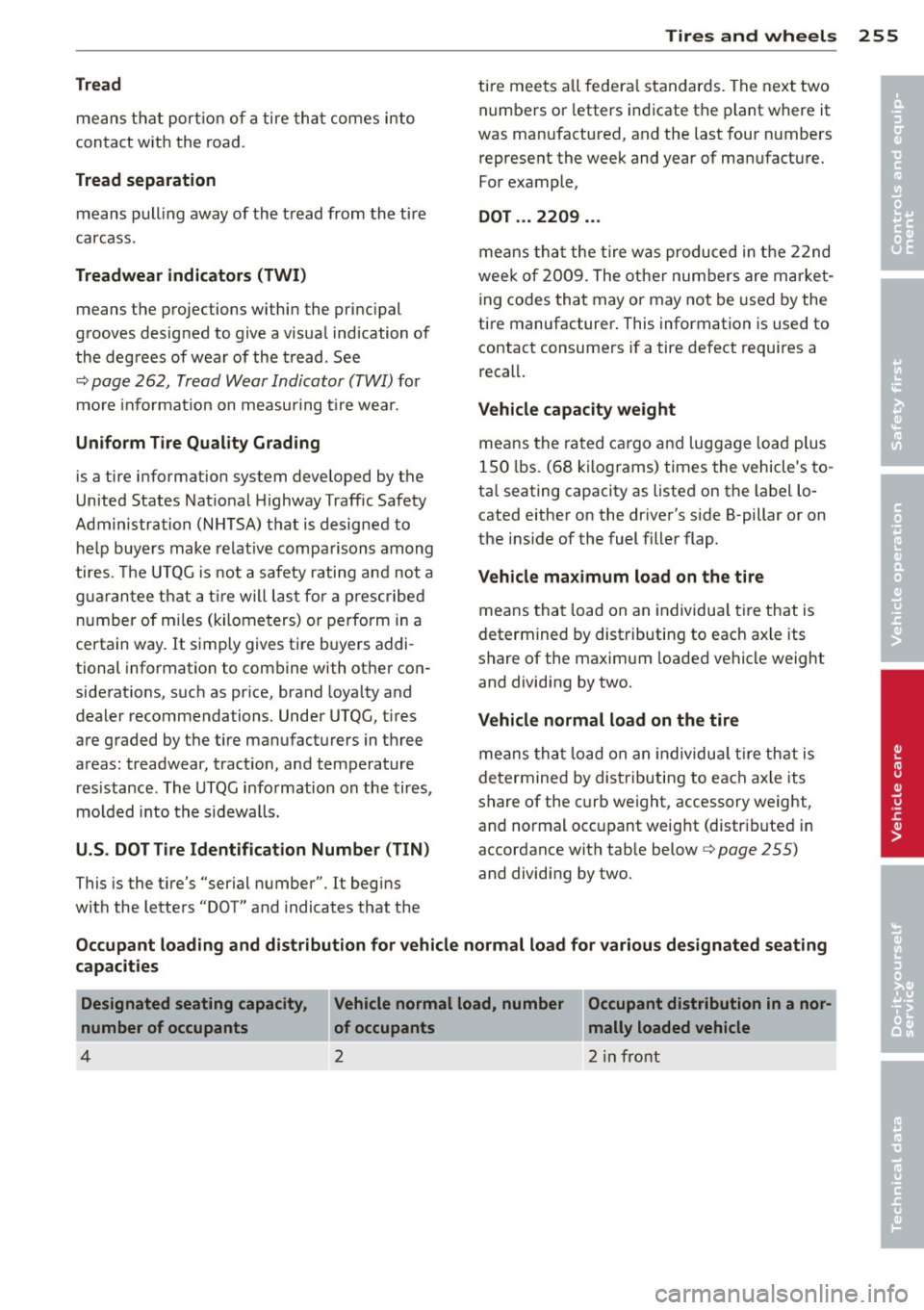
accordance with tab le below
c:> page 255)
and dividing by two.
Occupant loading and distribution for vehicle normal load for various designated seating
capacities
Designated seating capacity,
number of occupants
4
Vehicle normal load, number Occupant distribution in a nor-
of occupants _____ mally loaded vehicle
2 2 in front
•
•