engine AUDI A5 COUPE 2013 Owners Manual
[x] Cancel search | Manufacturer: AUDI, Model Year: 2013, Model line: A5 COUPE, Model: AUDI A5 COUPE 2013Pages: 294, PDF Size: 73.84 MB
Page 266 of 294
264 Emergency situations
@ Tips
The discharged battery must be properly
connected to the vehicle's electrical sys
tem. When jump starting or charging the
battery, never connect the negative
ground cable to the battery negative post
because the batte ry manager system must
be able to detect the battery 's state of
charge. Always connect the negative
ground cab le to the negative ground post
of the battery manager control unit.
Use of jumper cables
Make sure to connect the jumper cable
clamps in exactly the order described below!
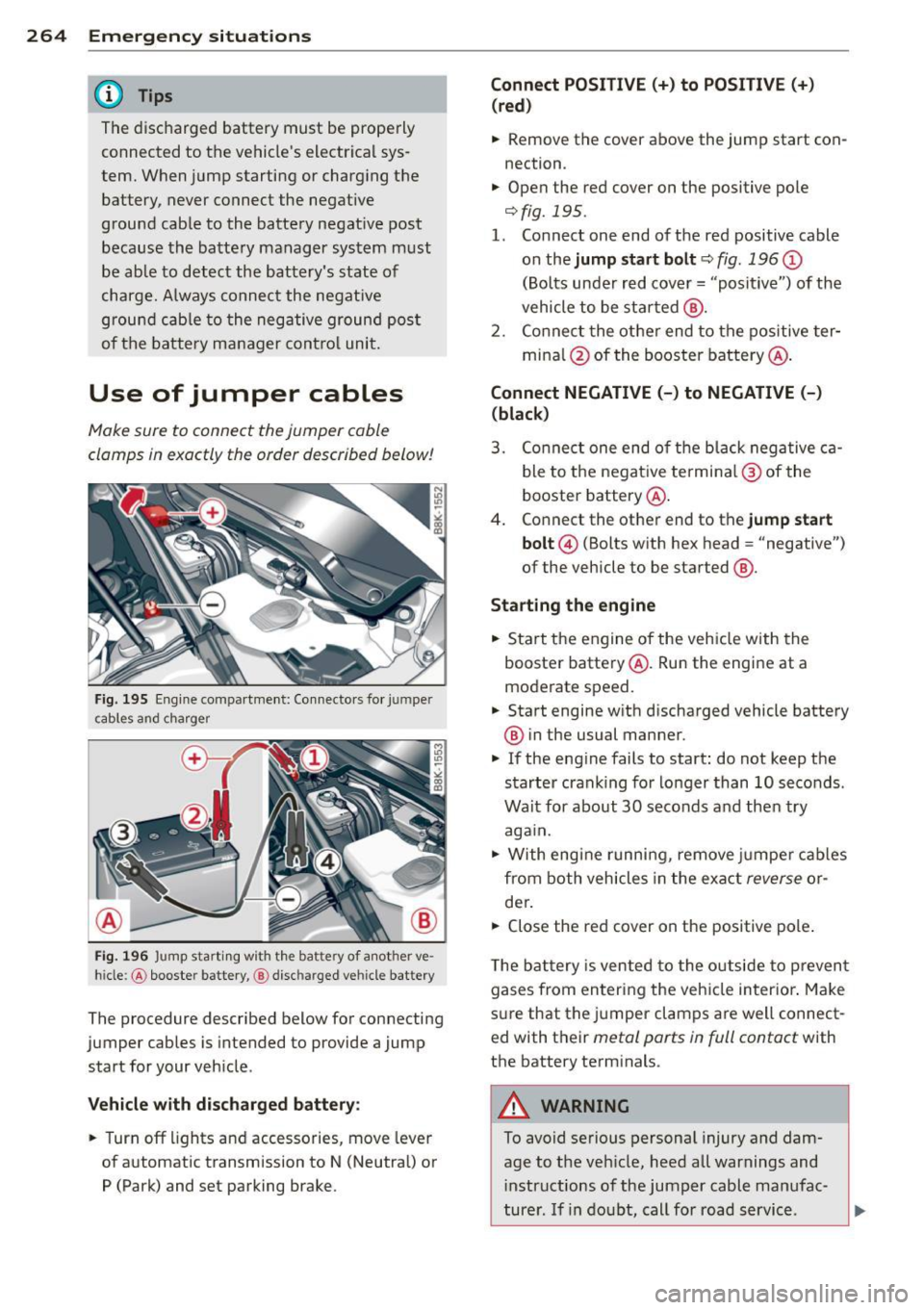
Fig. 195 Engine compartment: Connecto rs fo r jum per
cables and charger
Fig. 196 Jump sta rting wi th the battery of anot her ve ·
h ide :@ booster battery, @ disc harged vehicle battery
The procedure described below for connecting
jumper cables is intended to provide a jump
start for your vehicle .
Vehicle with discharged battery:
.. Turn off lights and accessories, move lever
of automatic transmission to N (Neutral) or
P (Park) and set parking brake .
Connect POSITIVE(+) to POSITIVE(+)
(red)
.. Remove the cover above the jump start con
nection .
.. Open the red
cover on the positive pole
¢fig. 195.
1. Connect one end of the red positive cable
on the
jump start bolt c::> fig. 196 @
(Bolts under red cover= "positive") of the
vehicle to be started @.
2. Connect the other end to the positive ter-
mina l@ of the booster battery@.
Connect NEGATIVE (-) to NEGATIVE (-)
(black)
3. Connect one end of the b lack negative ca
ble to the negative terminal @of the
booster battery @.
4. Connect the other end to the
jump start
bolt @
(Bolts with hex head= "negative")
of the vehicle to be started ®·
Starting the engine
.. Sta rt the engine of the vehicle with the
booster battery@. Run the engine at a
moderate speed.
.. Start engine with discharged vehicle battery
® in the usual manner .
.. If the eng ine fails to start: do not keep the
starter cranking for longer than 10 seconds .
Wait for about 30 seconds and then try
again .
.. With engine running, remove jumper cables
from both vehicles in the exact
reverse or
der .
.. Close the red
cover on the positive pole .
T he battery is vented to the outside to prevent
gases from entering the vehicle interior . Make
sure that the jumper clamps are well connect
ed with their
metal parts in full contact with
the battery terminals.
A WARNING
--
To avoid serious personal injury and dam
age to the veh icle, heed all warnings and
i nstructions of the jumper cable manufac-
turer . If in doubt, call for road service . ..,.
Page 267 of 294
-Jumper cables must be long enough so
that the vehicles do not touch.
- When connecting jumper cables, make
sure that they cannot get caught in any
moving parts in the eng ine compart
ment.
- Do not bend over the batteries - danger
of chemical burns!
- The battery ce ll locking screws must be
tightened securely .
- Before you check anything in the engine
compartment, always read and heed all
WARNINGS ¢
page 209, Engine com
partment .
(D Note
Improper hook -up of jumper cables can ru
in the generator.
- Always connect POSITIVE( +) to POSI
TIVE(+), and NEGATIVE( -) to NEGATIVE
( - ) ground post of the battery manager
control unit.
- Check that a ll screw plugs on the battery
cells are screwed in firmly. If not, tighten plugs prior to connecting clamp on nega
tive battery terminal.
- Please note that the procedure for con
necting a jumper cable as described
above applies spec ifically to the case of
your vehicle be ing jump started . When
you are giving a jump start to anothe r ve
hicle, do
not connect the negat ive( -) ca
ble to the negative( -) terminal on the
discharged battery@¢
fig. 196. In
stead, securely connect the negative(-)
cable to either a solid metal component
that is firmly bolted to the engine block
or to the engine block itse lf. If the bat
tery that is being charged does not vent
to the outside, escaping battery gas
could ignite and exp lode!
Em erg en cy si tuation s 265
Emergency towing
with commercial tow
truck
General hints
Your Audi requires special handling for tow
ing.
T he following information is to be used by
commercial tow truck operators who know
how to operate their equipment safely.
- Nev er t ow your Audi , tow ing will c aus e
damage t o the engin e and transmi ssion.
- Nev er wrap th e safety chain s or winch c a
ble s around th e bra ke lines.
- To pre ve nt unne cessary dam ag e, your Aud i
mu st be tra ns po rted wi th a flat bed tru ck .
- To load th e vehicle on to th e flat be d, use
the t owing l oop found in the vehicl e too ls
a nd atta ch to th e front or rear anch o rage
c::> page 266 and ¢page 266 .
A WARNING
A vehicle being towed is not safe for pas
sengers. Never allow anyone to ride in a
vehicle be ing towed, for any reason.
-
•
•
Page 270 of 294
268 Emergency situations
fall from a lift if there is a change in ve
hicle weight distribution and balance.
This might happen, for example, when
heavy components such as the engine
block or transmission are removed .
- When removing heavy components like
these, anchor vehicle to hoist or add cor
responding weights to maintain the cen
ter of gravity. Otherwise, the vehicle
might tilt or slip off the hoist, causing
serious personal injury.
(D Note
- Be aware of the following points before
lifting the vehicle:
-The vehicle should never be lifted or
jacked up from underneath the engine
oil pan, the transmission housing, the
front or rear axle or the body side
members. This could lead to serious
damage.
- To avoid damage to the underbody or
chassis frame, a rubber pad must be
inserted between the floor jack and
the lift points.
- Before driving over a workshop hoist,
check that the vehicle weight does not
exceed the permissible lifting capacity
of the hoist.
- Before driving over a workshop hoist,
ensure that there is sufficient clear
ance between the hoist and low parts
of the vehicle.
Page 271 of 294
General information Explanation of
technical data
Som e of t he technical data listed in this man
ual requires further explanation .
The technical data for your vehicle is listed in
the charts starting on
c:> page 2 71. This sec
tion provides general information, notes and
r estr ictions wh ich app ly to this data.
Vehicle identification
The key data is given on the vehicle identifi ca
tion number ( VIN) plate and the vehicle data
sti cker .
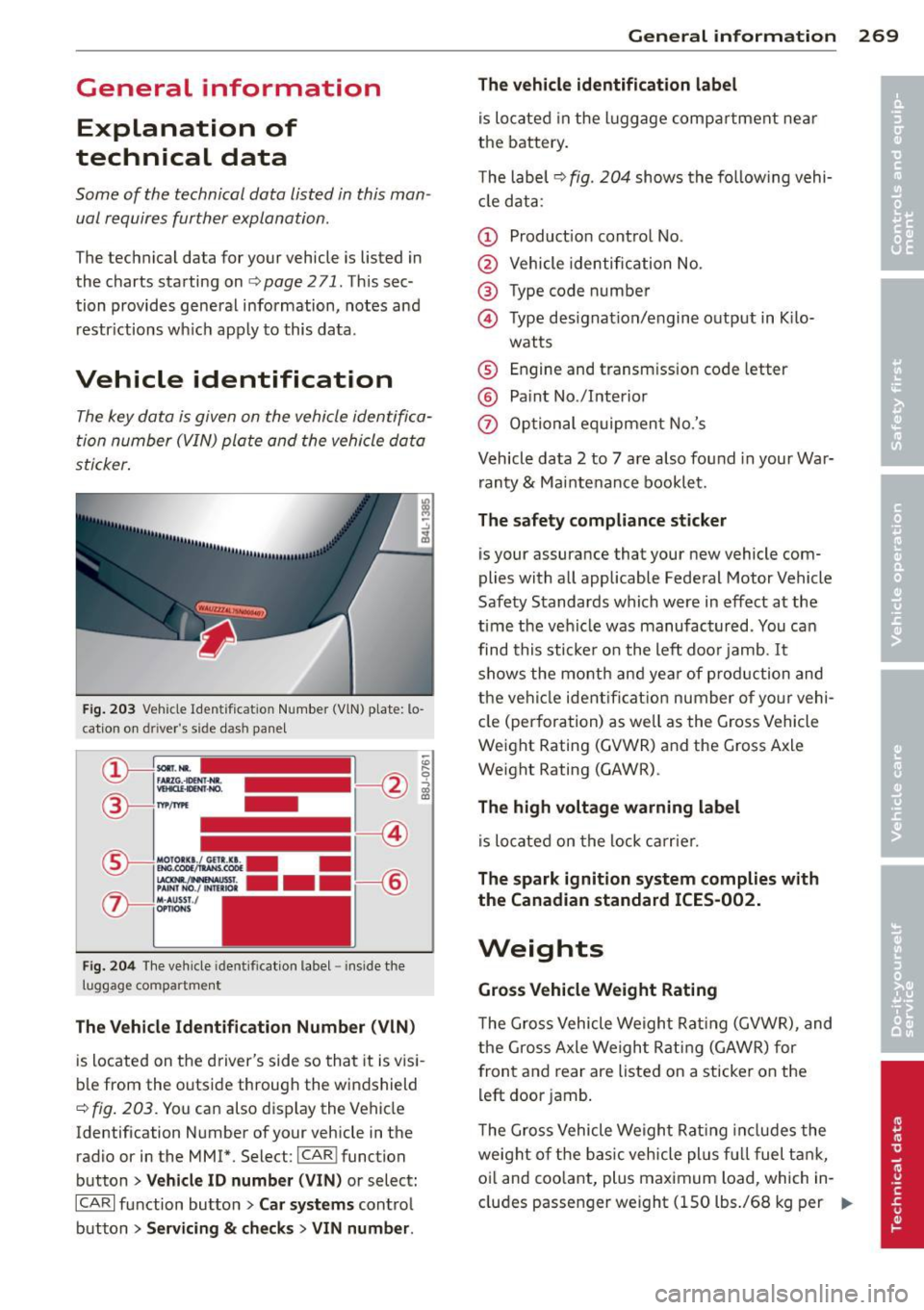
Fig. 20 3 Vehicle Ident ificat ion Num ber (VlN) p la te: lo
cation o n drive r"s side dash pa nel
Fi g. 2 04 The ve hicle ident ification label -in side the
l u ggage compartme nt
The Vehicle Identification Number (VlN)
is located on the d river's side so tha t it is v is i
b le from the outside throug h the windshield
c:> fig . 203. You can also d isplay the Vehicle
Identification N umber of your vehicle in the
radio or in the MM!*. Select: ICAR !function
button
> Vehicle ID number (VIN) or select :
I CA R
I function butto n > Car systems contro l
button
> Servicing & checks > VIN number .
General inform ation 269
The vehicle identification label
is lo cated in the l uggage comp artment near
the battery.
T he label ~
fig. 204 shows th e fo llow ing vehi
cl e d ata :
(D Product ion cont ro l No .
@ Vehicle identific ation No.
@ Type code number
© Type designat ion/e ngine o utput in K ilo-
wat ts
® Engine and transm ission code letter
® Pa int No./lnterior
0 Option al eq uipmen t No.'s
Vehicle data 2 to 7 are a lso fo und in your War
ranty
& Mai nte nance bookle t.
The safety compliance sticker
is your assurance that your new vehicle com
plies wi th a ll applicable Fede ral Motor Vehicle
Safety S tandards which were in effect at the
tim e the ve hicle was manufactur ed . You ca n
find this sticke r o n the left doo r jamb.
It
sh ows the m onth and ye ar of pro duction and
t h e ve hicl e ident ifi cat io n number of yo ur vehi
cle (perfora tion) as well as the G ross Vehicle
Weight Rating (GVW R) and the Gross Axle
Weight Rating (GAWR) .
The high voltage warning label
is lo cated on the l ock ca rrie r.
The spark ignition system complies with
the Canadian standard ICES-002.
Weights
Gross Vehicle Weight Rating
T he Gro ss Vehicle Weigh t Rat ing (GVWR), and
the Gross Axle We igh t Ra tin g (GAWR) for
fron t and rear are listed on a sticker on the
l eft door jamb .
T he Gro ss Vehicle Weigh t Rat ing incl udes the
weig ht o f the bas ic vehicle plus f ull fuel t ank,
oi l and coo lant, p lus maximum load, which in
cludes passen ger we ight (150 lbs./68 kg per ..,.
Page 273 of 294
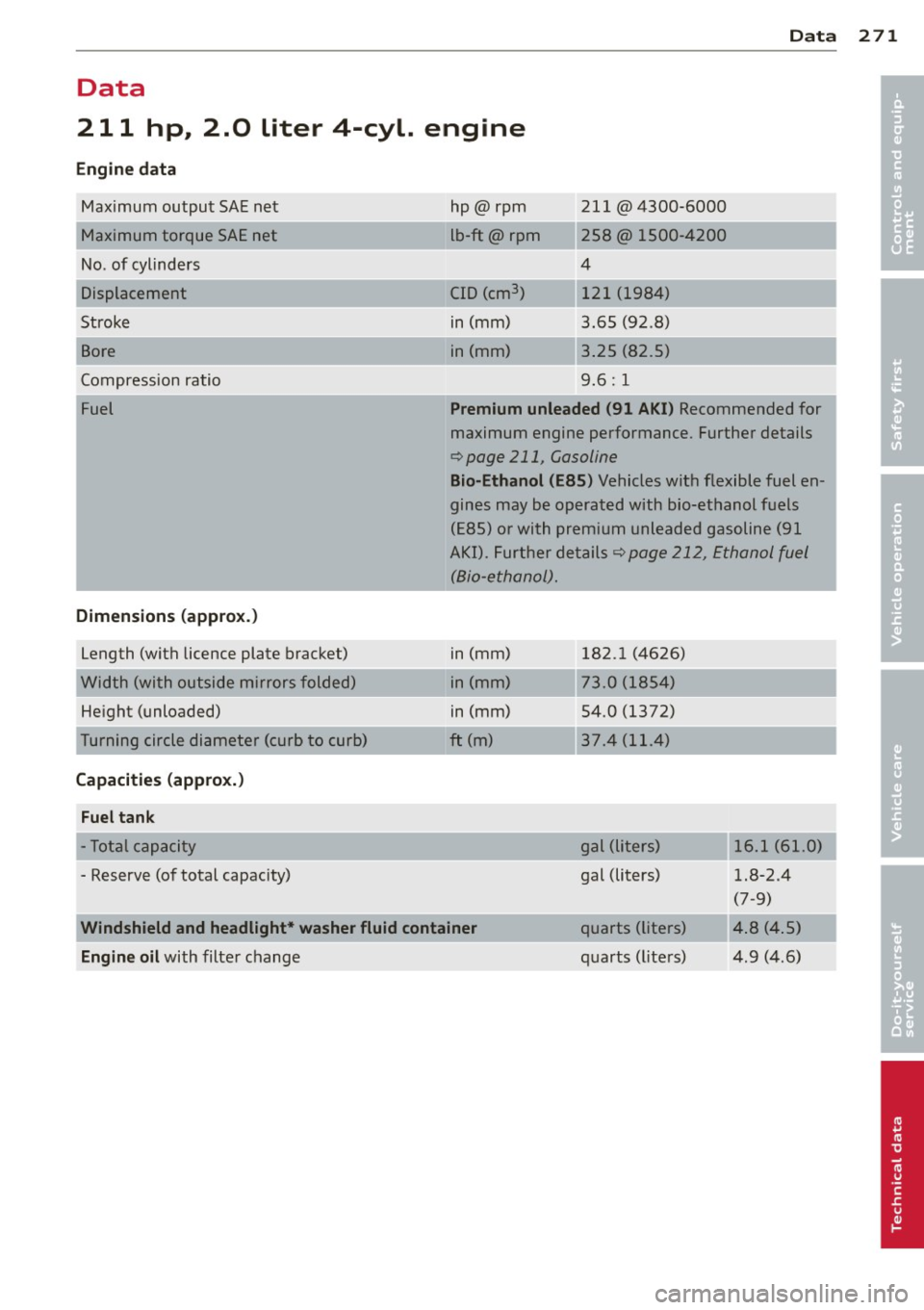
Data
Data
211 hp, 2.0 liter 4-cyl. engine
Engine data
Maximum output SAE net
Maximum torque SAE net
No. of cylinders
Displacement
Stroke
Bore
Compression ratio
Fuel
Dimensions (approx.)
length (with licence plate bracket)
Width (with outside mirrors folded)
He ight (unloaded)
T urning circle diameter (curb to curb)
Capacities (approx. )
Fuel tank
- Total capacity
- Reserve (of total capacity) hp@rpm
lb-ft@rpm
C[D (cm
3
)
in (mm)
in (mm)
211 @4300-6000
258@ 1500-4200
4
121 (1984)
3 .65 (92.8)
3 .25 (82.5)
9.6: 1
Premium unleaded (91 AKI) Recommended for
maximum engine performance. Further details
Q page 211, Gasoline
B io-Ethanol (ESS ) Vehicles with flexible fuel en
gines may be operated with bio-ethanol fuels
(E85) or with premium unleaded gasoline (91
AKI). Further details Q page 212, Ethanol fuel
(Bio-ethanol).
in (mm)
in (mm)
in (mm)
ft (m)
182.1 (4626)
73.0 (1854)
54.0 (1372)
37.4 (11.4)
gal (liters)
gal (liters)
1.8-2.4
(7-9)
Wind shield and headlight* washer fluid container
Engine oil
with filte r change quarts (liters)
quarts (lite
rs)
4 .8 (4 .5)
4 .9 (4.6)
271
•
•
Page 274 of 294
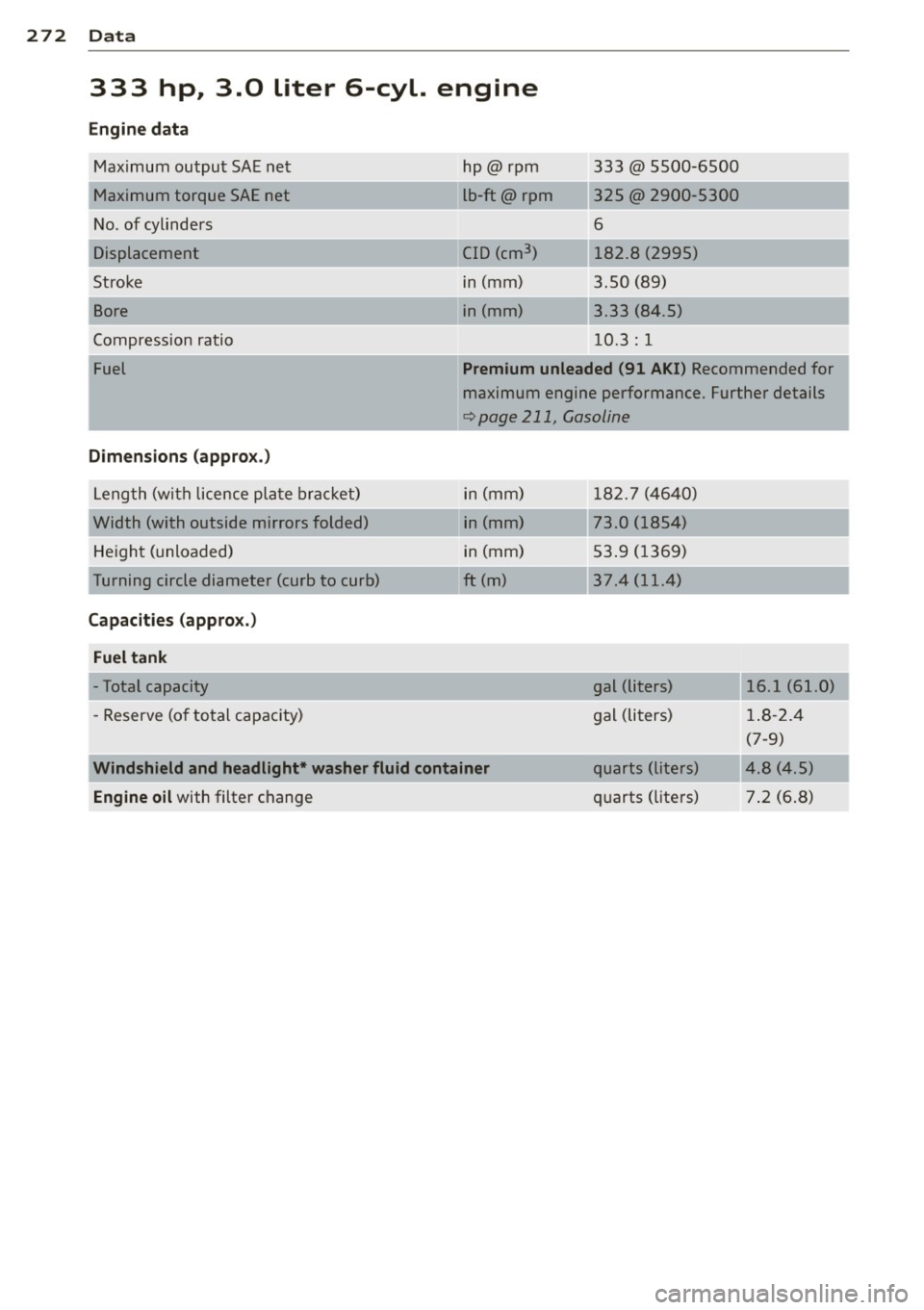
272 Data
333 hp, 3.0 liter 6-cyl. engine
Engine data
Maximum output SAE net
Maximum torque SAE net
N o. of cylinders
Displacement
Strok e
Bore
C ompressio n ratio
Fuel
Dimensions (approx .)
Leng th (wit h licence pl ate bra ck et)
Width (with outside mirrors folded) He igh t (unloaded)
T urning circle diamet er (curb to curb)
Capacities (appro x.)
Fuel tank
- Total capacity
- Reserve (o f to tal capacity) h
p@rpm
L b-ft@ rpm
C ID (cm
3
)
in (mm)
i n (mm)
333 @ 5500-6500
325
@ 2900-5300
6
182.8 (2995)
3.50 (89)
3 .33 (84.5)
1 0.3 : 1
Premium unleaded (91 AKI) Recomme nded for
m aximum engine performance. Further details
¢ pag e 211, Gasoline
in (mm) 182 .7 (4 640)
in (mm) 73.0 (185 4)
in (mm) 53. 9 (136 9)
ft (m) 37.4 (11.4)
gal (liters) 1 6.1 (61.0)
g al (li ters) 1.8-2 .4
(7 -9)
Windshield and headlight* washer fluid container quarts (li ters) 4.8 (4.5)
Engine oil with filter change qu
arts ( lite rs) 7. 2 (6 .8)
Page 275 of 294
Consumer Information
Warranty coverages
Your Audi is covered by the following war
ranties :
- New Vehicle Limited Warranty
- Limited Warranty Against Corrosion Perfo-
ration
- Emissions Control System Warranty
- Emissions Performance Warranty
- California Emissions Control Warranty (USA
vehicles only)
- California Emissions Performance Warranty
(USA vehicles only)
Detailed information regarding yo ur warran
ties can be found in your
Warranty & Mainte
nance booklet .
Operating your vehicle
outside the U.S.A. or
Canada
Government regulations in the United States
and Canada require that automobiles meet
specific emission regulations and safety
standards. Therefore, veh icles built for the
U.S.A. and Canada differ from vehicles sold in
other countries .
I f you p lan to take your vehicle outside the
continental limits of the United States or Can
ada, there is the possibility that:
- unleaded fuels for vehicles with cata lytic
converter may not be available;
- fuel may have a considerably lower octane
rating . Improper fuel may cause engine
damage;
- service may be inadequate due to lack of
proper service facilities, tools or testing
equipment;
- replacement parts may not be readily availa
ble.
- Navigation systems for vehicles built for the
U.S.A. and Canada will not necessari ly work
in Europe, and may not work in other coun
tries outside of North America.
Consumer Information 273
@ Note
Audi cannot be responsible for mechanical
damage that could result from inadequate
fuel, serv ice or parts availab ility.
Audi Service Repair
Manuals and Literature
Audi Offic ial Factory Service Manuals and Lit
erature are published as soon as possible after
model introduct ion. Service manuals and lit
erat ure are available to order from the Audi
T echnical Literature Ordering Center at:
www.audi.techliterature.com
Maintenance
' General
Your vehicle has been designed to help keep
maintenance requirements to a m inimum.
However, a certain amount of regular mainte
nance is still necessary to assure your vehicle's
safety, economy and reliability . For detailed
vehicle maintenance consult your Warranty
&
Maintenance booklet.
Under difficult operating conditions , for ex
ample at extremely low outside temperatures,
in very dusty regions, when towing a tra iler
very frequently, etc., some serv ice work
shou ld be pe rformed between the intervals
specified. This applies particularly to:
- oil changes, and
- cleaning or replacing the air filter.
® For the sake of the environment
By regularly maintaining your veh icle, you
help make sure that emission standards
are maintained, thus min imiz ing adverse
effects on the environment .
Important considerations for you and
your vehicle
The increasing use of electronics, sophisticat
ed fuel injection and emission contro l sys-
tems, and the genera lly increasing technica l ..,_
•
•
Page 276 of 294
274 Con sum er Inf ormation
comp lexity of today's automobi les, have
steadi ly reduced the scope of maintenance
and repairs which can be carried out by vehicle
owners.
Also, s afety an d e nvir onm ent al con
cerns place very strict limits on the nature of repairs and adjustments to engine and trans
miss ion pa rts which an owner can perform .
Maintenance, adjustments and repa irs usua lly
require special tools, testing devices and oth
er equipment avai lab le to specially trained
workshop personnel in order to assure proper
performance, reliab ility and safety of the vehi
cle and its many systems .
Improper ma intenance, adjustments and re
pa irs can impair the operation and reliab ility
of your vehicle and even void your vehicle war ranty. Therefo re , proof of servici ng in accord
ance w it h the ma intenance sched ule may be a
condition for upholding a poss ible warranty
claim made within the warran ty period.
Above all, operational safety can be adve rsely
affected, creating unnecessary risks for you
and your passengers.
If in doubt about any serv icing, have it done
by your author ized Audi dealer or any other
p roperly equipped and qualified workshop .
We strong ly urge you to give your authorized
Audi dealer the opportunity to perform all
schedu led maintenance and necessary repairs .
Your dea ler has the facilities, or iginal parts
and tra ined spec ialists to keep your vehicle
running properly .
Performing lim it e d m aint en anc e y ourself
The fo llowing pages describe a limited num
ber of procedures which can be performed on
you r vehicle with ordinary too ls, shou ld the
need arise and trained personnel be unavaila
ble. Before performing any of these proce
dures, always thoroughly read all of the app li
cable text and ca refully follow the instruc
tions given. Always rigorously obse rve the
WARNINGS p rovided .
Before you ch eck anything in th e engin e
compartme nt, alway s read an d heed all WARNINGS
¢ & a
nd ¢ & in Working in the
engine comportment on page 216 .
A WARNING
--Serious personal in jury may occur as a re-
sult of improperly performed mainte nance, adjustments or repa irs.
- Always be extremely careful when work
ing on the vehicle. Always follow com
monly accepted safety pract ices and gen
eral common sense. Never r isk personal
in jur y.
- Do not attempt any of the maintenance,
checks or repairs descr ibed o n the fol
lowing pages if you are not fu lly fam iliar
with these or other procedures with re spect to the vehi cle, or are uncerta in how
to proceed .
- Do not do any work withou t the proper
too ls and equipment . Have the necessary
work done by your authorized A udi deal
er or anothe r properly equipped and
qualified workshop.
- The engine compar tment o f any motor
vehicle is a potentially hazardous area. Never reach into the area around or
touch the rad iator fan. It is temperature
control led and can sw itch on suddenly -
even when the engine is off and the igni
tion key has been removed. The rad iator
fan switches on automatically when the coo lant reaches a certai n tempera ture
and will cont inue to run until the coo lant
temperature drops .
- Always remove the ign ition key befo re
anyone gets under the veh icle.
- Always support your veh icle with safety
s tands if it is necessary to work under
neath the vehicle. The jack s upplied with
the vehicle is not adequate for this pur
pose and co uld co llapse causing serio us
personal injury.
- If you must work unde rneath the vehicle
wit h the wheels on the ground, a lways
make sure the vehicle is on leve l ground,
that the wheels are always secure ly
blocked and that the engine cannot be
started.
Page 277 of 294
-Always make sure the transm ission se
lector lever (automatic transmiss ion) is
in "P" (Park position) or Neutral (manual
transmission) and the park brake is firm
ly appl ied .
® For the sake of the environment
-Changing the eng ine settings w ill ad
versely affect em ission levels. This is det
rimental to the environment and increas
es fuel consumption .
- Always observe env ironmental regula
tions when d ispos ing of old engine oil,
used brake fluid, dirty engine coolant,
spent batter ies or worn out t ires.
- Undeployed airbag modules and p reten
s ioners might be classified as Perchlo
rate Material -special handling may ap
ply, see www.dtsc.ca .gov/hazardous
waste/perch lorate . When the veh icle or
parts of the restraint system including
airbag modules safety belts with preten
s ioners are scrapped, all applicable laws
and regulations must be observed. Your
authorized Audi dealer is familiar w ith
these requirements and we recommend
that you have your dealer perform this
serv ice for you .
Additional accessories,
modifications and
parts replacement
Additional accessories and parts
replacement
Always consult on authorized Audi dealer be
fore purchasing accessories.
Your veh icle incorporates the latest safety de
sign featu res ensu ring a high standard of ac
tive and passive safety.
This safety could be compromised by non-ap
proved changes to the veh icle. For this reason ,
if parts have to be replaced, p lease observe
the following points when installing addition
al accessories:
Con sumer In formation 275
Approved Audi accessories and genuine Audi
parts are available from authorized Audi deal
ers.
T hese dea lers a lso have the necessary facili
ties, tools and trained specialists to install the
parts and accessories proper ly.
A WARNING
Using the wrong spare parts or using non
approved accessories can cause damage to
the vehicle and serious persona l injury.
- Use on ly accessories express ly approved
by Audi and genuine Audi spare parts
- These parts and accessories have been
specially designed to be used on your ve
hicle.
- Never install accessories such as tele
phone cradles or beverage holders on air
bag covers or within the airbag deploy
ment zones . Do ing so will increase the
risk of injury if a irbags are triggered in an
accident!
- Before you check anything in the engine
compartment, always read and heed all
WARNINGS ~
page 209.
(D Note
-If items other than genuine Audi spare
parts, add-on equipment and accessory
items are used or if repair work is not
performed accord ing to specified meth
ods, this can result in severe damage to
your vehicle's engine and body (such as
corrosion) and adversely affect your vehi
cle's warranty .
- If emergency repairs must be performed
elsewhere, have the vehicle examined by
an authorized Audi dealer as soon as
possible.
- The manufacturer cannot be held liable
for damage wh ich occurs due to failure
to comply with these stipulations.
•
•
Page 282 of 294
28 0 Index
Changing engine o il
Chass is 222
Unde rcoat ing . ........... .... .... . 205
Checking
Eng ine coolant leve l .... ... .. .. .. .. .
223
Checking tire pressure . ... .. .. .. .. .. . 237
Ch ild restra ints
Da nger of us ing ch ild restra ints in the
front seat . . . . . . . . . . . . . . . . . . . . . . . .
143
Where can I get additional information
about child restraints and their use? ..
184
Ch ild restra int system anchors . .. .. .. . 180
Ch ild safety .. .. . .......... .. .. .... . 166
Convertible locking retractor . . . . . . . . . 176
Important safety instructions for us ing
ch ild safety seats .. ..... .. .. .. .. .. .
169
Important th ings to know when dr iving
with ch ildren . ............. .. .... .
166
Ins tall ing a chi ld restraint using the
L A T C H system .. ... .... ... .. .. .... .
181
Lower anchorages ..... ... .. .. .... . 181
Mounti ng and releasing the ancho rage
hook .. .. .. ............. .. .. .. ...
181
Tether anchors . . . . . . . . . . . . . . . . . . . . 182
Tether straps . . . . . . . . . . . . . . . . . . . . . 182
Chil d safety seats .. ..... ... .. .. .... . 172
Booste r seats .. .. ..... ... .. .. .... . 174
Convertible child seats .... .. .. .... . 173
Convertible locking retractor .. .. ..... 176
Danger of us ing ch ild restra ints in the
front seat . . . . . . . . . . . . . . . . . . . . . . . .
143
H ow do I properly install a child safety
seat in my vehicle? ............ .. ...
169
Infant seats ............. .. .. .. .. . 172
Ins tall ing .. ... .......... .. .. .. .. . 176
LA T CH system .. .. ..... ... .. .. .... . 181
Safety instructions ..... ... .. .. .... . 169
Unused safety belts on the rear seat . . 17 1
Cigare tte lig hte r . . . . . . . . . . . . . . . . . . . . . 59
C leaning
A lcantara ® (synthetic suede) .. .. .. .. .
209
Eng ine compartment .......... .. ... 209
Exhaust tail p ipes ...... .... ... .. .. . 205
Fab rics and fabr ic coverings .. .. ..... 206
Instrument panel ....... .. .. .. .. .. . 207
In ter ior .. ... ............ .. .. .. .. . 206
Leather ..... .. .. ..... ... .. .. .... . 208
MMI disp lay/controls . ... .. .. .... .. . 206
Plastic and vinyl . .... .. ..... .... . .. 203
Plastic parts ..... .. ... ..... ... .. .. 207
Safety be lts ... .. ... .. ..... ... .. .. 209
Tr im strips .... .. ............. .... 203
Cleaning and p rotection .......... .... 2 00
Cl imate controls ... ..... ........... .. 67
Climate control system
Automatic recircu lation ......... .... .
70
synchroni zing .. .. ............. .. .. . 70
Clock . . . . . . . . . . . . . . . . . . . . . . . . . . . . . . 12
Closing
Panoramic t ilting sunroof ........ ... .
41
Power w indows ... ............ .. .. . 40
Su n blind ..... .. .. ........... .... . 41
Closing/opening
at the lock cylinder . . . . . . . . . . . . . . . . . . 3 7
by remote control ..................
35
with the centra l locki ng switch ... .... . 36
with the conven ien ce key ........ .. .. . 36
Co ld tire inflation pressure . ........... 235
Coming home ..... ... .. ..... ... .. .. . 44
Compact spare tire . .. .. ...... ... .. .. 252
also refer to Spare ti re .......... .... 252
Compartments . . . . . . . . . . . . . . . . . . . . . . 60
Compass in the mirror . .. ..... ... .. .. .
51
Compliance . ...... .. .............. . 276
Consumer Information . . . . . . . . . . 132, 273
Contacting NHTSA . ... .......... .. .. 132
Convenience key
Indicator lights .. ... .. .. ... ..... .. .
75
Start ing engine (S TART E NGIN E STOP
button) ... .... ................... .
74
Stopping the eng ine (START ENG IN E
STOP b utton) .... .. .... .... ... .. .. .
75
Switching on ignition . .. ..... .... . .. . 74
unlocking/locking . .... ..... ... .. .. . 36
Co nvenience openi ng/clos ing ... .. .... . 40
Convertib le child safety seats ..... .... 173
Convertib le locking retractor
Activating ..... .. .. ... ..... ... .. ..
178
Deact ivat ing ... .. .. .... .... ... .. .. 178
Using to secure a child safety seat l.76, 178
Coolant system .. .. ... .......... .. .. 223
Cooling mode (automat ic cl imate co ntrol) 68
Cooling System
Expansion tank . .. ............. .. ..
223