engine AUDI A5 COUPE 2013 Manual Online
[x] Cancel search | Manufacturer: AUDI, Model Year: 2013, Model line: A5 COUPE, Model: AUDI A5 COUPE 2013Pages: 294, PDF Size: 73.84 MB
Page 227 of 294
scalding from hot coo lant by following
these steps.
- Turn
off the engi ne and a llow it to cool
down.
- Protect your face, hands and arms from
escapi ng fl uid and steam by cover ing
the cap with a large, thick rag .
- Turn the cap slowly and very ca refully
i n a cou nte r-clockw ise dir ect ion while
a pply ing lig ht, downwa rd p ress ure on
the top of the cap.
- T o avo id being burned, do no t sp ill an
tifree ze o r coolan t on t he exh aust sys
tem or ho t engine parts . Un der certain
conditions, the ethylene glyco l in en
gine coolant can catch fire .
- Antifree ze is poisono us. Always store an
tifreeze in its or iginal co ntainer and we ll
o ut o f the reac h of children.
- If you drain the coolant , it must be
caught and safely stored in a p roper con
tainer clear ly marked "poison".
(D Note
- Coolant po llutes the env ironment and
could ca use a n engine fire . Excess coo l
ant wi ll be forced out through the pres
sure re lief va lve in the cap when the en
gine becomes hot.
- If, in an emergency, only water can be
added , the correct ratio between water
and antifreeze¢
page 223 must be re
stored as soon as possib le .
@ For the sake of the environment
Drained coolant should not be re used . Al
ways dispose of used c oolant while observ
ing all envir onmental regulations .
Radiator fan
The radiator fan switches on automa tically by
itself
T he radiator fan is driven by the engine via the
V-be lt. The viscous clutch regulates the speed
of the fan according to the temperature of the
coolant .
Checkin g and fillin g 225
An auxiliary electric radiato r fan* sw itches on
and
off depending on coolant temperature
and othe r vehicle ope rat ing con ditions.
After yo u switc h the engi ne off, the aux iliary
f an can con tinue r unning for up to 10 minutes
- even with the ignition off. It can even switch
on again later by itself¢ & , if
- t he temperatu re of the engine coo lant rises
due to the heat b uild -up from the en gine in
the engi ne compartment, or
- the engine compartment heats up be cause
the vehicle is parked in intense sunlight.
A WARNING
- To reduce the risk of personal in jury nev
er touch the radiator fan.
- The a uxiliary electric fan is temperat ure
contro lled and can switch on sud denly
even when the engine is not running.
- The a uxiliary radiator fa n switches on a u
tomatically when the engine coo lant
reaches a certain temperature and will
continue to run until the coo lant temper
ature drops .
Brake fluid
Checking brake fluid level
The brake fluid level can be checked with a
qui ck glance.
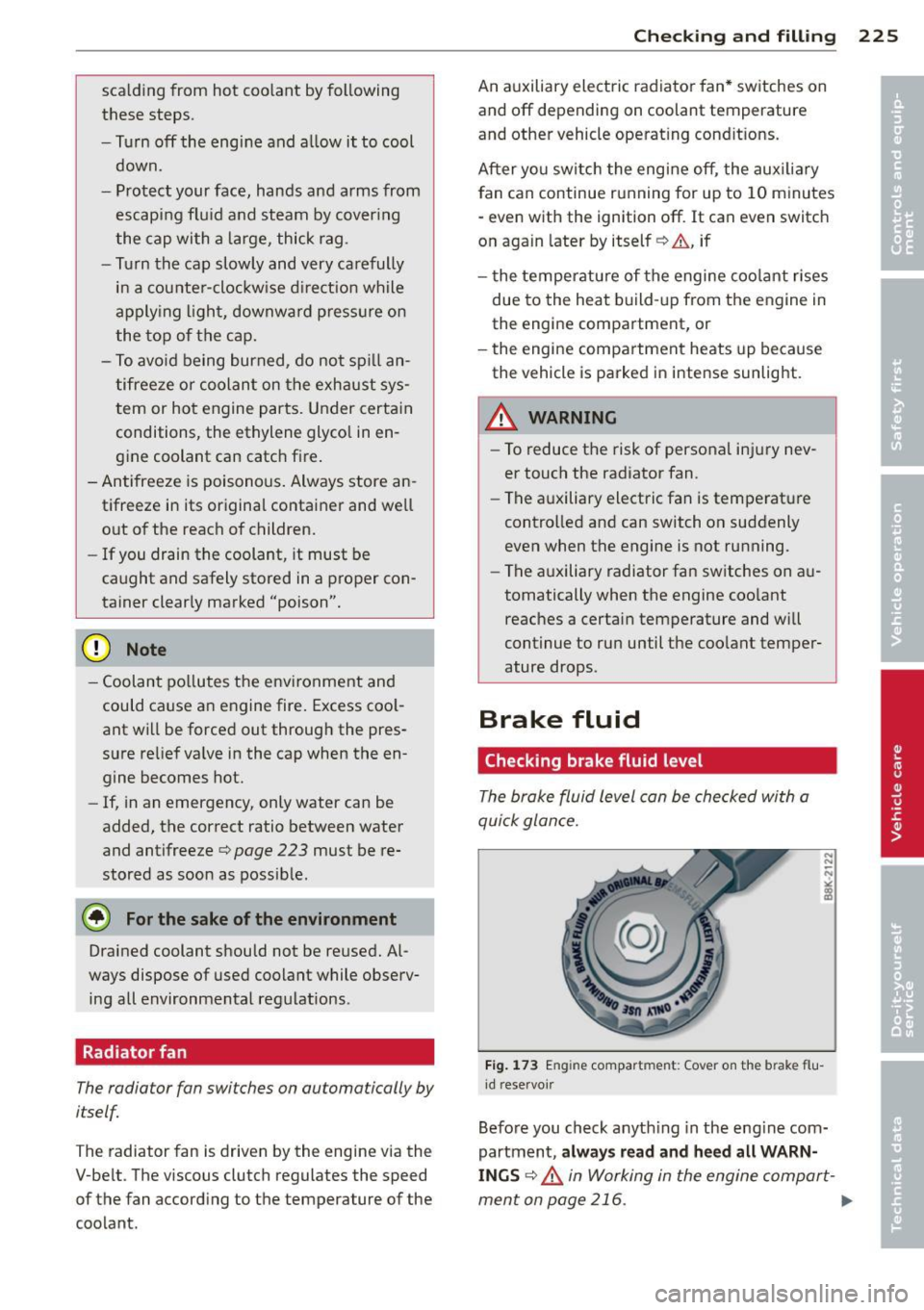
Fig. 17 3 En gin e compar tment: Cover o n the brak e flu
i d reservoi r
Before you check anyth ing in the eng ine com
partment ,
always re ad and heed all WARN
INGS c::> ,& in Working in the engine compar t-
ment on page 216 . .,..
Page 228 of 294
226 Check ing and filling
• Read the brake fluid level from the brake
fluid reservoir ¢
fig. 173, ¢ page 218,
fig . 169.
The brake fluid level must be be
tween the "MIN" and "MAX" markings.
The brake fluid reservoir is located at the rear partition of the engine compartment on the
left side ¢
page 218 .
The fluid level may drop slightly after some
time due to the automatic adjustment of the brake pads . This is not cause for alarm .
I f the brake fluid level falls
considerably be
l ow the "MIN" mark, the brake wa rning/indi
cator light (U .S . mode ls:
1111 , Canadian
models :. ) will come on
¢ page 15. Do not
continue to operate the vehicle. The complete
brake system should be thoroughly checked
by an authorized Audi dealer or qualified
workshop and the cause corrected . If the
brake fluid level is too low, the brake warn ing/
i ndicato r light w ill illuminate . Contact an au
thor ized Audi dealer
imm ediat ely .
@ Tips
The brake f luid reservoir is located under
neath the cove r.
Changing brake fluid
Have the brake fluid changed by an experi
enced technician .
Brake fluid absorbs moisture from the a ir . If
the water content in the brake fluid is too
h igh, corrosion in the brake system may result
after a per iod of t ime . The bo iling po int of the
b rake fluid w ill also decrease considerably and
decrease braking performance.
Therefore, the brake flu id must be changed
ev ery two years. A lways use new brake fluid
which confo rms to Fede ral Motor Vehicle
S tanda rd "FMVSS 116 DO T 4".
The brake flu id reservoir can be difficult to
reach, therefo re , we recommend that you
have the brake fl uid changed by yo ur au tho r
ized
Audi d eale r. Your dea le r has the correct tools, the
right brake flu id and the know -how
to do this for you.
A WARNING
'-
- Brake flu id is poisonous. It must be stor-
ed only in the closed or iginal container
out of the reach of children!
- Brake failure can resu lt from o ld or inap
propriate brake f lu id. Observe these pre
cautions:
- Use only brake f luid that meets SA E
specifi cation
J 1703 and conforms to
Federa l Motor Vehicle Standard 1 16 .
Always check with your authorized Audi
dealer to make sure yo u are using the
correct brake fluid. The correct type of
brake flu id is also ind icated on the
brake f lu id reservoir.
- The brake fluid must be new. Heavy use
of the brakes can cause a vapor lock if
the brake fluid is left i n the system too
long . This can se riously affect the effi
c iency of the brakes as well as your
safety . T his could result in an accident.
W Note
Brake fluid will damage the paint of your
vehicle .
@ For the sake of the environment
Because of the prob lem of proper disposal
of brake fluid as well as the spec ial tools
required and the necessary expertise, we
recommend that you have the brake flu id
changed by your autho rized Aud i deale r.
Battery
General information
Under normal operat ing cond itions, the bat
tery in your Audi does not need any ma inte
nance. With
high outside temperatures or
long da ily drives we recommend that you have
the e lectrolyte leve l che cked by an autho rized
A udi dealer or qualified workshop. The elec
trolyte level should also be checked each time
the battery is charged
¢ page 229. ..,_
Page 230 of 294
228 Checking and filling
-Always wear eye protection. Do not let
battery acid or any lead particles get on
your skin or clothing . Shield your eyes .
Explosive gases can cause blindness or
other injury .
- Battery acid contains sulfuric acid . Sulfu
ric acid can cause blindness and severe
burns .
- Always wear gloves and eye protection.
Do not tilt the battery because acid
could leak out of the ventilation open
ings.
- If you get battery acid in your eyes or
on your skin, immediately rinse with
cold water for several minutes and get
medical attention .
- If you should ingest any battery acid,
seek medical attention immediately.
- Do not expose the battery to an open
flame, electric sparks or an open light.
- Do not smoke.
- Do not interchange the positive and neg-
ative cables.
= When working on the battery , be sure
not to short-circuit the terminals with
tools or other metal objects. This would cause the battery to heat up very quickly,
which could lead to damage or explosion
and personal injury.
- When a battery is charged, it produces hydrogen gas which is explosive and
could cause personal injury .
- Always keep the battery well out of the
reach of children .
- Before work is done on the electrical sys tem, disconnect the negative ground cable .
- Before performing any work on the elec
trical system, switch
off the engine and
ignition as well as any electrical equip
ment . The negative cable on the battery
must be disconnected . If you are just go
ing to replace a light bulb, then it is
enough to switch
off the lights.
- Before disconnecting the battery, switch
off the anti-theft alarm system! Other
wise you will set off the alarm. -
When disconnecting the battery, first
disconnect the negative cable and then
the positive cable.
- Before reconnecting the battery, make
sure all electrical consumers are switch
ed off. Reconnect the positive cable first
and then the negative cable . Never inter
change the cables - this could start a fire!
- Never charge a frozen or a thawed-out
battery .
It could explode! If a battery has
frozen , then it must be replaced . A dis
charged battery can freeze over at 32°F
(QOC).
- Make sure the vent hose is always attach
ed to the opening on the side of the bat
tery .
- Never use batteries which are damaged.
There is the danger of an explosion! Al
ways replace a damaged battery.
A WARNING
California Proposition 6S Warning:
- Battery posts, terminals and related ac
cessories contain lead and lead com
pounds, chemicals known to the State of
California to cause cancer and reproduc
tive problems. Wash hands after han
dling.
(D Note
- Do not disconnect the vehicle battery
when the ignition is switched on or when the engine is running, otherwise, you will
damage electronic components in the
electrical system.
- If your vehicle is going to stand for a
long period of time without being driven,
protect the battery from "freezing", oth
erwise it will be damaged and will then
have to be replaced .
Page 231 of 294
Battery charging
Starting the engine requires a well charged battery .
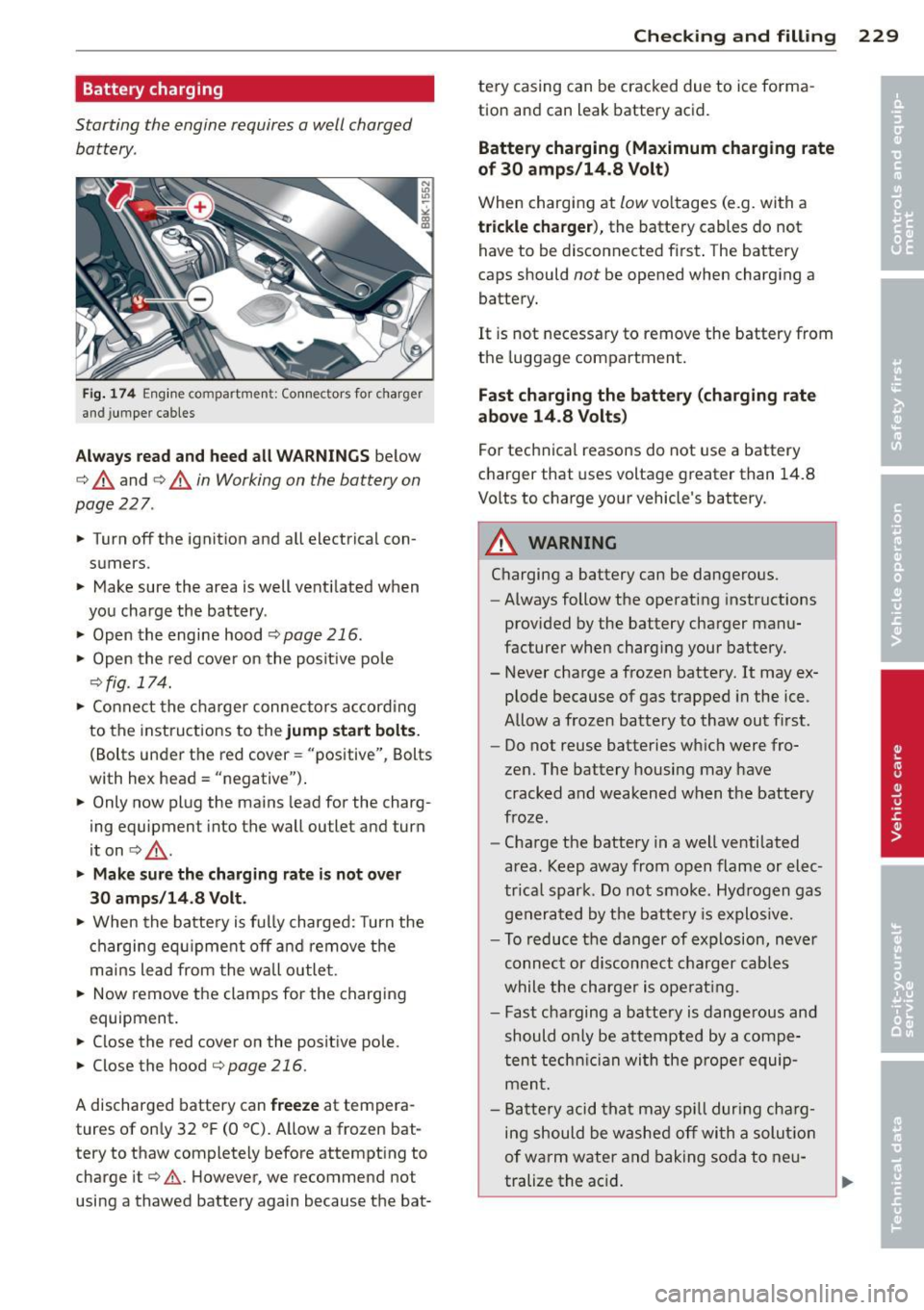
Fig. 174 Eng ine co mpa rtmen t: Connectors for charger
an d jumper cables
Alwa ys r ea d and heed all WARNINGS below
c:> &. and c:> &. in Working on the battery on
page 227 .
.. Turn off the ignit ion and a ll electrical con
sumers .
.. Make sure the area is well ventilated when
you charge the battery .
.. Open the engine hood
c:>page 216.
.. Open the red cove r on the posit ive pole
c:>fig. 174.
.. Connect the charger connectors accord ing
to the instructions to the
j ump start b olts .
(Bolts under the red cover= "positive", Bolts
with hex head= "negative") .
.. Only now plug the mains lead for the charg
ing equipmen t into the wall outlet and turn
it on
c:> 8_ .
.. Ma ke sur e t he charging rat e is not over
30 amp s/14 .8 Vol t.
.. When the batte ry is fully charged: Turn the
charging eq uipment
off and remove the
ma ins lead from the wall outlet.
.. Now remove the clamps for the charging
equipment.
.. Close the red cover on the positive pole.
.. Close the hood
c:> page 216.
A discharged battery can free ze at tempera
tures of on ly 32 °F (0 °C). A llow a frozen bat
tery to thaw completely before attempt ing to
charge it
c:> .&. . However, we recommend not
using a thawed battery again because the bat-
Checkin g and fillin g 229
tery casing can be cracked due to ice forma
tion and can leak battery acid.
Battery charging (Maximum charging rate
of 30 amps /14.8 Volt )
When charging at low voltages (e.g. with a
trickle cha rger ), the battery cables do not
have to be disconnected f irst . The battery
caps should
not be opened when charging a
battery.
It is not necessary to remove the battery from
the luggage compartment.
Fast chargin g the batter y (cha rging rat e
ab ov e 14 .8 V olt s)
For technical reasons do not use a battery
charger that uses voltage greater than 14.8
Volts to charge your vehicle's battery.
&_ WARNING
-=-
Charging a battery can be dangerous .
- Always follow the operating instructions
provided by the battery charger manu
facturer when charging your battery .
- Never charge a frozen battery. It may ex plode because of gas trapped in the ice .
Allow a frozen battery to thaw out f irst.
- Do not reuse batteries which were fro
zen. The battery housing may have
cracked and weakened when the battery
froze.
- Charge the battery in a well ventilated
area. Keep away from open flame or elec
trica l spark . Do not smoke . Hyd rogen gas
generated by the battery is explos ive .
- To reduce the danger of explosion, never
connect or d isconnect charger cab les
while the charger is operat ing .
- Fast charging a battery is dangerous and
should only be attempted by a compe
tent techn ic ian with the prope r equip
men t.
- Ba ttery acid that may spi ll dur ing charg
ing should be washed
off wi th a solut ion
of warm water and baking soda to neu-
tralize the ac id. ....
L..._ _____________ _J ....
Page 232 of 294
230 Check ing and filling
Never use a fa st charger as a booster to
start the engine . T his will seriously dam
age sensitive electronic components, such
as control units, relays, rad io, etc ., as well
as the battery charger.
Battery replacement
The new bat tery must have the same specifi
cations and dimensions as the original equip
ment battery .
Intelligent energy man agement in your veh i
cle is respons ible for d istributing the e lectr i
cal energy throughout your vehicle
c::>
page 191. The intell igent energy ma nage
ment system w ill keep the engine battery
cha rged bette r then vehicles w it h out th is sys
tem. To make sure t he addi tional e lectrica l en
e rgy is availab le once again after you have
cha nged t he battery, we recommend that you
install batteries of the same type and ma nu
facture only (the same as those installed at
the time your vehicle was delivered). Specifi
cations are listed on the battery hous ing. Your
author ized Audi dealer must code the battery
in the ene rgy management system to enable
you to use the ene rgy management functions
cor rectly after repla cing t he battery .
If it is not possible to use a battery of this
type, the new battery must have the same ca
pac ity, voltage ( 12 volts), amperage , con
s truction and plug sea ling .
When insta lling the battery , make sure the ig
ni tion and all electr ical cons umers are turned
off.
0 Note
Ma ke sure t he vent ilation hose on the s ide
of the batte ry is con nected, ot herwis e
fumes or battery ac id can leak out.
@ For the sake of the environment
Because of the problem of proper d isposa l
of a battery , we recommend your au thor
i z ed Audi deale r change the batte ry for you
. Batteries contain sul fur ic acid and
l ead and must a lways be disposed of prop
erly in comp liance with a ll environmental
regulations. Disposing of vehicle batter ies
i mproperly is very dangerous to the envi
ro nment .
Windshield/headlight*
washer container
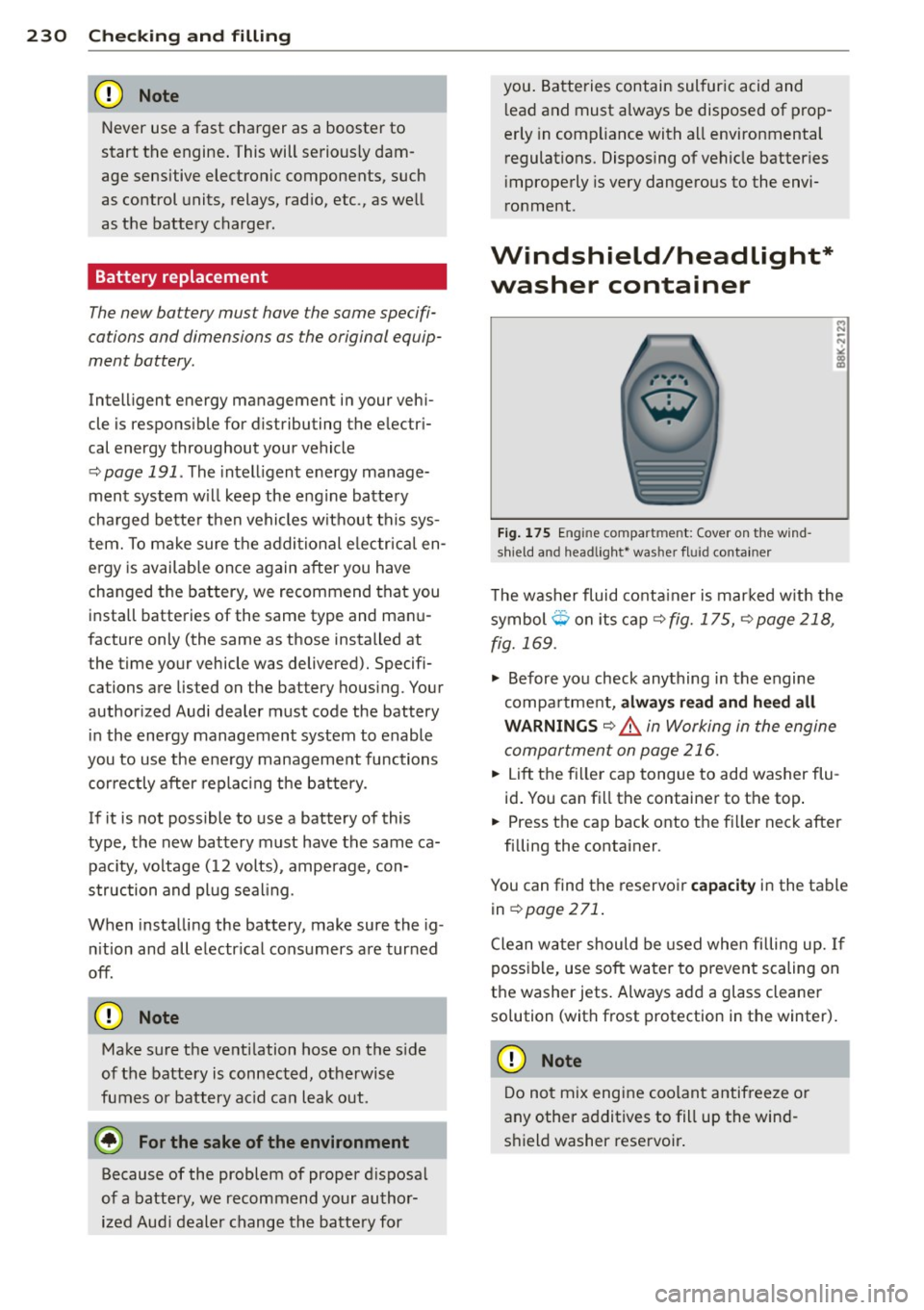
Fig. 17 5 En gin e compa rt m en t: Cover o n the wind
s hi eld an d headlig ht• was her fluid conta iner
T he was her fluid co nta iner is mar ked w ith the
symbol Oon itsc ap c::> fig.17 5,
c::>page218,
fig. 169 .
.,. Before yo u check anything in the engine
compa rtment,
always read and heed all
WARNINGS c::> A in Working in the engine
compartment on page 216.
.,. Lift t he fi ller cap tongue to ad d washer flu
id . You can fi ll the containe r to the top .
.,. Press t he cap back o nto the f iller neck afte r
fi lling the conta iner .
You can find the reservo ir
capacity in the table
in
c::> page 271.
Clean wa ter should be used when filling up. If
poss ib le, use so ft wa ter to preven t scaling on
t h e washer jets . A lways add a glass clea ner
so lution (with frost protection in the winter) .
(D Note
Do not mix engine coo lant antifreeze or
any other a dditives to fill up the wind
s hi eld washer rese rvoir .
Page 238 of 294
236 Tires and wheels
change. In the event of discrepancies, the tire
pressure labe l is located on the driver's side B
p ill ar a lways takes precedence.
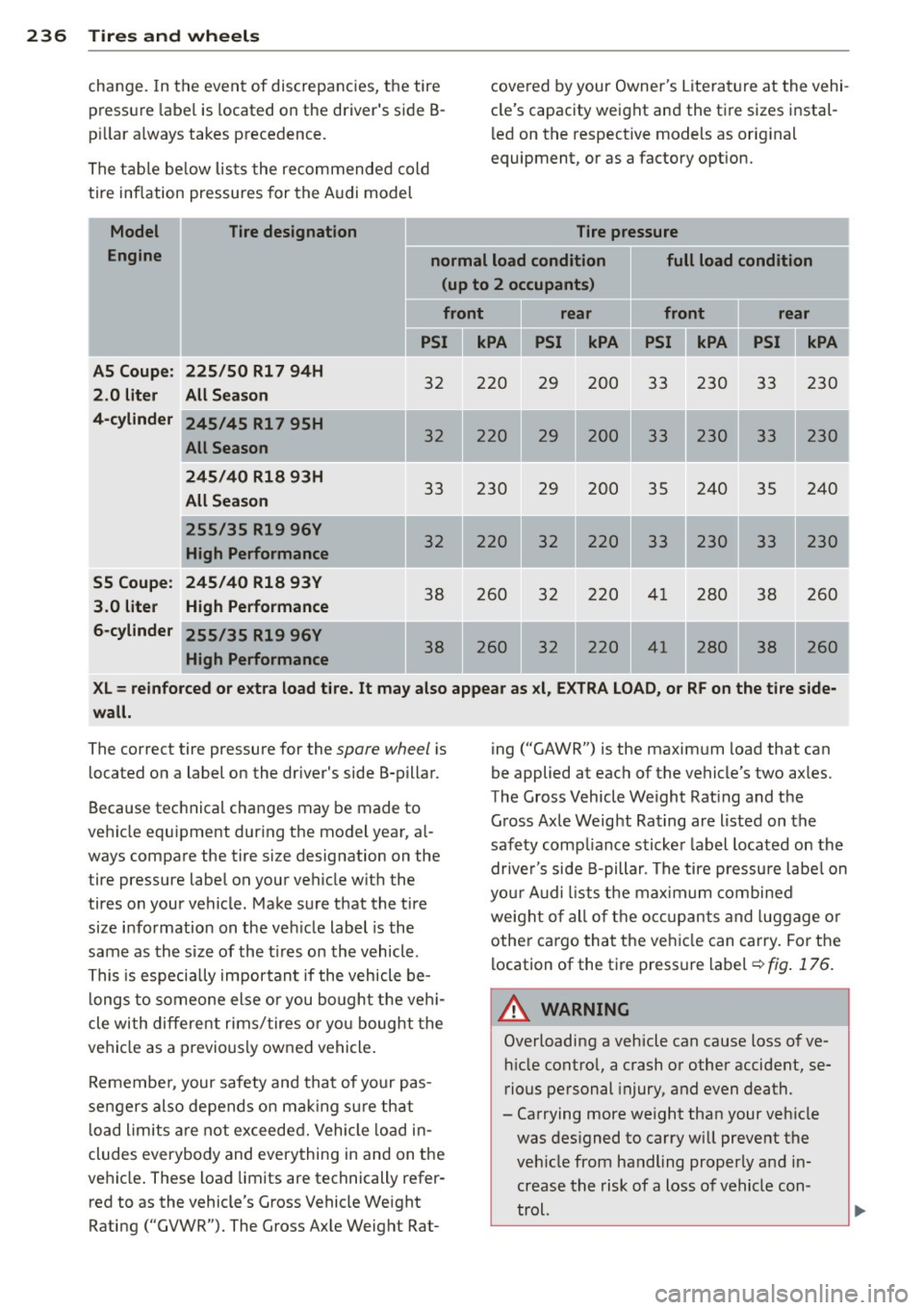
The table below lis ts the recommended cold
tire inflation pressures for the Audi model
I Model II
Tire designation
covered by your Owner's Literature at the vehi
cle's capacity weight and the tire sizes instal
l ed on the respective models as orig inal
equipment, or as a factory option.
Tire pressure
Engine normal load condition full load condition
(up to 2 occupants)
front rear front rear
I
PSI Jl kPA PSI Jl kPA PSI Jl kPA PSI Jl kPA
AS Coupe: 225/50 R17 94H
2.0 liter All Season
4-cylinder 245/45 Rl 7 95H
I Au Season
245/40 R18 93H
All Season
2SS /35 R19 96V
High Performance
55 Coupe: 245/40 R18 93V
3 .0 liter High Performance
6-cylinder
-255/35 R19 96V
High Performance
32 220
32 220
33 230
32 220
38 260
38
260
29 200 33 230 33 230
.
29 200 33 230 33 230
I
29 200 35 240 35 240
'
32 220 33
230 33 230
I
32 220 41 280 38 260
32 220 41 280 38 260
I
XL= reinforced or extra load tire. It may also appear as xl, EXTRA LOAD, or RF on the tire side
wall.
The correct tire pressure for the spare wheel is
located on a label on the driver's side B-pillar.
Because technical changes may be made to
vehicle equipment during the model year, a l
ways compare the tire size designation on the
tire pressure label on your vehicle with the
tires on your vehicle . Make sure that the tire
size information on the veh icle label is the
same as the size of the t ires on the vehicle .
This is especially important if the vehicle be
lo ngs to someone else or you bought the veh i
cle with different rims/tires o r you bought the
vehicle as a previously owned vehicle .
Remember, your safety and that of your pas
sengers also depends on mak ing sure that
l oad limits are not exceeded. Vehicle load in
cludes everybody and everything in and on the
vehicle . These load limits are technically refer
red to as the vehicle's Gross Vehicle Weight
Rating ("GVWR"). The Gross Axle Weight Rat- ing
("GAWR") is the maximum load that can
be applied at each of the vehicle's two axles.
The Gross Vehicle Weight Rating and the
G ross Axle Weight Rating are listed on the
safety comp liance sticker label located on the
drive r's side B-pillar . The tire pressure label on
your Audi lists the maximum combined
weight of all of the occupa nts and luggage or
other cargo that the vehicle can carry. For the
location of the tire pressure label¢
fig. 176.
A WARNING ._
Overloading a vehicle can cause loss of ve
hicle contro l, a crash or other accident, se
rious personal injury, and even death.
- Carrying more weight than your vehicle
was designed to carry will prevent the
veh icle from handling properly and in
crease the risk of a loss of vehicle con
trol.
Page 254 of 294
252 What do I do n ow ?
What do I do now?
Vehicle tool kit
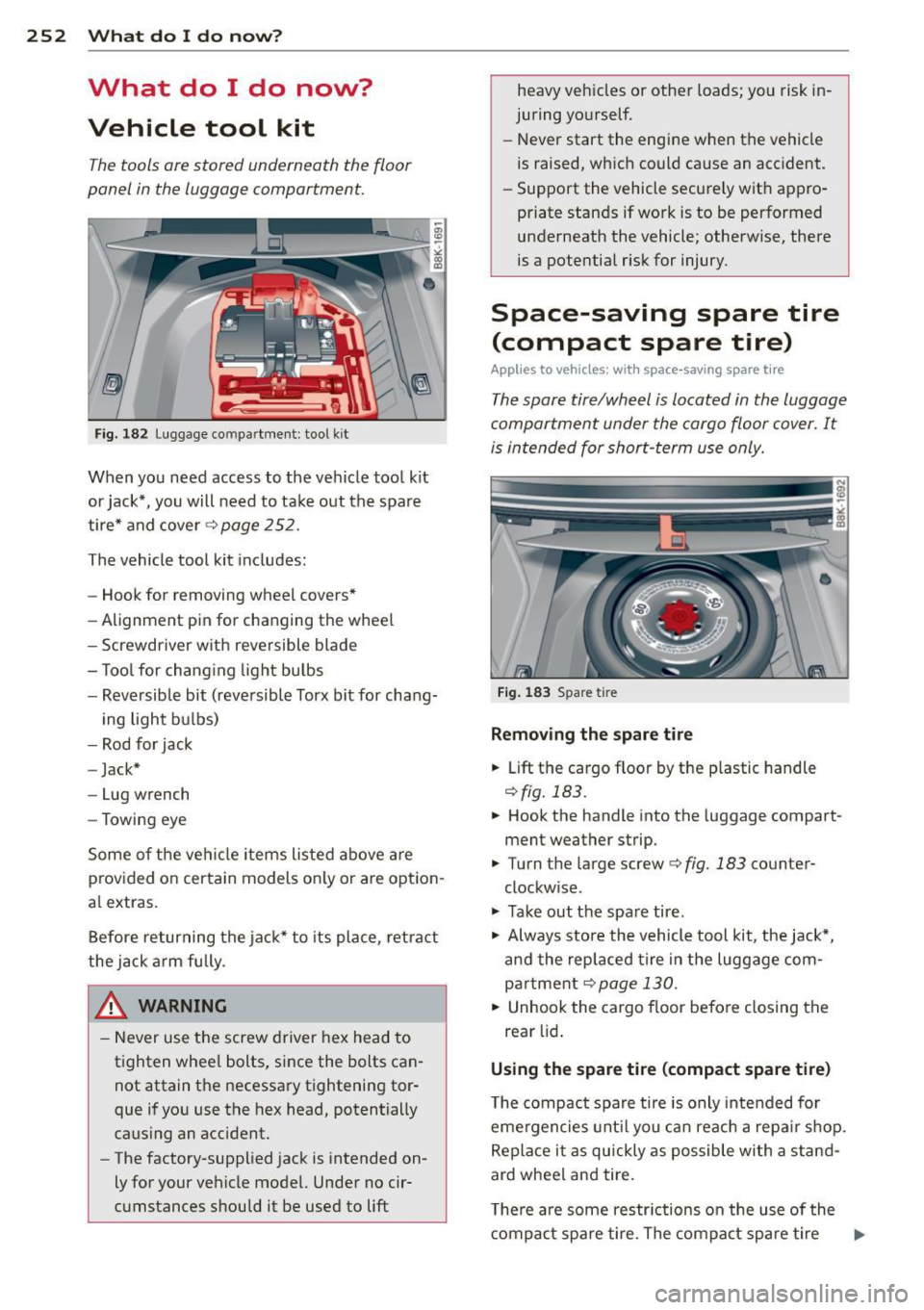
The tools ore stored underneath the floor
panel in the luggage comportment.
Fig. 182 Luggage compartment: tool kit
When you need access to the vehicle too l kit
or jack*, you will need to take out the spare
tire* and cover ¢
page 252.
The vehicle tool kit includes:
- Hook for removing wheel covers*
- Alignment pin for changing the whee l
- Screwdriver w ith reversible blade
- T ool for chang ing ligh t bu lbs
- Reversible bit (reversible Torx bit for chang-
ing light b ulbs)
- Rod for jack
- Jack*
- Lug wrench
- Towing eye
Some o f the ve hicl e items listed above a re
p rovided on certain models o nly or are option
a l extras.
Before returning the jack* to its place, retra ct
the jack a rm fully .
_&. WARNING
- Never use the screw driver hex head to
tighten whee l bolts, s ince the bolts can
not attain the necessa ry tightening tor
que i f you use the hex head, potentially
causing an accident.
- The factory -supplied jack is intended on
ly for your veh icle model. Under no cir
c u mstances should it be used to lift heavy vehicles or othe
r loads; yo u risk in
juring yo urself .
- Never start the engine when the vehicle
is raised, wh ich could cause an acc ident.
- Support the vehicle securely wit h app ro
priate stands if work is to be performed
underneath the vehicle; otherwise, there
is a potentia l risk for injury.
Space-saving spare tire
(compact spare tire)
App lies to vehicles: wit h space-saving spare t ire
The spore tire/wheel is located in the luggage
compartmen t under the cargo floor cover. It
is intended for short-term use only.
F ig . 1 83 Spa re tire
Removing the spare t ire
.. Lift t he cargo floor by the p lastic handle
¢fig . 183.
.. Hook the handle into the luggage compart
ment weather strip.
.. Turn the large screw ¢
fig. 183 counter
clockw ise .
.. Take out the spare tire .
.. Always store the vehicl e tool kit, the jack*,
and the rep laced tire in the luggage com
pa rtment
¢page 130.
.. Unhook the cargo floor be fo re closing the
rea r lid.
Using the spare tire (compact spare tire)
T he compact spare ti re is only inte nded for
eme rgen cies unt il you can reach a rep air shop.
Repl ace it as quickly as possible with a stand
ard wheel and tire.
T he re a re some restr ictions on the use of the
c ompac t spa re tire. The compact spa re tire ...
Page 255 of 294
has been designed specifically for your type of
vehicle.
It must not be swapped with a com
pact spare t ire from another type of veh icle .
Snow cha ins
F or techn ica l reasons, the use of snow chains
on the compact spare tire is
not p ermitt ed .
If you do have to dr ive with snow cha ins and a
front tire fails, mou nt the spare whee l w it h
tire ins tead of a rea r tir e. Install the snow
chains on the rear t ire and use it to replace
the defective front tire .
A WARNING
-Never use the spare tire if it is damaged
or if it is worn down to the tread wear in
dicators.
- If the spare tire is mo re than 6 years o ld,
use it only in an emergency and w ith ex
treme caution and careful driving.
- The spare tire is intended only for tem
porary and short-term use. It should be
replaced as soon as possib le w ith the
normal wheel and t ire .
- After mounting the compact spare tire,
the tire pressure must be checked as
soon as poss ible. The tire pressure of the
compact spa re tire must be 4.2 bar ; oth
erwise, you risk hav ing an accident.
- Do not drive faster than SO mph (80 km/
h). You risk having an acc ident .
-Avo id full-throttle acce lerat ion, heavy
braking, and fast corner ing . You risk hav
ing an acc ident.
- Never drive us ing more t han one spare
wheel and tire . You risk hav ing an acci
de nt.
- No rma l summer or winte r tires must not
be mounted on the compact spare whee l
rim.
- For technical reasons, the use of ti re
ch ains on the spare tire is no t permitted.
If it is necess ary to dr ive wi th tire ch ain s,
the spare whee l must be moun ted on the
front axle in the event o f a flat in a rear
t ire. The newly ava ilable front w heel
must then be installed in place of the
What do I do now? 253
'
rea r whee l w ith the flat tire. Installing
the t ire cha in be fore mounting the whee l
and tire is recommended.
- Loose items in the passenger compart
ment can cause serious personal injury
during hard brak ing or in a n accident.
Never store the inflatable spa re tire or
jack and tools in the passenge r compart
ment.
Changing a wheel
Before changing a wheel
Observe the following precautions for your
own and your passenger 's safety when chang
ing a wheel .
.,. After you expe rie nce a tir e fail ure, p ull the
car we ll away from mov ing traffic and try to
reac h
level ground before you stop ¢ .&, .
.,. All passengers should
leave the car and
move to a safe location ( for instance, behind
the guardra il) ¢ .&, .
.,. Engage the
park ing brake to prevent your
veh icle from rolling unintentionally¢.&, .
.,. Shift into
1st gear on veh icles with man ual
transm iss ion, or move th e
selector lever to
the P po sition
on vehi cles w ith automa tic
t ra nsm iss io n.
.,. If you are towing a tra iler : u nhi tch the trail
er from your vehicle .
.,. Take the
ja ck r=:> page 252 and the spare tire
r=:> page 252 out of the luggage compart
ment.
A WARNING
You o r you r passengers could be i njured
while changing a w heel if you do not fo l-
low these saf ety p recaut ions :
- If you have a fla t tire, move a safe d is
tance off th e road . T urn off the engine,
tur n the eme rgency flashers on and use
o ther warni ng devi ce s to a le rt other mo
t oris ts.
- Ma ke sure tha t passenge rs wait in a safe
p la ce aw ay from the vehicle and well
-
away from the road and tra ffic. .,. •
•
Page 264 of 294
262 Fuses and bulb s
Bulbs
Replacing bulbs
For your safety, we recommend that you have
your authorized Audi dealer replace any bulbs
for you .
It is becoming increasingly more and more
difficult to replace vehicle light bulbs since in
many cases, other parts of the car must first
be removed before you are able to get to the
bu lb . Thi s appl ies especial ly to the light bulbs
in the front of your car which you can only
reach through the engine compartment .
Sheet metal and bulb holders can have sharp
edges that can cause ser ious cuts, parts must
be correctly taken apart and then properly p ut
back together to help prevent breakage of
parts and long term damage from water that
can enter housings that have not been proper
ly resealed.
F or your safety, we recommend that you have
your authorized Audi dealer replace any bulbs
for you, since your dealer has the proper tools,
the correct bu lbs and the expertise.
Gas di scharg e lamps (Xenon lights)*:
Due to the high electrical vo ltage, have the
bu lbs rep laced by a qualified technician.
H eadlights with Xenon light are identified by
the high voltage sticker.
A WARNING
Changing Xenon lamps without the neces
sary equipment can cause serious personal
injury.
- Bulb s are pressurized and can exp lode
when being changed . Potential risk of in
jury!
- On vehicles equipped with gas discharge
bulbs (Xenon light)* life-threatening in
jur ies can result from improper handling
of the high-voltage portions of such
lamps!
- Only your authorized Aud i dealer or a
qualified workshop shou ld change the
bulbs in gas d ischarge lamps. There are parts with sharp edges
on the openings
and on the bulb holders that can cause
serious cuts. If you are uncertain about
what to do, have the work performed by
an author ized Audi dealer or other quali
fied workshop . Ser ious personal injury
may resu lt from improperly performed
wo rk.
@ Tips
- If you st ill prefer to replace the light
bulbs yourself, be aware that the engine
compartment is a hazardous area to
work in
~ page 209, Engine compart
ment~ ,&..
-It is best to ask your authorized Audi
dealer whenever yo u want to change a
bulb .
Page 265 of 294
Emergency situations
General
This chapter is intended for trained emer
gency crews and working personnel who
have the necessary tools and equipment to
perform these operations.
Starting by pushing or
towing
(D Note
Vehicles with an automatic transmission
cannot be started by pushing or towing .
Starting with jumper
cables
If necessary, the engine can be started by
connecting it to the battery of another vehi
cle.
If the engine should fail to start because of a
discharged or weak battery, the battery can be
connected to the battery of
another vehicle,
using a
pair of jumper cables to start the en
g ine.
Jumper cables
Use only jumper cables of sufficiently
largecross section to carry the starter current
safe ly. Refer to the manufacturer's specifica
tions.
Use only jumper cables with
insulated termi
na l clamps which are distinctly marked:
plus(+) cable in most cases colored red
minus(-) cable
in most cases colored black .
A WARNING
Batteries contain electricity, acid, and gas.
Any of these can cause very serious or fatal
injury. Follow the instructions below for
safe handling of your vehicle's battery.
- Always shield your eyes and avoid lean
ing over the battery whenever possible.
Emergency situations 263
-A discharged battery can freeze at tem
peratures just below 32 °F (0 °C). Before
connecting a jumper cable, you must
thaw the frozen battery completely, oth
erwise it could explode.
- Do not allow battery acid to contact eyes
or skin . Flush any contacted area with
water immediately .
- Improper use of a booster battery to
start a vehicle may cause an explosion.
- Vehicle batter ies generate explosive gas
es. Keep sparks, flame and lighted c iga
rettes away from batteries.
- Do not try to jump start any veh icle w ith
a low ac id level in the battery.
- The voltage of the booster battery must
also have a 12-Volt rating. The capacity
(Ah) of the booster battery should not be
lower than that of the discharged bat
tery. Use of batteries of diff erent voltage
or substantially different "Ah" rat ing
may cause an exp losion and personal in
jury.
- Never charge a frozen battery. Gas trap
ped in the ice may cause an explosion.
- Never charge or use a battery that has
been frozen . The battery case may have
be weakened.
- Use of batter ies of different voltage or
substantially different capacity (Ah) rat
ing may cause an exp losion and injury .
The ca pa city (Ah) of the booster battery
should not be lower than that of the dis
charged battery.
- Before you check anything in the engine
compartment, always read and heed all
WARNINGS¢
page 209, Engine com
partment.
(D Note
- App lying a higher voltage booster bat
tery will cause expensive damage to sen
sit ive electronic components, such as
control units, relays, rad io, etc .
- There must be no electrical contact be
tween the vehicles as otherwise current
could already start to flow as soon as the
posit ive(+) terminals are connected. ..,. •
•