warning AUDI A5 COUPE 2013 Owners Manual
[x] Cancel search | Manufacturer: AUDI, Model Year: 2013, Model line: A5 COUPE, Model: AUDI A5 COUPE 2013Pages: 294, PDF Size: 73.84 MB
Page 244 of 294
242 Tires and wheels
& WARNING
Sudden tire failure can lead to loss of con
trol, a crash and serious persona l injury!
- Never drive a vehicle when the tread on
any tire is worn down to the wear indica
tors.
- Worn tires are a safety hazard, they do
not grip well on wet roads and increase
your risk of "hydroplaning" and loss of control.
- Always keep chemicals that can cause tire damage, such as grease, oil, gasoline
and brake fluid away from tires.
- Tires age even if they are not be ing used
and can fail suddenly, especially at high
speeds. Tires that are more than 6 years
old can only be used in an emergency
and then with special care and at lower
speeds.
- Never mount used tires on your vehicle if
you are not sure of their "previous histo
ry." Old used tires may have been dam
aged even though the damage cannot be
seen that can lead to sudden tire failure
and loss of vehicle control.
New tires and replacing tires and wheels
New tires and wheels have to be broken in .
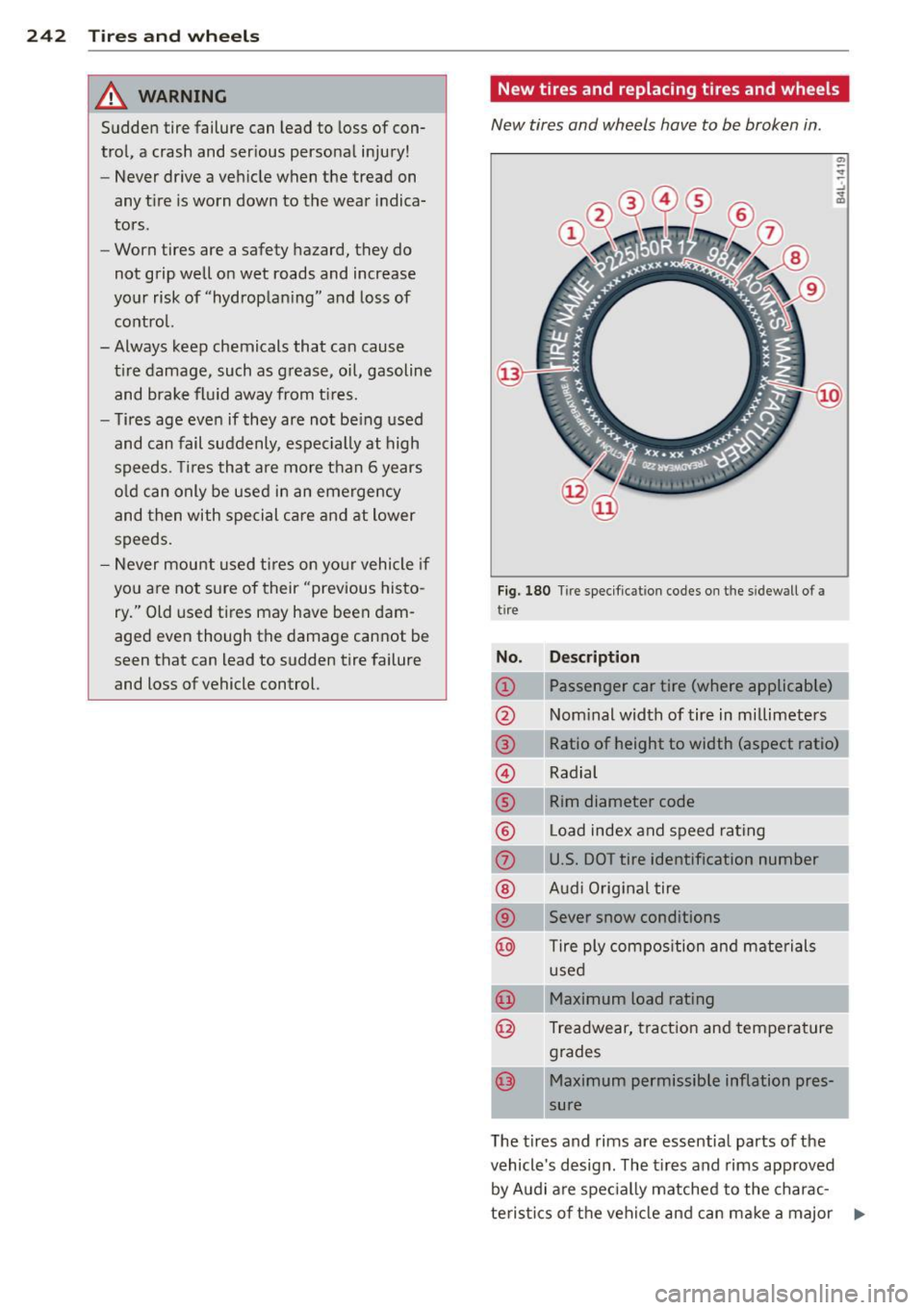
Fig. 180 Tir e specificat ion codes on the s idewall of a
t ire
No. Description
(!) Passenger car tire (where applicable)
@ Nominal width of tire in millimeters
@ Ratio of height to width (aspect ratio)
© Radial
® Rim diameter code
@ Load index and speed rating
(J) U.S. DOT tire identification number
@ Audi Orig inal tire
@ Sever snow conditions
@ Tire ply composition and materials
used
Maximum load rating
Treadwear, traction and temperature
grades
Maximum permissible inflation pres
sure
T he tires and rims are essential parts of the
vehicle 's design . The tires and rims approved
by Audi are spec ially matched to the charac
teristics of the vehicle and can make a major .,..
Page 246 of 294
24 4 T ire s and wheel s
S up to 110 mph (180 km/h)
T up to 118 mph (190 km/h)
U up to 124 mph (200 km/h)
H up to 130 mph (210 km/h)
V up to 149 mph (240 km/h)1l
Z over 149 mph (240 km/h)ll
W up to 168 mph (270 km/h)ll
Y up to 186 mph (298 km/h)
1 l
Your veh icle is no rma lly factory equipped with
tires, which possess excellent driving cha rac
terist ics and give yo ur Audi opt imum d riving
comfort . An e lectronic speed limiter
c::> page 31 will normally prevent your vehicle
from going faster than the tire speed rating
¢ &. .
U.S. DOT Ti re Identification Numb er (TIN)
and ti re manuf actur e date
This is the tire's "serial number" . It begins
with the letters "DOT" and indicates that the
tire meets all federal standards. The next two
numbers or letters indicate the plant where it
was manufactured, and the last four numbers
represent the week and year of manufacture.
For example, the numbers 2212 mean that
the tire was produced in the 22nd wee k of
2012. The other n umbers are mar keting co
des that may or may not be used by the tire
manufacturer . This information is used to con
tact consumers if a tire defect requires a re
call.
Audi Original tir e
Tires with the identification "AO" or "RO" have
been specia lly matched with your Audi . We
recommend using only these tires because
they meet the highest standards regard ing
safety and driving character istics when used
correctly. Your authorized Audi dealer will
glad ly provide you with more information.
Tire ply compo sit ion and materi als used
The number of plies indicates the number of
l ayers of rubber-coated fabric in the tire. In
ll For tir es w it h a m ax im um spee d ca pabil ity ove r
1 4 9 mp h (2 40 k m/h) , t ire man ufact urers somet imes
u se the letters "ZR. "
genera l, the greater the number of plies, the
more weight a tire can support. Tire manufac
turers also must indicate the mate rials in the
t ire, which include steel, nylon, po lyester, and
others.
Ma ximum Load Rating
This number ind icates the maximum load in
ki lograms and pounds that can be carried by
the tire.
Tire quality grading for treadwear ,
traction , and t emp eratu re resi stance
T read wear, t raction and temperat ure grades
c::> page
245.
Ma ximum Permi ssible Inflat ion Pressure
T h is number is the greatest amount of a ir
pressure that should ever be put in the tire
u nder norma l driving cond itions.
.&, WARNING ~ -
- Using incorrect or unmatched tires and/
or wheels or improper tire and wheel
comb inat ions can lead to loss of control ,
coll is ion and serious personal injury.
-Always use t ires, rims and whee l bolts
that meet the specifications of original
factory- installed tires or other combina
tions that have been specifically ap
p roved by the vehicle manufacture r.
- Tires age even if they are not being used
and can fail suddenly, especially at high
speeds. Tires that are more than 6 yea rs
old can only be used in an emergen cy
a nd then w it h specia l care and at lower
speeds.
- Never mo unt used tires on your veh icle if
you are no t sure of the ir "previo us histo
ry." O ld used tires may have been dam
aged even though the damage cannot be
seen that can lead to sudden tire fa ilure
and loss of vehicle control.
Page 248 of 294
246 Tires and wheels
The relative performance of tires depends
upon the actual conditions of their use, how
ever, and may depart significantly from the norm due to variations in driving habits, serv
ice practices and differences in road character
istics and climate.
Traction
The traction grades , from highest to lowest,
are AA, A, Band
C. Those grades represent the
tire's ability to stop on wet pavement as measured under controlled conditions on
specified government test surfaces of asphalt
and concrete . A tire marked C may have poor
traction performance ¢.&, .
Temperature
The tempera ture grades are A (the highest),
B, and
C, representing the tire's resistance to
the generation of heat and its ability to dissi
pate heat when tested under controlled condi
tions on a specified indoor laboratory test
wheel.
Sustained high temperature can cause the
material of the tire to degenerate and reduce
tire life, and excessive temperature can lead
to sudden tire failure~.&, .
The grade
C corresponds to a level of perform
ance which all passenger car tires must meet under the Federal Motor Vehicle Safety Stand
ard No.
109. Grades Band A represent higher
levels of performance on the laboratory test
wheel than the minimum required by law.
A WARNING
The traction grade assigned to this tire is
based on straight-ahead braking traction
tests, and does not include acceleration,
cornering, hydroplaning or peak traction
characteristics.
A WARNING
The temperature grade for this tire is es
tablished for a tire that is properly inflated
and not overloaded . Excessive speed, un
derinflation, or excessive loading, either
-
separately or in combination, can cause heat buildup and possible tire failure.
Winter tires
Winter tires can improve vehicle handling on
snow and ice. At temperatures below 45 °F (7 °C) we recommend changing to winter
tires.
In some heavy snow areas, local governments
may require true winter or "snow" tires, those
with very deeply cut tread . These tires should
only be used in pairs and be installed on all
four wheels . Make sure you purchase snow
tires that are the same size and construction
type as the other tires on your vehicle .
Your vehicle is equipped with all wheel drive,
this will improve traction during winter driv
ing, even with the standard tires. However, we
strongly recommend that you always equip all
four wheels on your vehicle with correctly fit
ted winter tires or all-season tires, when win
ter road conditions are expected. This also im
proves the vehicle's braking performance and
reduces stopping distances.
Summer tires provide less grip on ice and
snow.
Winter tires (snow tires) must always be fitted
on all four wheels.
Ask your authorized Audi dealer or qualified
workshop for permitted
winter tire sizes . Use
only radial winter tires.
Winter tires lose their effectiveness when the
tread is worn down to a depth of
O .15 7 inch
(4 mm).
Only drive with winter tires under winter con
ditions. Summer tires handle better when
there is no snow or ice on the roads and the
temperature is above 45 °F (7 °().
If you have a flat ti re, see notes on spare
wheel
¢page 242.
Please always remember that winter tires may
have a lower speed rating than the tires origi-
nally installed on your vehicle at the time it .,.
Page 249 of 294
was manufacture d. Please see ¢ page 243,
Speed rating (letter code) for a listing of the
speed rat ing letter codes and t he maxim um
speed at whic h the tires can be driven .
The s peed rating letter code(¢
page 233) is
on the side wall of the tire
c::> page 242 .
A WARNING
Winter tires have maximum speed limits
that may be lower than your vehicle's max
imum speed. Always know the maximum
speed before driving off . Never drive faster
than the speed permitted for your specific
w inte r tir es . This will cause damag e to the
ti res leading to an ac cident and serious
pe rsonal in jury to you and yo ur passen
gers .
A WARNING
Driv ing faster than the maximum speed
for which the winter tires on your vehicle
were designed can ca use tire fai lure in
cl uding a blowout and sudden deflat ion,
loss of control, crashes and serious per
sonal injuries . Have worn or damaged tires
rep laced immed iate ly.
- Winter tires have maximum speed rat ing
that may be lower tha n your veh icle's
maximum speed .
- Never drive faster than the speed for
w hich the winter or other tires installed
on your veh icle are rated .
A WARNING
Always adjust your d rivi ng to the road and
traffic conditions. Neve r let the good ac
c eleration of the w inte r ti res and all whee l
drive temp t you in to taking extra r is k s . A l
ways remember:
- When bra king, an a ll whee l dr ive vehicle
hand les in the s ame way as a front drive
vehicle.
- Drive carefu lly and reduce your speed on
icy and slippery roads, even winter tires
cannot he lp un der blac k ice conditions.
Tire s an d wheel s 24 7
'
@) For the sake of the environment
Use summer tires when weather condi
tions permit. They are qu ieter, do not wear
as quickly and reduce fuel consumpt ion.
Snow chains
Snow cha ins may be fitted only to the front
whee ls, and o nly to certain tire sizes . Ask your
autho rized Aud i deale r on which tire sizes
snow c ha ins can be used.
The snow chains must have low-prof ile links
and must not be t hicker than 0.53 inch
(13.5 mm) , includ ing the lock .
Remove wheel center covers and trim discs
before putt ing snow cha ins on your vehicle
c::> Q) . For safety reasons cover caps must then
be fitted over the wheel bolts. These are ava il
able from autho riz ed Aud i dealers.
A WARNING
Using the wrong snow chai ns for your vehi
cle o r insta lling them in co rr ect ly can in
crease the risk of loss of cont ro l leading to
serious pe rsonal injury.
- Snow chains are available in different
sizes. A lways make sure to follow t he i n
structions p rov ided by the snow chain
manufacturer.
- When driving with snow chains never
drive faster than the speed permitted for
your specif ic snow chains.
- Always observe local regulations .
(D Note
-Remove s now c hain s be fo re dr iv ing o n
roads not covered with snow to avoid
damaging tires and wea ring the snow
chains down unnecessa rily.
- Snow chains, which come into direc t con
tact with the whee l rim , can scratch or
damage it . Therefo re, make sure that the
snow chains are s uitably covered. Check
the pos ition of the snow chains after
•
•
Page 250 of 294
248 Tires and wheels
driving a few yards and correct if neces
sary. Follow the instructions from the
snow cha in manufacturer when doing so.
(D Tips
Where snow chains are mandatory oncer
tain roads, this normally also applies to
vehicles with all wheel drive.
Wheel bolts
Wheel bolts must always be tightened to the
correct torque.
The design of whee l bolts is matched to the
factory installed rims. If different rims are fit
ted, the correct wheel bolts with the right length and correctly shaped bolt heads must
be used. This ensures that wheels are fitted
securely and that the brake system functions
correctly .
In certain circumstances, you may not use
wheel bolts from a different vehicle -even if it
is the same model
¢ page 275.
.&_ WARNING
Improperly tightened or maintained wheel
bolts can become loose causing loss of
control, a collision and serious persona l in
Jury.
- Always keep the wheel bolts and the
threads in the wheel hubs clean so the
wheel bolts can turn easily and be prop
erly tightened.
- Never grease or oil the wheel bolts and
the threads in the wheel hubs. They can
become loose while driving if greased or
oiled, even if tightened to the specified
torque.
- Only use wheel bolts that belong to the
rim being installed.
- Never use different wheels bolts on your
vehicle.
- Always maintain the correct tightening
torque for the wheel bolts to reduce the
risk of a wheel loss . If the tightening tor
que of the wheel bolts is too low, they
can loosen and come out when the veh i- cle
is moving.
If the tightening torque is
too high, the wheel bolts and threads
can be damaged and the wheel can be
come loose.
(D Note
The specified torque for the whee l bolts is
90 ft lbs . (120 Nm) with a tolerance of
± 7,4 ft lbs. (± 10 Nm). Torque wheel bolts
diagonally . After changing a wheel, the
torque must be checked as soon as possi
ble with a torque wrench -preferably by an
authorized Audi dealer or qualified work
shop.
Low aspect ratio tires
Your Audi is factory -equipped with low aspect
ratio tires. These tires have been thoroughly
tested and been se lected specifically for your
model for their superb performance, road feel
and handling under a variety of driving condi
t ions . Ask your authorized Audi dealer for
more details .
The low aspect ratio of these tires is indicated
by a numeral of
55 or less in the tire's s ize
designation . The numeral represents the ratio
of the tire's sidewall height in relation to its
tread width expressed in percentage. Conven
tional tires have a height/w idth rat io of 60 or
more.
The performance of low-aspect-ratio tires is
particularly sensitive to improper inflation
pressure. It is therefore important that low
aspect ratio tires are inflated to the specified
pressure and that the inflation pressure is
regularly checked and maintained. Tire pres
sures should be checked at least once a
month and always before a long trip
¢ page 237, Checking tire pressure.
What you can do to avoid tire and rim
damage
Low aspect ratio tires can be damaged more
easily by impact with potholes, curbs, gul lies
or ridges on the road, particularly if the tire is
underinflated . ..,.
Page 252 of 294
250 Tire s and wheel s
When the malfunction indicator is illuminat
ed, the system may not be able to detect or
signal low t ire pressure as intended. TPMS
malfunctions may occur for a variety of rea
sons, including the installation of replace
ment or a lternate tires or wheels on the vehi
cle that prevent the TPMS from funct ioning
properly . Always check the TPMS malfunct ion
tellta le afte r replacing one or more t ires or
wheels on your veh icle to ensure that the re
p lacement or a lternate tires and wheels allow
the TPMS to continue to function properly.
Tire pressure indicator appears
Applies to vehicles: with tire pressure monitoring system
The tire pressure indicator in the instrument
cluster informs you if the tire pressure is too
low or if there is a system malfunction.
N
I
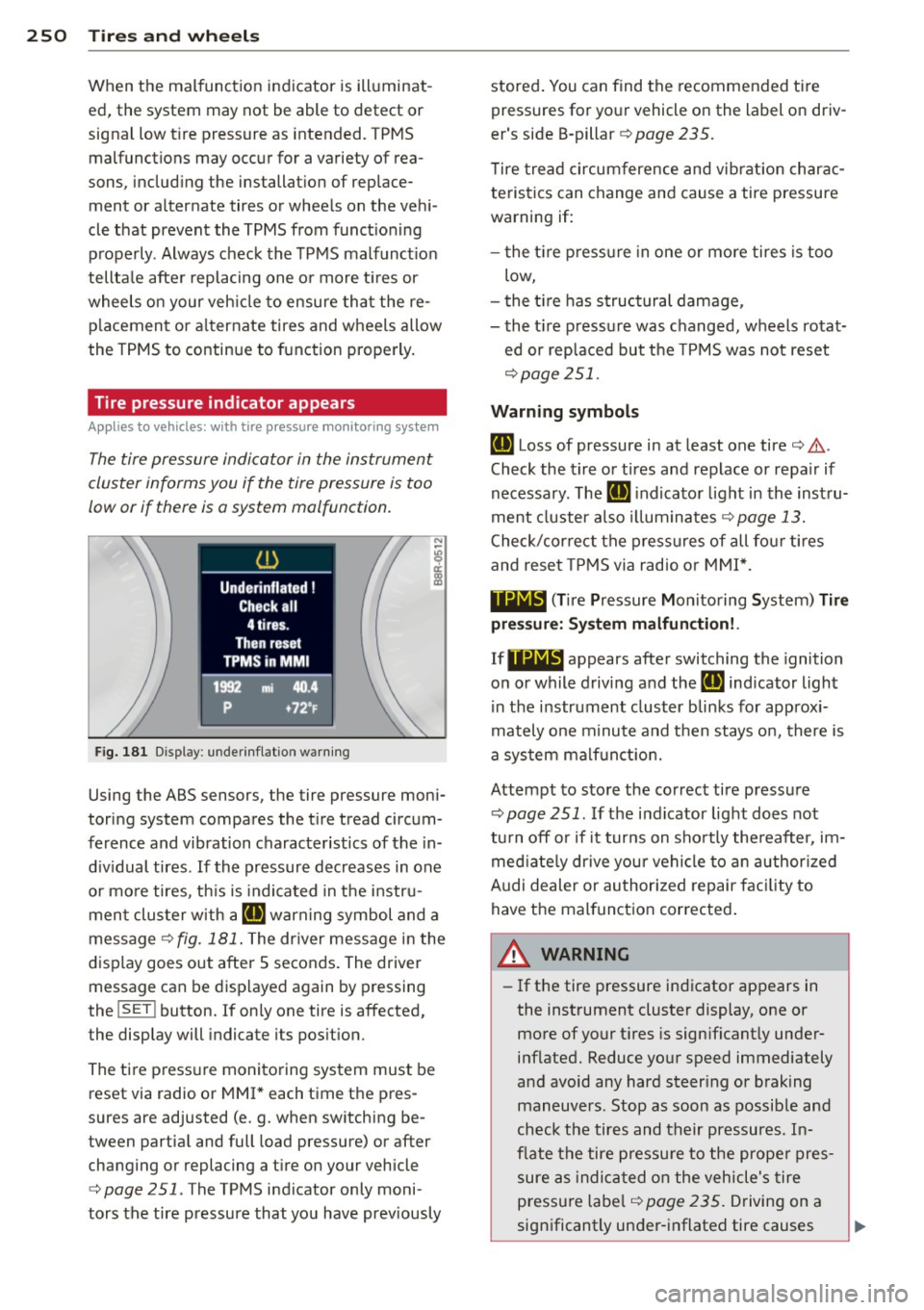
F ig. 181 Display : underinflatio n warning
Using the ABS sensors, the tire pressure moni
toring system compares the t ire tread circum
ference and vibration characteristics of the in
d iv idual tires . If the pressure decreases in one
or more tires, th is is indicated in the instru
ment cluster w ith a
IE warning symbol and a
message¢
fig. 181 . The driver message in the
display goes out after 5 seconds. The driver
message can be displayed again by pressing
the
! SE T! button. If on ly one tire is affected,
the display will indicate its pos it ion.
The tire pressure monitoring system must be reset via radio or MMI * each time the pres
sures are adjusted (e. g . when switching be
tween partia l and full load pressure) or after
changing or replacing a t ire on your vehicle
¢
page 251 . The TPMS indicator only moni
tors the tire pressure that you have prev iously stored
. You can find the recommended tire
pressures for yo ur vehicle on the label on driv
er's side B-pillar ¢
page 235.
Tire tread circumference and vibration charac
teristics can change and cause a tire pressure
warning if:
- the t ire p ress ure in one or more tires is too
low,
- the t ire has structural damage ,
- the t ire pressure was changed, wheels rotat-
ed or rep laced but the TPMS was not reset
¢ page 251.
Warning symbols
IE Loss of pressure in at least one tire¢.&. .
Check the tire or tires and replace or repa ir if
necessary. The
IE i ndicato r light in the inst ru
ment cluster a lso illuminates
¢ page 13.
Check/cor rect the press ures of all fo ur tires
and reset TPMS via radio or MMI*.
11@1~1 (Tir e Pressure Mon itoring System) Tir e
pr ess ure : Sy ste m malfun cti on!.
If11Nlf:1 appears after switching the ignition
on or while driving and the
IE indicator light
in the instrument cluster blinks for approx i
mately one minute and then stays on, there is
a system malf unct ion.
Attempt to store the correct tire pressure
¢ page 251. If the indicator light does not
tu rn
off or if it turns on sho rtly the reafter, im
med iate ly dr ive you r vehicle to a n author ized
A udi dealer or authorized repair fac ility to
have the malfunction corrected .
A WARNING
=
-If the tire pressure indicator appears in
the instrument cluster display, one or
more of your t ires is sign ificant ly under
inflated. Reduce your speed immediately
and avoid any hard steer ing or braking
maneuvers. Stop as soon as possib le and
check the tires and their pressures. In
flate the tire pressu re to the prope r pres
sure as indicated on the vehicle's tire
pressu re labe l¢
page 235. D riving on a
significantly under-inflated tire causes
Page 254 of 294
252 What do I do n ow ?
What do I do now?
Vehicle tool kit
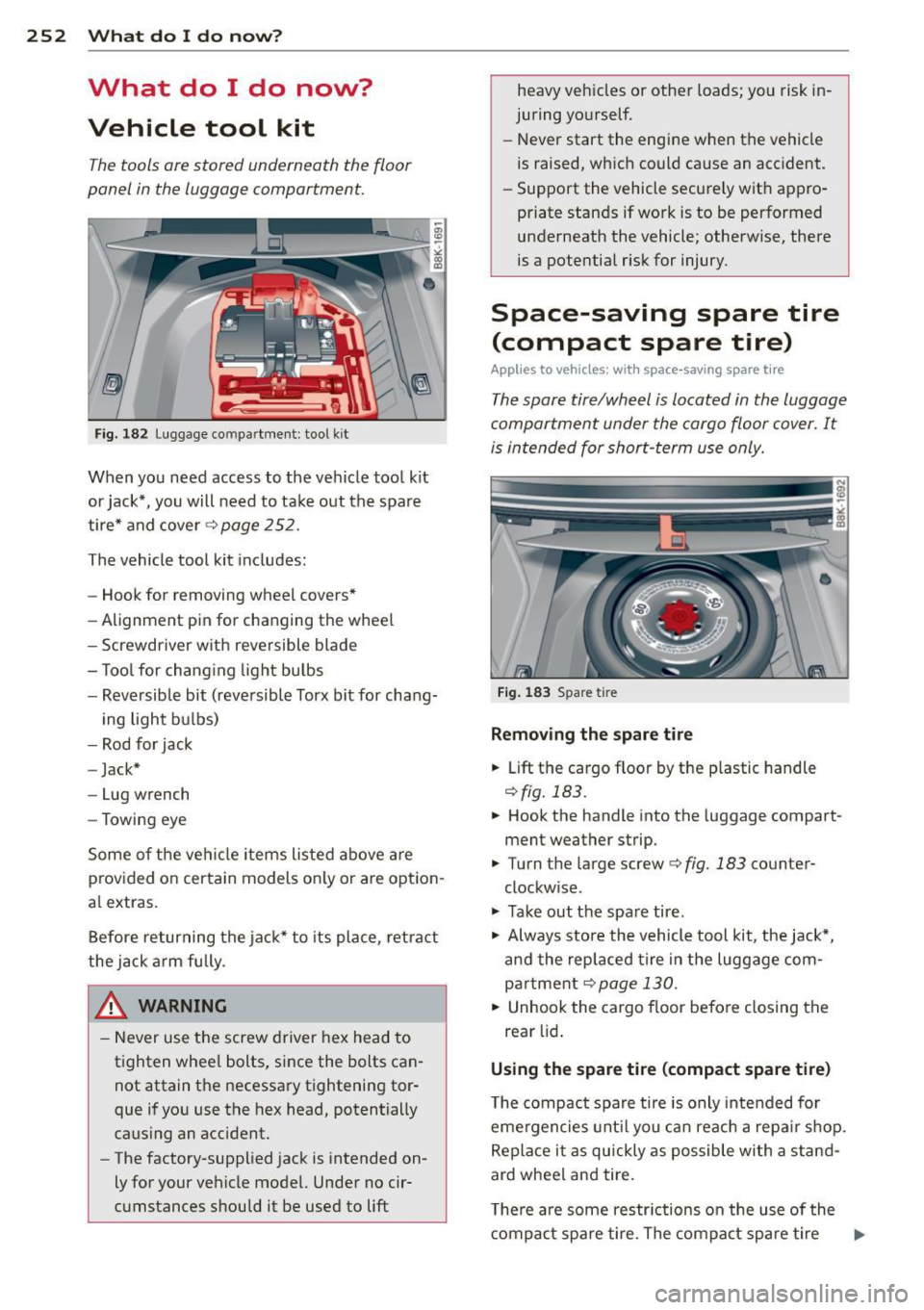
The tools ore stored underneath the floor
panel in the luggage comportment.
Fig. 182 Luggage compartment: tool kit
When you need access to the vehicle too l kit
or jack*, you will need to take out the spare
tire* and cover ¢
page 252.
The vehicle tool kit includes:
- Hook for removing wheel covers*
- Alignment pin for changing the whee l
- Screwdriver w ith reversible blade
- T ool for chang ing ligh t bu lbs
- Reversible bit (reversible Torx bit for chang-
ing light b ulbs)
- Rod for jack
- Jack*
- Lug wrench
- Towing eye
Some o f the ve hicl e items listed above a re
p rovided on certain models o nly or are option
a l extras.
Before returning the jack* to its place, retra ct
the jack a rm fully .
_&. WARNING
- Never use the screw driver hex head to
tighten whee l bolts, s ince the bolts can
not attain the necessa ry tightening tor
que i f you use the hex head, potentially
causing an accident.
- The factory -supplied jack is intended on
ly for your veh icle model. Under no cir
c u mstances should it be used to lift heavy vehicles or othe
r loads; yo u risk in
juring yo urself .
- Never start the engine when the vehicle
is raised, wh ich could cause an acc ident.
- Support the vehicle securely wit h app ro
priate stands if work is to be performed
underneath the vehicle; otherwise, there
is a potentia l risk for injury.
Space-saving spare tire
(compact spare tire)
App lies to vehicles: wit h space-saving spare t ire
The spore tire/wheel is located in the luggage
compartmen t under the cargo floor cover. It
is intended for short-term use only.
F ig . 1 83 Spa re tire
Removing the spare t ire
.. Lift t he cargo floor by the p lastic handle
¢fig . 183.
.. Hook the handle into the luggage compart
ment weather strip.
.. Turn the large screw ¢
fig. 183 counter
clockw ise .
.. Take out the spare tire .
.. Always store the vehicl e tool kit, the jack*,
and the rep laced tire in the luggage com
pa rtment
¢page 130.
.. Unhook the cargo floor be fo re closing the
rea r lid.
Using the spare tire (compact spare tire)
T he compact spare ti re is only inte nded for
eme rgen cies unt il you can reach a rep air shop.
Repl ace it as quickly as possible with a stand
ard wheel and tire.
T he re a re some restr ictions on the use of the
c ompac t spa re tire. The compact spa re tire ...
Page 255 of 294
has been designed specifically for your type of
vehicle.
It must not be swapped with a com
pact spare t ire from another type of veh icle .
Snow cha ins
F or techn ica l reasons, the use of snow chains
on the compact spare tire is
not p ermitt ed .
If you do have to dr ive with snow cha ins and a
front tire fails, mou nt the spare whee l w it h
tire ins tead of a rea r tir e. Install the snow
chains on the rear t ire and use it to replace
the defective front tire .
A WARNING
-Never use the spare tire if it is damaged
or if it is worn down to the tread wear in
dicators.
- If the spare tire is mo re than 6 years o ld,
use it only in an emergency and w ith ex
treme caution and careful driving.
- The spare tire is intended only for tem
porary and short-term use. It should be
replaced as soon as possib le w ith the
normal wheel and t ire .
- After mounting the compact spare tire,
the tire pressure must be checked as
soon as poss ible. The tire pressure of the
compact spa re tire must be 4.2 bar ; oth
erwise, you risk hav ing an accident.
- Do not drive faster than SO mph (80 km/
h). You risk having an acc ident .
-Avo id full-throttle acce lerat ion, heavy
braking, and fast corner ing . You risk hav
ing an acc ident.
- Never drive us ing more t han one spare
wheel and tire . You risk hav ing an acci
de nt.
- No rma l summer or winte r tires must not
be mounted on the compact spare whee l
rim.
- For technical reasons, the use of ti re
ch ains on the spare tire is no t permitted.
If it is necess ary to dr ive wi th tire ch ain s,
the spare whee l must be moun ted on the
front axle in the event o f a flat in a rear
t ire. The newly ava ilable front w heel
must then be installed in place of the
What do I do now? 253
'
rea r whee l w ith the flat tire. Installing
the t ire cha in be fore mounting the whee l
and tire is recommended.
- Loose items in the passenger compart
ment can cause serious personal injury
during hard brak ing or in a n accident.
Never store the inflatable spa re tire or
jack and tools in the passenge r compart
ment.
Changing a wheel
Before changing a wheel
Observe the following precautions for your
own and your passenger 's safety when chang
ing a wheel .
.,. After you expe rie nce a tir e fail ure, p ull the
car we ll away from mov ing traffic and try to
reac h
level ground before you stop ¢ .&, .
.,. All passengers should
leave the car and
move to a safe location ( for instance, behind
the guardra il) ¢ .&, .
.,. Engage the
park ing brake to prevent your
veh icle from rolling unintentionally¢.&, .
.,. Shift into
1st gear on veh icles with man ual
transm iss ion, or move th e
selector lever to
the P po sition
on vehi cles w ith automa tic
t ra nsm iss io n.
.,. If you are towing a tra iler : u nhi tch the trail
er from your vehicle .
.,. Take the
ja ck r=:> page 252 and the spare tire
r=:> page 252 out of the luggage compart
ment.
A WARNING
You o r you r passengers could be i njured
while changing a w heel if you do not fo l-
low these saf ety p recaut ions :
- If you have a fla t tire, move a safe d is
tance off th e road . T urn off the engine,
tur n the eme rgency flashers on and use
o ther warni ng devi ce s to a le rt other mo
t oris ts.
- Ma ke sure tha t passenge rs wait in a safe
p la ce aw ay from the vehicle and well
-
away from the road and tra ffic. .,. •
•
Page 256 of 294
254 What do I do now?
-To help prevent the vehicle from moving
sudden ly and possibly slipping off the
jack, always fully set the parking brake
and block the wheel diagonally opposite
the wheel being changed with the fold ing chocks or other objects. When one
front whee l is lifted off the gro und, plac
ing the A utomat ic Transm iss io n in "P"
(Park) will
not prevent the vehi cle from
moving .
- Be fore yo u change a wheel, be sure the
ground is leve l and fi rm . If necessa ry,
use a sturdy board under the jack.
- After installing the spare tire, make sure
that you replace the f lat ti re/wheel in its
storage area properly and tighten the
knurled retain ing screw secu rely .
@ Note
If you are chang ing the wheel on a steep
incline, use a rock or similar object to
block the opposite wheel to prevent the
veh icle from mov ing.
(D} Tips
Obey a ll laws .
Changing a wheel
When you change a wheel, follow the se
quence described below step -by -step and in
exactly that order.
1. Remove the decorative wheel c ove r* or
the wheel bolt cap s*. For more de tails see
a lso
¢ page 255, Decorative wheel cov
ers
or ¢ page 255, Wheels with wheel
bolt caps.
2 . Loosen the wheel bolts ¢ page 255.
3. Locate the proper mount ing point for the
jack and align the jack below that point
¢ page 256.
4. Lift the car with the jack¢ page 256 .
S. Remove the wheel with th e flat tire and
then install the spare tire
¢page 257.
6. Tighten all wheel bo lts ligh tly.
7 . lowe r the ve hicle w ith the jack . 8
. Use the wheel bolt w rench and firmly
tighten all wheel bolts in a crisscross pat
te rn
¢ page 255.
9. Replace the decorati ve wheel cover * or
the wheel bolt caps *.
A WARNING
Always read and fo llow all WARNINGS and
in fo rmat ion¢ .&.
in Raising the vehicle on
page 256
and ¢ page 258.
After changing a wheel
A wheel change is not complete without the
doing the following .
.,. Always store the vehicle tool kit, the jack*,
and the replaced tire in the luggage com
partme nt
¢ page 130.
.,. Check the tire pressure of the spare tire as
soon as possible.
.,. As soon as poss ib le, have the tightening
torque s on all whee l bolts chec ked w ith a
to rque wrenc h. The co rrect tighte ning tor
que is
90 ft lbs. (120 Nm) .
.,. Have the flat tire replaced as soon as possi
ble.
@ Tips
- If you notice that the wheel bo lts a re
co rroded and difficult to turn while
chang ing a tire, they shou ld be rep laced
before you check the tightening torque.
- Dr ive at reduced speed until you have the
tightening torques checked.
Page 257 of 294
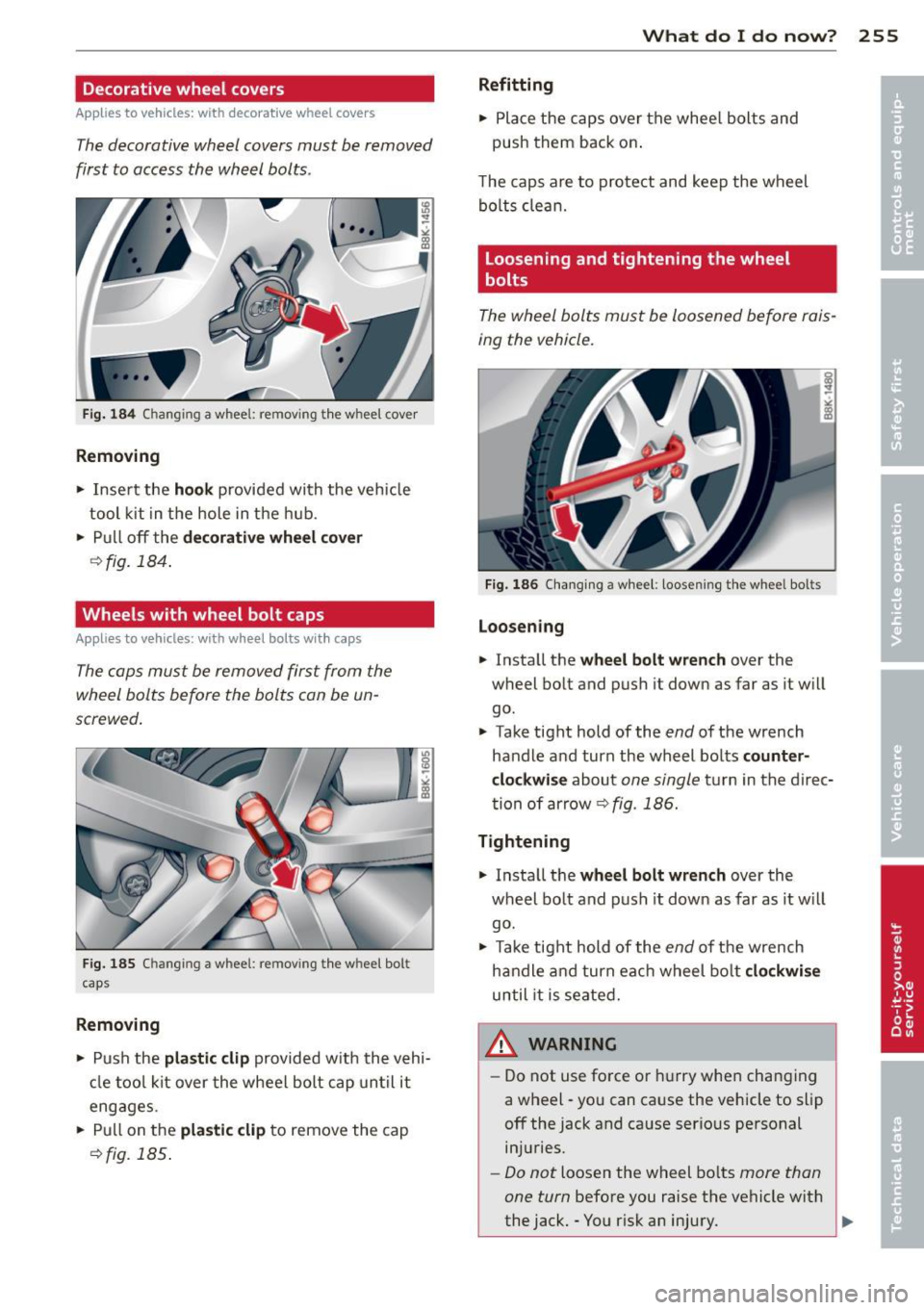
Decorative wheel covers
Applies to vehicles: with decorative wheel covers
The decorative wheel covers must be removed
first to access the wheel bolts .
Fig. 18 4 Changing a wheel: removing t he w heel cover
Removing
.,. Inse rt the hook provided with the vehicle
tool kit in the hole in the hub .
.,. Pull off the
decorati ve wh eel cov er
¢ fig . 184 .
Wheels with wheel bolt caps
Applies to vehicles: with wheel bolts w it h ca ps
The caps must be removed first from the
wheel bolts before the bolts can be un
screwed .
Fig. 185 C hanging a w hee l: removing the wheel bolt
caps
Removing
.,. Push the pla stic cli p provided with the vehi
cl e tool kit over the wheel bolt cap until it
engages.
.,. Pull on the
pla stic clip to remove the cap
¢ fig. 185 .
What do I do now ? 255
Refitting
.. Place the caps over the whee l bolts and
push them back on .
T he caps are to protect and keep the wheel
bolts clean.
Loosening and tightening the wheel
bolts
The wheel bolts must be loosened before rais
ing the vehicle.
Fig. 186 Cha ng ing a whee l: loosening th e wheel bolts
Lo osen ing
.,. Insta ll the wheel bolt w rench over the
wheel bolt and push it down as far as it will
go.
.,. Take tight hold of the
end of the wrench
handle and turn the wheel bo lts
counter
cl oc kwi se
about one single turn in the direc
tion of arrow ¢
fig. 186.
Tightening
.,. Install the whee l bolt wren ch over the
wheel bolt and push it down as far as it w ill
go .
.,. Take tight hold of the
end of the wrench
handle a nd turn each wheel bo lt
cl oc kwise
until it is seated.
A WARNING
- Do not use force or hurry when changing
a wheel -you can cause the vehicle to slip
off the jack and ca use serio us personal
injuries.
- Do not loosen the wheel bo lts more than
one turn
before you raise the vehicle with
the jack. -You risk an injury. ..,.