warning AUDI A5 COUPE 2013 Owners Manual
[x] Cancel search | Manufacturer: AUDI, Model Year: 2013, Model line: A5 COUPE, Model: AUDI A5 COUPE 2013Pages: 294, PDF Size: 73.84 MB
Page 258 of 294
256 What do I do now?
@ Tips
-Never use the hexagonal socket in the
handle of the screwdriver to loosen or
tighten the wheel bo lts.
- If a whee l bolt is very tight, you may find
it easier to loosen by carefully pushing
down on the end of the wheel bolt
wrench with
one foot only. As you do so,
hold on to the car to keep your balance
and take care not to slip.
Raising the vehicle
The vehicle must be lifted with the jack first
before the wheel can be removed .
*
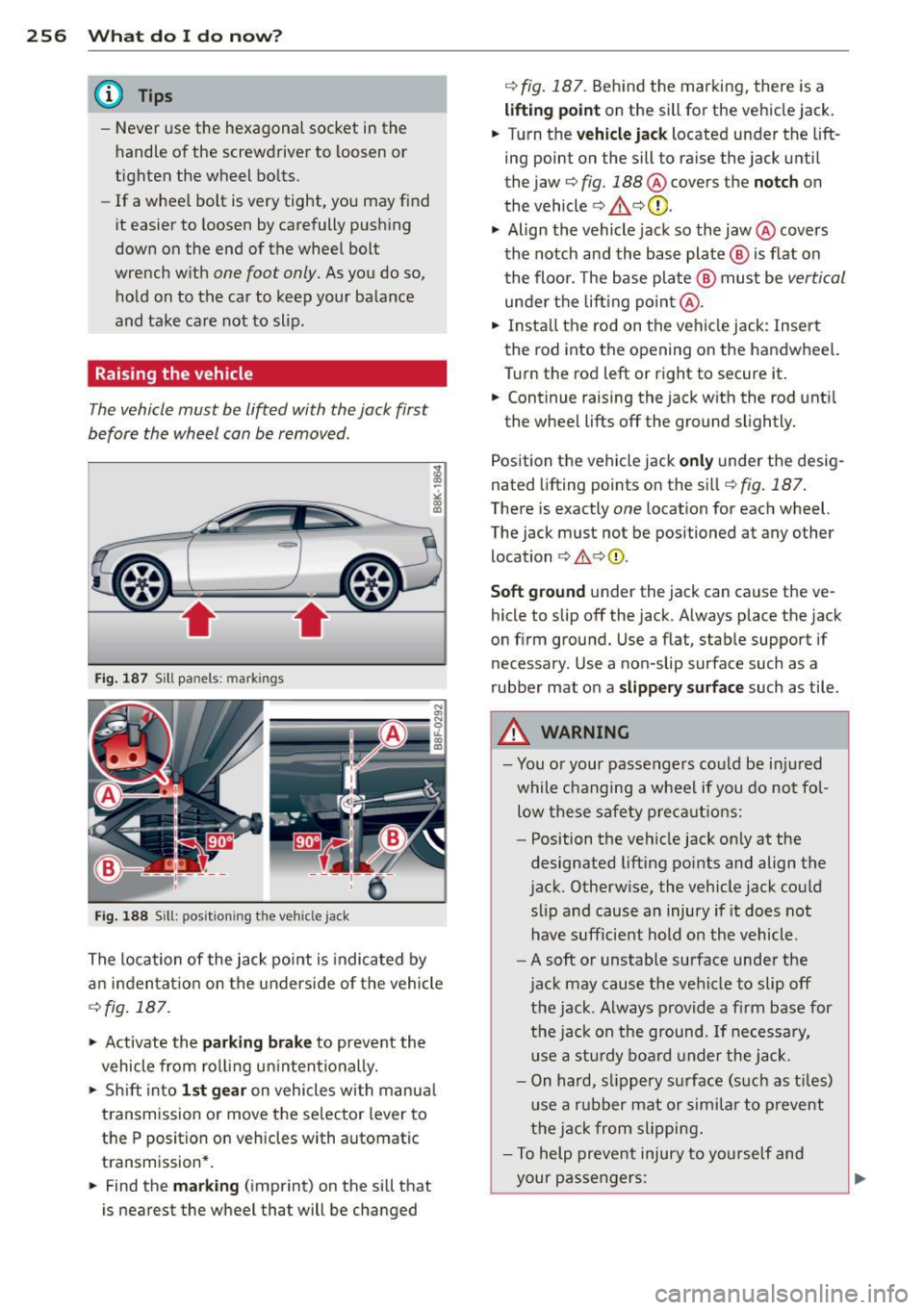
Fig. 187 Sill panels: mark ings
Fi g. 188 Sill : posit ion ing th e vehicle jack
The location of the jack point is indicated by
an indentat io n on the underside of the vehicle
¢fig . 187.
... Activate the parking brake to prevent the
vehicle from rolling unintentionally.
... Shift into
1st gear on vehicles with manua l
transmission or move the selector lever to
the P position on vehicles with automatic
transmission*.
... Find the
marking (imprint) on the sill that
is nearest the wheel that will be changed
¢fig. 187. Behind the marking, there is a
lifting point on the sill for the vehicle jack.
... Turn the
vehicle jack located under the lift
ing point on the sill to raise the jack unti l
the jaw ¢
fig. 1 BB @covers the notch on
the vehicle ¢
.&,¢(D .
... Align the vehicle jack so the jaw @covers
the notch and the base plate ® is flat on
the floor. The base plate
@ must be vertical
under the lifting point @.
... Insta ll the rod on the vehicle jack: Insert
the rod into the opening on the handwheel.
Turn the rod left or right to secure it.
... Continue raising the jack w ith the rod unti l
the wheel lifts off the ground slightly.
Position the vehicle jack
only under the desig
nated lifting points on the sill ¢
fig . 187.
There is exactly one location for each wheel.
The jack must not be positioned at any other location ¢,&. ¢(}).
Soft ground under the jack can cause the ve
hicle to slip off the jack. Always place the jack
on firm ground. Use a flat, stab le support if
necessary . Use a non-slip surface such as a
rubber mat on a
slippery surface such as tile .
&_ WARNING
--You or your passengers could be injured
while changing a wheel if you do not fol
low these safety precautions:
- Position the vehicle jack only at the
designated lifting points and align the
jack. Otherwise, the vehicle jack could
slip and cause an injury if it does not
have sufficient hold on the vehicle.
- A soft or unstable surface under the
jack may cause the vehicle to slip off
the jack . Always provide a f irm base for
the jack on the ground.
If necessary,
us e a sturdy board under the jack.
- On hard, slippery surface (such as til es)
u se a r ubber mat or similar to prevent
the jack from slipping.
- To help prevent injury to yourself and
your passengers:
Page 260 of 294
258 What do I do now?
-The w heel bolt s should be clea n and easy
to tu rn. Check for dirt and corrosion on
t h e mat ing s urfaces o f both the whee l
and the h ub. Remove a ll dirt from these
su rfaces befor e remo unt ing the wheel.
- Do no t use the hexagona l socket in the
screwdriver handle to l oosen o r ti gh ten
t h e wheel bo lts .
Tires with unidirectional tread design
Tires with unidirectional tread design must be
mounted with their tread pattern pointed in the right direction .
Using a spare tire with a tread pattern
intended for use in a specific direction
When using a spare tire w it h a t read patte rn
in te nded for use in a specific direction, p lease
n ote t he follow ing:
- The direction of rotation is marked by an
ar
row on the side of the tire .
-If the spare t ire has to be installed in the in
correct d irection, use the spare tire only
temporarily si nce the t ire will not be able to
achieve its optimum perfo rma nce character
ist ics w ith r ega rd to aquaplani ng, noise and
wea r.
- We recommend tha t you pay particular at
tent io n to this fact du ring wet weathe r and
t h at you a djust your spee d to matc h roa d
condition s.
- Re place the fla t tire w ith a n ew on e and
h av e it installed o n your ve hicle as soon as
p ossib le to res tore the ha nd ling ad vantages
o f a un idirect ional t ire.
Notes on wheel changing
Please rea d the information c::> page 242, New
tires and replacing tires and wheels
if you are
go ing t o use a spare t ire which is different
from the tires on your ve hicle.
Afte r you change a tire :
-Check the tire pressure on the spare imme
diately after installation. -
Have the wheel bolt tightening torque
checked with a torque wrench as soon as
possible by your authorized Audi dealer or
a qualified workshop.
- With steel and alloy wheel rims, the wheel
bolts are correctly tightened at a torque of
90 ft lbs. (120 Nm).
- If you notice that the wheel bolts are cor ·
roded and difficult to turn while chang ing
a tire , they should be replaced before you
check the tightening torque .
- Replace the flat tire w ith a new one and
have it installed on your vehicle as soon as
possible. Remount the wheel cover.
Until then, drive with extra care and at re·
duced speeds.
A WARNING ..__ -
- If you are going to equ ip your ve hicle
wit h tir es o r rims which differ from th ose
which w ere fac tory i nstalled, then be
s ure to read the information
c::> pag e 242 ,
N ew t ires and repl acin g tires and
wheels.
- Always make sure the dam age d wheel o r
eve n a flat tire and t he jack and to ol kit
a re p roperly secu red in the lugg age com
p art ment and are no t loose in the pas
sen ger compartment.
- In an a cci dent or sudde n maneuver they
co uld fly forwa rd, in juring a nyone in the
veh icle.
- Always s to re damage d whee l, jack an d
too ls sec urely in the l ugga ge com pa rt
ment. Othe rwise, in a n accide nt or s ud
den maneuver they co uld f ly forwa rd,
causing inj ury to passe ngers in the ve hi
cle .
(I) Note
Do not use comme rcially ava ilab le tire
sea lants. Ot herwise , th e e lectr ica l comp o
nents of the tire pressu re monitoring sys
tem* w ill no longe r work pr oper ly and th e
se nso r fo r th e tire pressure moni tor ing
syst em* will have to be repla ced by a
qu alifie d w ork s hop .
Page 261 of 294
Fuses and bulbs
Fuses
Replacing a fuse
Fuses that have blown will have metal strips
that have burned through.
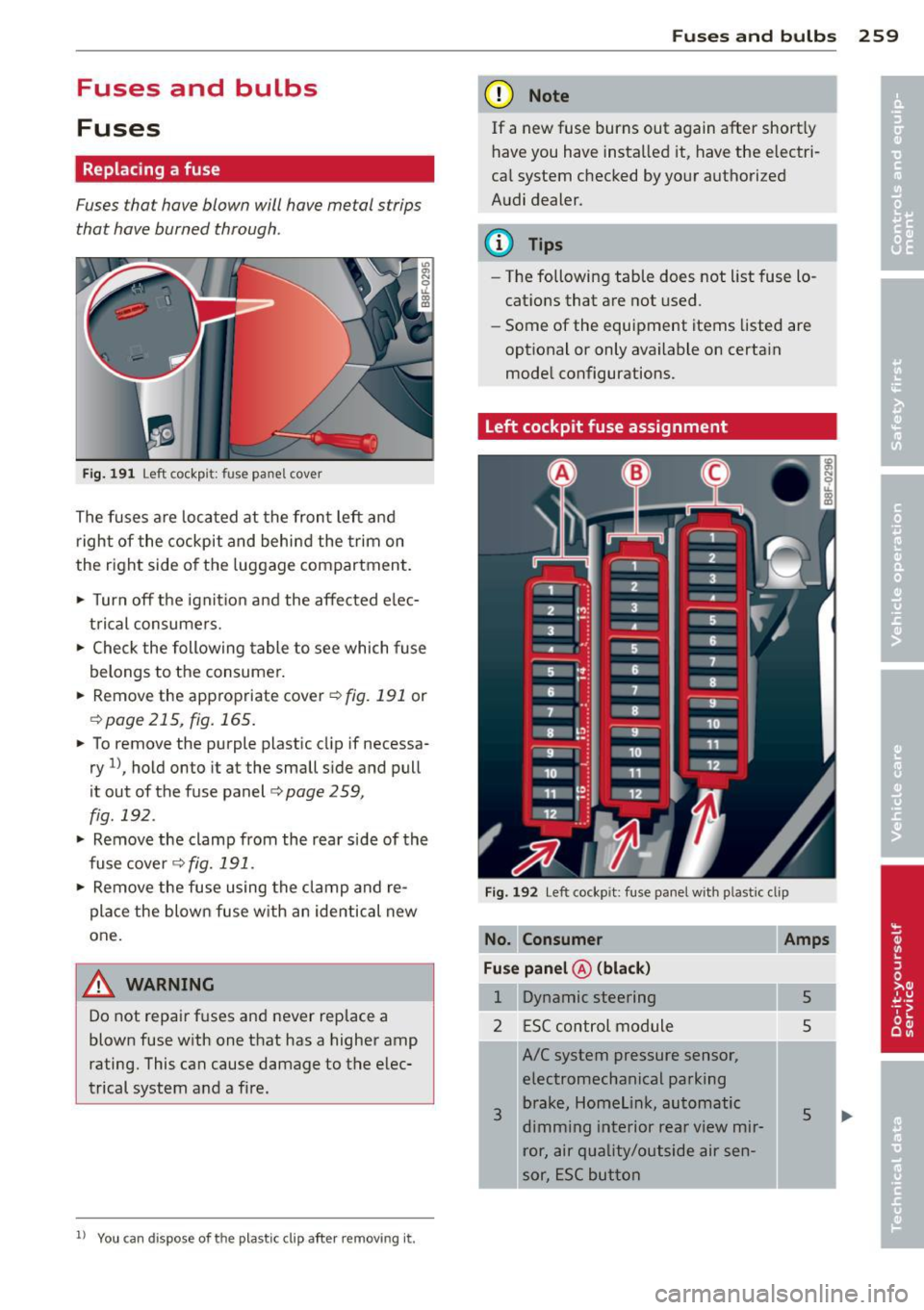
Fig. 191 Left cockp it : fuse panel cover
The fuses are located at the front left and
r igh t of the cockpit and behi nd the trim on
the right side of the luggage compartment .
.. Turn off the ign it ion a nd the affected elec-
t rical consumers .
.. Check the following table to see which fuse
belongs to the consume r .
.. Remove the appropriate cover¢
fig. 191 or
¢page 215, fig. 165 .
.. To remove the purple plastic cl ip if necessa
ry
ll, hold onto it at the small s ide and pull
it out of the fuse panel¢
page 259,
fig. 192 .
.. Remove the clamp from the rear side of the
fuse cover ¢
fig. 191 .
.. Remove the fuse using the clamp and re
pla ce the blown fuse w ith an identical new
one.
& WARNING , -
Do not repair f uses and never replace a
blown fuse w ith one that has a higher amp
rating. This can cause damage to the e lec
trical system and a fire.
11 You can dis pos e of the plastic clip after removing it.
Fu se s and bulb s 259
(D Note
If a new fuse burns out again after short ly
have you have insta lled it, have the electri
ca l system checked by your authorized
A udi dealer .
{!) Tips
-The following table does not list fuse lo
cat ions that are not used .
- Some of the equipment items listed are
opt ional or only available on certa in
mode l configurations.
Left cockpit fuse assignment
Fi g. 192 Left cockpit: fuse panel wit h plastic clip
No. Consumer
Fu se panel @(black)
1 Dynamic steering
2 ESC control module
3
A/C system pressure sensor,
electromechanical parking
brake, Homelink, automatic
dimming interior rear view mir
r or, air quality/outside ai r sen
sor, ESC button
Amps
s
s
s
Page 262 of 294
260 Fuses and bulb s
No.
5 Sound actuator/exhaust sound
tuning
6 Headlight range control sys
tem/cornering light
7
8
Headlight (corner ing light)
Control modules (electrome
chanical parking brake, shock
absorber, quattro sport, trailer
hitch), DCDC converter
9 Adaptive cruise contro l
10 Shift gate
1 1 Side ass ist
Headlight range control, park
ing system
13 Airbag
14 Rear wiper (allroad)
15 Auxiliary fuse (instrument pan
el)
1
16
Auxiliary fuse terminal 15 (en
gine area)
Fu se pane l @ (b row n)
2 Brake light sensor
5
6
7
Left seat heating with/w ithout
seat venti lation
ESC Horn
Front left door (window regula-
8 tor, central locking, mirror, switch, lighting)
9 Wiper motor
10 ESC Two-door models: rear left win
dow regulator, Fo ur-door mod-
11 els: rear left door (window regu lator, central locking, switch,
lighting)
12 Rain and light sensor
F u se p anel© (red )
3
4 Dynamic steer ing
Amps
5/15
5/7,5 7,5
5
5
5
5
5
5
15
10
40
5
25
15/30
5
15
30
30
25
30
-No . Consumer Amps
6
Windshield washer system,
35
headlight washer system
7
Vehicle e lectrical system control
20
module 1
8
Vehicle electrical system control
30
module 1
9 Sunroof 20
10 Vehicle electrical system control
30
module
1
11 Sun shade motor 20
-
12 Anti-theft alarm warning sys-
tern 5
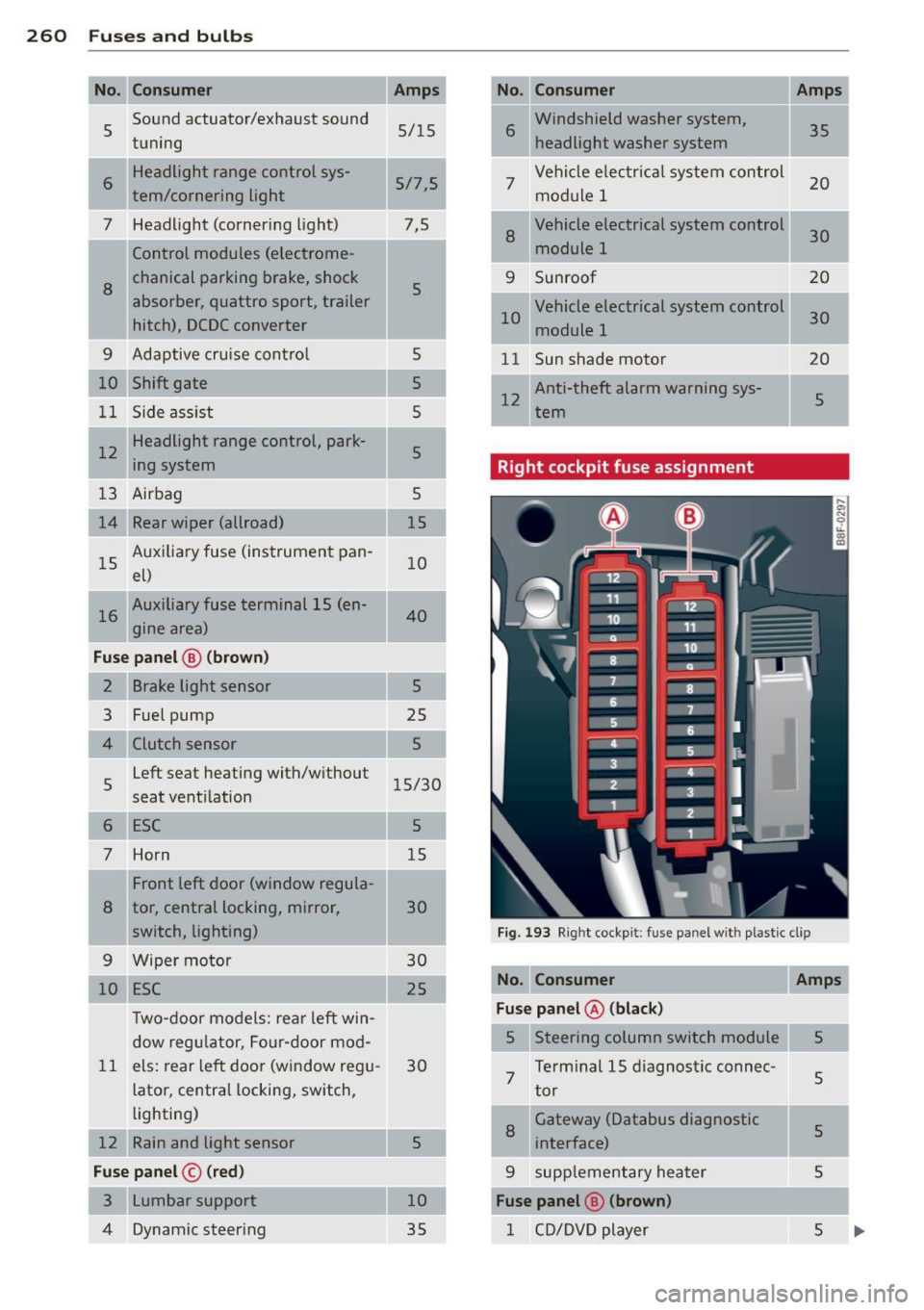
Right cockpit fuse assignment
Fig.
193 Right cockpit : fuse panel wit h plastic cl ip
No. Consume r
Fuse pane l@ (black )
..
5 Steering column switch module
7
8
Terminal 15 diagnostic connec
tor
Gateway (Databus diagnostic interface)
9 supp lementary heater
Fuse pan el@ (bro wn)
1 CD/DVD player
Amp s
5
5
5
5
5
•
I
Page 264 of 294
262 Fuses and bulb s
Bulbs
Replacing bulbs
For your safety, we recommend that you have
your authorized Audi dealer replace any bulbs
for you .
It is becoming increasingly more and more
difficult to replace vehicle light bulbs since in
many cases, other parts of the car must first
be removed before you are able to get to the
bu lb . Thi s appl ies especial ly to the light bulbs
in the front of your car which you can only
reach through the engine compartment .
Sheet metal and bulb holders can have sharp
edges that can cause ser ious cuts, parts must
be correctly taken apart and then properly p ut
back together to help prevent breakage of
parts and long term damage from water that
can enter housings that have not been proper
ly resealed.
F or your safety, we recommend that you have
your authorized Audi dealer replace any bulbs
for you, since your dealer has the proper tools,
the correct bu lbs and the expertise.
Gas di scharg e lamps (Xenon lights)*:
Due to the high electrical vo ltage, have the
bu lbs rep laced by a qualified technician.
H eadlights with Xenon light are identified by
the high voltage sticker.
A WARNING
Changing Xenon lamps without the neces
sary equipment can cause serious personal
injury.
- Bulb s are pressurized and can exp lode
when being changed . Potential risk of in
jury!
- On vehicles equipped with gas discharge
bulbs (Xenon light)* life-threatening in
jur ies can result from improper handling
of the high-voltage portions of such
lamps!
- Only your authorized Aud i dealer or a
qualified workshop shou ld change the
bulbs in gas d ischarge lamps. There are parts with sharp edges
on the openings
and on the bulb holders that can cause
serious cuts. If you are uncertain about
what to do, have the work performed by
an author ized Audi dealer or other quali
fied workshop . Ser ious personal injury
may resu lt from improperly performed
wo rk.
@ Tips
- If you st ill prefer to replace the light
bulbs yourself, be aware that the engine
compartment is a hazardous area to
work in
~ page 209, Engine compart
ment~ ,&..
-It is best to ask your authorized Audi
dealer whenever yo u want to change a
bulb .
Page 265 of 294
Emergency situations
General
This chapter is intended for trained emer
gency crews and working personnel who
have the necessary tools and equipment to
perform these operations.
Starting by pushing or
towing
(D Note
Vehicles with an automatic transmission
cannot be started by pushing or towing .
Starting with jumper
cables
If necessary, the engine can be started by
connecting it to the battery of another vehi
cle.
If the engine should fail to start because of a
discharged or weak battery, the battery can be
connected to the battery of
another vehicle,
using a
pair of jumper cables to start the en
g ine.
Jumper cables
Use only jumper cables of sufficiently
largecross section to carry the starter current
safe ly. Refer to the manufacturer's specifica
tions.
Use only jumper cables with
insulated termi
na l clamps which are distinctly marked:
plus(+) cable in most cases colored red
minus(-) cable
in most cases colored black .
A WARNING
Batteries contain electricity, acid, and gas.
Any of these can cause very serious or fatal
injury. Follow the instructions below for
safe handling of your vehicle's battery.
- Always shield your eyes and avoid lean
ing over the battery whenever possible.
Emergency situations 263
-A discharged battery can freeze at tem
peratures just below 32 °F (0 °C). Before
connecting a jumper cable, you must
thaw the frozen battery completely, oth
erwise it could explode.
- Do not allow battery acid to contact eyes
or skin . Flush any contacted area with
water immediately .
- Improper use of a booster battery to
start a vehicle may cause an explosion.
- Vehicle batter ies generate explosive gas
es. Keep sparks, flame and lighted c iga
rettes away from batteries.
- Do not try to jump start any veh icle w ith
a low ac id level in the battery.
- The voltage of the booster battery must
also have a 12-Volt rating. The capacity
(Ah) of the booster battery should not be
lower than that of the discharged bat
tery. Use of batteries of diff erent voltage
or substantially different "Ah" rat ing
may cause an exp losion and personal in
jury.
- Never charge a frozen battery. Gas trap
ped in the ice may cause an explosion.
- Never charge or use a battery that has
been frozen . The battery case may have
be weakened.
- Use of batter ies of different voltage or
substantially different capacity (Ah) rat
ing may cause an exp losion and injury .
The ca pa city (Ah) of the booster battery
should not be lower than that of the dis
charged battery.
- Before you check anything in the engine
compartment, always read and heed all
WARNINGS¢
page 209, Engine com
partment.
(D Note
- App lying a higher voltage booster bat
tery will cause expensive damage to sen
sit ive electronic components, such as
control units, relays, rad io, etc .
- There must be no electrical contact be
tween the vehicles as otherwise current
could already start to flow as soon as the
posit ive(+) terminals are connected. ..,. •
•
Page 266 of 294
264 Emergency situations
@ Tips
The discharged battery must be properly
connected to the vehicle's electrical sys
tem. When jump starting or charging the
battery, never connect the negative
ground cable to the battery negative post
because the batte ry manager system must
be able to detect the battery 's state of
charge. Always connect the negative
ground cab le to the negative ground post
of the battery manager control unit.
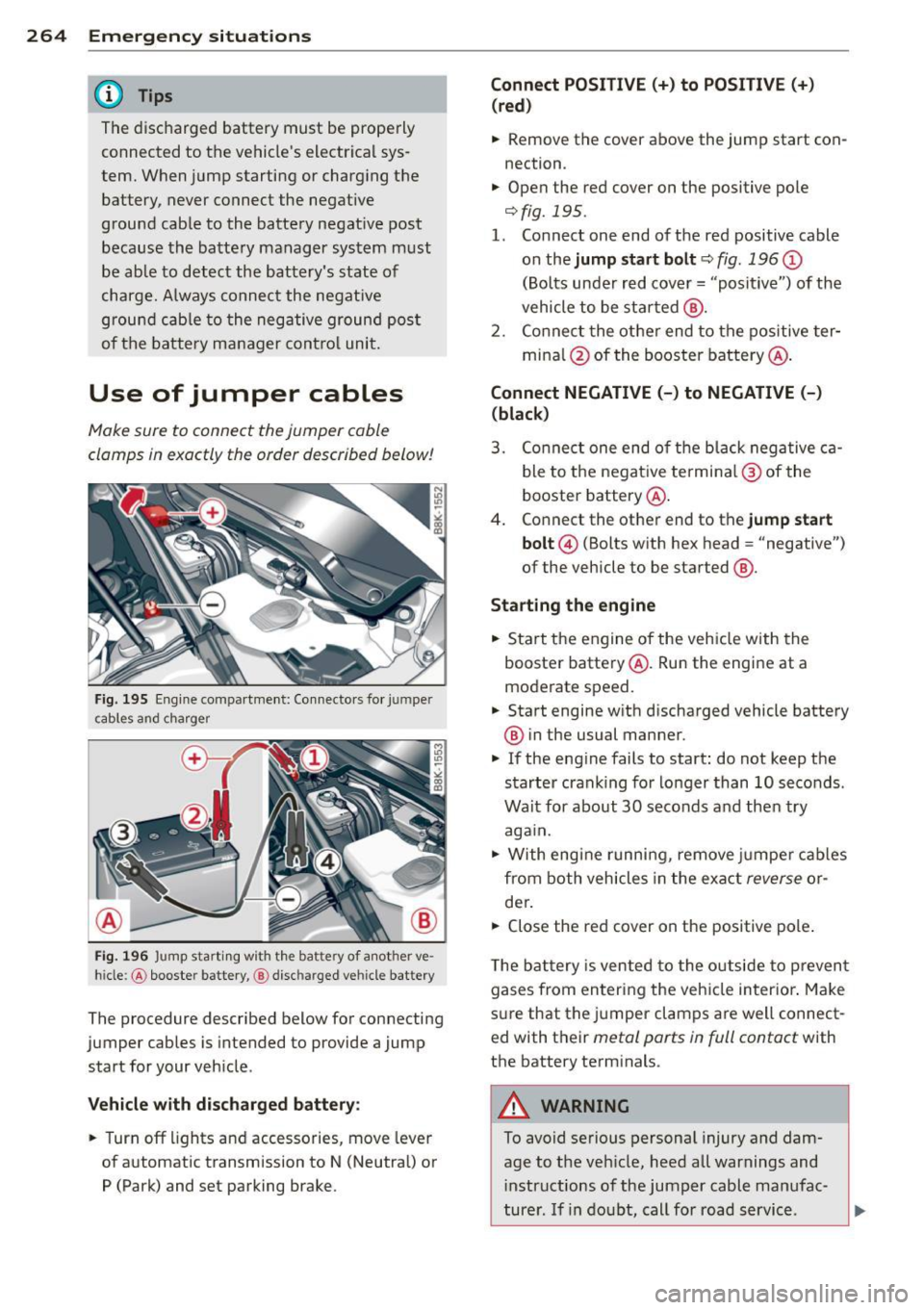
Use of jumper cables
Make sure to connect the jumper cable
clamps in exactly the order described below!
Fig. 195 Engine compartment: Connecto rs fo r jum per
cables and charger
Fig. 196 Jump sta rting wi th the battery of anot her ve ·
h ide :@ booster battery, @ disc harged vehicle battery
The procedure described below for connecting
jumper cables is intended to provide a jump
start for your vehicle .
Vehicle with discharged battery:
.. Turn off lights and accessories, move lever
of automatic transmission to N (Neutral) or
P (Park) and set parking brake .
Connect POSITIVE(+) to POSITIVE(+)
(red)
.. Remove the cover above the jump start con
nection .
.. Open the red
cover on the positive pole
¢fig. 195.
1. Connect one end of the red positive cable
on the
jump start bolt c::> fig. 196 @
(Bolts under red cover= "positive") of the
vehicle to be started @.
2. Connect the other end to the positive ter-
mina l@ of the booster battery@.
Connect NEGATIVE (-) to NEGATIVE (-)
(black)
3. Connect one end of the b lack negative ca
ble to the negative terminal @of the
booster battery @.
4. Connect the other end to the
jump start
bolt @
(Bolts with hex head= "negative")
of the vehicle to be started ®·
Starting the engine
.. Sta rt the engine of the vehicle with the
booster battery@. Run the engine at a
moderate speed.
.. Start engine with discharged vehicle battery
® in the usual manner .
.. If the eng ine fails to start: do not keep the
starter cranking for longer than 10 seconds .
Wait for about 30 seconds and then try
again .
.. With engine running, remove jumper cables
from both vehicles in the exact
reverse or
der .
.. Close the red
cover on the positive pole .
T he battery is vented to the outside to prevent
gases from entering the vehicle interior . Make
sure that the jumper clamps are well connect
ed with their
metal parts in full contact with
the battery terminals.
A WARNING
--
To avoid serious personal injury and dam
age to the veh icle, heed all warnings and
i nstructions of the jumper cable manufac-
turer . If in doubt, call for road service . ..,.
Page 267 of 294
-Jumper cables must be long enough so
that the vehicles do not touch.
- When connecting jumper cables, make
sure that they cannot get caught in any
moving parts in the eng ine compart
ment.
- Do not bend over the batteries - danger
of chemical burns!
- The battery ce ll locking screws must be
tightened securely .
- Before you check anything in the engine
compartment, always read and heed all
WARNINGS ¢
page 209, Engine com
partment .
(D Note
Improper hook -up of jumper cables can ru
in the generator.
- Always connect POSITIVE( +) to POSI
TIVE(+), and NEGATIVE( -) to NEGATIVE
( - ) ground post of the battery manager
control unit.
- Check that a ll screw plugs on the battery
cells are screwed in firmly. If not, tighten plugs prior to connecting clamp on nega
tive battery terminal.
- Please note that the procedure for con
necting a jumper cable as described
above applies spec ifically to the case of
your vehicle be ing jump started . When
you are giving a jump start to anothe r ve
hicle, do
not connect the negat ive( -) ca
ble to the negative( -) terminal on the
discharged battery@¢
fig. 196. In
stead, securely connect the negative(-)
cable to either a solid metal component
that is firmly bolted to the engine block
or to the engine block itse lf. If the bat
tery that is being charged does not vent
to the outside, escaping battery gas
could ignite and exp lode!
Em erg en cy si tuation s 265
Emergency towing
with commercial tow
truck
General hints
Your Audi requires special handling for tow
ing.
T he following information is to be used by
commercial tow truck operators who know
how to operate their equipment safely.
- Nev er t ow your Audi , tow ing will c aus e
damage t o the engin e and transmi ssion.
- Nev er wrap th e safety chain s or winch c a
ble s around th e bra ke lines.
- To pre ve nt unne cessary dam ag e, your Aud i
mu st be tra ns po rted wi th a flat bed tru ck .
- To load th e vehicle on to th e flat be d, use
the t owing l oop found in the vehicl e too ls
a nd atta ch to th e front or rear anch o rage
c::> page 266 and ¢page 266 .
A WARNING
A vehicle being towed is not safe for pas
sengers. Never allow anyone to ride in a
vehicle be ing towed, for any reason.
-
•
•
Page 268 of 294
266 Emergency situations
Front towing loop
Do not install the front towing loop until it is
needed .
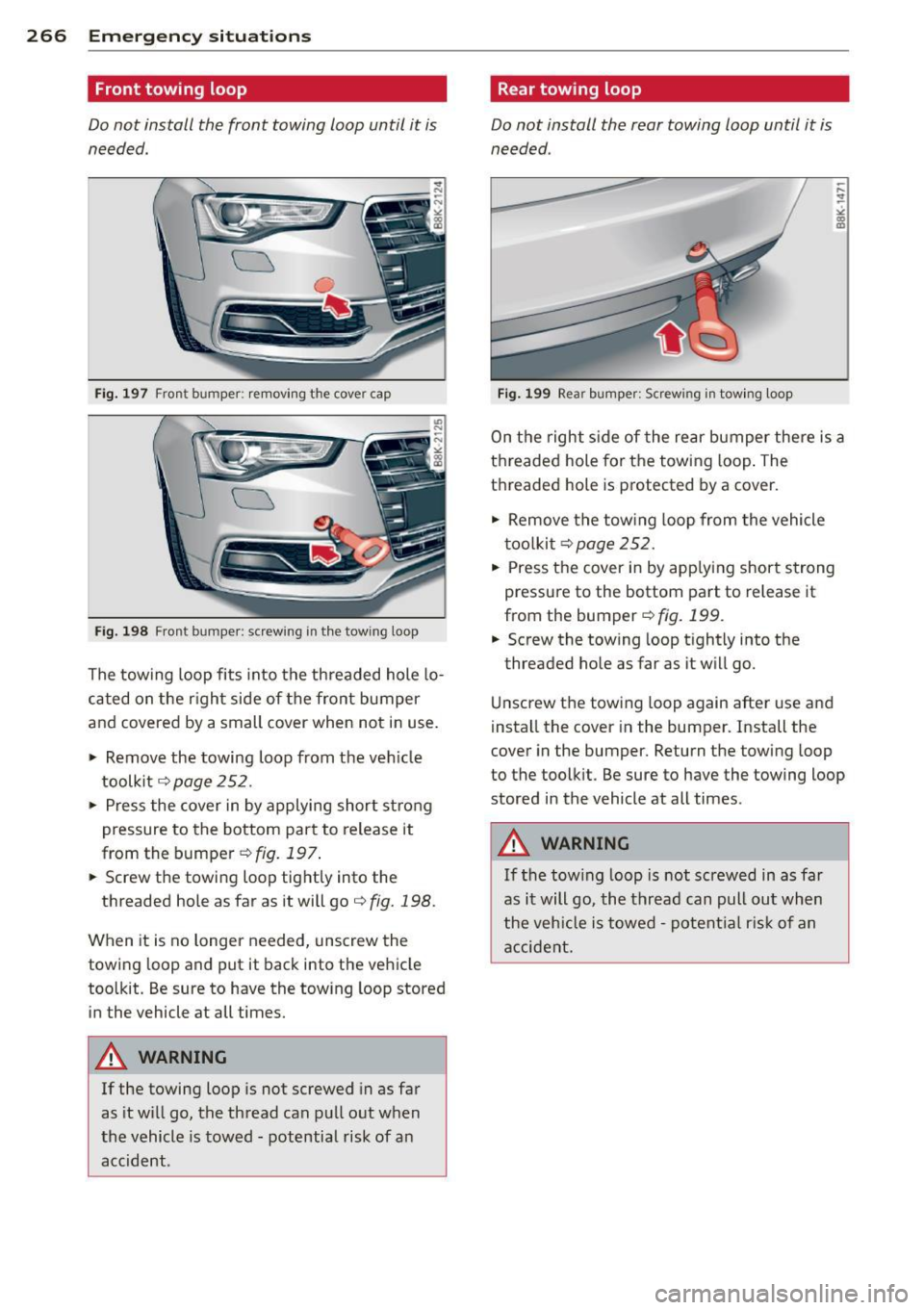
Fig. 197 Fron t bumper: removing th e cove r cap
Fig. 198 Front bumper: screw ing in t he tow ing loop
The towing loop fits into the threaded hole lo
cated on the right side of the front bumper
and covered by a small cover when not in use.
... Remove the towing loop from the veh icle
toolkit
c::> page 252 .
... Press the cover in by applying short strong
pressure to the bottom part to release it
from the bumper
c::> fig . 197 .
• Screw the towing loop tightly into the
threaded hole as far as it will go
c::> fig. 198.
When it is no longer needed, unscrew the
towing loop and put it back into the vehicle
too lkit. Be sure to have the towing loop stored
in the vehicle at all times.
A WARNING
If the towing loop is not screwed in as far
as it w ill go, the thread can pull out when
the vehicle is towed -potential risk of an
accident.
Rear towing loop
Do not install the rear towing loop until it is
needed .
Fig. 199 Rear bumper: Screw ing in towing loop
On the right sid e of the rear bumper there is a
threaded hole for the towing loop . The
threaded hole is protected by a cover .
... Remove the tow ing loop from the vehicle
toolkit
c::> page 252.
• Press the cover in by applying short strong
pressure to the bottom part to release it
from the bumper
c::> fig. 199.
• Screw the towing loop tightly into the
threaded hole as far as it will go.
Unscrew the towing loop again after use and
install the cover in the bumper. Install the
cover in the bumper. Return the towing loop
to the toolkit . Be sure to have the towing loop
stored in the vehicle at all times .
A WARNING
If the towing loop is not screwed in as far
as it will go, the thread can pull out when
the vehicle is towed -potential r isk of an
accident.
Page 269 of 294
Loading the vehicle onto a flat bed truck
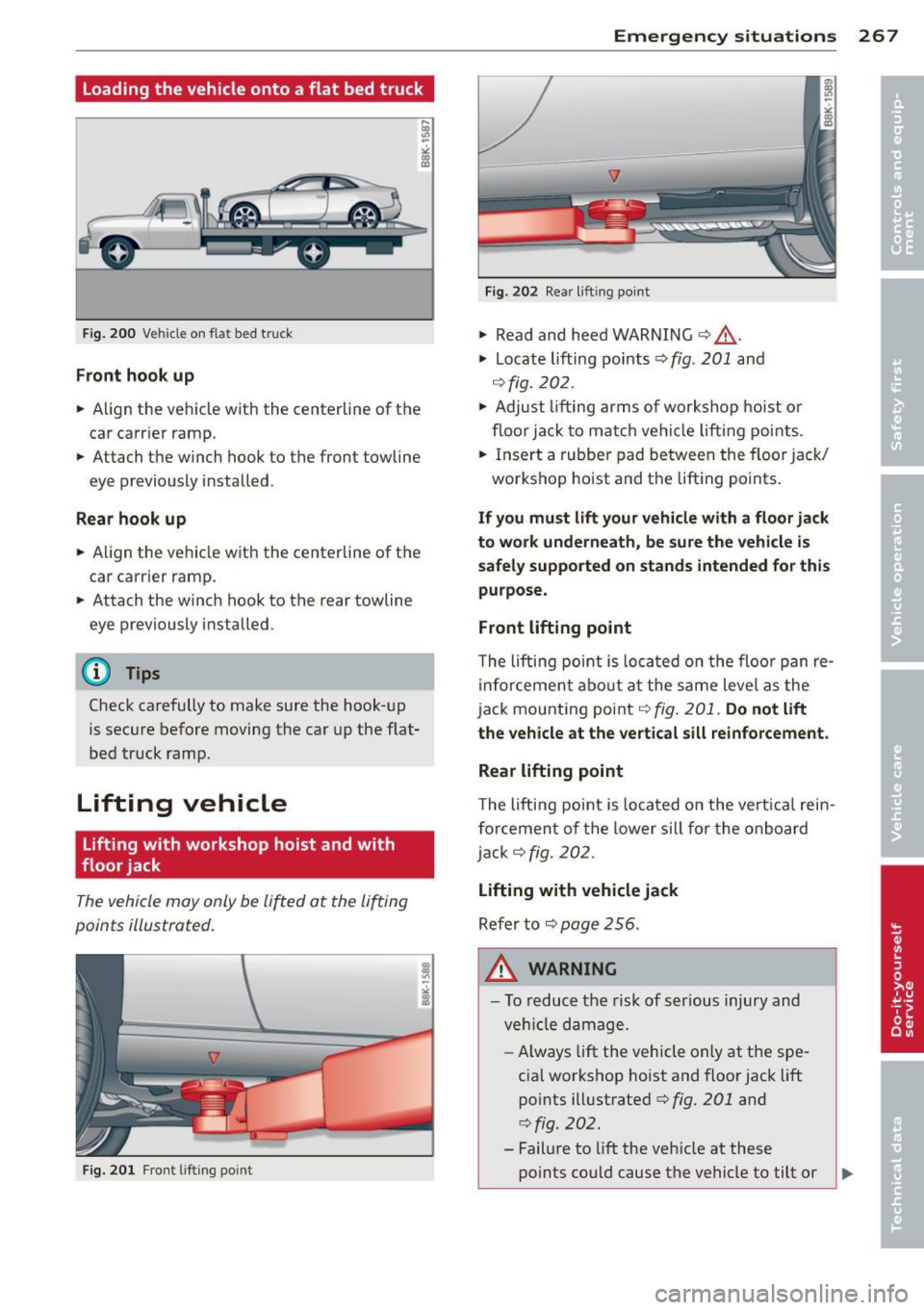
Fig. 200 Veh icle on flat bed truck
F ront hook up
.. Align the vehicle with the centerline of the
car carr ier ramp.
.. Attach the winch hook to the front towline
eye previously installed .
Rear ho ok up
.. Align the vehicle with the centerline of the
car carrier ramp.
.. Attach the winch hook to the rear towline
eye previously installed.
(D} Tips
Check carefully to make sure the hook-up
is secure before moving the car up the flat
bed truck ramp.
Lifting vehicle
Lifting with workshop hoist and with
floor jack
The vehicle may only be li~ed at the lifting
points illustrated .
Fig. 201 Front l ifting po int
Emergenc y situ ation s 267
Fig. 202 Rea r lift ing po int
.,. Read and heed WARNING c::> .&, .
.,. Locate lifting points c::> fig. 201 and
¢fig. 202 .
.,. Adjust lifting arms of workshop hoist or
floor jack to match veh icle lifting points.
.. Insert a rubbe r pad between the floor jack/
workshop hoist and the lift ing points.
If yo u mu st lift your veh icle with a fl oo r jack
to w ork und ern eath , be sure the vehicle is
s afel y supp orted o n sta nd s intended for thi s
purpo se .
Front lifting point
T he lifti ng point is loca ted o n the floo r pan re
i nforcemen t abo ut at the same level as the
jack mounting point
c::> fig. 201. Do not lift
the vehicle at the vertic al sill reinforc ement.
Rear lifting point
The lifting point is located o n the vert ica l rein
forcement of the lower s ill for the on board
jack
c::> fig. 202 .
Lifting with vehicle jack
Refer to c:;, page 256.
A WARNING
-To reduce the risk of ser ious injury and
veh icle damage.
- Always lift the vehicle only at the spe
cia l workshop hoist and floor jack lift
points illustrated
c:;, fig. 201 and
c:;, fig. 202.
- Fail ure to lift the veh icle at these
-
po ints could cause the vehicle to tilt or ..,.