airbag AUDI A5 COUPE 2013 User Guide
[x] Cancel search | Manufacturer: AUDI, Model Year: 2013, Model line: A5 COUPE, Model: AUDI A5 COUPE 2013Pages: 294, PDF Size: 73.84 MB
Page 126 of 294
124 Driving Safely
Driving Safely
General notes
Safe driving habits
Please remember -safety first!
This chapter contains important information,
tips, instructions and warnings that you need
to read and observe for your own safety, the
safety of your passengers and others. We have
summarized here what you need to know
about safety belts, airbags, child restraints as
well as child safety. Your safety is for us
priori
ty number 1.
Always observe the information
and warnings in this section -for your own
safety as well as that of your passengers.
The information in this section applies to all
model versions of your vehicle. Some of the
features described in this sections may be
standard equipment on some models, or may
be optional equipment on others. If you are
not sure, ask your authorized Audi dealer.
A WARNING
-Always make sure that you follow the in
structions and heed the WARNINGS in
this Manual. It is in your interest and in
the interest of your passengers.
- Always keep the complete Owner's Liter
ature in your Audi when you lend or sell
your vehicle so that this important infor
mation will always be available to the
driver and passengers.
- Always keep the Owner's literature handy
so that you can find it easily if you have
questions.
Safety equipment
The safety features are part of the occupant
restraint system and work together to help
reduce the risk of injury in a wide variety of
accident situations.
Your safety and the safety of your passengers
should not be left to chance. Advances in
technology have made a variety of features
available to help reduce the risk of injury in an accident.
The following is a list of just a few of
the safety features in your Audi:
- sophisticated safety belts for driver and all
passenger seating positions,
- belt force limiters for the seats,
- belt pretensioners for the seats,
- head restraints for each seating position,
- front airbags,
- side airbags in the front seats,
- side curtain airbags,
- special LATCH anchorages for child re-
straints,
- adjustable steering column.
These individual safety features, can work to gether as a system to help protect you and
your passengers in a wide range of accidents.
These features cannot work as a system if
they are not always correctly adjusted and cor
rectly used.
Safety is everybody's responsibility!
Important things to do before driving
Safety is everybody's job! Vehicle and occu
pant safety always depends on the informed and careful driver.
For your safety and the safety of your passen
gers,
before driving always:
.,. Make sure that all lights and signals a re op
erating correctly.
.,. Make sure that the tire pressure is correct.
.,. Make sure that all windows are clean and
afford good visibility to the outside.
.,. Secure all luggage and other items carefully
qpage59 .
.,. Make sure that nothing can interfere with
the pedals.
.,. Adjust front seat, head restraint and mir
rors correctly for your height.
.,. Instruct rear seat passengers to adjust the
head restraints according to their height.
.,. Make sure to use the right child restraint
correctly to protect children¢
page 166,
Child Safety. "'
Page 127 of 294
.. Sit properly in your seat and make sure that
your passengers do the same
¢page 53,
Seats and storage.
.. Fasten your safety belt and wear it properly.
Also instruct your passengers to fasten their
safety belts properly¢
page 134 .
What impairs driving safety?
Safe driving is directly related to the condi
tion of the vehicle , the driver as well as the
driver's ability to concentrate on the road
without being distracted .
The driver is responsible for the safety of the
vehicle and all of its occupants. If your ability
to drive is impaired, safety r isks for everybody
in the vehicle increase and you a lso become a
hazard to everyone else on the road
~ .&_.
Therefo re:
.. Do not let yourself be distracted by passen
gers or by using a cellular telephone .
.. NEVE R drive when yo ur driv ing ability is im
paired (by medicat ions, alcohol, drugs, etc.).
.. Observe all traffic laws, rules of the road
and speed limits and plain common sense .
.. ALWAYS adjust your speed to road, traffic
and weather conditions .
.,. Take frequent breaks on long trips. Do not
drive for more than two hours at a stretch.
.. Do NOT drive when you are tired, under
pressure or when you are stressed .
& WARNING
Impaired driving safety increases the risk
of serious personal injury and death when
ever a vehicle is being used.
Driving Safely 125
Proper occupant
seating positions
Proper seating position for the driver
The proper driver seating position is impor
tant for safe, relaxed driving.
Fig. 127 Correct seat ing pos it ion
For your own safety and to reduce the risk of
injury in the event of an accident, we recom
mend that you adjust the driver's seat to the
follow ing pos ition:
.. Adjust the driver's seat so that you can easi
ly push the pedals all the way to the floor
wh ile keeping your knee(s) slightly bent
¢&_ .
.. Adjust the angle of the seatback so that it is
in an upr ight position so that your back
comes in full contact w ith it when you drive.
.. Adjust the steering wheel so that there is a
distance of at least 10 inches (25 cm) be
tween the steering wheel and yo ur breast
bone
~ fig. 12 7. If not possible, see your au
thorized Audi dealer about adaptive equip
ment.
.. Adjust the steer ing wheel so that the steer
ing wheel and airbag cover points at your
chest and not at your face .
.,. Grasp the top of the steering whee l with
your elbow(s) slightly bent .
.. App lies to vehicles with adjustable head re
s tra ints: Ad just the head restraint so the up
per edge is as even as possible with the top
of your head. If that is not possible, try to
adjust the head restraint so that it is as
close to this pos it ion as possible .
.. Fasten and wear safety be lts correctly
¢ page 13 7 . .,._
Page 128 of 294
126 Driving Safely
• Always keep both feet in the footwell so
that you are in control of the vehicle at all
times.
For detailed information on how to adjust the
driver's seat, see
¢ page 54 .
A WARNING
Drivers who are unbelted, out of position
or too close to the airbag can be seriously
injured by an airbag as it unfolds. To help
reduce the risk of serious personal injury:
- Always adjust the driver's seat and the
steering wheel so that there are at least
10 inches (25 cm) between your breast
bone and the steering wheel.
- Always hold the steering wheel on the
outside of the steering wheel rim with
your hands at the 9 o'clock and 3 o'clock positions to help reduce the risk of per
sonal injury if the driver's airbag inflates.
- Never hold the steering wheel at the
12 o'clock position or with your hands at
other positions inside the steering wheel
rim or on the steering wheel hub. Hold
ing the steering wheel the wrong way
can cause serious injuries to the hands,
arms and head if the driver's airbag de
ploys.
- Pointing the steering wheel toward your
face decreases the ability of the supple
mental driver 's airbag to protect you in a
collision .
- Always sit in an upright position and nev
er lean against or place any part of your
body too close to the area where the air
bags are located.
- Before driving, always adjust the front
seats and head restraints properly and
make sure that all passengers are prop
erly restrained.
- Never adjust the seats while the vehicle
is moving . Your seat may move unexpect
edly and you could lose control of the ve
hicle.
- Never drive with the backrest reclined or
tilted far back! The farther the backrests
are tilted back, the greater the risk of in- jury due to incorrect positioning of the
safety belt and improper seating posi
tion.
- Children must always ride in child safety
seats ¢
page 166. Special precautions
apply when installing a child safety seat
on the front passenger seat¢
page 142 .
Proper seating position for the front
passenger
The proper front passenger seating position
is important for safe, relaxed driving .
For your own safety and to reduce the risk of
injury in the event of an accident, we recom
mend that you adjust the seat for the front
passenger to the following position :
• Move the front passenger seat back as far
as possible . There must be a minimum of
10 inches (25 cm) between the breastbone
and the instrument panel¢,&. .
• Adjust the angle of the seatback so that it is
in an upright position and your back comes
in full contact with it whenever the vehicle is
moving.
• Applies to vehicles with adjustable head re
straints: Adjust the head restraint so the up
per edge is as even as possible with the top
of your head. If tha t is not possible, try to
adjust the head restraint so that it is as
close to this position as possible.
• Keep both feet flat on the floor in front of
the front passenger seat.
• Fasten and wear safety belts correctly
¢page 137.
For detailed information on how to adjust the
front passenger's seat, see
¢ page 53.
A WARNING
-
Front seat passengers who are unbelted,
out of position or too close to the airbag
can be seriously injured or killed by the air
bag as it unfolds. To help reduce the risk of
serious personal injury:
Page 129 of 294
-Passengers must always sit in an upright
posit ion and never lean against or place
any part of their body too close to the
area where the airbags are located .
- Passengers who are unbelted, out of po
sition or too close to the airbag can be
seriously injured by an airbag as it un
folds with great force in the blink of an
eye .
- Always make sure that there are at least 10 inches (25 cm) between the front
passenge r's breastbone and the instru
ment pane l.
- Each passenger must always sit on a seat
of the ir own and properly fasten and
wear the safety bel t belong ing to that
seat .
- Before driv ing, a lways adj ust the front
passenger seat and head restra int prop
er ly .
- Always keep your feet on the f loor in
front of the seat . Never rest them on the
seat, instrument panel, out of the win
dow, etc . The airbag system and safety
belt w ill not be ab le to protect you prop
erly and can even increase the risk of in
jury in a crash .
- Never drive with the backrest reclined or tilted far back! The farther the backrests
are tilted back, the greater the risk of in
jury due to incorrect positioning of the
safety belt and improper seating posi
t ion.
- Children must always ride in child safety
seats
c::> page 166. Spec ial precautions
apply when installing a child safety seat
on the front passenge r seat
c::> page 142.
Proper seating positions for passengers
in rear seats
Rear seat passengers must sit upright with
both feet on the floor consistent with their
physical size and be properly restrained whenever the vehicle is in use.
To reduce the risk of injury caused by an incor
rect seat ing pos ition in the event of a sudden
braking maneuver or an accident, your pas-
Dr ivin g Sa fely 12 7
sengers on the rear bench seat must always
observe the following:
1-Make s ure th at the seatback is secure ly
la tched in the upright position
c::> page 63 .
.,. Keep both feet flat in the footwell in front
of the rear seat.
.,. Fasten and wear safety be lts properly
c::> page 13 7 .
.,. Make sure that children are always properly
restrai ned in a child restraint that is appro
p riate for the ir s ize and age
c::> page 166.
.&, WARNING
P assengers who are imp roperly seated on
the rea r seat can be seriously i njured in a
crash.
- Each passenger must always si t on a seat
of their own and pr operly fasten and
wear the safety belt belonging to that
seat.
- Safety belts only offer maximum protec
tion when the sea tback is sec urely latch
ed in the upright position and the safety
be lts are properly positioned on the
body. By not s itting upright, a rear seat
passenger increases the risk of personal
inju ry from improperly positioned safety
belts!
- Always adjust the head restraint properly
so that it can give maximum protection .
Proper adjustment of head restraints
Applies to vehicles: wit h adjustab le hea d r est ra in ts
Correctly adjusted head restraints are an im
portant part of your vehicle 's occupant re
straint system and can help to reduce the risk
of injuries in accident situations .
Fig. 1 28 Head restra int: v iewed fro m th e front
Page 131 of 294
Driver and passenger
side footwell
Important safety instructions
Applies to vehicles: with knee airbags
A WARNING
Always make sure that the knee a irbag can
inflate without interference . Objects be
tween yourself and the airbag can increase
the risk of inju ry in an acc ident by interfer
ing w ith the way the a irbag deploys or by
be ing p ush ed into you as the airbag de
ploys .
- No persons (ch ild ren) or animals should
ride in the footwell in front of the pas
senger seat. If the airbag deploys, this
can result in serious or fata l injuries .
- No objec ts of any k ind sho uld be car ried
in t he footwell area in front of the driv
er's or passenger's seat . B ulky objects
(shopping bags, for example) can ham
per or prevent proper deployment of the
airbag . Small objects can be thrown
through the vehicle if the airbag deploys and injure you o r your passengers .
Pedal area
Pedals
The pedals must always be free to move and
must never be interfered with by a floor mat
or any other object.
M ake sure t hat all pedals move freely witho ut
in te rference and th at nothing prevents them
from returning to the ir origina l positions.
Only use floo r mats that leave the peda l area
free and can be secured w it h floor mat fas ten
e rs.
If a b rake circuit fails, increased b rake pedal
travel is req uired to br ing the vehi cle to a full
stop.
Dr iving S afel y 129
A WARNING
Pedals that cannot move free ly can cause
loss of vehicle control and increase the risk
of ser ious inju ry .
- Never p lace any objects in the drive r's
footwell . An ob ject cou ld get into the
pedal area and inte rfe re with pedal func
tion . In case of sudde n bra ki ng o r an ac
cident, yo u wo uld not be a ble to brake or
ac celer ate!
- Always ma ke su re tha t no thing can fall
or m ove into the driver's footwel l.
Floor mats on the driver side
Always use floor mats that can be securely
attached to the floor mat fasteners and do
not interfere with the free movement of the
pedals .
"' Ma ke s ure that the floor mats are prope rly
secured and cannot move and inte rfe re with
t he ped als~ ,&. .
U se on ly floor mats that leave the pedal area
unobst ructed and that are firmly secu red so
that they cannot slip o ut of posi tion . You ca n
obt ain suitab le floo r mats from yo ur aut ho r
ized Audi dea ler .
Floor mat fastene rs a re insta lled in your Aud i.
Floor mats used in your vehicle must be at
tac hed to these fastene rs . Prope rly secur ing
the floor mats will prevent them from sliding
i nto positions that could interfere with the
peda ls o r impa ir safe ope rat io n of yo ur vehicle
i n othe r ways.
A WARNING
Pedals that cannot move free ly can result
in a loss of vehicle control and inc rease the
risk of serious persona l injury.
- Always ma ke s ure that floo r mats a re
properly secu red.
- Never p lace or ins tall floor mats o r other
f loor coverings in the vehicle that cannot
be properly secured in p lace to prevent
them from slipping and interfer ing with
~
•
•
Page 138 of 294
136 Safet y belt s
with the vehicle interior has all the energy
they had just before the crash.
Neve r rely on airbags a lone for p rotec tion.
Even when they deploy, airbags provide only
addit io nal p rotection . Airbags are not sup
posed to deploy in all kinds of accidents. Al
though your Audi is equipped with a irbags, all
vehicle occupants, including the driver, must
wear safety belts correctly in order to min i
mize the risk of severe injury or death in a
crash .
Remember too, that airbags wi ll deploy on ly
once and that your safety belts are always
there to offer protection in those accidents in
which airbags are not supposed to deploy or when they have a lready deployed . Unbelted
occupants can also be thrown out of the vehi
cle whe re even more severe o r fatal in juries
can occu r.
It is also impo rtant for the rear passenge rs to
wear safety belts correctly. Unbelted passen
gers in the re ar seats end anger no t on ly them
selves but a lso the d river a nd other passen
gers ~
fig. 134. In a frontal collision they will
be thrown forward violent ly, where they can
h it and injure the dr iver and/or front seat pas
senger.
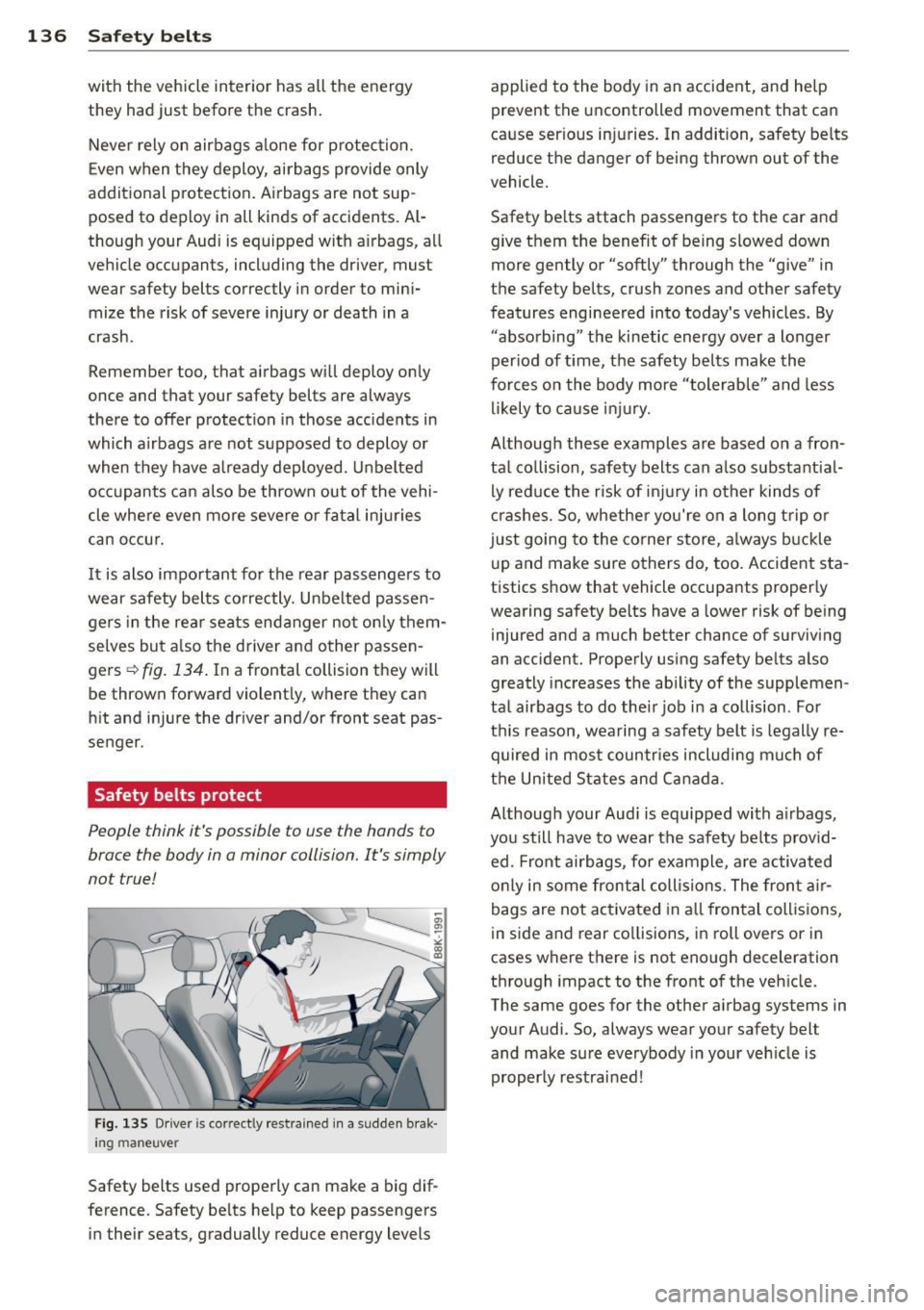
Safety belts protect
People think it's possible to use the hands to
brace the body in a minor collision. It's simply
not true!
F ig . 135 Driver is co rrectly re st ra ined in a s udden b rak ·
i n g m an euve r
Safety belts used properly can make a big dif
ference . Safety be lts he lp to keep passengers
in their seats, gradually reduce energy levels applied to the body in an accident, and help
prevent the
uncontrolled movement that can
ca use serio us in juries . In addition, safety be lts
reduce the danger of being thrown out of the
vehicle .
Safety be lts attach passengers to the car and
give them the benefit of being slowed down
more gently or "softly" through the "give" in
the safety belts, crush zones and other safety
features engineered into today's vehicles. By
"abso rbing" t he kinetic energy over a longer
per iod of t ime, the safety belts make the
forces o n the body more " tolerable" and less
l ikely to ca u se inju ry.
Although these examples are based on a fron
ta l co llision, saf ety belts can a lso substantia l
ly red uce the r isk of injury in other kinds of
cr ashes. So, whether you're on a long t rip o r
j u st going to the corner store, a lways buckle
u p and make sure others do, too. Accident sta
tistics show that veh icle occupants properly
wearing safety belts have a lower risk of be ing
injured and a much better chance of surviving
an accident. Properly using safety be lts also
greatly increases the ability of the supplemen
tal airbags to do the ir job i n a collision. Fo r
t hi s reason, wea ring a safety belt is legally re
quired in mos t countr ies includi ng mu ch of
t h e Un ited States and C anada .
Althoug h your Aud i is equipped with a irbags,
you still have to wear the safety be lts prov id
ed . F ront ai rbags, fo r example , a re ac tivated
o nly in some front al coll isions. The fron t air
bags are not act ivated in a ll fron tal collis ions,
in side and rear co llisions, in roll overs or in
cases where there is not eno ugh deceleration
through impact to the front o f the veh icle.
The same goes for the other a irbag systems in
your Audi. So, always wear your safety belt and make su re everybody in your veh icle is
properly restrai ned !
Page 142 of 294
140 Safety belts
• Let the belt wind up on the retractor as you
guide the belt tongue to its stowed position .
A WARNING
Never unfasten safety belt while the vehi
cle is moving. Doing so will increase your
r isk of being injured or killed .
Improperly worn safety belts
Incorrectly positioned safety belts can cause
severe injurie s.
Wearing safety belts improperly can cause se
rious inj ury or death. Safety belts can only
work when they are correct ly positioned on
the body. Improper seating positions reduce
the effect iveness of safety belts and will even
increase the r isk of injury and death by mov
ing the safety belt to critical areas of the
body. Imprope r seat ing pos itions also in
crease the risk of serious inj ury and death
when an airbag deploys and str ikes an occu
pant who is not in the correct seating posi
t ion . A dr iver is respons ib le for the safety of
a ll vehicle occupants and especially for chi l
dren. Therefore:
• Never permit anyone to assume an inco rrect
sitting position in the vehicle whi le traveling
¢ ir). .
A WARNING
Improperly worn safety belts increase the
risk of serious personal injury and death
whenever a veh icle is being used .
- Always make sure that all vehicle occu-
pants are correctly restrained and stay in
a correct seating posit ion wheneve r the
vehicle is be ing used.
- Always read and heed all WARNINGS and
other important informat ion
¢page 137.
Safety belt preten
sioners
How safety belt pretensioners work
In front, side and rear -end collisions above a
particular severity, safety belts are tensioned
automatically.
T he safety belts are equipped with safety belt
pretensioners. The system is activated by sen
sors in front, side and rear-end collisions of
great severity. This tightens the belt and takes
up belt slack ¢
& in Service and disposal of
safety belt pretensioner on page 141.
Taking
up the slack helps to reduce forward occupant
movement during a collision.
([) Note
Never let the belt remain over a rear seat
back that has been fo lded forward.
(D Tips
The safety belt pretensioner can only be
activated once.
-In minor frontal and side collisions, in
rear-end co llisions, in a rollover and in
accidents involving very little impact
force, the safety belt pretensioner are not activated .
- In the case of a side crash, the safety belt pretensioners will activate on the
dr iver's or front passenger's sides only,
depending on which side of the veh icle
the crash occurs.
- When the safety belt pretensioners are
act ivated, a fine dust is re leased. This is
normal and is not caused by a fire in the
vehicle .
- The relevant safety requ irements must
be observed when the vehicle o r compo
nents of the system are scrapped. An au
thorized Audi dealer or qualified work
shop is familiar with these regulations
and wi ll be pleased to pass on the infor
mation to you.
Page 143 of 294
-Be sure to observe all safety, environ
mental and other regulations if the vehi
cle or individual parts of the system, par
ticularly the safety belt or airbag, are to
be disposed. We recommend you have
your authorized Audi dealer perform this service for you .
Service and disposal of safety belt
pretension er
The safety belt pretensioners are parts of the
safety belts on your Audi. Installing, remov ing, servicing or repairing of belt pretension
ers can damage the safety belt system and
prevent it from working correctly in a colli
sion.
There are some important things you have to know to make sure that the effectiveness of
the system will not be impaired and that dis
carded components do not cause injury or pol
lute the env ironment.
A WARNING
Improper care, servicing and repair proce
dures can increase the risk of personal in
jury and death by preventing a safety belt
pretens ioner from activating when needed
or activating it unexpectedly:
- The belt pretensioner system can be acti
vated only once. If belt pretensioners
have been activated, the system must be
replaced.
- Never repair, adjust, or change any parts
of the safety belt system.
- Safety belt systems including safety belt
pretensioners cannot be repaired. Spe
cial procedures are required for removal,
installation and disposal of this system.
- For any work on the safety belt system,
we strongly recommend that you see
your authorized Audi dealer or qualified
technician who has an Audi approved re pair manual, training and special equip
ment necessary .
Safety belts 141
@:) For the sake of the environment
Undeployed airbag modules and preten
sioners might be classified as Perchlorate
Material -special handling may apply, see
www. dtsc. ca.gov/hazard o u swa ste/ per-
ch lo rate. When the vehicle or parts of the
restraint system including airbag modules
safety be lts with pretensioners are scrap
ped, all applicable laws and regulations
must be observed. Your authorized Audi
dealer is familiar with these requirements
and we recommend that you have your
dealer perform this service for you.
•
•
Page 144 of 294
142 Airbag sys te m
Airbag system
Important things to know
Importance of wearing safety belts and
sitting properly
Airbags are only supplemental restraints. For
airbags to do their job , occupants must al
ways properly wear their safety belts and be
in a proper seating position.
F or your safety and the safety of your passen
gers, before driving off, always:
• Adjust the dr iver's seat and steering wheel
properly ¢
page 125,
• Adjust the front passenger's seat properly
¢page 54,
• Wear safety be lts properly ¢ page 137,
• Always properly use the proper child re-
stra int to protect children¢
page 166.
In a collision airbags must inflate within the
blink of an eye and with considerable force .
The supplementa l airbags can cause injuries if
the dr iver or the front seat passenger is not
seated properly . Therefore in order to he lp the
a irbag to do its job, it is important, both as a
d river and as a passenge r to sit properly at all
times.
By keeping room between your body and the
steering wheel and the front of the passenger
compartment, the airbag ca n inflate fully and
comp letely and provide supp lemental p rotec
tion in ce rtain frontal collisions¢
page 125,
Proper occupant seating positions .
For detai ls
on the operat ion of the seat adjustment con
trols ¢
page 54.
It's especially important that children a re
properly restrained ¢
page 166.
There is a lot that the driver and the passen
gers can and must do to help the individua l
safety features ins talled in your A udi work to
gether as a system.
Prope r seat ing pos ition is important so that
the front airbag on the driver s ide can do i ts
job. If yo u have a physical impa irment or con- dition that prevents you from sitting properly
on the driver seat with the safety belt properly
fastened and reaching the peda ls , spec ial
modifications to your vehicle may be necessa
ry.
Contact your a uthorized Audi dea ler, or call
Audi C ustomer Re lations at 1-800-822-2834 .
When the airbag system dep loys, a gas gener
ator will f ill the airbags, break open the pad
ded covers, and inf late between the steering
whee l and the dr iver and between the instru
ment pane l and the front passenger. The air
bags will deflate immediately after dep loy
ment so that the front occupants can see
th rough the w indshield aga in without inter
ruption .
All of th is take s place in the blink of an eye, so
fast that many people don't even realize that
the a irbags have dep loyed . The airbags also
inflate with a great dea l of force and nothing
shou ld be in their way when they deploy.
F ront a irbags in combination with properly
worn safety belts slow down and lim it the oc
cupant's forward movement. Together they
help to prevent the drive r and front seat pas
senger from hitting parts of the inside the ve
hicle while reducing the forces acting on the
occupant dur ing the crash. In this way they
help to reduce the risk of injury to the head
and uppe r body i n the c rash . A irbags do not
protect the a rms or the lower parts of the
body.
Both front a irbags w ill not i nflate in all fronta l
collisions . The t rigge ring of the a irbag system
depends on the vehicle dece lerat ion rate
c aused by the co llision and registered by the
elect ron ic cont ro l u nit. If t his rate is below
the re ference value programmed into the con
trol unit, the airbags will not be trigge red ,
even though the car may be bad ly damaged as
a resu lt of the collision . Veh icle damage, re
pair costs or even the lack of veh icle damage
is no t necessarily an indication of whether an
airbag should inflate or not .
It is not possib le to define a range of vehicle
speeds that w ill cover every possib le kind and .,.
Page 145 of 294
angle of impact that will always trigger the
airbags, since the circumstances will vary con
siderably between one collision and another.
Important factors include, for example, the nature (hard or soft) of the object which the
car hits, the angle of impact, vehicle speed,
etc. The front airbags will also not inflate in
side or rear collisions, or in ro ll-overs .
Alwa ys rem ember : Airbags will deploy only
once, and only in certa in kinds of collisions .
Your safety belts are always there to offer pro
tection in those s ituations in which airbags
are not supposed to deploy , or when they have
a lready deployed ; fo r example , when yo ur ve
h icle strikes or is struck by another after the
first collision .
This is just one of the reasons why an a irbag is
a supplementary restra int and is not a s ubst i
tute for a safety belt . The airbag system
works most effectively when used with the
safety belts. Therefore, always properly wear
your safety belts
¢ page 134.
A WARNING
Sitting too close to the steer ing wheel or
instrument panel will decrease the effec
tiveness of the airbags and will increase
the risk of pe rsonal injury in a co llision .
- Never sit closer than
10 inches (25 cm)
to the stee ring wheel or instrument pan
el.
- If you cannot sit more than
10 i nches
(25 cm) from the steer ing whee l, investi
gate whether adaptive equipment may
be available to help you reach the pedals
and increase your seating dis tance from
the steering wheel.
- If you are unrestrained, lean ing fo rward,
sitting sideways or out of position in any
way, yo ur risk of inj ury is much highe r.
- You w il l also receive serio us inju ries and
cou ld even be killed if you are up against
the airbag or too close to it when it in
flates -even with an Advanced Airbag.
- To reduce the r isk o f injury when an air
bag inflates, a lways wear safety belts
proper ly ¢
page 137, Safety belts .
Airbag system 143
-Always make certain that chi ld ren age 12
or younger a lways ride in the rear seat. If
children are not properly restrained, they may be severe ly inju red or killed when an
airbag inf lates .
- Never let ch ildren ride unrestra ined or
improperly restrained in the vehicle . Ad
just the front seats prope rly.
- Never ride with the backrest reclined.
- Always sit as far as possible from the
steer ing whee l or the instrument pane l
¢page 125.
-Always sit upright with your back against
the backrest of your seat.
- Never p lace your feet on the instrument
panel or on the seat. Always keep both
feet on the f loor in front of the seat to
he lp prevent serio us in juries to the legs
a nd h ips if the airbag inflates.
- Never recline the front passenger 's seat
to tra nsport objects. Items can a lso
move i nto the area of the s ide a irbag or
the front a irbag du ring bra king or in a
sud den maneuve r. Obje cts ne ar the air
bags can become projectiles and cause
injury when an airbag inflates.
_&. WARNING ~
A irbags that have de ployed in a crash must
be replaced.
- Use on ly original equipment airbags ap
proved by Audi and installed by a trai ned
technician who has the necessary too ls
and d iagnost ic equipment to properly re
place any airbag in your vehicle and as
sure system effectiveness in a crash .
- Never perm it salvaged or recycled air
bags to be installed in your vehicle .
Child restraints on the front seat - some
important things to know
.,. Be su re to read t he important information
and head the WARNINGS fo r important de
tails about children and Advanced Airbags
¢ page 166. ..,.
•
•