oil level AUDI A5 COUPE 2013 User Guide
[x] Cancel search | Manufacturer: AUDI, Model Year: 2013, Model line: A5 COUPE, Model: AUDI A5 COUPE 2013Pages: 294, PDF Size: 73.84 MB
Page 223 of 294
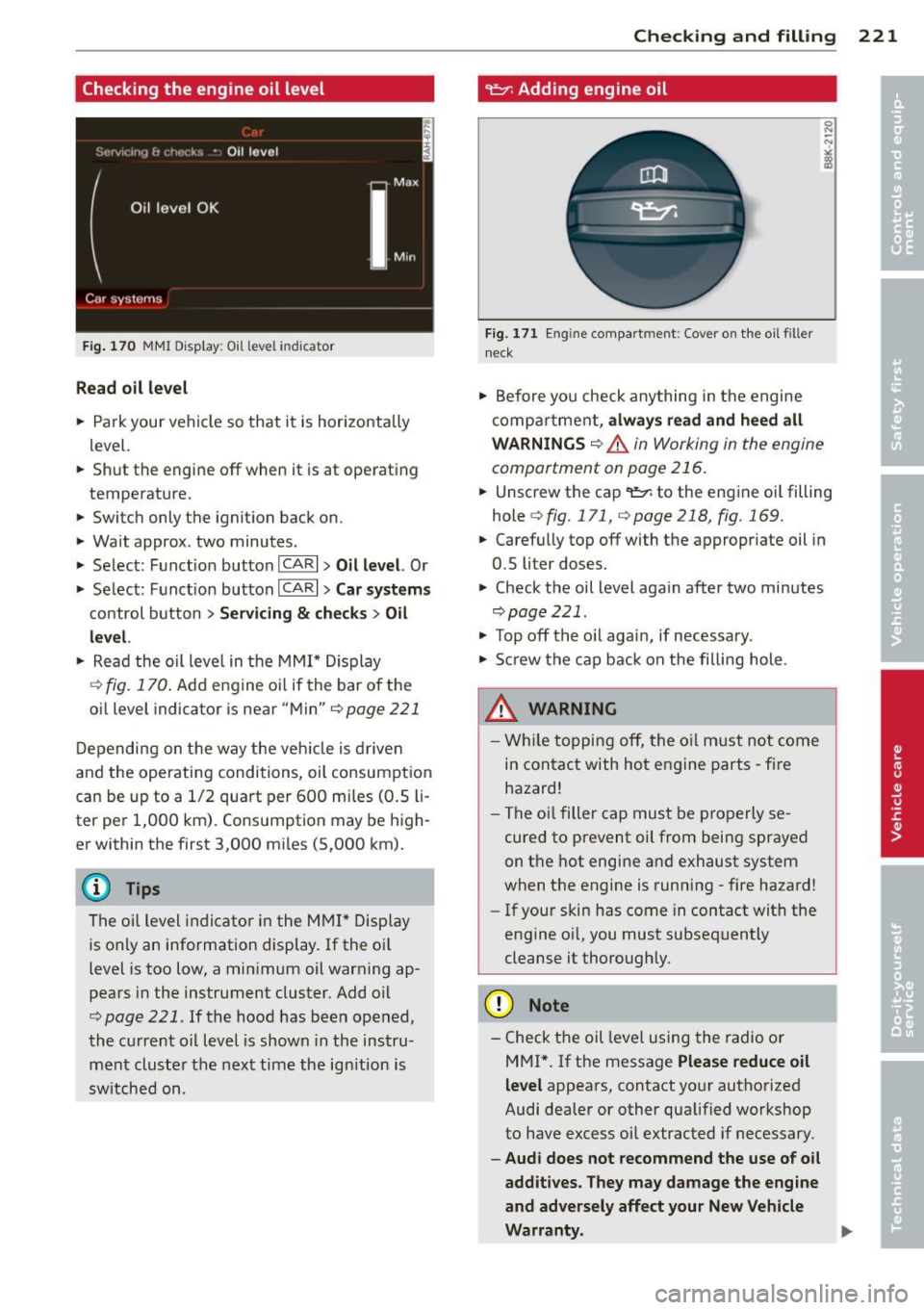
Checking the engine oil level
Fig . 170 MMI Disp lay: Oil l eve l ind icator
Re ad oil le vel
.,. Park you r vehicle so that it is horizontally
level.
.. Shut the engine off when it is at operating
temperature.
.,. Switch only the ignition back on.
.,. Wait approx . two minutes .
.,. Select : Funct ion button
ICAR I > Oil l evel. Or
.,. Se lect: Function button
ICA RI > Car syste m s
control button > Servic ing & c he ck s > Oil
l e v el.
.,. Read the oil leve l in the MMI * Display
r:!> fig . 170 . Add engine oi l if the bar o f the
oi l level ind icator is near "Min"
c> page 221
D epending on the way the veh icle is driven
and the operating conditions, oil consumption
can be up to a 1/2 quart per 600 miles (0 .5
li
ter per 1,000 km) . Consumption may be high
er within the first 3,000 mi les (S,000 km).
@ Tips
The oil level indicator in the MMI* Disp lay
is only an information display.
If the oi l
level is too low, a min imum oil warning ap
pears in the instrument cluster. Add oil
¢ page 221 . If the hood has been opened,
the current oil level is shown in the instru
ment cluster the next time the ign ition is
sw itched on . Checkin
g and fillin g 221
~ Adding engine oil
Fig. 171 Eng in e compa rtm en t: Cove r on the oil filler
n eck
.,. Before yo u check anything in the engine
compa rtment,
alwa ys read and h eed all
WARNING S
c> .&. in Working in the engine
compartment on page 216 .
.. Unscrew the cap
'e:;r. to the engin e oil filling
hole ¢fig . 171, r:!>page 218, fig. 169 .
.,. Carefully top off with the appropr iate oil in
0 .5 liter doses .
.. Check the oil level aga in after two minutes
r:!> page 221 .
.,. Top off the o il aga in, if necessary.
.,. Sc rew the c ap back on the filling hole .
&_ WARNING
-Wh ile topping off, the o il m ust not come
in contact with hot engine parts -fire
hazard!
- The oi l filler cap mus t be p roperly se
cured to prevent oil from being sprayed
on the hot engine and exhaust system
when the engine is running -fire hazard!
- If you r skin has come in contact with the
engine o il, you must subsequently
cleanse it thoroughly.
(D Note
- Check the oil leve l using the radio or
M MI* . If the message
Plea se reduce oil
level
appears, contact yo ur authorized
Audi dea ler or other qualified workshop
to have excess oil extracted if necessary.
- Audi does not recommend the u se of o il
addit iv es. They m ay damage the engine
and adversely aff ect your New Vehi cle
W arranty .
Page 225 of 294
Engine cooling system
Coolant
The engine coolant performs two functions: it
keeps the engine from overheating and it pro
tects the engine from freezing in the winter .
The cooling system is sealed and generally re
quires little attention .
The cooling system has been filled at the fac
tory with a permanent coolant which does not
need to be changed. The coolant consists of a
mixture of water and the manufacturer's gly
col-based coolant additive G13 antifreeze with
anticorrosion additives (50% for USA models;
60% for Canadian models). This mixture both
assures the necessary frost protection and
protects metal components in the engine's
cooling system from corrosion and scaling. It
also raises the boiling point of the coolant.
Do not reduce the concentration of the cool
ant in the summer by adding plain water.
The
proportion of coolant additive must be at least 50% but not more than 60%
to main
tain antifreeze protection and cooling efficien
cy. If the coolant frost protection is too low,
the coolant could freeze and damage the vehi
cle heating and engine cooling system .
For year-round driving, antifreeze is added at
the factory for temperatures down to:
- -31°F(-35 °C)USA
- -40 °F ( - 40 °C) Canada.
A WARNING
Before you check anything in the engine
compartment, always read and heed all
WARNINGS
¢ .&. in Working in the engine
compartment on page 216.
(D Note
- Before winter sets in, have the coolant
checked to see if the coolant additive in
your vehicle is sufficient to meet the cli
mate conditions . This is especially impor
tant if you live in a region where the win
ter is extremely cold. If necessary, in-
Checking and filling 223
crease the proportion of coolant additive
to 60%.
- When adding coolant additive to your
cooling system, remember:
- We recommend using only coolant ad
ditive G12++ or G13 for your vehicle .
This coolant additive is available at au
thorized Audi dealers. Other types of
antifreeze can significantly reduce cor
rosion protection. The resulting corro
sion can cause a loss of coolant and se
rious engine damage.
- Do not add any type of radiator leak seal
ant to your vehicle's engine coolant.
Adding radiator repair fluid may adverse
ly affect the function and performance of
your cooling system and could result in
damage not covered by your New Vehicle
Limited Warranty.
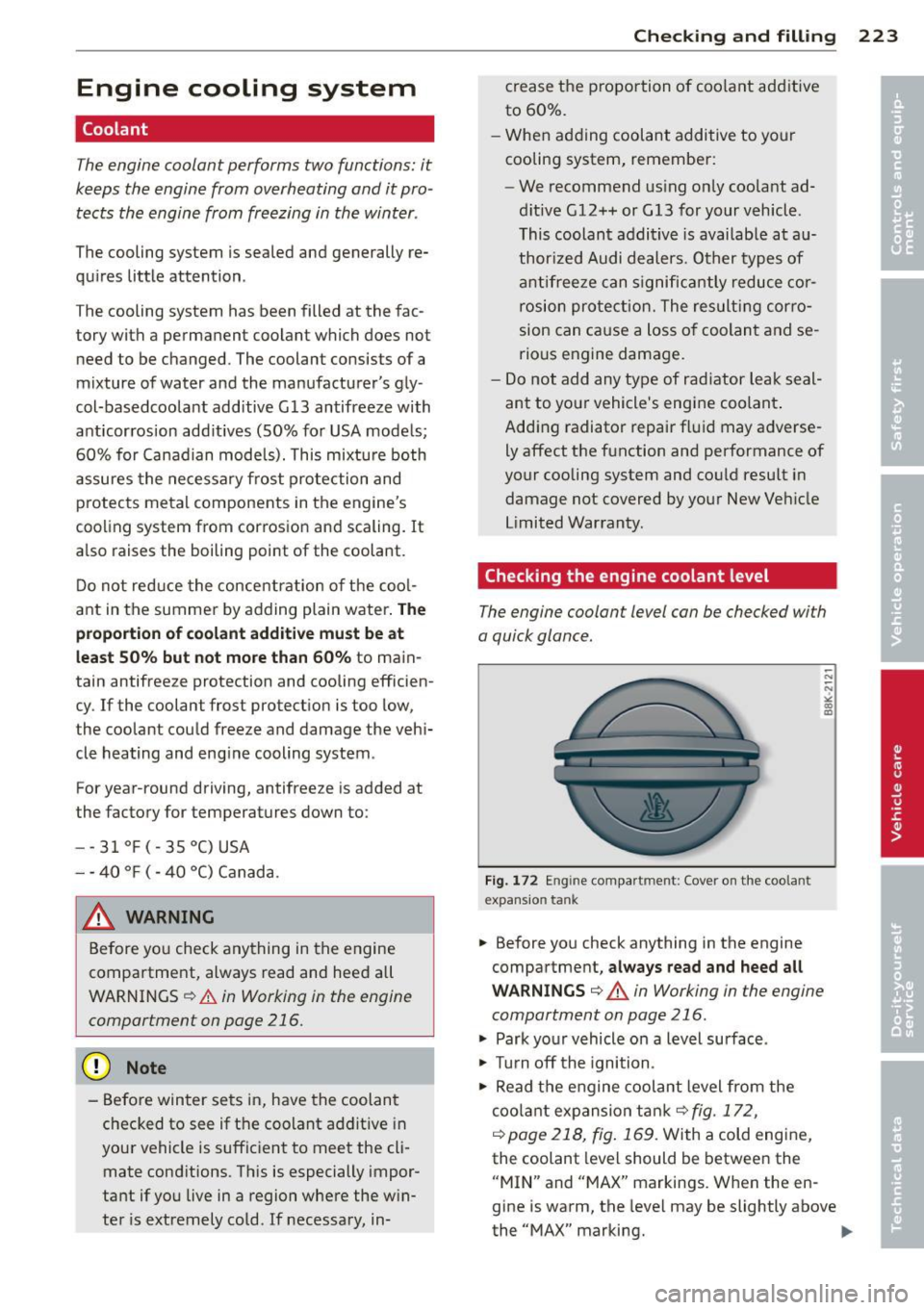
Checking the engine coolant level
The engine coolant level can be checked with
a quick glance.
Fig. 172 Engine compar tment: Cover on the coola nt
expansio n tank
-... ;;; ,; a, m
.. Before you check anything in the engine
compartment,
always read and heed all
WARNINGS ¢ & in Working in the engine
compartment on page 216.
"' Park your vehicle on a level surface .
"' Turn off the ignition .
"' Read the engine coolant level from the
coolant expansion tank¢
fig. 172 ,
¢ page 218, fig. 169 .
With a cold engine,
the coolant level should be between the
"MIN" and "MAX" markings . When the en
gine is warm, the level may be slightly above
the "MAX" marking.
Iii>
Page 226 of 294
224 Check ing and filling
The location of the coolant expansion tank
can be seen in the engine compartment illus
tration
¢ page 218.
To obtain an accurate read ing, the eng ine
must be switched off .
The expans io n tank in you r vehicle is equipped
with an e lectr ic cool ant level sensor.
When the coolant level is too low, the warning light in the A uto-Check System
¢ page 18 w ill
b link until you add coo lant and the level has
been restored to no rm al. Even though the re is
an e lec tric coolant level sensor, we s till rec
ommend you check the coolant leve l from
time to time.
Coolant loss
Coolant loss may indicate a leak in the cooling
system. In the event of coolan t loss, the cool
i ng system should be inspected immedia tely
by your authorized A udi dealer. It is not
enough merely to add coolant.
I n a
s e aled system, losses can occur only if
the boiling poin t of the coolant is excee ded as
a result of overheating.
A WARNING
The cooling system is unde r pressure and
can get ve ry hot. Reduce the risk of sca ld
ing from hot coolant by following these
steps.
- Turn off the engine and allow it to cool
down.
- Protect yo ur face, hands and arms from
escaping fluid and steam by covering the
cap with a large, thick rag.
- Turn the cap slowly and ve ry carefu lly in
a counter-clockwise direction wh ile ap
plying light, downward pressure on the
top of the cap .
- To avoid being b urned, do not spill ant i
freeze or coolant on t he exhaust system
or hot eng ine parts. Unde r certain condi
tions, t he ethy lene g lycol in engine cool
an t can ca tch fire .
(D Note
Do not ad d any type of radiator leak sea l
ant to your veh icle's engine coo lant. Add
i ng radiator repa ir fluid may adverse ly af
fect the funct ion and performance of your
cooling system and could result in damage not cove red by your New Veh icle L imited
War ran ty .
Adding coolant
Be very careful when adding engine coolant.
Before you check anyth ing in the eng ine com
partmen t,
always read and heed all WARN
INGS ¢ &. in Working in the engine compart
ment on page 216.
.. Turn off the engine.
.. Let the engine cool down.
.. Place a thick rag over the coolant expansion
tank ¢
page 223, fig. 172 and carefully turn
the cap counter-clockwise ¢
,&..
.,. Add coo lant.
.. Twist the cap on aga in
t ightly.
Replacement engine coo lant must confo rm to
exact spec ificat ions ¢
page 223, Coolant. We
recommend using on ly coo la nt add itive G 12+
+ , G 13 or in an eme rgency G12+. Do
not use a
different additive. In an emergency use plain
water until yo u can get the correct additive
and can restore the correct ratio . This sho uld
be done as soon as possible .
If you have los t a considerab le amount o f
coolant , then you sho uld add cold antifreeze
and cold wate r on ly w hen the engine is cold.
Always use
new engine coo lan t when refilling.
Do not f ill coo lant abov e the
"MAX" ma rk . Ex
cess coo la nt w ill be fo rced o ut through the
pressure relief valve in the cap when the en
gine becomes hot.
A WARNING
-= -
-The cooling system is under pressure and
can get very hot. Reduce the risk of ..,.
Page 277 of 294
-Always make sure the transm ission se
lector lever (automatic transmiss ion) is
in "P" (Park position) or Neutral (manual
transmission) and the park brake is firm
ly appl ied .
® For the sake of the environment
-Changing the eng ine settings w ill ad
versely affect em ission levels. This is det
rimental to the environment and increas
es fuel consumption .
- Always observe env ironmental regula
tions when d ispos ing of old engine oil,
used brake fluid, dirty engine coolant,
spent batter ies or worn out t ires.
- Undeployed airbag modules and p reten
s ioners might be classified as Perchlo
rate Material -special handling may ap
ply, see www.dtsc.ca .gov/hazardous
waste/perch lorate . When the veh icle or
parts of the restraint system including
airbag modules safety belts with preten
s ioners are scrapped, all applicable laws
and regulations must be observed. Your
authorized Audi dealer is familiar w ith
these requirements and we recommend
that you have your dealer perform this
serv ice for you .
Additional accessories,
modifications and
parts replacement
Additional accessories and parts
replacement
Always consult on authorized Audi dealer be
fore purchasing accessories.
Your veh icle incorporates the latest safety de
sign featu res ensu ring a high standard of ac
tive and passive safety.
This safety could be compromised by non-ap
proved changes to the veh icle. For this reason ,
if parts have to be replaced, p lease observe
the following points when installing addition
al accessories:
Con sumer In formation 275
Approved Audi accessories and genuine Audi
parts are available from authorized Audi deal
ers.
T hese dea lers a lso have the necessary facili
ties, tools and trained specialists to install the
parts and accessories proper ly.
A WARNING
Using the wrong spare parts or using non
approved accessories can cause damage to
the vehicle and serious persona l injury.
- Use on ly accessories express ly approved
by Audi and genuine Audi spare parts
- These parts and accessories have been
specially designed to be used on your ve
hicle.
- Never install accessories such as tele
phone cradles or beverage holders on air
bag covers or within the airbag deploy
ment zones . Do ing so will increase the
risk of injury if a irbags are triggered in an
accident!
- Before you check anything in the engine
compartment, always read and heed all
WARNINGS ~
page 209.
(D Note
-If items other than genuine Audi spare
parts, add-on equipment and accessory
items are used or if repair work is not
performed accord ing to specified meth
ods, this can result in severe damage to
your vehicle's engine and body (such as
corrosion) and adversely affect your vehi
cle's warranty .
- If emergency repairs must be performed
elsewhere, have the vehicle examined by
an authorized Audi dealer as soon as
possible.
- The manufacturer cannot be held liable
for damage wh ich occurs due to failure
to comply with these stipulations.
•
•
Page 284 of 294
28 2 Index
Eng ine
Compartment .. . ...... ... .. .. .... . 218
Coolant .. .. ... ... .... ... .. .. .... . 223
Hood .. .. ............... .. .. .... . 216
Starting . . . . . . . . . . . . . . . . . . . . . . 71, 74
Starting with jumper cables .. .. .. ... 263
Stopping . . . . . . . . . . . . . . . . . . . . . . 73, 75
Engine compartment Safety instructions . . . . . . . . . . . . . . . . . 216
Working the engine compartment 216
Eng ine coolant
Indicator light . .. ..... ... .. .. .... .. 18
E ng ine coolant system ............... 223
Adding coo lant ......... .. .. .. .. .. . 224
Chec king coolant leve l ..... .. .. .... . 223
Check ing the eng ine coolant leve l .. .. . 223
Radiator fan . .. .. ..... ... .. .. .... . 225
E ng ine coolant temperature
Tempe ratu re ga uge ................. 10
Eng ine data .... ........... ........ . 271
E ngine hood
C losing . . . . . . . . . . . . . . . . . . . . . . . . . . 216
How to release the hood ... .. .. .. .. . 216 Proper disposal of d
rained eng ine cool -
ant . ... .. .... .. .. ... ..... ... .. .. 224
Proper d isposal of drained eng ine
o il ... .... .... .. ............ 221,222
Recycling used engine oil ........ .... 221
Roof rack . . . . . . . . . . . . . . . . . . . . . . . . . 62
Unleaded fuel .. .. ... .. ....... ... .. 211
What shou ld I do with an o ld battery? . 230
EPC
refer to Electronic power control . . . . . . 20
E SC (Electronic Stab ilizat ion Con trol)
Warning/indicator lights ..... ... .. .. . 19
E thy l alcoho l (Fuel) . ... .......... .. .. 212
Event Data Recorder (EDR) ........ .... 185
E xhaus t tail pipes
Cleaning . ..... .. ... .. ..... .... . .. 205
E xpansion tank .. .. ................ . 223
Exterior lighting . .. ... .......... .. .. . 43
E xterior mirrors
Adjusting ..... .. .. ... ..... ... .. .. . 46
Dimm ing . ..... .. .. ... ..... ... .. .. . 47
Heating ... .... .. .. ... ..... ... .. .. . 46
E ng ine oil ... ... .......... .. .. .. .. . 218
F
Adding .. .. ............. ........ . 22 1
Addit ives ... ... .. ..... ... .. .. .... . 22 1
C hanging . .... .. ..... ... .. .. .... . 222
Check oil leve l ........... .... .... . 221
Consumpt ion ............ .. .. .. .. . 221
Indicator ligh t ............. .. .. 17,21
O il consumption ............... .... 220
O il grades .. .......... ........ ... . 218
O il level symbol .............. .. .... 21
Pr essu re malfunct ion ................ 17
Sensor defective . . . . . . . . . . . . . . . . . . . . 2 1
Specif ication and viscos ity . ... .... .. . 2 18
E ng ine speed limitat ion .......... ..... 21
Environment Break- in period ............... .... . 193
Cata lytic converter ............ .... . 194
Disposing of your vehicle battery .. .. . 230
Driving a t high speeds ......... .. ... 195
D riving to m inim ize pollution and no ise 195
F uel . .. ................. .. .. ..... 2 13
Fu el economy .......... .. .. .. .. .. . 195
L eaks under your veh icle ... .. .. .. .. . 216
L etting the vehicle stand and wa rm up . 195
Proper disposal of drained brake fluid . 226 F
an
Radiator
Fastening 225
Boos ter sea ts . . . . . . . . . . . . . . . . . . . . . 17 4
Co nvertib le child sa fe ty seats . . . . . . . . 173
Infan t seats
Flat tire 172
Chang ing . .. .. .. ............. .. .. 253
flexib le fuel . .... .. ... .......... .... 212
Floor mats . ..... .. .. .... .... ... .. .. 129
Fog lights/rear fog light(s) ...... ....... 43
Fo lding the rear seats .... ..... ... .. .. . 63
Foot peda ls . ....................... 129
For the sake of the environment
Gasoli ne fumes and the env ironme nt .. 213
L etting the engine warm up . . . . . . 71, 74
Ref ueling . .. .. .. ............. .. .. 213
Sav ing f uel by early u pshi fting . .. .... . 11
Front a irbags
Description . . . . . . . . . . . . . . . . . . . . . . . 146
How they work ........ ........... . 151
Frontal coll is ions and the laws of phys ics 135