ECO mode AUDI A5 COUPE 2013 Owner's Guide
[x] Cancel search | Manufacturer: AUDI, Model Year: 2013, Model line: A5 COUPE, Model: AUDI A5 COUPE 2013Pages: 294, PDF Size: 73.84 MB
Page 228 of 294
226 Check ing and filling
• Read the brake fluid level from the brake
fluid reservoir ¢
fig. 173, ¢ page 218,
fig . 169.
The brake fluid level must be be
tween the "MIN" and "MAX" markings.
The brake fluid reservoir is located at the rear partition of the engine compartment on the
left side ¢
page 218 .
The fluid level may drop slightly after some
time due to the automatic adjustment of the brake pads . This is not cause for alarm .
I f the brake fluid level falls
considerably be
l ow the "MIN" mark, the brake wa rning/indi
cator light (U .S . mode ls:
1111 , Canadian
models :. ) will come on
¢ page 15. Do not
continue to operate the vehicle. The complete
brake system should be thoroughly checked
by an authorized Audi dealer or qualified
workshop and the cause corrected . If the
brake fluid level is too low, the brake warn ing/
i ndicato r light w ill illuminate . Contact an au
thor ized Audi dealer
imm ediat ely .
@ Tips
The brake f luid reservoir is located under
neath the cove r.
Changing brake fluid
Have the brake fluid changed by an experi
enced technician .
Brake fluid absorbs moisture from the a ir . If
the water content in the brake fluid is too
h igh, corrosion in the brake system may result
after a per iod of t ime . The bo iling po int of the
b rake fluid w ill also decrease considerably and
decrease braking performance.
Therefore, the brake flu id must be changed
ev ery two years. A lways use new brake fluid
which confo rms to Fede ral Motor Vehicle
S tanda rd "FMVSS 116 DO T 4".
The brake flu id reservoir can be difficult to
reach, therefo re , we recommend that you
have the brake fl uid changed by yo ur au tho r
ized
Audi d eale r. Your dea le r has the correct tools, the
right brake flu id and the know -how
to do this for you.
A WARNING
'-
- Brake flu id is poisonous. It must be stor-
ed only in the closed or iginal container
out of the reach of children!
- Brake failure can resu lt from o ld or inap
propriate brake f lu id. Observe these pre
cautions:
- Use only brake f luid that meets SA E
specifi cation
J 1703 and conforms to
Federa l Motor Vehicle Standard 1 16 .
Always check with your authorized Audi
dealer to make sure yo u are using the
correct brake fluid. The correct type of
brake flu id is also ind icated on the
brake f lu id reservoir.
- The brake fluid must be new. Heavy use
of the brakes can cause a vapor lock if
the brake fluid is left i n the system too
long . This can se riously affect the effi
c iency of the brakes as well as your
safety . T his could result in an accident.
W Note
Brake fluid will damage the paint of your
vehicle .
@ For the sake of the environment
Because of the prob lem of proper disposal
of brake fluid as well as the spec ial tools
required and the necessary expertise, we
recommend that you have the brake flu id
changed by your autho rized Aud i deale r.
Battery
General information
Under normal operat ing cond itions, the bat
tery in your Audi does not need any ma inte
nance. With
high outside temperatures or
long da ily drives we recommend that you have
the e lectrolyte leve l che cked by an autho rized
A udi dealer or qualified workshop. The elec
trolyte level should also be checked each time
the battery is charged
¢ page 229. ..,_
Page 238 of 294
236 Tires and wheels
change. In the event of discrepancies, the tire
pressure labe l is located on the driver's side B
p ill ar a lways takes precedence.
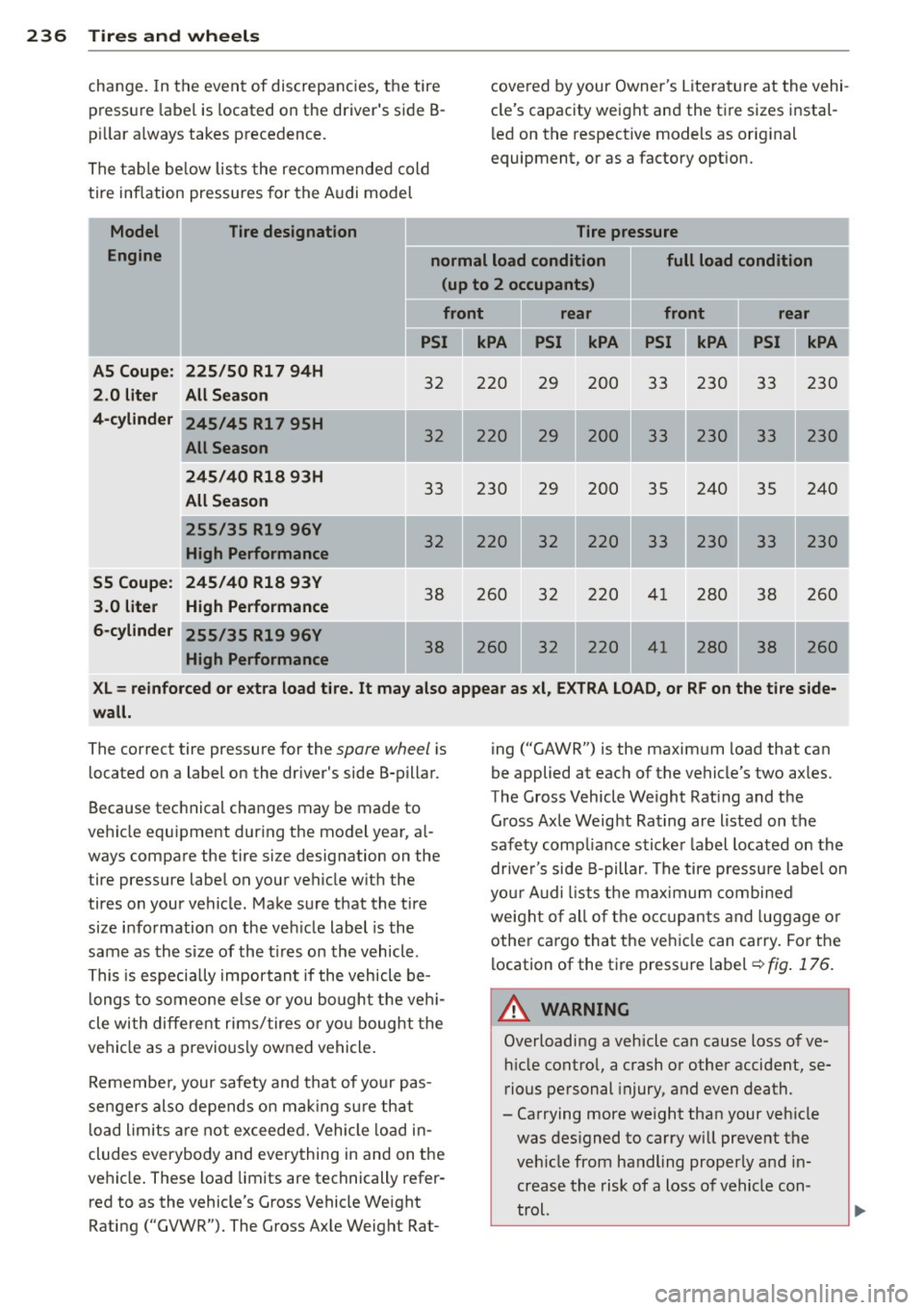
The table below lis ts the recommended cold
tire inflation pressures for the Audi model
I Model II
Tire designation
covered by your Owner's Literature at the vehi
cle's capacity weight and the tire sizes instal
l ed on the respective models as orig inal
equipment, or as a factory option.
Tire pressure
Engine normal load condition full load condition
(up to 2 occupants)
front rear front rear
I
PSI Jl kPA PSI Jl kPA PSI Jl kPA PSI Jl kPA
AS Coupe: 225/50 R17 94H
2.0 liter All Season
4-cylinder 245/45 Rl 7 95H
I Au Season
245/40 R18 93H
All Season
2SS /35 R19 96V
High Performance
55 Coupe: 245/40 R18 93V
3 .0 liter High Performance
6-cylinder
-255/35 R19 96V
High Performance
32 220
32 220
33 230
32 220
38 260
38
260
29 200 33 230 33 230
.
29 200 33 230 33 230
I
29 200 35 240 35 240
'
32 220 33
230 33 230
I
32 220 41 280 38 260
32 220 41 280 38 260
I
XL= reinforced or extra load tire. It may also appear as xl, EXTRA LOAD, or RF on the tire side
wall.
The correct tire pressure for the spare wheel is
located on a label on the driver's side B-pillar.
Because technical changes may be made to
vehicle equipment during the model year, a l
ways compare the tire size designation on the
tire pressure label on your vehicle with the
tires on your vehicle . Make sure that the tire
size information on the veh icle label is the
same as the size of the t ires on the vehicle .
This is especially important if the vehicle be
lo ngs to someone else or you bought the veh i
cle with different rims/tires o r you bought the
vehicle as a previously owned vehicle .
Remember, your safety and that of your pas
sengers also depends on mak ing sure that
l oad limits are not exceeded. Vehicle load in
cludes everybody and everything in and on the
vehicle . These load limits are technically refer
red to as the vehicle's Gross Vehicle Weight
Rating ("GVWR"). The Gross Axle Weight Rat- ing
("GAWR") is the maximum load that can
be applied at each of the vehicle's two axles.
The Gross Vehicle Weight Rating and the
G ross Axle Weight Rating are listed on the
safety comp liance sticker label located on the
drive r's side B-pillar . The tire pressure label on
your Audi lists the maximum combined
weight of all of the occupa nts and luggage or
other cargo that the vehicle can carry. For the
location of the tire pressure label¢
fig. 176.
A WARNING ._
Overloading a vehicle can cause loss of ve
hicle contro l, a crash or other accident, se
rious personal injury, and even death.
- Carrying more weight than your vehicle
was designed to carry will prevent the
veh icle from handling properly and in
crease the risk of a loss of vehicle con
trol.
Page 250 of 294
248 Tires and wheels
driving a few yards and correct if neces
sary. Follow the instructions from the
snow cha in manufacturer when doing so.
(D Tips
Where snow chains are mandatory oncer
tain roads, this normally also applies to
vehicles with all wheel drive.
Wheel bolts
Wheel bolts must always be tightened to the
correct torque.
The design of whee l bolts is matched to the
factory installed rims. If different rims are fit
ted, the correct wheel bolts with the right length and correctly shaped bolt heads must
be used. This ensures that wheels are fitted
securely and that the brake system functions
correctly .
In certain circumstances, you may not use
wheel bolts from a different vehicle -even if it
is the same model
¢ page 275.
.&_ WARNING
Improperly tightened or maintained wheel
bolts can become loose causing loss of
control, a collision and serious persona l in
Jury.
- Always keep the wheel bolts and the
threads in the wheel hubs clean so the
wheel bolts can turn easily and be prop
erly tightened.
- Never grease or oil the wheel bolts and
the threads in the wheel hubs. They can
become loose while driving if greased or
oiled, even if tightened to the specified
torque.
- Only use wheel bolts that belong to the
rim being installed.
- Never use different wheels bolts on your
vehicle.
- Always maintain the correct tightening
torque for the wheel bolts to reduce the
risk of a wheel loss . If the tightening tor
que of the wheel bolts is too low, they
can loosen and come out when the veh i- cle
is moving.
If the tightening torque is
too high, the wheel bolts and threads
can be damaged and the wheel can be
come loose.
(D Note
The specified torque for the whee l bolts is
90 ft lbs . (120 Nm) with a tolerance of
± 7,4 ft lbs. (± 10 Nm). Torque wheel bolts
diagonally . After changing a wheel, the
torque must be checked as soon as possi
ble with a torque wrench -preferably by an
authorized Audi dealer or qualified work
shop.
Low aspect ratio tires
Your Audi is factory -equipped with low aspect
ratio tires. These tires have been thoroughly
tested and been se lected specifically for your
model for their superb performance, road feel
and handling under a variety of driving condi
t ions . Ask your authorized Audi dealer for
more details .
The low aspect ratio of these tires is indicated
by a numeral of
55 or less in the tire's s ize
designation . The numeral represents the ratio
of the tire's sidewall height in relation to its
tread width expressed in percentage. Conven
tional tires have a height/w idth rat io of 60 or
more.
The performance of low-aspect-ratio tires is
particularly sensitive to improper inflation
pressure. It is therefore important that low
aspect ratio tires are inflated to the specified
pressure and that the inflation pressure is
regularly checked and maintained. Tire pres
sures should be checked at least once a
month and always before a long trip
¢ page 237, Checking tire pressure.
What you can do to avoid tire and rim
damage
Low aspect ratio tires can be damaged more
easily by impact with potholes, curbs, gul lies
or ridges on the road, particularly if the tire is
underinflated . ..,.
Page 266 of 294
264 Emergency situations
@ Tips
The discharged battery must be properly
connected to the vehicle's electrical sys
tem. When jump starting or charging the
battery, never connect the negative
ground cable to the battery negative post
because the batte ry manager system must
be able to detect the battery 's state of
charge. Always connect the negative
ground cab le to the negative ground post
of the battery manager control unit.
Use of jumper cables
Make sure to connect the jumper cable
clamps in exactly the order described below!
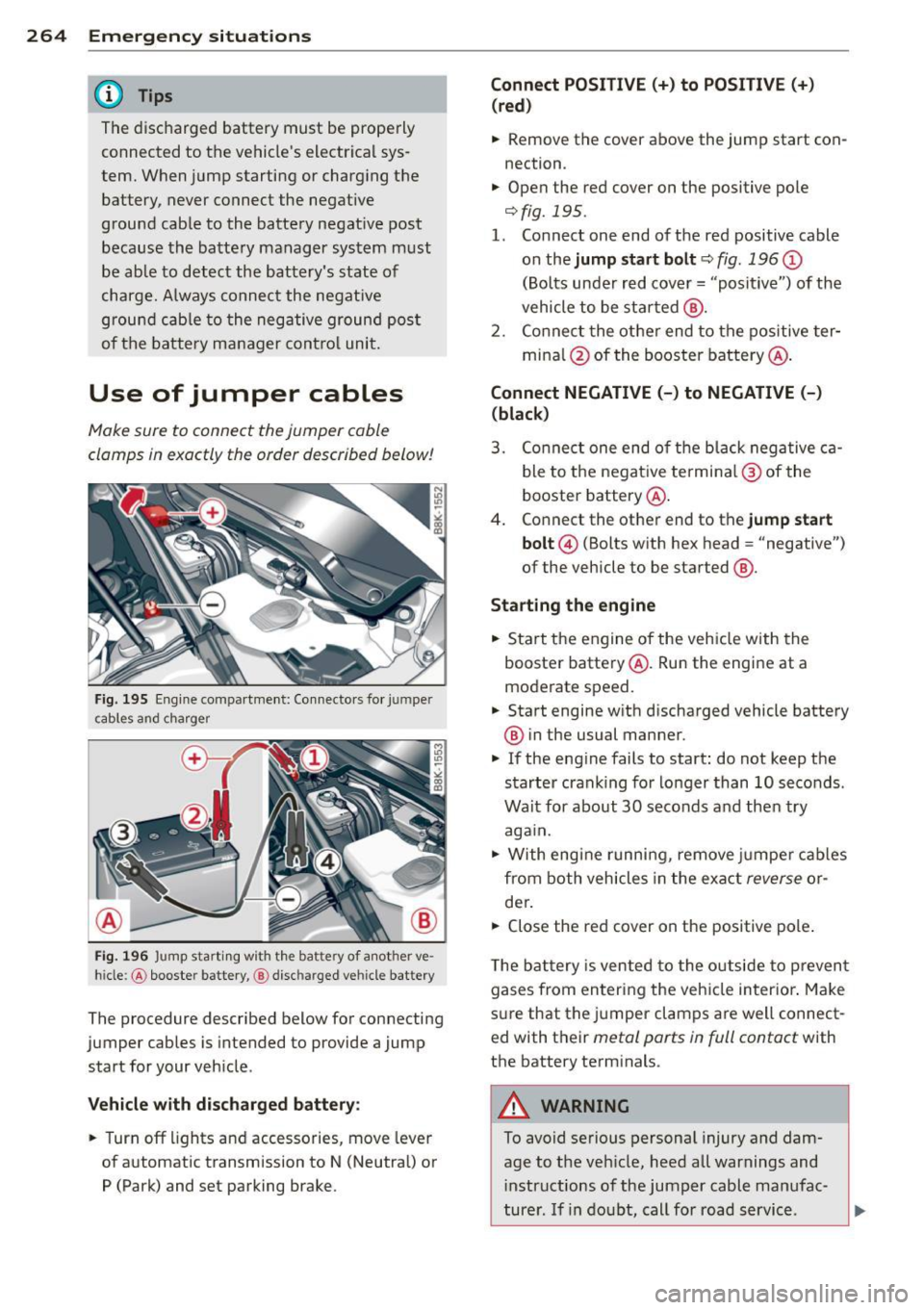
Fig. 195 Engine compartment: Connecto rs fo r jum per
cables and charger
Fig. 196 Jump sta rting wi th the battery of anot her ve ·
h ide :@ booster battery, @ disc harged vehicle battery
The procedure described below for connecting
jumper cables is intended to provide a jump
start for your vehicle .
Vehicle with discharged battery:
.. Turn off lights and accessories, move lever
of automatic transmission to N (Neutral) or
P (Park) and set parking brake .
Connect POSITIVE(+) to POSITIVE(+)
(red)
.. Remove the cover above the jump start con
nection .
.. Open the red
cover on the positive pole
¢fig. 195.
1. Connect one end of the red positive cable
on the
jump start bolt c::> fig. 196 @
(Bolts under red cover= "positive") of the
vehicle to be started @.
2. Connect the other end to the positive ter-
mina l@ of the booster battery@.
Connect NEGATIVE (-) to NEGATIVE (-)
(black)
3. Connect one end of the b lack negative ca
ble to the negative terminal @of the
booster battery @.
4. Connect the other end to the
jump start
bolt @
(Bolts with hex head= "negative")
of the vehicle to be started ®·
Starting the engine
.. Sta rt the engine of the vehicle with the
booster battery@. Run the engine at a
moderate speed.
.. Start engine with discharged vehicle battery
® in the usual manner .
.. If the eng ine fails to start: do not keep the
starter cranking for longer than 10 seconds .
Wait for about 30 seconds and then try
again .
.. With engine running, remove jumper cables
from both vehicles in the exact
reverse or
der .
.. Close the red
cover on the positive pole .
T he battery is vented to the outside to prevent
gases from entering the vehicle interior . Make
sure that the jumper clamps are well connect
ed with their
metal parts in full contact with
the battery terminals.
A WARNING
--
To avoid serious personal injury and dam
age to the veh icle, heed all warnings and
i nstructions of the jumper cable manufac-
turer . If in doubt, call for road service . ..,.
Page 275 of 294
Consumer Information
Warranty coverages
Your Audi is covered by the following war
ranties :
- New Vehicle Limited Warranty
- Limited Warranty Against Corrosion Perfo-
ration
- Emissions Control System Warranty
- Emissions Performance Warranty
- California Emissions Control Warranty (USA
vehicles only)
- California Emissions Performance Warranty
(USA vehicles only)
Detailed information regarding yo ur warran
ties can be found in your
Warranty & Mainte
nance booklet .
Operating your vehicle
outside the U.S.A. or
Canada
Government regulations in the United States
and Canada require that automobiles meet
specific emission regulations and safety
standards. Therefore, veh icles built for the
U.S.A. and Canada differ from vehicles sold in
other countries .
I f you p lan to take your vehicle outside the
continental limits of the United States or Can
ada, there is the possibility that:
- unleaded fuels for vehicles with cata lytic
converter may not be available;
- fuel may have a considerably lower octane
rating . Improper fuel may cause engine
damage;
- service may be inadequate due to lack of
proper service facilities, tools or testing
equipment;
- replacement parts may not be readily availa
ble.
- Navigation systems for vehicles built for the
U.S.A. and Canada will not necessari ly work
in Europe, and may not work in other coun
tries outside of North America.
Consumer Information 273
@ Note
Audi cannot be responsible for mechanical
damage that could result from inadequate
fuel, serv ice or parts availab ility.
Audi Service Repair
Manuals and Literature
Audi Offic ial Factory Service Manuals and Lit
erature are published as soon as possible after
model introduct ion. Service manuals and lit
erat ure are available to order from the Audi
T echnical Literature Ordering Center at:
www.audi.techliterature.com
Maintenance
' General
Your vehicle has been designed to help keep
maintenance requirements to a m inimum.
However, a certain amount of regular mainte
nance is still necessary to assure your vehicle's
safety, economy and reliability . For detailed
vehicle maintenance consult your Warranty
&
Maintenance booklet.
Under difficult operating conditions , for ex
ample at extremely low outside temperatures,
in very dusty regions, when towing a tra iler
very frequently, etc., some serv ice work
shou ld be pe rformed between the intervals
specified. This applies particularly to:
- oil changes, and
- cleaning or replacing the air filter.
® For the sake of the environment
By regularly maintaining your veh icle, you
help make sure that emission standards
are maintained, thus min imiz ing adverse
effects on the environment .
Important considerations for you and
your vehicle
The increasing use of electronics, sophisticat
ed fuel injection and emission contro l sys-
tems, and the genera lly increasing technica l ..,_
•
•
Page 285 of 294
Front passenger's door emergency locking 3 7
Front seats Adjusting .. ............. .... .. ... 126
C hi ld restra ints in the front seat . .. .. . 14 3
Fue l
Addit ives . ..... ........... ... ... .. 211
Blended gasoline .............. .... 211
Consumpt ion . . . . . . . . . . . . . . . . . . . . . . 25
Fill er ne ck .. .. ........... .. .. .. ... 2 13
Fu el gauge . ............. .. .. .. .. .. 12
Gasoline ... .... ...... ... .. .. .. ... 211
Gasoline additives ..... ... .. .. .. .. . 2 12
L ow fuel level symbo l . . . . . . . . . . . . . . . 21
Octane rating ............ .... .. .. . 211
Recommendation . . . . . . . . . . . . . . . . . . 211
Refue lling ..... ........... ... ... .. 213
Reserve .. ..... ........... ... ... ... 1 2
Tank capacity ............... ... ... 271
Tank system ............. .... .. .. .. 2 1
Un loc king the f ue l filler fl ap by hand . . 215
Fuel economy messages (eff iciency pro-
gram) ..... ... ...... ............. ... 29
F ue l filler flap
Unlock ing the fue l filler f lap by hand 215
F uses
Assignment . . . . . . . . . . . . . 2 59 , 26 0, 26 1
Replacing . ... .... .... ... .. .. .. ... 259
G
Garage door opener (Home Link) .. .. .. . 119
Garment hooks . . . . . . . . . . . . . . . . . . . . . . 60
Gas discharge lamps ..... ... .. .. .. .. . 262
Gauges Eng ine coolan t temper ature .. .. .. .. .. 10
Fu el gauge ... .. .. .... ... .. .. .... .. 12
Tac hometer . . . . . . . . . . . . . . . . . . . . . . . 11
Gea r recommendat ion . . . . . . . . . . . . . . . . 28
Gearshift ind icator ......... .. .. .. .. .. 27
Gea rshift lever
6 -speed manual transmission ... .. .. .. 82
Ge ne ral illustra tion
I nstruments and controls . . . . . . . . . . . . . 8
Generator (warn ing/indicator lights) .. .. 17
Glossa ry o f tir e and load ing te rm ino logy 232
Glove compartment . . . . . . . . . . . . . . . . . . 60
GPS controlled clock ..... ... .. .. .. .. .. 1 2
Inde x 283
Gross Vehicle Weight Rating (GVW R) ... 269
H
Head lights
C leaning sys tem . ... .. .. ...... ... .. . 49
De fective . . . . . . . . . . . . . . . . . . . . . . . . . 21
Head light range control ..... ... .. .. . 22
Left hand drive, r ight hand drive .. .. .. . 4S
Travel mode . . . . . . . . . . . . . . . . . . . . . . . 45
Head light washer rese rvoir .... ... .. .. 2 30
Head restraints .. .. .. ... ....... .... . 127
Adjusting ....... .. ........ 56, 57, 127
Remov ing/ instal ling .. ......... .. .. . 57
Heated exter ior mirro rs .. .... ... .... .... .. . 46
r ear w indow ..... .. ..... ........... 69
seats ........ ... .. ..... ........... 69
windshield washer sp ray no zzles . .. .. . 49
Heating ...... .. ...... ............. . 67
Heavy clothing and safety be lts . ... .. .. 137
Hig h beam .. .. .. .. .. . .. .... .... .. .. . 44
Hig h voltage warning label ......... .. 269
Hill des cent con tro l .. .. ......... .. .. . 91
Homelink (remote control)
Hood 119
Opening . ... .. .... . ... ...... ... .. 216
Re lease lever .. .. ............. .... 216
Horn ...... .. .. .. ................... 8
How are child rest raint system anchors re -
lated to ch ild safety .. .. .. ...... .... . 180
How many a irbags does my vehicle have? 149
How ofte n should I che ck my tire pres -
s ur es? ..... .. .. .. ... ............ .. 238
How safety belt pretens ioners work .... 140
Hydrop laning ..... ... .. .. ..... ... .. 242
I
Ign it ion
switching on/off .. .. . ... ...... ... .. . 71
Ig nition key
E mergen cy un lo ck ing ........... .. .. . 35
Ig nition lock .. .. .. .. ............... . 71
Ind icator light ... .. . .. .... .... .. .. . 18
Malfunction . . . . . . . . . . . . . . . . . . . . . . . 23
Immobilizer . . . . . . . . . . . . . . . . . . . . . . . . 12
•
•