brake light AUDI A5 COUPE 2013 Owner's Guide
[x] Cancel search | Manufacturer: AUDI, Model Year: 2013, Model line: A5 COUPE, Model: AUDI A5 COUPE 2013Pages: 294, PDF Size: 73.84 MB
Page 199 of 294
Trailer towing Driving with a trailer
General information
Your Audi was designed primarily for passen
ger transportation .
If you plan to tow a tra iler, p lease remember
that the addit ional load will affect durab ility,
economy and performance .
T railer towing not on ly places more stress on
the vehicle, it also calls for more concentra
tion from the driver.
F or this reason, a lways fo llow the operating
and driving instructions provided and use
common sense.
Technical requirements
Traile r hitch
Use a weight-carrying hitch conforming to the
gross trailer we ight. The hitch must be suita
b le for your veh icle and trailer and must be
mounted secure ly on t he veh icle's chassis at a
technically sound location . Use only a t railer
h itch w ith a removab le ball moun t. A lways
check with the tr ailer hitch man ufac tur er to
make sure that you are using the correct
hitch.
Do not use a bumper hitch.
T he hitc h must be installed in such a way that
it does not inte rfe re with the impac t-absorb
i ng b umper syst em. No modifica tions should
be made to the vehicle exhaus t and b rake sys
tems . From t ime to time, check that a ll hitch
mo unt ing bolt s remain securely fas tened.
W hen you are not tow ing a trailer, remove the
trai le r hi tch ball moun t. T h is prevents the
hi tch from causing damage sho uld your ve hi
cle be str uck from be hind
¢ &. .
Trailer brakes
If yo ur tra iler is equ ipped w it h a braking sys
tem, check to be su re that it conforms to a ll
r eg ulat io ns.
Trailer towin g 197
The trailer hyd ra ulic bra ke system must not be
direct ly connected to the vehicle's hydraulic
brake system
¢ &. .
Safety chains
Alw ays use s afety chains between your ve hicle
and t he tra ile r.
Trailer lights
Tra ile r lights m ust meet all reg ulations . Be
su re to check w ith your authorized Audi dealer
fo r c orrec t w iri ng, sw itches, and relays.
Mirrors
If you a re unable to see the traffic behind you
u sing the regula r outside m irrors, then you
must insta ll ext ended mir ro rs. It is important
t h at you
always have clea r vis io n to the rear .
.8, WARNING
- If a trai ler has elec trica l br ake s plea se
no te th at t hese bra kes are not activat ed
by the fa ctory -fit ted control unit -risk of
accident!
- After removing the t railer hi tch, do no t
s to re it in yo ur vehicle . In case of sudden
brak ing, the hitch could fly fo rward and
in ju re you or yo ur passenge rs .
Operating instructions
Maximum traile r we ight
-
A trai ler fo r you r vehicle is limited to a typical
class 1 or class 2 tra iler.
Trailer load distribution
B e sure the lo ad in the tra iler is h eld secure ly
i n p lace to p reven t it from shifting fo rward,
backward or sideways.
Never allow a passenger to ride in a trailer
¢ &. in Driving instru ctions on page 198.
Engine cooling system
T owing a t railer ma kes t he engine wor k hard
er . It is impo rta nt that the cooling system's
perfo rman ce is up to the additional load.
Make sure tha t the coo ling sys tem h as enough
f lu id . .,..
•
•
Page 200 of 294
198 Trailer towing
Tire pre ss ure
When towing a trai le r, inflate the t ires of your
vehicle to the co ld tire pressure listed under
"Full load" on the label located on the driver 's
side B-pillar (visible when the door is open).
Inflate trailer tires to trailer and tire manufac
turers' specifications.
Light s
The headlight settings should be checked with
the trailer attached before dr iving off. Check
to make sure both vehicle and tra iler lights
are working properly.
Saf ety chains
Be sure tra iler sa fe ty cha ins a re p roperly con
nected from the trailer to the hitch on the ve
hicle. Leave eno ugh slack in the chains to per
mit turning corners. When you install safety
cha ins, make sure they w ill not drag on the
road when you are driving.
The chains shou ld cross under the trai ler
tongue to prevent it from dropping in case of
separation from the hitch.
Driving instructions
Driving with a trailer always requires extra
care and consideration.
To obtain the best possible handling o f vehicle
and trai ler, p lease note the following:
.,. Do not tow a loaded tra iler whe n your car it
self is no t loaded .
.,. Be especia lly careful when passing other
vehicles .
.,. Observe speed limits .
.,. Do not drive at the maximum permissible
speed.
.,. Always apply brakes early .
.,. Monitor the temperature gauge.
Weigh t di stribution
Towing a loaded trai ler with an empty car re
sults in a highly unstable distribution of
weight . If this cannot be avo ided, drive at very
low speeds only to avoid the risk of losing
steer ing control. A "ba
lanced' ' rig is easier to operate and con
trol. This means that the tow vehicle should be loaded to the extent possible and permissi
ble, while keep ing the trai ler as light as possi
ble under the c ircumstances. Whenever poss i
ble, transfer some cargo to the luggage com
partment of the tow veh icle while obse rving
tongue load requ irements and vehicle load ing
considerations.
Speed
The higher the speed, the more d iff icu lt it be
comes for the driver to control the rig. Do not
drive at t he maximum permissible speed. Re
duce your speed even more if load, weather or
wind conditions are unfavorable -pa rtic ularly
whe n going downhill.
Reduce veh icle speed
immediately if the trail
er shows the slightest s ign of sway ing.
Do n ot
try to sto p th e swaying by acc elerating .
Observe speed limits. In some areas, speeds
fo r vehicles tow ing tra ile rs a re lower than for
regular veh icles .
Always apply brakes early. When driving downh ill, shift into a lower gear to use the en
gine braking effect to slow the vehicle . U se of
the brakes alone can cause them to overheat
and fail.
Coolant tempe rature
The coo lant temperature gauge c> page 10
must be observed carefu lly. If the needle
moves close to the upper end of the scale, re
duce speed immediately and/or turn off the
air conditioner.
If the coolant temperature warning light •
i n t he i nstrument cluster starts flashing, pull
off the road, stop and let the engine
idle for
abo ut two min utes to prevent he at build-up .
_& WARNING
Anyone not proper ly restra ined in a mov
i ng vehicle is a t a much greater risk in an
accident . Never let anyone ride in yo ur car
who is not p roperly wea ring the rest raints
prov ided by Audi.
-
Page 202 of 294
200 Cleaning and protection
Cleaning and protect ion
General information
Regular core preserves vehicle value .
Any automobile is exposed to industr ial
fumes, corrosive road salt, etc. A well cared
for Audi can look like new many years after
p ur chase . Reg ular and correct care w ill con
tr ibute to maintain ing the beauty and valu e of
your Aud i.
Furthermore, good care may be a condition
for substantiating a warranty claim should
corrosion damage or paint defects occur.
Your auth orized Audi dealer has a variety of
dedicated vehicle-care products and can ad
v ise wh ich ones to use for cleaning the ext eri
or a nd inte rior o f you r vehi cle.
Whether you use products recommended by
Aud i or other commercially ava ilable clean ing
agen ts, pleas e make sure you apply t hem cor
r ectly .
A WARNING
-Cleani ng agen ts m ay be poi sonous. Kee p
them o ut of t he rea ch of childre n.
- H eed a ll ca ution labels.
- Always read directions on th e co ntai ner
b efore using a ny produc t. Follow the di
rec tions caref ully.
- Most chemical cleaners a re concentrat ed
and have to be diluted.
- Use spot removing flui ds only i n well
ventila ted areas.
- Do not use gasoline, ke rosene, d iesel
fuel, nail pol is h remov er or ot her volati le
fluid s. T hey may be to xic, flammab le or
h azar dou s in other w ays. D o not was h,
w ax or dry the vehicle wi th the ig nit ion
on or the eng ine running .
- D o not cl ean t he under sides of ch assis,
f en ders, wheel cove rs , etc. without pro
tectin g your hands and a rms. You may
c u t yourself on s harp-ed ged metal parts . -
Moisture and ice on b rakes may impair
brak ing eff ic iency
c::> page 188. Test t he
brakes carefully each time you was h the
ve hicle.
@ For the sake of the environment
Selec t on ly environ mentally frien dly clean
i ng products. Leftover cleaning pr oducts
s hou ld not d isposed of in the househo ld
waste .
Care of exterior
Washing
Frequent washing protec ts the vehicle .
The best p rotection against environmen tal i n
fluences is
frequent wash ing and waxing . H ow
often t his is requ ire d d epends o n:
- How much t he ve hicle is used
- W he re the veh icle is parked (garage, i n the
open under trees, etc .)
- The seasona l and weather conditions
- Environmental infl uences
T he longer b ird d roppings, inse cts, tree res in,
r oad and indus trial grime, t ar, soo t, ro ad salt
and other mater ials remain on the veh icle
body, the more lasting their destr uctive ef
f ects w ill be . Hig h temperatures ca used by ex
pos ure to intense su nlight i ntens ify the c orro
s ive effect, particular ly when hum id ity is high
as wel l.
U nder certa in circumstances,
weekly washing
may be necessary. Unde r other cond itions, a
monthly washing and waxing may be ade
quate .
After the winter, the unders ide of the vehicle
sho uld be thoroughly washed, preferab ly in a
professional ca r wash.
A WARNING
-A lways read and heed all WARNINGS and
other info rma tion
c::> page 20 0.
Page 207 of 294
Cast (light) alloy wheels
Cast (light) alloy wheels require special care.
~ Wash the wheels with a sponge or hose
brush every other week.
~ For deep cleaning afterwards, use only a
dedicated
aci d-fr ee cast alloy wheel cleaner.
~ Rub a coat of liqui d wax onto the r ims every
t hr ee month. Be sure to reach and treat a ll
parts of the r im.
To preserve the decorat ive appearance of the
cast alloy whee ls, some special care is neces
sary. I n add it ion to road d ir t and sa lt, b rake
dust is a lso cor ros ive. If left on for too long,
b rake dus t ca n cause pitting.
Use only specia l
acid-free cleaners formulated
fo r alloy rims. Safe products are available at
your author ized Audi dealer. Never leave the
cleane r on the rims longer than specif ied on
the label. If not rinsed
off promptly, the acid
contained in some cleaners can attack the
threads on the whee l bolts.
Never use abras ive or metal polishing clean
ing agents.
If the protective coating has been
chipped, e .g. by kicked up road dirt, touch it
up as soon as possib le.
A WARNING
- Moisture and ice on brakes may affect
braking efficiency
q page 188. Test the
brakes carefully each time you wash the
vehicle .
- Always read and heed all WARNINGS and
other information
q page 200.
Body cavity sealing
-
The body cavity sealing does not need to be
checked.
All body cavities which co uld be affected by
corrosion have been thoro ughly protected at
the factory.
This sea ling does not require any inspection or
addit ional treatment . If any wax should seep
out of the cav ity when the ambient tempera-
Cleaning and protec tion 205
ture is high, it can be removed with a p lastic
scraper and a suitable solvent.
A WARNING
Solvents can be dangerous.
- Benzine is flammab le and toxic. If you
use benzine fo r removing the wax, keep
sparks, flame and lighted cigarettes
away. Never dump benz ine on the
ground, i nto open streams or down sew
age drains.
- Be sure to observe all safety and environ
mental regulations. Follow all instruc
tions on the container.
- Always read a nd heed all WARNINGS and
other information
q page 200.
Chassis
Have the undercoating checked for damage
from time to time.
The lower body she ll of your Audi is also thor
oughly protected against corros ion.
Any damage to the unde rcoat ing caused by
road hazards sho uld be repaired prompt ly .
A WARNING
Too much undercoating i n the wrong p la
ces can cause a fire.
- Do not apply additiona l undercoating or
r u stproof ing on or near the exhaust
manifold, exhaust pipes, catalytic con
verter or heat shields. While driving, the substance used fo r undercoating could
overheat and cause a fire.
- Always read and heed all WARNINGS and
other information
q page 200.
Exhaust tail pipes
Road salt and other co rrosive materials w ill
damage the mate rial in the exhaust tail pipes
i f th ey a re not clea ned regularly. Do not clea n
the tail pipes with wheel cleane r, pa int polish,
c h rome pol ish or o ther ab ras ive cleane rs .
Clean the tail pipes with ca r care products
that are suitable fo r stainless steel. •
•
Page 227 of 294
scalding from hot coo lant by following
these steps.
- Turn
off the engi ne and a llow it to cool
down.
- Protect your face, hands and arms from
escapi ng fl uid and steam by cover ing
the cap with a large, thick rag .
- Turn the cap slowly and very ca refully
i n a cou nte r-clockw ise dir ect ion while
a pply ing lig ht, downwa rd p ress ure on
the top of the cap.
- T o avo id being burned, do no t sp ill an
tifree ze o r coolan t on t he exh aust sys
tem or ho t engine parts . Un der certain
conditions, the ethylene glyco l in en
gine coolant can catch fire .
- Antifree ze is poisono us. Always store an
tifreeze in its or iginal co ntainer and we ll
o ut o f the reac h of children.
- If you drain the coolant , it must be
caught and safely stored in a p roper con
tainer clear ly marked "poison".
(D Note
- Coolant po llutes the env ironment and
could ca use a n engine fire . Excess coo l
ant wi ll be forced out through the pres
sure re lief va lve in the cap when the en
gine becomes hot.
- If, in an emergency, only water can be
added , the correct ratio between water
and antifreeze¢
page 223 must be re
stored as soon as possib le .
@ For the sake of the environment
Drained coolant should not be re used . Al
ways dispose of used c oolant while observ
ing all envir onmental regulations .
Radiator fan
The radiator fan switches on automa tically by
itself
T he radiator fan is driven by the engine via the
V-be lt. The viscous clutch regulates the speed
of the fan according to the temperature of the
coolant .
Checkin g and fillin g 225
An auxiliary electric radiato r fan* sw itches on
and
off depending on coolant temperature
and othe r vehicle ope rat ing con ditions.
After yo u switc h the engi ne off, the aux iliary
f an can con tinue r unning for up to 10 minutes
- even with the ignition off. It can even switch
on again later by itself¢ & , if
- t he temperatu re of the engine coo lant rises
due to the heat b uild -up from the en gine in
the engi ne compartment, or
- the engine compartment heats up be cause
the vehicle is parked in intense sunlight.
A WARNING
- To reduce the risk of personal in jury nev
er touch the radiator fan.
- The a uxiliary electric fan is temperat ure
contro lled and can switch on sud denly
even when the engine is not running.
- The a uxiliary radiator fa n switches on a u
tomatically when the engine coo lant
reaches a certain temperature and will
continue to run until the coo lant temper
ature drops .
Brake fluid
Checking brake fluid level
The brake fluid level can be checked with a
qui ck glance.
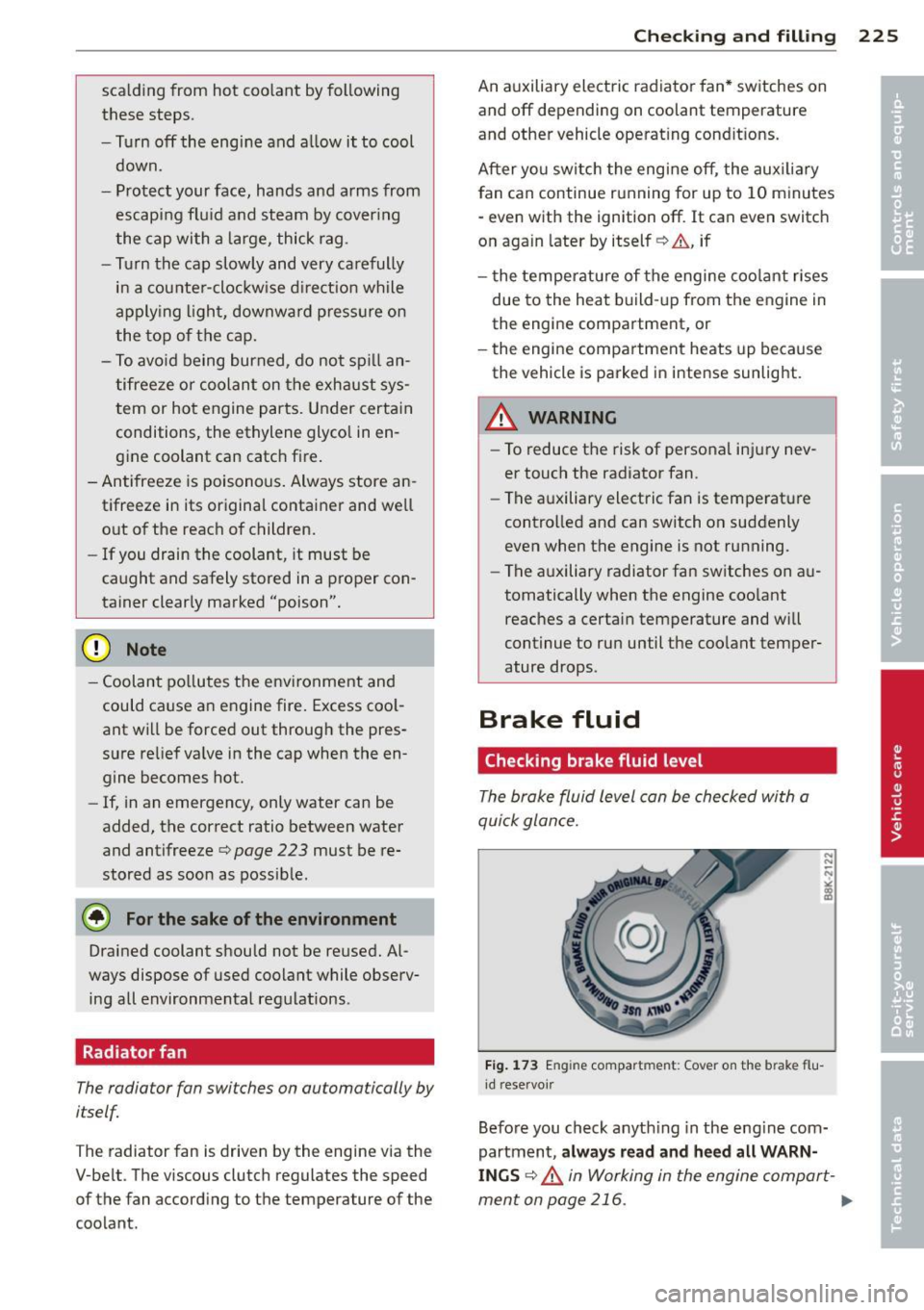
Fig. 17 3 En gin e compar tment: Cover o n the brak e flu
i d reservoi r
Before you check anyth ing in the eng ine com
partment ,
always re ad and heed all WARN
INGS c::> ,& in Working in the engine compar t-
ment on page 216 . .,..
Page 228 of 294
226 Check ing and filling
• Read the brake fluid level from the brake
fluid reservoir ¢
fig. 173, ¢ page 218,
fig . 169.
The brake fluid level must be be
tween the "MIN" and "MAX" markings.
The brake fluid reservoir is located at the rear partition of the engine compartment on the
left side ¢
page 218 .
The fluid level may drop slightly after some
time due to the automatic adjustment of the brake pads . This is not cause for alarm .
I f the brake fluid level falls
considerably be
l ow the "MIN" mark, the brake wa rning/indi
cator light (U .S . mode ls:
1111 , Canadian
models :. ) will come on
¢ page 15. Do not
continue to operate the vehicle. The complete
brake system should be thoroughly checked
by an authorized Audi dealer or qualified
workshop and the cause corrected . If the
brake fluid level is too low, the brake warn ing/
i ndicato r light w ill illuminate . Contact an au
thor ized Audi dealer
imm ediat ely .
@ Tips
The brake f luid reservoir is located under
neath the cove r.
Changing brake fluid
Have the brake fluid changed by an experi
enced technician .
Brake fluid absorbs moisture from the a ir . If
the water content in the brake fluid is too
h igh, corrosion in the brake system may result
after a per iod of t ime . The bo iling po int of the
b rake fluid w ill also decrease considerably and
decrease braking performance.
Therefore, the brake flu id must be changed
ev ery two years. A lways use new brake fluid
which confo rms to Fede ral Motor Vehicle
S tanda rd "FMVSS 116 DO T 4".
The brake flu id reservoir can be difficult to
reach, therefo re , we recommend that you
have the brake fl uid changed by yo ur au tho r
ized
Audi d eale r. Your dea le r has the correct tools, the
right brake flu id and the know -how
to do this for you.
A WARNING
'-
- Brake flu id is poisonous. It must be stor-
ed only in the closed or iginal container
out of the reach of children!
- Brake failure can resu lt from o ld or inap
propriate brake f lu id. Observe these pre
cautions:
- Use only brake f luid that meets SA E
specifi cation
J 1703 and conforms to
Federa l Motor Vehicle Standard 1 16 .
Always check with your authorized Audi
dealer to make sure yo u are using the
correct brake fluid. The correct type of
brake flu id is also ind icated on the
brake f lu id reservoir.
- The brake fluid must be new. Heavy use
of the brakes can cause a vapor lock if
the brake fluid is left i n the system too
long . This can se riously affect the effi
c iency of the brakes as well as your
safety . T his could result in an accident.
W Note
Brake fluid will damage the paint of your
vehicle .
@ For the sake of the environment
Because of the prob lem of proper disposal
of brake fluid as well as the spec ial tools
required and the necessary expertise, we
recommend that you have the brake flu id
changed by your autho rized Aud i deale r.
Battery
General information
Under normal operat ing cond itions, the bat
tery in your Audi does not need any ma inte
nance. With
high outside temperatures or
long da ily drives we recommend that you have
the e lectrolyte leve l che cked by an autho rized
A udi dealer or qualified workshop. The elec
trolyte level should also be checked each time
the battery is charged
¢ page 229. ..,_
Page 258 of 294
256 What do I do now?
@ Tips
-Never use the hexagonal socket in the
handle of the screwdriver to loosen or
tighten the wheel bo lts.
- If a whee l bolt is very tight, you may find
it easier to loosen by carefully pushing
down on the end of the wheel bolt
wrench with
one foot only. As you do so,
hold on to the car to keep your balance
and take care not to slip.
Raising the vehicle
The vehicle must be lifted with the jack first
before the wheel can be removed .
*
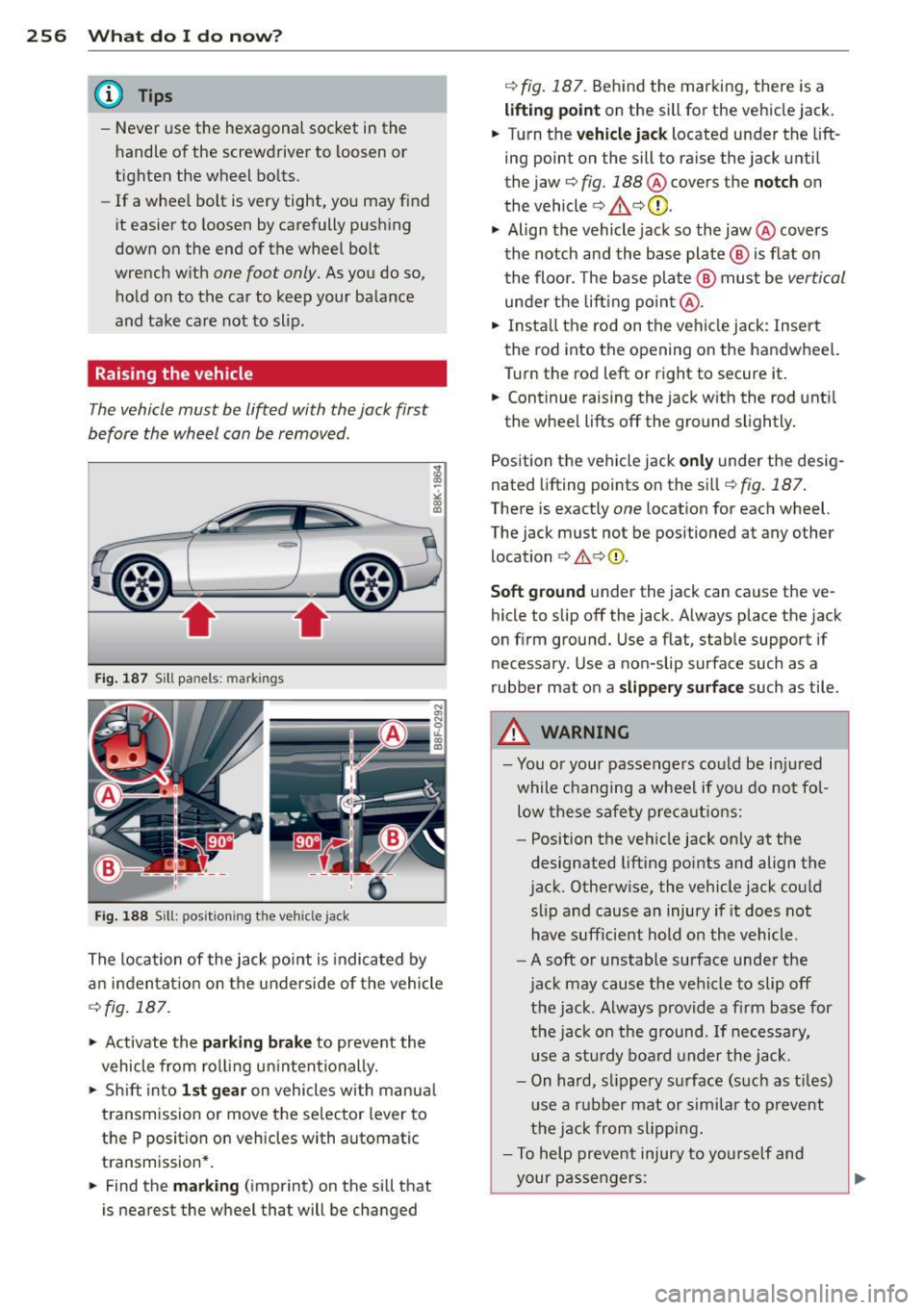
Fig. 187 Sill panels: mark ings
Fi g. 188 Sill : posit ion ing th e vehicle jack
The location of the jack point is indicated by
an indentat io n on the underside of the vehicle
¢fig . 187.
... Activate the parking brake to prevent the
vehicle from rolling unintentionally.
... Shift into
1st gear on vehicles with manua l
transmission or move the selector lever to
the P position on vehicles with automatic
transmission*.
... Find the
marking (imprint) on the sill that
is nearest the wheel that will be changed
¢fig. 187. Behind the marking, there is a
lifting point on the sill for the vehicle jack.
... Turn the
vehicle jack located under the lift
ing point on the sill to raise the jack unti l
the jaw ¢
fig. 1 BB @covers the notch on
the vehicle ¢
.&,¢(D .
... Align the vehicle jack so the jaw @covers
the notch and the base plate ® is flat on
the floor. The base plate
@ must be vertical
under the lifting point @.
... Insta ll the rod on the vehicle jack: Insert
the rod into the opening on the handwheel.
Turn the rod left or right to secure it.
... Continue raising the jack w ith the rod unti l
the wheel lifts off the ground slightly.
Position the vehicle jack
only under the desig
nated lifting points on the sill ¢
fig . 187.
There is exactly one location for each wheel.
The jack must not be positioned at any other location ¢,&. ¢(}).
Soft ground under the jack can cause the ve
hicle to slip off the jack. Always place the jack
on firm ground. Use a flat, stab le support if
necessary . Use a non-slip surface such as a
rubber mat on a
slippery surface such as tile .
&_ WARNING
--You or your passengers could be injured
while changing a wheel if you do not fol
low these safety precautions:
- Position the vehicle jack only at the
designated lifting points and align the
jack. Otherwise, the vehicle jack could
slip and cause an injury if it does not
have sufficient hold on the vehicle.
- A soft or unstable surface under the
jack may cause the vehicle to slip off
the jack . Always provide a f irm base for
the jack on the ground.
If necessary,
us e a sturdy board under the jack.
- On hard, slippery surface (such as til es)
u se a r ubber mat or similar to prevent
the jack from slipping.
- To help prevent injury to yourself and
your passengers:
Page 262 of 294
260 Fuses and bulb s
No.
5 Sound actuator/exhaust sound
tuning
6 Headlight range control sys
tem/cornering light
7
8
Headlight (corner ing light)
Control modules (electrome
chanical parking brake, shock
absorber, quattro sport, trailer
hitch), DCDC converter
9 Adaptive cruise contro l
10 Shift gate
1 1 Side ass ist
Headlight range control, park
ing system
13 Airbag
14 Rear wiper (allroad)
15 Auxiliary fuse (instrument pan
el)
1
16
Auxiliary fuse terminal 15 (en
gine area)
Fu se pane l @ (b row n)
2 Brake light sensor
5
6
7
Left seat heating with/w ithout
seat venti lation
ESC Horn
Front left door (window regula-
8 tor, central locking, mirror, switch, lighting)
9 Wiper motor
10 ESC Two-door models: rear left win
dow regulator, Fo ur-door mod-
11 els: rear left door (window regu lator, central locking, switch,
lighting)
12 Rain and light sensor
F u se p anel© (red )
3
4 Dynamic steer ing
Amps
5/15
5/7,5 7,5
5
5
5
5
5
5
15
10
40
5
25
15/30
5
15
30
30
25
30
-No . Consumer Amps
6
Windshield washer system,
35
headlight washer system
7
Vehicle e lectrical system control
20
module 1
8
Vehicle electrical system control
30
module 1
9 Sunroof 20
10 Vehicle electrical system control
30
module
1
11 Sun shade motor 20
-
12 Anti-theft alarm warning sys-
tern 5
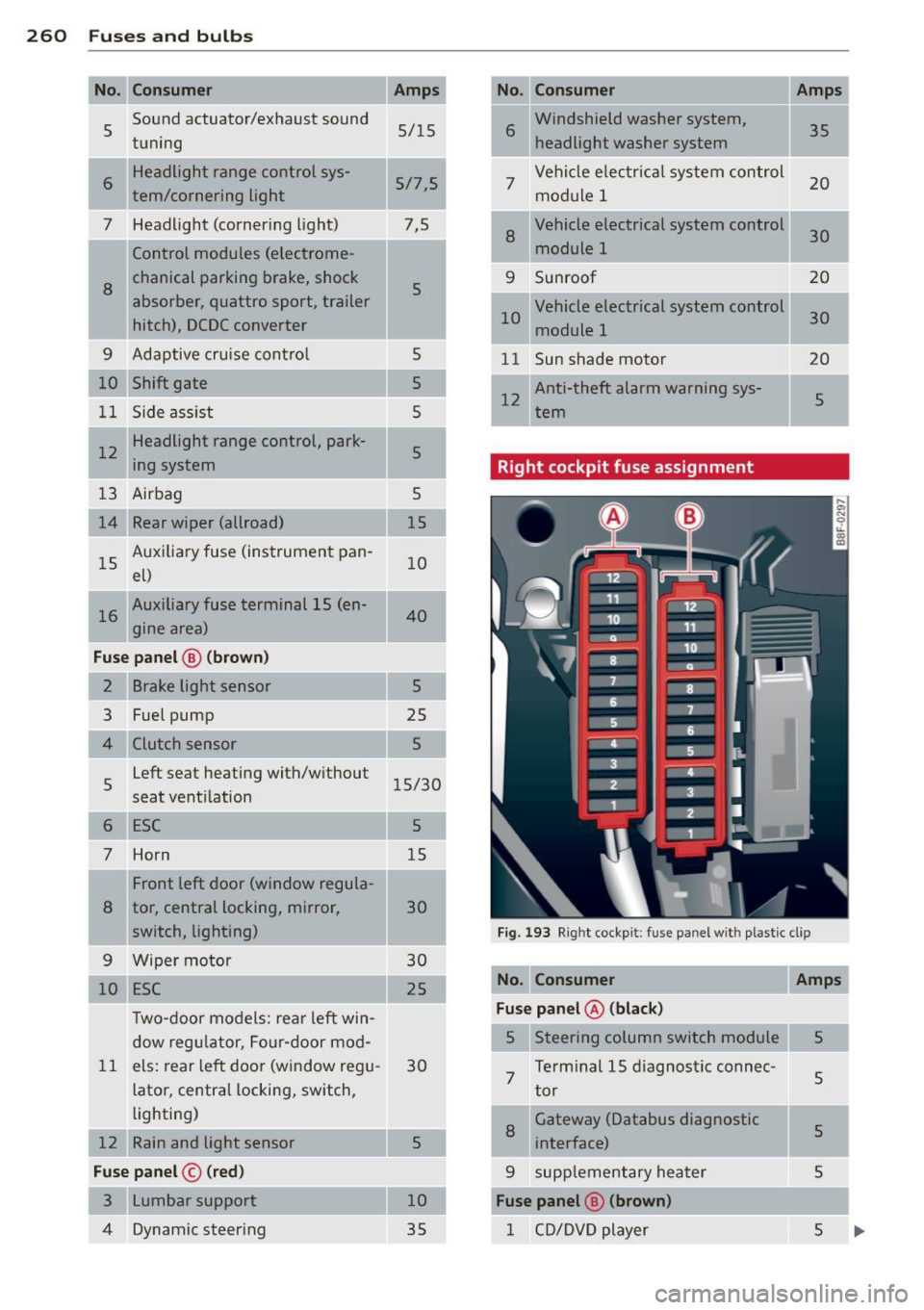
Right cockpit fuse assignment
Fig.
193 Right cockpit : fuse panel wit h plastic cl ip
No. Consume r
Fuse pane l@ (black )
..
5 Steering column switch module
7
8
Terminal 15 diagnostic connec
tor
Gateway (Databus diagnostic interface)
9 supp lementary heater
Fuse pan el@ (bro wn)
1 CD/DVD player
Amp s
5
5
5
5
5
•
I
Page 263 of 294
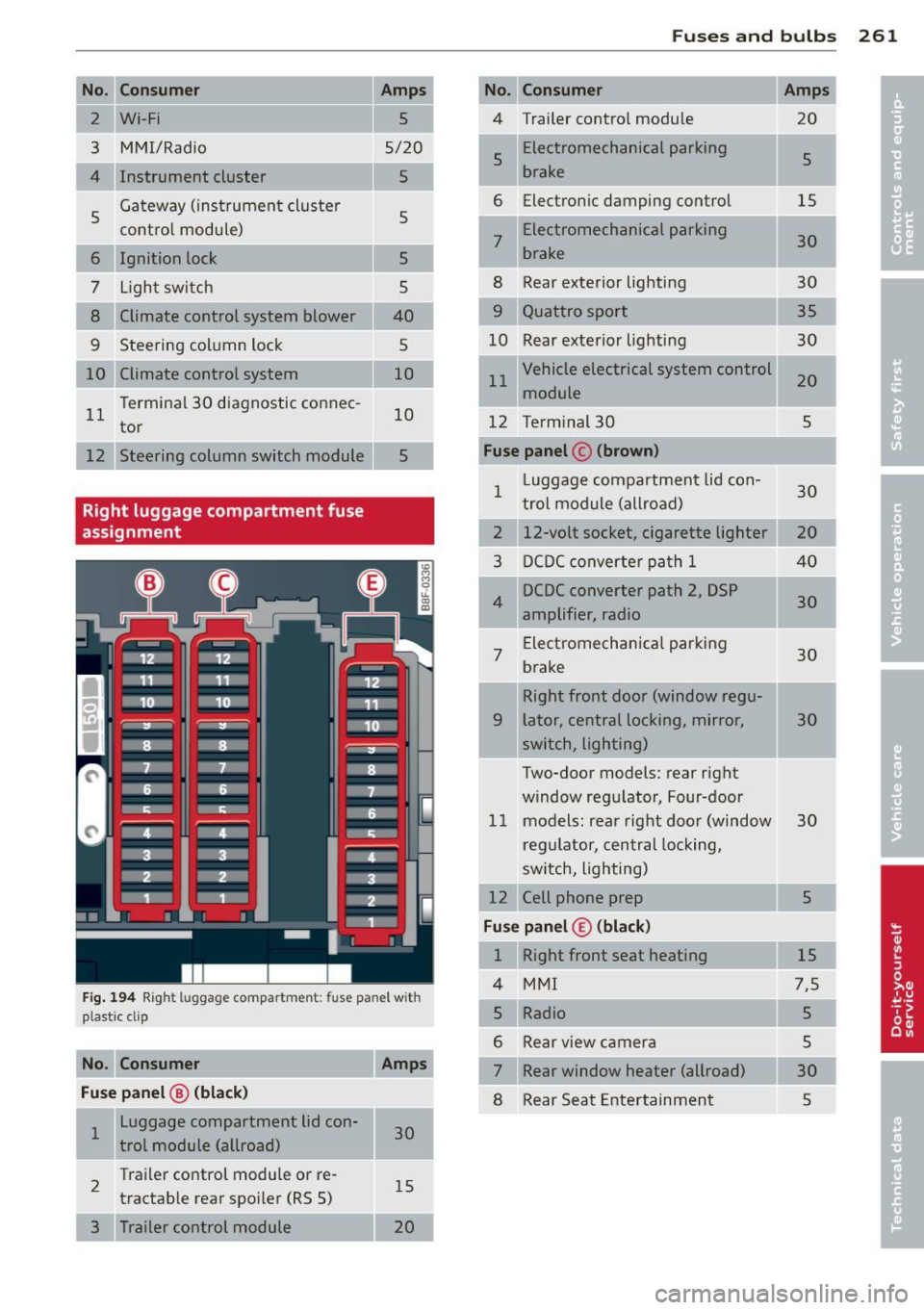
-No. Consumer
2 Wi-Fi
3 MMI/Radio
4 Instrument cluster
Gateway (inst
rument cluster
5 control module)
6 Ignition lock
7 L ight switch
8 Climate control system blower
9 Steering col umn lock
10 Climate control system
11 T
ermina l 30 diagnostic connec-
tor
Steering column switch module
Right luggage compartment fuse
assignment Amps
5
5/20
5
5
5
5
40
5
10
10
5
Fig . 194 Right l uggage compart ment : fuse panel with
plastic d ip
No . Con sumer Amps
Fuse panel @ (black )
1 Luggage compar
tment lid con-
30
trol module (allroad)
2
Trailer control module or re-
15
tractable rear spoiler (RS 5)
3 Tra iler control module 20
Fu se s and bulb s 261
No. Consumer
4 Trailer control module
Electromechanical parking
5 5
brake
6 Electronic damping control
15
Electromechanical parking
7 30
brake
8 Rear exterior lighting 30
9 Quattro sport 35
10 Rear exterior lighting 30
11 Vehicle electrical system control
20
module
12 Te rm inal 30
s
Fuse panel © (brown)
1 L
uggage compartmen t lid con-
30
trol module (all ro ad)
2 12-volt socket, cigarette lighter
20
3 DCDC converte r pa th 1 40
4 DCDC converter path 2, DSP
30
amplifier, radio
7 E
lect romechanical parking
30
b rake
Right front door (window regu-
9 lator, cent ral locking, mir ro r, 30
switch, lighting)
Two-door models: rear right
window regu lator, Four-door
1 1 models : rea r right door (window
30
regulator, central locking,
sw itch, lighting)
Cell phone prep
5
Fu se panel © (black )
1 Right front seat heating
15
4 MMI 7,5
5 Radio
5
6 Rear view c amer a 5
7 Rear window heater (allroad)
30
8 Rear Seat Enter tainmen t 5
Page 266 of 294
264 Emergency situations
@ Tips
The discharged battery must be properly
connected to the vehicle's electrical sys
tem. When jump starting or charging the
battery, never connect the negative
ground cable to the battery negative post
because the batte ry manager system must
be able to detect the battery 's state of
charge. Always connect the negative
ground cab le to the negative ground post
of the battery manager control unit.
Use of jumper cables
Make sure to connect the jumper cable
clamps in exactly the order described below!
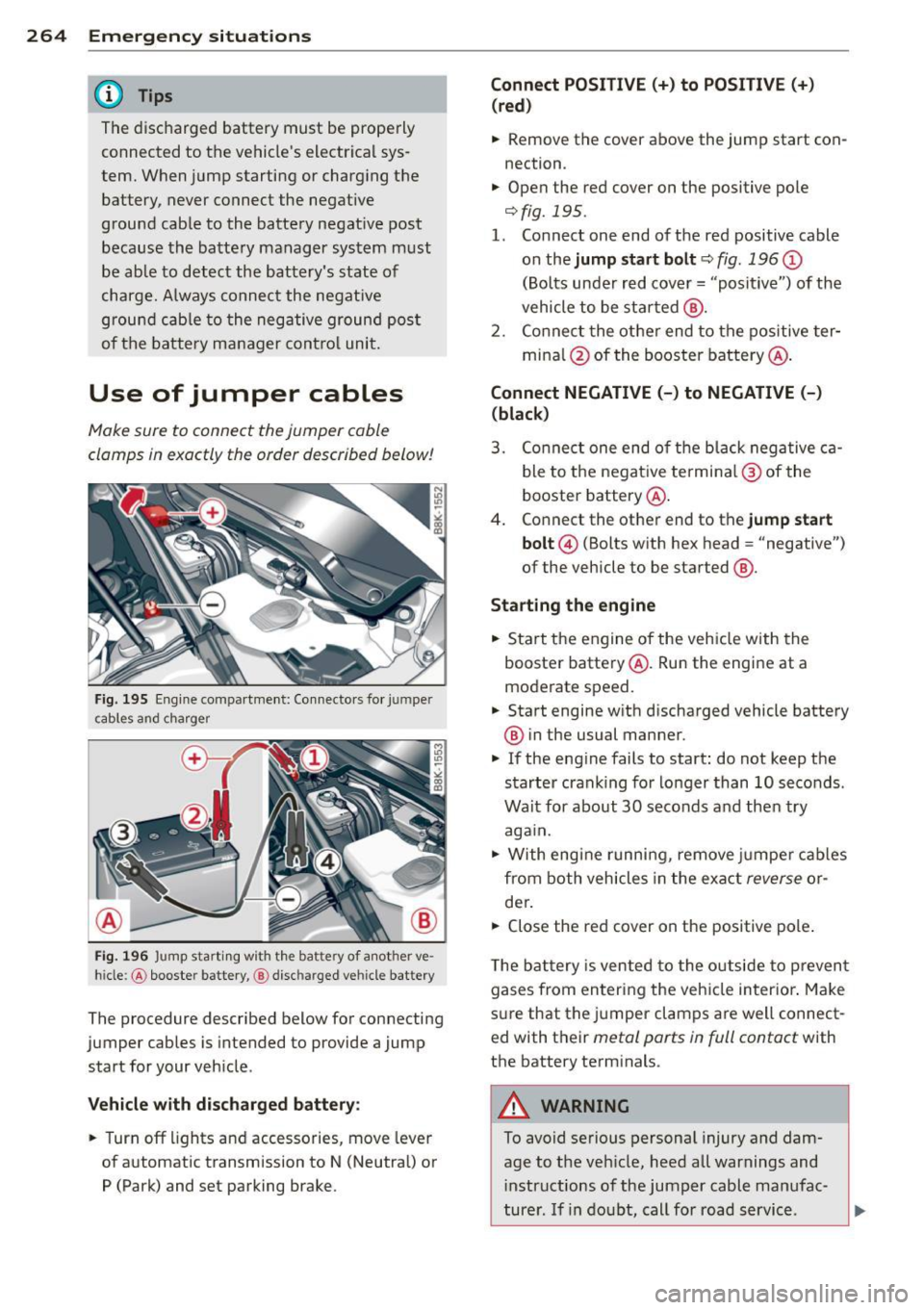
Fig. 195 Engine compartment: Connecto rs fo r jum per
cables and charger
Fig. 196 Jump sta rting wi th the battery of anot her ve ·
h ide :@ booster battery, @ disc harged vehicle battery
The procedure described below for connecting
jumper cables is intended to provide a jump
start for your vehicle .
Vehicle with discharged battery:
.. Turn off lights and accessories, move lever
of automatic transmission to N (Neutral) or
P (Park) and set parking brake .
Connect POSITIVE(+) to POSITIVE(+)
(red)
.. Remove the cover above the jump start con
nection .
.. Open the red
cover on the positive pole
¢fig. 195.
1. Connect one end of the red positive cable
on the
jump start bolt c::> fig. 196 @
(Bolts under red cover= "positive") of the
vehicle to be started @.
2. Connect the other end to the positive ter-
mina l@ of the booster battery@.
Connect NEGATIVE (-) to NEGATIVE (-)
(black)
3. Connect one end of the b lack negative ca
ble to the negative terminal @of the
booster battery @.
4. Connect the other end to the
jump start
bolt @
(Bolts with hex head= "negative")
of the vehicle to be started ®·
Starting the engine
.. Sta rt the engine of the vehicle with the
booster battery@. Run the engine at a
moderate speed.
.. Start engine with discharged vehicle battery
® in the usual manner .
.. If the eng ine fails to start: do not keep the
starter cranking for longer than 10 seconds .
Wait for about 30 seconds and then try
again .
.. With engine running, remove jumper cables
from both vehicles in the exact
reverse or
der .
.. Close the red
cover on the positive pole .
T he battery is vented to the outside to prevent
gases from entering the vehicle interior . Make
sure that the jumper clamps are well connect
ed with their
metal parts in full contact with
the battery terminals.
A WARNING
--
To avoid serious personal injury and dam
age to the veh icle, heed all warnings and
i nstructions of the jumper cable manufac-
turer . If in doubt, call for road service . ..,.