ignition AUDI A5 COUPE 2013 Workshop Manual
[x] Cancel search | Manufacturer: AUDI, Model Year: 2013, Model line: A5 COUPE, Model: AUDI A5 COUPE 2013Pages: 294, PDF Size: 73.84 MB
Page 122 of 294
120 Homelink® Programming the transmitter (version
A)
Applies to vehicles: with Homelink
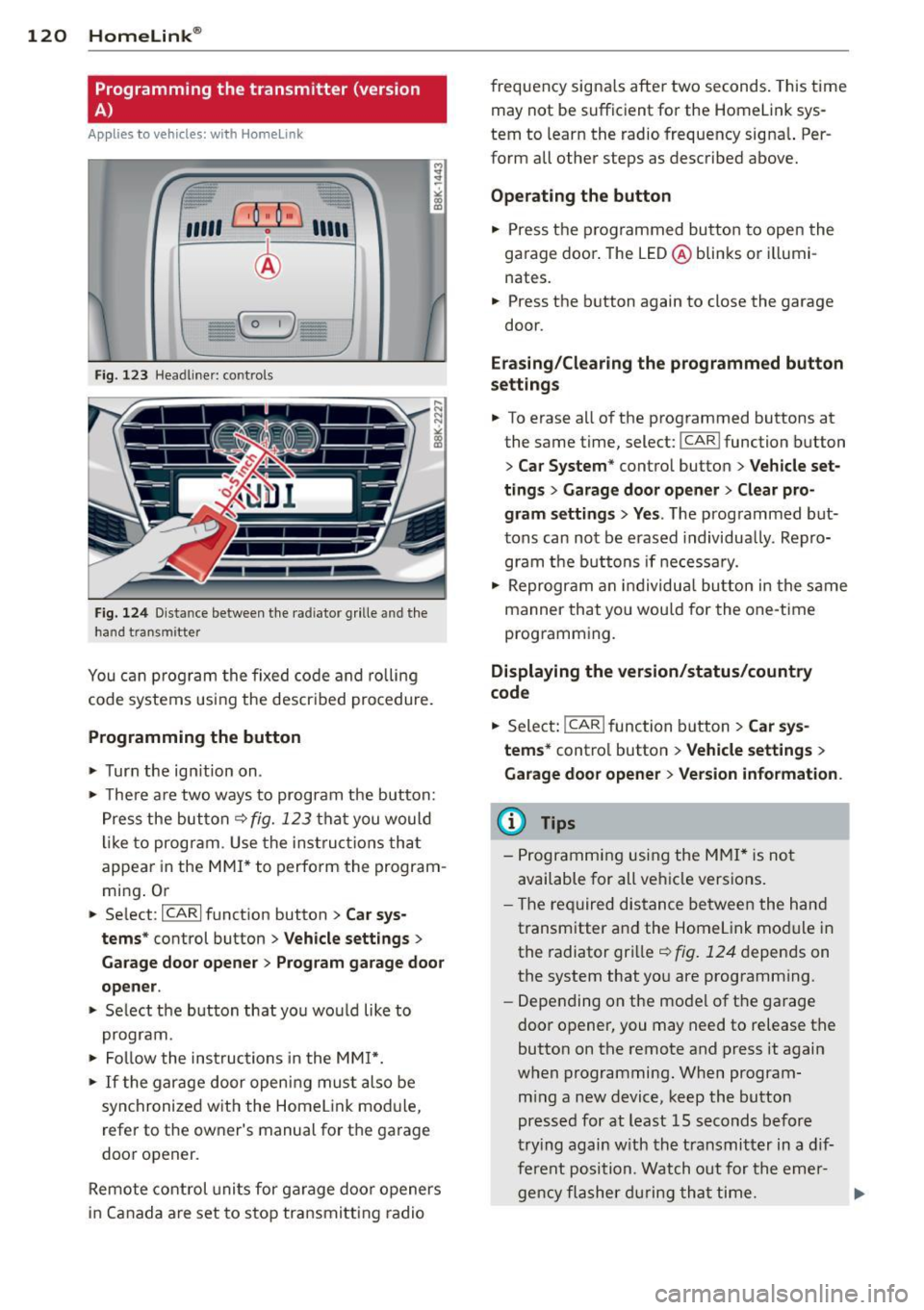
Fig. 123 Head line r: controls
Fig. 124 Dista nce between the radiator grille and the
hand transm itter
You can program the fixed code and rolling
code systems using the described procedure.
Programming the button
.,. Turn the ignition on .
.,. There are two ways to program the button:
Press the button
q fig. 123 that you would
like to program . Use the instructions that
appear in the MMI* to perform the program
ming. Or
.,. Select :
~IC~A~R~I function button > Car sys
tems*
control button > Vehicle settings>
Garage door opener> Program garage door
opener .
.,. Select the button that you would like to
program.
.,. Follow the instructions in the
MMI*.
.,. If the garage door opening must also be
synchronized with the Homelink module,
refer to the owner's manual for the garage
door opener.
Remote control units for garage door openers
in Canada are set to stop transmitting radio frequency
signals after two seconds. This time
may not be sufficient for the Homelink sys
tem to learn the radio frequency signal. Per
form all other steps as described above.
Operating the button
.,. Press the programmed button to open the
garage door. The LED@blinks or illumi
nates .
.,. Press the button again to close the garage
door.
Erasing/Clearing the programmed button
settings
.,. To erase all of the programmed buttons at
the same time, select:
I CAR ! function button
> Car System* control button > Vehicle set·
tings
> Garage door opener> Clear pro
gram settings> Yes .
The programmed but
tons can not be erased individually. Repro
gram the buttons if necessary .
.,. Reprogram an individual button in the same
manner that you would for the one-time
programming .
Displaying the version/status/country
code
.,. Select: !CAR ! function button> Car sys
tems*
control button > Vehicle settings >
Garage door opener > Version information .
@ Tips
- Programming using the MMI* is not
available for all vehicle versions.
- The required distance between the hand
transmitter and the Homelink module in
the radiator grille
q fig. 124 depends on
the system that you are programming .
- Depending on the model of the garage
door opener, you may need to release the
button on the remote and press it again
when programming. When program
ming a new device, keep the button
pressed for at least 15 seconds before
trying again with the transmitter in a dif
ferent position . Watch out for the emer-
gency flasher during that time. .,..
Page 123 of 294
-For security reasons, we recommend that
you clear the programmed buttons be
fore se lling the vehicle .
Programming the transmitter (version
B)
Applies to vehicles: with Home Link
,,,,, r ,o :O·,) ,,;;~
®
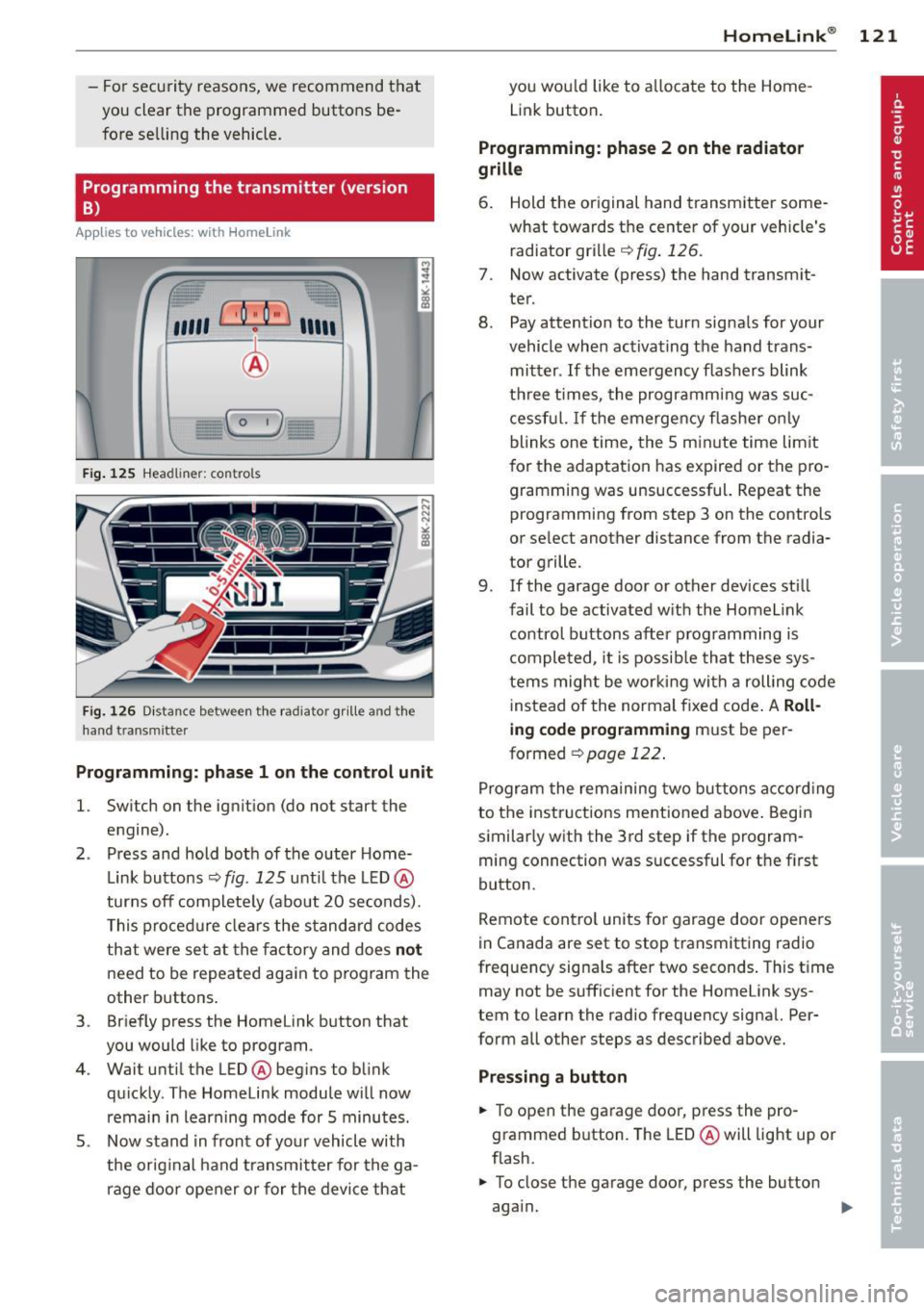
Fig. 125 Hea dli ner: c o n tro ls
Fig. 126 Dis ta n ce betw een th e radiato r gri lle a nd the
hand t rans mitte r
Programming: phase 1 on the control unit
l. Switch on the ignition (do not start the
engine) .
2 . Press and hold both of the outer Home
Link buttons ¢
fig. 125 unti l the LED @
turns off completely (about 20 seconds).
This procedure clears the standard codes
that were set at the factory and does
not
need to be repeated again to program the
other buttons .
3 . Briefly press the Homelink button that
you would like to program .
4. Wait until the LED @beg ins to blink
quickly . The Homelink module will now
remain in learning mode for 5 minutes.
5 . Now stand in front of your vehicle with
the original hand transmitter for the ga
rage door opener or for the device that
Homelink ® 121
you wou ld like to allocate to the Home
Link button .
Programming: phase 2 on the radiator
grille
6. Hold the or iginal hand transmitter some
what towards the center of your vehicle's radiator grille ¢
fig. 126.
7. Now activate (press) the hand transm it
ter.
8. Pay attention to the turn sig nals for your
vehicle when activating the hand trans
mitter .
If the emergency flashers blink
three times, the programm ing was suc
cessful. If the emergency flasher only
blinks one time, the 5 minute time lim it
for the adaptation has expired or the pro
gramming was unsuccessful. Repeat the
programming from step 3 on the controls
or se lect another distance from the radia
tor grille.
9. If the garage door or other devices still
fail to be activated with the Homelink control buttons after programming is
completed, it is possible that these sys
tems might be working with a roll ing code
instead of the normal fixed code . A
Roll
ing code programming must be per
formed
¢ page 122 .
Program the remaining two buttons according
to the instructions ment ioned above . Begin
similarly with the 3rd step if the program
ming connection was successful for the f irst
button .
Remote contro l units for garage door openers
in Canada are set to stop transmitting radio
frequency signa ls after two seconds . This time
may not be sufficient for the Homelink sys
tem to learn the radio frequency sign al. Per
form all other steps as described above.
Pressing a button
.,. To open the garage door, press the pro
grammed b utton. The LED @ will light up or
flash .
.,. To close the garage door, press the button
aga in.
Page 124 of 294
122 Homelink®
Erasing the button s
.. Switch on the igni tion (do not start the en
gine) .
.. Press and ho ld both of the o uter buttons
until the LED @ turns off complete ly (about
20 seconds) to erase all of the buttons si
multaneously .
.. Programmed buttons cannot be erased indi
vidually . Reprogram the buttons if necessa
ry.
Reprog ramming the button s
.. Switch on the ignition (do not start the en
gine).
.. To reprogram an ind ividual button, press
and hold the des ired button unt il the L ED @
begins to blink (about 10 seconds) . Re lease
the button .
.. Wait until the L ED@ begins to blink quic k
ly . T he Homelink module will now remain in
l earning mode for 5 minutes .
.. Cont in u e with step 5 .
(D Tips
-The requ ired distance between the hand
transmitter and the Homelin k module in
the radiator grille¢
fig. 126 depends on
the system that you are programming.
- Depending on the mode l of the garage
door opener, you may need to release the
button on the remote and press it again
when programming. When program ming a new dev ice, keep the button
pressed for at least 15 seco nds befo re
trying again with the transmitte r in a dif
ferent pos it ion. Watch out fo r the emer
gency flasher duri ng t hat time.
- Fo r secu rity reaso ns, we recommend that
you clear the programmed but tons be
fore se lling the vehicle.
Programming the rolling code
Applies to veh icles: w ith Homelink
Additionally, a rolling code programming for
the Homelink universal remote control is re
quired for some systems .
Identifying the rolling code
.. Press the previously programmed HomeLink
button again and hold it down .
.. Look at the LED@¢
page 121, fig . 125 . If
the L ED blinks q uickly, the feat ures, such as
the garage door opene r, a re eq uipped w ith
t he rol ling code.
.. Program the rolling code as follows:
Activating the garage door opener motor
unit
.. Locate the setting but ton on the garage
door opene r motor un it. The exac t loca tion
and colo r of the bu tton may vary depending
on the garage door opener manufacturer .
.. Press the setting button on the garage door
opener motor unit ( usua lly this will activate
a "setting light display" on the motor unit).
Now you will have about
3 0 seconds time to
pe rform the Homelink button programm ing
on the controls .
Programming on the controls
.. Quickly press the p rev iously programmed
Homelink b utton .
.. Press the Home link button once more to
end the roll ing code programm ing .
After the controls have been programmed, the garage door opener s hou ld recognize the
Homelink signa l and operate when the Home
Li nk button is pressed. Now you may program
the other buttons as needed .
(D Tips
-Programming the rolling code can be
performed quicke r and more easily with
th e help of a second person. The Home
Li nk button may need to be pressed a
t hird t ime to en d the adjus tment pro ce
dure for some garage door openers.
Page 146 of 294
144 Airbag sys tem
Even tho ugh your vehicle is equip ped with an
Advanced Airbag System , make certain that
a ll c hildren, especially those 12 years and
younge r, a lways ride in the back seat properly
restra ined for their age and size. The airbag
on the passenger side makes the front seat a potentially dangerous place for a ch ild to r ide.
The front seat is not the safest place for a
child in a fo rward-facing ch ild safety seat. It
can be a very dangerous place for a n infant or
a child in a rea rward-facing seat.
The Advanced Airbag System i n your veh icle
has been certified to comp ly with the Requ ire
men ts of Uni ted Sta tes Federa l Mo tor Veh icle
Safety Standard 208 as applicable at the time
your veh icle was manufactured.
The Standard requires the front a irbag on t he
passenger side to be turned off ("sup
pressed") if a ch ild up to about one year of
age restrained in one of the rear -facing o r for
ward -facing infant restraints listed i n Federal
Motor Vehicle Safety Standard 208 with which
the Advanced A irbag System in your vehicle
was certified has been installed o n the front
passenger seat . For a listing of the child re
strai nts t hat we re used to certify compliance
with the US Safety Standard
r=v page 168.
The PASSENGER AIR BAG OFF light in the in
strument panel te lls you when the front Ad
vanced A irbag on the passenger side has been
turned off by the e lectronic control unit.
Each t ime you turn on the ignition, the
PAS
SENGER AIR BA G OFF
light will come on for a
few seconds a nd:
- will stay on if the front passenger seat is not
occupied,
- wi ll stay on if there is a small child or child
restraint on the front passenger seat,
- wi ll go off if the front passenger seat is oc
cupied by an adult as registered by the
weight-sensing mat
r=v page 153, Monitor
ing the Advanced Airbag System .
The PASSENGER AIR BAG OFF light comes on
when the control un it detects a total weight
on the front passenger seat that requ ires the
fro nt airbag to be turned off.
If the total weight on the front passenge r
seat is more than that of a typica l 1 year -old
c hil d but less than the weight o f a small
adult, the front airbag on the passenger side
can deploy (the
PASSENGER AIR BAG OFF
li ght does not come on). If the PASSENGER
AIR BAG OFF
light does not come on , the
front a irbag on the passeng er side has not
been turned off by the elec troni c con trol unit
and can deploy if the control uni t se nses an
impact that meets the cond itions stored in its
memo ry .
For example, the airbag may deploy if:
- a small ch ild that is heav ier t han a typical 1
year-old ch ild is on the front passenger seat
( r egard less of whethe r the child is i n one of
t he child safety seats listed
r=v page 168), or
- a child who has outgrown ch ild restraints is
on t he front passenge r seat.
If the front passenger airbag is turned off, the
PASSENGER AIR BAG OFF light comes on in
the instr ument cluster and stays on.
The front airbag on the passenger s ide may
not deploy (the PASSENGER AIR BAG OFF
li gh t does not illum inate and stay lit) even if a
small adult o r teenager, or a passenger who is
not sitt ing up rig ht w ith their back against a
non- recl ined ba ck res t w it h thei r feet on the
vehicle f loor i n front of the sea t is on the front
passenger seat
r=v page 125 , Proper seating
position for the driver.
If t he fron t passenger a irbag dep loys, the
F ede ra l Standard req uires the airbag to meet
t h e "low risk" dep loyment criteria to red uce
t h e risk of injury t hrough interactio n wit h the
airbag. "Low risk" dep loyment occ urs in those
crashes that take place at lower dece lerat ions
as defined in the electronic control unit
r=v page 153, PASSENGER AIR BAG OFF light .
Always remember, a child safety seat or infant
carr ier installed on the front seat may be
struck and knocked out of posit ion by the rap
idly inflat ing passenger 's airbag in a fronta l
collision . T he a irbag could great ly reduce the
effectiveness of the ch ild restra int and even
seriously injure t he ch ild dur ing inflation .
Page 147 of 294
For this reason, and because the back seat is
the safest place for children - when properly restrained according to their age and size - we
strongly recommend that children always sit in the back seat
Q page 166, Child Safety.
A WARNING
-
A child in a rearward-facing child safety
seat installed on the front passenger seat
w ill be seriously injured and can be k illed if
the front a irbag inflates - even with an Ad
vanced Airbag System.
- T he inflating a irbag w ill hit the child
safety seat or infant carrier w ith great
force and w ill smash the ch ild safety sea t
and child against the backrest, cente r
armrest, door or roof .
- Always install rear -facing child safety
seats on the rear seat.
- If you mus t inst all a rearward facing
child safety seat on the front passenger
seat beca use of exceptional circumstan
ces and the
PASSENGER AIR BAG OFF
light does not come on and stay on , im
med iately install the rear-facing child
safety seat in a rear seating posit ion and
have the a irbag system inspected by your
authorized Aud i dealer .
- Forward-fac ing ch ild safety seats instal
led on the front passenger's seat may in
terfe re with the deployment of the air
bag and cause se rious personal injury to
the ch ild.
A WARNING
If, in exceptional c irc umstances, you mus t
install a forwa rd-facing child restra int on
the front passenger's seat:
- Alw ays make sure the forw ard -fac ing
sea t has been des igned and certified by
its manufacturer for use on a front seat
with a passenger front and side airbag.
- Never put the forward -facing child re
straint up aga inst or very near the instru
ment pane l.
- Always move the passenger seat into its
rearmost position in the seat's fore and
A irbag system 145
aft ad justment range, as far away from
the airbag as possible before installing
the forward-fac ing ch ild restraint. The
backrest must be adj usted to an upright
position .
- Make sure that the
PASSENGER AIR BAG
OFF
li ght comes on and stays on all the
time wheneve r the ignit ion is switched
on.
A WARNING
T o reduce the risk of ser ious injury, make
su re that the
PASSENGER AIR BAG OFF
light w ill be displayed whenever a child re
straint is installed on the front passenger
seat and the ignition is switched on.
- If the
PASSENGER AIR BAG OFF light
does not s tay on, per form the checks de
scribed
Q page 153, Monitoring the Ad
vanced Airbag System.
- Take the chi ld restraint off the front pas
senger seat and install it properly at one
of the rear seat positions if the
PASSEN
GER AIR BAG Off light does not stay on.
- Have the airbag system inspected by
your author ized Audi dealer immed iate
ly .
-Always carefu lly follow instr uctions from
child restraint manufacturers when in
stall ing ch ild restra ints .
A WARNING
If, in except iona l circumstances, you must
install a forward or rearward-facing child
restra int on the front passenger's seat :
- Improper instal lation of ch ild restraints
can reduce their effectiveness o r even
prevent them from providing any protec
tion.
- An improper ly installed ch ild restra int
can interfere with the airbag as it de
ploys and seriously i njure o r even kill the
child -even with an Advanced Airbag
System.
- Always carefu lly follow the manufact ur
er 's ins tructions p rov ided with the ch ild
safety seat or carrier . •
•
Page 151 of 294
-Always move the passenger seat into its
rearmost position in the seat's fore and
aft adjustment range, as far away from
the a irbag as poss ible, before installing
the forward-facing child restraint. The backrest must be adjusted to an upr ight
posit ion.
- Make sure that the
PASSENGER AIR BAG
OFF
light comes on and stays on all the
t ime w henever the ignition is sw itched
on.
Advanced Airbag System components
The fron t passenger seat in your vehicle has a
lot of very important parts of the Advanced
Airbag System in it. These parts include the
weight-sensing mat, sensors, wiring, brack
ets, and more. The function of the system in
the front passenger seat is checked by the
e lectronic control u nit when the ignit ion is on .
The control un it mon itors the Advanced Air
bag System and turns the airbag indicator
l ight on whe n a ma lfunction in t he sys tem
components is de tected. The function of the
airbag indicator light is described in greater
detai l below . Because the front passenger
seat contains important parts of the Ad
vanced A irbag System, you m ust take care to
prevent it from being damaged. Damage to
the seat may prevent the Advanced Airbag for
the front passenger seat from doing its job in
a crash .
The front Advanced Airb ag Sy stem
consists of the following:
- Crash sensors in the front of the veh icle that
measure veh icle acceleration/decele ration
to provide information to the Advanced Air
bag System about the seve rity of the crash.
- An electronic co ntrol unit, with integrated
c rash se nsors for front and side impacts .
T he cont ro l unit " decides " whethe r to fire
the front airbags based on the inform ation
received from the crash senso rs . The contro l
unit a lso "decides" whether the safety belt
pretensioners should be activated .
Airbag system 149
-An Advanced A irbag w ith gas gene rator and
contro l valve fo r the driver ins ide the steer
ing wheel h ub.
- An Advanced Airbag w ith gas gene rator and
contro l valve inside the instrument pane l for
the front passenger.
- A weight-sensing mat under the upholstery
padding of the front passenger seat cushion
that measures the total weight on the seat.
The informat ion reg istered is sent continu
ously to the electronic control unit to regu
late deployment of the front Advanced Air
bag on the passenger side.
- An airbag monitor ing system and ind icator
light in the instrument cluster
q page 153 .
-A sensor in each front seat registers the dis
tance between the respective seat and the
steer ing whee l o r inst rument panel. The in
forma tion registered is sent cont inuo usly to
t he elect ron ic cont ro l uni t to regula te de
ployment o f the front Advance d Airbags .
- The
PASSENGER AIR BAG OFF ligh t comes
on and st ays on in the cen ter o f th e instr u
ment panel
<:!;> page 153, fig . 143 and tells
you whe n the front Advanced Airbag on the
passenger side has been tu rned
off .
-A sensor below the safety be lt latch fo r the
front seat passenger to measure the tension on the safety be lt . The tension on the safety
be lt and the weight registered by the
weight-sensi ng mat he lp the control unit
"decide" whether the front a irbag for the
front passenge r seat should be turned
off or
not
r:!;> pag e 143, Child restraints on the
front seat -some important things to
know.
- A senso r in the safety belt latch fo r the d riv
er a nd fo r the fro nt sea t passenger tha t
senses w hethe r that safe ty belt is latched or
no t and transmi ts this informa tion to the
electronic control unit.
_&. WARNING
Damage to the front passenger seat can
prevent the front airbag from work ing
properly.
-
•
•
Page 153 of 294
BAG OFF light comes on and stays on to tell
you when the front Advanced Airbag on the
passenger side has been turned
off
c:> page 143, Child restraints on the front seat
- some important things to know.
A WARNING
To reduce the risk of injury whe n an airbag
inflates, always wear safety belts properly .
- If you are unrestrained, lean ing forward,
sitting sideways or out of position in any
way, yo ur risk of injury is much highe r.
- You w ill also receive serious injuries and
could even be killed if you are up against
the a irbag or too close to it when it in·
flates · even with an Advanced Airbag
c:>page 142.
More important things to know about
front airbags
Fi g. 1 42 Inflated front a irbags
Safety belts are important to help keep front
seat occupants in the proper sea ted pos ition
so that airbags c an u nfo ld properly and pro
vide supp lemental protection in a fronta l co l
lision.
The front a irbags are designed to provide ad
d itiona l protection for the chest and face of
the dr iver and the front seat passenge r when:
- safety belts are worn properly,
- the seats have been posit io ned so that the
occupant is p roperly seated as far as possi
ble from the a irbag,
- and the head restraints have been properly
adjusted.
Because airbags inflate in the blink of an eye
with great force, things you have on your lap
A irba g sy stem 151
or have p laced on the seat co uld become dan
gerous projectiles, and be p ushed into you if
the a irbag inf lates.
When an airbag deploys, fine dust is re leased.
T his is norma l and is not caused by a fi re in
the ve hicle . This dust is made up mostly of a
powder used to lubricate the airbags as they
deploy. It could irr itate skin .
It is important to remembe r that wh ile the
supplementa l airbag system is designed to re
duce the like lihood of serious injur ies, other
injuries, for example swelling, bruis ing and
minor abrasions, can also happen when air
bags inflate . A irbags do not protect the arms
o r the lower parts of the body. Front a irbags
on ly supp lement the three point safety belts
in some fronta l co llisions in which the vehicle
decelera tion is high e no ugh to deploy the air
bags .
Front airbags will not deploy :
-if the ignition is sw itched off when a crash
occu rs,
- in side collisions,
- in rear-end collisions,
- in rollovers,
- when the crash deceleration measured by
the airbag system is less than the minimum
threshold needed for a irbag deployment as
reg istered by the electronic control unit .
The front pa sse n ger ai rbag will also not
deplo y:
- when the front passenger seat is not occu
pied,
- when the weight on the front passenger seat as sensed by the Advanced Airbag Sys·
tern ind icates that the front airbag on the
passe nger side has to be turned off by the
electronic control unit (the
PAS SENGER A IR
BAG OFF
light comes on and stays on) .
A WARNING
Sitting in the wrong position can increase
the r is k of se rious inj ury in crashes.
- To reduce the risk of injury when the air
bags inflate, the drive r and passenge rs
Page 155 of 294
Monitoring the
Advanced Airbag
System
Airbag monitoring indicator light
Two separate indicators monitor the function
of the Advanced Airbag System: the airbag
monitoring indicator light and the
PAS SEN
GER AIR B AG OFF
light.
The Advanced Airbag System (including the
e lectronic control unit, sensor circuits and sys
tem wiring) is monitored continuously to
make sure that it is functioning properly
whenever the ignit ion is on . Each t ime you
turn on the ignition, the
I airbag monitoring
i ndicator light w ill come o n for a few seconds
(self diagnostics) .
The system mu st be in spected when the
I indicator l ight:
- does not come on when the ignit ion is
switched on,
- does not go out a few seconds after yo u
have switched on the ignition, o r
- comes on while d riving .
If an airbag system malfunction is detected,
the indicator light will first start flashing to
catch the driver's attention and then stay on
continuously to serve as a constant reminder
to have the system inspected immediately.
If a malfunction occurs that turns the front
a irbag on the passenger side off, the
PASSEN
GER AIR BAG OFF
li ght will come on and stay
on whenever the ignition is on.
_& WARNING
An airbag system that is not funct ioning
properly cannot provide supp lemen tal p ro
tection in a frontal crash .
-If the airbag indicator l ight c::> page 20
comes whe n the vehicle is be ing used,
have the system inspected immediately
by yo ur authorized Audi dea ler .
It is pos
sible that the airbag will inflate when it
is not supposed to, or w ill not inflate
when it should.
-
A irba g sy stem 153
PASSENGER AIR BAG OFF light
Fig. 143 Sect io n fro m the instrume nt panel: PASSEN
GER AIR BAG OFF light
The PAS SENGER AIR BAG OFF light is located
in the center of the inst rument pa ne l
¢ fig. 143 .
The PAS SENG ER AIR BAG OFF light w ill come
on and stay on to tell you when the front Ad
vanced Airbag on the passenger s ide has been
tu rned off by the electronic cont rol unit. Each
time you turn on th e ignit ion, the
PAS SEN
GER AIR BAG OFF
light will flash for a few
seconds and:
- wi ll stay on if t he front passenge r seat is not
occup ied,
- w il l stay on i f there is a small c hild or child
restraint on the front passenger seat,
- w ill go out if the front passenger sea t is oc
cupied by an adult as registered by the
we ight -sensing mat .
T he
PAS SENGER AIR BAG OFF light mu st
com e on and sta y o n
if the igni tion is on and
- a car bed has been installed on the front
seat, or
- a rearward -facing child restraint has been
installed o n the front passenger seat, o r
- a forward-fac ing child restraint has been in
stalled on the front passenger seat , or
- the weight registered on the front passen
ger seat is equal to or less than the com
bined weight of a typical 1 year-old restra in
ed in one of the rear-facing or forwa rd-fac
ing infan t restra ints listed i n Federal Motor
Ve hicle Safety Standard 208 wi th which the
Advanced A irbag System in you r vehicle was
cert ified.
111-
Page 156 of 294
154 Airbag sys te m
If the front passenger seat is not occupied,
the front airbag will not deploy, and the
PAS
SENGER AIR BAG OF F
light wi ll stay on. Nev
er install a rearward-fac ing ch ild restra int on
the front passenger seat, the safest place fo r
a child in any kind of child restraint is at one
of the seat ing positions on the rear seat
¢ page 143, Child restraints on the front seat
- some important things to know
and
¢ page 166, Child Safety.
If th e PASSEN GER AI R BAG OFF light c ome s
on
when one of the conditions listed above is
met, be sure to check the light regular ly to
make certa in that the
PAS SENGER AIR BA G
O FF
light stays on cont inuous ly whenever the
ignition is on. If the
PASSENGER AIR BAG
OFF
li ght does not appear and not stay on all
the time, stop as soon as it is safe to do so
and
- reactivate the system by turning the ignition off and then turning it on again;
- remove and re install the child restraint.
Make sure that the child restraint is properly
installed and that the safety belt for the
front passenger seat has been correctly routed around the child restraint as descr i
bed in the child restraint manufacturer's i n
structions;
- make sure that the convertible locking fea
ture on the safety belt for the front passen
ger seat has been activated and that the
safety belt has been pulled tight. The belt
must not be loose o r have loops of slack so
that the senso r below the safety be lt latch
on the seat can do its job
¢ page 176 .
-make su re that th ings that may increase the
weight of the ch ild and child safety seat are
not being transpo rted on the front passen
ger seat;
- make su re that the safety belt tension sen
sor is not b locked. Shake the safety be lt
l atch on the front passenger seat back and
forth;
- If a strap or tether is being used to tie the
child safety seat to the front passenger
seat, make sure that it is not so tight that it causes the weight
-sensing mat to measure
more weight than is act ually on the seat.
If th e PASSENGER AIR BAG OFF lig ht still
does not come on
and does not s tay on con
t in uous ly (when the ignition is switched on) ,
- take the child restraint off the front passen-
ge r seat and install it properly at one of the
rea r seat posi tions. H ave the airbag system
inspected by yo ur authorized Audi dealer
immediate ly .
- move the child to a rear seat position and
make sure t hat the c hild is properly restrain
ed in a c hild restraint that is appropriate for
its size and age.
T he
PAS SENGER AIR BAG OFF light should
NOT come on when t he ignition is on and an
adult is sitting in a proper seating position on
the front passenger seat. If the
PA SSENGER
AIR BAG OFF
light comes on and stays on or
flashes for about 5 seconds wh ile driving, un
der these c ircumstances, make sure that:
- the adult on the front passenger seat is properly seated on the center of the seat
cushion with his or her back up aga inst the
backrest and the backrest is not recl ined
¢ page 125, Proper occupant seating posi
tions,
- the adult is not tak ing weight off the seat by
holding on to the passenger assist handle
above the front passenger door or support
ing their weight on the armrest,
- the safety belt is being properly wo rn and
t ha t the re is no t a lot of s lack in the safety
be lt webb ing ,
- accesso ry seat covers or cushions or other
t hings tha t may cause an incorrect reading
or impression on the weight-sensing mat
under the upho lstery of the seat have been
removed from the front passenger seat,
- a safety belt extender has not been left in
the safety belt latch for the front passenger
seat.
In add ition to the
PASSENGER AIR BAG OFF
light in the center o f the instrument panel,
t h e message
PASSENGER AIR BAG OFF or
PASSENGER AIR BAG ON wi ll briefly appear ..,.
Page 165 of 294
The side curtain airbags are located on both
sides of the interior above the front and rear
side windows ¢
fig. 148. They are ident ified
by the word "AIRBAG" on the windshie ld
frame and the center roof pillar.
The side curtain airbag system supp lements
the safety belts and can help to reduce the
risk of inju ry for occupants ' heads and upper
t orso on the side of the vehicle that is struck
in a side collision . The side curta in a irbag in
flates in s ide impacts and only when the veh i
cle acce le rat ion reg istered by the contro l unit
i s high enoug h.
If th is rate is below the refer
ence va lue programmed into the control un it,
the side airbags will not be triggered, even
though the car may be badly damaged as a re
sult of the collision .
It is not possible to de
f ine an a irbag triggering range that will cover
every possible angle of impact, since the cir
cumstances will vary considerably between
one co llision and another . Important factors
in clude, for examp le, the nature (hard o r soft)
of the impacting object, the ang le of impact ,
ve hicl e speed, et c. ¢
page 164, How side cur
tain airbags work.
Aside from the ir normal safety function, safe
ty belts work to he lp keep the driver or front
passenger in posit ion i n the event of a co lli
sion so that the side curtai n ai rbags can pro
vide p rotection.
The airbag system is not a subst itute for your
safety belt. Rathe r, it is pa rt of the overall oc
cupa nt restraint system in your veh icle. Al
ways remember that the airbag system can
only help to protect you if you are wearing
your safety belt and wearing it properly. This
is another reason why you shou ld a lways wear
your safety belts, not just because the law re
qu ires you to do so ¢
page 134, General
notes .
It is important to remember that while the
side curta in a irbag system is designed to he lp
reduce the likelihood of serious injuries, other
i njuries, for example, swelling, bruising, and
minor abrasions can also be associated w ith
these airbags. Remembe r too, these a irbags
will dep loy only once and only in certain kinds
A irbag system 163
of accidents -your safety belts are always
there to offer protection.
The side curtain airbag system basically
con sists of:
-The e lectronic control module and external
side impact sensors
- The side curtain airbags above the front and
rear side windows
- The a irbag in dic ator light in t he in str ument
panel
T he airbag system is mon itored e lectronically
to make ce rtain it is functioning prope rly at all
times. Each time yo u turn on the ignit ion, the
airbag system ind icator light will come on for
a few seconds (self diagnostics) .
The side curtain airbag is not activated :
-if the ignition is turned off ,
- in side collisions whe n the acceleration
measured by the sensor is too low,
- in rear-end collisions,
- in rollovers.
A WARNING
-Safety belts and the airbag system will
only provide protection when occupants
are in the proper seating position
¢ page 53, Seats and s torage .
-If the ai rbag ind icator light ¢ page 20
comes when the veh icle is being used,
have the system inspected immediately
by your au thori zed A udi dealer.
It is pos
sible tha t the airbag will inflate when it
is not supposed to, or will not inflate
when it should. •
•