ESP AUDI A5 COUPE 2013 Manual PDF
[x] Cancel search | Manufacturer: AUDI, Model Year: 2013, Model line: A5 COUPE, Model: AUDI A5 COUPE 2013Pages: 294, PDF Size: 73.84 MB
Page 211 of 294
CD Note
-Never use chemical solvents (e.g . lighter
flu id, turpentine), waxes, shoe polish or
s imilar products on the leather surfaces
in your Audi.
- To avoid damage, have stubborn stains removed by a commerc ial cleaning spe
cialist .
Cleaning Alcantara ® (synthetic suede)
App lies to vehicles: with Alcantara® upholstery
Rem oving dus t and dirt
.,. Moisten a cloth, squeeze out excess water
and wipe down the seat surfaces .
Rem ov ing sta in s
.,. Moisten a cloth with lukewarm water or
with diluted
e th yl (rubb ing ) a lcohol.
.,. Dab at the stain. Start at the outside and
work inwards .
.,. Once the stain is no longer visible, use a
soft dry cloth or t issue to soak up the mois
tu re.
Do not use leather cleaning products on Al
cantara ®.
You may use a suitable shampoo for removing
dust and dirt. Dust and grit in the pores and seams can
scratch and damage the surface. If the car is
left standing in the sun for long periods, the
Alcantara ® should be protected against direct
sunlight to prevent it from fad ing . Slight color
variations will develop in normal use and are
not an indication of material deterioration.
CD Note
- Never use chemical solvents (e.g . lighter
flu id, turpentine), waxes, shoe polish or
s imilar products on Alcantara ® surfaces.
- To avoid damage, have stubborn stains
removed by a commerc ial cleaning spe
cia list .
- Do not use brushes, st iff sponges or s im
i larly abrasive cleaning aids .
Cleaning and protec tion
Safety belts
Only well-maintained safety belts work relia
bly when needed .
.,. Keep belts clean.
.,. For cleaning, use a mild soap and water so l
ution . Let belts dry thoroughly and away
from d irect sunlight .
.,. Do not allow inertia ree l safety belts to re
tract befo re they are completely dry.
.,. Check the condition of your safety bel ts
reg
ularly .
Heavi ly so iled safety be lts may not ret ra ct
properly.
A WARNING
-Damaged safety belts can break in a crash .
- Anyth ing that might damage yo ur safety
be lts could mea n that you and your pas
sengers would not be adequate ly pro
tected in an accident .
- Safety belt performance depends on cor
rect insta llation. Never remove be lts
from the vehicle to clean them.
- Do not use chemical clean ing agents,
bleach or dyes. They have corrosive prop
erties which wea ken the webbing.
- When clean ing you r safety be lts, inspect
them for damage . If you discover dam
age, see yo ur authorized Audi dealer .
- Always read and heed a ll WARNINGS and
other information
¢ page 200.
Engine compartment
Be especially careful when cleaning the en
gine compartment.
Alway s swit ch off th e ign ition befor e clean
ing the engine
¢ ,&. .
Plenum panel
Remove leaves from the plenum panel in front
of the windshield under the eng ine hood . This
prevents t he wate r drain holes from becomi ng
blocked, and it p revents deb ris from enter ing
the ve hicl e interio r th ro ugh the heating and
ventilat ion duc ts . .,..
209
•
•
Page 214 of 294
212 Fuel supply and filling your fuel tank
- Anti-knock index must be 87 AKI or higher.
- Blend must contain not more than 15%
MTBE .
Seasonally adjusted gasoline
Many gasoline grades are blended to perform
especially well for winter or summer driving .
During seasonal change-over, we suggest that
you fill up at busy gas stat ions where the sea
sonal adjustment is more likely to be made in
time.
CD Note
- Fuels containing a high percentage of
ethanol such as ESO and E85 may only
be used in vehicles with flex ible fuel en
gines. Using high ethano l fuel in vehicles
not equipped with flexib le fue l eng ines
can cause severe engine damage.
- Methanol fuels which do not mee t these
requirements may cause corrosion and
damage to plastic and rubber compo
nents in the fuel system.
- Do not use fuels that fail to meet the
specified criteria in this chapter.
- If you are unable to determine whether
or not a particular fuel blend meets the
specifications, ask your service station or
its fuel supplier.
- Do not use fuel for which the contents
cannot be identif ied.
- Fuel system damage and performance
problems resulting from the use of fuels
different from those specified are not
the respons ibility of Audi and are not
covered under the New Vehicle or the
Emission Control System Warranties .
- If you experience a loss of fuel economy
or driveab ility and performance prob
le ms due to the use of one of these fuel
blends, we recommend that you switch
to unblended fuel.
Ethanol fuel (Bio-ethanol)
Applies to vehicles: wit h flexible fue l e ngi ne
Vehicles with f lexible fuel engines may be op
erated with bio-ethanol fuels such as E85 (85% ethano
l and 15% gasoline) or with un
leaded gasoline (91 AKI/ROZ 95). The vehicle
may also be operated with a mixture of these
fuels.
Your fuel consumption wi ll increase when us
ing bio-ethano l fue ls due to the lower amount
of energy contained per unit volume in etha
nol.
Warming up the Flexible fuel engine in
low temperatures
Due to the chemical composition of bio-etha
nol, a certain amount of fuel ends up in the
engine oil when driving short distances in very
low temperatures . Th is fuel evaporates again
when the engine is warmed up.
II Please warm up engine.
If the driver message appears in the instru
ment cluster disp lay, drive with a warm en
gine to reduce the oil level.
CD Note
- Never fill with methanol or with a higher
percentage of bio-ethanol than 85%
(E85). A higher percentage of bio-etha
nol in the fuel can cause damage to the
eng ine or to the fuel system .
- Read and follow the information and t ips
about gasoline¢
page 211.
Gasoline additives
A major concern among many auto manufac
turers is carbon depos it build-up caused by
the type of gaso line you use .
Although gasoline grades differ from one manufacturer to another, they have certain
th ings in common . All gasol ine grades conta in
substances that can cause deposits to collect
on vital engine parts, such as fue l injectors
and intake valves. A lthough most gasoline
brands include add itives to keep engine and
f uel systems clean, they are not equally effec
tive .
Audi recommends using TOP TIER Detergent
Gasoline . For mo re information on TOP TIER .,.
Page 216 of 294
214 Fuel supply and filling your fuel tank
Refuelling procedure
.. Inse rt the fue l nozzle from the gasol ine
pump into the fue l filler neck as far as it will
go.
.. Select a m edium refu elling rate so that the
no zzle switches
off automatica lly when the
tank is full.
Putting the fuel cap back on
.. After filling your tank, twist the fuel cap
clockwise as far as it will go.
.. Close the fuel filler flap.
To avoid fuel spi lling or evaporating from the
fuel tank always close fuel cap properly and
comp letely.
A WARNING
Improper refueling or handling of fue l can
cause fire, explosion and severe burns.
- Fuel is highly f lammable and can cause
severe burns and other injuries.
- Failure to shut the engine
off while refu
eling and/or to insert the pump nozzle
fully into the fuel filler neck could cause
fuel to spray out of filler neck or to over
flow. Fuel spray and overflow ing fuel can
cause a fire .
- Never use a cellular telephone while re
fueling . The electromagnetic radiation
can cause sparks that can ignite fue l va
pors and cause a fire.
- Never get back into your vehicle while re
fueling. If in exceptiona l circumstances
you must get back in your vehicle wh ile
refue ling, make certa in that you close
the door and touch metal to discharge
static electricity before touching the fill
er nozzle again . Static electricity can
cause sparks that can ignite fuel vapors
released during refueling.
- Never smoke or have an open flame any
where in or near your vehicle when refu
eling or filling a portable fuel container.
- For your safety, we strongly recommend that you do not travel w ith a portable
fuel container in your vehicle. The con- tainer, fu
ll or empty may leak and could
cause a fire, especially in a crash .
- If, under exceptional circumstances, you
must transport a portab le fuel container,
please observe the following:
- Never fill a portable fuel container
wh ile it is anywhere in or on the vehicle
(for example, in the luggage compart
ment, or on the trunk) . Static electrici
ty can build up while filling and can ig
nite fue l vapors causing a fire .
-Always place a portab le fue l container
on the ground before filling .
- Always keep the filler nozzle complete
ly inside the portable container before
and during filling.
- If filling a portab le container made of
metal, the filler nozzle must always be
in contact with the container. This will
help prevent static electricity from dis
charging and cause a fire.
- Never spill fuel inside the vehicle or luggage compartment . Fuel vapors are
highly flammable .
- Always observe local and state/provin
c ial laws regarding the use, storage
and transportation of fuel containers .
- Make certain the fuel container meets
industry standards (ANSI/ ASTM
F852-86) .
(D Note
If any fuel has spi lled onto the car, it
should be removed immediately to prevent
damage to the paint.
@) For the sake of the environment
As soon as the correct ly operated nozzle
switches
off automat ically for the first
time, the tank is full. Do not try to add
more fuel because fuel may spill out . In
addition, the expansion space in the fuel
tank wi ll be filled -causing the fuel to
overflow when it becomes warm and pol
lute the environment.
Page 218 of 294
216 Checking and filling
Checking and filling
Engine hood
Releasing the engine hood
The engine hood is released from inside the
vehicle .
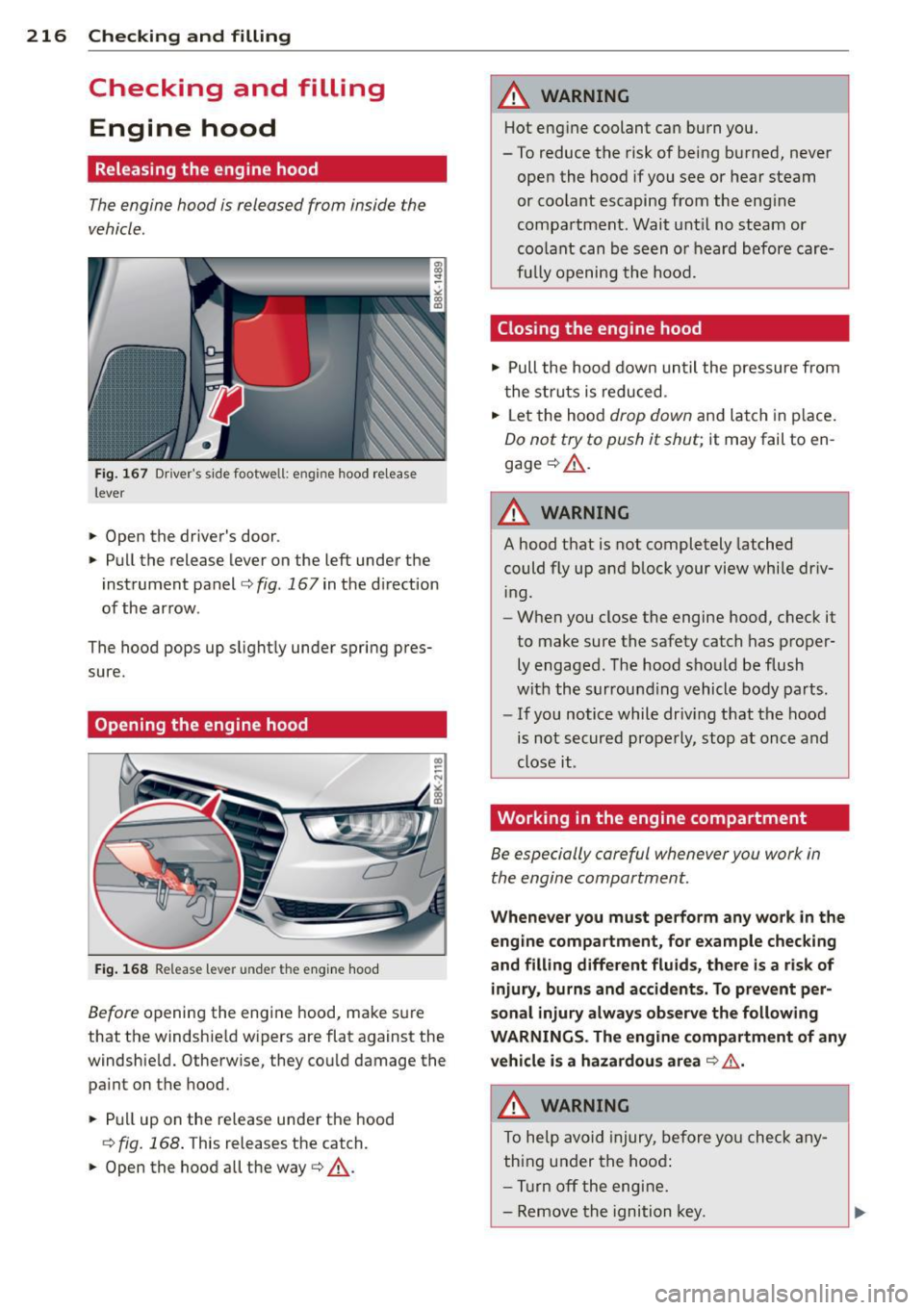
Fig . 16 7 Dr iver' s side footwe ll: e ngin e hood re lease
lever
.. Open the drive r's door.
.. Pull the release lever on the left under the
inst rument panel
c> fig . 167 in the d irect ion
of the ar row .
The hood pops up s light ly under spring pres
sure.
Opening the engine hood
Fig. 168 Re lease lever under the eng ine hood
Before opening the engine hood, make s ure
that the windshie ld w ipers are flat against the
windshie ld. Otherwise, they co uld damage the
pa in t on the hood.
.. Pull up on the release unde r the hood
r:!> fig . 168 . This releases the catch.
.. Open the hood all the way
c> .&,.
A WARNING
-Hot eng ine co olant can burn you.
- To reduce the risk of being b urned, never
o pen the hood if you see or hear steam
or coo la nt escapi ng from the eng ine
compa rtment . W ait unt il no steam or
coo lant can b e se en o r heard before care
fu lly openi ng the ho od.
Closing the engine hood
.. Pull the hood down un til the pressure from
t he stru ts is reduced .
.. Let the hood
drop down an d latc h in p lace.
Do not try to push it shut; it may fail to en
gage
c> .&, .
A WARNING
--
A ho od t hat is not completely latched
could fly up an d block your vi ew while dr iv
i ng.
- W hen you close the engine hood, c heck it
to make sure the safety catch has p ro per
ly engaged . The ho od s houl d be flush
wit h the surrou nding vehicle body parts.
- If you notice while dr iv ing t hat t he hood
is not s ecured properly, stop at once and
close it .
Working in the engine compartment
Be especially careful whenever you work in
the engine compartment .
Whenever you must perform any wo rk in the
engine compartment, for example checking
and filling different fluids, th ere is a risk of
injury, burns and accidents. To prevent per
sonal injury always observe the following
WARNINGS. The engine compartm ent of any
vehicle is a hazardous area
c> &, .
A WARNING
To he lp avo id i njury, before yo u check any
thi ng under the hoo d:
- Tu rn off the eng ine.
- Remove the igni tion key.
Page 225 of 294
Engine cooling system
Coolant
The engine coolant performs two functions: it
keeps the engine from overheating and it pro
tects the engine from freezing in the winter .
The cooling system is sealed and generally re
quires little attention .
The cooling system has been filled at the fac
tory with a permanent coolant which does not
need to be changed. The coolant consists of a
mixture of water and the manufacturer's gly
col-based coolant additive G13 antifreeze with
anticorrosion additives (50% for USA models;
60% for Canadian models). This mixture both
assures the necessary frost protection and
protects metal components in the engine's
cooling system from corrosion and scaling. It
also raises the boiling point of the coolant.
Do not reduce the concentration of the cool
ant in the summer by adding plain water.
The
proportion of coolant additive must be at least 50% but not more than 60%
to main
tain antifreeze protection and cooling efficien
cy. If the coolant frost protection is too low,
the coolant could freeze and damage the vehi
cle heating and engine cooling system .
For year-round driving, antifreeze is added at
the factory for temperatures down to:
- -31°F(-35 °C)USA
- -40 °F ( - 40 °C) Canada.
A WARNING
Before you check anything in the engine
compartment, always read and heed all
WARNINGS
¢ .&. in Working in the engine
compartment on page 216.
(D Note
- Before winter sets in, have the coolant
checked to see if the coolant additive in
your vehicle is sufficient to meet the cli
mate conditions . This is especially impor
tant if you live in a region where the win
ter is extremely cold. If necessary, in-
Checking and filling 223
crease the proportion of coolant additive
to 60%.
- When adding coolant additive to your
cooling system, remember:
- We recommend using only coolant ad
ditive G12++ or G13 for your vehicle .
This coolant additive is available at au
thorized Audi dealers. Other types of
antifreeze can significantly reduce cor
rosion protection. The resulting corro
sion can cause a loss of coolant and se
rious engine damage.
- Do not add any type of radiator leak seal
ant to your vehicle's engine coolant.
Adding radiator repair fluid may adverse
ly affect the function and performance of
your cooling system and could result in
damage not covered by your New Vehicle
Limited Warranty.
Checking the engine coolant level
The engine coolant level can be checked with
a quick glance.
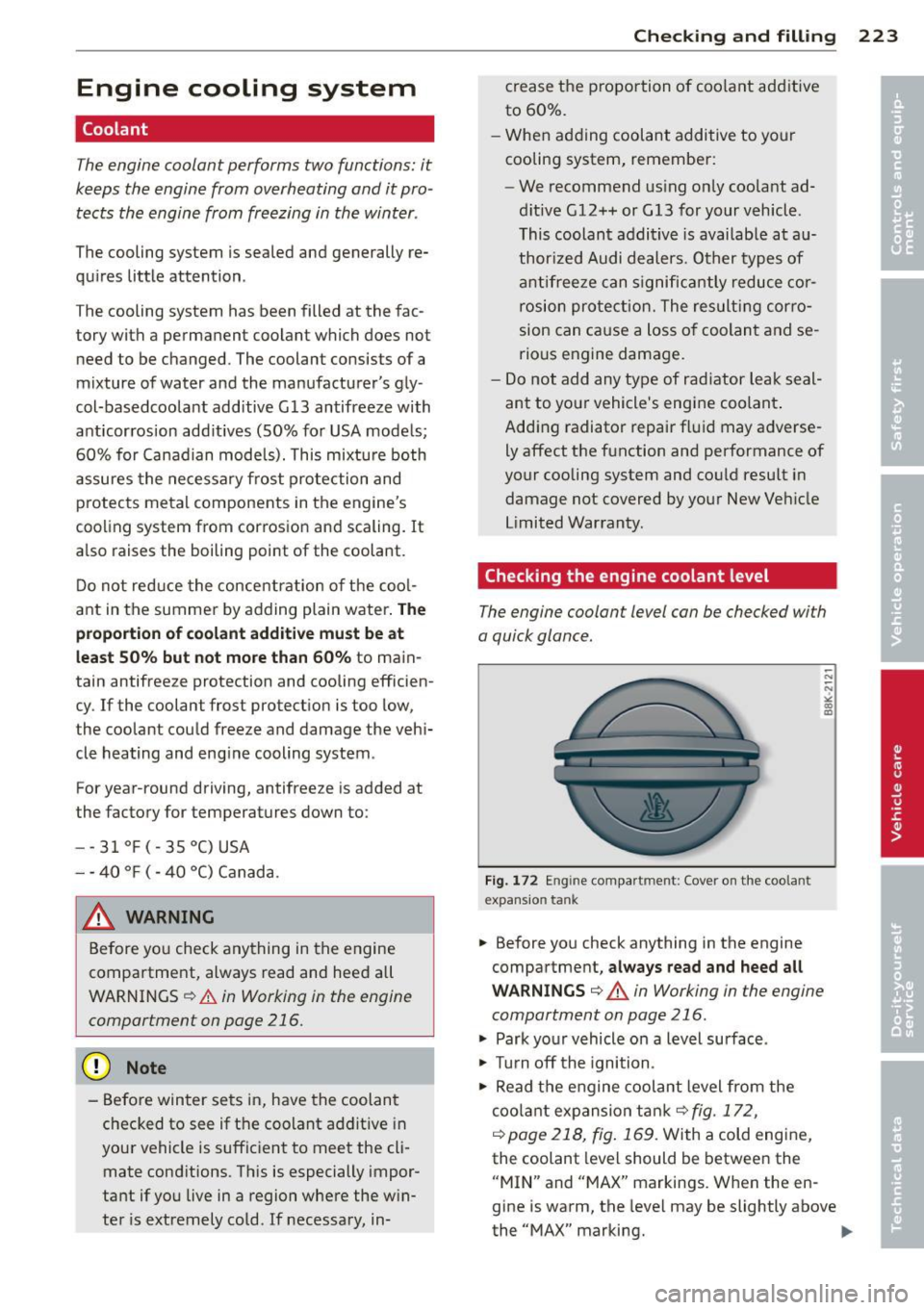
Fig. 172 Engine compar tment: Cover on the coola nt
expansio n tank
-... ;;; ,; a, m
.. Before you check anything in the engine
compartment,
always read and heed all
WARNINGS ¢ & in Working in the engine
compartment on page 216.
"' Park your vehicle on a level surface .
"' Turn off the ignition .
"' Read the engine coolant level from the
coolant expansion tank¢
fig. 172 ,
¢ page 218, fig. 169 .
With a cold engine,
the coolant level should be between the
"MIN" and "MAX" markings . When the en
gine is warm, the level may be slightly above
the "MAX" marking.
Iii>
Page 229 of 294
Have the battery checked when you take your
vehicle in for service. Yo u are well advised to
replace a battery that is older than 5 years.
W ith certa in types o f airbag deployment, the
battery is disconnec ted from the vehicle elec
trica l system for safety reasons
c::> &. in Re
pair, care and disposal of the airbags on
page 156.
Di sconn ecting the battery t erminal s
Some vehicle functions (power w indow regu
l ators, for example) are lost if the battery ter
minals are disconnected . These functions have
to be re learned after the battery terminals are
connec ted again. To prevent this, the battery
should only be disconnected from the vehicle
e lectrical system when absolutely necessary
for repairs .
Vehicl es not driven for long p eriod s
If you do not drive your vehicle over a period
of several days or weeks, electrical compo
nents are gradually cu t back or switched off .
This reduces energy consumption and main
tains starting capability over a longer per iod
c::> page 191.
Some of the conven ience functions may not
operate, such as the inter ior lights or the
power seat adjustment. The conven ience
functions will be ava ilable again whe n you
turn on the ignition and sta rt the eng ine.
Winter operation
During the winter months, battery capacity
tends to decrease as temperatures drop . This
i s because more powe r is also consumed while
start ing , and the head lights, rea r window de
fogger, etc., are used more often .
Avo id unnecessary power consumption, par
ticularly in c ity t raffic or when t rave ling on ly
short d istances. Let you r authorized Audi
dea le r che ck t he capacity of the vehicle bat
t ery before w inte r sets in
c::> page 229. A well
cha rged batte ry w ill no t only p revent sta rting
p rob lems when the weathe r is cold, b ut will
a lso last longer.
Checkin g and fillin g 22 7
(D Tips
If your vehicle is left standing for seve ral
weeks at extremely low temperatures, the
vehicle battery shou ld be removed and
stored where it w ill not freeze. This will
prevent it from be ing damaged and having
to be replaced .
Working on the battery
Be especially careful when working on or near
the battery.
The battery is located in the l uggage compart
ment under the floor. Before you check any
th ing in the luggage compartment,
read and
h eed all WARNINGS
c::> &_ .
Always heed the safety warnings , when work
ing on the vehicle battery or the vehicle e lec
trical system to prevent injury.
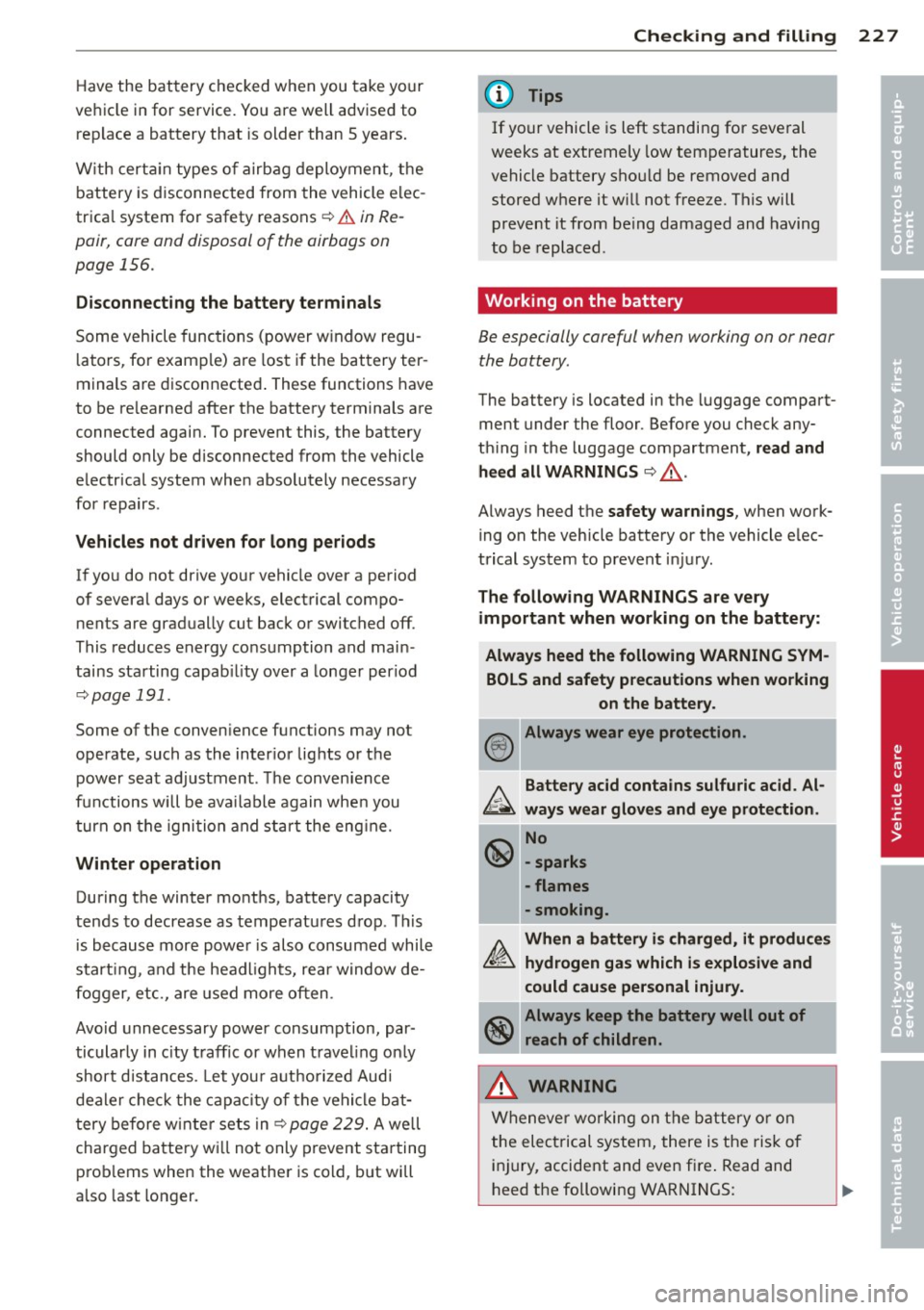
The following WARNINGS are very
important when working on the battery:
Al ways heed the follo wing WARNING SYM
BOLS and safety precautions when working on the battery.
® Always wear eye protection .
/).. Batte ry acid contains sulfuric acid . Al
~ ways w ear glov es and ey e protection .
IC No
\!!51 -sparks
-flames
- smoking.
A Wh en a battery i s charged , it produces
~ hydrogen g as which i s explosive and
could cau se per sonal injur y.
~ Always keep the battery well out of
'if!:11 reach of children .
_&. WARNING
Whenever working on t he battery o r on
the electrical system, there is the risk of
injury, accident and even fire . Read and
heed the following WARNINGS:
-
•
•
Page 232 of 294
230 Check ing and filling
Never use a fa st charger as a booster to
start the engine . T his will seriously dam
age sensitive electronic components, such
as control units, relays, rad io, etc ., as well
as the battery charger.
Battery replacement
The new bat tery must have the same specifi
cations and dimensions as the original equip
ment battery .
Intelligent energy man agement in your veh i
cle is respons ible for d istributing the e lectr i
cal energy throughout your vehicle
c::>
page 191. The intell igent energy ma nage
ment system w ill keep the engine battery
cha rged bette r then vehicles w it h out th is sys
tem. To make sure t he addi tional e lectrica l en
e rgy is availab le once again after you have
cha nged t he battery, we recommend that you
install batteries of the same type and ma nu
facture only (the same as those installed at
the time your vehicle was delivered). Specifi
cations are listed on the battery hous ing. Your
author ized Audi dealer must code the battery
in the ene rgy management system to enable
you to use the ene rgy management functions
cor rectly after repla cing t he battery .
If it is not possible to use a battery of this
type, the new battery must have the same ca
pac ity, voltage ( 12 volts), amperage , con
s truction and plug sea ling .
When insta lling the battery , make sure the ig
ni tion and all electr ical cons umers are turned
off.
0 Note
Ma ke sure t he vent ilation hose on the s ide
of the batte ry is con nected, ot herwis e
fumes or battery ac id can leak out.
@ For the sake of the environment
Because of the problem of proper d isposa l
of a battery , we recommend your au thor
i z ed Audi deale r change the batte ry for you
. Batteries contain sul fur ic acid and
l ead and must a lways be disposed of prop
erly in comp liance with a ll environmental
regulations. Disposing of vehicle batter ies
i mproperly is very dangerous to the envi
ro nment .
Windshield/headlight*
washer container
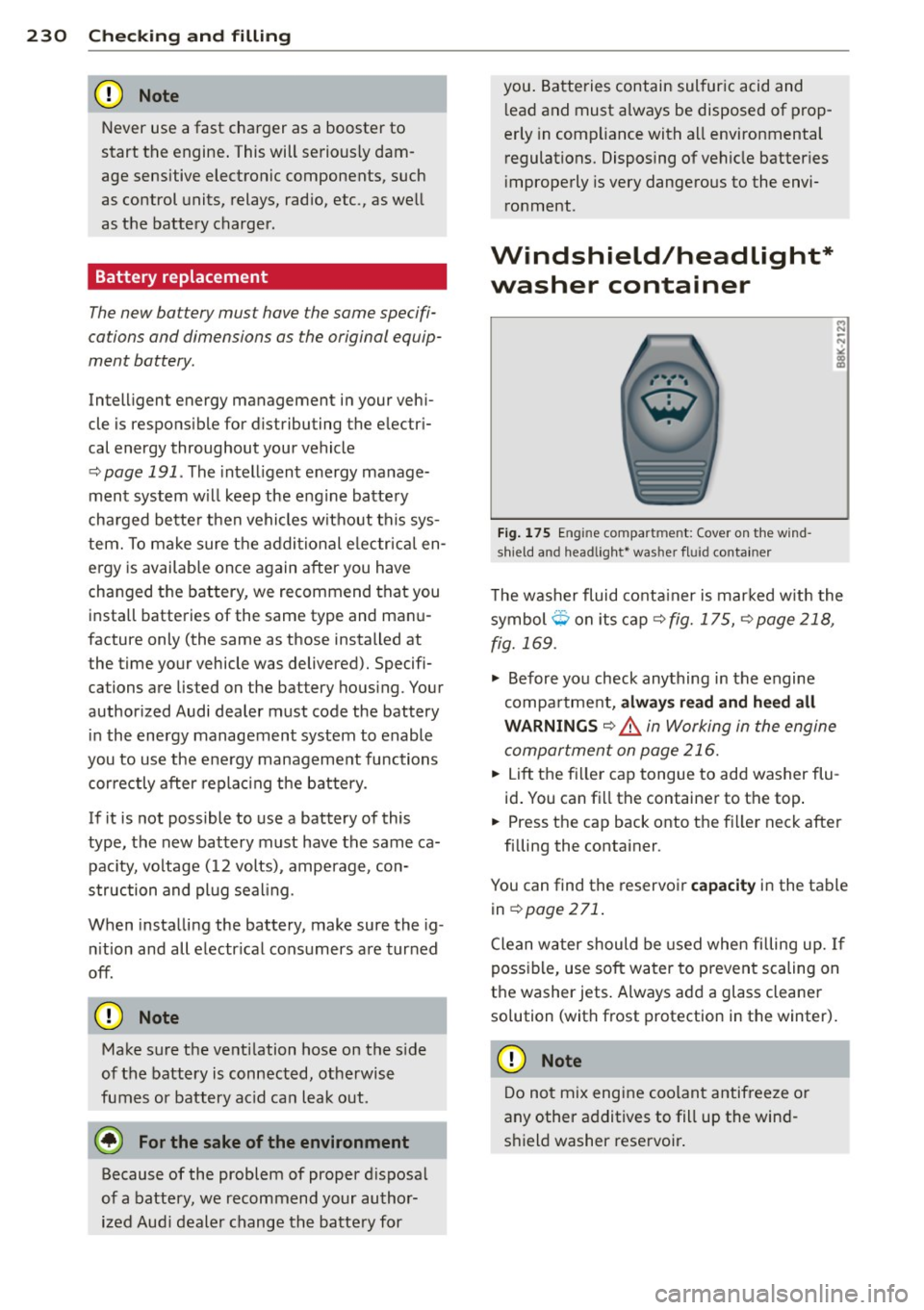
Fig. 17 5 En gin e compa rt m en t: Cover o n the wind
s hi eld an d headlig ht• was her fluid conta iner
T he was her fluid co nta iner is mar ked w ith the
symbol Oon itsc ap c::> fig.17 5,
c::>page218,
fig. 169 .
.,. Before yo u check anything in the engine
compa rtment,
always read and heed all
WARNINGS c::> A in Working in the engine
compartment on page 216.
.,. Lift t he fi ller cap tongue to ad d washer flu
id . You can fi ll the containe r to the top .
.,. Press t he cap back o nto the f iller neck afte r
fi lling the conta iner .
You can find the reservo ir
capacity in the table
in
c::> page 271.
Clean wa ter should be used when filling up. If
poss ib le, use so ft wa ter to preven t scaling on
t h e washer jets . A lways add a glass clea ner
so lution (with frost protection in the winter) .
(D Note
Do not mix engine coo lant antifreeze or
any other a dditives to fill up the wind
s hi eld washer rese rvoir .
Page 233 of 294
Tires and wheels
Tires
General notes
Tires may be the least appreciated and most
abused parts of a motor vehicle .
Tires may be the least appreciated and most
abused parts of a motor vehicle . Tires are,
however, one of the most important parts of a
vehicle, particularly considering the compara
tively small patch of rubber on each tire that
assures that a ll- important contact between
you, your vehicle and the road.
Maintaining the correct tire pressure, mak ing
sure that your vehicle and its tires do not have
to carry more weight than they can safely han
d le, avoiding damage from road hazards and
r eg ularly inspect ing t ires for damage i nclud
ing cuts, slashes irregu la r wear and ove rall
condition are the most important things that
you can do to he lp avoid sudden tire failure in
cluding tread separat ion and blowouts.
A vo idin g damage
If you have to drive over a curb or similar ob
stacle, drive very slow ly and as close as possi
b le at a right angle to the curb.
A lways keep chemicals includ ing grease, o il ,
gasoline and brake fluid off the t ires .
I nspect the t ires regularly for damage (cuts,
cracks or b listers, etc.). Remove any fo reign
bod ies embedded in the treads.
Storing tires Mark tires when you remove them to indicate
the direction of rotation . Th is ensures you to
be ab le to mount them correctly when you re
i nstall them .
When removed, the wheels or t ires should be
sto red in a cool, dry and preferably dark place .
Store tires in a vertical pos ition if they are not
mounted on rims, in a horizontal pos it ion if
they are mounted on rims .
Tires an d wheel s 231
New tires
New ti res have to be broken in¢& .
The tread depth of new t ires may vary, accord
ing to the type a nd make of t ire and the tread
patte rn.
H idden damage
Damage to tires and r ims is often not readily
visible . If you notice unusual v ib rat ion or the
vehicle pulls to one s ide, th is may ind icate
that one of the t ires has been damaged . T he
ti res m ust be chec ked immed iate ly by an au
thorized Audi dea le r or q ua lified wor kshop .
Unidirectional tires
A un idirectional tire can be identified by ar
rows on the sidewa ll, that po int in the direc
tion the t ire is designed to rotate. You must
f ol low the specified di rection of rotation . T his
is necessary so that these tires can develop
their optimum characteristics regarding grip, road noise, wear and hydrop laning resistance.
For more information ¢
page 258.
A WARNING
New tires or t ires that are o ld, worn or
damaged cannot provide maximum con
trol and braking ability .
-
-New tires tend to be slippery and must
also be broken-in. To reduce the risk of losing control, a collision and serious
personal injuries, drive w ith special care
for the first 350 miles (560 km).
- Driving with worn or damaged tires can
lead to loss of control, sudden tire fail
ure, including a blowout and sudden de
fl ation, cras hes and se riou s personal in
juries . Have worn or damaged t ires re
placed immediate ly.
- Tires age even if they are not being used
and can fai l sudden ly, especially at hig h
speeds. Tires that are more than 6 years
old can only be used in an emergency
and then w ith special care and at low
speed.
•
•
Page 234 of 294
232 Tire s and wheel s
-Never mount used tires on yo ur vehicle if
you are not sure of their "previous histo
ry." Old used tires may have been dam
aged even though the damage cannot be
seen that can lead to sudden tire failure
and loss of vehicle control.
Glossary of tire and loading terminology
Accessory weight
means the comb ined we ight (in excess of
those standard items which may be rep laced)
of automa tic tra nsmission, power steer ing,
power br akes, power windows, power seats,
radio, and heater, to the extent that these
items are availab le as factory -installed equip
ment (whether installed or not) .
Aspect ratio
means the ratio of the height to the w idt h of
the tire in percent. Numbers of 55 or lower in
dicate a low sidewall fo r improved steer ing re
sponse and better overall handling on dry
pavement.
Bead
means t he pa rt of the tire that is made of
steel wires, wrapped o r reinforced by ply cords
and that is shaped to fit the r im.
Bead s eparation
means a b reakdown of the bond between
components in the bead.
Cord
means the strands forming the plies in the
tire.
Cold tire inflatio n pre ssure
means the tire pressure recommended by the
ve hicle manufacturer for a tire of a designated
size that has not been dr iven for more than a
couple of miles (kilometers) at low speeds in
the three hour period before the tire pressure i s measu red or adjusted. -
If you notice unusual vibration or if the
veh icle pulls to one side when driv ing, a l
ways stop as soon as it is safe to do so and check the wheels and tires for dam
age.
Curb weight
means the weight of a motor ve hicle w ith
standard equipment including t he maximum
capa city of fuel, o il, and coola nt, a ir cond i
tion ing and additional weig ht o f option al
equipment .
Extra load tire
means a tire design to operate at h igher loads
and at h igher inflation pressures than the cor
respondi ng standa rd tire. Extra load tires may
be identified as "X L", "xl", "EXTRA LOA D", o r
"R F" on the sidewall .
Gross Axle Weight Rating ( "GAWR ")
means the load-carrying capacity of a s ingle
axle system, measured at the tire-ground in
te rfaces .
Gross Vehicle Weight Rating ( "GVWR ")
means the maximum total loaded we ight of
t h e ve hicle.
Groove
means the space between two adjacent tread
ribs .
Load rat ing (code )
means the maximum load that a tire is rated
to carry for a given inflation press ure. Yo u
may not find this information on all tires be
ca use it is not required by law.
Maximum load rating
me ans the lo ad r ating for a tire a t the m axi
mum pe rm issib le inflation pressure for that
t ir e.
Page 235 of 294
Maximum loaded vehicle weight
means the sum of:
(a) Curb weight
(b) Accessory weight
(c) Vehicle capacity weight, and
(d) Production options weight
Maximum (permissible) inflation pressure
means the maximum cold inflation pressure
to which a tire may be inflated. Also called
"maximum inflation pressu re."
Normal occupant weight
means 150 lbs . (68 k ilograms) times the
number of occupants seated in the vehicle up
to the total seating capacity of your vehicle .
Occupant distribution
means distribution of occupants in a vehicle .
Outer diameter means the overall diameter of an inflated new
tire.
Overall width
means the linear distance between the exteri
ors of the sidewalls of an inflated tire, includ
ing e levations due to labeling, decorations, or
protective bands or ribs.
Ply
means a layer of rubber-coated para llel cords.
Production options weight
means the comb ined weight of those installed
regular production options weighing over 5
lbs . (2 .3 kg) in excess of those standard items
which they replace, not previously considered
in curb weight or accessory weight, including
heavy duty brakes, r ide leve lers, roof rack,
heavy duty battery, and specia l trim .
Radial ply tire
means a pneumatic t ire in which the p ly cords
that extend to the beads are laid at substan
tially 90 degrees to the centerline of the
tread.
Tires and wheels 233
Recommended inflation pressure
see~
page 232, Cold tire inflation pressure.
Reinforced tire
means a t ire design to operate at higher loads
and at higher inflation pressures than the cor
responding standard tire. Reinforced tires
may be identified as "XL" , "x l", " EXTRA LOAD",
o r "R F" on the sidewall.
Rim
means a metal support for a tire or a t ire and
tube assembly upon which the tire beads are
seated.
Rim diameter
means nom inal d iameter of the bead seat. If
you change your wheel s ize, you w ill have to
purchase new tires to match the new r im di
ameter.
Rim size designation
means r im diameter and width.
Rim width
means nom inal distance between rim fla nges.
Sidewall
means that portion of a tire between the
tread and bead.
Speed rating (letter code)
means the speed at which a tire is designed to
be driven for extended periods of time. The
ratings range from 93 mph (150 km/h) to
186 mph (298 km/h)
~ page 243 . You may
not find this information on all tires because
it is not requ ired by law.
The speed rating letter code, where applica
ble, is molded on the tire sidewall and indi
cates the max imum pe rm issib le road speeds
~ .&. in Winter tires on page 247 .
Tire pressure monitoring system*
means a system that detects when one or
more of a veh icle's tires are underinflated and
illuminates a low tire pressure warning tell
tale.
•
•