ESP AUDI A5 COUPE 2013 Repair Manual
[x] Cancel search | Manufacturer: AUDI, Model Year: 2013, Model line: A5 COUPE, Model: AUDI A5 COUPE 2013Pages: 294, PDF Size: 73.84 MB
Page 189 of 294
-Always acce lerate with specia l care on
even, smooth surfaces s uch as those that
are wet or covered with ice and snow.
The drive wheels can spin even with
these assistance systems that cannot al
ways help to reduce the risk of loss of ve hicle control.
(0 Tips
- ABS and ASR on ly work correctly when
all four wheels are equ ipped w ith ident i
ca l tires. Different tire s izes can lead to a
reduct ion i n eng ine power.
- You may hear noises when the systems
described are wo rking .
- If the indicator light D] or m!S (USA
models) ;tiJ (Canada models) appears,
the re may be a malfunct ion
c::> page 19,
~ page 19.
Switching on/off
ESC turns on automatically when you start
the engine .
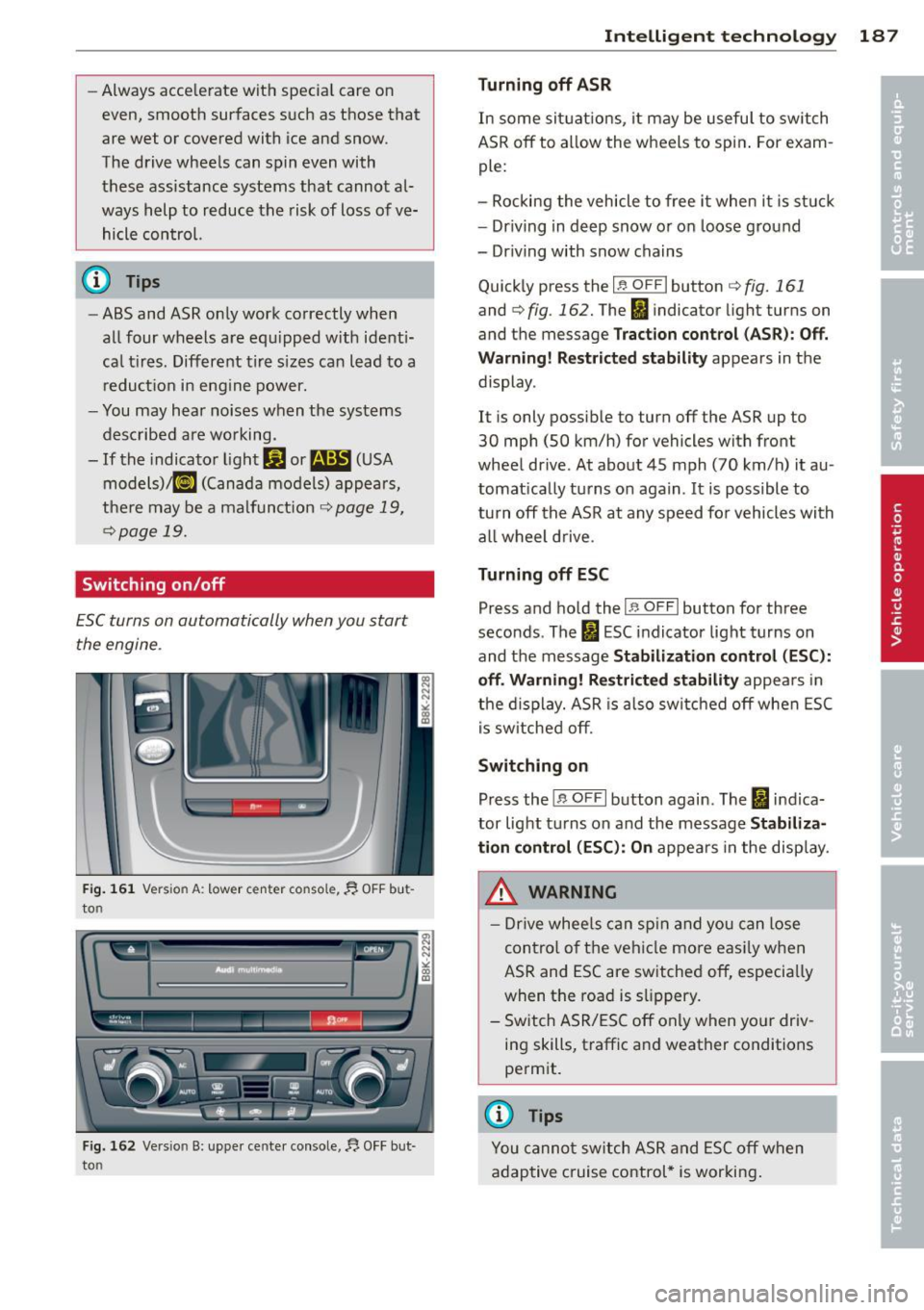
Fig . 161 Vers ion A: low er c en ter co nsol e, fj. OFF bu t
to n
Fig. 162 Ve rsio n B: upper ce nte r console,~ OFF bu t
to n
Intelligen t technolog y 187
Turning off ASR
In some sit uatio ns, it may be useful to switch
ASR
off to a llow the wheels to spin . For exam
ple:
- Rocking the vehicle to free it when i t is st uck
- Dr iving in deep snow or on loose ground
- Dr iving with snow chains
Qu ick ly press the
I~ O FF I button c::> fig. 161
and c::> fig . 162. The Ii indicator light turns on
and the message
Trac tion control (A SR) : Off.
War ning! R estrict ed stability
appears in the
display .
It i s only possible to turn
off the ASR up to
30 mph (SO km/h) for vehicles wi th front
wheel drive . At about 45 mph (70 km/h) it au
tomat ically turns on again .
It is possible to
turn
off the ASR at any speed fo r vehicles with
all wheel drive .
Turning off ESC
Press and hold the I;; OFFI button for three
seconds . The
fl ESC indicator light turns on
and the message
Stabil ization cont rol (ESC ):
o ff . Warni ng ! Re str icted stab ilit y
appea rs in
the d isplay. ASR is also sw itched
off when ESC
i s sw itched off.
Switching on
Press the j ;; O FFI button again . The fi indica
tor light t urns on and the message
St abi liz a
t ion control (ESC ): On
appears in the disp lay.
_&. WARNING
- Drive whee ls can sp in and you can lose
contro l of the vehicle more eas ily when
ASR and ESC are switched off, especia lly
when the road is s lippery .
- Switch ASR/ESC
off only when yo ur driv
ing skills, traffic and weather conditions
permit.
@ Tips
You cannot sw itch ASR and ESC off when
adaptive cruise control* is working .
-
Page 190 of 294
188 Intelligent technology
Braking
What affects braking efficiency?
New brake pads
During the first 250 miles (400 km), new
b rake pads do not possess their fu ll braking
effect , they have to be "broken in" first¢.&. .
You can compensate for this slightly reduced braking power by push ing harder on the brake
pedal. Avoid heavy braking loads during the
break-in per iod.
Operating condition s and d riv ing hab it s
The brakes on today's automob iles are st ill
subject to wea r, depending largely on operat
ing conditions and driving habits¢.&. . On
vehicles that are e ither driven mostly in stop
and-go city traffic or are driven hard, the b rake pads should be checked by your author
ized Audi dealer more often than specified in
the
Warranty & Maint enan ce booklet . Failure
to have your b rake pads inspected can res ult
in red uced brake pe rformance.
On steep slopes, you shou ld use the brak ing
effect of the engine. This way, you p revent un
necessa ry wear on the brake system. If yo u
must use yo ur brakes, do not hol d the brakes
down continuously. P ump the brakes at inter
va ls.
Operating noise
Noises may occur when braking depending on
the speed, brak ing fo rce and outside condi
tions such as temperature and humidity.
Effect of water and road salt
In ce rtain situat ions, for example after driving
through water , in heavy ra in, after overn ight
conde nsation or afte r washing your car, the
b rak ing effect can be redu ced by mois ture or
ice on the brake rotors and brake pads . The
brakes must be dried first with a few careful
brake applications .
A t higher speeds and with the w indshield w ip
ers turned on, the brake pads press against
the brake rotors for a short amount of time .
This occurs at regular intervals witho ut the driver noticing and p
rovides fo r bette r brake
response time under wet conditions .
T he effec tiveness of the brakes can be red uced
when the vehicle is d riven on a sa lt -covered
r oad and the brakes are not used . Likewise,
you clean off accumulated salt coating from brake d iscs and pads with a few cautio us ap
plicat ions of the brake ¢ .&. .
Corro sio n
The re may be a tendency for di rt to b uild up
on the brake pads and corrosion to form on
the discs if the car is not driven regularly or only fo r short trips w ith litt le use of the
brakes.
If the brakes are not used frequently, o r if cor
rosion has formed on the discs, it is advisable
to clean off the pads and d iscs by braking
firmly a few times from a moderately high
speed ¢.&. .
Fault s in the brak e syst e m
If you s hou ld notice a sudden increase i n
brake pedal trave l, then one of the two brake
c ircuits may have failed ¢.&. .
Low brake fluid level
Malfunctions can occ ur in the b ra ke system if
the brake fluid level is too low. The brake fluid
l evel is monitored electronica lly.
Brake booster
T he bra ke booster inc reases the pressure that
you generate wi th the b rake peda l. It works
o n ly when the engine is runn ing .¢ .&.
Brake lining wear status
Brake lining wear may be checked by visual in
spect ion of the condition of the brake pads
th rough the ope nings in the wheel. If neces
sary, the wheel may be removed for t his in
spect ion ¢
page 253, Changing a wheel.
_& WARNING ,____
-New b rake pads don't have the best stop
p ing power and m ust be "broken-in" dur-
ing the initial 100 to 150 miles (150 to
11>-
Page 194 of 294
192 Intelligent technology
With the engine turned off
If you listen to the radio, for example, with
the engine turned off or use othe r MMI func
tions, the battery is being discharged .
If sta rting capability is jeopa rdized due to en
e rgy consumpt ion, the fo llowing warning ap
pears in the MMI display:
Please start the engine soon or the system
will be turned off.
The warning ind icates that the system will be
turned off automatically after 3 minutes.
If
you wish to continue using the functions, you
have to start the engine.
With the engine running
Although electrical energy is generated when
the vehicle is be ing driven, the battery can be
come discharged . This happens most ly when
l ittle energy is be ing generated a nd a great
deal consumed and the battery's state of
cha rge is not optimal.
To br ing the energy balance back into equili
b rium, consumers which require especially
la rge amounts of energy are tempo rarily cut
back or switched off. Heating sys tems in par
ticular requi re a great dea l of energy . If you
notice, for example , that the heated seats* or
the heated rear window are not heating, they
have been temporar ily cut back or switched
off. These systems will be ava ilable again as
soon as the energy ba lance has been restored.
You will a lso notice that engine idle speed has
been increased slightly. This is norma l and not
a cause for concern . By increasing engine idle
speed the add itional energy required is gener
ated and the batte ry is charged.
Page 195 of 294
Driving and
environment
The first 1
1000
miles
(11500 km) and
afterwards
New engine
The engine needs to be run-in during the first
1,000 miles (1 ,500 km) .
For the first 600 mile s (1,000
kilometers ):
.,. Do not use full throttle.
.,. Do not d rive at engine speeds that are more
than 2/3 of the max imum permitted RPM .
From 600 to 1,000 miles (1 ,000 to
1,500 kilometers ):
.. Speeds ca n gradually be increased to the
maximum perm iss ible road or eng ine speed .
During and after break-in period
.. Do not rev the eng ine up to h igh speeds
when it is cold. Th is applies whether the
transmission is in N (Neutral) or in gear.
After the break- in peri od
.. Do not exceed maximum eng ine speed un
der any circumstances .
.. Upshift into the next higher gear before
reaching the red area at the end of the tach
ometer scale c.>page 10.
During the first few hours of driving, the en
g ine's internal friction is higher than later
when all the moving parts have been broken
in . How well this break -in process is done de
pends to a considerable extent on the way the
vehicle is driven du ring the first 1,000 miles
(1,500 kilome ters).
(D Note
Extremely h igh engine speeds are auto
mat ica lly reduc ed. However, t hese rpm
lim its are programmed for a n engine well
r u n- in, not a new engine.
Driving and environment 193
@) For the sake of the environment
Do not drive with unnecessarily high en
g ine speeds -upshifting ear ly saves f uel,
reduces noise and protects the environ
ment.
New tires
If your vehicle is running on new tires, drive
very carefully for the first 350 miles (500 ki lo
meters) after fitting.
.&, WARNING
N ew tires tend to be sl ippery and mus t al
so be "b roken -in" . Be sure to remember
this dur ing the f irst 350 m iles (500 kilo
meters) . Brake gently . Avoid fo llowing
closely behind other vehicles or other sit
uations that m ight require sudden, hard
b raking .
Avoid damaging the
vehicle
When you are d rivi ng on poo r roads, or over
cu rbs, steep ramps, etc., make certa in that
low- ly in g parts s uch as spo ile rs and ex ha ust
system parts do not bottom o ut and get dam
aged.
Th is is espec ially true for veh icles with low
s lung chassis (spo rts chas sis)* and fully load
ed vehicles.
Driving through water
on roads
Note the following to avoid ve hicle damage
when driving through water, for e xamp le on
flooded roads:
- The wa ter must not be any higher than the
bottom of the vehicle body .
- Do not dr ive faster than walk ing speed .
•
•
Page 197 of 294
@ For the sake of the environment
Even when the Emission Control System is
operating properly, the exhaust gas can
have a sulfur-like exhaust gas smell under
some operating states. This depends on
the sulfur content of the fuel being used.
Using a different brand of fuel may help,
or filling the tank w ith lead-free super
grade gasoline.
Operate your vehicle
economically and minimize pollution
General
Your personal style of driving will determine
the economy of your vehicle, as well as ex
haust and noise levels.
Fuel economy, environmental impact, and
wear on you r engine, bra kes and t ires largely
depend on th ree factors:
= your persona l dr iving style
- operating conditions
- technica l lim itations
I f you anticipate what yo u need to do next and
drive economically, you can easi ly cut your
fuel consumption by 10-15 percent. This sec
tion will give you some t ips on how you can
he lp the environment and your pocketbook.
@ Tips
The consumpt ion estimates as published
by ENVIRONMENTAL PROTECTION AGENCY
(EPA) and Transport Canada may not corre
spond to your actual consumption on the
road, wh ich will vary depending upon vehi
cle load and speed, road and weather con
ditions, tr ip length, etc.
Drive smoothly and keep a lookout
ahead
Vehicles use the most fuel when they are ac
celerating.
" Avoid unnecessary accele rat ing and braking.
Dri vin g and en vironm ent 195
Vehicles use the most fue l when they a re ac
ce lerating. If you anticipate what is going to
happen next, you will need to brake less and,
th us, acce lerate less. Let the vehicle coast
whenever possible -for example when you see
that the next traff ic light is red.
Avoid full throttle
Driving at moderate speeds saves fuel and
improves your mileage.
" Try and keep well below your car's maxi-
mum speed.
Acce lerating gently red uces fue l cons ump
tion, engine wear, and does not disturb the environment.
Fuel consumpt ion, exhaust emiss ions and en
gine noise increase disproportionately at high
speeds . If you drive at approximately th ree
quarters of top speed, fuel consumption w ill
be reduced by one half. Never drive faster
than the posted speed limit and weather con
ditions perm it.
Reducing unnecessary idling
Even when your car is just idling it burns up
fuel .
" Shut the eng ine off when you are not driv
ing the vehicle.
" Do not warm up the ve hicle by letting the
eng ine run at idle .
It makes sense to shut off the engine in traffic
jams, when wa it ing for tra ins to pass at rail
road crossings, or at traffic lig hts t hat have
long waits on red . T ur ning the eng ine off for
just 30-40 seconds saves mo re fuel than is
bur ned star ting the e ngine again.
It takes a long t ime for the engine to warm up
fully when it is run ning at idle . However, wea r
and noxious emissions are espec ia lly high
whe n the eng ine is wa rm ing up. So yo u shou ld
drive away as soon a s you start the e ngine and
avo id r unning at high rpms whi le the engine is
still warming up.
Ill-
•
•
Page 200 of 294
198 Trailer towing
Tire pre ss ure
When towing a trai le r, inflate the t ires of your
vehicle to the co ld tire pressure listed under
"Full load" on the label located on the driver 's
side B-pillar (visible when the door is open).
Inflate trailer tires to trailer and tire manufac
turers' specifications.
Light s
The headlight settings should be checked with
the trailer attached before dr iving off. Check
to make sure both vehicle and tra iler lights
are working properly.
Saf ety chains
Be sure tra iler sa fe ty cha ins a re p roperly con
nected from the trailer to the hitch on the ve
hicle. Leave eno ugh slack in the chains to per
mit turning corners. When you install safety
cha ins, make sure they w ill not drag on the
road when you are driving.
The chains shou ld cross under the trai ler
tongue to prevent it from dropping in case of
separation from the hitch.
Driving instructions
Driving with a trailer always requires extra
care and consideration.
To obtain the best possible handling o f vehicle
and trai ler, p lease note the following:
.,. Do not tow a loaded tra iler whe n your car it
self is no t loaded .
.,. Be especia lly careful when passing other
vehicles .
.,. Observe speed limits .
.,. Do not drive at the maximum permissible
speed.
.,. Always apply brakes early .
.,. Monitor the temperature gauge.
Weigh t di stribution
Towing a loaded trai ler with an empty car re
sults in a highly unstable distribution of
weight . If this cannot be avo ided, drive at very
low speeds only to avoid the risk of losing
steer ing control. A "ba
lanced' ' rig is easier to operate and con
trol. This means that the tow vehicle should be loaded to the extent possible and permissi
ble, while keep ing the trai ler as light as possi
ble under the c ircumstances. Whenever poss i
ble, transfer some cargo to the luggage com
partment of the tow veh icle while obse rving
tongue load requ irements and vehicle load ing
considerations.
Speed
The higher the speed, the more d iff icu lt it be
comes for the driver to control the rig. Do not
drive at t he maximum permissible speed. Re
duce your speed even more if load, weather or
wind conditions are unfavorable -pa rtic ularly
whe n going downhill.
Reduce veh icle speed
immediately if the trail
er shows the slightest s ign of sway ing.
Do n ot
try to sto p th e swaying by acc elerating .
Observe speed limits. In some areas, speeds
fo r vehicles tow ing tra ile rs a re lower than for
regular veh icles .
Always apply brakes early. When driving downh ill, shift into a lower gear to use the en
gine braking effect to slow the vehicle . U se of
the brakes alone can cause them to overheat
and fail.
Coolant tempe rature
The coo lant temperature gauge c> page 10
must be observed carefu lly. If the needle
moves close to the upper end of the scale, re
duce speed immediately and/or turn off the
air conditioner.
If the coolant temperature warning light •
i n t he i nstrument cluster starts flashing, pull
off the road, stop and let the engine
idle for
abo ut two min utes to prevent he at build-up .
_& WARNING
Anyone not proper ly restra ined in a mov
i ng vehicle is a t a much greater risk in an
accident . Never let anyone ride in yo ur car
who is not p roperly wea ring the rest raints
prov ided by Audi.
-
Page 201 of 294
Trailer towing tips
Important to know
Your vehicle hand les different ly when tow ing
a trailer because o f the addit ional weight and
d iffe ren t weight distribution . Safety, perform
ance and economy w ill greatly depend on how
caref ully you load your trailer and operate
your rig.
B efore you actua lly tow your trailer, pr actice
turning, stopp ing and bac king up in an area
away from traffic. Keep practicing until you have become comp lete ly fam iliar with the way
your veh icle-trailer comb ination behaves and
responds.
Backing up is d ifficu lt a nd requires practice .
Backing up with a tra iler genera lly requires
steer ing action opposite to that when backing
up your vehicle without a trailer.
M aintain a g reater distance betwee n your ve
h icle and the one in front o f you . You will need
mo re room to stop. To compensate for the
trailer, you will need a larger than normal
turning radius .
W hen pass ing, remember that yo u cannot ac
celerate as fast as yo u normally wo uld be
cause of the added load. Ma ke s ure you have
e nough room to pass . After passing , allow
p lenty o f room fo r your tra iler before chang
in g la nes aga in .
Avoid jerky starts, sharp turns or rap id lane
changes.
(D Tips
- Do not tow a tra iler during the break-in
period of you r vehicle.
- If you tow a trailer, your A udi may re
quire more frequent maintenance due to
the extra load
o page 2 73.
Trailer towin g 199
Parking on a slope
Do not park on a slope with a trailer . If it can
not be avoided, do so only after doing the fol lowing:
When parking:
.. App ly the foot brake.
.. Have someone p lace chocks under both the
veh icle and the tra iler wheels .
.,. With chocks in place, slowly release t he
bra kes unt il t he whee l chocks absorb the
load .
.. Tur n the whee ls towa rds t he curb .
.,. App ly the parking brake.
.. Place an a utomat ic t ransm ission* in P, re
spectively a manual transmission in first or
reverse gear.
When restarting after parking:
.. App ly the foot br ake .
.. Sta rt t he engine.
.. Move the se lector lever to D/S, respectively
a man ual transmiss ion in first gear .
.. Release the parking brake and s low ly pull
out and away from the wheel chocks .
.. Stop and have someone retr ieve the wheel
chocks.
@ Tips
If you move the selector leve r of the auto
matic transmissio n* to P before applying
the pa rking brake and before bloc king the
whee ls, you may hav e to use mor e forc e
la ter to m ove the lever out of the P p osi
tion.
•
•
Page 205 of 294
paint extra protection, particularly if water no
l onger beads on the clean paint .
P rotec t plastic body pa rts with ca r wax in the
same way as the vehicle body.
During warm weather dead insects tend to
collect on the front bumper and on the for
ward area of the hood . They a re much easier
to remove from paint that is waxed
often.
Poli shing
Polish your vehicle only if the pa int has lost its
shine and the g loss cannot be brought back
with wax.
If the polish used does not conta in preserva
tive compounds, the paint must be waxed af
terwards .
A WARNING
Always read and heed a ll WARNINGS and
other information
¢ page 200.
(D Note
Do not use car wax on
- matte or anod ized metal trim
- rubber or rubber-like tr im .
Trim strips
Metal trim needs special core.
For env ironmenta l reasons , Aud i fabricates
the bright tr im strips and trim pieces from
pure chromium-free a lum inum.
Dir t and mar ks on the trim str ips should be
removed with a
pH-balan ced cl eaning agent
(do not use a chrome cleaner) . Authorized
Audi dealers ca rry clea ning products w hich
have been tested for use on your vehicle and
are not harmful to the env ironment.
To avoid cor ros ion on the exterior trim str ips,
only a pH-balanced sol ution should be used
for the windshield washer.
A WARNING
Always read and heed a ll WARNINGS and
other information
¢ page 200.
Cleaning and protec tion 203
Plastic and vinyl
Plastic needs special core .
Use a clean, damp cloth or sponge to remove
dust and light surface dirt. For o ther soil, use
a lukewarm all-purpose cleaning so lu tion or a
mild saddle soap for v inyl tr im . Remove water
spots and traces of soap with a clean, damp
cloth or sponge. Use a clea n, soft cloth to rub
dry.
Grease, tar or oil stains can be removed w ith a
clean cloth or sponge soaked with all-purpose
cleaner or with a so lvent designed espec ially
to clean v inyl.
Occas ionally app ly a colorless v inyl or leather
preservative to retain the material's luster
and pliability .
A WARNING
Always read and heed all WARNI NGS and
other information
¢ page 200 .
Aluminum trim
Use only neutral-pH products to remove spots
and deposits from a luminum surfaces .
Chrome care products and a lkaline cleaners
will attack a luminum surfaces and can dam
age them over t ime.
A WARNING
A lways read and heed all WARNINGS and
other information
¢ page 200 .
Touch-up paint
Minor point damages should be touched up
immediately.
.. Use either a touch-up paint stick or spray
paint to cover m inor scratches and nicks.
Your a uthorized Audi dea ler has touch -up
paint for minor scratches and stone chips.
Scratches sho uld be touched up soon after
they occur to prevent corrosion .
•
•
Page 209 of 294
@ Tips
Open Velcro fasteners on your clothing can
damage the seat cover. Please make sure
that Velcro fasteners are closed.
Plastic parts and instrument panel
Always use a clean cloth moistened in clear
water to clean these areas . For pers istent dirt
use an Audi approved
s ol vent-fr ee plastic
cleane r/protectant.
_& WARNING
So lvents can change the properties of
some plast ics and make i t harder for the
airbag to dep loy.
-
- Never clean the instr ument pane l or the
s u rface of airbag modules with cleaning
products that contain solvents.
- Products containing solvents w ill mak e
the surface of this part porous.
- Serious injur ies can result if plas tic par ts
come loose when the airbag is deployed .
- Always read and heed all WARN INGS and
other informa tion ¢
page 200.
(D Note
Clea ning agents contain ing solvents will
attac k the mater ial a nd can change the
way it behaves.
Natural leather
Applies to vehicles: with natural leather
Audi makes great efforts to maintain the
properties, natural look and feel of interior
leather.
General
We offer many different types of leather on
our veh icles . Most are different types of nappa
l eather, which has a smooth surface and
comes in var ious co lors .
The intensity of the color determines the v isu
al characteristics and appearance.
If the sur
face of the leathe r has a typical natural look,
then the leather is a nappa leat her tha t has
Cleaning and protec tion 207
been left in a re lative ly natural condit ion . This
leather offers particular ly good comfort and
breathes well. Fine veins, closed grains, insect
bites, sk in fo lds, and subt le variations in color
rema in v isible. These character istics demon
strate that the material is natural.
Natura l nappa leather is not covered by a co l
or finish. It is therefore more sens itive to soil
ing and wear, which is someth ing you need to
consider if children, animals or other facto rs
mig ht prove to be part icularly hard o n the
l eather .
By contrast, leather types that are covered by
a colo red finish layer are more durable. This
has a positive effect on the leather's resist
ance to wear and soiling in dai ly use . On the
othe r hand, the typ ical character istics of natu
ral leathe r are barely or not app arent. Howev
er, th is does not mean that the leathe r itse lf
is of infe rior quality.
Care and handling
Because of the exclusive nature of the types of
leather that Aud i uses and their uniq ue p rop
erties (such as sen sitiv ity to oils, grease, soil
i ng, etc.), you w ill need to be somewhat ca re
ful with these leathers, and a certain type of care is requi red. For example, dark clothing
mater ia ls can disco lor leather seats (especia l
ly if such clothing is damp and was not dyed
correct ly) . Dust and dirt particles in pores,
folds, and seams can have an abrasive effect
and can damage the leather surface as well as
weaken seams.
The leather should be cleaned regularly as
needed . After hav ing been used for a relat ively
long time, your leather seats will acq uire a
r ich aged fin ish. This is a character istic of nat
u ral leathe r and a s ign of true quali ty.
In order to maintain the value of this natural
product over the l ife of your veh icle, you
shou ld follow t he recomme ndat ions below:
IJJ,-
•
•
Page 210 of 294
208 Cleaning and protection
-To keep your leather from bleaching out,
do not a llow it to be exposed to bright
sunlight for long periods of time. If you
have to leave the vehicle parked outside
for long periods, cover the leather to
protect it from direct exposure to sun
li ght.
- Sharp objects on clothing, such as zip pers, rivets or sharp pieces on belts can
l eave pe rmanent scratches or scrape
marks on the surface of the leather.
@ Tips
-After each time you clean the leather and
at regular intervals, use a leather preser
vat ive cream that contains UV-blockers
and that works into the leather. This
cream will nourish and moistur ize the
l eather, helping it to breathe and stay
supple. It also helps to build up a protec
tive coating on the surface.
- Clean the leather every 2 -3 months,
and clean any areas that get soiled.
- Remove fresh marks made by ballpoint
pens, ink, lipst ick, shoe polish, etc . as
soon as possible.
- Preserve the color of the leather as need
ed by using a special colored leather care
cream to touch up areas of uneven color.
Cleaning and caring for leather
upholstery and trim
App lies to vehicles: with nat ura l leather
Natural leather requires special care and at
tention.
Normal cleaning
.. Clean soi led areas wit h a slightly moistened
cotton or woo len cloth.
More stubborn dirt
.. More stubborn dirt can be removed using a
cloth saturated with a mild soap so lution (2
tablespoons mi ld liquid soap) . ..
Never allow the soap solution to saturate
the leather, and make certain that no water
soaks into the seams.
.. Wipe off the soap so lution with a soft, dry
cloth.
Cleaning spots
.. Remove fresh water-based spots (such as
coffee, tea, juices, blood) with an absorbent
cloth or paper towel.
.. Remove fresh
grease or oil-based spots
(such as butter, mayonnaise, chocolate) with
an absorbent cloth or pape r towel, or use
the cleaner from the leather care k it if the
spot has not yet penetrated into the surface
of the leathe r.
.. Use an oil/grease dissolving spray, if
oil/
grease spots have dried on.
.. Remove specific kinds of spots (ballpoint
pen, fe lt marker, fingernai l polish, water
based paint, shoe polish, etc.) with a spot
remover specifically formulated for leather.
Leather care
.. Every half year use an approved leather care
product (available from your authorized
Audi dea ler) to care for the leather .
.. App ly the product very spar ingly.
.. Wipe it off with a damp cloth.
If you have any questions about cleaning and
caring for the leather in your vehicle, it is best
to contact your authorized Audi dealer, who
will be glad to help you and tell you about our
full range of leather care products, such as :
- Leather cleaning and care kit
- Creams to care for colored leather
- Spot removers for ballpoint pens, shoe pol-
ish, etc .
- Oil/grease dissolving spray
- New and upcom ing products.
,&. WARNING
Always read and heed all WARNINGS and
other information
~page 200.