change time AUDI A5 COUPE 2014 Owner's Manual
[x] Cancel search | Manufacturer: AUDI, Model Year: 2014, Model line: A5 COUPE, Model: AUDI A5 COUPE 2014Pages: 286, PDF Size: 70.99 MB
Page 214 of 286
212 Check ing and filling
and ad versely a ffect yo ur New Vehicl e
W arr ant y.
@) For the sake of the environment
- Under no circumstances can the oil come
in contact with the sewage network o r
the soil.
- Observe and follow lega l regu lations
when disposing of empty oil containers .
Changing the engine oil
We recommend that have your oil changed by
an authorized Audi dealer or a qualified serv
ice station.
Before you check anything in the engine com
partment,
a lw ays rea d an d h eed all WARN
INGS c::> .& in Working in the engine compart
ment on page 206.
The engine oil must be changed accord ing to
the intervals specified in your Warranty
&
Maintenance book let. This is very important
because the lubricating properties of oil di
minish gradua lly during normal vehicle use .
Under some ci rcumstances the engine oi l
should be changed more frequently. Change
oil more often if you drive most ly short dis
tances, operate the vehicle in dusty areas or under predominantly stop-and-go traffic con
ditions, or have your vehicle where tempera
tures remain below freezing for extended pe
riods .
Detergent addit ives in the oil w ill make fresh
oil look dark after the engine has been run n ing for a short time. This is normal and is not
a reason to change the oil more often than recommended.
Because of the problem of proper disposal,
along w ith the special tools and necessary ex
pertise required , we strongly recommend that
you have your o il changed by an authorized
Audi de ale r or a qual ified servi ce station.
If y ou choo se to c hang e y our oi l y our self,
please note the followi ng important informa
tion :
A WARNING
To reduce the risk of personal injury if you
must change the eng ine oil in your vehicle
yourself:
- Wear eye protect ion.
- To reduce the risk of burns from hot en- gine oil, let the engine cool down to the
touch.
- When removing the o il dra in plug with
your fingers, stay as far away as possible.
Always keep your forearm parallel to the
ground to help prevent hot oil from runn ing down you r arm.
- Dra in the oil into a container designed
for this purpose, one large enough to
hold at least the total amount of oil in
your engine.
- Engine oil is poisonous. Keep it we ll out
of the rea ch of childre n.
- Continuous contact with used eng ine o il
is harmfu l to your sk in. Always protect
your skin by washing oil off tho roughly
with soap and wate r.
@ Note
Never mix oil additives with your engine
oi l. These additives can damage your en
g ine and adversely affect you r A ud i Limit
ed New Veh icle War ranty.
@ For the sake of the environment
- Before changing your oil, first make su re
you know where you can prope rly dispose
o f the used oil.
- Always dispose of used eng ine oi l proper
ly. Do not dump it on garden soil, wood
ed areas, into open streams or down
sewage drains.
- Recycle used engi ne oil by taking it to a
used engine oil collection facility in you r
area, or contact a service station.
Page 218 of 286
216 Checking and filling
Brake fluid
Checking brake fluid level
The brake fluid level can be checked with a
quick glance .
N N ~ N
" (X) (0
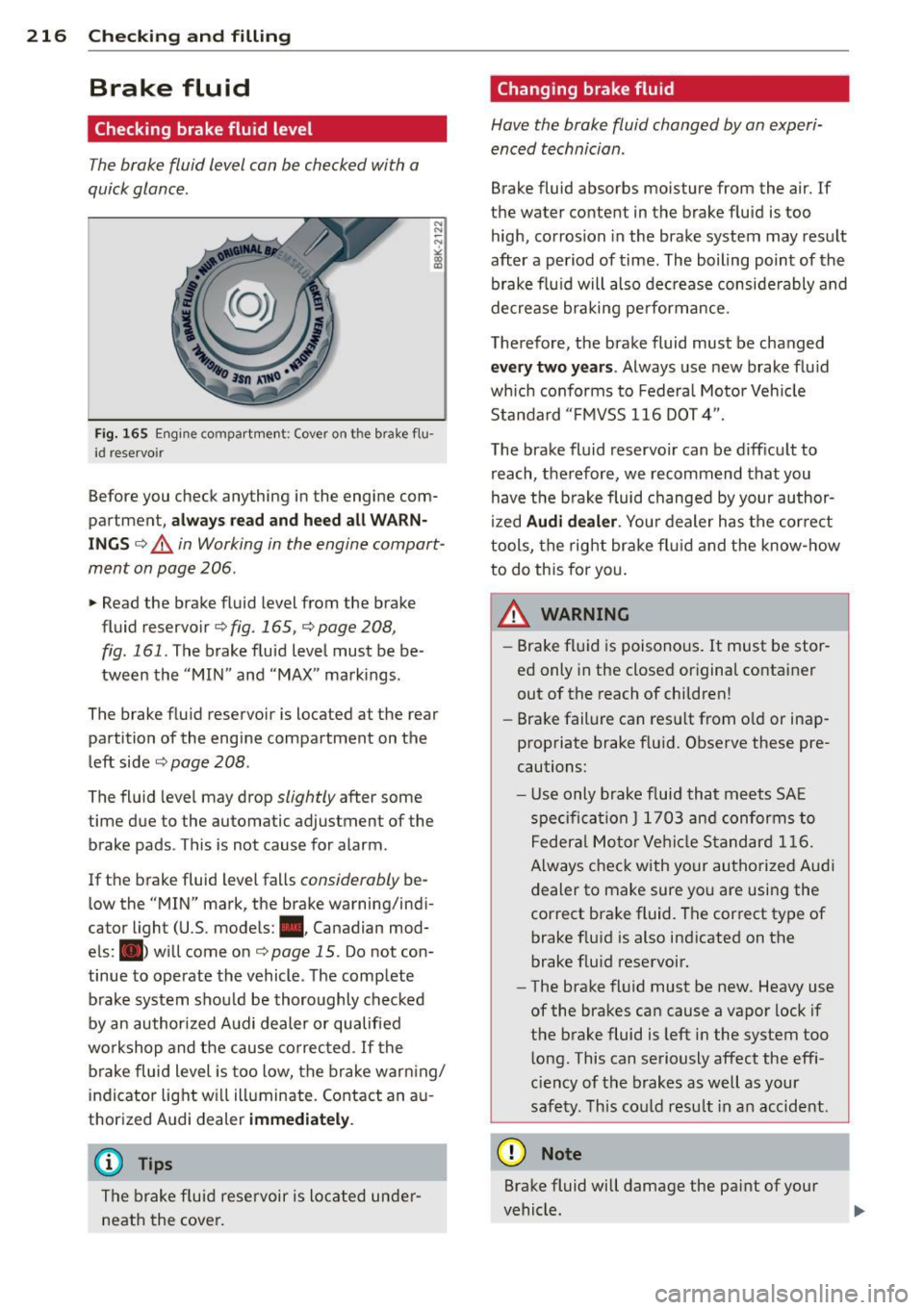
Fig. 165 Engine compartme nt: Cover on the brake flu ·
id reservo ir
Before you check anything in the engine com
partment,
always read and heed all WARN·
INGS ¢ .&._ in Working in the engine compart
ment on page 206 .
.. Read the brake fluid level from the brake
fluid reservoir ¢
fig. 165, ¢ page 208,
fig. 161.
The brake fluid level must be be ·
tween the "MIN" and
"MAX" markings.
The brake fluid reservoir is located at the rear
partition of the engine compartment on the
left side ¢
page 208 .
The fluid level may drop slightly after some
time due to the automatic adjustment of the
brake pads . This is not cause for alarm.
If the brake fluid level falls
considerably be
low the "MIN" mark, the brake warning/indi
cator light (U.S. models: ., Canadian mod
els: .) will come on¢
page 15. Do not con
tinue to operate the vehicle . The complete
brake system should be thoroughly checked
by an authorized Audi dealer or qualified
workshop and the cause corrected.
If the
brake fluid level is too low, the brake warning/
indicator light will illuminate. Contact an au
thorized Audi dealer
immediately .
@ Tips
The brake fluid reservoir is located under
neath the cover.
Changing brake fluid
Have the brake fluid changed by an experi
enced technician .
Brake fluid absorbs moisture from the air. If
t he water content in the brake fluid is too
high, corrosion in the brake system may result
after a period of time . The boiling point of the
brake fluid will also decrease considerably and
decrease braking performance.
Therefore, the brake fluid must be changed
every two years . Always use new brake fluid
which conforms to Federal Motor Vehicle
Standard "FMVSS 116 DOT 4".
The brake fluid reservoir can be difficult to reach, therefore, we recommend that you
have the brake fluid changed by your author
ized
Audi dealer. Your dealer has the correct
tools, the right brake fluid and the know-how
to do this for you .
A WARNING
- Brake fluid is poisonous. It must be stor
ed only in the closed original container
out of the reach of children!
- Brake failure can result from old or inap
propriate brake fluid. Observe these pre
cautions:
- Use only brake fluid that meets SAE
specification
J 1703 and conforms to
Federal Motor Vehicle Standard 116.
Always check with your authorized Audi
dealer to make sure you are using the
correct brake fluid. The correct type of
brake fluid is also indicated on the
brake fluid reservoir.
- The brake fluid must be new. Heavy use
of the brakes can cause a vapor lock if
the brake fluid is left in the system too
long . This can seriously affect the effi
ciency of the brakes as well as your
safety. This could result in an accident.
(D Note
Brake fluid will damage the paint of your
vehicle.
Page 219 of 286
@ For the sake of the environment
Because of the pr oblem of proper d isposa l
of brake flu id as we ll as the special tools
requ ired and the necessary expert ise, we
recommend that you have the brake fluid
changed by your author ized Audi dealer .
Battery
General information
Under normal operating conditions, the bat
tery in your Audi does not need any mainte
nance. With
high outside temperatures or
long daily dr ives we recommend that you have
the electro lyte level checked by an authorized
Aud i dealer or qualified workshop . The elec
trolyte leve l should also be checked each time
the battery is charged ¢
page 219.
Have the battery checked when you take your
ve hicle in for service . Yo u are well adv ised to
replace a battery that is older than 5 yea rs .
W ith certa in types of a irbag deployment, t he
b attery is d isconnected from the vehicle elec
tr ica l system for safety reasons¢.&.
in Re
pair, care and disposal of the airbags on
page 150.
Disconnecting the battery terminals
Some vehicle functions (power w indow regu
lators , for example) are lost if the battery ter
m inals a re d isconnected. These func tions have
to be re lea rned after the batte ry term inals a re
connected agai n. T o prevent this , the bat tery
should only be d isconnec ted from the vehicle
e lec tric al system when absolu tely necessa ry
for repairs .
Vehicles not driven for long periods
If you do not drive you r vehicle over a period
of severa l days or weeks, elec trical compo
nen ts are gr adually cut b ack o r swi tched off .
This redu ces energy cons umption and main
tains starting capab ility over a longer per io d
¢ page 186.
Some o f the conven ience f unctions m ay not
ope rate, su ch as the in ter ior lig hts or t he
Checkin g and fillin g 217
power seat adjus tment. The convenience
funct io ns w ill be available again when yo u
turn o n the ign ition and start the engine.
Winter operation
D ur ing the w inte r mon ths, bat tery capa city
tends to dec rease as tempera tures drop . This
is beca use more power is a lso consumed wh ile
starting, and the headlights, rear window de
fogge r, etc., are used more often.
Avoid unnecessary powe r consumpt ion, pa r
ticular ly in city traffic or when traveling only
sho rt distances. Let yo ur authorized A udi
dealer check the capacity of the vehicle bat
tery before w inter sets in
¢ page 219. A well
charged battery will no t on ly prevent star tin g
problems w hen the weather is cold, but w ill
also last longer .
@ Tips
If your vehicle is left standing for seve ral
weeks at extremely low temperatures, the
vehicle battery s hou ld be removed and
stored where it will not freeze . This will
p revent it from be ing damaged and having
to be repla ced .
Working on the battery
Be especially careful when working on or near
the bat tery.
The battery is located in the luggage compar t
ment under the floor . B efo re you che ck any
thi ng in the luggage compartment,
read and
heed all WARNINGS
¢ ,&. .
Always heed the safety warnings , when work
i ng on the veh icle batte ry or t he vehicle e lec
t rical sys tem to p reven t inju ry.
The following WARNINGS are very
important when working on the battery:
Always heed the following WARNING SYM· BO LS and safety precautions when working
on the battery .
®
Always wear eye protection.
•
•
Page 222 of 286
220 Check ing and filling
- To r educe the danger of explosion, never
co nnect or disconn ect cha rger cables
wh ile the c harger is operating.
- Fast char ging a battery is dangerous and
shou ld on ly be attempted by a compe
tent technician w ith the proper equip
ment .
- Battery acid that may spill d uring charg
ing should be washed
off with a solution
of warm water and baking soda to neu
tralize the acid.
(Q) Note
Never use a fast charger as a booster to
start the engine . This will seriously dam
age sensitive electronic components, such
as control units, relays, rad io, etc., as we ll
as the battery charger.
Battery replacement
The new battery must have the same specif/·
cations and dimensions as the original equip
ment battery.
In tell igent energy management in your veh i
cle is respons ible for d istributing the e lectr i
cal energy throughout you r vehicle
~ page 186. The intell igen t energy m anage
men t system w ill keep the engine ba tte ry
charged better then vehicles w ithout this sys
tem . To make sure the additional e lectrica l en
ergy is available once again after you have
changed the battery, we recommend that you install batteries o f the same type and ma nu
facture only (the same as those installed at
the time your vehicle was delivered). Specifi
cations are listed on the battery hous ing. You r
author ized Audi dealer must code the battery
in the ene rgy managemen t system to enable
you to use the ene rgy management functions
correctly after replac ing the battery.
I f it is not poss ible to use a battery of this
type, the new bat tery m ust h ave the s ame ca
pac ity, voltage ( 12-volts), amperage, con
struction and plug sea ling. When installing the battery, make su
re the ig
nition and a ll electrical consumers are turned
off.
(D Note
Make sure the ventilat ion hose on the side
of the battery is connected, otherwise
fumes or battery acid can leak out .
@ For the sake of the environment
Because o f the p rob lem of p roper disposal
of a battery, we recommend your author
i zed Audi dealer change the battery fo r
you. Batteries contain sulfur ic acid and
l ead and must always be disposed of prop
erly in comp liance with all environmental
regula tions. Dispos ing of veh icle batter ies
i mprope rly is very dange rous to the envi
r o nment .
Windshield/headlight*
washer container
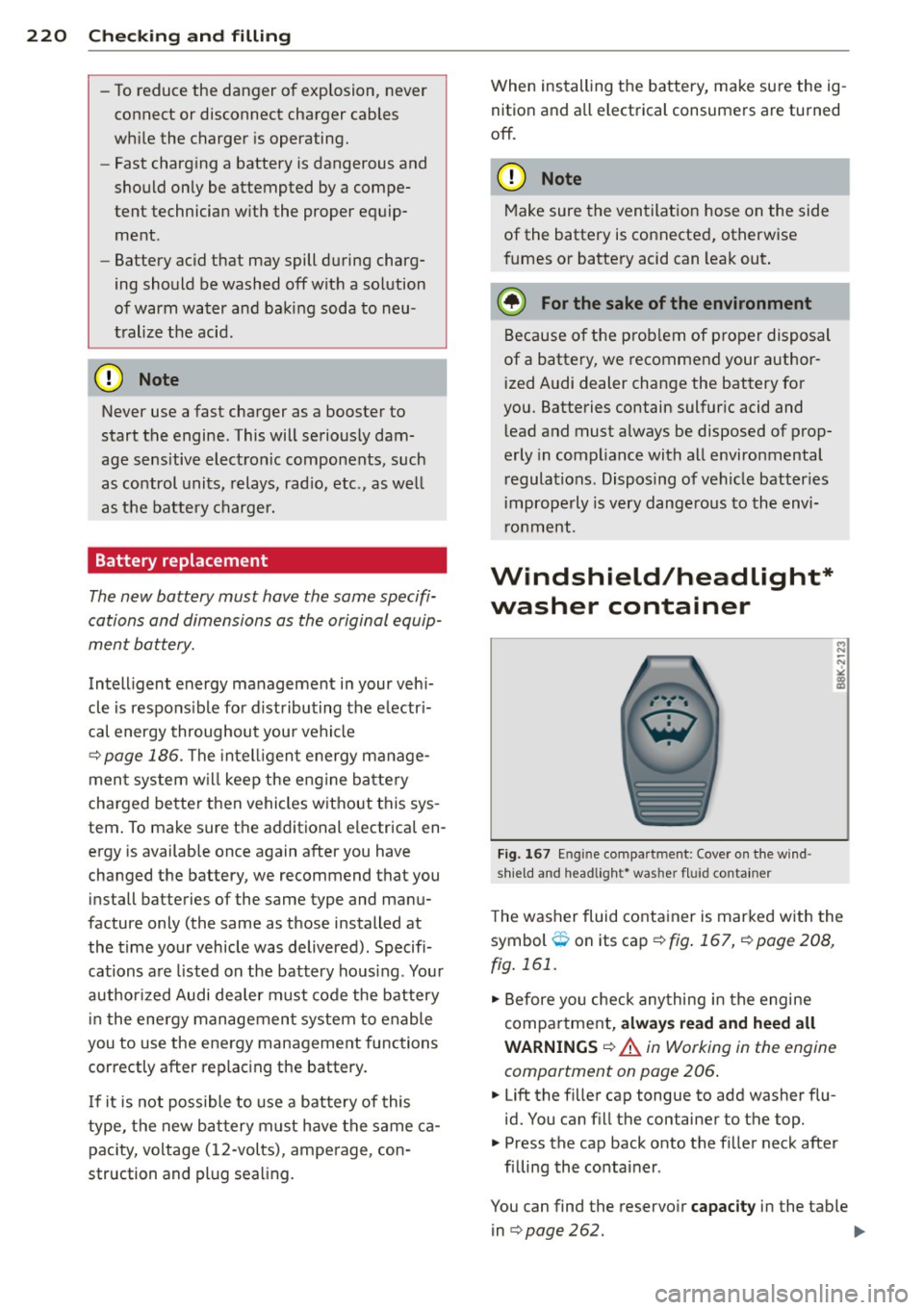
Fig. 167 En gin e compa rt m en t: Cove r on the w ind·
s h iel d a nd h eadligh t• was he r fl uid conta in er
.., N
-~ (X) a,
The washer fluid conta iner is marked w ith the
symbol
O on its cap~ fig. 167, ~ page 208,
fig .161.
.. Before yo u check any thing in the engine
compa rtment,
always read and heed all
WARNINGS q A in Working in the engine
compartment on page 206 .
.. Lift the fi ller cap tongue to add washer flu
id. You can f ill the container to the top.
.. Press the cap back onto the filler neck after
fi lling the conta iner .
You can find the reservo ir
capacity in the table
in
q page 262. .,.
Page 226 of 286
224 Tires and wheels
Gross Vehicle Weight Rating ("GVWR" )
means the maximum total loaded weight o f
the vehicle.
Groove
means the space between two adjacent tread
ribs.
Load rating (code)
means the maximum load that a tire is rated
to carry for a given inflat ion pressure. You
may not find this informat ion on all tires be
cause it is not requ ired by law .
Ma ximum load rating
means the load rating for a t ire at the maxi
mum permissible inflation pressure for that
tire .
Maximum loaded vehicle weight
means the sum of:
(a) Curb weight
(b) Accessory weight
(c) Vehicle capacity we ight, and
(d) Production opt ions weight
Maximum (permissible) inflation pressure
means the maximum cold inflation pressure
to which a tire may be inflated . Also called
"maximum inflation pressure."
Normal occupant weight
means 150 lbs. (68 kilog rams) times the
number of occupants seated in the vehicle up
to the tota l seating capacity of your vehicle.
Occupant distribution
means dist ribution of occupants in a veh icle.
Outer diameter
means the overall diameter of an inflated new
tire.
Overall width
means the linear distance between the exteri
ors of the sidewalls of an inflated tire, includ
ing elevations due to labeling, decorations, or
protective bands or ribs .
Ply
means a layer of rubbe r-coated parallel cords.
Production options weight
means the combined weight of those installed
regular production opt ions we ighing over 5
lbs. ( 2.3 kg) in excess of those standa rd items
wh ich they replace, not previously cons idered
in curb weight or accessory weight, including
heavy duty brakes, ride levelers, roof rack,
heavy duty battery, and special tr im.
Radial ply tire
means a pneumat ic tire in which the ply cords
that extend to the beads are laid at substan
tially 90 deg rees to the center line of the
tread.
Recommended inflation pressure
see c:::> page 223, Cold tire inflation pressure .
Reinforced tire
means a tire design to operate at higher loads
and at higher inflation pressures than the cor
responding standard tire. Reinforced tires
may be identified as "XL", "xl", "EXTRA LOAD",
or "RF" on the sidewall.
Rim
means a metal support for a tire or a t ire and
tube assembly upon which the tire beads are
seated .
Rim diameter
means nominal diameter of the bead seat. If
you change your wheel s ize, you w ill have to
purchase new tires to match the new rim di
ameter .
Rim size designation
means rim diameter and width.
Rim width
means nom inal distance between rim flanges.
Sidewall
means that portion of a tire between the
tread and bead .
Page 229 of 286
you have stored. The system does not recog
nize the load condition of your vehicle.
The effectiveness of the tire pressu re monitor
ing system* will be impaired if you store nor
mal load pressures but then operate the vehi
cle at its maximum load¢,&.
See the illustration ¢
fig. 168 for the location
of the label on driver's side B-pillar (color of
the actual labe l and exact location on the ve
hicle will vary slig htly) .
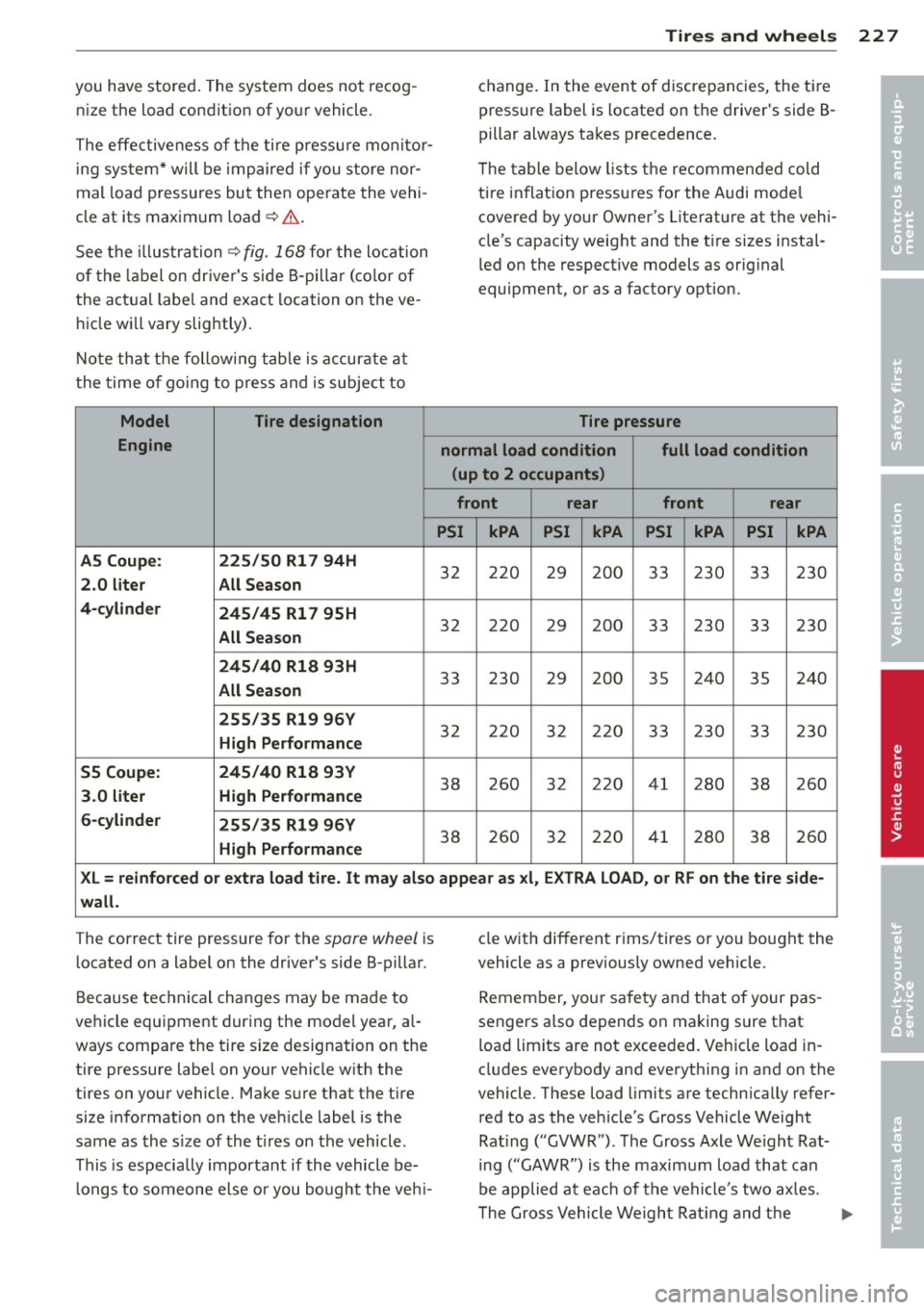
Note that the following table is accurate at
the time of go ing to press and is subject to
Model Tire designation
Engine
AS Coupe: 225/50 Rl 7 94H
2.0 liter All Season
4-cylinder 245/45 R17 95H
All Season
245/40 R18 93H
All Season
255/35 R19 96V High Performance
SS Coupe: 245/40 R18 93V
3.0 liter High Performance
6-cylinder 255/35 R19 96V
High Performance
Tires and wheels 22 7
ch ange. In the event of discrepancies, the tire
pressure label is located on the driver's side B
pillar always takes precedence.
T he table below lists the recommended cold
ti re inflation pressures for the Audi mode l
covered by your Owner's Literature at the vehi
cle's capacity weight and the tir e sizes instal
l ed on the respective models as orig inal
equipment, or as a factory option.
Tire pressure
normal load condition full load condition (up to 2 occupants)
front rear front rear
PSI kPA PSI kPA PSI kPA PSI kPA
32 220 29 200 33 230 33 230
32 220 29 200 33 230 33 230
33 230 29 200 35 240 35 240
32 220 32 220 33 230 33 230
38 260 32 220 41 280
38 260
38 260 32 220 41 280 38 260
•
•
XL= reinfo rced or extra load tire. It may also appear as xl, EXTRA LOAD, or RF on the tire side-
wall.
The correct tire pressure for the spare wheel is
lo cated on a label on the driver's side B-pillar.
Because technical changes may be made to
vehicle equipment during t he model year, al
ways compare the tire size designation on the
tire pressure label on your vehicle w ith the
tires on your vehicle. Make sure that the tire
size information on the veh icle label is the
same as the size of the tires on the vehicle.
This is especially important if the vehicle be
l ongs to someone else or you bought the vehi- cle
with different rims/tires or you bought the
vehicle as a previously owned vehicle.
Remember, your safety and that of your pas
sengers also depends on making sure that
l oad lim its are not exceeded. Vehicle load in
cludes everybody and everything in and on the
vehicle. These load limits are techn ically refer
red to as the veh icle's Gross Vehicle Weight
Rat ing ("GVWR"). The Gross Axle Weight Rat
ing ("GAWR") is the maximum load that can
be applied at each of the vehicle's two axles .
T he Gross Vehicle Weight Rating and the .,,.
Page 243 of 286
When the malfunction indicator is illuminat
ed, the system may not be able to detect or
signal low tire pressure as intended. TPMS
malfunctions may occur for a variety of rea
sons, including the installation of replace
ment or alternate tires or whee ls on the veh i
cle that prevent the TPMS from funct io ni ng
p roperly . Always check the T PMS malfunct ion
tellta le afte r replacing one o r more t ires or
wheels on your veh icle to ensure that the re
p lacemen t or a lternate tires and wheels allow
the TPMS to continue to function properly .
Tire pressure indicator appears
Applies to vehicles: with tire pressure monitoring system
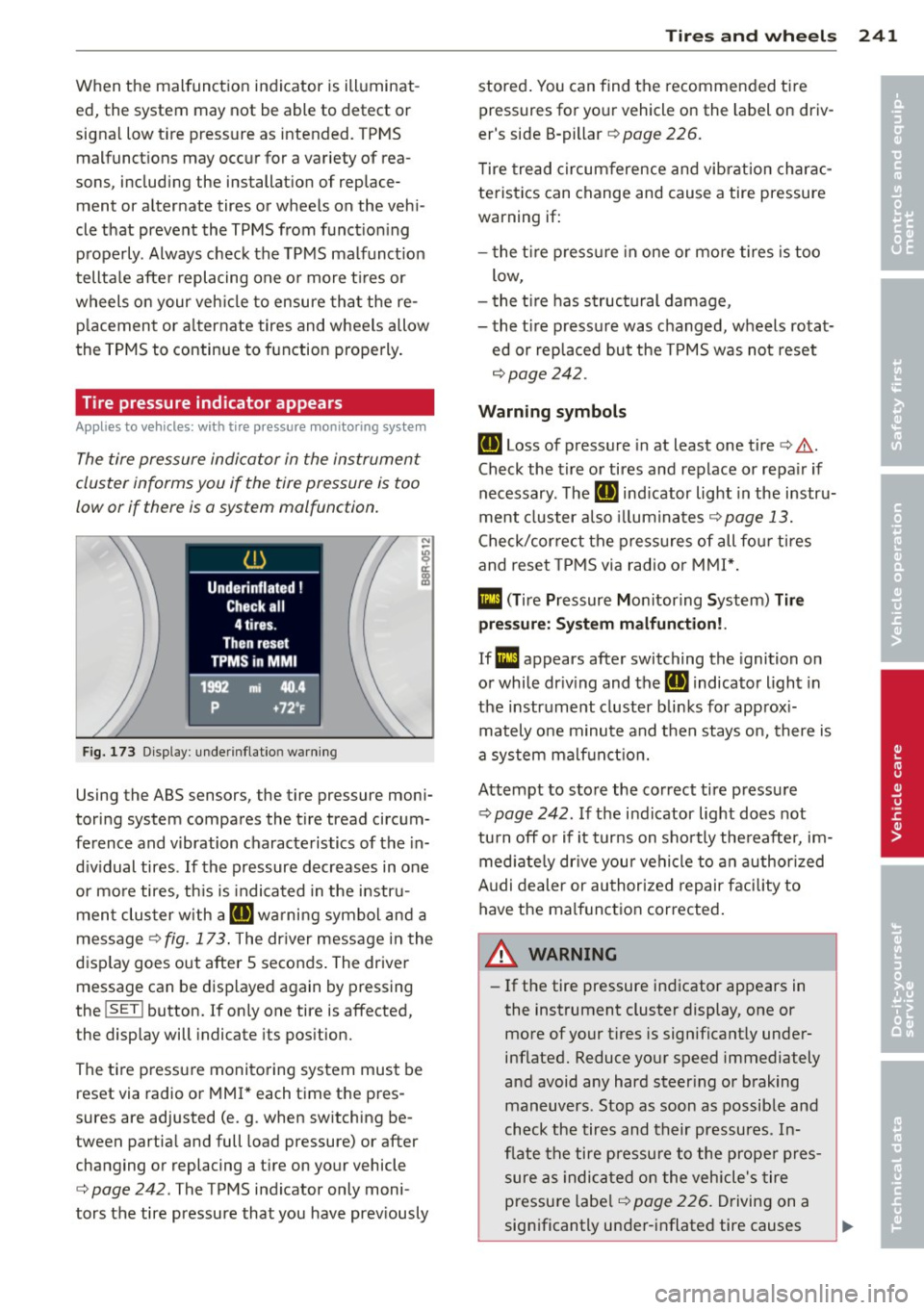
The tire pressure indicator in the instrument
cluster informs you if the tire pressure is too
low or if there is a system malfunction.
Fig. 173 Display : underinflatio n warning
Using the ABS sensors, the tire pressure moni
toring system compares the t ire tread circum
ference and vibration characteristics of the in
d iv idual tires . If the pressure decreases in one
or mo re tires, th is is indica ted in the instru
ment clus ter with a
RE wa rning symbol and a
message¢
fig. 173 . The driver message in the
disp lay goes out after 5 seconds . The driver
message can be displayed again by pressing
the
! SET ! button. If only one tire is affected,
the display will indicate its pos ition.
The ti re pressu re monitoring system must be
reset via radio or MMI* each time the pres
sures are adjusted (e.g . when switching be
tween partia l and full load pressure) or after
changing or replacing a t ire on your vehicle
¢
page 242 . The TPMS indicator only moni
tors the tire pressure that you have prev iously
Tire s an d wheel s 241
stored . You can find the recommended t ire
pressures for yo ur vehicle on the label on driv
er's side 8-pillar ¢
page 226.
T ire tread circum ference and vibration charac
teristics can change and cause a tire pressure
warning if:
- t he t ire p ress ure in one or more tires is too
low,
- t he t ire has s tructural damage,
- the t ire pressure was changed, wheels rotat-
ed or replaced but the TPMS was not reset
¢ page 242.
Warning symbo ls
RE Loss of pressure in at least one tire c> & .
Check the tire or tires and replace or repa ir if
necessary. The
RE ind icator light in the instru
ment cluster a lso illuminates
c::!;> page 13.
Check/correct the press ures of all fou r tires
and reset TPMS via radio or MMI*.
Ill (T ir e Pressure Monitor ing System) Tire
press ure: Syst em malfun ction!.
If II! appears after switching the ignition on
o r while dr iv ing and the
RE i ndicator light in
the instr ume nt cluster blinks for app rox i
mately o ne minute and t hen stays o n, there is
a system malf unct ion.
Attempt to store the co rrect tire pressure
¢ page 242 . If the ind icator light does not
tu rn off o r if it turns on sho rtly the reafter, im
med iate ly dr ive your vehicle to a n author ized
Audi dealer or au thorized repair faci lity to
have the malfunc tion corrected .
A WARNING
-=
-If the tire pressure indicator appears in
the instrument cluster display, one or
more of your t ires is significant ly under
inflated. Reduce your speed immediately
and avoid any hard steer ing or b raking
maneuvers. Stop as soon as possib le and
check the tires and their pressures. In
flate the tire pressure to the prope r pres
sure as indicated on the vehicle's tire
pressu re labe l
¢page 226. Driving on a
significantly under-inflated tire causes
•
•